
InspectAPedia® FREE Encyclopedia of Building & Environmental Construction, Diagnosis, Maintenance & Repair
|
Question? Just ask us! InspectAPedia
|
 ASHI Standard of Practice - ca 1997
- obsolete
ASHI Standard of Practice - ca 1997
- obsolete
- POST a QUESTION or COMMENT about home inspection certification, licensing, professional associations, procedures, reports, ethics, classes & education
Home Inspection Standards in 1997:
History & archives of versions of the Standards of Practice for professional home inspectors in the United States and Canada. Standards of practice for home inspections in 1997. Home inspection professional information: associations, education, standards, ethics, certification & licensing.
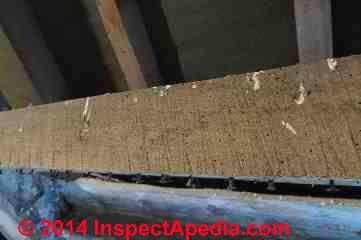
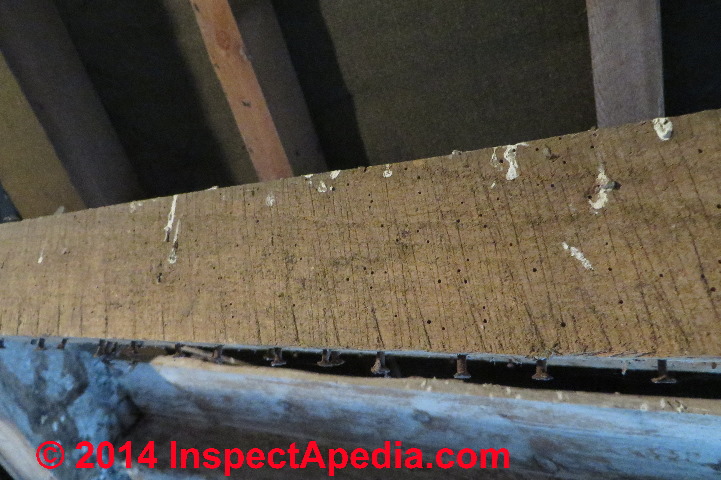
Page top photo, a pit-sawn beam examined at Brinstone Farm, St. Weonards, Herefordshire, UK. Buildings in this area date from the 1600's and hedgerows or other field markers, paths and roadways date to Roman times.
InspectAPedia tolerates no conflicts of interest. We have no relationship with advertisers, products, or services discussed at this website.
ASHI Standards of Practice Effective 1997
   ASHI Standards of Practice

TABLE OF CONTENTS
Section
 1.   Introduction
 2.   Purpose & Scope
 3.   General Limitations & Exclusions
 4.   Structural Components
 5.   Exterior
 6.   Roofing
 7.   Plumbing
 8.   Electrical
 9.   Heating
10.   Central Air Conditioning
11.   Interiors
12.   Insulation & Ventilation
Note: Underlined words are defined in the Glossary.

1. INTRODUCTION

1.1   The American Society of Home Inspectors, Inc.
(ASHI) is a not-for-profit professional society established in 1976 whose
volunteer membership consists of private, fee- paid home inspectors. ASHI's
objectives include promotion of excellence within the profession and continual
improvement of its member's inspection services to the public.
1.2   These Standards of Practice:
A. provide inspection guidelines.
B. make public the services provided by private fee-paid inspectors.
C. define certain terms relating to these inspections.

2. PURPOSE AND SCOPE

2.1 Inspections performed to these guidelines are intended to provide the
client with a better understanding of the property conditions, as observed at
the time of the inspection.

2.2   Inspectors shall:
A. observe readily accessible installed systems and components listed in
   these Standards.
B. submit a written report to the client which shall:
   1. describe those components specified to be described in sections 4-12
   of these Standards.
   2. state which systems and components designated for inspection in these
   Standards have been inspected.
   3. state any systems and components so inspected which were found to be
   in need of immediate major repair.

2.3   These Standards are not intended to limit inspectors from:
A. reporting observations and conditions in addition to those required in
   Section 2.2.
B. excluding systems and components from the inspection if requested by the
   client.

3. GENERAL LIMITATIONS AND EXCLUSIONS

3.1   General limitations:
A. inspections done in accordance with these Standards are visual and are not
   technically exhaustive.
B. these Standards are applicable to buildings with four or less dwelling units
   and their garages or carports.

3.2   General exclusions:
A. Inspectors are NOT required to report on:
   1.   life expectancy of any component or system.
   2.   the causes of the need for a major repair.
   3.   the methods, materials and costs of corrections.
   4.   the suitability of the property for any specialized use.
   5.   compliance or non-compliance with applicable regulatory requirements.
   6.   the market value of the property or its marketability.
   7.   the advisability or inadvisability of purchase of the property.
   8.   any component or system which was not observed.
   9.   the presence or absence of pests such as wood damaging organisms,
  rodents, or insects.
  10.   cosmetic items, underground items, or items not permanently installed
B.   Inspectors are NOT required to:
   1. offer or perform any act or service contrary to law.
   2. offer warranties or guarantees of any kind.
   3. offer or perform engineering, architectural, plumbing, or any other job
   function requiring an occupational license in the jurisdiction where
   the inspection is taking place, unless the inspector holds a valid
   occupational license in which case he/she may inform the client that
   he/she is so licensed, and is therefore qualified to go beyond the ASHI
   Standards of Practice, and for and additional fee, perform additional
   inspections beyond those within the scope of the basic ASHI inspection.
   4. calculate the strength, adequacy, or efficiency of any system or
   component.
   5. enter any area or perform any procedure which may damage the property
   or its components or be dangerous to the inspector or other persons.
   6. operate any system or component which is shut down or otherwise
   inoperable.
   7. operate any system or component which does not respond to normal
   operating controls.
   8. disturb insulation, move personal items, furniture, equipment, plant
   life, soil, snow, ice, or debris which obstructs access or visibility.
   9. determine the presence or absence of any suspected hazardous substance
   including but not limited to toxins, carcinogens, noise, contaminants
   in soil, water, and air.
   10. determine the effectiveness of any system installed to control or
 remove suspected hazardous substances.
   11. predict future conditions, including but not limited to failure of
 components.
   12. project operating cost of components.
   13. evaluate acoustical characteristics of any system or component.

3.3 Limitations and exclusions specific to individual systems are listed in
 following sections.

4. SYSTEM: STRUCTURAL COMPONENTS

4.1   The inspector shall observe:
A. structural components including:
   1.  foundations
   2.  floors
   3.  walls
   4.  columns
   5.  ceilings
   6.  roofs

4.2   The inspector shall:
A. describe the type of:
   1.  foundation
   2.  floor structure
   3.  wall structure
   4.  columns
   5.  ceiling structure
   6.  roof structure
B. probe structural components where deterioration is suspected. However,
   probing is NOT required when probing would damage any finished surface.
C. enter under floor crawl spaces and attic spaces except when access is
   obstructed, when entry could damage the property, or when dangerous or
   adverse situations are suspected.
D. report the methods used to observe underfloor crawl spaces and attics.
E. report signs of water penetration into the building or signs of abnormal or
   harmful condensation on building components.

5. SYSTEM: EXTERIOR

5.1   The inspector shall observe:
A. wall cladding, flashings and trim.
B. entryway doors and representative number of windows.
C. garage door operators.
D. decks, balconies, stoops, steps, areaway, and porches including railings.
E. eaves, soffits and fascias.
F. vegetation, grading, drainage, driveways, patios, walkways and retaining
   walls with respect to their effect on the condition of the building.

5.2   The inspector shall:
A. describe wall cladding materials.
B. operate all entryway doors and representative number of windows including
   garage doors, manually or by using permanently installed controls of any
   garage door operator.
C. report whether or not any garage door operator will automatically reverse or
   stop when meeting reasonable resistance during closing.

5.3   The inspector is NOT required to observe:
A. storm windows, storm doors, screening, shutters, awnings and similar
   seasonal accessories.
B. fences.
C. safety glazing.
D. garage door operator remote control transmitters.
E. geological conditions.
F. soil conditions.
G. recreational facilities.
H. outbuildings other than garages and carports.

6. SYSTEM: ROOFING
6.1   The inspector shall observe:
A. roof coverings.
B. roof drainage systems.
C. flashings.
D. skylights, chimneys and roof penetrations.
E. signs of leaks or abnormal condensation on building components.

6.2   The inspector shall:
A. describe the type of roof covering materials.
B. report the methods used to observe the roofing.

6.3   The inspector is NOT required to:
A. walk on the roofing.
B. observe attached accessories including but not limited to solar systems,
   antennae, and lightening arrestors.

7. SYSTEM:PLUMBING

7.1   The inspector shall observe:
A. interior water supply and distribution system including:
   1.  piping materials, including supports and insulation.
   2.  fixtures and faucets.
   3.  functional flow.
   4.  leaks.
   5.  cross connections.
B. interior drain, waste and vent system including:
   1.  traps; drain, waste, and vent piping; piping supports and pipe
   insulation.
   2.  leaks.
   3.  functional drainage.
C. hot water systems including:
   1.  water heating equipment.
   2.  normal operating controls.
   3.  automatic safety controls.
   4.  chimneys, flues, and vents.
D. fuel storage and distribution systems including:
   1.  interior fuel storage equipment, supply piping, venting, and supports.
   2.  leaks.
E. sump pumps.

7.2  The inspector shall:
A. describe:
   1.  water supply and distribution piping materials.
   2.  drain, waste, and vent piping materials.
   3.  water heater equipment.
B. operate all plumbing fixtures, including their faucets, and all exterior
   faucets attached to the house.

7.3  The inspector is NOT required to:
A. state the effectiveness of anti-siphon devices.
B. determine whether water supply and waste disposal systems are public or
   private.
C. operate automatic safety controls.
D. operate any valve except water closet flush valves, fixture faucets and
   hose faucets.
E. observe:
   1.  water conditioning systems.
   2.  fire and lawn sprinkler systems.
   3.  on-site water supply quantity and quality.
   4.  on-site waste disposal systems.
   5.  foundation irrigation systems.
   6.  spas, except as to functional flow and functional drainage.

8.   SYSTEM: ELECTRICAL

8.1   The inspector shall observe:
A. service entrance conductors.
B. service equipment, grounding equipment, main over current device, main
   and distribution panels.
C. amperage and voltage ratings of the service.
D. branch circuit conductors, their over current devices, and the
   compatibility of their ampacaties and voltages.
E. the operation of a representative number of installed lighting fixtures,
   switches and receptacles located inside the house, garage, and on its
   exterior walls.
F. the polarity and grounding of all receptacles within six feet of interior
   plumbing fixtures, and all receptacles in the garage or carport, and on
   the exterior of inspected structures.
G. the operation of Ground Fault Circuit Interrupters.

8.2   The inspector shall:
A. describe:
   1.  service amperage and voltage.
   2.  service entry conductor materials.
   3.  service type as being overhead or underground.
   4.  location of main and distribution panels.
B. report any observed aluminum branch circuit wiring.

8.3  The inspector is NOT required to:
A. insert any tool, probe or testing device inside the panels.
B. test or operate any over current device except Ground Fault Circuit
   Interrupters.
C. dismantle any electrical device or control other than to remove the covers
   of the main and auxiliary distribution panel.
D. observe:
   1.  low voltage systems.
   2.  smoke detectors.
   3.  telephone, security, cable TV, intercoms, or other ancillary wiring
   that is not a part of the primary electrical distribution systems.

9.   SYSTEM: HEATING
9.1   The inspector shall observe:
A. Permanently installed heating systems including:
 1.  heating equipment.
   2.  normal operating controls.
   3.  automatic safety controls.
   4.  chimneys, flues, and vents.
   5.  solid fuel heating devices.
   6.  heat distribution systems including fans, pumps, ducts, and piping,
 with supports, dampers, insulation, air filters, registers, radiators,
 fan-coil units, convectors.
   7.  the presence of an installed heat source in each room.

9.2  The inspector shall:
A. describe:
   1.  energy source.
   2.  heating equipment and distribution type.
B. operate the systems using normal operating controls.
C. open readily openable access panels provided by the manufacturer or
   installer for routine homeowner maintenance.

9.3  The inspector is NOT required to:
A. operate heating systems when weather conditions or other circumstances may
   cause equipment damage.
B. operate automatic safety controls.
C. ignite or extinguish solid fuel fires.
D. observe:
   1.  the interior of flues.
   2.  fireplace insert flue connectors.
   3.  humidifiers.
   4.  electronic air filters.
   5.  the uniformity or adequacy of heat supply to the various rooms.

10.  SYSTEM: CENTRAL AIR CONDITIONING
10.1  The inspector shall observe:
A. central air conditioning including:
   1.  cooling and air handling equipment.
   2.  normal operating controls.
B. distribution systems including:
   1.  fans, pumps, ducts, and piping, with supports, dampers, insulation,
 air filters, registers and fan-coil units.
   2.  the presence of an installed cooling source in each room.

10.2 The inspector shall:
A. describe:
   1.  energy sources.
   2.  cooling equipment type.
B. operate the systems using normal operating controls.
C. open readily openable access panels provided by the manufacturer or
   installer for routine homeowner maintenance.

10.3 The inspector is NOT required to:
A. operate cooling systems when weather conditions or other circumstances
   may cause equipment damage.
B. observe non-central air conditioners.
C. observe the uniformity or adequacy of cool-air supply to the various rooms

11.  SYSTEM: INTERIORS
11.1  The inspector shall observe:
A. walls, ceilings, and floors.
B. steps, stairways, balconies, and railings.
C. counters and a representative number of cabinets.
D. a representative number of doors and windows.
E. separation walls, ceilings, and doors between a dwelling unit and an
   attached garage or another dwelling unit.
F. sumps.

11.2 The inspector shall:
A. operate a representative number of primary windows and interior doors.
B. report signs of water penetration into the building or signs of abnormal
   or harmful condensation on building components.

11.3 The inspector is NOT required to observe:
A. paint, wallpaper, and other finish treatments on the interior walls,
   ceilings, and floors.
B. carpeting.
C. draperies, blinds, or other window treatments.
D. household appliances.
E. recreational facilities or another dwelling unit.

12.  SYSTEM: INSULATION & VENTILATION
12.1  The inspector shall observe:
A. insulation and vapor retarders in unfinished spaces.
B. ventilation of attics and foundation areas.
C. kitchen, bathroom, and laundry venting systems.

12.2 The inspector shall describe:
A. insulation and vapor retarders in unfinished spaces.
B. absence of same in unfinished space at conditioned surfaces.

12.3 The inspector is NOT required to report on:
A. concealed insulation and vapor retarders.
B. venting equipment which is integral with household appliances.
   GLOSSARY

AUTOMATIC SAFETY CONTROLS:
Devices designed and installed to protect systems and components from
excessively high or low pressures and temperatures, excessive electrical
current, loss of water, loss of ignition, fuel leaks, fire, freezing, or other
unsafe conditions.

CENTRAL AIR CONDITIONING:
A system which uses ducts to distribute cooled and/or dehumidified air to more
than one room or uses pipes to distribute chilled water to heat exchangers in
more than one room, and which is not plugged into an electrical convenience
outlet.

COMPONENT:
A readily accessible and observable aspect of a system, such as a floor, or
wall, but not individual pieces such as boards or nails where many similar
pieces make up the component.

CROSS CONNECTION:
Any physical connection or arrangement between potable water and any source of
contamination.

DANGEROUS OR ADVERSE SITUATIONS:
Situations which pose a threat of injury to the inspector, and those situations
which require use of special use of special protective clothing or safety
equipment.

DESCRIBE:
Report in writing a system or component by its type, or other observed
characteristics, to distinguish it from other components used for the same
purpose.

DISMANTLE:
To take apart or remove any component, device or piece of equipment that is
bolted, screwed, or fastened by other means and that would not be dismantled
by a homeowner in the course of normal household maintenance.

ENGINEERING:
Analysis or design work requiring extensive preparation and experience in the
use of mathematics, chemistry, physics, and the engineering sciences.

ENTER:
To go into an area to observe all visible components.

FUNCTIONAL DRAINAGE:
A drain is functional when it empties in a reasonable amount of time and does
not overflow when another fixture is drained simultaneously.

FUNCTIONAL FLOW:
A reasonable flow at the highest fixture in a dwelling when another fixture is
operated simultaneously.

HOUSEHOLD APPLIANCES:
Kitchen and laundry appliances, room air conditioners, and similar appliances.

INSPECTOR:
Any person who examines any component of a building, through visual means and
through normal user controls, without the use of mathematical sciences.

INSTALLED:
Attached or connected such that the installed item requires tools for removal.

NORMAL OPERATING CONTROLS:
Homeowner operated devices such as a thermostat, wall switch, or safety switch.

OBSERVE:
The act of making a visual examination.

ON-SITE WATER SUPPLY QUALITY:
Water quality is based on the bacterial, chemical, mineral, and solids content
of the water.

ON-SITE WATER SUPPLY QUANTITY:
Water quantity is the rate of flow of water.

OPERATE:
To cause systems or equipment to function.

PRIMARY WINDOWS AND DOORS:
Windows and/or exterior doors which are designed to remain in the respective
openings year round and not left open for the entire summer.

READILY OPERABLE ACCESS PANEL:
A panel provided for homeowner inspection and maintenance which has removable or
operable fasteners or latch devices in order to be lifted off, swung open, or
otherwise removed by one person, and its edges and fasteners are not painted in
place. Limited to those panels within normal reach or from a 4-foot step-ladder,
and which are not blocked by stored items, furniture, or building components.

RECREATIONAL FACILITIES:
Spas, saunas, steam baths, swimming pools, tennis courts, playground equipment,
and other exercise, entertainment, or athletic facilities.

REPRESENTATIVE NUMBER:
For multiple identical components such as windows and electric outlets - one
such component on each side of the building.

ROOF DRAINAGE SYSTEMS:
Gutters, downspouts, leaders, splash blocks, and similar components used to
carry water off a roof and away from a building.

SAFETY GLAZING:
Tempered Glass, laminated glass, or rigid plastic.

SHUT DOWN:
A piece of equipment or a system is shut down when it cannot be operated by the
device or control which a home owner should normally use to operate it. If its
safety switch or circuit breaker is in the "off" position, or its fuse is
missing or blown, the inspector is not required to reestablish the circuit for
the purpose of operating the equipment or system.

SOLID FUEL HEATING DEVICE:
Any wood, coal, or other similar organic fuel burning device, including but not
limited to fireplaces whether masonry or factory-built, fireplace inserts and
stoves, woodstoves (room heaters,) central furnaces, and combinations of
these devices.

STRUCTURAL COMPONENT:
A component which supports non-variable forces or weighs (dead loads) and
variable forces or weights (live loads.)

SYSTEM:
A combination of interacting or interdependent components, assembled to carry
out one or more functions.

TECHNICALLY EXHAUSTIVE:
An inspection is technically exhaustive when it involves the extensive use of
measurements, instruments, testing, calculations, and other means to develop
scientific or engineering findings, conclusions, and recommendations.

UNDERFLOOR CRAWL SPACE:
The area within the confines of the foundation and between the ground and the
underside of the lowest floor structural component.
...
Continue reading at HOME INSPECTION SCOPE of COVERAGE or select a topic from the closely-related articles below, or see the complete ARTICLE INDEX.
Or see these
Recommended Articles
- CONSULTANTS & EXPERTS DIRECTORIES
- HOME & BUILDING INSPECTION - home
- HOME INSPECTION BUSINESSES & FRANCHISES
- HOME INSPECTION COMPONENTS MASTER LIST
- HOME INSPECTION ETHICAL CODES
- HOME INSPECTION, GET THE MOST FROM
- HOME INSPECTION PUBLICATIONS
- HOME INSPECTION REPORT CHOICES
- HOME INSPECTION REPORT WRITING
- HOME INSPECTION SAFETY HAZARDS
- HOME INSPECTION STANDARDS & ETHICAL CODES
- HOME INSPECTOR CERTIFICATION
- HOME INSPECTOR EDUCATION
- HOUSE DOCTOR, HOW TO BE A
Suggested citation for this web page
HOME INSPECTION STANDARDS 1997 at InspectApedia.com - online encyclopedia of building & environmental inspection, testing, diagnosis, repair, & problem prevention advice.
Or see this
INDEX to RELATED ARTICLES: ARTICLE INDEX to BUILDING & HOME INSPECTION
Or use the SEARCH BOX found below to Ask a Question or Search InspectApedia
Ask a Question or Search InspectApedia
Try the search box just below, or if you prefer, post a question or comment in the Comments box below and we will respond promptly.
Search the InspectApedia website
Note: appearance of your Comment below may be delayed: if your comment contains an image, photograph, web link, or text that looks to the software as if it might be a web link, your posting will appear after it has been approved by a moderator. Apologies for the delay.
Only one image can be added per comment but you can post as many comments, and therefore images, as you like.
You will not receive a notification when a response to your question has been posted.
Please bookmark this page to make it easy for you to check back for our response.
Our Comment Box is provided by Countable Web Productions countable.ca
Citations & References
In addition to any citations in the article above, a full list is available on request.
- John Cranor [Website: /www.house-whisperer.com ] is an ASHI member and a home inspector (The House Whisperer) is located in Glen Allen, VA 23060. He is also a contributor to InspectApedia.com in several technical areas such as plumbing and appliances (dryer vents). Contact Mr. Cranor at 804-873-8534 or by Email: johncranor@verizon.net
- Mark Cramer Inspection Services Mark Cramer, Tampa Florida, Mr. Cramer is a past president of ASHI, the American Society of Home Inspectors and is a Florida home inspector and home inspection educator. Contact Mark Cramer at: 727-595-4211 mark@BestTampaInspector.com 11/06
- Roger Hankey is principal of Hankey and Brown Inspections, Winter Park, CO. Mr. Hankey is a past chairman of the ASHI Standards Committee and served in other ASHI chapter and national leadership roles. Mr. Hankey is a National Radon Proficiency Program certified measurement professional and a Level II infrared thermographer. Contact Roger Hankey at: 970-393-6604 - rogerhankey47@gmail.com . Website: www.HankeyandBrown.com Mr. Hankey is a frequent contributor to InspectAPedia.com.
- Our recommended books about building & mechanical systems design, inspection, problem diagnosis, and repair, and about indoor environment and IAQ testing, diagnosis, and cleanup are at the InspectAPedia Bookstore. Also see our Book Reviews - InspectAPedia.
- [ASHI Headquarters Website]
- Building Pathology, Deterioration, Diagnostics, and Intervention, Samuel Y. Harris, P.E., AIA, Esq., ISBN 0-471-33172-4, John Wiley & Sons, 2001 [General building science-DF] ISBN-10: 0471331724 ISBN-13: 978-0471331728
- Building Pathology: Principles and Practice, David Watt, Wiley-Blackwell; 2 edition (March 7, 2008) ISBN-10: 1405161035 ISBN-13: 978-1405161039
- CRAWL SPACE MOISTURE CONTROL [PDF] U.S. Department of Energy
- Historic Preservation Technology: A Primer, Robert A. Young, Wiley (March 21, 2008) ISBN-10: 0471788368 ISBN-13: 978-0471788362
- In addition to citations & references found in this article, see the research citations given at the end of the related articles found at our suggested
CONTINUE READING or RECOMMENDED ARTICLES.
- Carson, Dunlop & Associates Ltd., 120 Carlton Street Suite 407, Toronto ON M5A 4K2. Tel: (416) 964-9415 1-800-268-7070 Email: info@carsondunlop.com. Alan Carson is a past president of ASHI, the American Society of Home Inspectors.
Thanks to Alan Carson and Bob Dunlop, for permission for InspectAPedia to use text excerpts from The HOME REFERENCE BOOK - the Encyclopedia of Homes and to use illustrations from The ILLUSTRATED HOME .
Carson Dunlop Associates provides extensive home inspection education and report writing material. In gratitude we provide links to tsome Carson Dunlop Associates products and services.
 | HOME | ABOUT | ASK a QUESTION | CONTACT | CONTENT USE POLICY | DESCRIPTION | POLICIES | PRIVACY | |
| © 2024 - 1985 Publisher InspectApedia.com - Daniel Friedman | |||||||||