
InspectAPedia® FREE Encyclopedia of Building & Environmental Construction, Diagnosis, Maintenance & Repair |
Question? Just ask us! InspectAPedia
|
 Steep Roof Defects List & Home Inspection Education
- POST a QUESTION or COMMENT about home & building inspection courses, standards, & defect checklists for steep slope roofing systems
This article lists significant steep slope roofing defects, definitions, and home inspection education topics.
This article series, beginning at BUILDING DEFECTS LISTS, provides lists of common building defects and basic defect knowledge that also outline recommended curriculum content for home inspector education. The building defects and inspection points listed in these articles also guide homeowners and home buyers to building areas that merit careful attention and often point areas of safety concern or important maintenance and repair tasks.
InspectAPedia tolerates no conflicts of interest. We have no relationship with advertisers, products, or services discussed at this website.
Home Inspection Education Curriculum - Steep Roofing
1.0 ROOFING Inspection Requirements & Common Steep Slope Roof Defects List
1.1 Steep Slope Roofing Inspection Recommendations
1.1.1 Knowledge Base for Steep Slope Roof Inspections
1. Describe the function of steep roof coverings.
2. Describe the following common roofing types:
asphalt shingle, wood shingles and shakes, slate, clay tile, concrete tile, fiber cement, metal, roll roofing.
3. List the materials/components of each of the roofing materials.
4. Describe the features of adequate installation and repair technique for each of the roofing materials, including slope, exposure, head lap, number and type of fasteners, sheathing and underlayment, weight per square, number of layers permitted.
5. Define the following terms with respect to steep roofing:
pitch, square, hip, mansard, butterfly, shed, gable, gambrel, live loads, dead loads, ice dams, drip edge flashing, eave protection, avalanche guards, underlayment, self-sealing, starter strips, cutting the points, low slope roof, , face grain, flat grain and edge grain with respect to wood shingles, undercoursing, underlayment, skip sheathing, solid sheathing, Dutch lap, open slating and French method with respect to slate roofing, Spanish tile and Mission tile.
6. Outline the typical life expectancies of each roofing material.
7. Describe the effect of these factors on the rate of aging of roofing materials:
UV exposure, color, ventilation, wind exposure, pitch, complexity of roof, foot traffic, concentrated water from drainage systems, tree branches.
8. Identify the codes or standards which apply to steep roof coverings in your area.
1.1.2 Inspection Skills for Steep Slope Roof Inspections
1. Describe the inspection procedure for each steep roof covering.
2. Identify the common steep roofing defects listed on the next page.
3. Identify the implication of each defect.
4. Identify safety issues for the inspector and occupant of the home (fall hazard and electric shock from service entrance wires).
5. Communicate findings to client verbally and in writing, recommending corrective action where needed.
STEEP ROOFING TYPICAL DEFECTS (may not include all defects)
ASPHALT ROOF DEFECTS
• Blisters
• Clawing ??
• Cracking
• Cupping, curling
• Damage
• Exposed fasteners
• Exposure too great
• Granule loss
• Ice dam potential
• Multiple layers
• No underlayment
• Overhangs too big, small
• Patches
• Shingles – torn, missing
• Slope too low
• Slots wide (old)
• Vulnerable areas
WOOD SHINGLES AND SHAKES ROOF DEFECTS
• Buckling
• Cupping, curling
• Damaged, broken or missing pieces
• Exposed fasteners
• Exposure too big
• Hip and ridge pieces falling apart
• Ice dam potential
• Joints line up in every other row
• Knots, flame pattern (lower quality materials)
• Loose pieces
• Moss, mildew, etc.
• Multiple layers( Duplication? JDG)
• No interlay on shakes maybe means shingles?(may be OK)
(Shakes on pitches of greater than 7/12 do not require interlay felts. JDG )
• Overhangs too big, small
• Patches
• Pieces too wide
• Rot
• Slope too low
• Spacing too tight
• Side-by-side
• Splitting
• Vulnerable areas
• Wear-through, burn-through
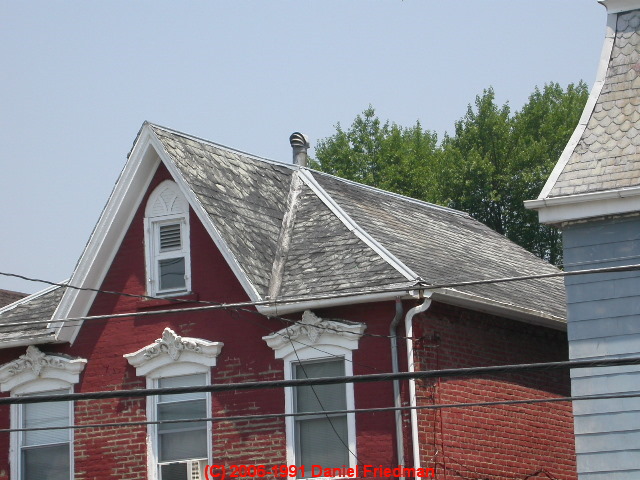
SLATE ROOF DEFECTS
• Broken Slates
• Brown, white surface on slates
• Cracked Slates
• Damaged slates
• Delaminating (Spalling) JDG
• Exposed fasteners (may be OK)
• Exposure too great
• Ice dam potential
• Loose Slates
• Missing Slages
• Missing or loose hip, ridge, rake, eave pieces
• Overhangs too big, small
• Patched Slates
• Ribbons (weak areas)(Not all ribbon types are bad) - JDG
• Slope too low
• Soft, crumbly Slates
• Tarred Slates
• Vulnerable areas
• Moss growth on slate roof
CLAY/CONCRETE/FIBER CEMENT ROOF DEFECTS
• Broken roof tiles
• Color fading
• Cracked
• Damaged roof tiles roof tiles
• Efflorescence on roof tiles
• Exposed fasteners, no fasteners
• Exposure too great
• Missing or loose hip, ridge, rake, eave pieces
• Patched roof tiles
• Slope too low (no membrane below)
• Spalling (Have never seen spalling metal surfaces.) JDG
• Vulnerable areas
METAL ROOF DEFECTS
• Buckled
• Dent, damage
• Exposed fasteners (may be OK)
• Exposure too great
• Failed fasteners
• Ice dam potential
• Loose
• Missing
• Open seams
• Overhangs too big, small
• Patched
• Rust
• Slope too low
• Tarred (temporary repairs better description)
ROLL ROOFING DEFECTS (on steep or low slope roofs)
• Algae discoloration
• Blisters
• Buckling or wrinkling
• Cracks
• Damage
• Exposed nails not sealed
• Granule loss
• Open seams
• Rusted nails, exposed nails (if not installed with ARMA exposed nail method)
• Seams facing uphill
• Vulnerable areas
• Limited life expectancy
• Parallel to eave method and parallel to rake method problems
Also see HOME & BUILDING INSPECTORS & INSPECTION METHODS. Use the Search Box at the top or bottom of these pages to find in-depth information about building, energy savings, and indoor environment inspection, diagnosis and repair at this website.
Watch out: these inspection lists do not list all possible defects for the systems discussed, and not all home or building inspectors will examine all of the items listed here. CONTACT us to suggest corrections or additions to articles at this website.
These curriculae and building defect lists are based on smilar curriculum documents first prepared by Joe Scaduto, an ASHI member who prepared course material for Northeastern University's Building Inspection Certificate program in 1988, subsequently by DF, InspectApedia's editor, for New York University ca 1988 and later, with others, recommended to ASHI, the American Society of Home Inspectors.
...
Continue reading at ARTICLE INDEX to BUILDING ROOFING or select a topic from the closely-related articles below, or see the complete ARTICLE INDEX.
Or see these
Recommended Articles
- BUILDING DEFECTS LISTS - home
- DEFECT CLUSTERS
- ARTICLE INDEX to BUILDING FLASHING
- ROOF FLASHING DEFECTS LIST
- ROOF LOW SLOPE DEFECTS LIST
- ROOFING INSPECTION & REPAIR - our complete list of articles on this topic.
Suggested citation for this web page
ROOF STEEP SLOPE DEFECTS LIST at InspectApedia.com - online encyclopedia of building & environmental inspection, testing, diagnosis, repair, & problem prevention advice.
Or see this
INDEX to RELATED ARTICLES: ARTICLE INDEX to BUILDING & HOME INSPECTION
Or use the SEARCH BOX found below to Ask a Question or Search InspectApedia
Ask a Question or Search InspectApedia
Try the search box just below, or if you prefer, post a question or comment in the Comments box below and we will respond promptly.
Search the InspectApedia website
Note: appearance of your Comment below may be delayed: if your comment contains an image, photograph, web link, or text that looks to the software as if it might be a web link, your posting will appear after it has been approved by a moderator. Apologies for the delay.
Only one image can be added per comment but you can post as many comments, and therefore images, as you like.
You will not receive a notification when a response to your question has been posted.
Please bookmark this page to make it easy for you to check back for our response.
Our Comment Box is provided by Countable Web Productions countable.ca
Citations & References
In addition to any citations in the article above, a full list is available on request.
- John Cranor [Website: /www.house-whisperer.com ] is an ASHI member and a home inspector (The House Whisperer) is located in Glen Allen, VA 23060. He is also a contributor to InspectApedia.com in several technical areas such as plumbing and appliances (dryer vents). Contact Mr. Cranor at 804-873-8534 or by Email: johncranor@verizon.net
- Mark Cramer Inspection Services Mark Cramer, Tampa Florida, Mr. Cramer is a past president of ASHI, the American Society of Home Inspectors and is a Florida home inspector and home inspection educator. Contact Mark Cramer at: 727-595-4211 mark@BestTampaInspector.com 11/06
- Roger Hankey is principal of Hankey and Brown Inspections, Winter Park, CO. Mr. Hankey is a past chairman of the ASHI Standards Committee and served in other ASHI chapter and national leadership roles. Mr. Hankey is a National Radon Proficiency Program certified measurement professional and a Level II infrared thermographer. Contact Roger Hankey at: 970-393-6604 - rogerhankey47@gmail.com . Website: www.HankeyandBrown.com Mr. Hankey is a frequent contributor to InspectAPedia.com.
- Arlene Puentes [Website: www.octoberhome.com ] , an ASHI member and a licensed home inspector in Kingston, NY, and has served on ASHI national committees as well as HVASHI Chapter President. Ms. Puentes can be contacted at ap@octoberhome.com
- Our recommended books about building & mechanical systems design, inspection, problem diagnosis, and repair, and about indoor environment and IAQ testing, diagnosis, and cleanup are at the InspectAPedia Bookstore. Also see our Book Reviews - InspectAPedia.
- Building Pathology, Deterioration, Diagnostics, and Intervention, Samuel Y. Harris, P.E., AIA, Esq., ISBN 0-471-33172-4, John Wiley & Sons, 2001 [General building science-DF] ISBN-10: 0471331724 ISBN-13: 978-0471331728
- Building Pathology: Principles and Practice, David Watt, Wiley-Blackwell; 2 edition (March 7, 2008) ISBN-10: 1405161035 ISBN-13: 978-1405161039
- In addition to citations & references found in this article, see the research citations given at the end of the related articles found at our suggested
CONTINUE READING or RECOMMENDED ARTICLES.
- Carson, Dunlop & Associates Ltd., 120 Carlton Street Suite 407, Toronto ON M5A 4K2. Tel: (416) 964-9415 1-800-268-7070 Email: info@carsondunlop.com. Alan Carson is a past president of ASHI, the American Society of Home Inspectors.
Thanks to Alan Carson and Bob Dunlop, for permission for InspectAPedia to use text excerpts from The HOME REFERENCE BOOK - the Encyclopedia of Homes and to use illustrations from The ILLUSTRATED HOME .
Carson Dunlop Associates provides extensive home inspection education and report writing material. In gratitude we provide links to tsome Carson Dunlop Associates products and services.
 | HOME | ABOUT | ASK a QUESTION | CONTACT | CONTENT USE POLICY | DESCRIPTION | POLICIES | PRIVACY | |
| © 2024 - 1985 Publisher InspectApedia.com - Daniel Friedman | |||||||||