
InspectAPedia® FREE Encyclopedia of Building & Environmental Construction, Diagnosis, Maintenance & Repair |
Question? Just ask us! InspectAPedia
|
 Air Conditioning System Defects List & Home Inspection Education
- POST a QUESTION or COMMENT about home & building inspection courses, standards, & defect checklists for air conditioning & heat pump inspections
This article lists significant air conditioning system defects, definitions, and home inspection education topics.
This article series, beginning at BUILDING DEFECTS LISTS, provides lists of common building defects and basic defect knowledge that also outline recommended curriculum content for home inspector education.
The building defects and inspection points listed in these articles also guide homeowners and home buyers to building areas that merit careful attention and often point areas of safety concern or important maintenance and repair tasks.
InspectAPedia tolerates no conflicts of interest. We have no relationship with advertisers, products, or services discussed at this website.
Home Inspection Education Curriculum - Air Conditioning
5. AIR CONDITIONING AND HEAT PUMPS
5.1 Air Conditioning Inspection Requirements
5.1.1 Knowledge Base
1. Describe the function of central air conditioning systems.
2. Describe the principle of central air conditioning including refrigerant cycle and heat transfer mechanisms. Describe an operating cycle, explaining the change in temperature, pressure and state of the refrigerant.
3. List the materials and components of a central air conditioning system including the compressor, condenser coil, evaporator coil, condensate system, refrigerant lines, condenser fan, evaporator fan, duct system, thermostat.
4. Describe the operation of an evaporative cooler comparing it to refrigerant based air conditioning systems. Describe an operating cycle.
5. Describe the materials and components of a typical evaporative cooler including air handler, water reservoir, overflow, water makeup valve and float, pump, rotary drum, spray system, drip tube, air filter, cabinet, evaporative pad.
6. Describe the features of adequate installation and repair technique for refrigerant based air conditioning and evaporative coolers.
7. Define the following terms with respect to air conditioning systems:
- split system,
- sensible heat,
- latent heat of vaporization,
- refrigerant,
- compressor,
- whole house fans,
- vapor-compression refrigeration system (direct expansion, mechanical system),
- capillary tube,
- thermostatic expansion valve,
- seasonal energy efficiency ratio(SEER),
- one ton of cooling,
- temperature drop,
- crankcase heater,
- rated load amperage (RLA),
- full load amperage (FLA),
- receiver,
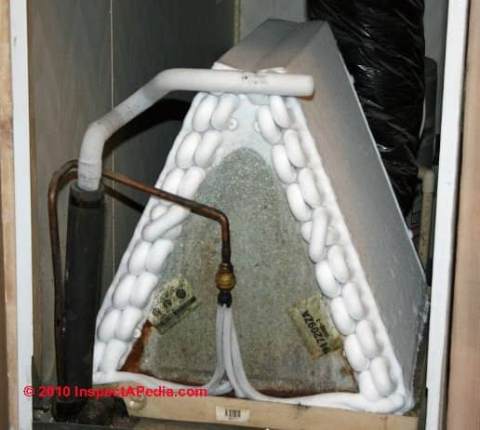
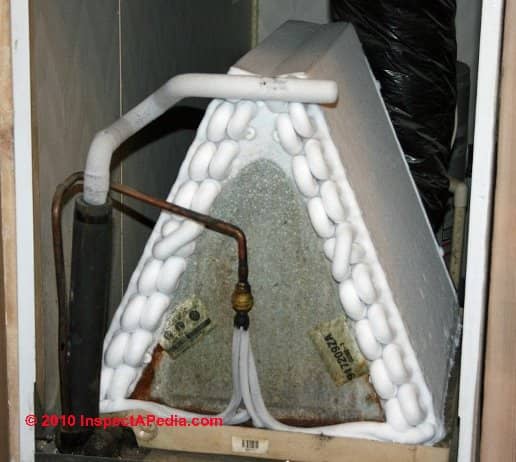
- A coil,
- condensate pump,
- trap and condensate line,
- filter/dryer,
- sight glass,
- expansion device (metering device),
- condensate drain pan(tray),
- auxiliary condensate drain pan(tray),
- condensate trap,
- condensate pump,
- suction line (return line),
- liquid line,
- high pressure refrigerant side,
- low pressure refrigerant side,
- filter/dryer,
- duct insulation,
- swamp cooler,
- rotary cooler,
- spray cooler,
- drip cooler,
- bleed-off(evaporative cooler),
- air gap(evaporative cooler),
- attic fan, whole house fan.
8. Outline the typical life expectancies of the air conditioning systems described above.
9. Identify the codes or standards which apply to the air conditioning systems described above.
5.1.2 Inspection Skills
1. Describe the inspection procedure for refrigerant based air conditioning and evaporative coolers.
2. Identify the common defects listed on the next page.
3. Describe the implication of each defect.
4. Identify safety issues for the home inspector and occupant of the home (electric shock, injury due to moving parts).
5. Communicate findings to client verbally and in writing, recommending corrective action where needed.
AIR CONDITIONING TYPICAL DEFECTS
CAPACITY REFRIGERANT LINES
• Oversized • Damaged
• Undersized • Leak
• Lines too warm or too cold
COMPRESSORS • Lines touching each other
• Low points or improper slope in lines
• Electric wires too small • Missing insulation
• Excess electric current draw
• Excess noise or vibration EXPANSION DEVICES - TE Valves
• Inadequate cooling
• Inoperative • Capillary tube crimped,
disconnected, leaking
• Missing electrical shutoff • Thermostatic expansion valve loose, clogged, sticking
• Out of level
• Running continuously CONDENSER FANS
• Short cycling
• Wrong fuse or breaker size • Corrosion
• Dirty
AIR COOLED CONDENSER COILS • Excess noise or vibration
• Inoperative
• Clothes dryer or water heater • Mechanical damage
exhaust too close
• Corrosion • Obstructed airflow
• Damaged
• Dirty EVAPORATOR FANS
WATER COOLED CONDENSER COILS • Corrosion
• Damage
• Cooled by pool water • Dirty
• Leak • Dirty or missing filter
• No water • Excess noise or vibration
• No backflow preventer • Inoperative
• Misadjustment of belt or pulleys
EVAPORATOR COILS • Undersized
• Corrosion DUCT SYSTEMS
• Damage
• Dirty • Dirty
• Frost • Disconnected or leaking
• No access to coil • Humidifier damper missing
• Temperature split too low • Incomplete
• Temperature split too high • Obstructed or collapsed
• Top of coil dry • Poor support
• Poor balancing
CONDENSATE SYSTEMS • Supply or return registers– obstructed
• Dirt in pan • Supply or return registers – poor location
• Inappropriate pan slope • Supply or return registers – too few
• No float switch • Undersized
• No auxiliary pan • Weak airflow
• Pan not well secured
• Pan cracked DUCT INSULATION
• Pan leaking or overflowing
• Rust or holes in pan • Incomplete
• Missing
DUCT VAPOR BARRIERS CONDENSATE PUMPS
• Damaged • Inoperative
• Missing • Leaking
• Poor wiring
CONDENSATE DRAIN LINES
THERMOSTATS
• Blocked or crimped
• Disconnected, missing • Damaged
• Improper discharge point • Dirty
• Leaking, damaged, split • Inoperative
• No trap • Loose
• Not level
• Poor adjustment or calibration
• Poor location
EVAPORATIVE COOLER Defect List
• Cabinet or ducts not weathertight
• Cabinet too close to grade
• Clogged pads
• Duct problems
• Electrical problems
• Excess noise or vibration
• Leaking
• Louvers obstructed
• Missing or dirty air filter
• No water
• No air gap on water supply
• Poor support for pump and water system
• Pump or fan inoperative
• Rust, mold and mildew
WHOLE HOUSE FAN Defect List
• Excess noise or vibration
• Inadequate attic venting
• Inoperative
Watch out: these inspection lists do not list all possible defects for the systems discussed, and not all home or building inspectors will examine all of the items listed here.
These curriculae and building defect lists are based on smilar curriculum documents first prepared by Joe Scaduto, an ASHI member who prepared course material for Northeastern University's Building Inspection Certificate program in 1988, subsequently by DF, InspectApedia's editor, for New York University ca 1988 and later, with others, recommended to ASHI, the American Society of Home Inspectors.
ASHI did not adopt this material though currently that association as well as others offer extensive HOME INSPECTOR EDUCATION material.
The curriculum and lists of defects are informed by additional analysis of the process of home inspection that was developed beginning Calgary, AB for Canadian and U.S. home inspector education and certification examinations in 1997. Other early contributors to home inspection education in the U.S. and Canada include Dr. Jess Aronstein, Alan Carson, Mike Casey, Mark Cramer, John Cox, Dwight Barnett, Douglas Hansen, Rick Heyl, Larry Hoytt, Bill Merrill, Kevin O'Malley, Dennis Robitalille, Keith Peddie, Pat Porzio, Roger Robinson.
...
Continue reading at AIR CONDITIONING & HEAT PUMP SYSTEMS or select a topic from the closely-related articles below, or see the complete ARTICLE INDEX.
Or see these
Recommended Articles
Suggested citation for this web page
DEFECTS LIST - AIR CONDITIONING at InspectApedia.com - online encyclopedia of building & environmental inspection, testing, diagnosis, repair, & problem prevention advice.
Or see this
INDEX to RELATED ARTICLES: ARTICLE INDEX to AIR CONDITIONING & HEAT PUMPS
Or use the SEARCH BOX found below to Ask a Question or Search InspectApedia
Ask a Question or Search InspectApedia
Try the search box just below, or if you prefer, post a question or comment in the Comments box below and we will respond promptly.
Search the InspectApedia website
Note: appearance of your Comment below may be delayed: if your comment contains an image, photograph, web link, or text that looks to the software as if it might be a web link, your posting will appear after it has been approved by a moderator. Apologies for the delay.
Only one image can be added per comment but you can post as many comments, and therefore images, as you like.
You will not receive a notification when a response to your question has been posted.
Please bookmark this page to make it easy for you to check back for our response.
Our Comment Box is provided by Countable Web Productions countable.ca
Citations & References
In addition to any citations in the article above, a full list is available on request.
- John Cranor [Website: /www.house-whisperer.com ] is an ASHI member and a home inspector (The House Whisperer) is located in Glen Allen, VA 23060. He is also a contributor to InspectApedia.com in several technical areas such as plumbing and appliances (dryer vents). Contact Mr. Cranor at 804-873-8534 or by Email: johncranor@verizon.net
- Mark Cramer Inspection Services Mark Cramer, Tampa Florida, Mr. Cramer is a past president of ASHI, the American Society of Home Inspectors and is a Florida home inspector and home inspection educator. Contact Mark Cramer at: 727-595-4211 mark@BestTampaInspector.com 11/06
- Roger Hankey is principal of Hankey and Brown Inspections, Winter Park, CO. Mr. Hankey is a past chairman of the ASHI Standards Committee and served in other ASHI chapter and national leadership roles. Mr. Hankey is a National Radon Proficiency Program certified measurement professional and a Level II infrared thermographer. Contact Roger Hankey at: 970-393-6604 - rogerhankey47@gmail.com . Website: www.HankeyandBrown.com Mr. Hankey is a frequent contributor to InspectAPedia.com.
- Arlene Puentes [Website: www.octoberhome.com ] , an ASHI member and a licensed home inspector in Kingston, NY, and has served on ASHI national committees as well as HVASHI Chapter President. Ms. Puentes can be contacted at ap@octoberhome.com
- Our recommended books about building & mechanical systems design, inspection, problem diagnosis, and repair, and about indoor environment and IAQ testing, diagnosis, and cleanup are at the InspectAPedia Bookstore. Also see our Book Reviews - InspectAPedia.
- ASHI Certification Links
- Home Inspection Reports - a Critique narrative vs. checklist type home inspection reports
- ASHI Standards of Practice - Jan 2000 and ASHI Standards History - links to older and alternative versions of Home Inspection Standards
- ASHI Code of Ethics 1993, and ASHI Ethics History - links to older versions; Note: newer may be found at ASHI
- ASHI in 1996 ASHI History - association description from 1996
- American Society of Home Inspectors (ASHI) Official Website
- Building Pathology, Deterioration, Diagnostics, and Intervention, Samuel Y. Harris, P.E., AIA, Esq., ISBN 0-471-33172-4, John Wiley & Sons, 2001 [General building science-DF] ISBN-10: 0471331724 ISBN-13: 978-0471331728
- Building Pathology: Principles and Practice, David Watt, Wiley-Blackwell; 2 edition (March 7, 2008) ISBN-10: 1405161035 ISBN-13: 978-1405161039
- CRAWL SPACE MOISTURE CONTROL [PDF] U.S. Department of Energy
- Historic Preservation Technology: A Primer, Robert A. Young, Wiley (March 21, 2008) ISBN-10: 0471788368 ISBN-13: 978-0471788362
- In addition to citations & references found in this article, see the research citations given at the end of the related articles found at our suggested
CONTINUE READING or RECOMMENDED ARTICLES.
- Carson, Dunlop & Associates Ltd., 120 Carlton Street Suite 407, Toronto ON M5A 4K2. Tel: (416) 964-9415 1-800-268-7070 Email: info@carsondunlop.com. Alan Carson is a past president of ASHI, the American Society of Home Inspectors.
Thanks to Alan Carson and Bob Dunlop, for permission for InspectAPedia to use text excerpts from The HOME REFERENCE BOOK - the Encyclopedia of Homes and to use illustrations from The ILLUSTRATED HOME .
Carson Dunlop Associates provides extensive home inspection education and report writing material. In gratitude we provide links to tsome Carson Dunlop Associates products and services.
 | HOME | ABOUT | ASK a QUESTION | CONTACT | CONTENT USE POLICY | DESCRIPTION | POLICIES | PRIVACY | |
| © 2024 - 1985 Publisher InspectApedia.com - Daniel Friedman | |||||||||