
InspectAPedia® FREE Encyclopedia of Building & Environmental Construction, Diagnosis, Maintenance & Repair |
Question? Just ask us! InspectAPedia
|
 Guide to Zone Dampers for Heating & Cooling Air Duct Controls
How to install & use manual or automatic HVAC zone dampers
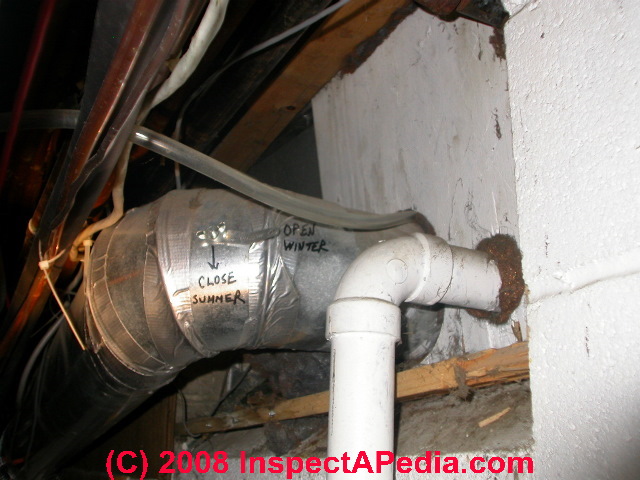
- POST a QUESTION or COMMENT about how to find, adjust, & use automatic or manual HVAC air duct control s or zone dampers in heating & A/C ducts in order to balance heated or cooled air flow in buildings.
Automatic or manual HVAC air duct airflow controls:
Here we explain both manual and automatic heating and air conditioning ductwork zone dampers & airflow controls used to control airflow through heating or cooling ductwork. We describe how to find sometimes hidden manual duct dampers, and which way to set the duct damper lever to increase or decrease airflow through various sections of the ductwork and the building.
We illustrate using air supply register controls to fine tune airflow in individual rooms or areas. We explain in detail automatic duct dampers and how they work. We also describe the use of individual airflow booster fans in the ductwork or in other locations to assure adequate cool or warm air supply in all areas.
InspectAPedia tolerates no conflicts of interest. We have no relationship with advertisers, products, or services discussed at this website.
Ductwork Zone Dampers & Airflow Controls - Hot Air Heat Troubleshooting & Repair Guide
 Manual Air Conditioning or Heating Duct Zone Controls

What is a zone damper and how do they work on heating or cooling ducts? - - Ductwork Zone Dampers & Airflow Controls - Hot Air Heat & Air Conditioning Troubleshooting & Repair Guide. [Click to enlarge any image]
Article Contents
- ZONE DAMPER CONTROLS
- MANUAL HVAC ZONE DAMPERS
- DUCT DAMPER POSITION for OPEN / CLOSED
- USE AIR REGISTER for ZONE CONTROL
- AUTOMATIC ZONE DAMPER CONTROLS
- AUTOMATIC FIRE DAMPERS
- ADDING a COOLING or HEATING ZONE
- SPLITTING a COOLING or HEATING ZONE - Y-dampers
- ZONE DAMPER IO MANUALS & WIRING GUIDES
- ZONE DAMPER ACTUATOR MOTOR REPLACEMENT
- Also see our separate article on BALANCING AIR DUCT FLOW where we discuss how to find and correct building conditions such as open suspended ceilings, windows, doors, etc. that foul up the proper distribution of conditioned air (heated or cooled) in buildings.
[Click to enlarge any image]
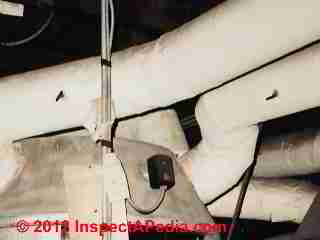
 Manual heating or air conditioning zone dampers are mechanical doors that are manually (by hand) open or closed in order to control the amount of warm or cool air flowing to a particular room or area in a building.
You can see two black manual duct damper handles on the white (asbestos-paper-covered) heating ducts in the photo at above left.
By totally or partially closing the damper door, the owner or occupants of the building can balance the flow of conditioned air into various areas.
But first you have to find all of the dampers - sometimes the ductwork or zone dampers are all located close to the furnace or air conditioner, but in some buildings there may be quite remote dampers.
So if air flow is too much or too little in some areas of the building, in addition to checking for crushed or disconnected air ducts, look for a stealth-damper whose location may not have been immediately obvious - this means looking on all accessible sides of all surfaces of the ductwork.
[Only a fool would have put a manual duct damper where you can't reach it, right?]
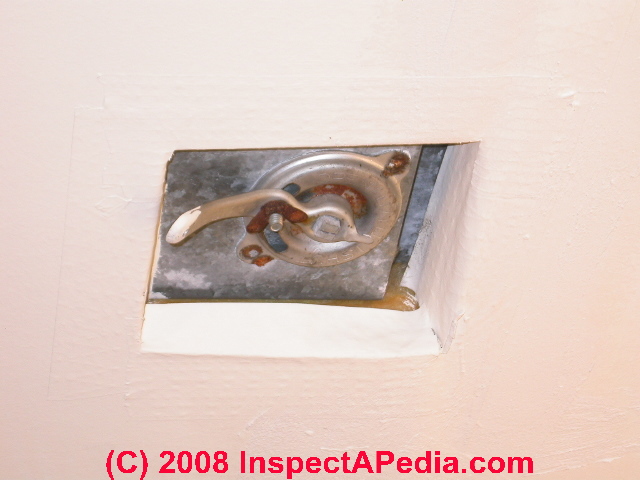
Because it can be tough for a new owner of an older home to even imagine, much less find where these duct air flow balancing controls are located, we include more photographs of what a manual duct air flow damper control lever might look like.
At below left our red arrow shows the direction of warm air movement out of a supply plenum and into ductwork, and our blue line shows the position of the duct damper - blocking most but not all of the airflow.
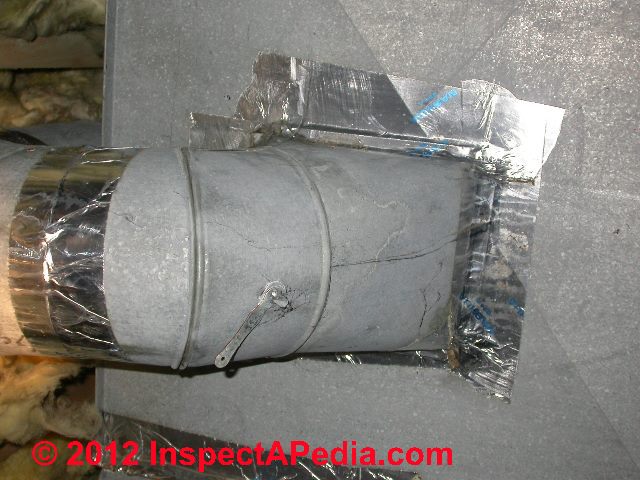
Shown in another example below, a manual zone damper or heating duct damper or cooling duct damper is particularly valuable in balancing air flow in buildings whose HVAC system includes long duct runs to some areas and short duct runs to other areas.
This damper is in the at about 80% open position.
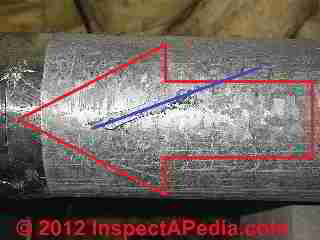
If we take no steps to balance the air flow among building areas, when the blower fan is running, the rooms closest to the blower will receive the most air flow and more distant rooms can be difficult to heat or cool.
How do I Set the Duct Damper Handle - in What Position?

In general, the handle of the duct airflow control lever or damper is parallel to the damper itself, so if the zone airflow control handle is across the duct it is closing off air flow.
That is, the position of the duct damper handle also indicates the position of the actual damping baffle inside the ductwork.
If the duct damper handle is parallel to the direction of the ductwork the damper is (probably) wide open (photo at left).
But if airflow control doesn't seem to work as predicted, some further checking is in order, since it's possible to mount the duct damper handle improperly.
The photo at left shows the duct damper handle turned parallel to the direction in which this old (asbestos-paper covered) heating duct runs, so this airflow damper is in the "open" position.
Using an Air Supply Register as a Heating or Cooling Air Flow Damper or Control
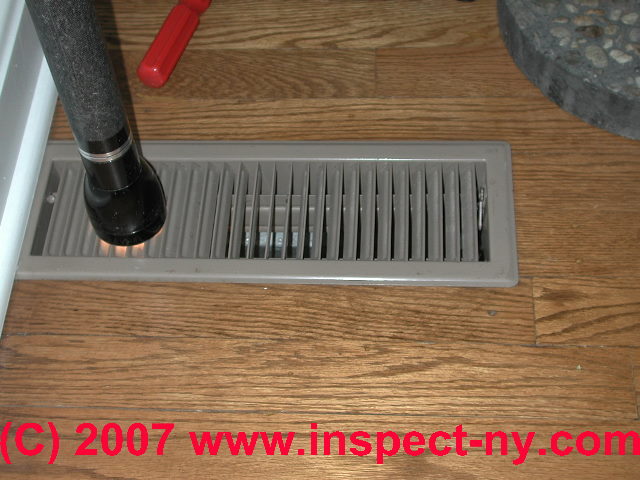
As we show here, an alternative to manual heating or cooling air zone dampers is the use of mechanical louvers that can be opened or closed at individual supply air registers.
But when an air duct serves multiple rooms in a building,
and when we wish that entire area to receive more or less air flow compared with other building areas,
it is simpler and more reliable to use a duct damper or zone damper to control the each heated or cooled area at once.
Automatic Heating or Air Conditioning Zone Damper Controls
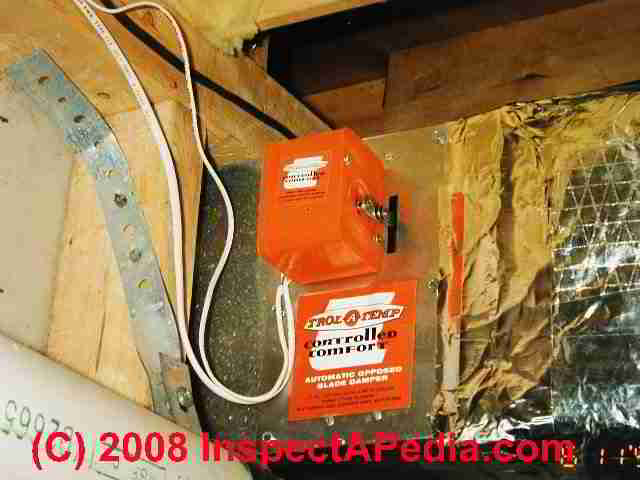
What is an automatic duct damper and how do they work?
Automatic heating or air conditioning zone dampers are mechanical doors that open or shut under thermostatic control to provide individual area or heating or cooling zone control in buildings served by a single warm air heater or central air conditioner.
In response to individual room thermostats the damper opens to permit conditioned air to flow into that room or building area when needed.
An automatic duct damper is usually controlled by a room thermostat, which opens or closes a metal baffle inside of a warm air (or cool air) heating (or cooling) duct in order to provide multiple heating zone control in a building.
The duct damper is located in an air duct and blocks the flow of warm or cool air into building rooms. It has nothing to do with venting flue gases up a chimney.
Our photo shows a motorized zone damper or air duct zone control produced by TrolATemp® a producer of automatic heating system controls. This unit is an automatic opposed-blade duct damper.
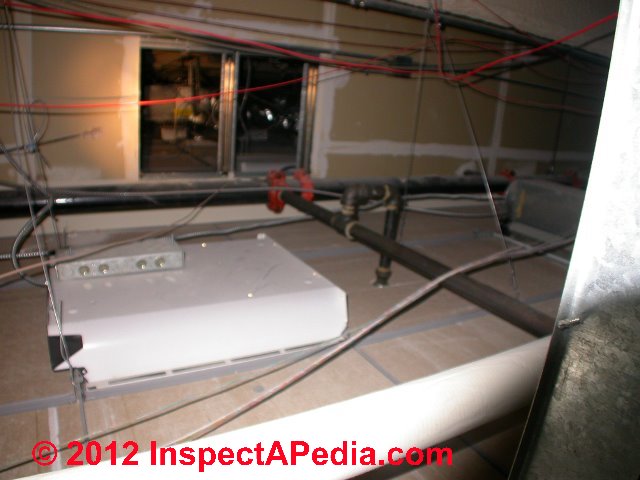
Here is a commercial automatic air supply register control which contains a booster fan as well.
You can spot an automatic zone damper on duct work by noticing that there is an external motor mounted on the ducts in one or more locations.
When heating or cooling are not needed in that building area or zone, the duct damper remains in the closed position.
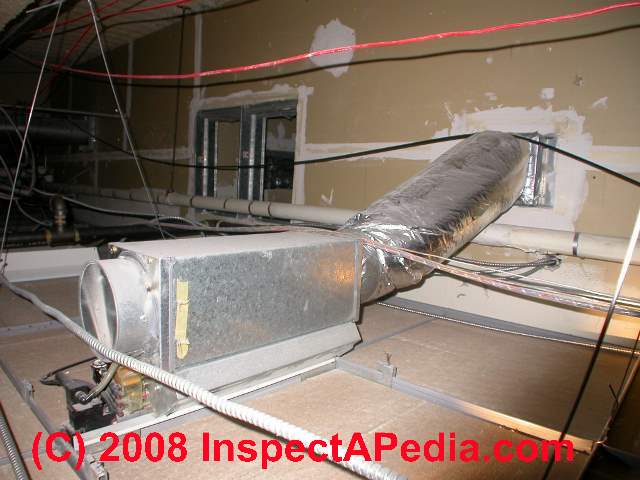
Our photo shows a commercial duct damper in a New York City office building. In this case the damper is controlling airflow out of a supply duct into a single ceiling supply plenum and register.
Automatic Fire Damper in Ductwork and how they work
The automatic fire/smoke damper operates (usually) by automatically closing a door or doors within the damper on the detection of a temperature increase or by operation of a separate smoke detector.
[Click to enlarge any image]
Our photo at at left shows a pair of open fire damper doors in the ceiling of a commercial building in New York City.
In event of a fire these doors are intended to be automatically closed. Similar dampers may be installed right in HVAC ducts where the ducts pass between different building areas.
Details about automatic fire and smoke dampers are
at AUTOMATIC FIRE SMOKE DAMPERS
Adding a Heating or Cooling Zone to an Existing Air Conditioning System
Reader Question: I want to use my existing system to add A/C to the basement
I'm wanting to use my already installed central heat and air unit for my house to supply AC to my basement. I will not need to heat the basement, only cool it. There is no thermostat down there and no vents. What is the best way to do this?
Note: AC might be required in the basement even in winter months when I would need to heat living area above the basement. I'm looking for stable temps all year around in the basement. I live in the Deep South so winters aren't very harsh here.
Thanks for any advice/suggestions you may have! - J.B. 6/16/2014
Reply:
If the unit you have has enough capacity you should be able to add ductwork to send supply air and take return air from the basement area. To be more sophisticated you could add a second cooling zone with its own thermostat.
Watch out: But if you think you will need to be heating some areas while cooling and dehumidifying others, your single central heating/cooling system won't work, as it won't like being asked to be in both heating and cooling mode simultaneously.
If that problem confronts you, that is if you need to sometimes heat one part of your home while cooling and dehumidifying another, I would think about using a separate system, perhaps a heat pump, so that you can separately heat or cool the basement while cooing or heating the upstairs, or vice versa.
See MINI SPLIT AIR CONDITIONERS & HEAT PUMPS or
see PORTABLE ROOM AIR CONDITIONERS for these alternative approaches.
You need to bring in your local HVAC technician to get some more accurate advice that is informed by your home, requirements, and the equipment you have already installed.
Reader follow-up: why do I need return air for my HVAC System?
Thanks for your prompt response! Sounds like I need a 2 zone board, 2 zone damper, and a thermostat for the basement. The AC unit is 2.5 tons, which is plenty to supply both the living area and basement based on measurements.
I'm a little confused when you mentioned "return air". Why would I need to return air somewhere. Could I not just dump cool air into the basement without running a return? Please explain what you mean by return air?
Reply: examples of bad HVAC design when adding a heating or cooling zone
JB:
You could indeed just "dump cool air into the basement" but this is usually unnecessarily expensive and it is also rather likely to be ineffective at dehumidifying that space.
When we are trying to push warm or cool air into a space through supply ducts and registers, we need also to provide ductwork and at least one central return-air register for air from the same space to return back to the air handler that is doing the heating or cooling.
If we don't provide a return air path to the air handler then we have designed a system that either won't cool or heat well because it has trouble pushing air into the space (think of blowing up a balloon), OR we have designed the most expensive possible cooling or heating system because it is pushing conditioned air just in one direction: into the conditioned space.
A "one-way" air movement design means that the heating or cooling system is forever taking supply air from some other source and trying to bring it to the temperature called-for by the thermostat in the conditioned space.
For an example of a really bad design and just the case that you are describing, imagine if you were heating the upstairs (by some other means of heat) while trying to cool the downstairs (which I must say is an odd situation but one that you describe).
And imagine that your air handler is taking heated air from upstairs, sending it through an air conditioner to cool it down, then blowing it into the basement. The air source is warm - we will never successfully dehumidify the cooled air conditioned space, and we are spending as much money as possible by always taking the heated air from area A and cooling it but sending it to area B.
A more efficient and effective design circulates the air from area B (Basement) repeatedly through the air handler where it is cooled and dehumidified.
And as your reply didn't mention it I must repeat this warning
Watch out: your single central heating/cooling system won't work to simultaneously heat one area while cooling another, as it won't operate in both heating and cooling mode simultaneously.
How to Push Warm or Cool Air to Where You Need More of It
Reader Question: how to add a thermostat control to move heat to other rooms
Do you do a thermostat that i can put in my room when it gets to hot it will turn a fan on to take the heat into other rooms? - K.H.
Reply:
If you are asking if we can sell you a heating part the answer is no, sorry, but we do not sell anything. InspectAPedia.com provides building and environmental diagnostic and repair information. In order to absolutely assure our readers that we write and report without bias we do not sell any products nor do we have any business or financial relationships that could create such conflicts of interest.
But we can tell you what you might want to install to address your heat distribution improvement question:
A competent onsite inspection by an expert usually finds additional clues that help accurately diagnose a problem with your heat or heating distribution system - something that might change how you want to "fix" a problem of uneven heat in the building.
That said If you are unable to turn down the heat in a room that is too hot (by partly closing a radiator control valve, by installing a thermostatically operated individual radiator valve, or partly closing an air supply register)
You could indeed direct warm air from one room into another that is adjoining by the following procedure:
- Purchase an air register booster fan - this is a fan-operated through-wall ventilating register - this looks like an warm air duct register cover that includes a small electric fan.
- Mount the fan assembly in an opening cut near the ceiling on the wall between two rooms - one that is too warm and a second that is too cool.
These systems often work using low-voltage motors and controls, powered by a separate power transformer and low voltage wiring - easy and less costly to run than a new 120V circuit. - In wiring the fan in this wall opening, install a thermostat that will switch the fan on or off as a function of room temperature.
Alternatively, some air register booster fans include a remote control that will operate the register booster for you with no additional wiring.
With that set-up, when the overheated room reaches the set temperature on the new wall thermostat, that switch will turn on the electric fan that will begin moving warm air from the too-hot room to the too cool room. When the room temperature in the "too hot" room falls, the new wall thermostat will turn off the air moving fan.
Several companies make these air-moving registers and they come in a variety of sizes and colors such as
- Airflow Breeze air movement register booster fans are produced by AirFlow Technology, Airflow Technology 1427 West 86th Street, Suite 328 Indianapolis, IN 46260 1-800-458-5540 website: http://www.aftproducts.com/Airflow_Breeze_3ff0ef340c6e0e13b.dept
Splitting up a Cooling or Heating Zone - Y Connectors & Dampers
On 2021-06-07 by mak.church (mod) - how to re-direct a cooling or heating duct: Y-Dampers & Controls
@Bal, Thank you for a helpful question about "either-or" zone damper controllers. Please note the following 4 follow up replies and images to your question.
There are HVAC duct dampers that in essence can redirect part of the system's airflow between two different ducts.
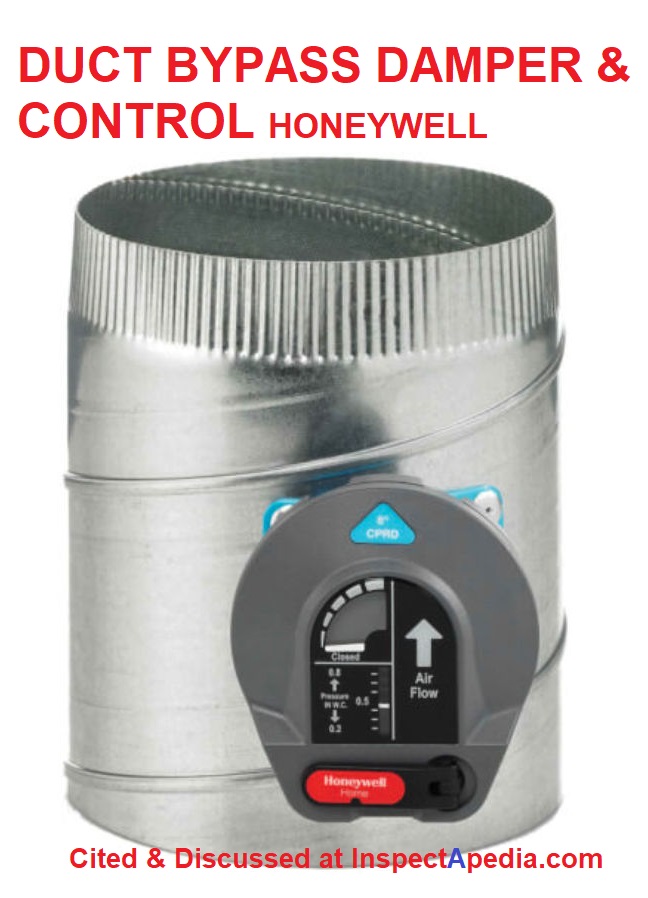
You'll find these by searching for "bypass damper" and "bypass damper control" and you'll find excellent products from Carrier, Honeywell, Trane and other manufacturers, distributed by your local HVACR supplier as well as from online vendors like supplyhouse.com.
Below we illustrate Honeywell's bypass damper and control
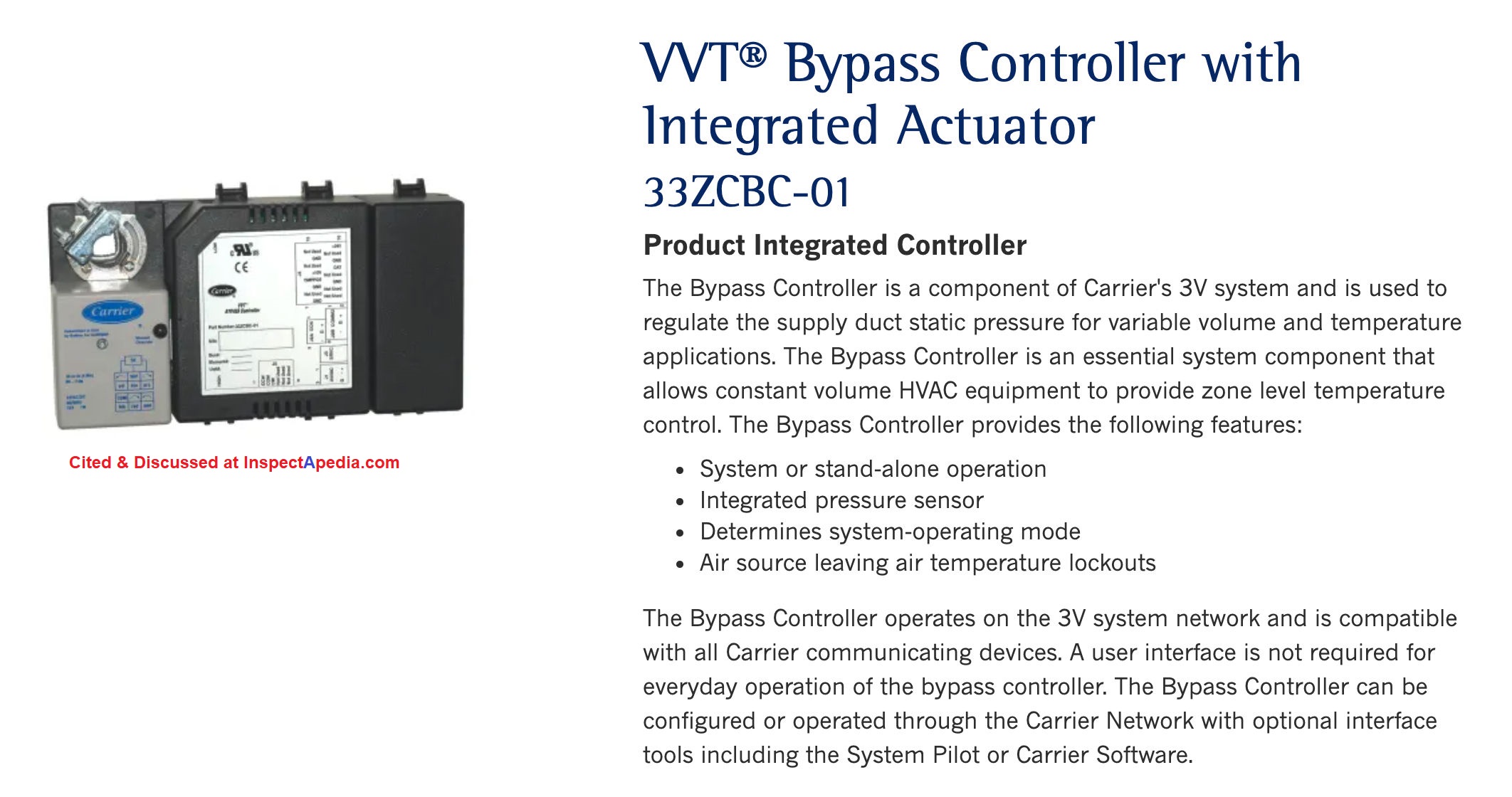
And in a second post we will show Carrier's Bypass smart damper controller.
@Bal, Post #2
When you connect a bypass damper not to the return-air system but rather to a duct serving another area of the building, HVAC engineers call that destination zone a "Dump Zone" - which is close to what you're asking-for.
But
Watch out: these products are usually sold as a way to balance or adjust airflow and are most-often used when a complex HVAC duct system can, depending on which other ducts are open or closed,
open part of the supply duct system to permit some supply air to be redirected to the return air side of the system - thus avoiding excess static pressure that otherwise causes air distribution system malfunction.
It is important to have your HVAC tech or designer actually measure air flow and measure static pressure in the duct system to be sure that the system is operating properly and without excessive static pressure and without improper balance between zones.
For example, if you are trying to switch cool air supply from Zone 1 to Zone 2, but if the area/volume of the two zones or the air leakiness of the two zones differ (e.g. one contains a stairwell and the other not) there may be serious imbalances in the air conditioning system and it may not work to the comfort of building occupants.
And these dampers do not do exactly what you're asking: they are NOT designed as a complete "either-or" damper sending air to one or another supply duct; When a bypass damper opens SOME of the system air passes into the duct connected to the original duct, but NOT ALL of it.
@Bal, Post #3: Continuing
So why don't we see an automatic Wye-Zone Damper - which is what you're asking for? There may be such a product but we haven't found it.
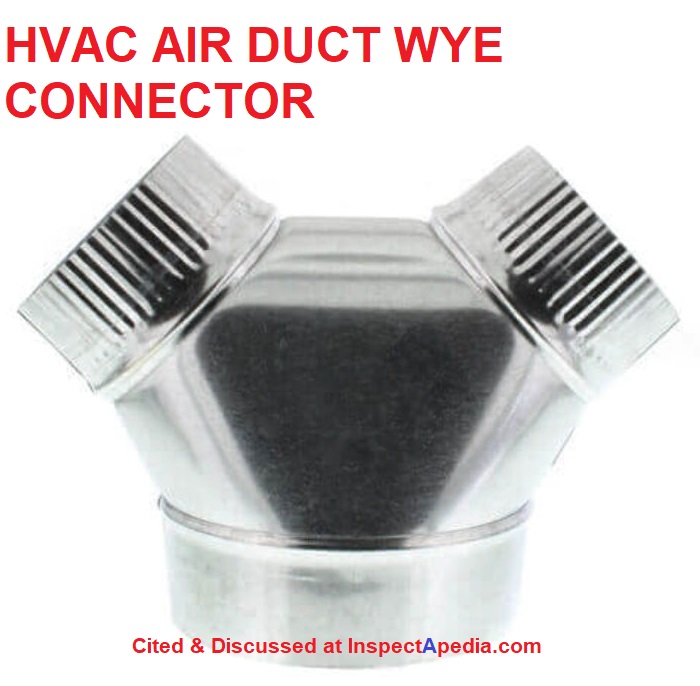
Instead most HVAC installers simply put a WYE in the supply duct - shown below - and add one or two zone dampers that permit adjusting air flow between the two zones.
Below is a simple 90° angle duct Wye connector, again widely available including from supplhyouse.com where we found this photo.
Air-Duct-Wye.png
Watch out: your HVAC designer will still need to measure air flow, static pressure, etc. as we mentioned earlier, to be sure that the system works properly under all combinations.
@Bal,
Post #4
Watch out: not all duct Wye branches are equal in how-smoothly the airflow transitions from the supply into the two sub-directions.
A Wye branch that makes a less-abrupt turn will have better air-flow, like this Nordfab Wye Branch - shown below. The company produces rolled-edge metal HVAC duct components of various dimensions, angles, features.
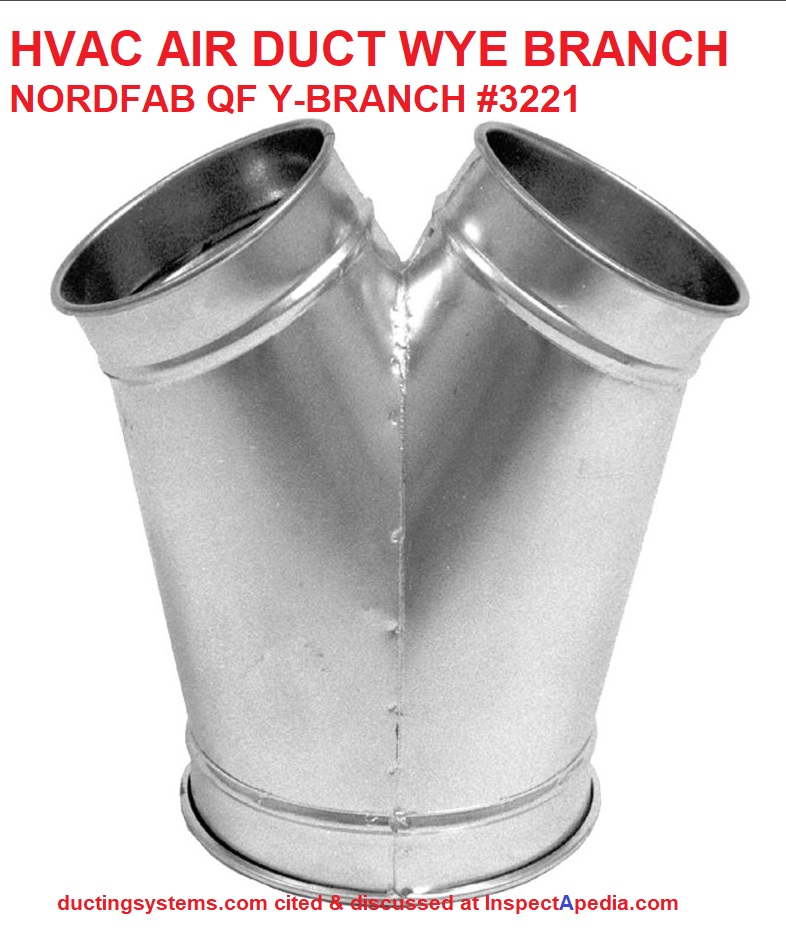
And where needed, HVAC air duct Y-branches do not have to be the same size on both legs. A main trunk line can branch off into a smaller one. (Remember our warning about proper zone and duct balancing.)
Also see this
- WYE BRANCH SPECIFICATIONS, NORFAB Y-Branch [PDF] Nordfab Ducting, Thomasville NC, USA, distributed by many HVAC vendors including Air Cleaning Specialists, Co., Tel: 866-455-2130 Web: www.ductingsystems.com - retrieved 2021/06/07 original source: https://www.ductingsystems.com/tech_data_pdf/3221_QF_Y-Branch.pdf
Bottom line: yes it's possible to choose between routing heating or cooling air between two zones or destinations, but for the system to work properly you can't just slap on more ducts and dampers; measurement, balancing, and proper duct sizing, etc. are very important.
Thank you for a helpful question about "either-or" zone damper controllers.
On 2021-06-06 by Bal
Is there any connector that can close one direction of pipe and open another. Basically redirect.
Does this exist? And can i get one with smart control?
Ductwork Zone Damper & Remote Control Installation & Wiring Manuals

Watch out: Turn off power source to
the heater before attempting installation, maintenance or repairs. Lock, tape or tag circuit breaker or fuse so that power cannot be turned on by accident. Failure to do so could result in serious electrical shock, burns or possible death. - King Electric
[Click to enlarge any image]
- APRILAIRE® ZONE CONTROLLER MANUAL Model 6504 [PDF] Research Products Corporation, Aprilaire, 1015 Washington Ave., Madison WI 53703 USA, Tel: 800-334-6011 Website: www.aprilaire.com
- APRILAIRE ZONE CONTROLLER MANUAL Model 67-series [PDF], Models 6704 - 6710. This zone controller inserts into existing HVAC ductwork and provides a motorized damper used to control air flow to provide sub-zoning in an existing HVAC sytsem.
- BARD MOTORIZED FRESH AIR DAMPER INSTALLATION INSTRUCTIONS Models WGMFAD-3A/5A, [PDF] used in Bard 1-Ton Wall Mount Air Conditioner, retrieved 2019/08/27 original source: http://www.bardhvac.com/digcat/volume_3_cd/install_pdf_file/2100-362(E).pdf
- BARD MOTORIZED FRESH AIR DAMPER IO MANUAL Models MFAD-2-3-5 [PDF] retrieved 2019/08/27 original source: http://www.bardhvac.com/digcat/S3364_TechDoc_CD/TechDoc-PDF/2100-225.pdf
- BRYANT ZONE DAMPER INSTALLATION INSTRUCTIONS [PDF], ZoneB2Kit-B through ZoneB8Kit-B, (1999) Bryant Heating & Cooling Systems 7310 W. Morris St. Indianapolis, IN 46231 USA, Tel: 800-962-9212
Excerpt:
The Zone Perfect Plus -B System allows air conditioning and heating equipment to control temperatures and humidity in up to 8 distinct spaces or Zones within a building. Each zone has independent temperature settings. - BRYANT® TWO-ZONE AONE DAMPER INSTALLATION [PDF] Op.Cit.
![Carrier Dampact 90 / 45 degree zone damper actuator installation - adapted from Honeywell's instructions [PDF] cited in this article (C) InspectApedia.com](Carrier-DAMPACT45DEG-R-Damper-Actuator-Control.jpg)
- CARRIER DAMPACT45DEG-R and DAMPACT90DEG-R INSTRUCTIONS (2014) [PDF]
- CARRIER DAMPACT45DEG-R and DAMPACT90DEG-R INSTRUCTIONS (2005) [PDF] CAC/BDP 7310 W. Morris St., Indianapolis, IN 46231 USA retrieved 2021/03/17, original source: https://resource.carrierenterprise.com/ is/content/ Watscocom/ carrier_dampact45deg-r_article_1422491345939_en_ii
See illustration. - Carrier DAMPACT® ZONE DAMPER INSTALLATION MANUALS & TROUBLESHOOTING - [manuals needed] see discussion of this controller at ZONE DAMPER REPAIR FAQs -
- Carrier SLIP-IN DAMPERS DAMPSLS-B, DAMPSLB-B INSTALLATION INSTRUCTIONS (2005) - CAC/BDP S 7310 W. Morris St. S Indianapolis, IN 46231 USA, Retrieved 2021/03/17, original source: carrierparts.com
Excerpt:
NOTE: Dampers are designed to be as quiet and efficient as possible. However, slip-in style dampers may exhibit some airflow noise associated with zoning. It is recommended to check damper operation with airflow moving through the duct system. - CARRIER ZONECC (2,4,8) KIT-B Installation and Start-Up Instructions [PDF] (1999) Op. Cit. - this is a very detailed 28-page IO manual
Excerpt: Introduction:
- The Comfort Zone II -B System allows air conditioning and
heating equipment to control temperatures and humidity in up to 8
distinct spaces or Zones within a building. Each zone has independent temperature settings.
The comfort temperature settings can change automatically
through the use of schedules.
This allows Comfort Zone II -B to change temperature settings in zones to reflect occupancy or usage. For example, you can condition the bedrooms in a home from 5:00 PM through 7:00 AM or the kitchen from 3:00 PM through 6:00 PM.
The Comfort Zone II -B System uses motorized air volume control dampers (also called zone dampers) to regulate flow of conditioned air into zones. In this manner Comfort Zone II -B can selectively heat or cool certain portions of a building depending upon space temperature requirements.
Each zone requires a motorized zone damper to control the air supplied to it and a zone sensor to sense zone temperature. There are 4 types of zone sensors available and they may be used in combination ... - CARRIER® ZONE DAMPER ZONECC3Z CONTROL INSTALLATION MANUAL [PDF] (2004) Carrier Corporation, 7310 W. Morris St. Indianapolis, IN 46231 USA Website: www.carrier.com
- CARRIER ZONE DAMPER SYSTXCC4ZC01 Infinity Damper Control INSTALLATION MANUAL [PDF], (2004) Carrier Corporation, 7310 W. Morris St. Indianapolis, IN 46231 USA
- EWC Controls, Inc., TB-217 REMOTE DAMPER CONTROL WIRING DIAGRAM [PDF] retrieved 2018/07/25, original source: https://ewccontrols.com/acrobat/090375a0217.pdf
- HONEYWELL® TRUEZONE ARD EARD ZD Series ZONE DAMPER INSTALLATION MANUAL [PDF] (2015), Honewell International, Inc., 1985 Douglas Drive North Golden Valley, MN 55422 customer.honeywell.com
- ICP International Comfort Products (Carrier) ZDAMPRNDB and ZDAMPRECB INSTALLATION MANUAL [PDF] (2013) ICP International Comfort Products
- INTERNATIONAL COMFORT ZONE CONTROLLER INSTALLATION [PDF], Observer® Zoning Panel, International Comfort Products, Lewisburg, TN 37091 USA
- INTERNATIONAL COMFORT Zone010ZP6 ZONE CONTROLLER INSTALLATION [PDF] (2014) Observer Zoning circuit board controller
Excerpt:
Before the actual installation of a zoning system can begin, decisions need to be made to determine the number and location of zones and sensors.
This affects duct and damper selections. This instruction covers the physical installation and start up of the Observer Zoning Board.
Use this instruction to guide the actual installation process after all the air side decisions have been made. One Zoning Board is capable of handling up to four zones of operation.
When greater than four zones are required, a second Zoning Board Module is needed for zones 5 through 8 (8 zones maximum). - LENNOX® LZP-2 ZONE CONTROL PANEL MANUAL [PDF] (2004) Installation instructions for zone control panels used with Lennox heating and cooling equipment. Lennox Industries, Dallas TX retrieved 2018/07/25, original source: https://resources.lennox.com/FileUploads/8644ead4-0a47-4172-a840-e08a19caee8cLennox_LZP_2_IOM.pdf
- TEMPERZONE EASY ZONE TOUCH INSTALLATION MANUAL [PDF] 24VAC wall controller can control up to 6 zone dampers.
Excerpts:
The EASY ZONE TOUCH is a zone control system designed to complement a heating cooling or air conditioning system of almost any manufacture that does not have zoning capability by adding active or passive zone control for up to 6 Zones.
...
It is recommended that when designing the duct layout, that all zones are connected directly to the supply air, and that all branch sizes are similar in length where possible and oversized by at least 15% to carry the extra air flow that may be present when zones are closed. - YORK OPPOSED BLADE DAMPERS 2RS267 2RB267 INSTALLATION MANUAL [PDF] used in York zone control systems, multi-blade dampers to control the flow of conditioned air in rectanguilar or rigid-round air ducts. Unitary Products Group, York Heating and Air Conditioning ,PO Box 1592, York Pennsylvania 17405 USA
- ZONEFIRST ZONE DAMPER Model ZDB ZDS INSTALLATION [PDF], ZoneFirst Corp., 6 Aspen Dr., Randolph NJ 07869 USA, Tel: 1-201-794-8004, Website: www.zonefirst.com Emaijl: info@zonefirst.com
- ZONEPAK® ZONING CONTROLLER MANUAL [PDF], SpacePak HVAC
Reader Comments, Questions & Answers About The Article Above
Below you will find questions and answers previously posted on this page at its page bottom reader comment box.
Reader Q&A - also see RECOMMENDED ARTICLES & FAQs
On 2021-03-17 by (mod) - fine-tuning the Carrier zone damper opening amount
@JEC,
It might be possible to deliberately mis-adjust some duct dampers so that the fully "closed" position is a bit short of actually fully-closed. But I don't see that for the zone damper you cite.
In particular there is a set-screw on the damper shaft that is used to adjust the "Closed" or "Open" position of the damper door. In the Carrier DAMPACT actuator illustration below I've colored the setscrew assembly in bright orange.
But
Watch out: mis-adjusting either the fully-open or fully-closed position can cause some automatic zone damper blades to jam or malfunction, I worry that if you set the blade to not close fully that when it tries to open it may rotate too far. (Some of these devices are specifically designed to prevent jamming or sticking. )
The ZDAMPRNDB and ZDAMPRECB INSTALLATION MANUAL [PDF] (2013) from ICP International Comfort Products does not describe a feature that would allow only partial closing of the automatic duct damper
If you don't already have a copy of those instructions click the link above.
Excerpt: When 24−vac is applied between common and open, the damper should go full open in approximately 15 sec.
However you might want to give ICP a call directly: 1-800-458-6650 - if you do, let me know what you're told as that will help other readers.
Similarly, the DAMPACT45DEG-R and DAMPACT90DEG-R INSTRUCTIONS [PDF] from Carrier (2005) describe the damper as fully-open or fully-closed and don't cite a minimum or in-between setting (though other zone dampers do permit those feature).
Excerpt:
Kit Part No. DAMPACT45DEG-R and DAMPACT90DEG-R are the replacement actuators designed for residential dampers. These kits contain the actuator, an anti-rotation mounting screw, and an Installation Instruction.
They can be used on dampers having round shafts or the newer dual flatted shafts. The 24-vac direct-drive actuator provides smooth, quiet performance in a smaller package. The DAMPACT45DEG-R kit is intended for round and newer rectangular dampers having a 45 degree rotation from closed to open.
The DAMPACT90DEG-R kit is for slip-in and older
rectangular dampers which rotate through 90 degrees from closed to open. Ninety degree rectangular dampers have round shafts while 45 degree
rectangular dampers have dual flatted shafts with an arrow on the shaft end.
On 2021-03-17 by (mod)
@Bender, you would buy just about any automatic duct damper product, wiring it to be activated by your thermostat. When the thermostat calls for heating or cooling the duct damper will open, and when the thermostat is satisfied the duct damper will close automagically.
Meanwhile if the fan continues to run, air will be delivered to whatever ducts are NOT closed by the automatic damper.
On 2021-03-16 by JEC
Can a Carrier zone damper model DAMPACT45DEG-B HF21KJ005 be set to a minimum setting in lieu of fully closed?
On 2020-12-17 by Bender - basement cold storage room for canning
Hi. I have a cold.storage room in my basement for my canning. In the summer, the temp climbs too high. I ran a duct fr my hvac system to cool it in the summer.
Problem is, that I run my furnace fan 24/7 in order to balance the temps between my main floor and my basement. So the hvac blows the room temp air in there with occasional bursts of ac.
This make the room as warm as the rest of the house.
I would like to add a automated duct that only opens when the thermostat calls for the ac.
I'm not sure which damper to buy or how to wire it to stay closed when the room temp air is running.
On 2020-09-15 by Anonymous
Is against the nec code to cover up low voltage dampers
On 2020-09-01 by Shannon
Sorry typos in the previous message, let me try again. Thank you, I've actually been reading the articles for about 5 hours now and haven't come across anything that may solve my problem. I've made sure that all the ductwork is free of kinks, disconnections and have fixed any holes in the ductwork.
I made sure all the vents in the ceiling are fully open and made sure the four wall vents are not obstructed. I'm pretty much at a loss because I don't understand why prior to the new unit all of my vents blew extremely hard, I even had to close the ones above my bed and my TV.
Since the new unit, only one vent blows - it's in the same room as the furnace/AC closet. Do you know if there's anything else that I can check? I was reading about a damper not sure in the picture if that is the damper, the little box hanging from the ductwork, I think I've seen two or three of them in my home.
Is there a way to check to see if those are working or do you think there is another issue that I can look for? Thank you in advance. 901-491-9825. hiiamboo@yahoo.com
Thank you, I've actually been reading the articles for about 5 hours now and haven't come across anything that may solve my problem. I've made sure that all the ductwork is free of kinks, disconnections and have fixed any holes in the ductwork.
I made sure all the vents in the ceiling are fully open and made sure the four wall vents are not obstructed. I'm pretty much at a loss because I don't understand why prior to the new unit all of my vents blue extremely hard right even had to close the ones above my bed and my TV's. Since the new unit only one vent blows not the one next to the furnace AC closet.
Do you know if there's anything else that I can check, I was reading about a damper not sure in the picture that is the damper that little box hanging from the ductwork I think I've seen two or three of them in my home.
Is there a way to check to see if those are working or do you think there is another issue that I can look for? Thank you in advance. 901-491-9825 hiiamboo@yahoo.com
I've been reading the articles for the past 4 hours and haven't been able to find answer. I've inspected all ductwork for disconnections and repaired any holes that I seen. I changed the air filter, I've gone around the house and made sure all of the vents are fully open, I made sure none of the wall vents are obstructed.
Prior to getting in the new unit all of my vents blew very hard, I even had to close most vents because they would blow too hard on me, especially over my bed and TV, since he installed thshnit my airflow has disappeared in all but one vent.
Thank you in advance for any assistance. 901-491-9825. hiiamboo@yahoo.com
On 2020-09-01 - by (mod) -
 Shannon,
Use the search box on this page to find ur artices on
And youl see the common causes of weak air flow and thus what t check, such as position of duct dampers, discnnected ductwork, crushed or blocked ducts, and more
On 2020-09-01 by Shannon
Hi I have a new Ameristar AC/Furnace unit that was installed the end of July last year, unfortunately I was trying to help a small business and ultimately have been ripped off, Ron Patterson Heating & Air installed it with many issues and now he blocked my phone number, Facebook, my friends and kids phone number and will not come back and fix the airflow problem - one vent upstairs blows great, the other 3 upstairs blows a little,
whereas, the vent downstairs barely blow at all. I've timed it several times and it takes more than 9 hours to change just one degree lower. Can anyone help and tell me if it's a damper problem and can I open or close it myself.
Btw: I've installed two new thermostat and even had my ducts inspected - they were fine. Thank you in advance for any assistance.
On 2020-08-15 by Sherron G. Perry
I have an heating system air duct damper that is squeeking continuously. How do I service it?
On 2020-04-11 - by (mod) -
Hi Bob, thanks for the interesting photo and question.
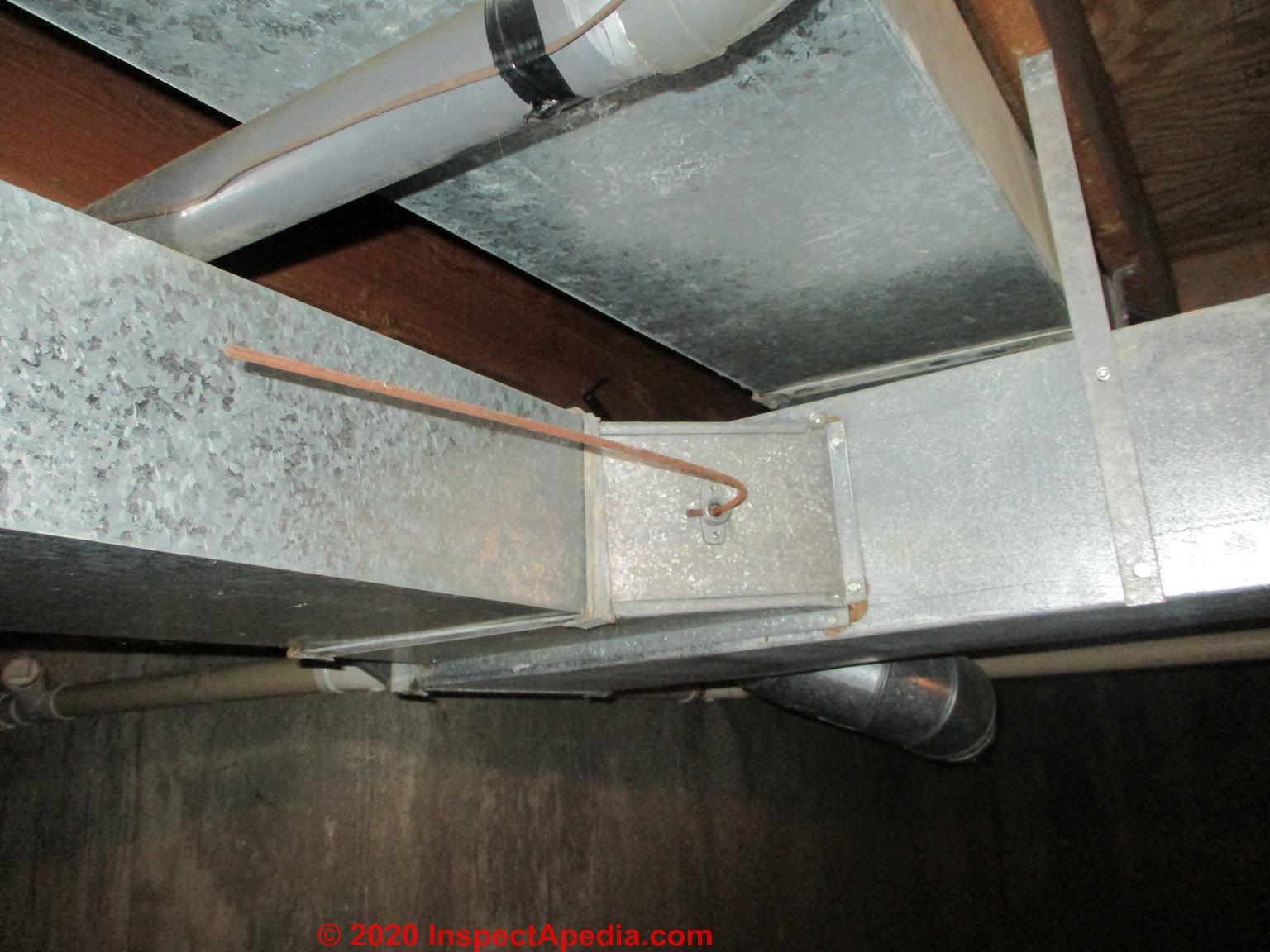
I don't recognize that device. Is it possible that it's a home-made extended-handle for a damper set into the duct to control air flow? Can you rotate it up or down?
On 2020-04-11 by Bob H
Could you identify this, not sure what I'm looking at... think it is some kind of temp sensor but not at all sure. Image attached, THANK YOU
On 2020-03-29 - by (mod) -
James
Please find our entire discussion now moved to
ZONE DAMPER ACTUATOR MOTOR REPLACEMENT
in order to keep it together, accessible, and to invite further reader comment or suggestions
Do keep me posted on your repair as that will help other readers.
Stuck Fresh Air Damper Control
This discussion moved to its own page at FRESH AIR DAMPER CONTROL REPAIR
...
Continue reading at ZONE DAMPER ACTUATOR MOTOR REPLACEMENT or select a topic from the closely-related articles below, or see the complete ARTICLE INDEX.
Or see ZONE DAMPER REPAIR FAQs - questions & answers posted originally on this page, for help diagnosing problems with manual or automatic air duct zone dampers & damper controls
Or see these
Recommended Articles
- AIR CONDITIONING & HEAT PUMP SYSTEMS - home
- DAMPERS & DRAFT REGULATOR TYPES
- DUCT SYSTEM DESIGN SIZE & DEFECTS - home
- FIRE & SMOKE DAMPERS, AUTOMATIC
- FRESH AIR DAMPER CONTROL REPAIR
- FURNACES, HEATING - home
- MANUALS & PARTS GUIDES - HVAC - home
- ZONE DAMPER CONTROLS
- ZONE DAMPER ACTUATOR MOTOR REPLACEMENT
Suggested citation for this web page
ZONE DAMPER CONTROLS at InspectApedia.com - online encyclopedia of building & environmental inspection, testing, diagnosis, repair, & problem prevention advice.
Or see this
INDEX to RELATED ARTICLES: ARTICLE INDEX to HVAC DUCT SYSTEMS
Or use the SEARCH BOX found below to Ask a Question or Search InspectApedia
Ask a Question or Search InspectApedia
Try the search box just below, or if you prefer, post a question or comment in the Comments box below and we will respond promptly.
Search the InspectApedia website
Note: appearance of your Comment below may be delayed: if your comment contains an image, photograph, web link, or text that looks to the software as if it might be a web link, your posting will appear after it has been approved by a moderator. Apologies for the delay.
Only one image can be added per comment but you can post as many comments, and therefore images, as you like.
You will not receive a notification when a response to your question has been posted.
Please bookmark this page to make it easy for you to check back for our response.
Our Comment Box is provided by Countable Web Productions countable.ca
Citations & References
In addition to any citations in the article above, a full list is available on request.
- Airflow Breeze air movement register booster fans are produced by AirFlow Technology, Airflow Technology 1427 West 86th Street, Suite 328 Indianapolis, IN 46260 1-800-458-5540 website: http://www.aftproducts.com/Airflow_Breeze_3ff0ef340c6e0e13b.dept
- "Warm Air Heating Systems". Instructional Technologies Institute, Inc., 145 "D" Grassy Plain St., Bethel, CT 06801 800/227-1663 [home inspection training material] 1987
- Wikipedia Web: https://www.wikipedia.org/ provided background information about some topics discussed at this website provided this citation is also found in the same article along with a " retrieved on" date. NOTE: because Wikipedia entries are fluid and can be amended in real time, we cite the retrieval date of Wikipedia citations and we do not assert that the information found there is necessarily authoritative. - "Fire Damper", Wikipedia, retrieved 28 Jan 2015, original source http://en.wikipedia.org/wiki/Fire_damper
- In addition to citations & references found in this article, see the research citations given at the end of the related articles found at our suggested
CONTINUE READING or RECOMMENDED ARTICLES.
- Carson, Dunlop & Associates Ltd., 120 Carlton Street Suite 407, Toronto ON M5A 4K2. Tel: (416) 964-9415 1-800-268-7070 Email: info@carsondunlop.com. Alan Carson is a past president of ASHI, the American Society of Home Inspectors.
Thanks to Alan Carson and Bob Dunlop, for permission for InspectAPedia to use text excerpts from The HOME REFERENCE BOOK - the Encyclopedia of Homes and to use illustrations from The ILLUSTRATED HOME .
Carson Dunlop Associates provides extensive home inspection education and report writing material. In gratitude we provide links to tsome Carson Dunlop Associates products and services.
 | HOME | ABOUT | ASK a QUESTION | CONTACT | CONTENT USE POLICY | DESCRIPTION | POLICIES | PRIVACY | |
| © 2024 - 1985 Publisher InspectApedia.com - Daniel Friedman | |||||||||