
InspectAPedia® FREE Encyclopedia of Building & Environmental Construction, Diagnosis, Maintenance & Repair |
Question? Just ask us! InspectAPedia
|
 Radiator Valves & Vent Controls
Home page - Hot Water & Steam Heat Radiator Valve Adjust or Repair
- POST a QUESTION or COMMENT about using, adjusting, & repairing radiator control valves and vents for both hot water and steam heat systems
Heating system radiator valve inspection & troubleshooting guide.
Here we explain the use, adjustment, diagnosis & repair of hot water or steam heating radiator valves & steam vents to control heat output from individual radiators. What to do about hot water or steam radiator valves or vents that are stuck open or closed.
Examples of common radiator valve questions that we answer: which way to turn the radiator valve to open or close it? How do you replace a leaky or stuck heating radiator valve? Can you install a radiator valve that opens or closes automatically - like a room thermostat?
InspectAPedia tolerates no conflicts of interest. We have no relationship with advertisers, products, or services discussed at this website.
Adjust & Fix or Replace Hot Water or Steam Heat Radiator Control Valves
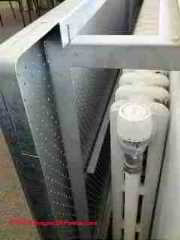
Hot water heating radiator or convector troubleshooting, repair, or installation articles in this series include the following:
Article Contents
- WHAT IS A RADIATOR VALVE ? - controls heat output at hot water or steam radiators
- WHICH WAY DO I TURN THE RADIATOR VALVE HANDLE? - clockwise (right) = closed
- FIX A STUCK RADIATOR VALVE - can't turn the handle?
Traditional "Manual" Radiator Valves
Radiator valves are a simple handle that controls the heat output at that radiator. The radiator valve can be opened to allow hot water or steam to enter and thus heat the room, or it can be closed to reduce or to completely turn off the heat at that individual radiator.
By "manual" radiator valve we mean that you have to turn the valve open or shut yourself. We discuss automatic (thermostatically controlled radiator valves) and other radiator controls below.
There are also automatic radiator valves that add a temperature setting knob or control that causes the valve to open or close automatically depending on the room temperature.
In our photo above, you can see a top-fed two pipe steam radiator at Google Headquarters in New York City.
If your heating system radiators won't get hot:
For hot water radiators or convector heat,
see COLD HOT WATER BASEBOARD / RADIATOR
For cold steam heat radiators
see COLD STEAM HEAT RADIATORS for help in diagnosing the problem.
If your heat is provided by baseboards, there will not normally be individual shutoff valves at those devices. If your system uses one circulator and provides multiple heating zones (and thermostats), there will be zone control valves (usually near the boiler) that are opened or closed by the room thermostat(s).
Cold heating baseboards are discussed
at AIRBOUND HEAT SYSTEM REPAIR by WATER FEED VALVE
Which Way to Turn the Radiator Valve
 If your heat is provided by individual hot water radiators or convector units, usually there is a control valve at each radiator or convector. Make sure that the control valve at the heating radiator is "open" or "on".
Usually turning a radiator valve "clockwise" or "down" closes the valve (turns the heat off or down).
and turning the valve handle counter-clockwise (to the lefty) opens the valve (turns the heat or or up).
As my daughter Mara says, you can remember this as "rightie tightie" and "leftie loosie".
Check the radiator control valve:
If a radiator is not getting hot: (steam or hot water) first see if the valve that controls it has been turned off.
Try turning the valve counter-clockwise to see if it will open.
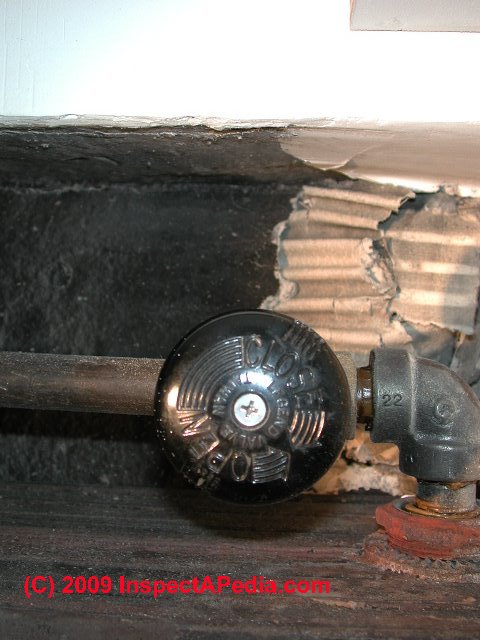
In our photo (left), the heating convector control valve was found at floor-level under the heating convector. The "open" and "close" directions for this "radiator valve" were nicely marked by the manufacturer (click to enlarge the photo).
If the radiator valve does not turn in that direction, try turning it in the other direction (clockwise or "closed") to see if the radiator valve is stuck. You may also find the same control valve at heating convectors (but not usually at heating baseboards).
While people sometimes turn off radiators in an unused portion of a building, we usually find that most radiator valves have been left in the "on" position - in fact turning off a hot radiator in some building areas could lead to its freezing and cracking.
Steam radiators, on the other hand, can usually be turned off with impunity since steam radiators do not normally contain water in its liquid form. [That's true as long as condensate has not become trapped inside of the steam radiator.]
If you can't turn the radiator valve handle, that is, if it's stuck,
see the advice given next on this page.Now that we know which way to turn the radiator valve for more or less heat, if you need to actually set a heat output level from your radiator
If you open the radiator valve but you still don't get heat there can be several causes such as an air bound hot water heating system or a steam radiator with a jammed steam vent.
At COLD HOT WATER BASEBOARD / RADIATOR we include links to details that will help you correct a problem with heating baseboards or radiators that are not working.
How to Fix Stuck Heating Radiator Valves
Watch out: don't use excessive force to try to turn a "stuck" radiator valve.
First, you may be trying to open a valve that is already in its fully open position. Second, the valve may actually be jammed.
Excessive force can break the valve or even cause a leak. If the valve won't turn at all counter-clockwise towards "open", try turning it the other way - clockwise, towards "closed". If the valve now turns you'll know it was already in its open position.
On 2020-10-21 by Matt - can't close radiator valve
I'm unable to close off the radiator so I don't know how to either free it up or replace the valve stem. I'd rather not have to replace the entire valve if possible.
On 2020-10-21 by (mod) - tips on freeing a stuck heating radiator valve
 Matt
Matt
I agree that if trying to turn the radiator valve clockwise (to close it) doesn't work it'd be risky to use a lot of force; if you break the valve and send hot water spewing into the room you'd end up having to shut down the whole heating system.
Sometimes we can free up a stuck radiator valve by a combination of:
- Apply a special penetrating oil - lubricant like Liquid Wrench:
Squirt drops of the oil around the valve stem and also allow it to wet the threads of the packing/compression nut through which the valve stem passes.
- Wait hours or longer for that to soak in.
- Try gently loosening (counterclockwise) the packing/compression nut through which the valve stem passes about 1/2 turn.
Watch for leaking water, and don't over loosen this nor try taking it fully off
- Try then turning the radiator valve clockwise or counter-clockwise a bit just to see if you can get it moving. Then wiggle it back and forth until you confirm that it was already fully open (turned counterclockwise) or closed (clockwise),
then close the valve by turning it clockwise until it stops.
Watch out: tighten by hand; don't use a giant wrench.
- then gently re-tighten the packing nut enough to be sure there's no leakage around the valve stem.
Note that even fully closed, depending on the type of radiator valve, the radiator may not be 100% "Off" if the valve stem stop washer (for stop type valves) is damaged or missing; to fix that requires removal and disassembly of the valve. But other radiator valves are the "gate" type valve that will either fully close - or not.
Watch out: sometimes using too much force will break a valve stem, especially gate valve stems; if the stem breaks off inside the valve, the valve handle will turn but the valve closing mechanism is not really moving up or down inside the valve; that valve will have to be replaced.
The best time to replace a bad radiator valve is when we are not in the midst of a heating season, for two reasons:
1. there's no discomfort or freeze risk from having to turn off the heating system if we're not in cold or freezing weather.
2. plumbers and heating service techs who normally work on hot water (or steam) heating systems are less consumed with emergency service calls during warm weather, so they have more time to do the job well and also are easier to schedule.
P.S.
Do read the article above where you will find more tips on closing off a heating radiator or baseboard, such as simply closing off or ending use of an air bleeder; letting the radiator remain deliberately air-bound is another way to keep a radiator from heating up when its control valve no longer works.
You can try some Liquid Wrench or spray WD-40 lubricant to see if you can free a stuck radiator valve but
Watch out: don't force the valve handle because if you break the valve and cause a leak, you'll be faced with having to shut your entire heating system down to wait for repair.
Broken Radiator Valves
Watch out: even if the radiator valve appears to be "open" - that is, turned fully counter-clockwise, if the radiator valve stem is broken internally you may be just turning the knob but the valve may be staying closed inside.
If your radiator valve turns too easily or if it does not appear to raise (opening) or lower (closing) when turning, and especially if turning the valve makes no difference in the behavior of the radiator, the valve stem may be broken. (First check for air bound radiators or if your heating system uses steam, check for a steam vent that is not opening.)
Usually while turning a radiator valve from "closed" to "open" position, if you look closely at the valve stem - the metal rod or shaft extending below the knob you are holding, and extending into the body of the valve itself - you'll see that as you "open" the valve the stem gets "longer" and often a less-oxidized, shiner part of the valve will become exposed as it moves upwards from having been inside the valve body.
That's a great way to convince yourself that yes, the valve is probably opening internally too, you're not just turning the knob. If the valve body has broken loose from the valve stem, that's an internal problem you can't see, but turning the radiator valve knob, even if it rotates, will not open a broken, stuck, frozen valve.
If only some of your hot water radiators, hot water heating convector units, or hot water baseboard heating sections are not getting hot and the radiator valve is open,
see AIRBOUND HEAT SYSTEM REPAIR by WATER FEED VALVE (hot water heat)
or if a steam radiator valve is open but the radiator is still cold, the steam vent may not be working.
Below are links to other radiator valve and heat control topics that were previously found on this page.
Automatic or Thermostatically Controlled Radiator Valves - TRVs
This topic has moved to
AUTOMATIC RADIATOR VALVES - Automatic or Thermostatically Controlled Radiator Valves
Radiator Valve Adjustment for more or less heat
This discussion moved
Types of Radiator Valves: Hot Water vs Steam
This discussion has moved
to RADIATOR VALVE TYPES - hot water vs steam
Automatic or Thermostatically Controlled Steam Vents
This topic has been moved and consolidated
at STEAM VENTS - topic home, where we discuss other steam vent problems such as spitting water, clogging, steam valves that do not open or close when they should, etc.
At STEAM VENT TYPES, SELECTION, we identify the different types of steam vents used on 1 pipe and 2 pipe steam systems.
Choosing & Installing Adjustable or Thermostatically Controlled Steam Vents to Control Steam Heat
This text has moved
to GUIDE TO CHOOSING & INSTALLING STEAM VENTS.
...
Reader Comments, Questions & Answers About The Article Above
Below you will find questions and answers previously posted on this page at its page bottom reader comment box.
Reader Q&A - also see RECOMMENDED ARTICLES & FAQs
On 2020-12-05 by Carlyle Wright - one radiator won't get hot
The pipe leading TO this one radiator does not get hot.
Also the pipe leading FROM this same radiator also does not get hot. As a result this one radiator does not get hot. Funny thing is that the larger pipes to which these pipes are connected are blazing hot.
My heating system uses hot water.
On 2020-12-05 - by (mod) -
Carlyle, I suspect that radiator is air bound. If there is an air bleeder valve on the rad you'd open it carefully, to let out air; the moment you see water you'd close it.
Watch out: if you break off or damage the air bleeder you'll have to shut down the rad or the heating system until it's repaired.
On 2020-12-02 by Ian - does radiator air bleeder location matter?
Have home central heating system installed by in my opinion not too professional workers. Does it matter which corner of a radiator is the water inlet outlet and air drain located at?
They kept saying it doesn't matter but some of my long ribs of one of the radiator far from both the inlet and outlet aren't as warm as the ones close to the circuit. I have air bled the radiator multiple times with no air ever coming out.
The whole system runs on 2.5 Bars I believe as within the green gauge on the gas operated water heater. Thank you for you answer
On 2020-12-03 - by (mod) - When a radiator isn't getting hot but the air bleeder releases no air
Ian
When a radiator isn't getting hot but the air bleeder releases no air (and assuming the air bleeder is properly located high on the radiator where it belongs) it's still possible that the supplying hydronic (hot water heat) piping system is partially air-bound somewhere in the circuit. That would be no surprise on a new heating system.
Ask your heating installers to return to force-bleed air from all of the piping.
Details are at COLD HOT WATER RADIATOR or BASEBOARD https://inspectapedia.com/heat/Cold_Radiator_Repair.php
On 2020-01-18 by R K Habbs - did high heat settings cause my radiator to leak?
Is the excessive heat which is controlled by building management the probable cause for my apartment radiator’s broken valve and subsequent leak?
My apartment steam radiator valve broke after building management turned the water back on Tuesday and my apartment temperature increased from the 60’s to the 90’s Fahrenheit. The valve has been kept closed for years.
Background
I live on the top floor (5 floor) of a 150-year-old, NYC walk up building. My 500+ sq. ft. apartment has two steam radiators. The boiler for my building and the adjacent building is under lock and key in the sub-basement.
On Tuesday (1/14/20), the water was turned off because of work done on the boiler and/or installation of a water vehicle onto nearly completed replaced roof. Normally my apartment temperature is in the 60's. Since, my apartment is being overheated. On Thursday (1/16/20) at 1:11AM my apartment temperature was 98 degrees and at 4PM it was 89 degrees.
On early Friday (1/17/20) morning I learned that my downstairs neighbor had a leak. (I thought he was inquiring about a recent contentious allegation regarding my bathroom.) That evening at 9:15PM the apartment temperature was 93 degrees. This morning at 5:30AM the temperature was 95 degrees.
Last night when the heat bordered on suffocating I realized that my valve was broken and water began flowing onto my apartment floor. The water flow has increased since. The valve has been turned off for years.
On 2020-01-18 - by (mod) - will excessive heat cause my radiator to leak
No, RK, heat alone would not explain a radiator valve leak.
Radiator valve usually leak because of this combination of factors
- age: gaskets become worn, dry, brittle
- corrosion: valves become stuck or difficult to turn
- debris: scale or rust collection can obstruct valve operating requiring it to be forced open or shut
- surprises: draining a heating system, leaving water off, combined with cooling down and drying out that occur during that time, will, in some valves or other plumbing devices, give time for a valve stem gasket already old and at the end of its life, to dry and shrink so that when water, heat, and pressure are restored the valve leaks around the valve stem.
(Of course there are other potential leak points at connections but that's another discussion).
Sometimes with continued use, warmth, water contact, the stem gasket will stop leaking;
Sometimes, with great care, one can slightly tighten the bell packing nut and stop the valve stem leak.
Otherwise that part will need replacement.
On 2019-11-07 by Dan - unable to bleed hot water heating radiators
I tried to bleed my hot water radiators that were warm at the bottom but cold at the top, and now they are getting no heat at all.
Our radiators on the first floor are working. Any ideas on what caused this or how I can fix it?
On 2019-11-07 by (mod)
Dan
Check first that the boiler is up to full operating temp (say 180F or more)then
Check the pressure at the boiler - it ought to be somewhere between 15 and just under 30 psi.
With those confirmed, try bleeding the cold rads again - if you bleed a cold rad without the system being hot and up to pressure you might accidentally draw air INTO the radiator; stop bleeding when water appears at the bleeder.
If the rads are still cold then the system is airbound but the air is somewhere else, not in the radiator.
IN that case see AIR-BOUND HEATING SYSTEMS - https://inspectapedia.com/heat/Air_Bound_Heating_System.php
...
Continue reading at RADIATOR VALVE TYPES - hot water, steam, automatic? what's the difference? or select a topic from the closely-related articles below, or see the complete ARTICLE INDEX.
Or see RADIATOR VALVE & HEAT CONTROL FAQs - questions and answers posted originally on this page.
Or see these
Recommended Articles
- AIR-BOUND HEATING SYSTEMS - home
- AIR BLEEDER VALVES - home - bleed air out of radiators that are not getting hot
- CHECK VALVES, HEATING SYSTEM - more hot water & steam heat controls
- RADIATOR VALVES & HEAT CONTROLS - find & identify
- AUTOMATIC RADIATOR VALVES - Automatic or Thermostatically Controlled Radiator Valves
- COLD HOT WATER RADIATOR or BASEBOARD - fix cold hot water heat (hydronic) radiators
- COLD STEAM HEAT RADIATORS - fix cold steam radiators
- RADIATOR CONTROL VALVES on CONVECTOR HEATERS
- RADIATOR VALVE ADJUSTMENT - How to Adjust or Control the Level of Heat From Radiators
- RADIATOR VALVES MANUAL - Which way to turn the radiator valve
- RADIATOR VALVE STUCK or BROKEN REPAIR - how to repair or replace radiator valves
- RADIATOR VALVE TYPES - what's the difference?
- STEAM HEAT VENT CHOICES & INSTALLATION - Adjustable or Thermostatically Controlled
Suggested citation for this web page
RADIATOR VALVES & HEAT CONTROLS at InspectApedia.com - online encyclopedia of building & environmental inspection, testing, diagnosis, repair, & problem prevention advice.
Or see this
INDEX to RELATED ARTICLES: ARTICLE INDEX to HEATING RADIATORS
Or use the SEARCH BOX found below to Ask a Question or Search InspectApedia
Ask a Question or Search InspectApedia
Questions & answers or comments about using, adjusting, & repairing radiator control valves and vents for both hot water and steam heat systems
Try the search box just below, or if you prefer, post a question or comment in the Comments box below and we will respond promptly.
Search the InspectApedia website
Note: appearance of your Comment below may be delayed: if your comment contains an image, photograph, web link, or text that looks to the software as if it might be a web link, your posting will appear after it has been approved by a moderator. Apologies for the delay.
Only one image can be added per comment but you can post as many comments, and therefore images, as you like.
You will not receive a notification when a response to your question has been posted.
Please bookmark this page to make it easy for you to check back for our response.
Our Comment Box is provided by Countable Web Productions countable.ca
Citations & References
In addition to any citations in the article above, a full list is available on request.
- [1] Dan Holihan, "Your Most Frequently Asked Questions About Cast-Iron Radiators – Answered! by Dan Holohan", http://www.oiltechtalk.com/pages/cast_iron.htm, retrieved 3/7/2013.
- Barnes & Jones Corporation, 91 Pacella Park Drive Randolph, MA 02368, Tel: 781-963-8000calibrated steam traps and vents, Email: bnesbitt@barnesandjones.com. Vent-Rite steam vents for radiator control.
- Energy Savers: Heat Distribution Systems, Steam Radiators & Hot Water Radiators, U.S. Department of Energy, web search 12/27/2010, original source: http://www.energysavers.gov/your_home
/space_heating_cooling/index.cfm/mytopic=12580 - Gorton Heating Corporation, 546 South Avenue East, Cranford, New Jersey 07016, Tel: 908-276-1323, email: info@gorton-valves.com, fast venting valves for steam heating systems.
- "Rv-4 One-Pipe Steam Radiator Valve", available from Armstrong International,
816 Maple Street, Three Rivers, MI 49093 USA, Tel: (269) 273-1415, Armstrong has offices in Beijing, China, Belgium, India and Mexico. Web search 12/27/2010, original source:
http://www.armstronginternational.com/thermostatic-valves-rv-4-one-pipe. - [6] "Special Steam Vents", Hoffman Specialty heating products, web search 12/27/2010, original source:
http://www.hoffmanspecialty.com/pdf/hs900/HS900-3474.pdf - [7] "Steam and Water Vents, Selection Guidelines - Steam Vents", Hoffman Specialty, web search 12/27/2010, original source:
http://www.hoffmanspecialty.com/pdf/hs900/HS900-stvents.pdf - Hoffman 1A adjustable steam vents, available from Hoffman Specialty, ITT, web search 12/27/2010, original source:
http://www.drillspot.com/products/51570/Hoffman_1A_Adjustable_Automatic_Air_Vent_For_Steam_Radiators - Hoffman Convector Steam Vents, available from Hoffman Specialty, ITT, web search 12/28/2010, original source: http://www.hoffmanspecialty.com/pdf/hs900/HS900-conv109.pdf
- [10] Report 95-14, PB96-198163 Thermostatic Radiator Valve (TRV) Demonstration Project, contact NYSERDA. 17 Columbia Circle, Albany, NY 12203-6399 Toll-Free: 1-866-NYSERDA, Tel:(518)465-6252, Ext. 241. Web Search 12/27/2010, original source: http://www.homeenergy.org/archive/hem.dis.anl.gov/eehem/96/960509.html
- [11] VariValve® Quick-Vent from Heat Timer, adjustable radiator and main line vent valves for one pipe steam systems, web search 12/27/2010, original source: http://www.heat-timer.com/enFiles/ProductDocument/literature/VariV056082C.pdf
- [12] "Care & Feeding of Air Vents", Dan Holohan, Old House Journal Online, November 2004
- [18] "Residential Steam Heating Systems", Instructional Technologies Institute, Inc., 145 "D" Grassy Plain St., Bethel, CT 06801 800/227-1663 [home inspection training material] 1987
- [21] Thanks to reader Paul Ruud for discussing improved steam heat controls and thermostatically operated steam radiator valves and air vents, 12/27/2010.
- The Steam Book, 1984, Training and Education Department, Fluid Handling Division, ITT [probably out of print, possibly available from several home inspection supply companies] Fuel Oil and Oil Heat Magazine, October 1990, offers an update,
- Principles of Steam Heating, Dan Holohan, technical editor of Fuel Oil and Oil Heat magazine, 389 Passaic Ave., Fairfield, NJ 07004 ($12.+1.25 postage/handling).
- "Residential Steam Heating Systems", Instructional Technologies Institute, Inc., 145 "D" Grassy Plain St., Bethel, CT 06801 800/227-1663 [home inspection training material] 1987
- "Residential Hydronic (circulating hot water) Heating Systems", Instructional Technologies Institute, Inc., 145 "D" Grassy Plain St., Bethel, CT 06801 800/227-1663 [home inspection training material] 1987
- In addition to citations & references found in this article, see the research citations given at the end of the related articles found at our suggested
CONTINUE READING or RECOMMENDED ARTICLES.
- Carson, Dunlop & Associates Ltd., 120 Carlton Street Suite 407, Toronto ON M5A 4K2. Tel: (416) 964-9415 1-800-268-7070 Email: info@carsondunlop.com. Alan Carson is a past president of ASHI, the American Society of Home Inspectors.
Thanks to Alan Carson and Bob Dunlop, for permission for InspectAPedia to use text excerpts from The HOME REFERENCE BOOK - the Encyclopedia of Homes and to use illustrations from The ILLUSTRATED HOME .
Carson Dunlop Associates provides extensive home inspection education and report writing material. In gratitude we provide links to tsome Carson Dunlop Associates products and services.
 | HOME | ABOUT | ASK a QUESTION | CONTACT | CONTENT USE POLICY | DESCRIPTION | POLICIES | PRIVACY | |
| © 2024 - 1985 Publisher InspectApedia.com - Daniel Friedman | |||||||||