
InspectAPedia® FREE Encyclopedia of Building & Environmental Construction, Diagnosis, Maintenance & Repair |
Question? Just ask us! InspectAPedia
|
 Finding & Fixing Leaks in Heating Radiators, Baseboards & Convectors
- POST a QUESTION or COMMENT about diagnosing & fixing leaks in hot water or steam heat radiators
Heating radiator leak troubleshooting:
This article describes how to find and fix leaks in hot water heating radiators. Where to Check for Leaks on Baseboards, Radiators, or Heating Convectors - How to identify, inspect, diagnose, and repair problems with hot water or steam radiators, baseboards, or heating convectors.
This article series answers most questions about all types of heating systems and gives important inspection, safety, and repair advice. In addition to cast iron radiators using hot water or steam as a heat source, we describe two other very common hot water heat distribution methods below.
InspectAPedia tolerates no conflicts of interest. We have no relationship with advertisers, products, or services discussed at this website.
Where to Check for Leaks on Baseboards, Radiators, or Heating Convectors

Here we describe the types and locations of leaks found on heating radiators: hot water, steam, cast iron, heat convectors, baseboards, convectors, or other types of radiators, as well as leaks found between abutting radiator sections near the bottom of the heating unit.
Article Contents:
Common leak locations on baseboard heating systems
Obviously, first look at the floor around each heating component to see if you see water stains or water damage. (Water damage can occur at steam radiators too, as condensate could be leaking at the condensate return pipe fittings.)
If you don't know what kind of heat your building uses, we explain how to figure out the answer at HEATING SYSTEM TYPES.
If your heating system is not working properly, see NO HEAT - BOILER or NO HEAT - FURNACE.
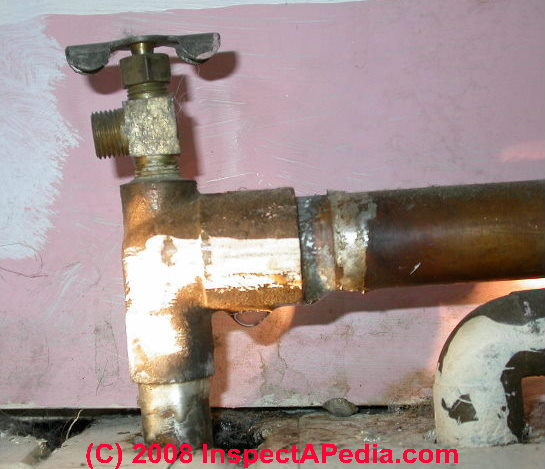 On heating systems using hot water baseboards, leaks can occur anywhere in the piping system, including at air bleeders located at the ends of baseboard sections, at couplings or elbows in the piping system, or where freezing has cracked or burst a heating baseboard pipe.
Our photo of a leaky heating baseboard (above left) shows that prolonged leaks may rot carpeting (leaving an obvious leak clue once someone vacuums up the ruined carpet at this spot) and may also cause hidden damage to the subfloor or even the structure. Or perhaps a mold problem may result.
Our baseboard piping leak photo (above right) shows how freezing pipes may cause separation at a solder joint instead of actually bursting the piping. In the case shown, the original solder joint had been poorly made, so this was a weak point that broke first.
Leaks at heating baseboard air bleed valves are shown
If your heating baseboards are not in fact getting warm when your thermostat is calling for heat and the boiler is indeed running,
see AIRBOUND HEAT SYSTEM REPAIR
Also see WINTERIZE A BUILDING for examples of freeze-burst copper forced hot water heating piping in a baseboard heat system.
Question: repair a pinhole leak in copper baseboard
I'm a journeyman plumber and I know how to braze but I'm not sure how to go about repairing a pinhole leak in a copper hot water baseboard heater. Obviously it has to be dry before I can braze it but how do I drain it and once repaired how do I properly fill it up with water and bleed the excess air?
Reply: solder repairs of small leaks in copper heating baseboard piping
The proper repair of a pinhole leak in copper piping would be soldering not brazing. But you'll most likely need to remove the water from the baseboard heater first. Or one can cut out a bad section of tubing or piping and solder in a short section with unions and copper piping of the same diameter. Be sure to properly sand and prep the copper pipe surfaces, remove any burs, and use a soldering paste or flux to assure a good solder connection.
Watch out: often the presence of a single pinhole leak is an indicator of more trouble ahead. Corrosion, or too-thin or defective copper piping may be prone to developing multiple leaks. I'd go ahead and patch or repair the present leak, but I'd keep an eye on the building heating distribution piping and baseboards for more leaks down the road.
Also see CHEMICAL TREATMENTS, BOILER where we include a discussion of leak-stop products for hot water heating boilers & steam boilers.
Question: leak at copper sweated elbow at radiator - can I use epoxy?
(Feb 13, 2014) sid jones said:
there is a leak after sweating a copper elbow to my hot water baseboard radiator
would epoxy be ok as an emergency fit?
Reply:
Sure, Sid , you will have temporary success if you can get the joint clean and dry long enough to bond. Try an automotive radiator repair epoxy intended to tolerate heat. Keep an eye on the patch lest it leak unattended.
Common Leaks in Cast Iron Hot Water or Steam Radiators
Leaks occur between sections of cast iron hot water or steam radiators.
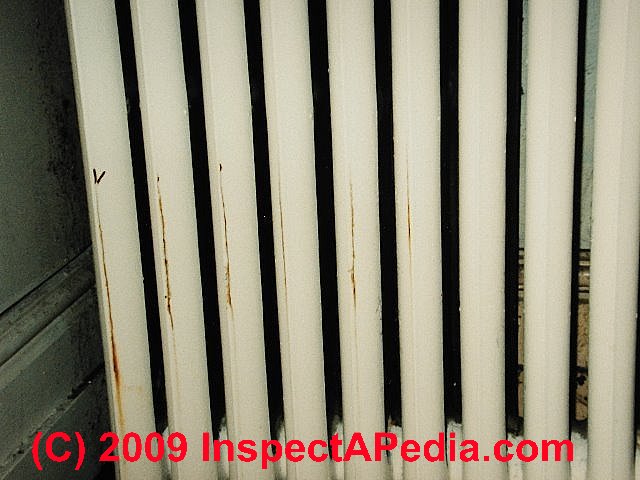
The radiator may leak where sections of cast iron are bolted together, or if the radiator has rusted-through or become cracked, perhaps by freezing, you may see rust and leak stains at splits in the individual radiator sections (photo below).
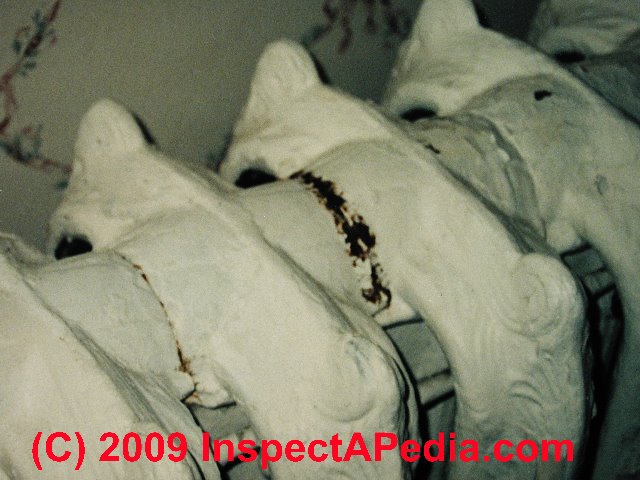
While an individual, accessible crack in a cast iron radiator might submit to an epoxy repair, extensive damage such as we show above usually means the heating radiator should be replaced.
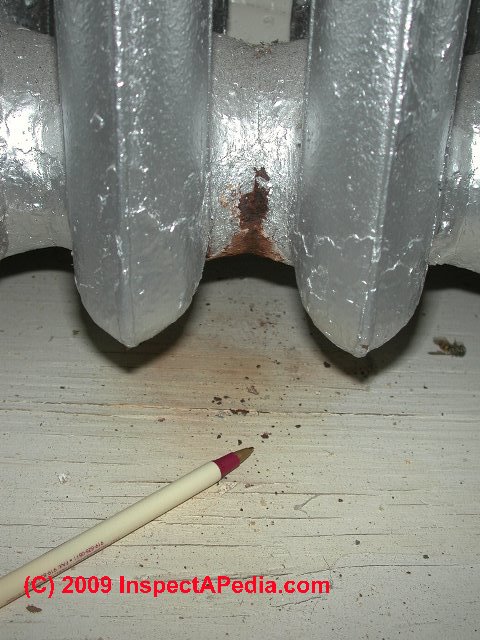
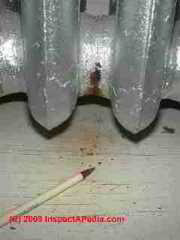
Sometimes a leak at a steam radiator is not critical - you may at least make it through the heating season, or the leaking may occur only when the radiator is cold (photo, above-right, also shown at page top, of a leaky steam radiator). This is a steam condensate leak.
If you see rust stains and leak indications between radiator sections at the top of the radiator, such as in our photo (above-left), or other rust, splits, or evidence of leakage from the body of the radiator, we recommend that you ask for repair advice from your heating service company.
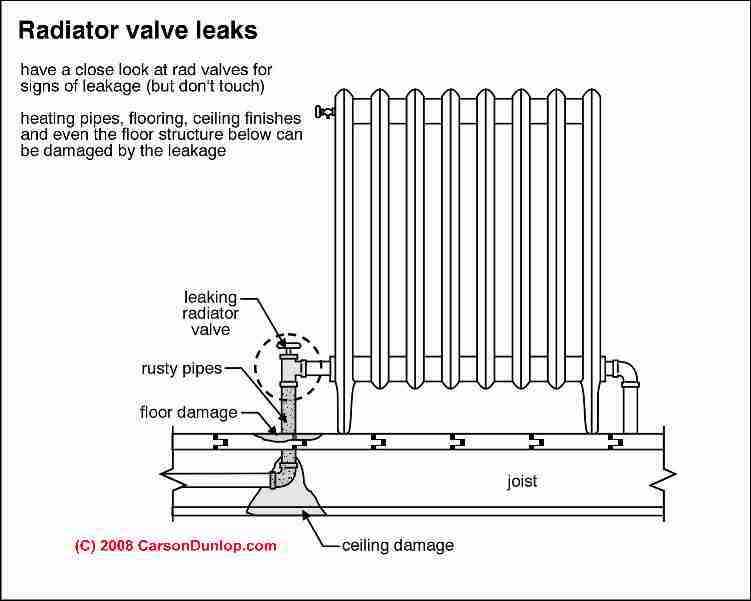
Leaks also occur at radiator valves, at radiator bleed valves, and at the piping fittings where valves and pipes join the radiator bottom or top.
As Carson Dunlop Associates' sketch (left) warns, watch out for hidden structural damage or damaged ceilings below leaky radiator valves.
Question: are steam radiator leaks dangerous?
Josh asked: I have an old one pipe steam radiator that has a small crack about 8 inches up. It drips a bit but my concern is the steam. Is this dangerous to have expelled into the air as far as breathing quality. I am not sure If it is a health issue. I have some concerns about having It replaced with a cheap one from china.
Thanks so much for your help. - Josh (also by email) J.F. Thank you so much for your help.
R said: Today at work, a few pipes and radiators blew in some of the rooms. The leak and steam got so bad you could hardly see your hand held out in front of your face.
I was in there for a while trying to find the shut off for the water and keeping the water from leaking out into the hall. I was breathing all that steam in for quite some time and I was wondering if there is anything I should be worried about. My lungs and eyes were a little irritated, but I am wondering if there could be something more. - R. 1/30/2014
Reply:
Josh
A competent onsite inspection by an expert usually finds additional clues that help accurately diagnose a problem with leaky radiators, including possible hidden damage from prior or long-standing leaks.
That said, here are some things to consider:
- Steam is water vapor, and having been boiled, would not be itself a health concern but
Watch out: steam vapor can cause burns. - A leak of condensate out of your radiator (such as the leak shown at page top of this article) into the building structure risks rot, mold, damage
- It might be possible, when the radiator is cold, to repair the crack using a high temperature-resistant epoxy - you'll need to clean the surfaces first. Also,
Watch out for lead paint on old radiators (see LEAD POISONING HAZARDS GUIDE)
Follow-up comment: Harmful chemicals in steam from steam boilers?
Thanks for the quick reply Daniel. I was unsure if chemicals were commonly used in the w
Reply to R about steam radiator leaks & chemical exposure:
While residential and most commercial steam systems operate at very low pressure - under 1 psi, there are some commercial systems that work at higher numbers - where an actual explosion would be potentially dangerous.
I am GUESSING that you are talking about a low pressure steam system and a failure of one or more steam vents on radiators - or an actual burst steam pipe.
The immediate dangers would be steam burns, or if vision is obscured, other obvious hazards like not being able to see to get safely out of the building.
Past those immediate worries, you will want to find out what boiler additive chemicals were being used in the steam system in your building, then to look at the MSDS exposure guidelines for those products. Without that data, an immediate answer to your question would be just speculation.
As I note in the article above,
Check with your boiler service company and take a look at the boiler service tag - let me know if any additives were used in your system (unlikely in residential steam boilers) and we can research further by reviewing the MSDS for those products.
Corrosive liquids used in some treatment compounds are skin, lung, and eye irritants (and considered unlikely to be ingested), but you would not expect to find these being released at harmful levels into occupied space from a steam radiator steam leak, since the same steam is also vented quite normally through steam radiator vents during normal system operation.
Let us know what chemicals were in use and if needed I'll be glad to do some further research.
With any chemical, even distilled water, the poison is in the dose.
Question: Can I fix a cracked heating radiator
(Oct 20, 2012) Rich Jankowski said:
i have a hot water heater and get heat thru a water baseboard heater .
There is a crack in the heater and water leaks out .Can it be sealed or will it need to be replace ?
Reply:
There are stop-leak products as well as epoxy sealers that MIGHT form a temporary repair and may require application on a cool dry surface, but I'd worry about the repair not being durable.
Please see CHEMICAL TREATMENTS, BOILER where we include a discussion of leak-stop products for hot water heating boilers & steam boilers, including boiler treatment products & MSDS information
Question: pipes and radiators blew up and released steam
(Jan 30, 2014) R said:
Today at work, a few pipes and radiators blew in some of the rooms. The leak and steam got so bad you could hardly see your hand held out in front of your face. I was in there for a while trying to find the shut off for the water and keeping the water from leaking out into the hall.
I was breathing all that steam in for quite some time and I was wondering if there is anything I should be worried about. My lungs and eyes were a little irritated, but I am wondering if there could be something more.
Reply:
R,
Ugh what a mess.
While residential and most commercial steam systems operate at very low pressure - under 1 psi, there are some commercial systems that work at higher numbers - where an actual explosion would be potentially dangerous.
I am GUESSING that you are talking about a low pressure steam system and a failure of one or more steam vents on radiators - or an actual burst steam pipe.
The immediate dangers would be steam burns, or if vision is obscured, other obvious hazards like not being able to see to get safely out of the building.
Past those immediate worries, you will want to find out what boiler additive chemicals were being used in the steam system in your building, then to look at the MSDS exposure guidelines for those products. Without that data, an immediate answer to your question would be just speculation.
As I note in the article above,
Check with your boiler service company and take a look at the boiler service tag - let me know if any additives were used in your system (unlikely in residential steam boilers) and we can research further by reviewing the MSDS for those products.
Corrosive liquids used in some treatment compounds are skin, lung, and eye irritants (and considered unlikely to be ingested), but you would not expect to find these being released at harmful levels into occupied space from a steam radiator steam leak, since the same steam is also vented quite normally through steam radiator vents during normal system operation.
Let us know what chemicals were in use and if needed I'll be glad to do some further research.
With any chemical, even distilled water, the poison is in the dose.
Using Epoxy to Repair a Leaky Cast Iron Radiator?
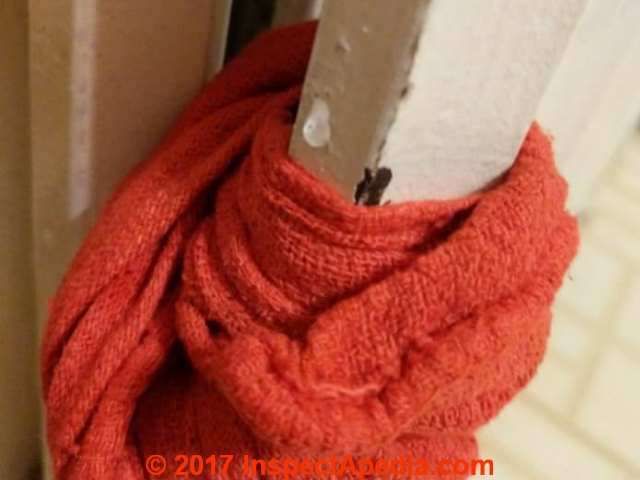
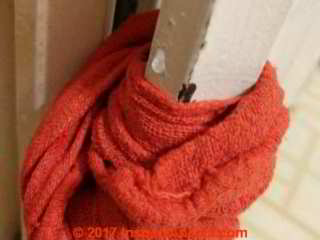 Question: how to repair a crack or leak in a cast iron radiator
2017/12/22 Justin said:
I just refitted a cast iron radiator that was on a steam system and added it to my water system.
It's the kind with the horizontal pipe across the top and bottom so it's definitely good for either application.
My problem is that it is unfortunately leaking. It's not leaking at any of the joints or anything but on one of the columns. There are no specific signs of cracks or damage, I haven't sanded the paint yet.
It's just sort of slowly seeping out. Is there any kind of repair I should attempt or should I just look around for another radiator?
This question and reply were posted originally at BASEBOARD or RADIATOR LEAK REPAIR FAQs
Reply: possible use of repair expoxy on heating radiator leaks
If the radiator is cracked you might be able to make a temporary repair by cleaning paint down to bare metal and using a waterproof mending epoxy such as is used on automobile engine blocks (hence a hint at where to get it).
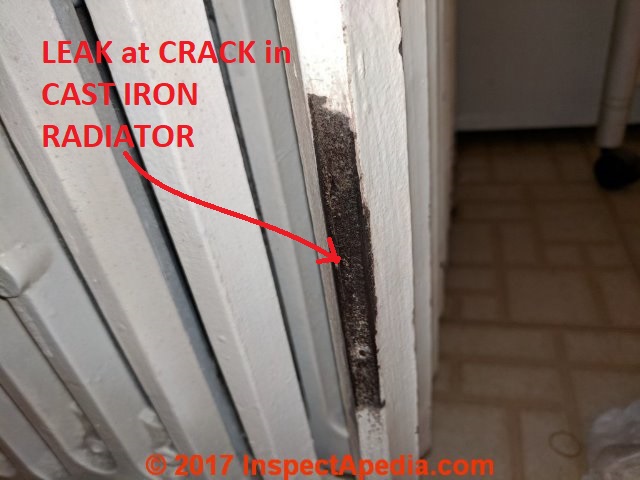 I would consider it only a temporary repair since I'd worried that the radiator may have or develop other leaks that cause a damaging flood when nobody is around to see the problem.
When you clean off the paint take care: if the radiator were for some reason badly rusted its iron may be thin and easily punctured.
Send me photos - or attach photos to your comment using the picture frame icon to the right of the Comment box - of what you find and I can comment further.
Ultimately you should expect to replace the radiator. When a leak has appeared in one spot I fear there are other imminent leaks just waiting to spring while you're out at the movies.
Reader follow-up: WaterWeld did not work
Here are some pictures of the radiator after removing the paint and my repair with JB Weld WaterWeld.
You can somewhat make out the hairline crack that runs a few inches down and around the column.
The WaterWeld did not work. I applied it while the radiator was shut off (both the send and return have a valve in the basement) and bled so there was only standing water pressure present.
I then closed the bleeder to make it even less likely for the leak to leak. It appeared to stay dry for the whole repair process.
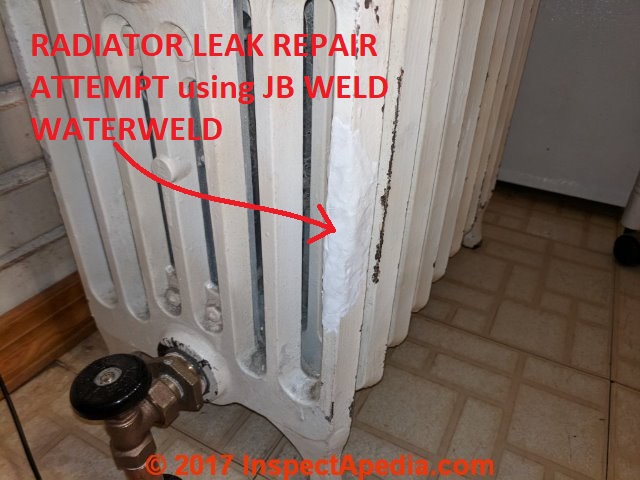 I sanded and scuffed up and scored the surface too. I let it cure for over an hour.
A leak eventually formed through the putty (not around). The same thing happened when I tried a second application over it too.
Considering that JBWeld's WaterWeld is rated for 900psi/300°F it's pretty disappointing results.
I'm going to try regular ol JB Weld next, it's just applying that is more involved since its a bit runny and it's a vertical surface.
If the JB Weld doesn't work as is I may attempt to fully address the crack by drilling and beveling it, but since the radiator is still in service I really don't want to get that involved with disconnecting and draining it.
Reply:
That epoxy repair product has worked for me on both automobile crankcases and on heating radiators, but mixing the two components well is quite important.
Reader follow-up:
I will say that the epoxy putty repair has gone back and forth leaking and not leaking.
It formed a few different pin hole leaks that seem to have stopped leaking. Similarly the whole repair pulled away from the radiator and leaked and then stopped leaking. I'm wondering if the heating/cooling cycles are causing this.
Either way it seems to be fine to last the season and I'll attempt the real repair with regular JB Weld in the spring.- Anonymous 2018/01/02
Spotting & Fixing Leaks in Steel Heating Radiators
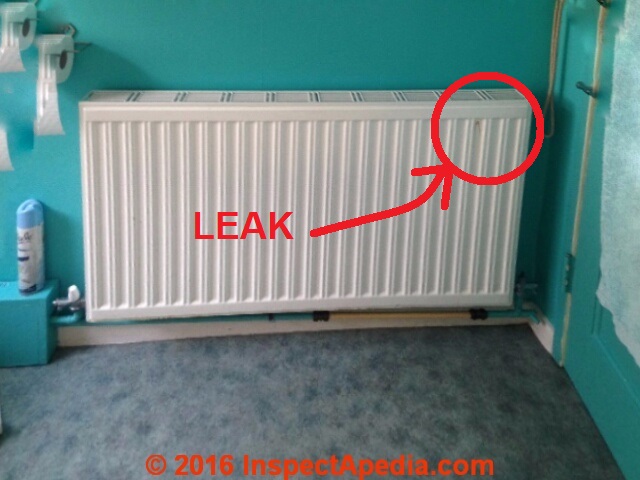
The steel radiator shown above and in more detail below is the heat sink radiator for a hydronic heating system in Scotland that uses a biomass boiler that burns wood pellets. The radiator is connected to a lagged hot water tank.
Other radiators in the home are controlled by thermostatic radiator valves. This radiator is developing a rust perforation leak (circled in red).
[Click to enlarge any image]
Steel water-filled radiators are widely used as heat sinks in systems that store heat during off-use periods to return it when needed or to absorb extra heating capacity to provide more even heat distribution in a building.
In New Zealand and some other countries, similar steel-constructed night storage heaters may be oil-filled and operate on electricity, accepting and storing heat during off-peak electricity-use hours.
See NIGHT STORAGE HEATERS & HEAT SINK RADIATORS.
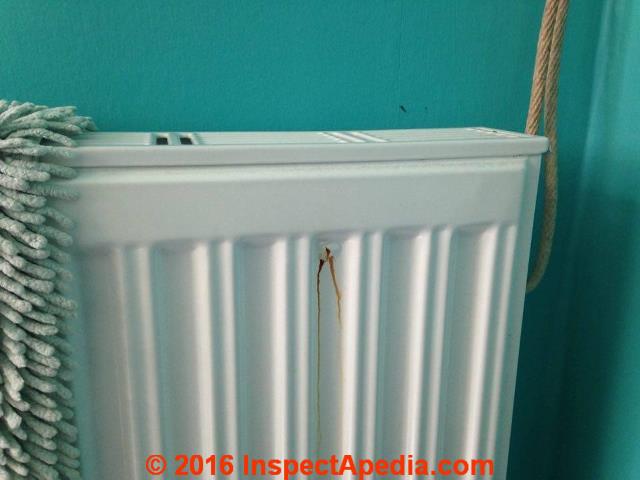
Question: small bubble on bathroom radiator is leaking water
A small bubble has appeared on our bathroom radiator and it is leaking water when the radiator is cold and leaving a rusty streak. It's been in place for a number of years and I have no knowledge of it being damaged.
You've already suggested using epoxy resin to seal it, which I will look into. However, will I most likely need to replace the radiator in the near future? - Anonymous by private email 2016/06/21
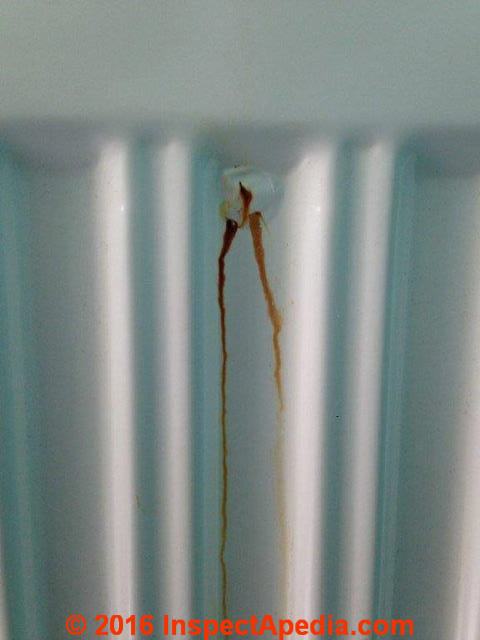
Reply:
Good photos, bad kind of leak in that the area around the leak is probably thin and fragile.
Watch out: DO NOT TOUCH THIS LEAKY SPOT, because from your photo it looks as if this is a steel radiator not a cast iron unit. If I'm right, then in that case the walls are pretty thin. Steel corrodes from the inside of the radiator outwards, so the area around that leak is pretty thin.
So poking around is likely to make the small leak into a big one immediately.
If you can turn off the radiator I'd do so, as I worry that the leak may worsen when you're not at home.
In an emergency you could epoxy or tape a patch to the radiator surface around the leak but I don't trust the repair: the adhesive is bonding only to paint on steel.
Other Questions about Radiator Leaks
These Q&A's have moved to BASEBOARD or RADIATOR LEAK REPAIR FAQs
...
Continue reading at STEAM RADIATOR VENT REPAIR if your radiator leaks are at a steam radiator vent or select a topic from the closely-related articles below, or see the complete ARTICLE INDEX.
Or see BASEBOARD or RADIATOR LEAK REPAIR FAQs questions & answers posted originally in this article
Or see these
Recommended Articles
- CHEMICAL TREATMENTS, BOILER for a discussion of leak-stop products used in heating systems
- WALL CONVECTOR HEATING UNITS
Suggested citation for this web page
LEAKS at BASEBOARD, CONVECTOR, RADIATOR at InspectApedia.com - online encyclopedia of building & environmental inspection, testing, diagnosis, repair, & problem prevention advice.
Or see this
INDEX to RELATED ARTICLES: ARTICLE INDEX to HEATING RADIATORS
Or use the SEARCH BOX found below to Ask a Question or Search InspectApedia
Ask a Question or Search InspectApedia
Try the search box just below, or if you prefer, post a question or comment in the Comments box below and we will respond promptly.
Search the InspectApedia website
Note: appearance of your Comment below may be delayed: if your comment contains an image, photograph, web link, or text that looks to the software as if it might be a web link, your posting will appear after it has been approved by a moderator. Apologies for the delay.
Only one image can be added per comment but you can post as many comments, and therefore images, as you like.
You will not receive a notification when a response to your question has been posted.
Please bookmark this page to make it easy for you to check back for our response.
Our Comment Box is provided by Countable Web Productions countable.ca
Citations & References
In addition to any citations in the article above, a full list is available on request.
- [1] The Chemical Treatment of Boiler Water-Volume 1, James W. McCoy, Chemical Publishing Company, 1981, ISBN 0820603775, ISBN 978-0820603773, andVolume 2, Quoting from the publisher's review:
This is the most comprehensive book for treatment of steam boilers. It is highly technical, and covers every aspect, how, why, when, etc. It is a must read for anyone who maintains boilers for a living. The only downfall is that a background in basic chemistry would be helpful before reading this text. I had to look info up on the internet as I read the book. - Boiler Water Treatment Principles and Practice, Vol. 1, Boiler Basics and Steam-Water Chemistry, Colin Frayne, Chemical Publishing Company, New York, NY, 2002, ISBN 0-8206-0371-6, 0820603716 or 978-0820603711original source: chemical-publishing.com/v/vspfiles/assets/images/pages
%20from%209780820603711_txt.pdf - [2] Quali Chem Technologies, Water & Chemical Specialists, Email: JZajac@QualiChemTech.com, Tel: 800 768-5810, web search 12/4/2011, original source: boilerchemicals.com/Steam-Boilers-Chemicals-s/58.htm
- [3] Boiler Water Treatment – Phosphate/Polymer Blend, Accepta, MSDS, web search 12/4/2012, original source: accepta.com/prod_docs/2112-MSDS-phosphate-polymer-boiler-water-treatment.pdf
- [4] Boiler Water Treatment Compounds, Spray Chem, web search 01/04/2012, original source: spraychem.com/page/chemicals1.php
- [5] Boiler System Chemical Treatment 101, Hayward Gorton Limited, 5 Brigden Gate Halton Hills ON L7G 0A3 T: (905) 693-8595 F: (905) 693-1452 info@haywardgordon.com, web search 12/4/2012, original source: haywardgordon.com/documents/Boiler_Chemical_Feed_Systems_101.pdf
- [6] J-B Weld Company, P.O. Box 483 Sulphur Springs, TX 75483, Tel: 903-885-7696, Website: http://www.jbweld.com/, Email: customerservice@jbweld.com, retrieved 3/7/2013
- Domestic and Commercial Oil Burners, Charles H. Burkhardt, McGraw Hill Book Company, New York 3rd Ed 1969.
- National Fuel Gas Code (Z223.1) $16.00 and National Fuel Gas Code Handbook (Z223.2) $47.00 American Gas Association (A.G.A.), 1515 Wilson Boulevard, Arlington, VA 22209 also available from National Fire Protection Association, Batterymarch Park, Quincy, MA 02269. Fundamentals of Gas Appliance Venting and Ventilation, 1985, American Gas Association Laboratories, Engineering Services Department. American Gas Association, 1515 Wilson Boulevard, Arlington, VA 22209. Catalog #XHO585. Reprinted 1989.
- The Steam Book, 1984, Training and Education Department, Fluid Handling Division, ITT [probably out of print, possibly available from several home inspection supply companies] Fuel Oil and Oil Heat Magazine, October 1990, offers an update,
- Principles of Steam Heating, $13.25 includes postage. Fuel oil & Oil Heat Magazine, 389 Passaic Ave., Fairfield, NJ 07004.
- The Lost Art of Steam Heating, Dan Holohan, 516-579-3046 FAX
- Principles of Steam Heating, Dan Holohan, technical editor of Fuel Oil and Oil Heat magazine, 389 Passaic Ave., Fairfield, NJ 07004 ($12.+1.25 postage/handling).
- "Residential Steam Heating Systems", Instructional Technologies Institute, Inc., 145 "D" Grassy Plain St., Bethel, CT 06801 800/227-1663 [home inspection training material] 1987
- "Residential Hydronic (circulating hot water) Heating Systems", Instructional Technologies Institute, Inc., 145 "D" Grassy Plain St., Bethel, CT 06801 800/227-1663 [home inspection training material] 1987
- "Warm Air Heating Systems". Instructional Technologies Institute, Inc., 145 "D" Grassy Plain St., Bethel, CT 06801 800/227-1663 [home inspection training material] 1987
- Heating, Ventilating, and Air Conditioning Volume I, Heating Fundamentals,
- Boilers, Boiler Conversions, James E. Brumbaugh, ISBN 0-672-23389-4 (v. 1) Volume II, Oil, Gas, and Coal Burners, Controls, Ducts, Piping, Valves, James E. Brumbaugh, ISBN 0-672-23390-7 (v. 2) Volume III, Radiant Heating, Water Heaters, Ventilation, Air Conditioning, Heat Pumps, Air Cleaners, James E. Brumbaugh, ISBN 0-672-23383-5 (v. 3) or ISBN 0-672-23380-0 (set) Special Sales Director, Macmillan Publishing Co., 866 Third Ave., New York, NY 10022. Macmillan Publishing Co., NY
- Installation Guide for Residential Hydronic Heating Systems
- Installation Guide #200, The Hydronics Institute, 35 Russo Place, Berkeley Heights, NJ 07922
- The ABC's of Retention Head Oil Burners, National Association of Oil Heat Service Managers, TM 115, National Old Timers' Association of the Energy Industry, PO Box 168, Mineola, NY 11501. (Excellent tips on spotting problems on oil-fired heating equipment. Booklet.)
- In addition to citations & references found in this article, see the research citations given at the end of the related articles found at our suggested
CONTINUE READING or RECOMMENDED ARTICLES.
- Carson, Dunlop & Associates Ltd., 120 Carlton Street Suite 407, Toronto ON M5A 4K2. Tel: (416) 964-9415 1-800-268-7070 Email: info@carsondunlop.com. Alan Carson is a past president of ASHI, the American Society of Home Inspectors.
Thanks to Alan Carson and Bob Dunlop, for permission for InspectAPedia to use text excerpts from The HOME REFERENCE BOOK - the Encyclopedia of Homes and to use illustrations from The ILLUSTRATED HOME .
Carson Dunlop Associates provides extensive home inspection education and report writing material. In gratitude we provide links to tsome Carson Dunlop Associates products and services.
 | HOME | ABOUT | ASK a QUESTION | CONTACT | CONTENT USE POLICY | DESCRIPTION | POLICIES | PRIVACY | |
| © 2024 - 1985 Publisher InspectApedia.com - Daniel Friedman | |||||||||