
InspectAPedia® FREE Encyclopedia of Building & Environmental Construction, Diagnosis, Maintenance & Repair |
Question? Just ask us! InspectAPedia
|
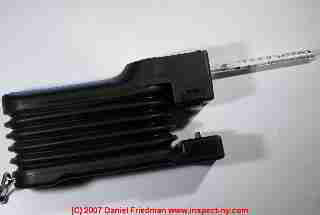 Guide to the Draeger Gas Pump
How to Select & Use Gas Detector Tubes
for Draeger, Gastec, Komyo Gas Detection
- POST a QUESTION or COMMENT about how to use gas sampling pumps to test for and measure the level of toxic or other gas contaminants in buildings
Gas detection indoors: how to use sampling pumps: This document discusses the Draeger or Drager gas testing pump and gas detection tubes as tools and methods used to test for the level of toxic and other gases in buildings and in outdoors.
We give additional references and explanation regarding toxicity of several of the most common indoor gases, based on literature search and obtained from the U.S. government and expert sources.
InspectAPedia tolerates no conflicts of interest. We have no relationship with advertisers, products, or services discussed at this website.
An Example of Use of a Draeger pump and Dräger Colorimetric Gas Detection Tube (to measure the level of CO2)
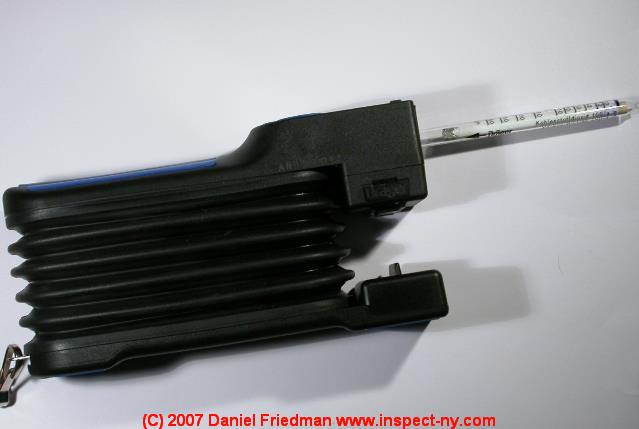
 Shown at the top of this page is is our Draeger bellows-type gas sampling pump. This instrument accepts a remarkably wide range of colorimetric gas detection tubes
offered by Drager, and includes a counter to count pump strokes.
Shown at the top of this page is is our Draeger bellows-type gas sampling pump. This instrument accepts a remarkably wide range of colorimetric gas detection tubes
offered by Drager, and includes a counter to count pump strokes.
As we explained at the beginning of this article, there is a variety of gas detection pumps available for use with gas detection tubes such as we describe just below, including easy to use, accurate, and quality instruments from Gastec, Sensidyne, as well as Drager and other manufacturers.
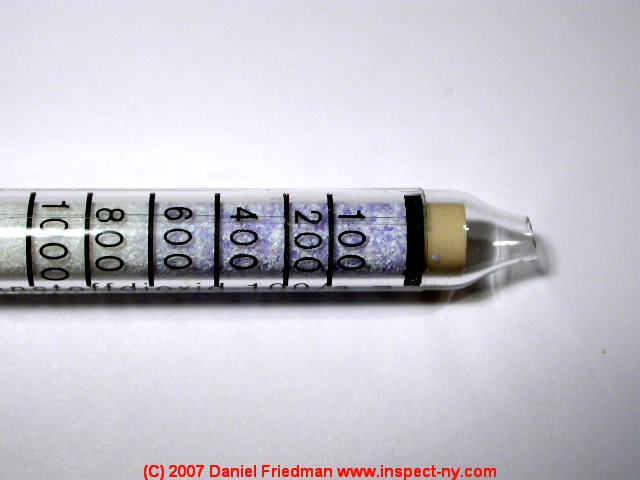
The photo below shows a Drager colorimetric gas detection tube (also called a "color detector tube") used to test levels of a very wide range of specific gases in air.
In an indoor air test (in our laboratory) this particular detector was not being used to measure oxygen, but rather carbon dioxide.
As the blue-stained portion of the tube shows, this tube detected that the CO2 level was about 600ppm which is typical of indoor air and is an acceptable and safe level.
See details about safe exposure levels at
NIOSH IDLH-Value for Gas Exposures: Immediately Dangerous to Life and Health
Colorimetric gas detection tubes and how they work
Colorimetric gas detection tubes such as those sold by Drager (or Draeger), Gastec, (two that we use predominantly) and by Kitagawa, and pumps from Drager, Gastec, Komyo Rikagaku Kitagawa, and RAE all work on a similar principle:
 a measured volume of gas (or air) is drawn through a tube which
contains chemicals which change in color in response to the presence of a specific target gas (or range of gases) present in the sample.
a measured volume of gas (or air) is drawn through a tube which
contains chemicals which change in color in response to the presence of a specific target gas (or range of gases) present in the sample.
By knowing the volume of gas or air sampled, the amount of color change read on a linear scale on the colorimetric gas detection tube can be translated into a very accurate measurement of level of gas present, described in percentage of the total air or in parts per million (PPM).
Well it's almost that simple but as we mention in more detail below, you may need to make adjustments for temperature and you may need to watch out for the presence of other gases or chemicals which can interfere with gas detector tube operation.
Watch Out: This text may assist readers in understanding these topics.
However it should by no means be considered exhaustive.
Seek prompt advice from your doctor or health/safety experts if you have any reason to be concerned about exposure to toxic gases.
How a Colorimetric gas detector tube is used
 Colorimetric gas detection tubes are sold and distributed in the U.S., Latin America, Asia, and Europe primarily by
- Drager (or in some spellings and literature, Draeger),
- Gastec (two that we use predominantly)
- Kitagawa.
- Komyo
- Rikagaku
- RAE
- Sensidyne
To select the appropriate gas detection tube you need to know what gas or gases is/are to be detected, and at what probable concentrations the gas may be present, or at what level of exposure the test is to be conducted.
NIOSH and other agencies publish specific test parameters that industrial hygienists use for industrial testing for the presence of gases in buildings or outdoors.
Check with the gas tube supplier: A building inspector, IAQ inspector, hygienist, building authority, or fire department who have the appropriate training and experience to perform these tests but who are uncertain about which detector tube to purchase should take advantage of the expert chemists and hygienists employed by the gas detector tube companies by calling for advice.
Using a color-changing gas detector tube (colorimetric) is simple: the tube and the instruction sheet are removed from the package.
Read the gas sampling tube instructions: The gas sampling tube instruction sheet may give various numbers of pump strokes or test air volume to be sampled depending on the level of detection needed. (More pump strokes = more air = a more sensitive test.) The ends of the glass tube are broken off using a special cutter provided by the manufacturer of the tube.
Connect the gas sampling tube to the gas pump: The "outlet" end of the detector tube is inserted into the gas collecting pump. The "inlet" end of the tube is exposed to the air to be tested, and the pump is operated for the required number of strokes before looking for a color change on the tube's gas concentration scale.
The documentation with each gas detection tube will describe the chemistry of the tube, its accuracy, its calibration, and the color change for which the user is to check.
Effects of temperature on gas level readings
The chemistry and thus the sensitivity and ultimate gas concentration reading shown by a colorimetric gas detection tube may be affected by temperature, it is important to read the temperature data in the gas detection tube specification sheet included with the particular gas detection tube being used.
A Gastec gas sampling pump is available which includes a "thermal ring" which can provide this important data at the time that a measurement is obtained.
Effects of other chemicals and gases on gas level readings
The gas detection tube instructions may also list other gases which, if present, can affect the accuracy of the test. The gas sampling tubes shown here were used to test for the presence of perchlorethylene and show what the tubes look like before and after the sealed end is snapped off.
The chemistry and thus the sensitivity and ultimate gas concentration reading shown by a colorimetric gas detection tube may therefore be affected by other gases or chemicals present in the location being measured.
For this reason it is also important to read the characteristics of the gas detector tube being used, and if there is risk of interference from other gases or chemicals it may be necessary to amend the test procedure, perhaps also including tests for the presence or level of these confounding gases.
However while it may be a real problem in gas measurements in industrial environments, in residential settings we have rarely encountered this issue.
Warning: About Selecting the Proper Dräger (or other brand) Gas Detection Tube
Gas Detection Tube and Gas Pump Must be Compatible: Interchanbgeability of gas detection tubes & pumps
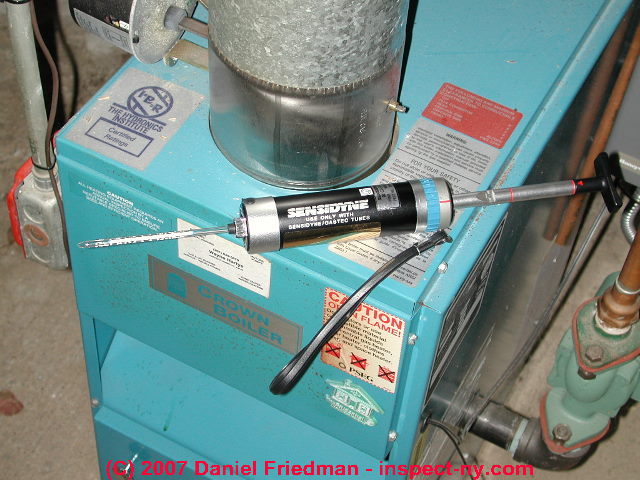 Colorimeteric gas detection tubes produced by different manufacturers are not necessarily interchangeable among gas detection pumps. Be sure that the gas detection tube you are using is one recommended for use with your gas detection pump - check both the gas detection pump manufacturer's instructions and the gas detection tube manufacturer's specifications.
For example, as we were informed in May 2008 by Nextteq GastecTM detection tube distributor in the U.S., Gastec tubes that are currently available are not intended for use on the SensidyneTM gas detection pump.
At one point in time, Sensidyne had the contract for Gastec tubes and lost it due to rebranding. The tubes they sell now are Kitagawa tubes, not Gastec. We don't want to confuse anyone out there that they can use a Gastec tube with the Sensidyne pump.
The Gastec tubes are not calibrated to work with a Sensidyne pump and therefore, the reading could be incorrect and prove fatal in some cases.
Really? MiIchael Shaw (Interscan Corporation, a producer of gas detection & recording systems) disagrees with the accuracy of the above quote. Here is an excerpt [edited for clarity] from what Michael wrote to us in March 2015:
The sample size is 100 ml. Gastec and Kitagawa colorimetric gas detection tube systems are essentially identical.
Dräger system uses the same test volume, but the sampling tube contents are not as densely packed.
A bellows pump cannot pull sufficient vacuum through the Japanese-produced gas detector tubes. But then, bellows pump is [in my opinion not a great] idea, in that with Dräger design, multiple squeezes (not at all reproducible) are needed, and it is very prone to leaks. It is however a less costly sampling pump design.
Comment: I [DF] have been using precision calibrated classic hand-operated plunger type gas pumps, field-calibrated electrical pumps equipped with a flow meter, and also the Dräger bellows pump for more than a decade. My Dräger pump has not seen heavy use but in my application it still works like new. I have tested different types of gas detector pump and tube systems against one another and found the results virtually identical.
The accuracy of Draeger samplers and detector tubes has also been studied for several decades and the accuracy of the bellows-pump design is well-established.
OPINION: I found that the precision of the piston pump could be deceptive. Failure to maintain the required coating of Si grease in the pump chamber, for example, produced a palpable difference in pump stroke force required and variations in the pump seal changed the time between the point at which I locked the pump pull-handle up and the time that the pump stopped drawing air.
These variations left me uncertain about the true pump volume being moved. The bellows pump looks less precise but in my experience, tested by repeating measurements at the same location and time, produced very consistent, repeatable results.
While May (1988) reported good correlation between diffusive samplers and active systems, studying diesel exhaust emissions, Clark found that interference errors were significant (Clark 1982).
And the effects of extremes of temperature and other environmental parameters has been shown to be significant while operating in typical building environmental temperatures and humidities is less-so. (McCammon 1982).
I agree that if a particular gas sampling pump lacks adequate power it may not perform properly with a tightly-packed detector tube.
I suspect that tube contents density varies quite a bit among different tests. One might ask if there is really a significant effect in colorimetric gas tube detector if the proper volume of air is in fact drawn through the tube but at a slower rate due to the density of the tube's contents.
The interchangeability of gas detection tubes and hand pumps has been studied by Haag (2001) who stirred a hornets' nest of marketing and technical issues, claims, counter-claims . Haag reported
Both pump flow profiles and test gas measurements demonstrate that three piston hand pumps in common use (RAE Systems LP-1200, Sensidyne/Gastec GV/100, and Matheson-Kitagawa 8014-400A) are fully interchangeable.
Two bellows pumps (Draeger Accuro and MSA Kwik-Draw) also are interchangeable with each other.
Mixing of bellows and piston systems is often possible, but there are enough exceptions to conclude that such practice should be discouraged because it can lead to inaccurate readings and thus potentially dangerous overexposures.
Currently the two types of systems use obviously different tube diameters; therefore, the likelihood of inadvertent mixing is low.
Technical specifications rather than brand name should be used assess hand pump interchangeability. Such specifications could include total volume, initial vacuum level, and a pump flow curve.
When two manufacturers' pumps meet the same standard and appropriate leak tests are performed, interchangeability is scientifically valid and poses no risk to the end user. Interchangeability allows the user greater flexibility and convenience.
Hirsh (2001) vigorously objected to Haag's report, calling it marketing propaganda, and noted that Draeger as well as various agencies do not support interchangeability of gas detection tubes.
Above, the author used a Drager bellows-pump for measuring oxygen, CO2 and other IAQ constituents during a commercial air flight as part of an ongoing private study.
See AIR QUALITY on COMMERCIAL AIRCRAFT
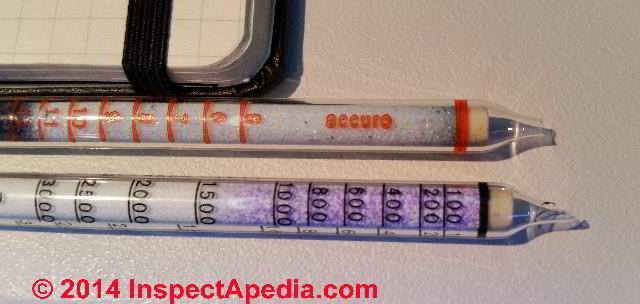
The accuracy of other Drager gas measuring systems such as the Drager chip system needs to be assessed and reported separately as that is a different and more recent technology. Verma (2001) found [excerpt from the article's conclusions]:
The Photovac Snapshot GC’s performance consistently meets the accuracy criteria (NIOSH-recommended criteria for detector tubes) at or below 1 ppm of benzene, even in the presence of hexane. The Drage ¨ r CMS instrument generally fails to meet the criteria at 1 ppm or less, but it is only slightly out of the acceptable range.
If a less stringent accuracy criteria of ± 35 percent is considered acceptable, then all Photovac Snapshot GC results become acceptable, but four of the nine readings for the Drage ¨ r CMS still fall outside of the acceptable range.
The discrepancies observed in the measurement of accuracy of the two instruments were random error and not a systematic “bias.” The precision of the Photovac Snapshot GC is generally very good at concentrations of 1 ppm or less (i.e., CV< ± 10%) while at higher benzene concentrations it is erratic, ranging from a CV of ± 2.1 percent to ± 27 percent in random fashion.
The precision of the Drage ¨ r CMS instrument is distinctly poorer than that of the Photovac Snapshot GC and typically ranges from a CV of ± 20 percent to ± 40 percent. The performance of both the Photovac GC and the Drage ¨ r CMS is better when measuring levels of up to 2 ppm benzene, which is fortunate since they are more relevant measurement ranges in industrial hygiene today.
Both the Photovac Snapshot GC and the Drage ¨ r CMS instrment appear to be good field instruments for the measurement of benzene, as long as their limitations regarding accuracy and precision are taken into consideration in their use. The results of this study could provide a reasonable guide.
Field studies comparing the performance of these instruments should be conducted and reported to validate the observations of the laboratory study .
Sampling for gases in air such as VOC's, MVOC's, toxic chemicals, and combustion products.
Unfortunately no single test or tool can detect all possible building contaminants. We use methods and equipment which can test for common contaminants. If the identity of a specific contaminant is known in advance we can also test for a very large number of specific contaminant gases in buildings.
We use gas sampling equipment provided by the two most reliable companies in the world, Draeger-Safety's detector-tubes and Drager accuro bellows pump, the Gastec cylinder pump and detector-tube system produced by Gastec or Sensidyne, and we also use Sensidyne's Gilian air pump.
For broad screening for combustibles and a number of other toxic gases and for leak tracing we also use Amprobe's Tif8850.
All of these instruments, their applications, and sensitivities (minimum detectable limits) for specific gases are described in our GAS SAMPLING PLAN online document.
Gas Detection Tube Must Be Properly Sensitive to the Anticipated Concentration of Gases Being Investigated
Be sure to select gas detection tubes designed to detect the proper gases being screened in a building, and also to select the gas detector tube which is calibrated to detect gases at the proper level of concern. The detection of many gases is supported at varying levels of sensitivity.
Selecting a gas detection tube which is not sensitive enough may result in failing to detect the presence of the target gas. Selection of a gas detection tube which is too sensitive may result in inability to accurately detect the actual level of gas which is present since the tube will become saturated before the actual gas level has been recorded.
Research on gas detector sampling pump accuracy & gas detector tube & pump interchangeability
- "Choosing and Using a Carbon Monoxide CO Monitor," Dan Friedman, The ASHI Technical Journal, Vol. 2 No. 1, July1991
- Dräger Accuro gas detection pump, bellows-type, from Dräger Systems (also written Draeger) Draeger, Inc. 7256 S. Sam Houston W Pkwy., Suite 100 Houston, TX 77085 USA, +1-800-437-2437 Website: https://www.draeger.com
- Dräger MSDS for Dräger CH25301 Air Current Tubes, Page 1 of 2.[PDF]
Dräger MSDS for Dräger CH25301 Air Current Tubes , Page 2 of 2. [PDF]
Watch out: the Dräger air current tube or "smoke tube" # CH16631 produces a sulfuric acid gas sulfuric acid H2SO4 /SO3 that is dangerous to life and is highly corrosive. Take a look at our copy of the Dräger MSDS for their CH25301 Air Current Tubes. We stored this MSDS in the box with the rubber bulb and tube cutter provided by Dräger.
These air current monitoring tubes are provided with rubber caps so that the tube can be "stopped" or shut down when not in use. But the sulfuric acid was so corrosive that it not only caused the rubbger caps to disintegrate, it actually "burned" or oxidized our copy of the MSDS paper form! - Brey, O., and R. Holloway. "Dry method for estimation of mixed venous CO 2 concentration." BMJ 4, no. 5782 (1971): 292-293.
Excerpts:
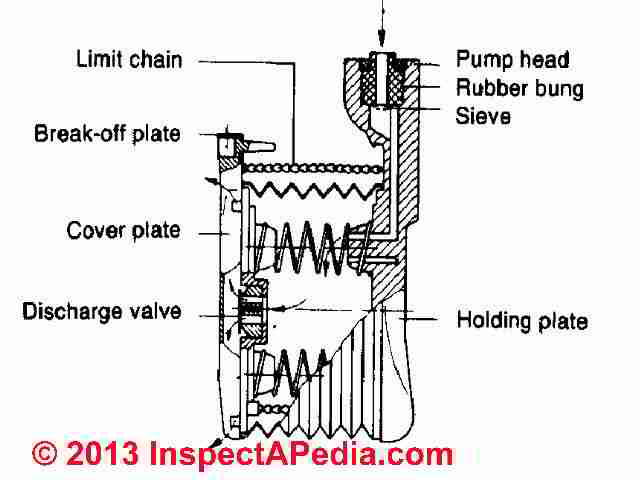
The hand-actuated bellows pump (Drager No. DBP 100753 Mod. 31) (Fig. 1), when fully compressed and released, sucks 1oo cm3 of unknown gas through a CO2 sensitive tube. The flow of gas stops when the limiting chain is taut. The CO2 detector tubes (0-5 % to 10 % CO2 measuring Drager tube No. CH. 31401) (Fig. 1) are made of glass. The seals are broken just before use.
Correct positioning is ensured by an arrow at one end which indicates the direction of flow from the tube into the pump. The other end is connected to the unknown-gas container.
The tube contains white material which turns blue on reacting with CO2. The reaction principle according to Beilstein2 is CO2 + N2H4 carbon dioxide hydrazine crystal violet as NH2 NH COOH carbonic acid monohydrazide redox indicator The length of discoloration can be read off as a percentage of CO2, the range being 0*5 to 10 %.
The time taken to release the compressed bellows is important and should be controlled to take 15-30 seconds. Gases other than CO2 do not affect the indicator system.3
We compared the results using the new dry method with those obtained on the Haldane. The differences found were small, as shown in Table I (mean difference 0-06, S.D. 0-28 volume %). The mean was not statistically different from zero. - Carlson, David H., Mark D.Osborne, John H. Johnson, "The development and application to detector tubes of a laboratory method to assess accuracy of occupational diesel pollutant concentration measurements." The American Industrial Hygiene Association Journal 43, no. 4 (1982): 275-285.
Abstract:
A laboratory method has been developed by which to determine the accuracy of techniques for measurement of airborne pollutant concentrations in diluted diesel exhaust. The method involves dilution of the hot exhaust from a diesel engine operated at various controlled speeds and loads and sampling the exhaust-air mixture in a manner designed to simulate sampling in air surrounding diesel equipment operated in confined spaces such as in an underground mine.
The method developed was applied to detector tubes for CO, CO2, NO, N02, and SO2.
This included recalibration of the detector tubes with certified gases which had been checked alongside NBS Standard Reference Gases. Detector tube diesel exhaust measurements were compared with simultaneous measurements by portable instruments which earlier tests had indicated were specific for the pollutant of concern.
The differences between detector tube and instrument readings were assumed to be made up of detector tube calibration and interference errors. The calibration errors were subtracted from the total error to obtain the interference error. All of the detector tubes tested were found to have significant diesel exhaust interference errors. - Grafstein, Ora, and Steven P. Levine. "An Expert System for Guiding Selection of Direct-Reading Air Monitoring Instruments." Applied Occupational and Environmental Hygiene 8, no. 3 (1993): 157-166.
- Haag, Werner R. "Interchangeability of gas detection tubes and hand pumps." AIHAJ-American Industrial Hygiene Association 62, no. 1 (2001): 65-69.
Excerpt from article conclusion:
Both pump flow profiles and test gas measurements demonstrate that three piston hand pumps in common use (RAE Systems LP-1200, Sensidyne/Gastec GV/100, and Matheson-Kitagawa 8014-400A) are fully interchangeable. Two bellows pumps (Draeger Accuro and MSA Kwik-Draw) also are interchangeable with each other.
Mixing of bellows and piston systems is often possible, but there are enough exceptions to conclude that such practice should be discouraged because it can lead to inaccurate readings and thus potentially dangerous overexposures. Currently the two types of systems use obviously different tube diameters; therefore, the likelihood of inadvertent mixing is low.
Technical specifications rather than brand name should be used assess hand pump interchangeability. Such specifications could include total volume, initial vacuum level, and a pump flow curve. When two manufacturers' pumps meet the same standard and appropriate leak tests are performed, interchangeability is scientifically valid and poses no risk to the end user. Interchangeability allows the user greater flexibility and convenience. - Hirsh, Daniel J. "Interchangeability of Gas Detection Tubes and Hand Pumps." AIHAJ-American Industrial Hygiene Association 62, no. 6 (2001): 667-668. [Letter to the Editor]
Quoting:
Draeger Safety does not condone the interchangeability of detector tubes by different manufacturers. This position is supported by the National Institute of Occupational Safety and Health, the Occupational Safety and Health Administration, the American National Standards Institute, the Industrial Safety Equipment Institute, the Interntional Union of Pure and Applied Chemistry, the Deutches Institut fur Norumng, the British Standards Institute, and Japanese Industrial Standards.
We feel with the publication of the article "Interchangeability of Gas Detection Tubes and Hand Pumps" (AIHAJ 62;65-69, 2001), the AIHA is irresponsible and is equivalent to publicly endorsing this unwise and potentially dangerous concept. We also feel that this article was more marketing-oriented than scientific.
We are shocked that AIHAJ's editorial staff would permit this article to be printed. You have published a thinly disguised marketing propaganda brochure as a scientific research article. The author stastes that "another improvement in sampling volume accuracy came with the introduction of the piston pump" as opposed to a bellows-style pump.
The original Draeger pump was a piston-style pump. However, more than 50 years ago Draeger switched to the bellows pump design due to its simplicity, accuracy, and minimal service versus a piston pump. MSA also used a piston pump in the past but has switched over to a bellows design in the past 10 years. Again, this article which was published in the applied studies section, is full of speculation and opinion by the author.
This "testing" was extremely limited and in no way should be published alongside other hard scientific research material. These tests do not take into consideration effect of temperature, pressure, and humidity, which are very important in dry chemistry reactions. External influences like extension hoses or other accessories were not considered either. These are real-world condictions that a user must consider when measuring gas concentrations with this technology. ... - Leesch, J. G. "Accuracy of different sampling pumps and detector tube combinations to determine phosphine concentrations." Journal of Economic Entomology 75, no. 5 (1982): 899-905.
- Lieben, Jan. "AIR SAMPLING INSTRUMENTS FOR EVALUATION OF ATMOSPHERIC CONTAMINANTS." American Journal of Public Health and the Nations Health 59, no. 8 (1969): 1552.
- Kim, Patrick, Jeffrey D. Albarella, James R. Carey, Matthew J. Placek, Avijit Sen, Aaron E. Wittrig, and William B. McNamara. "Towards the development of a portable device for the monitoring of gaseous toxic industrial chemicals based on a chemical sensor array." Sensors and Actuators B: Chemical 134, no. 1 (2008): 307-312.
Abstract:
The ability of chemical sensor array (CSA) technology to identify multiple gaseous analytes and differentiate between various analyte concentrations has been documented. To date, CSA response was monitored using a flatbed scanner driven by a personal computer.
While this system is suitable for use in a laboratory setting it is not suitable for use in the field for environmental monitoring. We describe herein progress made towards the development of a rapid, inexpensive, portable, battery-operated, handheld device based on CSA technology for the detection of toxic industrial compounds (TICs).
This prototype successfully differentiates between four TICs at both permissible exposure limit (PEL) and immediately dangerous to life and health (IDLH) concentrations, and three interferent gases, in less than 2 min. - McCammon, Charles S, Evaluation of portable, direct-reading combustible gas meters, (1974)
- McCAMMON, CHARLES S. "The NIOSHI charcoal tube and other solid sorbent sampling tube certification program." The American Industrial Hygiene Association Journal 37, no. 8 (1976): 489-491.McCAMMON, CHARLES S. "The NIOSHI charcoal tube and other solid sorbent sampling tube certification program." The American Industrial Hygiene Association Journal 37, no. 8 (1976): 489-491.
- McCAMMON, CHARLES S. "A Summary of the NIOSH evaluation program of portable direct-reading meters." The American Industrial Hygiene Association Journal 37, no. 5 (1976): 289-295.
Abstract:
The National Institute for Occupation Safety and Health (NIOSH) has developed a program to evaluate portable, direct-reading instruments. The results of these evaluations for CO, SO2, combustible gas, and NO2 instruments are reported. Realistic performance specifications have been developed for each of these types of instruments. - McCammon, Charles S., William E. Crouse, and Herbert B. Carroll. "The effect of extreme humidity and temperature on gas detector tube performance." The American Industrial Hygiene Association Journal 43, no. 1 (1982): 18-25.
Abstract:
Five replicate samples of each of two brands of detector tubes were tested at two concentrations (at the current OSHA standard and at 2 times the standard) under four different environmental conditions of temperature and humidity for carbon monoxide, carbon dioxide, nitrogen dioxide, nitric oxide, hydrogen sulfide and formaldehyde.
Each tube was read by three different observers. An analysis of variance was used to statistically determine the magnitude of biases due to humidity and temperature. Both humidity and temperature caused increases in the coefficient of variation of certain tubes from different manufacturers. - Schmitt, Donald J. "Evaluation of Drager CO2 Gas Detector System." (1995). Defense Technical Information Center, Ft. Belvoir VA
Abstract:
This test series evaluated the DRAEGER CO2 0.1% a and CO2 0.01%/a gas detector tubes using the DRAEGER Accuro and the DRAEGER initial test series, conducted in Navy Experimental Diving Unit's (NEDU) treatment chamber during July 1994, evaluated both pumps at one atmosphere, and the CO2 0.1% a tube at the surface and 9.1, 27.4, 45.7 and 50.3 meters of seawater (MSW) (30, 90, 150 and 165 feet of seawater (FSW). - Jennifer Moore, Sales Administrator, Nextteq, LLC, Tampa FL, Nexteq 813-249-5888. Nextteq is the master Distributor for Gastec in the United States. According to the company's website, Gastec Gas Sampling Pumps are the industry’s first and only pumps to provide on-the-spot measurement of ambient temperature. [Private email, JM to DF 5/23/08]
...
Continue reading at FIRE OFF-GASSING HAZARD DETECTION or select a topic from the closely-related articles below, or see the complete ARTICLE INDEX.
Or see these
Recommended Articles
- COLORIMETRIC GAS DETECTION TUBES
- CONVERT PPM to % CONCENTRATION
- Drager GAS DETECTORS
- FIRE OFF-GASSING HAZARD DETECTION
- GAS DETECTION INSTRUMENTS - home
- GAS DETECTOR WARNINGS
- GAS DETECTOR TUBE WARNINGS
- GAUGE, REFRIGERATION PRESSURE TEST
- GAS EXPOSURE LIMITS & STANDARDS
- GASES, EXPOSURE, TESTING
- ODORS GASES SMELLS, DIAGNOSIS & CURE
- SMELL PATCH TEST to FIND ODOR SOURCE
- TIF 5000 GAS DETECTOR
- TIF 8800 GAS DETECTOR
Suggested citation for this web page
Drager GAS DETECTORS at InspectApedia.com - online encyclopedia of building & environmental inspection, testing, diagnosis, repair, & problem prevention advice.
Or see this
INDEX to RELATED ARTICLES: ARTICLE INDEX to GAS HAZARDS in BUILDINGS
Or use the SEARCH BOX found below to Ask a Question or Search InspectApedia
Ask a Question or Search InspectApedia
Questions & answers or comments about how to use gas sampling pumps to test for and measure the level of toxic or other gas contaminants in buildings.
Try the search box just below, or if you prefer, post a question or comment in the Comments box below and we will respond promptly.
Search the InspectApedia website
Note: appearance of your Comment below may be delayed: if your comment contains an image, photograph, web link, or text that looks to the software as if it might be a web link, your posting will appear after it has been approved by a moderator. Apologies for the delay.
Only one image can be added per comment but you can post as many comments, and therefore images, as you like.
You will not receive a notification when a response to your question has been posted.
Please bookmark this page to make it easy for you to check back for our response.
Our Comment Box is provided by Countable Web Productions countable.ca
Citations & References
In addition to any citations in the article above, a full list is available on request.
- Michael D. Shaw, Interscan Corporation, 4590 Ish Drive #110, Simi Valley CA 93063, USA Tel: 800-458-6153, Website: www.gasdetection.com Email: info@gasdetection.com Interscan is a provider of gas monitoring instruments designed for 21 environmental gases. The company provides gas detection instruments and record-keeping software custom-tailored to the needs of their customers.
- Coffey, Christopher C., and Terri A. Pearce. "Direct-reading methods for workplace air monitoring." Journal of Chemical Health and Safety 17, no. 3 (2010): 10-21.
- Cohen, B. S., and S. V. Hering. "Air sampling instruments for evaluation of atmospheric contaminants ACGIH." Cincinati, OH (1995).
- In addition to citations & references found in this article, see the research citations given at the end of the related articles found at our suggested
CONTINUE READING or RECOMMENDED ARTICLES.
- Carson, Dunlop & Associates Ltd., 120 Carlton Street Suite 407, Toronto ON M5A 4K2. Tel: (416) 964-9415 1-800-268-7070 Email: info@carsondunlop.com. Alan Carson is a past president of ASHI, the American Society of Home Inspectors.
Thanks to Alan Carson and Bob Dunlop, for permission for InspectAPedia to use text excerpts from The HOME REFERENCE BOOK - the Encyclopedia of Homes and to use illustrations from The ILLUSTRATED HOME .
Carson Dunlop Associates provides extensive home inspection education and report writing material. In gratitude we provide links to tsome Carson Dunlop Associates products and services.
 | HOME | ABOUT | ASK a QUESTION | CONTACT | CONTENT USE POLICY | DESCRIPTION | POLICIES | PRIVACY | |
| © 2024 - 1985 Publisher InspectApedia.com - Daniel Friedman | |||||||||