
InspectAPedia® FREE Encyclopedia of Building & Environmental Construction, Diagnosis, Maintenance & Repair |
Question? Just ask us! InspectAPedia
|
 Asbestos & Lead Content in Ceramic Floor Tile or Ceramic Wall Tile?
- POST a QUESTION or COMMENT about the asbestos content in ceramic tiles
Do or did ceramic wall or floor tiles contain asbestos or lead?
Do or did tile grout, tile bedding compounds, thin-set mortars, or tile mastic used with ceramic tiles contain asbestos or lead ?
We explain the ingredients in ceramic floor tiles, cite authoritative research on the presence or absence of asbestos in these ceramic tile, or its absence, and we point to sources of confusion about the question of which ceramic products (tiles, pottery, filters) contain or ever contained asbestos as a filler or as a fiber strengthen
We include research citations indicating various hazards in the production of some tile products.
We report on an international survey of certified asbestos testing laboratories who were asked for their experience in receiving ceramic tile samples or mortar/grout samples and testing them for asbestos content.
InspectAPedia tolerates no conflicts of interest. We have no relationship with advertisers, products, or services discussed at this website.
Does Ceramic Floor Tile or Ceramic Wall Tile Contain Asbestos?
Is asbestos found non-resilient flooring such as ceramic floor tiles?
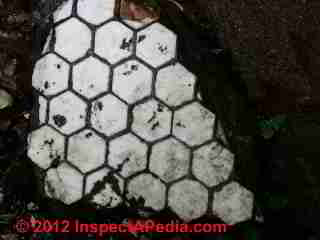
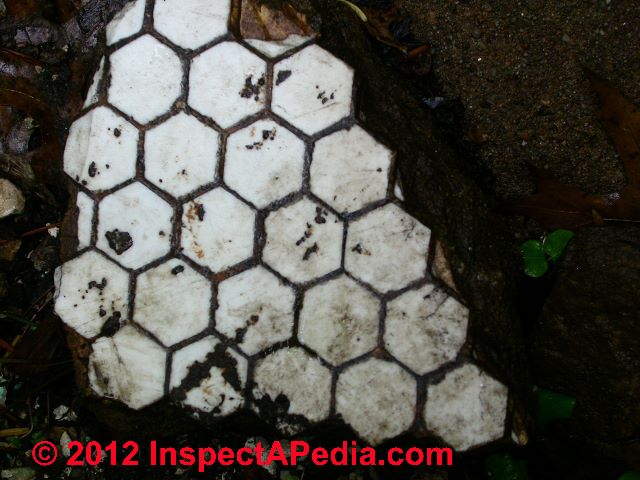
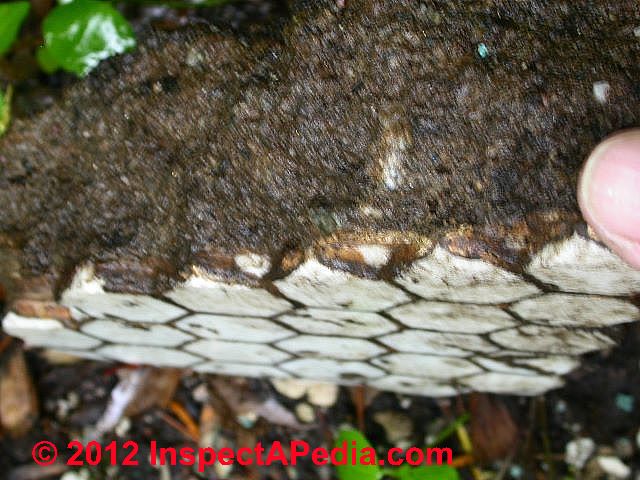
Our page top photo illustrates a fragment-section of old ceramic floor tile. At left we show a side-view or cross-section of how this old ceramic floor tile was installed by bedding it directly into concrete. We would not expect to find evidence of asbestos in this tile installation.
[Click to enlarge any image]This example was found in a pile of demolition debris left at a building renovation site. The tile was set into and well bonded to concrete, and was removed under wet conditions.
The short answer for now appears to be "yes and no" depending on the tile and tile grout age and source, as follows:
- Artists materials including ceramics, clays, glazes often contain a variety of hazardous materials including arsenic, asbestos, lead, silica.
See ASBESTOS in CERAMIC MATERIALS - Ceramic floor and wall tile produced in North America would not be expected to contain asbestos.
However you may find asbestos in some tile grouts and thinset tile mastics and possibly in hand-made tiles made as part of an art project using art clay. - Ceramic floor and wall tile produced outside of North America may contain asbestos depending on where it was produced and what additives were intentionally or accidentally included by the manufacturer.
This may be true particularly for files produced in the Mediterranean area [44] and for some ceramic tiles made in China, as we discuss in more detail
at CHINESE CERAMIC TILE ASBESTOS
- Ceramic tile grout may contain asbestos as we discuss
at CERAMIC TILE GROUT ASBESTOS - Non-ceramic floor tiles such as terrazzo floor tiles (and possibly some unglazed ceramic quarry tiles), produced both in the U.S. and from other countries may contain asbestos depending on its formula.
Some "manmade" "terrazzo" consisting of concrete, marble, and/or epoxy alone won't contain asbestos.
Details, including authoritative citations and an ongoing survey of the results of tile testing at asbestos testing labs in the U.S., Canada, Japan, Korea, the U. K. and other locales are provided below.
OPINION: researching this question we find that the dominant opinion among experts and amateurs is that ceramic tiles are made of clay subjected to high temperatures and finished with a hard glazed surface. Not asbestos.
If there are some ceramic tiles whose clay source included asbestos or to which asbestos was added [a topic of ongoing research that we report and update below] the tiles are nevertheless a non-friable material that would not normally be a hazardous source of asbestos in buildings.
Non-friable materials are hard and do not easily release particles into the indoor environment.
Watch out: grinding, tile-saw cutting, sanding or similar activities performed on ceramic tiles of any composition could produce fine dust and debris that should be controlled and treated as a respiratory hazard, asbestos-containing or not.
See ASBESTOS REMOVAL, WETTING GUIDELINES
Question: does this [ceramic] floor tile contain asbestos?
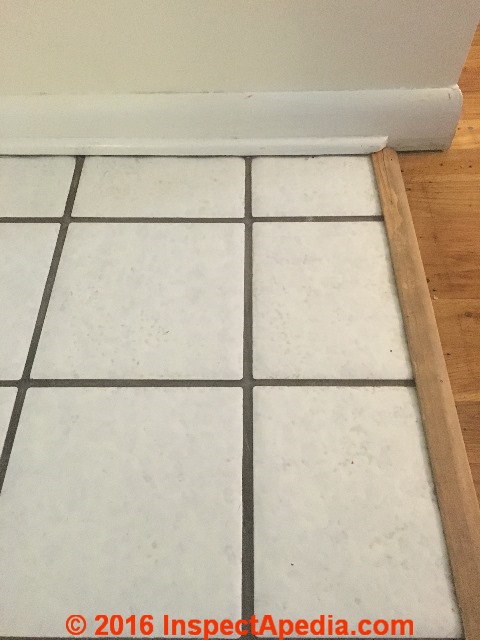
My husband & I are planning on replacing the floor tile in our entryway. I'm trying to research to see if it could contain asbestos as we have two young children. Our home was built in 1965 in a Pittsburgh suburb.
Could you take a look at this picture and let me know what you think? Thank you! - anonymous by private email, 2016/07/15
Reply:
From your photo this looks like ceramic floor tile. If it is a modern, U.S.-made product it probably does not contain asbestos. However some mastic adhesives did contain asbestos so care in removing that material would be appropriate.
See ASBESTOS-CONTAINING ADHESIVES
If you cannot remove the flooring without making a dusty mess, it may be worth having a sample of tile and more-likely the adhesive mastic tested.
If you do decide to have the materials tested let us know the result as that may help other readers.
Do Ceramic Floor or Wall Tiles Contain Dangerous Levels of Asbestos or Not ? - research question status
Deliberate Inclusion of Asbestos as an Add-in to Ceramic Tiles?
Asbestos could have been included in some ceramic floor tile formulas into the 1970's as a filler or in fiber form as a strengthener.
At least one asbestos testing lab director reports that asbestos is found in ceramic tiles made in some parts of the world such as the Mediterranean area and in unglazed terrazzo (non-ceramic) tiles.[44]
Below at CHINESE CERAMIC TILE ASBESTOS we discuss reports of asbestos in some recent Chinese ceramic tile and flooring products.
Don't Confuse Asphalt-based or Vinyl-based Asbestos-containing Floor Tiles with Ceramic Tile Products
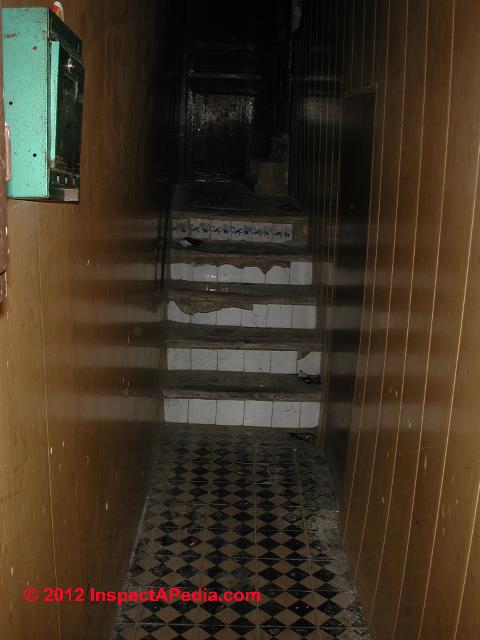
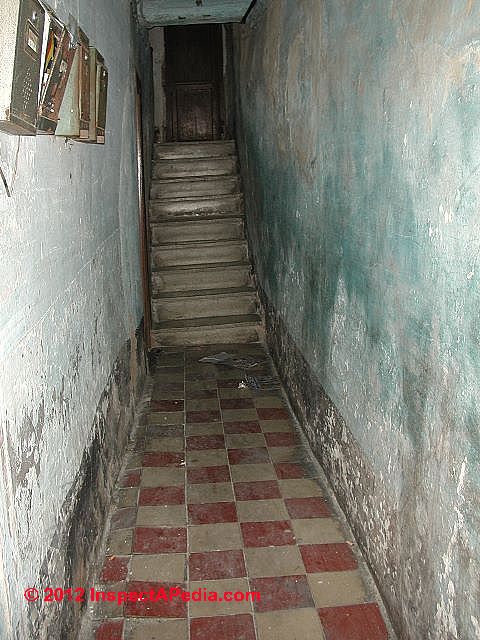
In our flooring photograph at left, the floor and stair tiles may be vinyl-asphalt or vinyl-asbestos floor tiles but they are not a ceramic product. For information about asbestos-containing vinyl or asphalt-based floor tiles,
see ASBESTOS FLOORING IDENTIFICATION.
Certainly as we see in Rosato [23], the asbestos industry was constantly looking for uses of asbestos mining waste products that included granular asbestos dust and short asbestos fibers.
Although we cite field and lab reports and research in this article, we have not yet located an authoritative reference source (text, journal article, government document) that documents the deliberate or accidental inclusion of asbestos material added to modern (20th century and later) ceramic floor or wall tiles made in North America. Please contact us if you have such information.
In contrast, it is certain asbestos was used in those forms in vinyl-asbestos flooring (a different material from ceramic tiles). And as we document below, asbestos was used in mixture with ceramic fibers (for certain products such as filters) and in ancient pottery applications.
Our photo above illustrates a floor tile installation in Barcelona, Spain. These floor tiles are estimated at more than 50 years old.
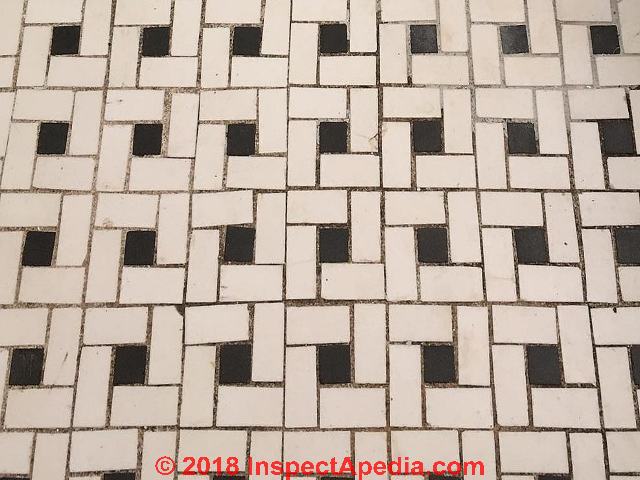
Question: will I release dangerous asbestos if I clean these black and white ceramic floor tiles from a 1948 home in Georgia?
 2018/05/06 Brittney said:
I’m wondering if you are able tell/may know if these floors contain asbestos just by looking at them?
My husband and I just purchased this house built in 1948 in Georgia. And I hadn’t thought much about asbestos in floors until finding this website and now I’m concerned. (See attached pic).
Do you think scrubbing the floors/grout should be safe ?
This question and reply were posted originally
at ASBESTOS FLOORING IDENTIFICATION
Reply:
It appears to me you're asking about a ceramic tile floor.
If That's the case, even if the style contained asbestos, which would be quite uncommon, the asbestos risk is beneath the limits of detection unless you're grinding chopping or sawing the material.
Cleaning the floor in your photos is not going to produce a measurable hazard even if there was asbestos in the tile or its grout - a situation that would be quite uncommon - as the materials are very hard and not at all friable.
Typically we need to use a liquid cleaner that includes mild bleaching agent to whiten the floor tile grout.
Question: do new ceramic tiles from China contain asbestos?
The ceramic tile that we purchased for our bathroom wall was made in China. What are the chances that it would contain asbestos? - Anon by private email 2017/03/24
Reply: maybe yes
A quick search for "Asbestos in Tile from China" intended to collect results on asbestos in ceramic tile made in China found these interesting and suggestive results, giving a definite possibility that your Chinese-made ceramic tiles could contain asbestos.
The most strongly-worded material comes from news reports, after which I cite some more-scholarly research on asbestos in Chinese ceramic tiles used on walls and floors.
- "Asbestos warning on tiles from China", ABC News Australia, 14 Feb 2010, retrieved 2017/03/24, original source: http://www.abc.net.au/news/2010-02-15/asbestos-warning-on-tiles-from-china/331176, Quoting:
A safety alert has been issued about wall tiles imported from China which may contain a deadly form of asbestos. WorkCover New South Wales says the decorative white natural stone tiles may contain tremolite - a form of asbestos.
WorkCover says importers should contact their suppliers to check that the tiles do not contain the substance. If the tiles do contain tremolite, they should be disposed of at an approved asbestos waste facility.
WorkCover says importers and retailers who suspect they may have tiles containing tremolite should contact WorkCover immediately. - This is a news report not a scholarly-research article - Ed. - Johnson, Nathan, "Made in China (with asbestos): MBA raises alarms" [news article], 2015/02/26 - retrieved 2017/03/24, original source: http://www.architectureanddesign.com.au/news/made-in-china-with-asbestos-mba-raises-alarms
Excerpt:
Master Builders Australia (MBA) have released an alarming media release warning the Australian design and construction industry to be wary of imported Chinese building products “laced with asbestos”.
MBA reported that Australian border-security officials have admitted to a limited capacity to stop contaminated goods entering Australia and that the Abbott government has conceded it is unable to guarantee Chinese imports are free of asbestos, amid some evidence of its use in the car, mining and building industries. - Xinyan, Zhou, and Fan Jianping. "Production of Precipitated Silicon Dioxide from Asbestos Tailings [J]." Chem. Prod. and Technol 4 (1998): 38.
Abstract:
The best technology parameters are studied in the production of precipitated silicon dioxide,light magne sium oxide and by-products of sodium sulfate and iron oxide red from the asbestos tailings in a wet method.
The process takes the advantage of natural resources and solves the environmental problems by the asbestos tailings, ... - Lu, Xinwei, Guang Yang, and Chunhui Ren. "Natural radioactivity and radiological hazards of building materials in Xianyang, China." Radiation Physics and Chemistry 81, no. 7 (2012): 780-784.
- LIU, Xiaoming, Lingrong XU, and Youmin HUANG. "Study on Asbestos tailings used as highway cenment stabilized base material [J]." Highway Engineering 5 (2010): 011.
Note: this discusses use of asbestos tailings but in highway construction, not tile - serving as an example of waste re-use - Ed. - ZHENG, Y., LI, Q., GAO, S. and SHANGGUAN, Y., 2009. Research on property of chrysotile asbestos fiber reinforced polypropylene/wood fiber composites [J]. New Building Materials, 3, p.030.
Ceramic tile is not friable - if your particular tile contains asbestos, the measurable asbestos risk would come with cutting, grinding, chopping, demolishing the building material to create an asbestos-containing dust hazard.
Reader follow-up: I don't want the Chinese ceramic tile in my home: plans to remove Chinese Ceramic Tile
Well the flooring says made in PRC.....that means People's Republic of China.
Ii realize where the "measurable risk" comes from but since my now deceased husband died of mesothelioma, from supposed MINIMAL exposure to asbestos I don't want ANYTHING containing asbestos in my home.
Unfortunately the ceramic tile has already been installed and that involved lots of cutting. The flooring has not so I will be returning it. I have contacted the company from which I purchased the material but have not yet heard back from them.
Reply: minimize the risk of installed Chinese asbestos-suspect ceramic tile
I don't blame you for taking these things seriously, and I'm cautious too about products from China - there have been enough disasters already.
What I meant by measurable risk is that installed ceramic tile is not going to release asbestos at detectable levels in a building unless it's disturbed.
While it's a different product (flooring) the US EPA advice on minimizing asbestos hazards in the home emphasizes that unless the asbestos-containing but non-friable material is damaged or being disturbed, the lowest risk to occupants is to leave it alone, or perhaps cover it over.
Removing it will expose you and the building and its occupants to a much greater risk, even if you hired a professional remediator who used negative air, containment, etc. (you're looking also at a very big cost).
OPINION: My advice is to leave the tile in place, or if it's going to make you worry - which is itself bad for us - you could consider laminating over the existing tile with a second layer of new material in which you have confidence. That may at most require some adjustments at the tub/shower controls to bring them forward.
What is the Composition of Ceramic Tiles?
Is there Accidental Inclusion of Asbestos in Clays Mined for Use in Producing Traditional Ceramic Tiles?
The term "clay" refers to both a particle size (smaller than 2-4mm) and a type of rock or mineral comprised of fine-grained sheet silicates.[48] The fine-grained clays used to manufacture ceramic tiles include basically compounds of silica, alumina, and varying amounts of metallic oxides and other impurities. [32]
Ceramic tiles are made from natural clay [such as Cretaceous clays [30] (not asbestos)] or porcelain, and are glazed or un-glazed.
Typical ceramic tile composition (in more detail) includes 33% refractory clay, 20% quartz, 45% sodium feldspar. Other sources list common tile ingredients including aluminum oxide, zirconium oxide, and quartz (silicon dioxide). Other ceramics have more complex formulas.
Ceramic tiles are made of clay (predominantly feldspar), water, and some mineral additives, processed with high heat to solidify the product and whose top or exposed surface is sealed with a glaze.
Porcelain tiles are a harder ceramic tile made of kaolin mixed with china stone, or in other sources, by using ground sand. Porcelain is heated to a higher temperature than other ceramics (more than 2000 degF) and is more dense than ceramic materials made of clay.
Many other materials have been included in clays used in making various ceramic products since the Stone Age (pottery) and continue to be added to give special properties or colors to modern ceramic tiles, including perlite, fly ash, granite stone grinding and cutting waste, etc. Indeed expert sources date the oldest known ceramics date to 27,000 BCE.
The oldest known ceramics made by humans are figurines found in the former Czechoslovakia that are thought to date from around 27,000 B.C.E.
It was determined that the figurines were made by mixing clay with bone, animal fat, earth, and bone ash (the ash that results when animal bones are heated to a high temperature), molding the mixture into a desired shape, and heating it in a domed pit. T
he manufacture of functional objects such as pots, dishes, and storage vessels, was developed in ancient Greece and Egypt during the period 9000 to 6000 B.C.E. [33]
We have not found a citation that includes asbestos among these. Contact us if you have related information.
List of Authoritative sources reporting the use of [or absence of] asbestos in any form of ceramic floor tiles
- Asbestos-containing ceramics, including wall tile or floor tile, or other flooring materials such as tile mastic: [excluding resilient flooring discussed separately
at ASBESTOS FLOORING IDENTIFICATION]- ASBESTOS in CERAMIC MATERIALS later in this article discusses asbestos and other hazardous materials common in artists tile, glazing, pottery materials and work areas.
Also see ARTS & CRAFTS MATERIAL HAZARDS & TOXICITY - Cement asbestos slates were described in the Journal of Hazardous Materials as [safely] recyclable in production of stoneware tile mixtures in 2008 [27] and a procedure for producing [safe] lightweight ceramic materials by a process bonding chrysotile asbestos fibers was described by Mackenzie and Meinhold in 1994. [28]
- ACM flooring underlayment [underlayment is not ceramic tile itself ] has been found under flooring in demolition projects, a practice that can extend to ceramic floor tiles [4]
- Asbetic flooring: using asbestos mine waste products (largely dust and very short asbestos fibers) is described by Rosato [23]. The result was a "hard but not completely water tight" flooring material. Asbetic is a mixture of ground mother rock and the shortest, otherwise unusable asbestos fibers. [He does not name ceramic tile flooring in this category.]
- Asbestos in tile mastics: some tile mastics and adhesives including adhesives used for floor or wall tiles did contain asbestos as a filler or fiber strengthener. Traditional ceramic tile installations were bedded in cement [photo at page top], not mastic, and not an asbestos containing material.
But from the 1960's some ceramic tile installations used a thin-set mortar or a thin-set mastic that might contain asbestos. For details
see MASTIC, CUTBACK ADHESIVE, FLASHING CEMENT ASBESTOS - Asbestos in tile mortar: Asbestos used as an ingredient in tile mortar is described in a patent dispute.[27]
- CHINESE CERAMIC TILE ASBESTOS discusses risks of asbestos in current ceramic tile products from China and includes additional research citations.
- CERAMIC TILE GROUT ASBESTOS discusses the risks of asbestos in a more-friable form in some tile grouts
- Survey of Accredited Laboratories for Asbestos Fiber Analysis [42]
- REFERENCES at the end of this article includes additional research citations reporting on the presence of and health risks of asbestos-containing ceramic tile.
- ASBESTOS in CERAMIC MATERIALS later in this article discusses asbestos and other hazardous materials common in artists tile, glazing, pottery materials and work areas.
- Possible sources of confusion about asbestos content in ceramic floor tiles:
- Asbestos in clay products: Asbestos has been reported in art clay (such as Fibro-Clay)[37] used in schools and in pottery clay where it occurred in the form of talc added as a flux to lower the firing temperature.
Talc and clay from at least one U.S. mine contained anthophyllite asbestos. It was unclear whether or not this material fell under the aegis of asbestos regulation.[36] The asbestos content of talc depended on where it was mined, and some talcs were asbestos-free[40].
Depending on the quarry source there may be deliberate or accidental inclusion of asbestos in terra cotta tiles such as roofing tiles.
Other clay products that may have had asbestos added in the form of talc or vermiculite (some vermiculite contains asbestos) in addition to art clays, may include clays used as pipe joint seals or insulation, and in the production of firebricks used to line the combustion chambers of heating equipment such as boilers or furnaces, and other school art projects such as paper maches.[38][39] - Pre-historic origins of use of asbestos in clay pottery: The use asbestos-strengthened ceramic wares (pottery) dates from the Stone Age and continued throughout the Bronze Age and into the Iron Age.
Specifically, asbestos fibers were used to strengthen earthenware pots and cooking utensils as long s 4,500 years ago, an application documented by various sources.[26] Also, a Wikipedia entry on Asbestos-ceramic describes pottery made with asbestos and clay [25]. - Asbestos textiles were used as safety protective clothing & gear for workers in the ceramics industries - a possible source of confusion associating the terms "ceramic tile" and "asbestos" in some search engine results. Some mesothelioma information and legal resource websites name "ceramic tiles" as containing asbestos [22] without citing an authoritative source.
- ASBESTOS List of Asbestos-Containing Products - the InspectAPedia master list of asbestos forms and asbestos-containing products, enumerates asbestos-containing-materials (ACM) using historical information derived from Rosato and other industry sources.
Rosato who provided an extensive discussion of asbestos used in flooring materials, referred exclusively to the use of asbestos in resilient flooring products (such as vinyl asbestos floor tiles) and excluded non-resilient flooring (stone, slate, ceramic tile).
Rosato confirms use of asbestos and clay as mixture ingredients in premix-molding-compounds and the use of asbestos fibers mixed with ceramic fibers to form filter paper for the paper making industry (these are not ceramic tile products) [23] - Asbestos ceramic bricks: Leonelli et als. refer to the disposition of asbestos by microwave treatment of asbestos waste into ceramic bricks - another possible source of association of the words "ceramic" and "asbestos" in web searches that does not extend to ceramic tiles. National Center for Biotechnology Information, NIH, USA[24]
- Asbestos in clay products: Asbestos has been reported in art clay (such as Fibro-Clay)[37] used in schools and in pottery clay where it occurred in the form of talc added as a flux to lower the firing temperature.
- Quaintance, Paul A. "Silicosis: A study of 106 pottery workers." [PDF] American Journal of Public Health and the Nations Health 24, no. 12 (1934): 1244-1251.
- William, Zaisser. "Method of waterproofing hollow-tile walls." U.S. Patent 1,735,447, issued November 12, 1929.
- describes use of asbestos in block or tile mortar joints as part of a water-resistant feature:
The mortar joints between the tiles are coated with a waterproofing mastic as at 24 Fig. 3, comprising asphalt, talc and asbestos v fibre applied in a liquid or pasty form over the adjoining surfaces of the tile. ...
2. in a waterproofin'gsysteni for hollow tile walls, the combination of a wall "constiucted froin "dOVEiZflIlGCi hollow tile with inort ar oin ts between ad o1n1ng tiles, a mastic coating comprising asphalt, talc and v asbestos :fibre for said joints overlapping the "edges of said tile, a waterprooi to the horizontal .joints of said tile
Do ceramic tiles risk releasing harmful particles into indoor air?
Ceramic floor or wall tiles of any formula, if in good condition have a low, most likely negligible risk of releasing harmful particles or fibers into indoor air. And a ceramic tile that comes loose intact or with a single break is also unlikely to release a measurable amount of dust or particulates into the building.
Watch out: Phillip A. Peterson
Vice President
Fibertec Industrial Hygiene Services, Inc.[49] advises that Although the tile themselves are unlikely to contain asbestos, the grout and bedding may well contain asbestos and the demolition of the tile will likely create an exposure hazard when the grout and/or bedding are disturbed.
Ceramic floor tiles that are being demolished, ground, sanded, or cut with a tile saw, if they are old enough to have been installed when asbestos was in common use in grout, tile bedding, or (in newer homes) thin set or tile mastic, could be hazardous and should be handled appropriately.
If you are considering demolition of old ceramic floor tiles or similar materials, or are using a sander, grinder or tile saw on such materials, there could indeed be an asbestos hazard and you should follow appropriate handling, dust control, personal protection, and cleanup procedures.
If you have a segment of floor tile (or any material) tested for asbestos the test should be performed by a certified asbestos testing laboratory.
In Any Case, Better to Leave Asbestos-Containing Floor Tiles In Place
As with known or suspected asbestos-containing floor tiles (such as asphalt or vinyl-asphalt asbestos floor tiles), when it's feasible expert sources recommend leaving the original floor tile material in place and covering it over with new flooring.
Leaving asbestos-suspect flooring in place, even if you need to level the floor before it is covered with new material, is not only less costly than a professional asbestos abatement project, it also is likely to be the course with the lowest risk of asbestos dust or fiber release and contamination in the building. According to the US EPA {discussing asbestos abatement in schools] :
... In addition, abatement activities may create more of a hazard than would normally exist if the ACM were simply protected and maintained in good condition as is the case for ceramic floor tiles. ...[3]
Similar sources indicate that simple deconstruction of a building with appropriately careful disassembly of its parts may not require asbestos abatement. [4]
Details about covering-over asbestos-containing floor tiles or other ACM flooring such as resilient sheet flooring are
at ASBESTOS FLOORING HAZARD REDUCTION
Special thank-you to reader A.H. who suggested clarification about the risk that ceramic wall tiles or ceramic floor tiles might contain asbestos. - Ed.
Contaminants & Health Hazards Ceramic Tile & of Other Ceramics: Clays, Pottery, Art Studios
For potential health hazards associated with exposure to artists materials for those working with ceramics, such as clays, glazing compounds, and pigments, see
our "ARTS & CRAFTS MATERIAL HAZARDS & TOXICITY entry included
at ENVIRONMENTAL HAZARDS - INSPECT, TEST, REMEDY and references at the end of this article. [51][52][53]
Also, as ingredients used in the manufacture of some ceramic tiles or in tile glazing may contain surprising contaminants of a wide variety, including heavy metals, lead, possibly arsenic, and radioactive materials, see
- Breedveld, Leo, Giorgio Timellini, Giorgio Casoni, Alberto Fregni, and Graziano Busani. "Eco-efficiency of fabric filters in the Italian ceramic tile industry." Journal of Cleaner Production 15, no. 1 (2007): 86-93.
- Candela, S., F. Ferri, and M. Olmi. "[Lead exposure in the ceramic tile industry: time trends and current exposure levels]." Annali dell'Istituto superiore di sanita 34, no. 1 (1997): 137-143.
- Counter, S. Allen, Marie Vahter, Goran Laurell, Leo H. Buchanan, Fernando Ortega, and Staffan Skerfving. "High lead exposure and auditory sensory-neural function in Andean children." Environmental health perspectives 105, no. 5 (1997): 522.
- Jordán, M. M., M. B. Almendro-Candel, M. Romero, and J. Ma Rincón. "Application of sewage sludge in the manufacturing of ceramic tile bodies." Applied Clay Science 30, no. 3 (2005): 219-224.
- Lavat, Araceli E., Monica A. Trezza, and Mónica Poggi. "Characterization of ceramic roof tile wastes as pozzolanic admixture." Waste management 29, no. 5 (2009): 1666-1674.
- Monfort, E., J. García-Ten, I. Celades, Ma F. Gazulla, and S. Gomar. "Evolution of fluorine emissions during the fast firing of ceramic tile." Applied Clay Science 38, no. 3 (2008): 250-258.
- Montero, M. A., M. M. Jordán, M. S. Hernández-Crespo, and T. Sanfeliu. "The use of sewage sludge and marble residues in the manufacture of ceramic tile bodies." Applied Clay Science 46, no. 4 (2009): 404-408.
- Romero, Maximina, A. Andrés, Rebeca Alonso, Javier Viguri, and J. Ma Rincón. "Sintering behaviour of ceramic bodies from contaminated marine sediments." Ceramics International 34, no. 8 (2008): 1917-1924.
- Vahter, Marie, S. Allen Counter, Göran Laurell, Leo H. Buchanan, Fernando Ortega, Andrejs Schütz, and Staffan Skerfving. "Extensive lead exposure in children living in an area with production of lead-glazed tiles in the Ecuadorian Andes." International archives of occupational and environmental health 70, no. 4 (1997): 282-286.
- Xinwei, Lu. "Radioactivity level in Chinese building ceramic tile." Radiation protection dosimetry 112, no. 2 (2004): 323-327.
Survey of Accredited Laboratories for Asbestos Fiber Analysis
Beginning in March 2012, and using the U.S. NIST directory of accredited laboratories certified for asbestos fiber analysis, [42] we polled at least one laboratory in each U.S. state, Puerto Rico, two Canadian Provinces, and laboratories in Japan and Korea, asking each if their laboratory had ever received ceramic tiles for asbestos testing and whether or not their lab had ever detected asbestos in ceramic tiles used on walls, floors, or other building services. Results will be included here.
We asked: "Can you tell us if your laboratory has ever received samples of ceramic wall or floor tile to test for asbestos, tell us if you have encountered asbestos in ceramic tiles used on walls or floors, and/or can you provide a reference to a paper, study, book, or expert who can tell us whether or not asbestos in any form was used in the production of ceramic wall tile or floor tile, or in terra-cotta or similar tile products." and we invited technical review of this article.
Table of Asbestos Test Labs Reporting Finding Asbestos in Ceramic Materials or Tiles |
||||||
Survey (n=55) (r=6) |
Estimated Avg. Exper- ience Tile Testing3 (R = 5 - 40) |
Asbestos Detected in Ceramic Floor/Wall Tiles |
Estimated Total Tile Samples Tested3 |
Estimated Avg. Exper- ience Years Grout Testing3 (R = 4 - 40) |
Asbestos Detected in Tile Grout, Bedding Mastic |
Estimated 3 Total Grout Samples Tested 3 |
Date: 4/23/12(1) |
||||||
6 |
15 | Never - 84% Common - 16% (2) |
540 | 10 | Never - 25 % |
15004 |
Notes to the table above:
(1) Survey initiated 3/8/2012
(2) Asbestos reported as extensive in ceramic tiles made out of North America, particularly in the Mediterranean area[44]
(3) Our calculated estimate of total number of actual lab samples processed by laboratories responding to the survey. Based on correspondence, e.g. P. P. to D.F. 3/14/12[49] estimated less than 150" tile samples over 20 years of ceramic tile, & 200 grout & bedding samples over 8 years of testing.
We estimated 6 tile samples per year or 25 grout samples per year per responding lab, and and multiplied that by known or estimated number of years of lab testing of tiles or grout. [E.g. 200 samples/8 yrs = 25 grout samples/year. 25 x 6(labs) x 10 yrs) =1500]
(4) In every case the asbestos mineral has been chrysotile asbestos and the concentration of asbestos has exceeded 2 percent (making them asbestos containing materials by definition). [49]
Watch out: while asbestos may be absent from your ceramic tile found on walls or floors, it may be present in joint compound used on drywall behind the tile or in some tile adhesive mastics. Also some ceramic tiles may contain lead.
Reader Comments, Questions & Answers About The Article Above
Below you will find questions and answers previously posted on this page at its page bottom reader comment box.
Reader Q&A - also see RECOMMENDED ARTICLES & FAQs
On 2023-09-01 by InspectApedia Publisher
@Brian,
PLEASE HELP US manage InspectApedia to keep it most useful and helpful to our readers by telling us if you meant to post this question here on our Contact Us page rather than on one of the topic pages that address your question such as the one I cite again just below.
We don't know if your ceramic tile, grout, and adhesive mastic contain asbestos or not. Even if not, silica dust is hazardous, so if you're chopping grinding sawing the hazard is increased. Beyond that, as I can't see the job and have no specifics, any answer is - sorry - just too speculative to be accurate.
Please continue this discussion using the Comment Box at the end of this article.
On 2023-09-01 by Brian
@InspectApedia DF, so it should be safe to remove the tile, grout and thin set so long as we are careful not to damage it too much?
Thank you.
On 2023-08-29 by InspectApedia DF (mod)
@Brian,
It is unlikely if the tile was produced in the US. Although you may find asbestos in some tile grouts and thinset tile mastics.
Also keep in mind that even if the tiles did contain asbestos, if in good condition, they are nevertheless a non-friable material that would not normally be a hazardous source of asbestos in buildings
Please read more above on this page.
Now PLEASE HELP US manage InspectApedia to keep it most useful and helpful to our readers by telling us if you meant to post this question here on our Contact Us page rather than on one of the topic pages that address your question such as the one I cite above.
On 2023-08-29 by Brian
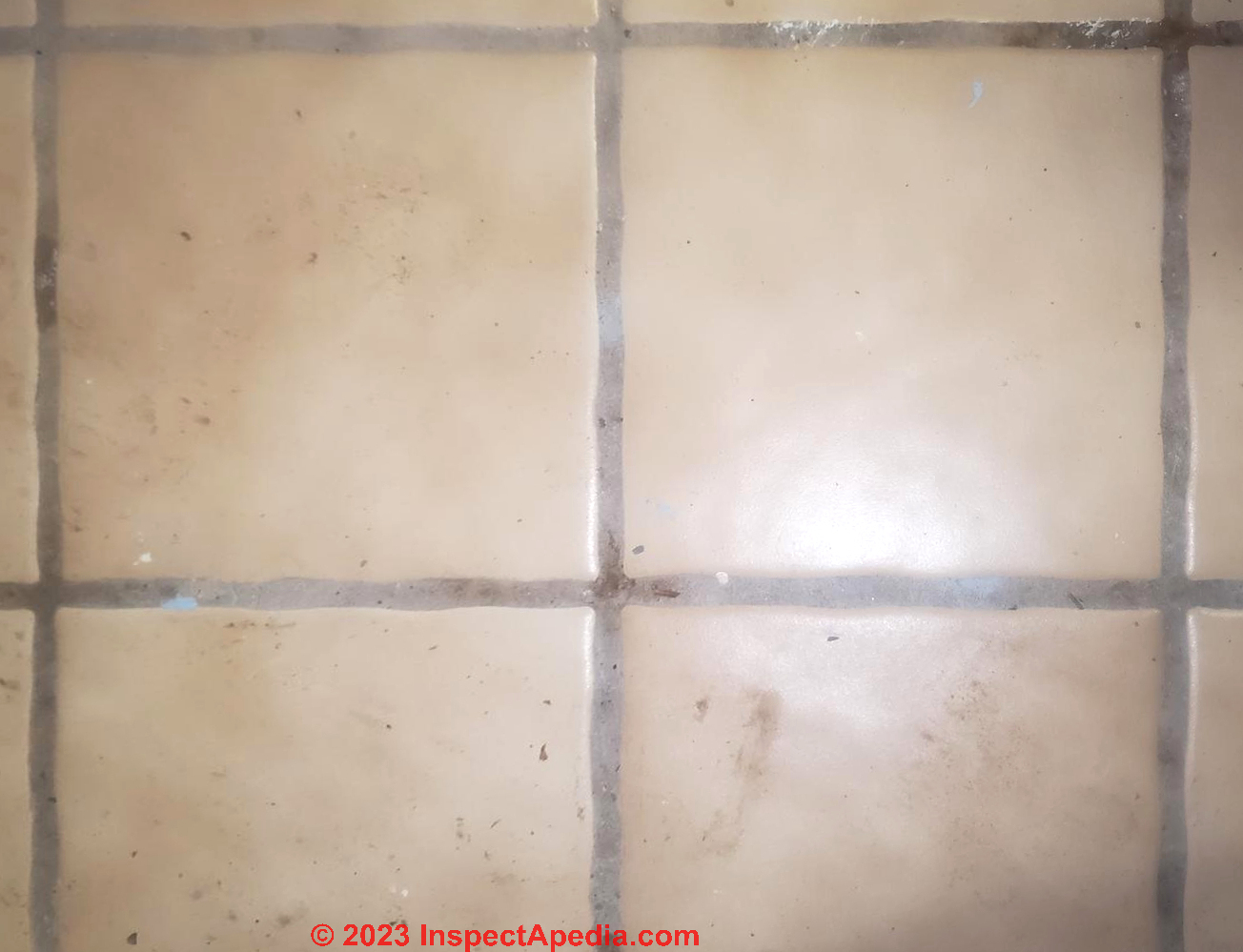
My house was built in 1964 in Florida. I have 6x6 tiles that I believe are ceramic. What are the chances they contain asbestos? (I know I have asbestos in the popcorn ceiling already).
This reader's Q&A were originally posted at HOW TO CONTACT InspectApedia.com
On 2022-01-19 by Inspectapedia Com Moderator
@Ryan,
Keep in mind that ceramic tile is anything BUT friable: it's hard as the dickens. You can't make hazardous dust from such material unless you're doing a demolition. Any mastic would have been behind the tile.
On 2022-01-19 by Ryan
@moderator
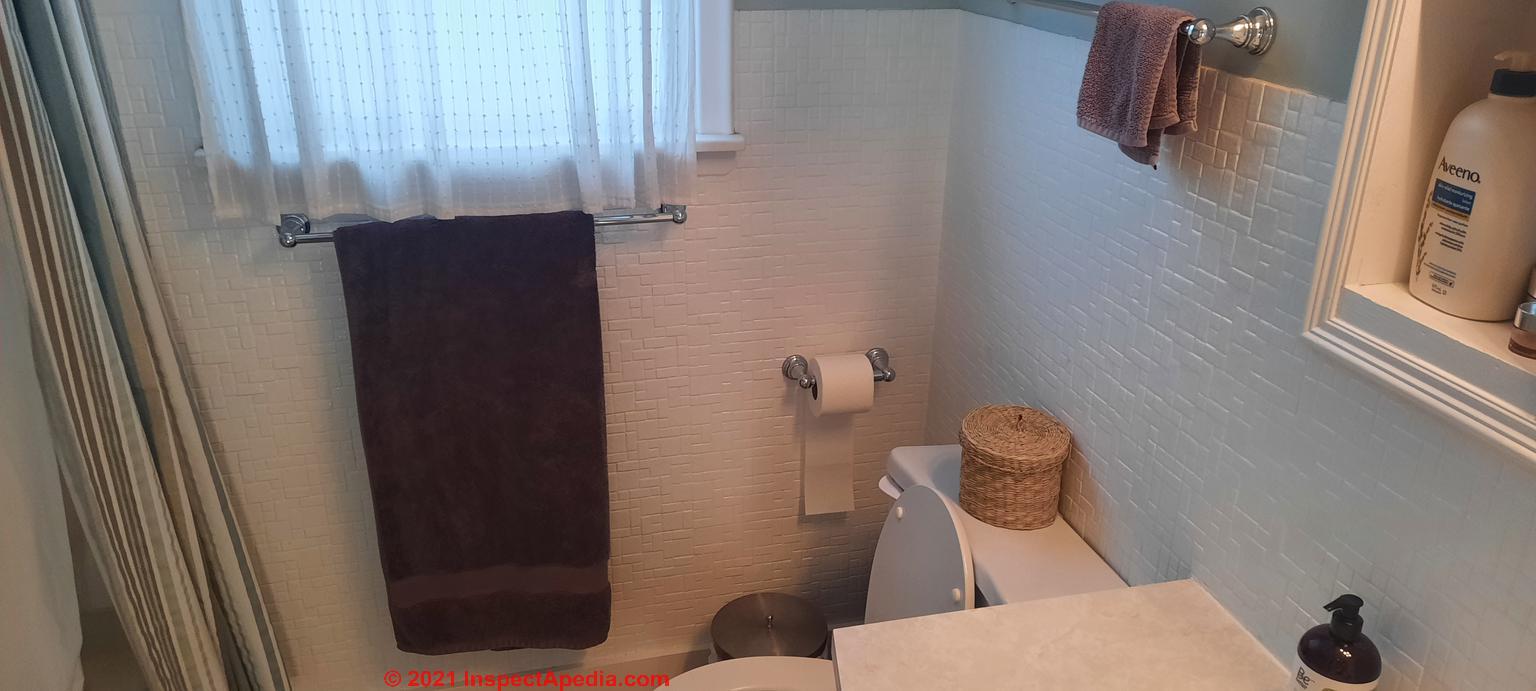
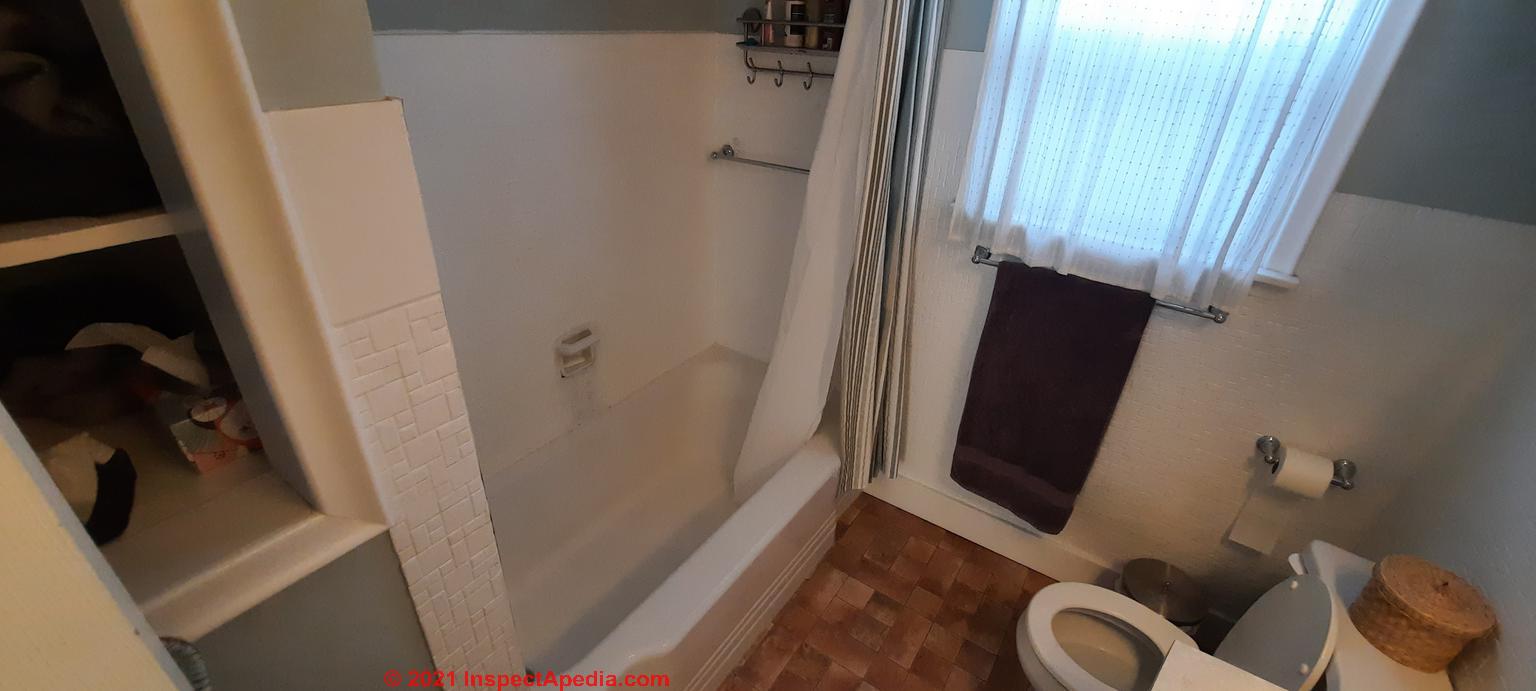
On 2022-01-19 by Ryan
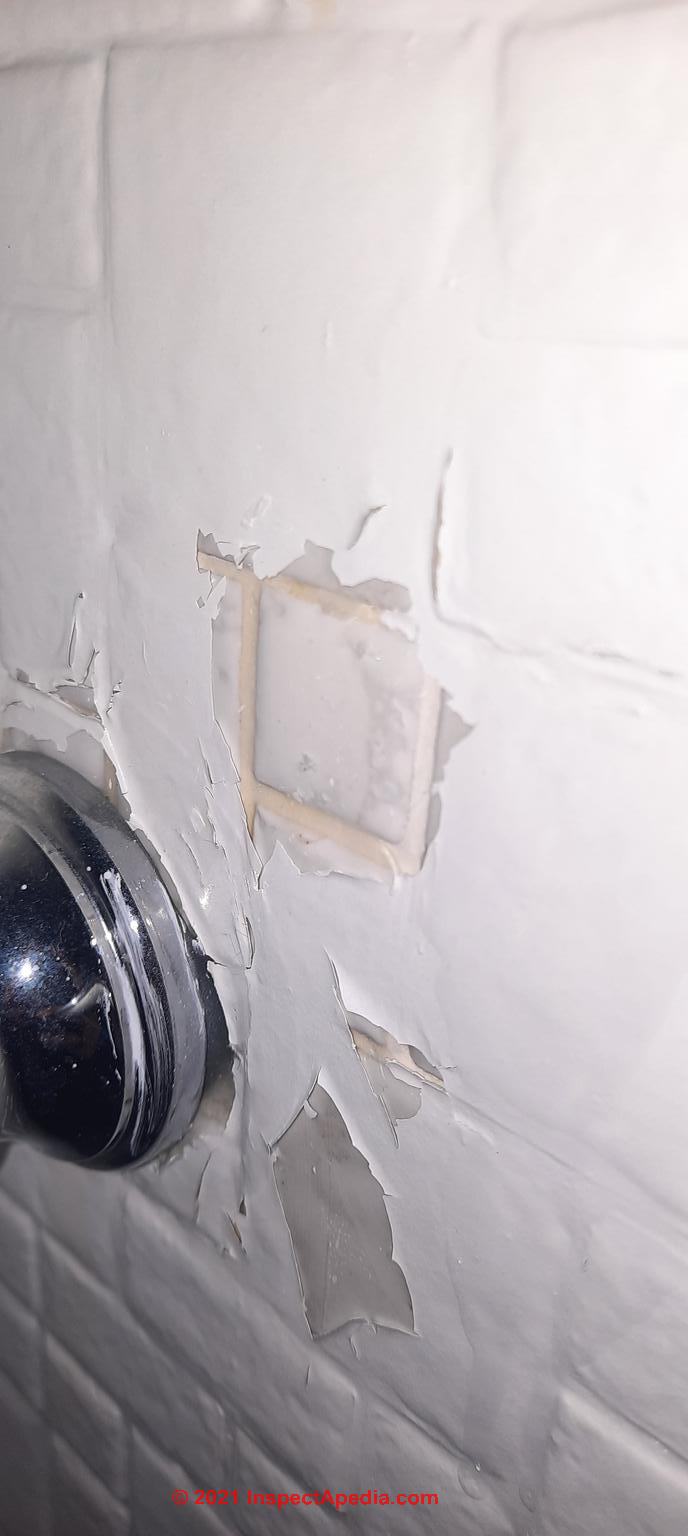
Just having to reno a bathroom. Boss didn't check tiles and mastic for asbestos. Nor did he check the multiple layers of vinyl tilea/sheet vinyl.
These tiles look old enough to be a concern for at least grout/mastic exposure. They have been painted white.. which also makes me wonder if someone else kniw they contain asbestos. Thoughts?
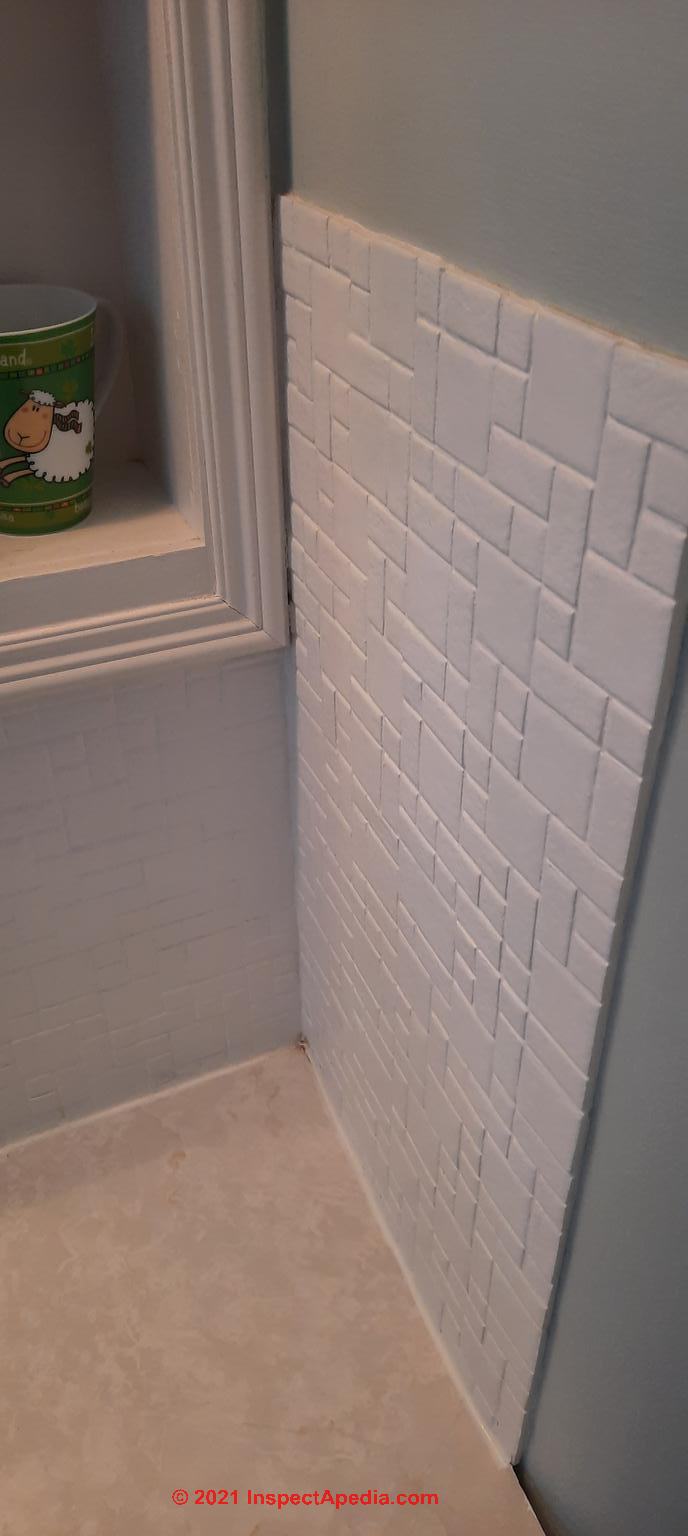 ...
... 
On 2021-11-17 by Inspectapedia Com Moderator
@ Asbestos grout in kitchen...?,
Not without more specific details or actual testing
On 2021-11-17 by Asbestos grout in kitchen...?
@Inspectapedia Com Moderator, i understood that there is now low asbestos in the kitchen since not zero, what is not the worst but also not the best and safest, but was also wondering if most of the grout was with asbestos, or only little percentage, if someone would know that. Thank you.
On 2021-11-17 by Inspectapedia Com Moderator
@ Asbestos grout in kitchen...?,
How did we get from low probability high worry?
On 2021-11-17 by Asbestos grout in kitchen...?
@Inspectapedia Com Moderator, Thank you very much! Whats the percentage/chance that the grout would contain asbestos in kitchen counter and bahtroom please in California? High chance?
Now I feel worried to use the counter as mugs and pots are coming with contact with the kitchen tiles/grout every day. Is it even safe to live in these possible asbestos houses? And is the garage and window safe in your opinion?
And when they cutting walls on that neighbours house without protections and just throwing in a truck without putting in bags, is that something to worry about, or is that normal procedure and the possible asbestos would not really affect house next to it or air while walking around the house.
Wondering also how safe it is to visit them. Thank you!
On 2021-11-17 by Inspectapedia Com Moderator
@Asbestos grout in kitchen counter/shower, window, garage?,
The probability of the Airborne asbestos at detectable levels from bathroom or other undisturbed, intact ceramic tile and tile grout is quite low but of course not zero as you can read in the article above on this page.
On 2021-11-16 by Asbestos grout in kitchen...?,
A few more photos...
 ...
... 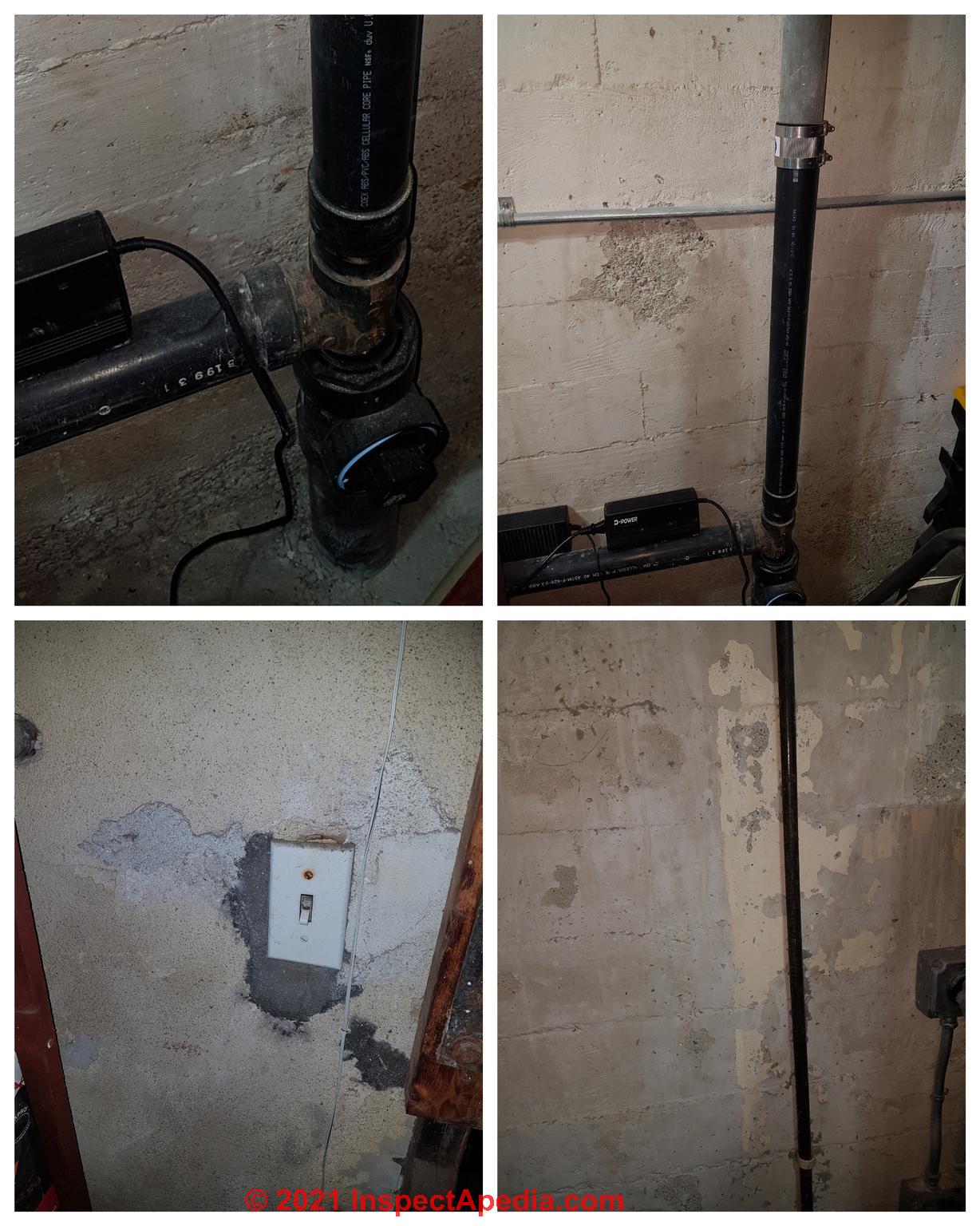
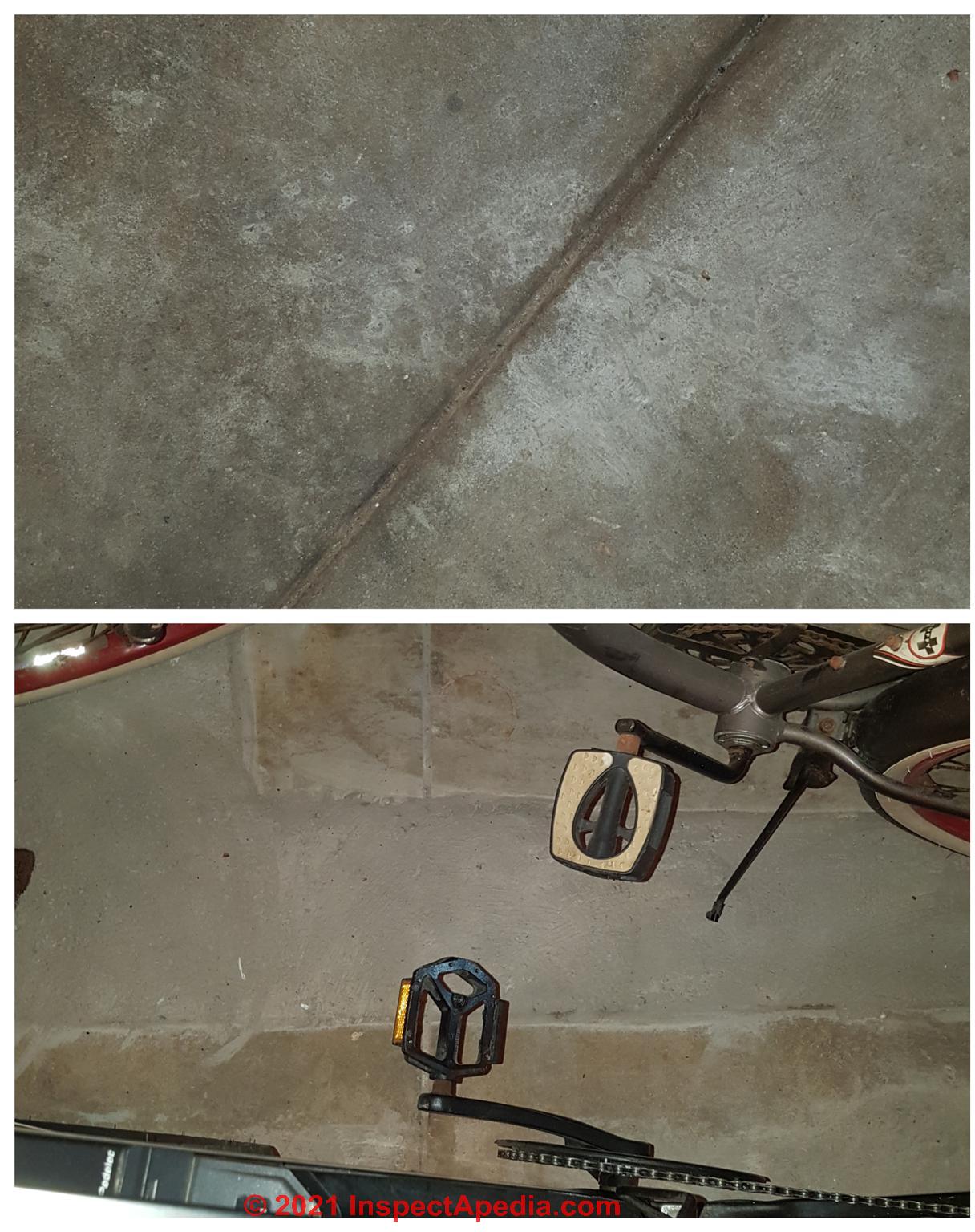 ...
...
On 2021-11-16 by Asbestos grout in kitchen counter/shower, window, garage?
Hi, just rented a 1920 house for few months and want to make sure I am safe here. Is any asbestos danger possible from using these things and spaces?
Grout/caulk in kitchen counter tiles and sink and in shower tiles?
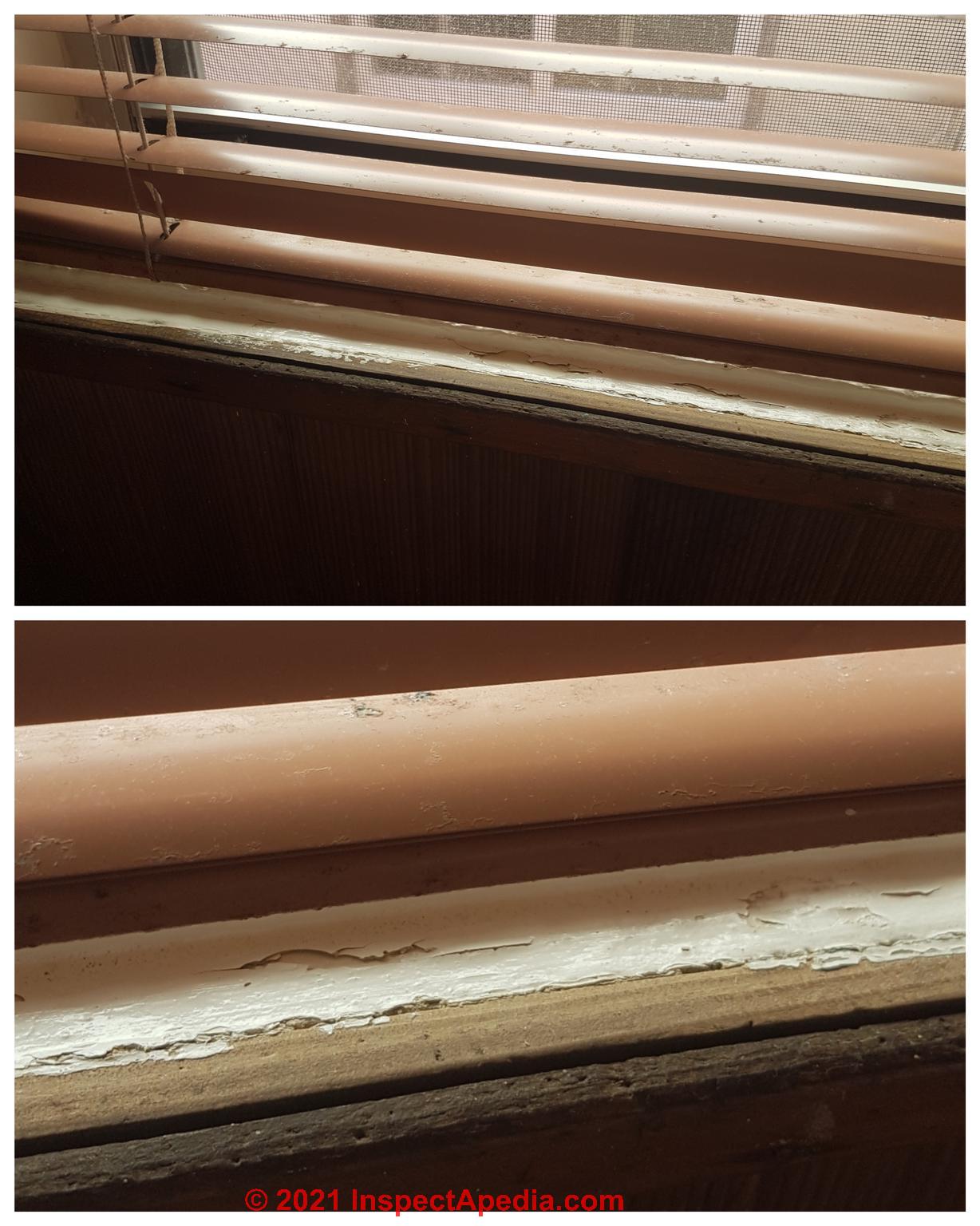
The kitchen counter worries me since its used daily. (photo #1) Window cracked paint/caulk? (photo#2) Garage floor, there are some dropping? (#3) Garage ceiling with parts of plaster/mud? (#4) Garage walls? (#5)
Also neigbour 1970 house is changing big windows and I could see piece of wall on the floor there and they just tearing and cutting the wall then dry sweeping it, and without bagging just throwing into open truck, while wind blows right from their house to our house while the windows are open here and I am worried to walked around, should I be?
They asked me to visit them. Thank you very much!
 ...
... 
On 2021-06-19 by Inspectapedia Com Moderator
@Rebekah,
We don't have an answer to the risk regarding grout around a cabinet installed in 1983 except to say that the data, which is quite limited, suggest that asbestos in that product would not be usual.
What would make sense would be to do your demolition and removal using wetting and other methods to minimize dust and dust exposure.
On 2021-06-19 by Rebekah
Thanks for your response to my question about sanding tile in the 1983 building. Yes! I have discovered the no-sand paint products!!
Now my remaining question is: If I remove a bathroom vanity that has tile grouted around it, do I run a significant risk of potential asbestos in the grout/adhesive being an issue? The building is in Minnesota.
Question: is there asbestos in a 1983 ceramic tile bath floor or wall tile?
Rebekah 2021/06/17
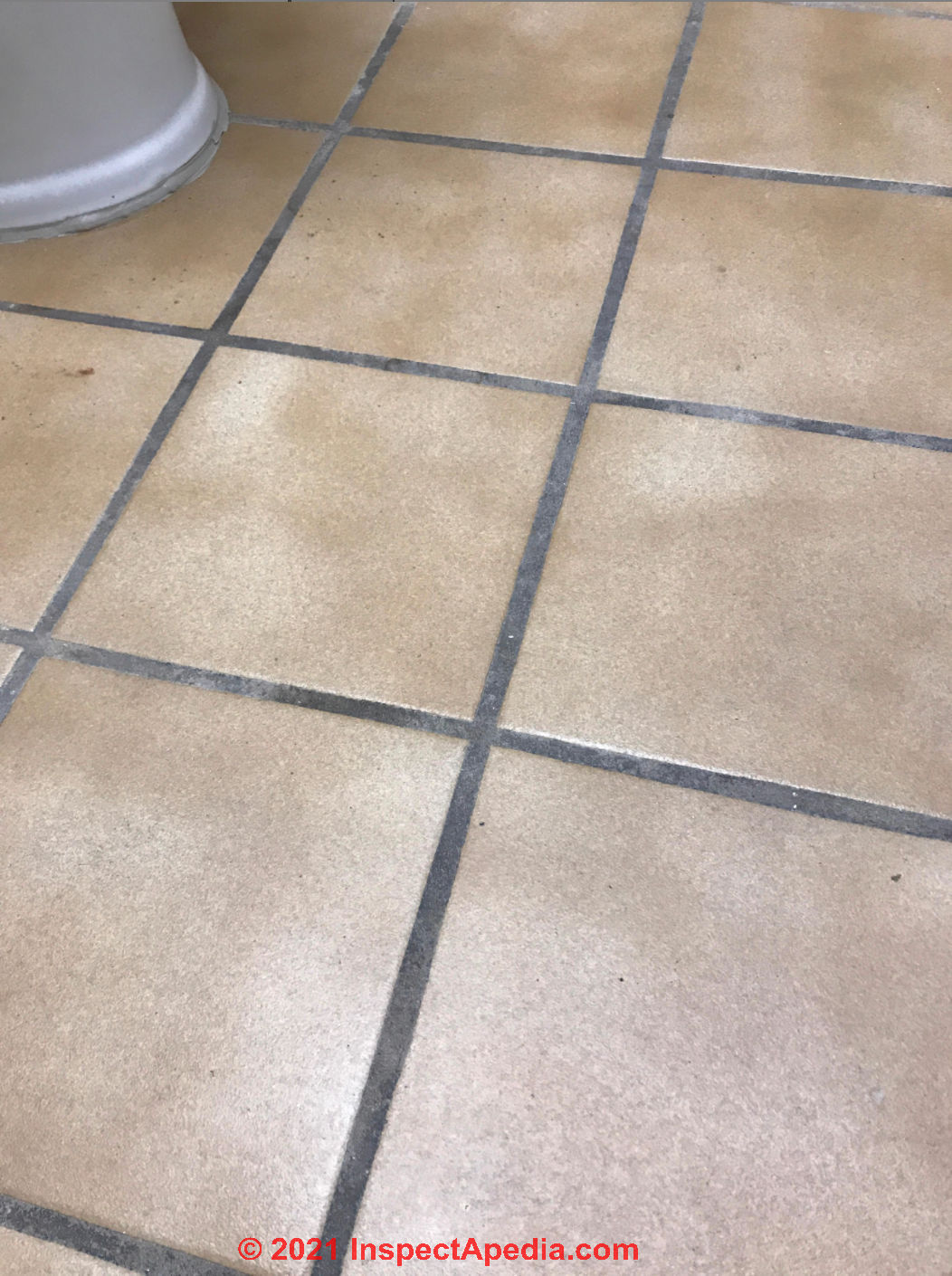 ...
... 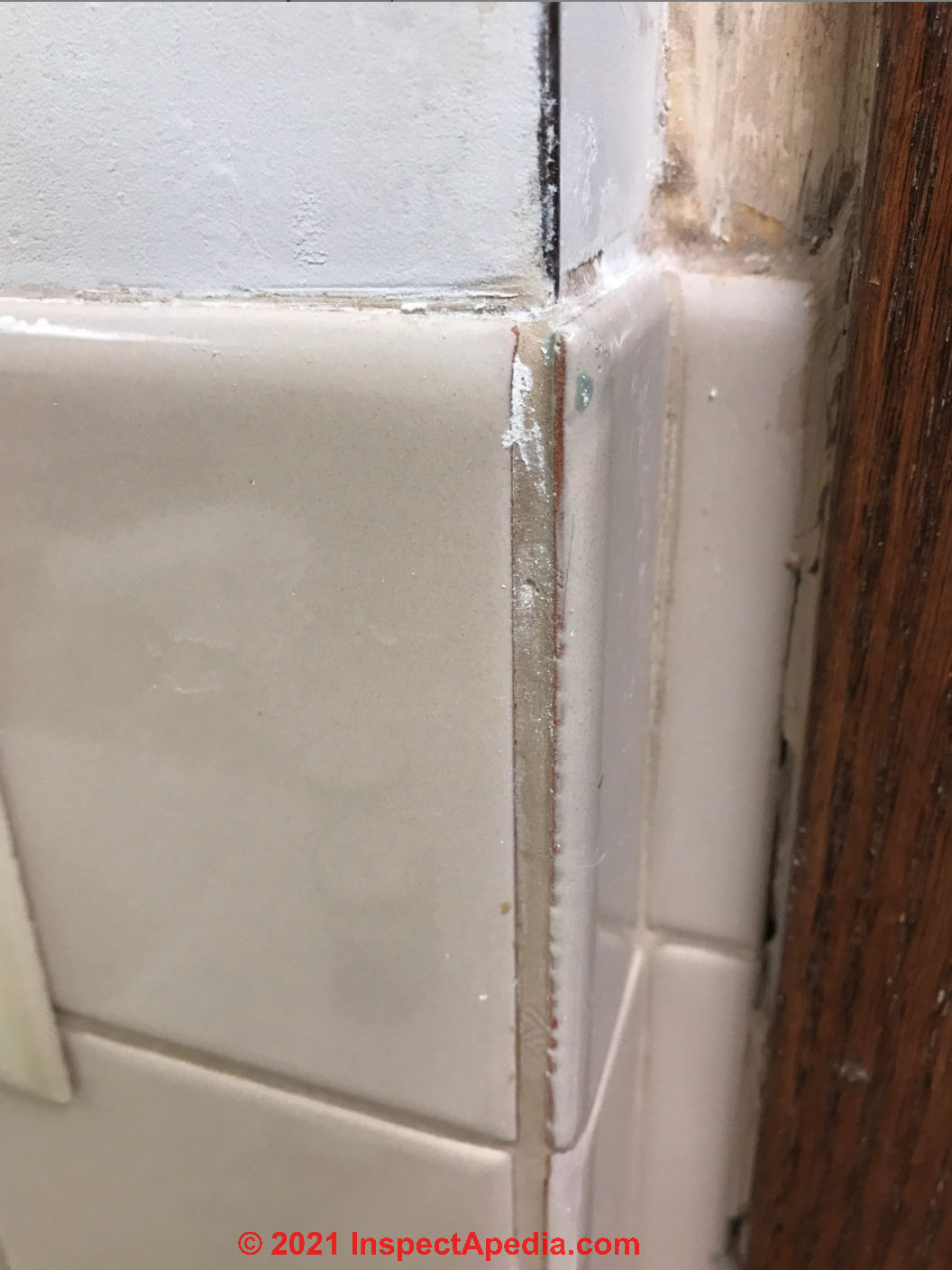
Hi! I’m doing a facelift project on some bathrooms in a building built in 1983. I plan to paint the tile and this will necessitate sanding the tile, grout, and any exposed adhesive. I’ll attach some photos. Do you think there’s a chance I’m dealing with asbestos ingredients?
Moderator reply:
I'm not sure you're correct that you need to send the tile and grout, and in fact I think you're going to find that that's practically impossible to do so in any useful way.
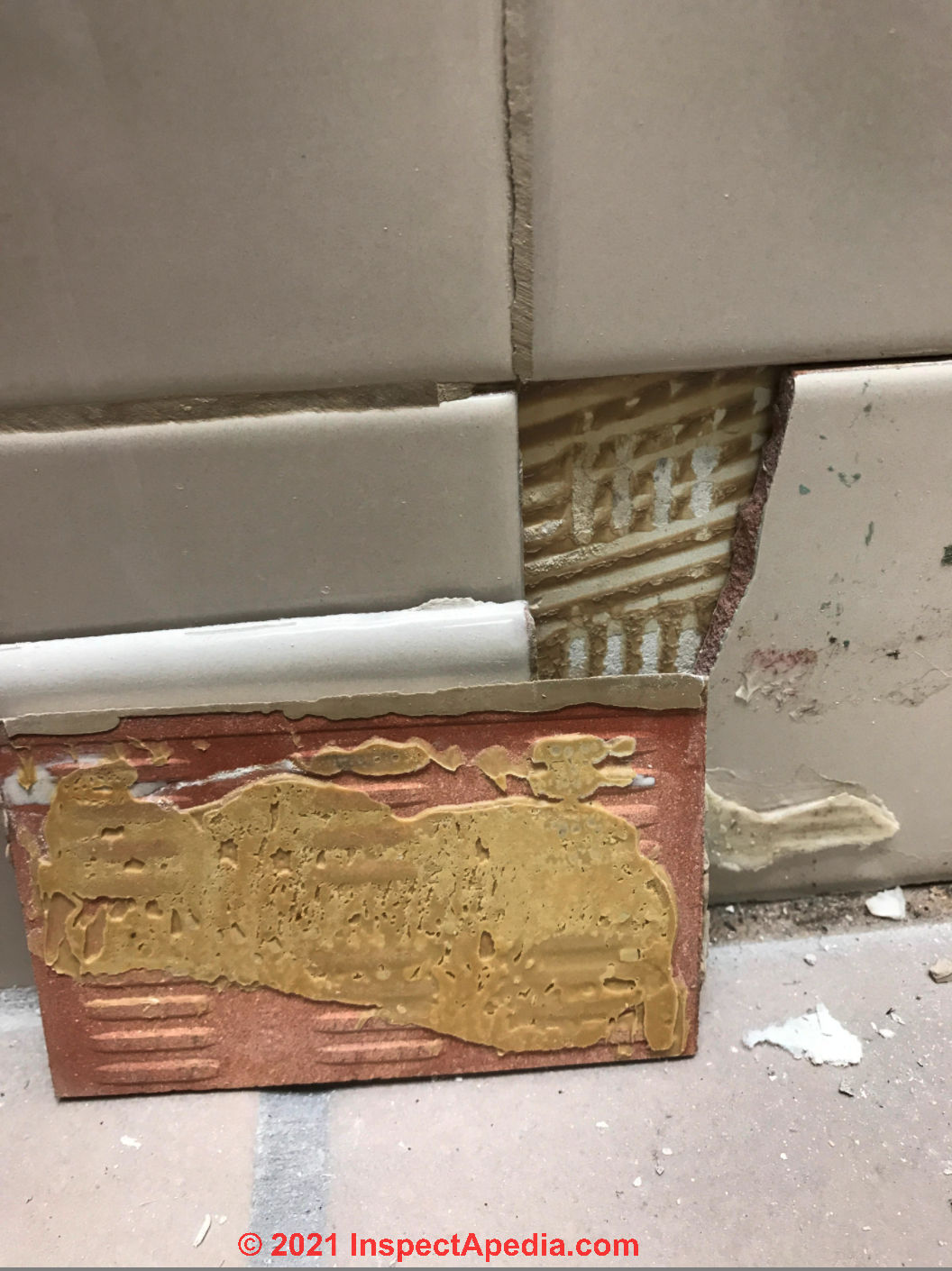 ...
... 
If you clean the soap film and scum off of the surface using any household cleaner, you will find that there are paints that are designed by the manufacturer to burn it to a ceramic surface.
About the asbestos part of the question, even though asbestos would be uncommon in ceramic tiles of that age in many countries we don't know where your building is located nor where the tile was made.
So we can't rule out the possibility of asbestos.
Sanding if you attempted to do that and were able to actually grind off the ceramic surface of the tile, would create a terrific dust hazard. I don't recommend trying it.
Question: is my hexagonal bath tile flooring an asbestos hazard?
Matthew Ferguson 2021/06/10
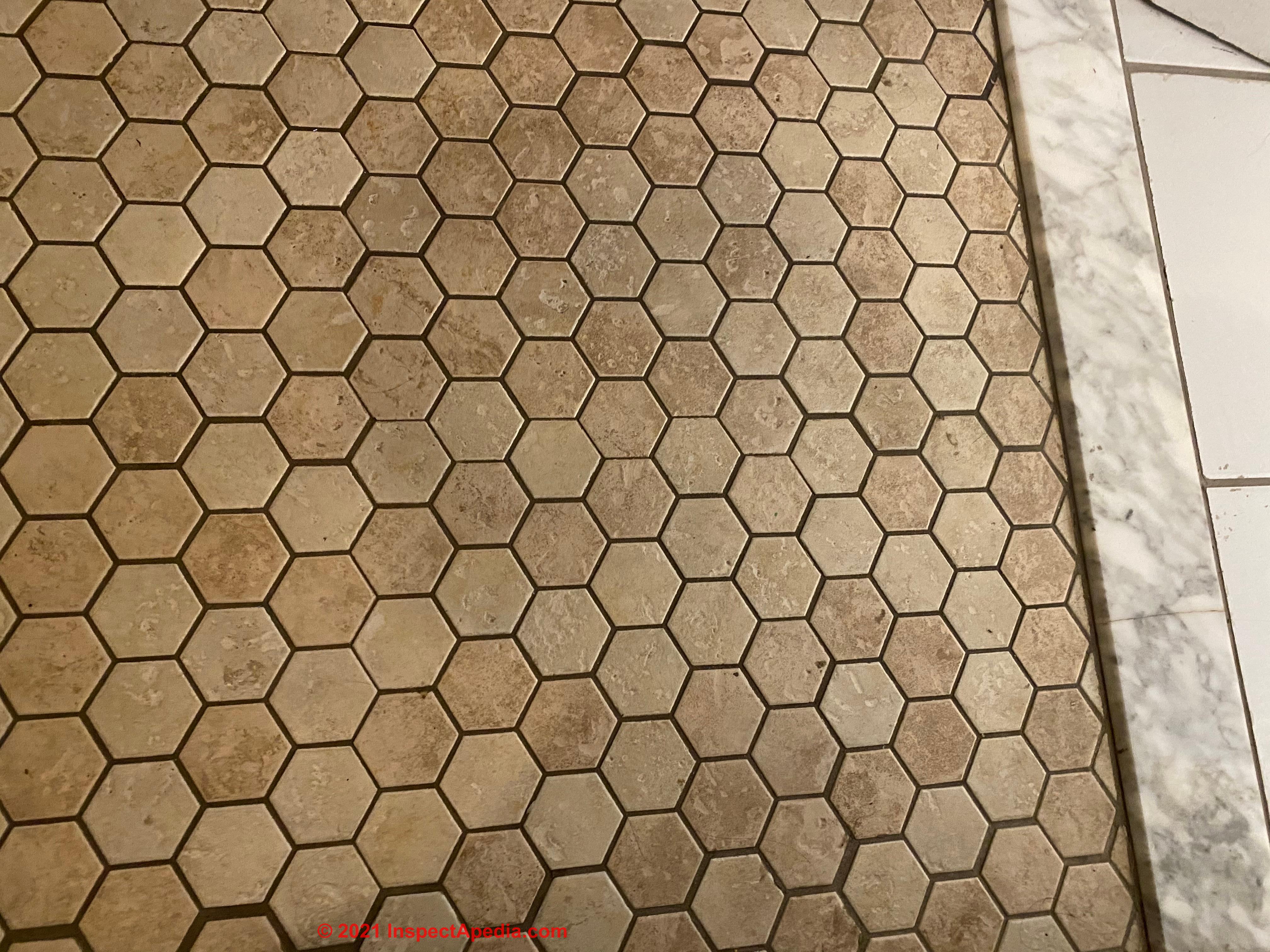
Would this hex tile flooring be suspected of having asbestos? The house resides in Baltimore Maryland. Thank you in advance for
any feedback .
Moderator reply:
Matthew
No one can say with certainty that your floor does or doesn't contain asbestos without testing, but please read the article above where you'll see that the chances are slim;
When we are discussing asbestos hazards in a hard - non-friable material like ceramic tile and grout, even if there was asbestos in the material there is no reasonable chance of measurable release of airborne asbestos from such a material unless it is being disturbed by demolition or similar conditions.
Question: hazards of tub tile wall demolition
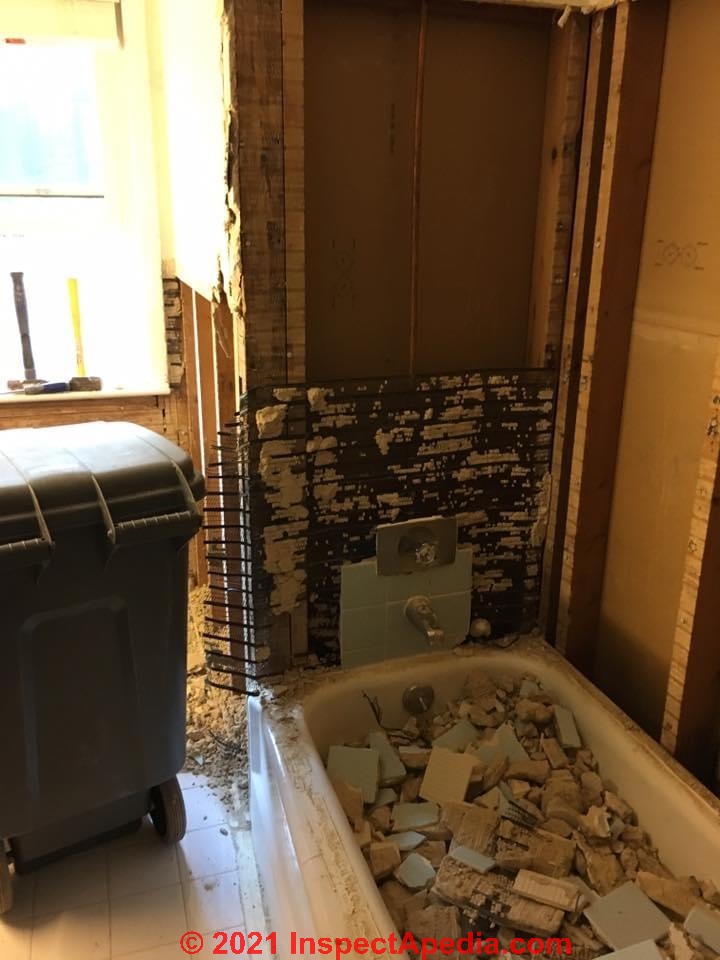
I have a question we removed ceramic tile from 2 bathrooms in our 1967 home. So obviously
Too late for us to prevent exposure we may have had. But how common was asbestos in mortar beds with metal lath and ceramic tile on top? This is a photo of some of the debris - by F, 2021/05/20
Moderator reply:
Watch out: plaster and tile and grout dust is hazardous regardless of whether or not it contains asbestos, as it contains respiratory abrasives and irritants and contaminants such as fine silica partiulates.
In the U.S., asbestos in ceramic tile itself not really very common; no one can say for certain what's in tiles or mortar from a photo - you'd at least want to know the age of the materials and their origin.
What you can do now, if it would ease your worry, would be to look for some settled dust that missed getting cleaned-up after your bath renovation.
You might find that atop horizontal trim such as over a window or door.
If you can find that old dust you can send a sample of it to an asbestos test lab or to any forensic lab who an identify the particles. IF there is a high level of asbestos in that dust that'd be diagnostic.
See TEST KIT for DUST, MOLD, PARTICLES: INSTRUCTIONS https://inspectapedia.com/sickhouse/Adhesive_Tape_Particle_Test.php
for an easy, low-cost way to collect settled dust samples.
Don't send them to us - send your sample to a certified asbestos test lab.
On 2021-05-14 - by (mod) -
@Zulu,
Asbestos is possible, though not so likely, in ceramic tile and its mastic; unfortunately nobody can say from the photo alone;
If your work is going without creating dust and debris it's not likely that even if the mastic-adhesive does contain asbestos, that there's a detectable airborne asbestos hazard from that source.
On 2021-05-13 by Zulu
Hi I have posted an image below. 1st pot on the forum please be kind. Am I dealing with Asbestos mastic here? Ceramic mosaic tiles have come of clean, there isn’t a glue texture attached to it. Age 1980 maybe.
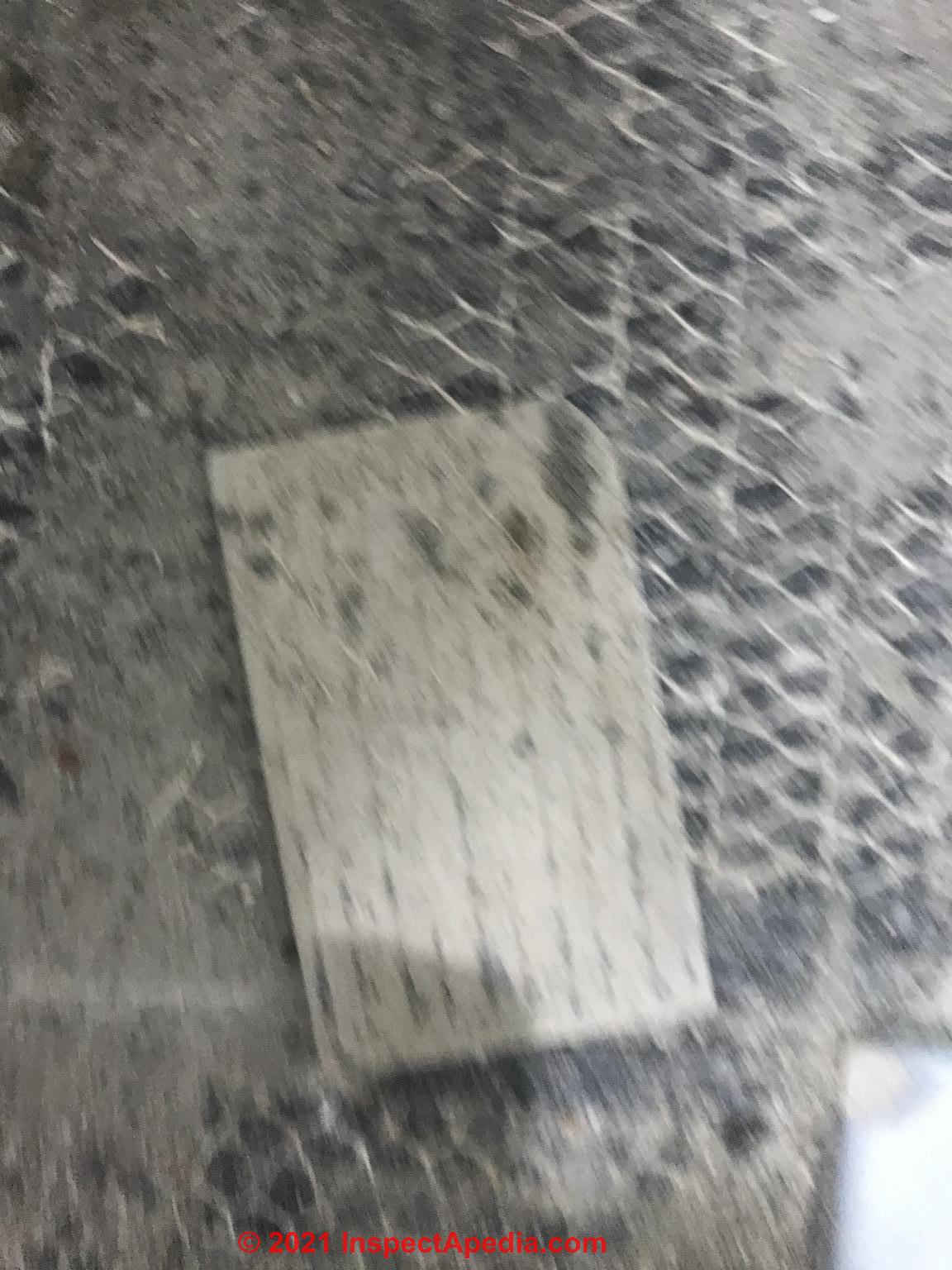
On 2020-09-12 - by (mod) -
It's not so likely but still possible especially if the product is old stock, though a search has not found reports specifically pointing to asbestos in Spanish ceramic tile.
IN any event it's not friable;
On 2020-09-12 by Alex
i have a spain made gres monococcion single fired tile by azulejera alcorense. Do you think it might has asbestos? Thanks!
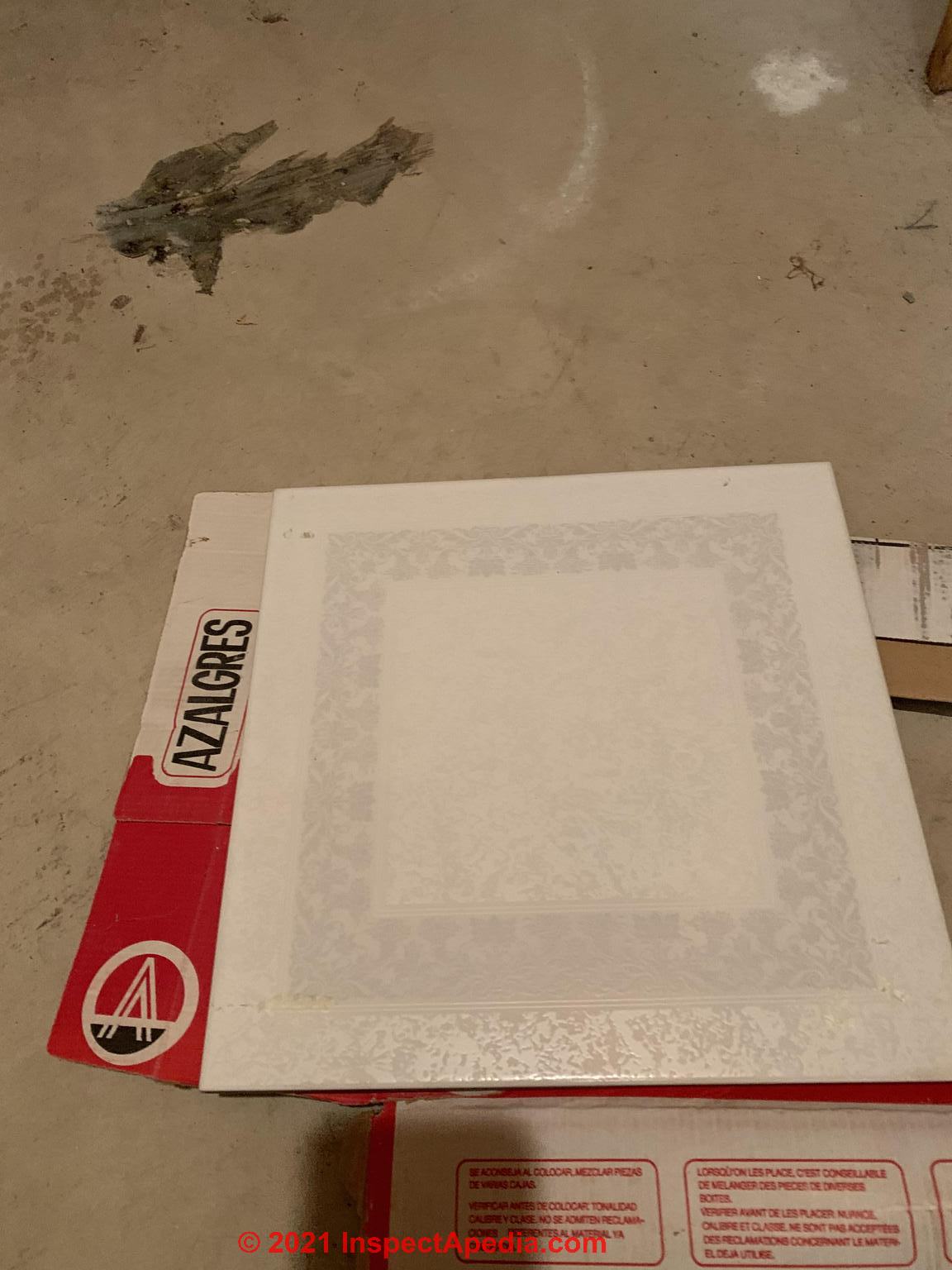
On 2020-08-11 - by (mod) -
Tilu
Some marble contains asbestos - depending on where it was mined.
Here are a couple of examples
Germine, Mark, and John H. Puffer. "Distribution of asbestos in the bedrock of the northern New Jersey area." Environmental Geology 3, no. 6 (1981): 337.
Jehan, Noor, and Irshad Ahmad. "Occurrence of tremolitic asbestos in Nowshera Formation Ghundai Tarako, district Swabi, North Pakistan." Journal of Himalayan Earth Sciences 40 (2007).
On 2020-08-10 by Tiiu Roiser
Greetings. I'm looking to install a new back splash and floor tile. Does natural marble contain any asbestos? Does it matter what country it is from? I'm looking at marble from Turkey and Spain. I don't trust anything from China. I'll be doing all the install and cutting myself and have little children around. Thank you in advance for any information.
On 2020-05-30 - by (mod) -
Nicole,
Some of those tan tile adhesive mastics contained asbestos - not particularly friable unless you're doing demolition.
Some of those in turn can be dissolved with water.
Ceramic tiles might contain asbestos themselves, but if you're not sawing or breaking-up the tiles, they're the personification of a "non friable" material that is therefore low-risk.
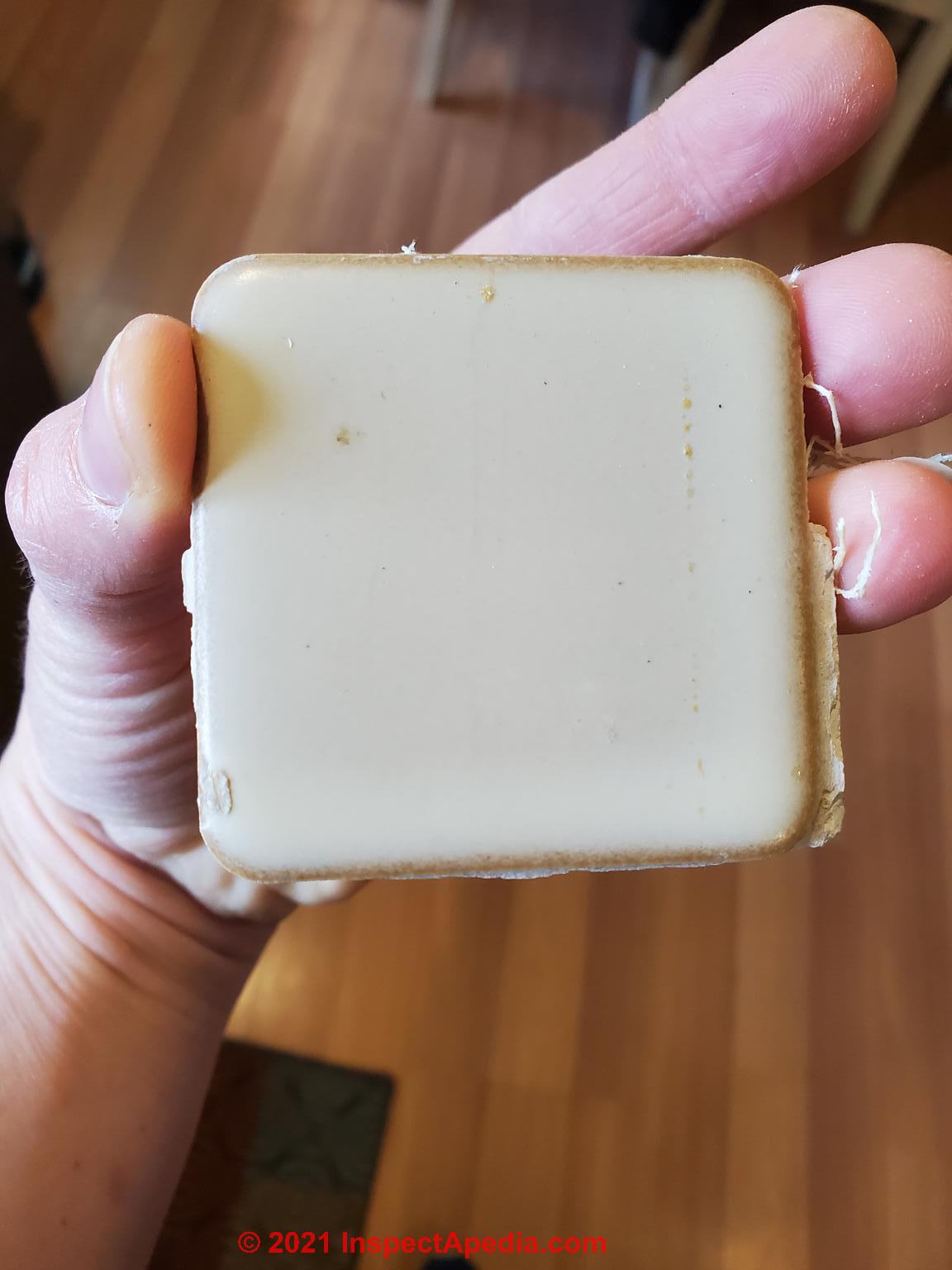
On 2020-05-30 by Nicole F
We just took down a backsplash in our house built in 1962 (America). The tiles just say Malaysia on the back. I believe they are porcelain. They measure 2.5 inches. The behind them looks like peanut butter. Are these a possible risk?
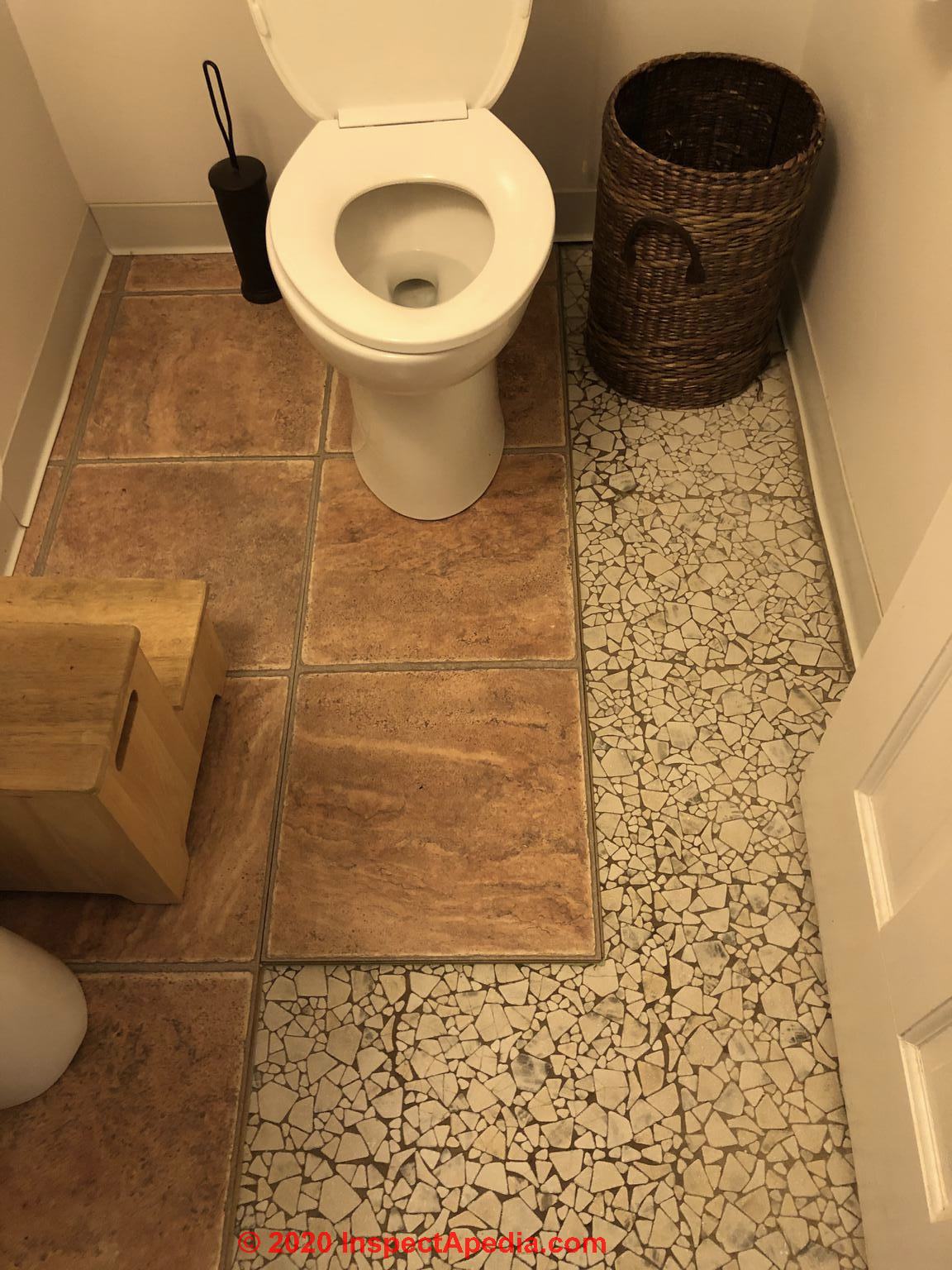 On 2020-11-02 by (mod)
- shattered stone or "broken tile" ceramic floor installed in square segments, 1960s
On 2020-11-02 by (mod)
- shattered stone or "broken tile" ceramic floor installed in square segments, 1960s
Maura
Than you for the question and floor photo
A ceamic mosaic floor tile pattern set in mud (tile cement for other readers not familiar with that term) would not, in the U.S. be likely to contain asbestos and in any event is not friable.
There were similar looking asphalt or vinyl-asbestos floor tiles by Armstrong in a Shattered Stone pattern.
Yes it was and remains common to install ceramic tile that is sold in rectangular or square segments pre-adhered to a mesh backer.
That lets the tile setter install the flooring in a rather uniform pattern far more rapidly than if she had to set every one of those small ceramic tile bits individually.
This Q&A were posted originally at ASBESTOS FLOORING IDENTIFICATION
On 2020-11-02 by Maura
Hi!-
Found this tile underneath a floating floor in the bathroom. It appears to be mosaic tile laid in mud with no visible seams unless you "zoom out".
Home was built in 1961 and we have original ceramic tile in other parts of the house so I assume it is tile that was laid with a square-ish template. Just want to be sure that I am not missing something
Question: do these Italian ceramic tiles contain asbestos?
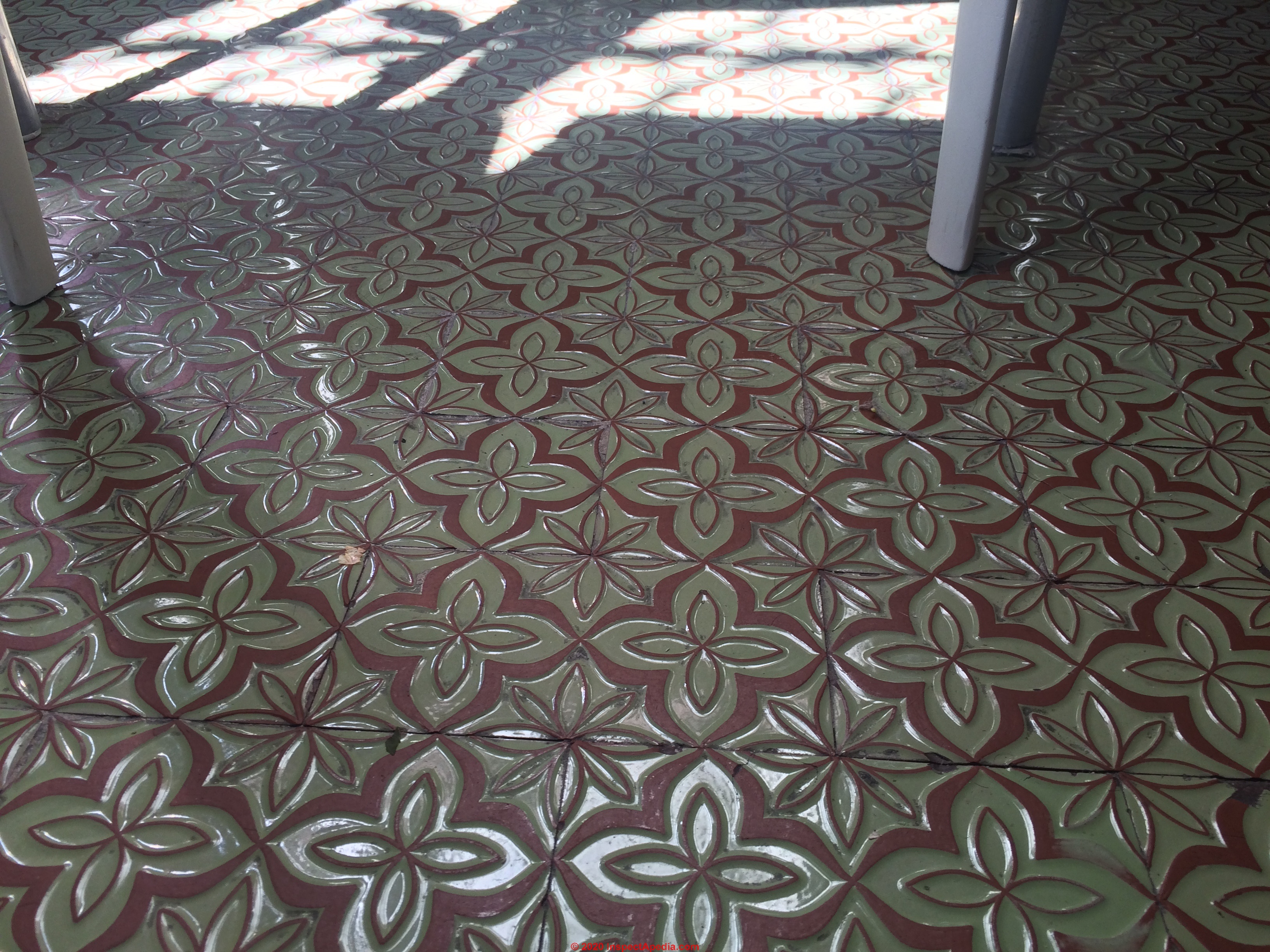
2020/05/06
Hi.. I recently rented a house in center of a city in Italy and I’m concerned that these tiles contain asbestos.. would you tell me if these look like they have it? And if they do, given that some of the tiles are very loose is it safe to live here?
Thank you - Anonymous by private email
Moderator reply:
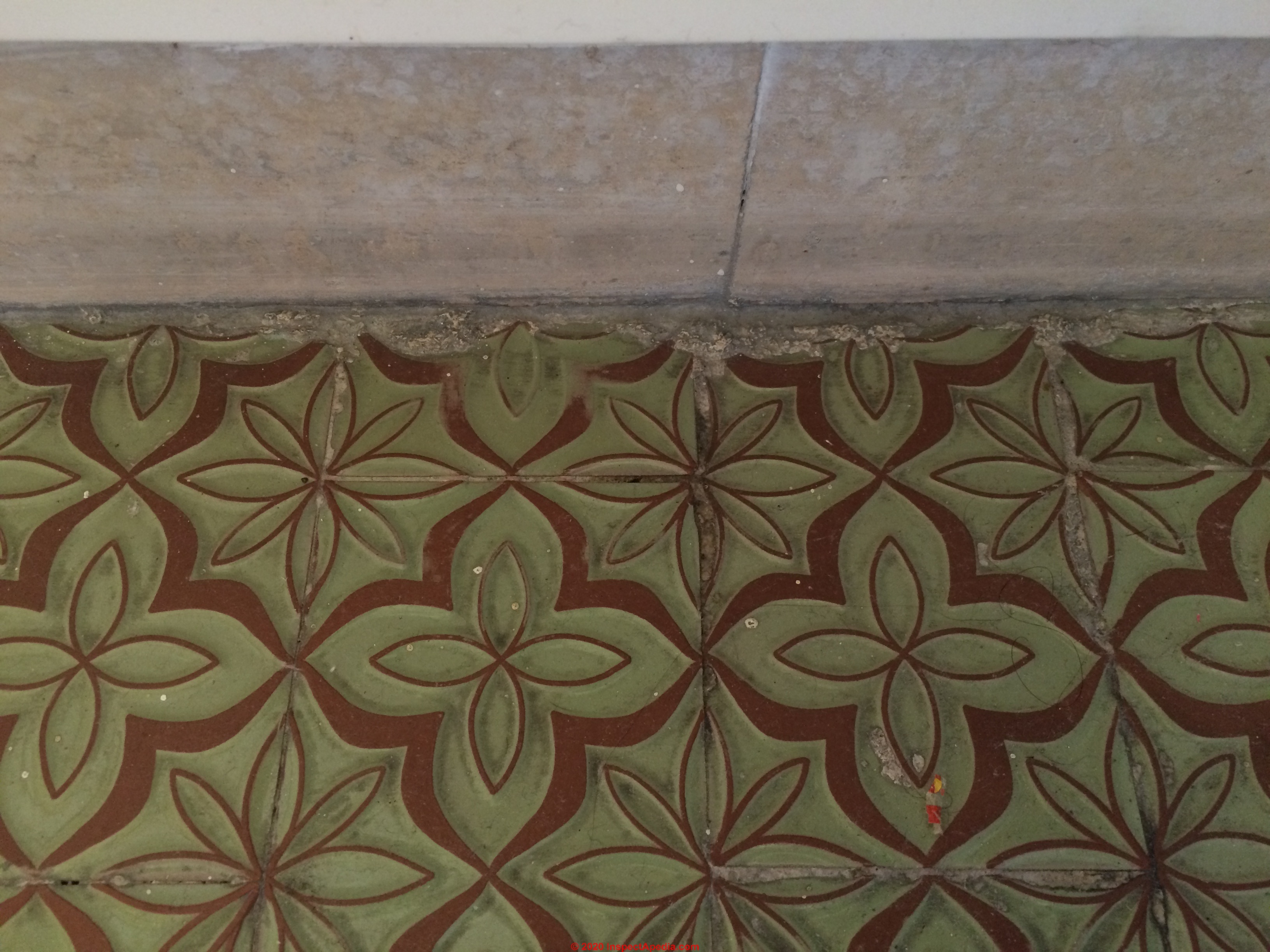
Are we looking at ceramic glaze on terra cotta-based tiles?
Reader follow-up:
I think so. The entire floor is covered with these 15*7.5 cm tiles. They have a greenish color and the part that's broken looks like clay.
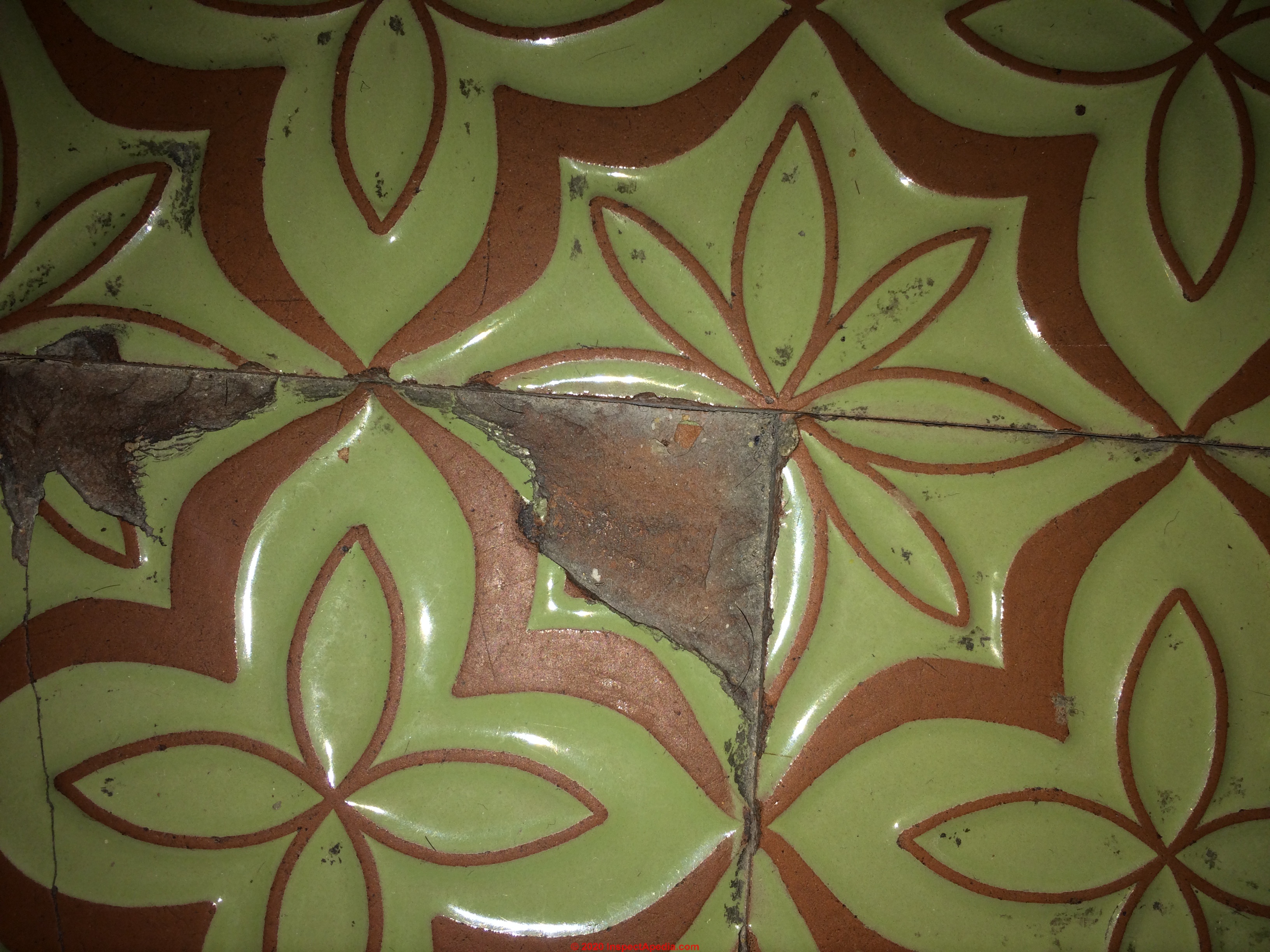
I asked the owner if they have one Icould see but they didn't.And like a lot of houses in italy this one was also built the ban of using asbestos and not renovated ever since. thank you for taking the time to see
Moderator reply:
Yep that's a ceramic on clay tile.
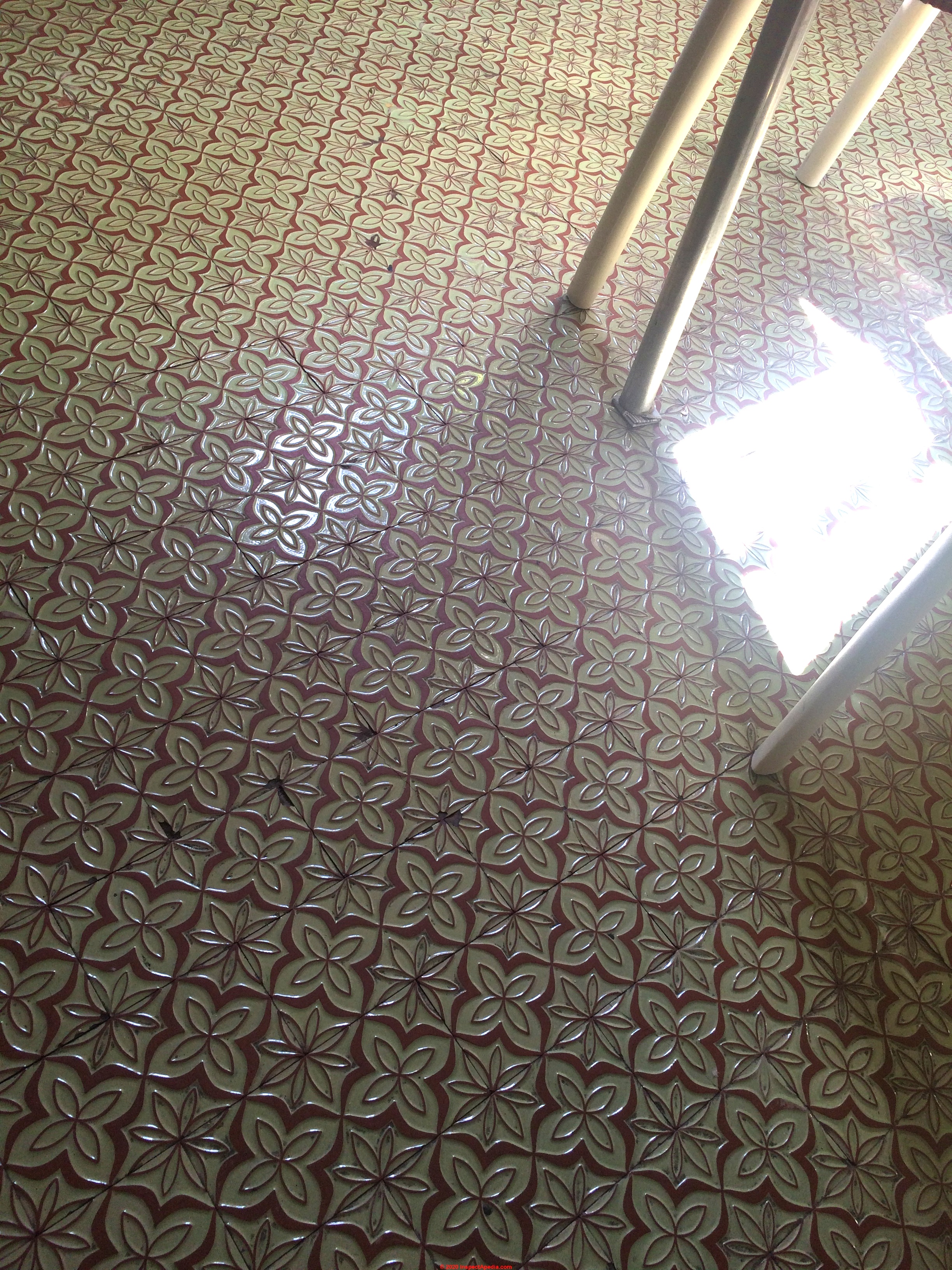
No one can tell you from looking alone if that tile contains asbestos - though usually it won't.
And if the floor is basically intact it's not shedding material at any measurable level.
Details of what we know about this question are at
CERAMIC TILE, ASBESTOS / LEAD?
please take a look there and of course I welcome follow-up questions or comments.
I'll post your photos, keeping you anonymous unless you want otherwise, at that page to see if any of our readers has seen your specific tile. The more we know about the location (country, city) and age of the building the better the guess.
Reader folllow-up:
Thank you for checking it . This is a really nice house ( except for the really old floor)and it would be a shame to leave it for asbestos..
Moderator comment:
Certainly you could cover the flooring with just about anything - perhaps a resilient floor - IF the tile is damaged and shedding - to eliminate your worry. Not as nice, perhaps, as ceramic but if the flooring is in bad shape (doesn't look so in your photos) you could avoid further damage as well as prevent any dust and debris from the floor.
On 2020-04-23 - by (mod) -
Thanks for the helpful comments, Paul. I agree. We have confirmed asbestos use in thin set mortars and tile mastics including the tan coloured water-solvent-based latex adesives used with some ceramict tile and slate tile setting, and incidentally, also in black asphalt-based mastic adhesives used in vinul floor tiles.
See MASTIC, CUTBACK ADHESIVE, FLASHING CEMENT ASBESTOS
On 2020-04-22 by Paul Roscoe - Asbestos found in some thin set tile mortars
If It’s old it’s gold as we say in our industry . If you research enough it is clear that thin set mortars did contain asbestos. They are not found in all but some, you can find manufacturers who made/sold it in the U.S but in the U.K not so easy but we do indeed find it here aswell we get several positive results every year. It all depends on the age (1950s-late 1970s) and as we know most old tiles have been replaced during renovations so you’ve got to get lucky so to speak to find it but I believe it will have been more common than first thought.
Also one of the large asbestos manufacturers in the U.K. Turner and Newall also sold small ‘poilte’ asbestos cement tiles coated with a enamel / ceramic coating to look like ceramic tiles, I have one in a display cabinet.
On 2020-01-07 by Anonymous
Thank you so much, that is very helpful
On 2020-01-07 by (mod) -
Asbestos is unlikely,
See if you can find the MSDS for the product
On 2020-01-07 by Ahmad
Thank you so much, as for the product that I used, here is the link for the company products:
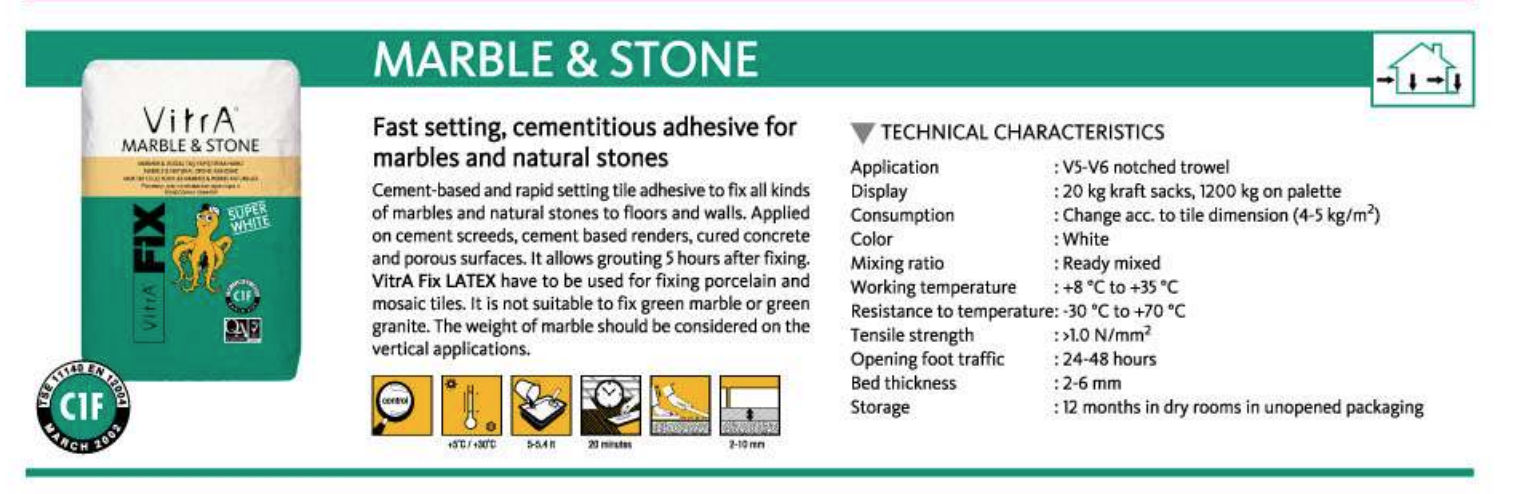
VITRA-FIX & VITRA-THERM CERAMIC TILE ADHESIVES [PDF] retrieved 2020/01/12 original source:
http://www.morentrade.com/docs/Building%20Chemicals01.pdf
and I attaching an image of the product that I used. As you can see, it says cement base Adhesive.
As I mentioned this was almost 10 years ago.
Appreciate your help.
On 2020-01-07 by (mod) -
Ahmad
By now, in most places in the world, I would expect manufacturers to have all stopped including asbestos in tile mastic.
However I can't say that I know that for a fact about the specific product that you have bought.
On 2020-01-07 by Ahmad
Hello,
I have installed Travertine floor tile back in 2010, and I used tile cement/glue that was made in Turkey at that time
. I am planning to remove it now and I am wondering if the glue has any asbestos in it.
I did lot of research but all i can find is that Turkey has complete ban in Dec 2010, but there was a partial ban before that, however, i couldn't find if construction material was included in the partial ban,
is there a way to tell other than testing?
Thanks.
On 2019-10-15 by (mod) -
Ashley
As the materials of concern are now gone all that's left might be a test of representative samples of settled dust to ask the forensic lab if there are high levels of hazardous mateirals (such as asbestos or silica) or even low levels of particles that for other reasons raise an IAQ concern.
That will not (nothing can) assess your prior exposure to unknown dust hazards but it'll tell you if further cleaning is warranted..
On 2019-10-15 by Ashley
Hi, I am kind of concerned about a small project that I undertook about a year ago. I know it's too late now to do too much although I know there is still some lingering dust on things. My home was built in 1980-1981 and there was a small area of tile in front of my fireplace.
I don't know when the tile was actually placed, if it was at the time of building or later.
I'm not super concerned about the ceramic tiles themselves but I am worried about the grout that was used.
I used a variety of things to remove the tiles including a grinding saw and there was a lot of dust as the material was very hard. It seemed more like cement than anything (gray and hard), if memory serves, although I think there may have been some reddish clay-colored material as well.
There were two styles of ceramic tile (possibly two installations with different grouts). I am kicking myself for not collecting samples at the time but now am worried that I may have lingering dust in the house and am concerned that I may have exposed myself while removing the material. Any thoughts or whether there are ways to do any type of swab testing of the room at this point? Thanks.
On 2019-09-04 by (mod) - Army Asbestos Testing Program contact information
Nomad
Thank you for the important comment; I'm not suprised as I've already found and cited some ceramic tiles that contained asbestos, though it's uncommon in North America. But your report is particularly helpful; if you have reports or even photos that'd be even more useful.
But if all you've got is the memory, I'm a bit stuck; we don't know who might have performed testing: a european asbestos lab or a lab in another country, even the U.S. that was contracted with the US military.
Keep in mind that worrying about this may be worse for your health than the tiles themselves. The hazard from an asbestos-containing ceramic tile would in my OPINION occur if the tiles were ground, chopped, sawn etc. so as to create a dusty mess. Othewise the particle release is likely to be below the limits of detection. Ceramic tile isn't friable.
One source occurs to me: you could contact the Army Asbestos Testing Program to ask if they were the people handling tests of materials from Iraq.
Army Public Health Center
8252 Blackhawk Road
Aberdeen Proving Ground, MD 21010-5403 USA
OR possibly one of these two sub-programs
Environmental Health Risk Assessment Division
Email Address: usarmy.apg.medcom-aphc.list.ehrad@mail.mil
Telephone Number: 410-436-2953
DSN: 584-2953
Mailing Address: U.S. Army Public Health Center Env. Health Risk Assessment Division 8252 Blackhawk Road (Bldg E1675) ATTN: MCHB-PH-HRA Aberdeen Proving Ground, MD 21010-5403
Environmental Health Sciences and Engineering
Email Address: usarmy.apg.medcom-aphc.list.org-ehe-ofcdir@mail.mil
Telephone Number: 410-436-2306
DSN: 584-2306
Mailing Address: Army Public Health Center ATTN: MCHB-PH-EHE 8252 Blackhawk Road Aberdeen Proving Ground, MD 21010-5403
APHC Phone Numbers
Toll-Free Number: 1-(800) 222-9698
Staff Duty Officer: (410) 436-4375
DSN: Dialing from within CONUS 584-4375
DSN: Dialing from OCONUS (312) 584-4375
Secure Fax: (410) 436-7301
Public Affairs Officer: (410) 417-2937
Media inquiries: usarmy.apg.medcom-aphc.mbx.pao@mail.mil
Website: https://phc.amedd.army.mil/topics/workplacehealth/ih/Pages/Army-Asbestos-and-Lead-Programs.aspx
On 2019-09-04 by Nomad Construction
I tested some material in Iraq in 2003 are various locations dated from 1950 to 1988 that showed 35% asbestos.
All of the material was from Mediterranean, communist and other businesses in the middle east.
How can I find out what company actually performed the test and what the material actually was? I took so many field sample and slept, drank and ate in al of these areas for 18 months at a time.
On 2019-08-24 by (mod) - drilling through ceramic wall tile - hazards?
 Re-posting from private email:
Anonymous asked:
Nice website. Very helpful. But before I start drilling, can you comment on whether or not I should take any precautions above and beyond what I would typically do for drilling?
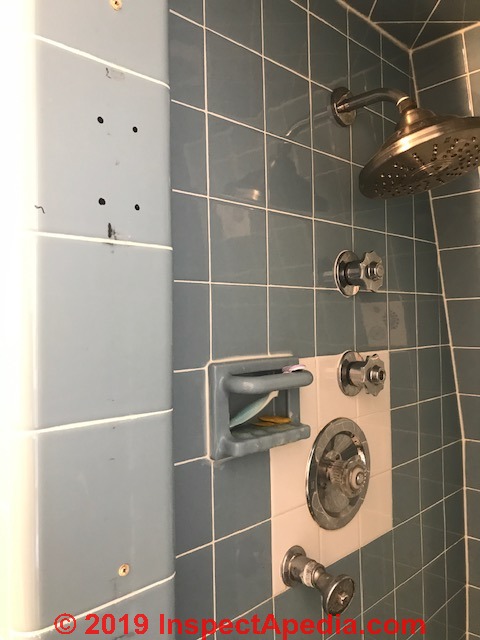
I have to drill into a 4x4 tile in an old shower and am modestly concerned.
Moderator reply:
What are you drilling? Ceramic tile? In the U.S. asbestos is unlikely but breathing silica dust still isn't great for the lungs; I suggest just keeping the drill hole wet and drilling slowly with an appropriate bit that will cut the tile
Reader follow-up:
Yes, I have a P100 mask. Was going to do as you say. Keep wet. Vacuum as I go. Thank you.
Moderator reply:
I'm assuming you're drilling small holes to mount a shower door - not much worry; just use damp wipe to clean up not a household vacuum
On 2019-05-01 by (mod) -
Gabrielle
What kind of floor are you showing: concrete with embedded stone chips (asbestos not likely), ceramic tile (see the article above on this page), or a vinyl sheet flooring (possible);
For some easy questions that actually answer the question better than a wild guess, see DOES THIS FLOOR CONTAIN ASBESTOS? https://inspectapedia.com/hazmat/DIY-Asbestos-Floor-Test.php
On 2019-05-01 by gabrielleines25
We are planning on redoing kitchen floor can you tell me what type it is how likely it may have abesitos?
IMAGE LOST by older version of Clark Van Oyen’s useful Comments code - now fixed. Please re-post the image if you can. Sorry. Mod.
On 2019-03-24 by (mod) -
Reader query - do these "Crystal" bath tiles from H&R Johnson LTD in the UK contain asbestos - anonymous by private email.
Reply:
I'm assuming you're in the U.K. (good luck with the Brexit fiasco) since that's the home of the manufacturer of their tile.
You might drop them an email to ask if they ever used asbestos in their tile or tile grout
https://www.johnson-tiles.com/company/
Johnson Tiles
Customer Service Enquiries ales@johnson-tiles.com?01782 524000
General Enquiries nfo@johnson-tiles.com 1782 575575
Sample Ordering
Samples@johnson-tiles.com 1782 524043
London Studio and Showroom
Material Lab
10Great Titchfield Street,
London W1W 8BB?020 7436 8629
info@material-lab.co.uk
Please keep me posted on what the company replies, What we both learn may help me help someone else.
IMAGE LOST by older version of Clark Van Oyen’s useful Comments code - now fixed. Please re-post the image if you can. Sorry. Mod.
On 2019-03-23 by (mod) - asbestos regulation murky in the U.S.
Thanks for the comment, Philip, we agree with one another.
Keep in mind that public resistance to friable asbestos in consumer products and many others has, however, meant that manufacturers switched to alternative materials and stopped using asbestos in most goods.
A typical example among construction products is the fiber cement siding industry (nee asbestos cement siding).
In the case of ceramic tile, asbestos content in ceramic tile in North America would be rare.
On 2019-03-23 by Philip
Officially/technically we did not stop, the ban and phaseout of asbestos was overturned by the 5th circuit court of appeals.
The EPA did ban several cardboard and paper products along with new uses of asbestos. And under the air pollution standards the EPA banned certain applications that could release fibers asbestos fibers when applied or after drying such as sprayed on acoustical ceilings.
Worse yet we have no, I repeat no, governmental organization that screens or tests products for asbestos, rather you are required, by law, to test building suspect building materials prior to renovation, remodeling, or demolition activities that would disturb them regardless of the date of manufacture and installation.
The EPA does have a proposed new use rule, which is important because it may if passed provide some funding to test new materials for asbestos and their likelihood of releasing hazardous fibers.
...
Continue reading at at FLOOR, CERAMIC TILE or select a topic from the closely-related articles below, or see the complete ARTICLE INDEX.
Or see CERAMIC TILE, ASBESTOS / LEAD FAQs - questions & answers posted originally at the end of this page
Or see these
Recommended Articles
- ASBESTOS in BRICKS or MORTAR
- ASBESTOS FLOOR TILE IDENTIFICATION PHOTOS 1949-1959
- ASBESTOS TESTING LAB LIST
- CERAMIC TILE, ASBESTOS / LEAD?
- CERAMIC TILE DAMAGE REPAIR
- FLOOR, CERAMIC TILE
- LEAD TESTS for the FAMILY
- MASTIC, CUTBACK ADHESIVE, FLASHING CEMENT ASBESTOS
Suggested citation for this web page
CERAMIC TILE, ASBESTOS / LEAD? at InspectApedia.com - online encyclopedia of building & environmental inspection, testing, diagnosis, repair, & problem prevention advice.
Or see this
INDEX to RELATED ARTICLES: ARTICLE INDEX to ASBESTOS HAZARDS
Or use the SEARCH BOX found below to Ask a Question or Search InspectApedia
Ask a Question or Search InspectApedia
Try the search box just below, or if you prefer, post a question or comment in the Comments box below and we will respond promptly.
Search the InspectApedia website
Note: appearance of your Comment below may be delayed: if your comment contains an image, photograph, web link, or text that looks to the software as if it might be a web link, your posting will appear after it has been approved by a moderator. Apologies for the delay.
Only one image can be added per comment but you can post as many comments, and therefore images, as you like.
You will not receive a notification when a response to your question has been posted.
Please bookmark this page to make it easy for you to check back for our response.
Our Comment Box is provided by Countable Web Productions countable.ca
Citations & References
In addition to any citations in the article above, a full list is available on request.
- [1] EPA, U.S. Environmental Protection Agency, Asbestos in Your Home, web search 08/31/2011, original source: www.epa.gov/asbestos/pubs/ashome.html
- [2] EPA Guidance for Controlling Asbestos-Containing Materials in buildings, NIAST, National Institute on Abatement Sciences & Technology, [republishing EPA public documents] 1985 ed., Exposure Evaluation Division, Office of Toxic Substances, Office of Pesticides and Toxic Substances, U.S. Environmental Protection Agency, Washington,D.C. 20460
- [3] EPA: "Asbestos Management", U.S. Environmental Protection Agency, Region 7, original author: Todd H. Dresser, Environmental Engineer, (formerly of), Burlington Board of Health, 29 Center Street, Burlington, MA 01803, web search 3/4/2012 original source: epa.gov/region07/education_resources/teachers/ehsstudy/ehs2.htm, [copy on file as: /hazmat/Asbestos Management _ Region 7 _ US EPA.pdf ]
- [4] US EPA, DECONSTRUCTION - BUILDING DISASSEMBLY AND MATERIAL SALVAGE - THE RIVERDALE CASE STUDY [PDF] U.S. EPA, web search 3/4/12, original source: epa.gov/wastes/conserve/rrr/imr/cdm/pubs/river.pdf, [copy on file as: /hazmat/Deconstruction_Riverdale_EPA.pdf]
- [5] TOXICS INFORMATION SERIES: ASBESTOS [PDF], U.S. EPA, April 1980
- [7] HISTORY OF ASBESTOS IN THE UK - THE STORY SO FAR ..., Silverdell PLC, 14 Buckingham St., London WC2N 6DF TelP 0207 389 6906, email: info@silverdell.plc.uk website: www.silverdell.plc.uk. Web search 3/4/12, original source: issuu.com/silverdell_plc/docs/silverdell_history_of_asbestos_article
- [12] "Asbestos in your home or at work," Forsyth County Environmental Affairs Department, Winston-Salem NC 12/08
- [14] ASBESTOS IN YOUR HOME U.S. EPA, Exposure Evaluation Division, Office of Toxic Substances, Office of Pesticides and Toxic Substances, U.S. Environmental Protection Agency, Washington,D.C. 20460
- [18] Asbestos products and their history and use in various building materials such as asphalt and vinyl flooring includes discussion which draws on ASBESTOS, ITS INDUSTRIAL APPLICATIONS, ROSATO 1959, D.V. Rosato, engineering consultant, Newton, MA, Reinhold Publishing, 1959 Library of Congress Catalog Card No.: 59-12535 (out of print).
- [19] David Grudzinski, Advantage Home Inspections, is a professional home inspector in Cranston, RI. 02910. He can be reached at 401-935-6547, fax- 401-490-0607 or by email to contact/us@advantagehomeinspections.us 04/26/2009
- [21] Rotterdam Convention PIC, see http://www.pic.int/home.php?type=s&id=77, and for a PDF on the composition of vinyl-asbestos flooring, see http://www.pic.int/en/DGDs/Alternatives/USA/American%20alternatives%20part%203.pdf
where PIC refers to
Prior Informed Consent Procedure for Certain Hazardous Chemicals and Pesticides in International Trade on 10 September 1998. - [22] CERAMIC TILE - WHAT IS ASBESTOS ? [PDF] Resource4Mesothelioma, Mesothelioma Information and Legal Guide web search 3/6/2012, original source: resource4mesothelioma.com/topics/whatisasbestos.html and
also
CERAMIC TILE ASBESTOS [local copy] original source mesothelioma.com/asbestos-exposure/products/ceramic-tiles.htm - [23] ASBESTOS, ITS INDUSTRIAL APPLICATIONS, D.V. Rosato, engineering consultant, Newton, MA, Reinhold Publishing, 1959 Library of Congress Catalog Card No.: 59-12535 [out of print, original copy, text and images provided by InspectAPedia.com (c)].
- [24] Microwave thermal inertisation of asbestos containing waste and its recycling in traditional ceramics.
Leonelli C, Veronesi P, Boccaccini DN, Rivasi MR, Barbieri L, Andreola F, Lancellotti I, Rabitti D, Pellacani GC.
Dipartimento di Ingegneria dei Materiali e dell'Ambiente, Università di Modena e Reggio Emilia, Via Vignolese 905, 41100 Modena, Italy. leonelli@unimore.it Journal of Hazardous Materials 135 (1–3): 149–155 - Citation: J Hazard Mater. 2006 Jul 31;135(1-3):149-55. Epub 2006 Jan 10., web search 3/6/2012, original source: http://www.ncbi.nlm.nih.gov/pubmed/16406335
Abstract: Asbestos was widely used as a building material prior to the 1970's. It is well known that asbestos is a health hazard and its progressive elimination is a priority for pollution prevention. Asbestos can be transformed to non-hazardous silicate phases by microwave thermal treatment. The aim of this investigation is to describe the microwave inertization process of asbestos containing waste (ACW) and its recycling in porcelain stoneware tiles, porous single-fired wall tiles and ceramic bricks following industrial manufacture procedure. Inertised asbestos powder was added in the percentages of 1, 3, and 5 wt.% to commercially available compositions and then fired following industrial thermal cycles. Water absorption and linear shrinkage of the obtained industrial products do not present significant variations with additions up to 5 wt.% of microwave inertised ACW. - [25] ASBESTEOS-CERAMIC, Wikipedia, web search 3/6/2012, original source: http://en.wikipedia.org/wiki/Asbestos-ceramic
- Thomas Hauswirth, Managing Member of Beacon Fine Home Inspections, LLC and (in 2007) Vice President, Connecticut Association of Home Inspectors Ph. 860-526-3355 Fax 860-526-2942 beaconinspections@sbcglobal.net 06/07: thanks for photographs of transite asbestos heating ducts
- [26] "History of asbestos discovery and use and asbestos-related disease in context with the occurrence of asbestos within ophiolite complexes", Malcolm Ross, Robert P. Nolan, Geological Society of America, Special Paper, 2003.
Abstract: Two ancient asbestos mines, one near Karystos, Greece and the other southeast of Mount Troodos, Cyprus, were located in what we now know to be ophiolite terrane. Evidence suggests that asbestos was discovered and utilized in Cyprus,perhaps as long as 5000 years ago, for manufacture of cremation cloths, lamp wicks, hats, and shoes. Some of the adverse health effects became known only in the early twentieth century, but it was not until the 1960's that the asbestos-related diseases - asbestosis, lung cancer, and mesothelioma - were fully understood.
Approximately 855 of the world's asbestos was produced from ophiolite complexes, most of which as the chrysotile variety; termolite, actinolite, and anthophyllite asbestos accounting for only a few percent of the total. Asbestos minerals crystallize within tectonized ophiolites -along shear, fault, and dilation zones, and at contacts with intruded dikes and sills. Important chrysotile asbestos mines are found in the ophiolites of eastern Canada, the Russian Urals, California, northwest Italy, northern Greece, and Cyprus. A high incidence of mesothelioma, a cancer of the lugn lining, is reported among residents of villages located within or near ophiolite complexes in Greece, Turkey, Cyprus, Corsica, and New Caledonia. These villages were exposed to tremolite asbestos while processing stucco and whitewash for application to homes. Asbestos contamination in various geographic localities has generated concern about health risks and has prompted costly remediatl actions, especially in the United Kingdom and the United States. A scientific basis for public policy is offered to address the utilization of asbestos-bearing rocks. - [27] 57 F.Supp. 339 (1965), TILE COUNCIL OF AMERICA, INC., Plaintiff, v. CERAMIC TILERS SUPPLY, INC., Defendant. No. 62-267. United States District Court S. D. California, Central Division. August 13, 1965. Quoting "the 392 patent ... It also discloses composition containing the ingredients above mentioned which include sand as well as one which includes asbestos but not sand together with the other ingredients heretofore mentioned. The 382 patent also discloses a method of manufacturing such compositions."
- [28] "The transformation sequence of cement–asbestos slates up to 1200 °C and safe recycling of the reaction product in stoneware tile mixtures
A.F. Gualtieri, C. Cavenati, I. Zanatto, M. Meloni, G. Elmi, M. Lassinantti Gualtier, Journal of Hazardous Materials Volume 152, Issue 2, 1 April 2008, Pages 563–570
" Quoting: " The material was powdered and studied to see if it is suitable to be recycled in stoneware tile
mixtures similarly to the protocol used in Gualtieri and Tartaglia [20] "
" The product of transformation of cement–asbestos (CATP) has a phase composition similar to that of a natural or a low temperature clinker with the exception of having a larger content of aluminium, iron and magnesium. This product can be safely recycled for the production of stoneware tile mixtures. The addition of 3–5 mass% of CATP does not bear significant variations to the standard parameters of white porcelain tile mixtures. " - [29] "A glass-bonded ceramic material from chrysotile (white asbestos)", K. J. D. Mackenzie and R. H.Meinhold, JOURNAL OF MATERIALS SCIENCE
Volume 29, Number 10, 2775-2783, DOI: 10.1007/BF00356832, Abstract:
A process has been developed for bonding chrysotile asbestos into a robust, dimensionally-stable lightweight ceramic material by fusing it with sodium silicate and/or ground waste glass. The chrysotile can retain its desirable properties of fibrous morphology and porosity, but the fibre bundles are stabilized by fusion into a glassy matrix, reducing the respirable fibre concentration. The glass-bonded materials have good resistance to mechanical abrasion, and any resulting dust is found by SEM to be particularly free of fibres. The thermal treatment also converts the chrysotile into crystalline forsterite, which should destroy its cell toxicity. Other methods of glass-bonding chrysotile compacts (hot pressing and impregnating with glaze) were also investigated, and the properties of the resulting materials are reported.
Reference Type: Journal Article
Author: Mackenzie, K. J. D.
Author: Meinhold, R. H.
Primary Title: A glass-bonded ceramic material from chrysotile (white asbestos)
Journal Name: Journal of Materials Science
Cover Date: 1994-01-01
Publisher: Springer Netherlands
Issn: 0022-2461
Subject: Chemistry and Materials Science
Start Page: 2775
End Page: 2783
Volume: 29
Issue: 10
Url: http://dx.doi.org/10.1007/BF00356832
Doi: 10.1007/BF00356832 - [30] "Firing transformations of cretaceous clays used in the manufacturing of ceramic tiles", M.M Jordána, Corresponding author contact information, A Boixa, T Sanfeliua, C de la Fuenteb, Applied Clay Science, Volume 14, Issue 4, April 1999, Pages 225–234
- [31] "Use of granite sawing wastes in the production of ceramic bricks and tiles", Romualdo R. Menezesa, Corresponding author contact information, E-mail the corresponding author, Heber S. Ferreirab, E-mail the corresponding author, Gelmires A. Nevesb, E-mail the corresponding author, Helio de L. Lirab, E-mail the corresponding author, Heber C. Ferreirab, E-mail the corresponding author , Journal of the European Ceramic Society, Volume 25, Issue 7, May 2005, Pages 1149–1158
- [32] [Chapter 4.4. Clay Masonry Units] of Olin's Construction: Principles, Materials, and Methods, 9th ed., H. Leslie Simmons, John Wiley & Sons 2011, ISBN 978-0-470-54740-3
- [33] Ceramics - Chemistry Encyclopedia - structure, water, uses, elements, examples, metal, number, salt http://www.chemistryexplained.com/Bo-Ce/Ceramics.html#ixzz1oRox0tMa
- [34] Books on tile production:
- Barsoum, Michael W. (1996). Fundamentals of Ceramics. New York: McGraw-Hill.
- Bender, W. and F. Handle, eds. Brick and Tile Making: Procedures and Operating Practices in the Heavy Clay Industries. Bauverlag GmbH, 1982.
- Jones, J. T. and M. F. Berard. Ceramics: Industrial Processing and Testing. Iowa State University Press, 1972.
- Kingery, W. D.; Bowen, H. K.; and Uhlmann, D. R. (1976). Introduction to Ceramics , 2nd edition. New York: Wiley.
- Pellacani, G. and T. Manfredini. Engineered Materials Handbook. ASM International, 1991, pp. 925-929.
- [35] Ceramic Tile Institute of America, CTIOA, Tel: 310-574-7800, website: www.ctioa.org/ Email: ctioa@earthlink.net Quote:
The mission of CTIOA: To promote appropriate and expanded use of ceramic tile and natural stone through education.
The Ceramic Tile Institute of America Inc. provides manufacturer’s information only. The Ceramic Tile Institute of America Inc. does not test the products listed nor do we validate manufacturer’s claims. The Ceramic Tile Institute of America inc. is not responsible for the performance of the products shown on this site. - [36] POTENTIAL ASBESTOS HAZARD in ART CLAY, [PDF] Mark K. McQuillan, [letter] Connecticut Department of Public Health, 26 June 2007, CT DOH, Phone: (860) 509-7740 Fax: (860) 509-7785
Telephone Device for the Deaf (860) 509-7191
410 Capitol Avenue - MS # 11EOH
P.O. Box 340308 Hartford, CT 06134
web search 3/8/12 original source: ct.gov/dph/lib/dph/environmental_health/asbestos/pdf/ArtClayLetter.pdf
[copy on file as: /hazmat/ArtClayLetter.pdf ] Excerpt:
Talc is added to certain clays as a “flux” to lower the temperature at which the clay needs to be heated. The DPH has become aware that the talc from at least one mine in the Northeast may be contaminated with a type of asbestos called anthophyllite. Although there has been debate if the asbestos found in talc actually falls under the regulatory definition of asbestos, there is enough uncertainty to warrant caution when using clays with added talc. A recent court case in New Jersey found talc mined by the R.T. Vanderbilt Company of New York was responsible for an asbestos-related cancer ( mesothelioma) in a pottery shop owner. The pottery shop owner had purchased talc (Nytal 100) in large bags and mixed it in clays he used and sold. - [37] CPSC and Milton Bradley Co. Recall "Fibro-Clay", US Consumer Product Safety Commission, Release #83-012, March 1983. web seach 3/8/12 original source cpsc.gov/cpscpub/prerel/prhtml83/83012.html [copy on file as /hazamat/FIBRO-CLAY_ Recall.pdf ]
Excerpt:
Milton Bradley made Fibro-Clay from 1967 until 1975, when it ceased manufacture of the product. The firm stated that no asbestos has been used in the formula since 1972, and that the quantity sold by its Educational Division was relatively small. - [38] US CPSC FOIA Request S606074: Duggan v. Duncan Ceramics, Report 950907CWE7271 and related investigation reports and correspoindence ..., [letter, CPSC to Jennifer N. Willis], 22 July 1997, with attachments, documents, technical articles, [copy on file as /hazmat/CPSC_FOIA_S606074.pdf ]
- [39] "Precautions for Elementary and Secondary Art Teachers", Ida Herma Williams, Center for Occupational Hazards, [available in op.cit. #37]
- [40] "Ceramics", Michael McCann, Ph.D., C.I.H., Center for SAFETY in the Arts, 5 Beekman St., New York NY 10038, [undated, available in op.cit.#37]
- [41] "Art and Craft Safety Guide", US CPSC, Publication #5015, original source: http://www.cpsc.gov/CPSCPUB/PUBS/5015.pdf, [copy on file as /hazmat/CPSC_5015.pdf
- [42] Asbestos Testing Laboratory Survey, Daniel Friedman (editor), InsapectAPedia.com, March 2012. Using the U.S. NIST directory of accredited laboratories certified for asbestos fiber analysis, [http://ts.nist.gov/standards/scopes/plmtm.htm] we polled at least one laboratory in each U.S. state, Puerto Rico, two Canadian Provinces, and laboratories in Japan and Korea, asking each if their laboratory had ever received ceramic tiles for asbestos testing and whether or not their lab had ever detected asbestos in ceramic tiles used on walls, floors, or other building services. Results will be included in this article.
- [43] "Where can you find asbestos? Floor tiles, textiles, composites", Health and Executive Safety, web search 3/8/12 original source: http://www.hse.gov.uk/asbestos/essentials/floortiles.htm Quoting:
HSE is the national independent watchdog for work-related health, safety and illness.
We are an independent regulator and act in the public interest to reduce work-related death and serious injury across Great Britain’s workplaces. - [44] International Asbestos Testing Laboratories, Frank E. Ehrenfeld III, Laboratory Director - Vice President, 9000 Commerce Parkway, Suite B, Mount Laurel, NJ 08054, Office: 856 231-9449, psersonal communication, email & telcon: 3/8/2012
- [45] Handbook of Clay Science, R.E. Grim, Elsevier Science, 2006, ISBN-10: 0080441831 ISBN-13: 978-0080441832[WATCH OUT the price for this book is very high]
- [46]The Clay Minerals Society 3635 Concorde Pkwy Suite 500, Chantilly, VA 20151-1110, United States, Tel: (703) 652-9960, Email: cms@clays.org website http://www.clays.org/,
- [47] SEMIQUANTITATIVE CHEMICAL ANALYSIS OF ASBESTOS FIBERS AND CLAY MINERALS WITH AN ANALYTICAL ELECTRON MICROSCOPE [PDF] Hisato Hayashi, Saburo Aita and Mikio Suzuki, Clays and Minerals, Vol. 26. No. 3, pp. 181-188, 1978, web search 3/8/12 original source: clays.org/journal/archive/volume%2026/26-3-181.pdf
- [48] Sheet silicates (phyllosilicates): clays, micas and serpentine (including chrysotile asbestos), E&ES213: Mineralogy
Lecture March 22, Ellen Thomas, Wesleyan University, 45 Wyllys Avenue, Middletown, CT 06459, (860) 685-2000 [copy on file as /hazmat/Clays and asbestos_EThomas_Wesleyan.pdf]
[Helpful definitions & descriptions of clay & asbestos from an environmental scientist - ed.] - [49] Phillip A. Peterson, Vice President, Fibertec Industrial Hygiene Services, Inc., 1914 Holloway Drive Holt, MI 48842, Phone: 517-699-0345, ext. 1, www.fibertec.us. Personal correspondence 3/14/2012 - DJF.
- [50] Asbestos Program, Michigan Occupational Safety & Health Administration, Michigan Department of Licensing and Regulatory Affairs
Michigan Occupational Safety & Health Administration Construction Safety & Health Division - Asbestos Program 7150 Harris Drive P. O. Box 30671 Lansing, Michigan 48909-8171 517.322.1320 (office) 517.322.1713 (fax) E-mail: asbestos@michigan.gov, website:
http://www.michigan.gov/lara/0,4601,7-154-11407_15333_15369-41708--,00.html
[4/23/12 requested technical review] - In addition to citations & references found in this article, see the research citations given at the end of the related articles found at our suggested
CONTINUE READING or RECOMMENDED ARTICLES.
- Carson, Dunlop & Associates Ltd., 120 Carlton Street Suite 407, Toronto ON M5A 4K2. Tel: (416) 964-9415 1-800-268-7070 Email: info@carsondunlop.com. Alan Carson is a past president of ASHI, the American Society of Home Inspectors.
Thanks to Alan Carson and Bob Dunlop, for permission for InspectAPedia to use text excerpts from The HOME REFERENCE BOOK - the Encyclopedia of Homes and to use illustrations from The ILLUSTRATED HOME .
Carson Dunlop Associates provides extensive home inspection education and report writing material. In gratitude we provide links to tsome Carson Dunlop Associates products and services.
 | HOME | ABOUT | ASK a QUESTION | CONTACT | CONTENT USE POLICY | DESCRIPTION | POLICIES | PRIVACY | |
| © 2024 - 1985 Publisher InspectApedia.com - Daniel Friedman | |||||||||