
InspectAPedia® FREE Encyclopedia of Building & Environmental Construction, Diagnosis, Maintenance & Repair |
Question? Just ask us! InspectAPedia
|
 Toxicity of Carbon Monoxide Gas Exposure
Complete Table of Carbon Monoxide CO Gas Exposure Limits PELs, TEVs & AQIs
- POST a QUESTION or COMMENT about the safe limits of exposure to carbon monoxide (CO) and about the effects of CO exposure.
Carbon monoxide gas (CO gas) exposure limits: this document lists the standards & limits for exposure to carbon monoxide gas (CO).
We give references and explanation regarding Toxicity of Carbon Monoxide, based on literature search and search on Compuserve's Safety Forum and other authorities including OSHA and NIOSH PEL & TLV gas exposure limit recommendations.
InspectAPedia tolerates no conflicts of interest. We have no relationship with advertisers, products, or services discussed at this website.
CO Carbon monoxide exposure limits PEL & TLV - OSHA - NIOSH
 IF YOU SUSPECT CARBON MONOXIDE POISONING GO INTO FRESH AIR IMMEDIATELY and get others out of the building, then call your fire department or emergency services for help.
Photo: an LP gas log fireplace in use in a San Miguel de Allende home.
The manufacturer's booklet assures us that this gas log fireplace will automagically shut-down if the oxygen level in the room becomes so low as to indicate an unsafe condition, risking fatal carbon monoxide poisoning. Nevertheless we would not suggest use of this fireplace without a properly installed, located, and tested CO detector at hand.
The fireplace or chiminea is used as an auxiliary heat source. The owners have modified the fireplace to include both an exhaust port and fan and an outdoor air supply - making the fireplace safer but reducing its heat output.
Links on this page also direct the reader to carbon dioxide gas information in a separate document. Seek prompt advice from your doctor or health/safety experts if you have any reason to be concerned about exposure to toxic gases.
Carbon monoxide poisoning can be fatal but exposure at lower limits can produce flu-like symptoms and headaches that are often mistaken for ordinary illness.
Seek prompt advice from your doctor or health/safety experts if you have any reason to be concerned about exposure to toxic gases. Carbon monoxide poisoning can be fatal but exposure at lower limits can produce flu-like symptoms and headaches that are often mistaken for ordinary illness.
Safety Suggestions: Install Carbon Monoxide Detectors in addition to Smoke Detectors
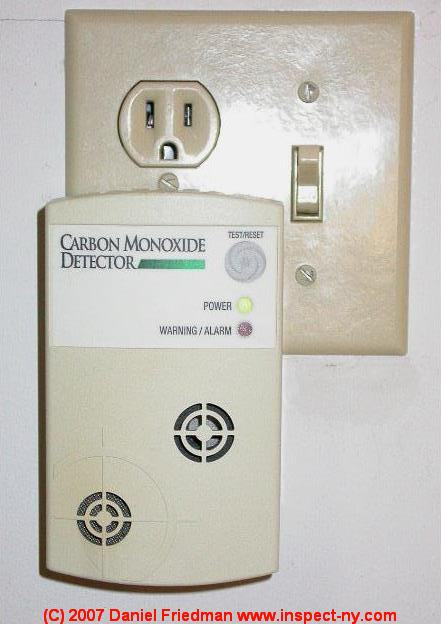
Carbon monoxide detectors are inexpensive and readily available, both as a battery-operated unit and as a unit that plugs into an electrical outlet in the home.
No home should be without this safety protection, and homes with gas-fired equipment (natural gas or LP propane), space heaters, or other sources of risk should be extra cautious. Smoke detectors do not protect against carbon monoxide poisoning, and the opposite is also true. Carbon monoxide detectors do not warn of smoke or fire.
Carbon monoxide is a colorless, odorless, tasteless gas that, in its effects on humans, is a chemical asphyxiant - that is, it causes asphyxiation, or death by preventing a person from receiving adequate oxygen. When inhaled, carbon monoxide combines with hemoglobin in the blood more readily than oxygen does.
Thus CO "displaces" or moves oxygen out from hemoglobin in the bloodstream. This interferes with oxygen transport by the blood.
A person suffering from carbon monoxide (CO) intoxication may first experience euphoria (similar to the effect of a martini or two), then carbon monoxide poisoning effects lead to a headache, followed by nausea and possibly vomiting as the concentration of carboxyhemoglobin in the blood increases.
To prevent these effects, OSHA has established a PEL of 50 ppm for an 8-hr exposure, identical to the TLV.
NIOSH, on the other hand, has decided to be more conservative and recommends a standard of 35 ppm.
All of these concentrations refer to exposures with durations of 8 hr/day, 40 hr/week for a working lifetime and all are attempts to establish a "no effect" level.
To prevent these effects, OSHA has established a PEL of 50 ppm for an 8-hr exposure, identical to the TLV. NIOSH, on the other hand, has decided to be more conservative and recommends a standard of 35 ppm.
All of these carbon monoxide or other gas exposure limit concentrations refer to exposures with durations of 8 hr/day, 40 hr/week for a working lifetime and all are attempts to establish a "no effect" level. Here are some other exposure levels and effects of carbon monoxide exposure from various sources:
Table I. Effects of Carbon Monoxide Exposure Levels, Duration, & CO Exposure Limits | |||
| PPM CO Exposure | Duration of CO Exposure |
Effects of Exposure to Carbon Monoxide at this level | Source/comment |
| 0 ppm | No effects, this is the normal level in a properly-operating heating appliance | No carbon monoxide should be detected in residential properties. Possible brief technical exceptions occur. | |
| 0-4.4 ppm | 8 Hours | Considered "Good" Air Quality | U.S. EPA 1999 Air Quality Index Reporting Guidelines. (AQI) |
| 4.5 - 9.4 ppm | 8 Hours | Considered "Moderate" Air Quality | U.S. EPA 1999 Air Quality Index Reporting Guidelines. |
| 9 ppm | Maximum allowable short term exposure | ASHRAE | |
| 9.5 - 12.4 ppm | 8 Hours | Considered "Unhealthy Air Quality for Sensitive People" | U.S. EPA 1999 Air Quality Index Reporting Guidelines. |
| 10 - 24 ppm | Investigation needed to find source; | Health effects on humans uncertain. | |
| 12.5 - 15.4 ppm | 8 Hours | Considered "Unhealthy" Air Quality | U.S. EPA 1999 Air Quality Index Reporting Guidelines. |
| 15.5 - 30.4 | 8 Hours | Considered "Very Unhealthy" Air Quality | U.S. EPA 1999 Air Quality Index Reporting Guidelines. |
| 25 ppm | Maximum allowable TWA exposure limit | OSHA. Used in personal CO alarms. | |
| 30 ppm | 30 Days | Non-response level for CO detectors over 30 days | Home CO detector alarms are designed to not sound when exposed to 30 ppm (or less) of continuous carbon monoxide for 30 days in order to avoid nuisance sounding. See CO ALARM CAUSES |
| 30.4 - 50.4 ppm | 8 Hours | 8-hour limit at which the U.S. EPA designates CO as hazardous | U.S. EPA 1999 Air Quality Index Reporting Guidelines. |
| 35 ppm | 8 Hours | Maximum allowable workplace exposure limit for an 8-hour work shift | NIOSH (40 hour work week) ACGIH threshold limit value (TLV) for an 8-hour work day. American Conference of Government Industrial Hygienists. This limit is designed to protect healthy workers. |
| 50 ppm | Maximum allowable workplace exposure limit for an 8-hour work shift | OSHA CO PEL (Permissible Exposure Limit) (40 hour work week or 8 hour work day) The U.S. EPA considers this level as hazardous for the general public. | |
| 125 ppm | Workplace alarm must sound | OSHA | |
| 200 ppm | Evacuate the area immediately. | Exposure at 200 ppm of CO causes dizziness, nausea, fatigue. | |
| 400 ppm | Evacuate the area. | 3 hour exposure may be fatal. | |
| 800 ppm | Evacuate the area. | 2-3 hour exposure causes convulsions, loss of consciousness, death. | |
| 1600 ppm | Evacuate the area. | ||
| 6400 ppm | Evacuate the area. | 30 minutes of exposure causes convulsions, loss of consciousness, death | |
| 12,800 ppm | Evacuate the area. | 1-3 minutes of exposure causes convulsions, loss of consciousness, death | |
NOTES to the Carbon Monoxide Effects Table:
Sources include OSHA, EPA, www.transducertech.com
AQIs as published in the Federal Register: 64 FR 42529-42573, August 4, 1999 and updated from 73 FR 164354-165-14, March 27, 2008.
See CO ALARM CAUSES for a discussion of the CO levels and time intervals at which carbon monoxide detectors & alarms respond.
ABBREVIATIONS: used with gas exposure limits
Definition of PEL = permissible exposure limit. PEL's are a regulatory limitation to exposure used to specify the allowable exposure to a substance in the workplace and assume that the exposure takes place over an 8-hour shift in a 40-hour work week. Note that there are more stringent exposure limits for higher levels of exposure that may occur over a shorter time interval
Definition of PPM = parts per million of concentration of the gas of interest in air. 1 ppm means one part of gas to 1 million parts of air.
See CONVERT PPM to % CONCENTRATION to convert between % and ppm concentration of gases in air
Definition of MAX = maximum exposure in ppm for any individual in the work area over an 8-hour period
Definition of MSDS = Material Safety Data Sheet, published for every chemical or substance that may be hazardous; if an exposure limit has been published for a substance being discussed in an MSDS, that limit, such as TWA or PEL, is required to be included in the MSDS publication.
Ref: 29 CFR 1910.1200 (g)(2)(i)(C)(2) and (g)(2)(vi).
TWA's and PEL's are not available for most chemicals. There are simply too many chemicals, many of which have not gone through the rigorous scientific study and peer review required. The absence of an exposure limit for a substance should not be used to assume that a substance is not hazardous.
See MSDS MATERIAL SAFETY DATA SHEETS
Definition of TIME = as used in environmental exposure literature: the point in time when the maximum exposure will occur from the beginning of any 8-hour period
Definition of TE = total exposure in ppm per hour
Definition of TLV = threshold limit value: the level of exposure that a worker can experience in the workplace without an unreasonable risk of disease or injury. These are not estimates of "level of risk" for different exposure levels nor do they address the different means by which a person may be exposed to a substance.
TLV's are specified by ACGIH, the American Conference of Government Industrial Hygienists. TLV's are guidelines prepared by ACGIH and are solely concerned with health risk. They do not address economic considerations.
TLV's are not regulatory but rather are advisory. (See PEL and TWA which are specified by OSHA).
Definition of TWA = time weighted average exposure level. TWA's are a regulatory exposure limit. The TWA calculation takes into account that exposure level may vary over a time period.
Original document source
This carbon monoxide discussion file originated from a technical expert message board discussion on Carbon Monoxide and later Carbon Dioxide alarms, featuring comments by one of the leading authorities on CO, Jack Peterson, P.E., CIH, Ph.D., in May, 1987.
NOTE: Daniel Friedman extracted CO and CO2 sections from that document, edited and added practical and field inspection-based information.
Since its original publication this document has been expanded by reference materials from a variety of other sources.
Reader Comments, Questions & Answers About The Article Above
Below you will find questions and answers previously posted on this page at its page bottom reader comment box.
Reader Q&A - also see RECOMMENDED ARTICLES & FAQs
Question:
My husband was washing away the paint of a small room with a water pressure machine. Due to the baby on the home he decided to close the door and the window to prevent the baby to frightened. A few minuted later he
came out of the room feeling dizzy, he sat down a smoked a cigarette when he stood up he began walking as if drunk still claiming of dizziness, he immediately fell and was unconscious for more than two hours. Was was the real problem? Was it Carbon Monoxide? - Kelly 10/4/11
Reply:
It could be a CO hazard, and it is certainly worth an immediate inspection of your heating equipment by an expert, including an inspection of the chimney as well as all fuel burning appliances and combustion air.
But one is tempted to suspect something about what he was doing.
FIRST STEP: be SURE you have working CO detectors in appropriate locations and correctly installed, including in bedrooms, baby's room, etc.
Question: what are the effects of Long Term CO poisoning.
Hello~ Could you please direct me to any articles dealing with Long Term CO poisoning.
My daughter was exposed for 3 1/2 years while renting an apt. with extemely faulty furnace ductwork.
The Landlord knew of the leaks ~ did NOTHING, and also gave her a defective CO detector.
Finally the Furnace completely broke down and the repair man said it was a miracle that she hadn't died as it was the worst hookup he had ever seen in 29 years. She has been convalescing for the past 11 months but still is quite lethargic and can't awaken on her own even after 12 hours of sleep.
Thank you for any help you can offer us!
Sincerely,
Vanessa Jordan
Reply:
Sure, Vanessa, please see these two articles
- MEDICAL EFFECTS of CO - separate article
- POISONING SYMPTOMS - CO - separate article
...
Continue reading at HEAT EXCHANGER LEAK ALLOWED or select a topic from the closely-related articles below, or see the complete ARTICLE INDEX.
Or see these
Carbon Monoxide Gas Articles
- CARBON MONOXIDE - CO
- CARBON MONOXIDE WARNINGS: HOME HEATERS
- CONVERT PPM to % CONCENTRATION to convert between % and ppm concentration of gases in air
- GAS DETECTION INSTRUMENTS
- GAS EXPOSURE EFFECTS, TOXIC
Suggested citation for this web page
CO EXPOSURE LIMITS at InspectApedia.com - online encyclopedia of building & environmental inspection, testing, diagnosis, repair, & problem prevention advice.
Or see this
INDEX to RELATED ARTICLES: ARTICLE INDEX to GAS HAZARDS in BUILDINGS
Or use the SEARCH BOX found below to Ask a Question or Search InspectApedia
Ask a Question or Search InspectApedia
Try the search box just below, or if you prefer, post a question or comment in the Comments box below and we will respond promptly.
Search the InspectApedia website
Note: appearance of your Comment below may be delayed: if your comment contains an image, photograph, web link, or text that looks to the software as if it might be a web link, your posting will appear after it has been approved by a moderator. Apologies for the delay.
Only one image can be added per comment but you can post as many comments, and therefore images, as you like.
You will not receive a notification when a response to your question has been posted.
Please bookmark this page to make it easy for you to check back for our response.
Our Comment Box is provided by Countable Web Productions countable.ca
Citations & References
In addition to any citations in the article above, a full list is available on request.
- "Choosing and Using a Carbon Monoxide CO Monitor," Dan Friedman, The ASHI Technical Journal, Vol. 2 No. 1, July1991
- Dräger MSDS for Dräger CH25301 Air Current Tubes, Page 1 of 2.
Dräger MSDS for Dräger CH25301 Air Current Tubes , Page 2 of 2.
Watch out: the Dräger air current tube or "smoke tube" # CH16631 produces a sulfuric acid gas sulfuric acid H2SO4 /SO3 that is dangerous to life and is highly corrosive. Take a look at our copy of the Dräger MSDS for their CH25301 Air Current Tubes. We stored this MSDS in the box with the rubber bulb and tube cutter provided by Dräger. These air current monitoring tubes are provided with rubber caps so that the tube can be "stopped" or shut down when not in use. But the sulfuric acid was so corrosive that it not only caused the rubbger caps to disintegrate, it actually "burned" or oxidized our copy of the MSDS paper form! - In addition to citations & references found in this article, see the research citations given at the end of the related articles found at our suggested
CONTINUE READING or RECOMMENDED ARTICLES.
- Carson, Dunlop & Associates Ltd., 120 Carlton Street Suite 407, Toronto ON M5A 4K2. Tel: (416) 964-9415 1-800-268-7070 Email: info@carsondunlop.com. Alan Carson is a past president of ASHI, the American Society of Home Inspectors.
Thanks to Alan Carson and Bob Dunlop, for permission for InspectAPedia to use text excerpts from The HOME REFERENCE BOOK - the Encyclopedia of Homes and to use illustrations from The ILLUSTRATED HOME .
Carson Dunlop Associates provides extensive home inspection education and report writing material. In gratitude we provide links to tsome Carson Dunlop Associates products and services.
 | HOME | ABOUT | ASK a QUESTION | CONTACT | CONTENT USE POLICY | DESCRIPTION | POLICIES | PRIVACY | |
| © 2024 - 1985 Publisher InspectApedia.com - Daniel Friedman | |||||||||