
InspectAPedia® FREE Encyclopedia of Building & Environmental Construction, Diagnosis, Maintenance & Repair |
Question? Just ask us! InspectAPedia
|
 Vinyl Siding Installation, Inspection, Defect Diagnosis & Vinyl Siding Repair Guide
- POST a QUESTION or COMMENT about vinyl siding: installation, inspection, defects, repairs, environmental & health questions
Vinyl siding inspection, troubleshooting, & repair home page:
This article discusses vinyl building wall siding installation, trim, flashing, nailing details, the requirement for a water and air barrier behind siding, vinyl siding defect inspection & repair, and vinyl siding health and environmental questions.
We include photographs and sketches of vinyl siding installation procedures and of common defects observed in vinyl exterior building siding, such as buckling, splitting, cracks, odors, and questions about the need for a vapor barrier behind vinyl siding and over building sheathing. Included are comments from several recognized building inspection and construction authorities.
We provide links to authoritative information for vinyl siding installation, vinyl siding defect recognition & defect diagnosis, and related health & environmental information.
InspectAPedia tolerates no conflicts of interest. We have no relationship with advertisers, products, or services discussed at this website.
Vinyl Siding Inspection, Installation, Diagnosis, & Repair Home Page
 ...
... 
[Click to enlarge any image]
PVC based vinyl siding was introduced in the U.S. in the 1950's and 60's, began to overtake aluminum siding for building exterior wall coverings in the 1970's and by the 1980's was the dominant exterior siding material on residential structures in the U.S. for both new construction and for remodeling.
The cost of covering a building exterior with vinyl siding was competitive with a properly executed exterior paint job, and the result more durable. This article series, Vinyl Siding, includes review & comments about moisture & vapor barriers. Vinyl siding is popular in part because it is lightweight and easy to work with, easy to cut, trim, and install.
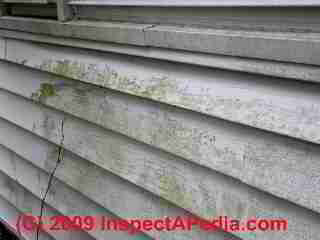
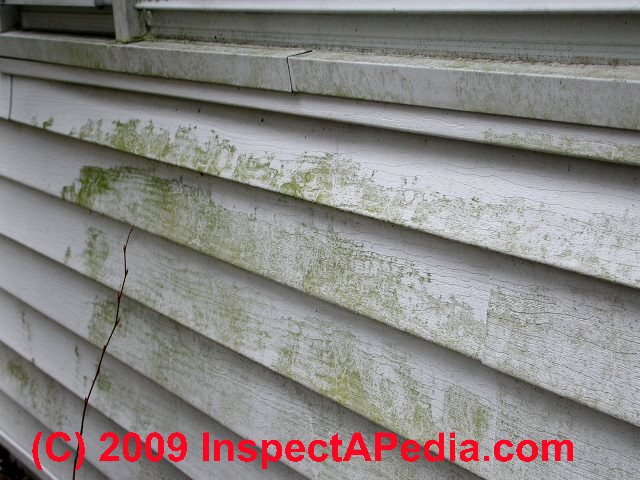
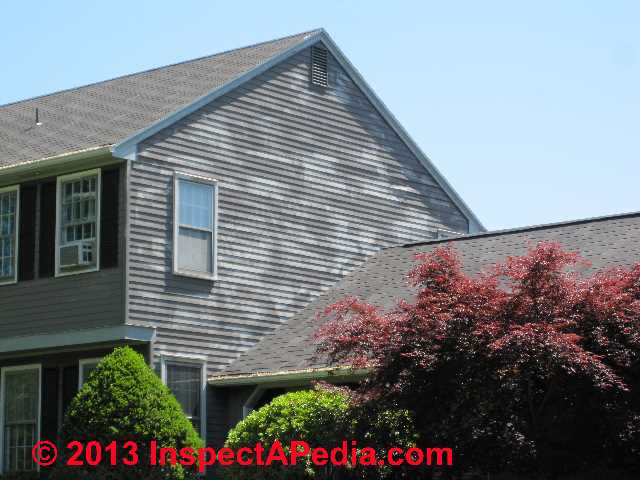
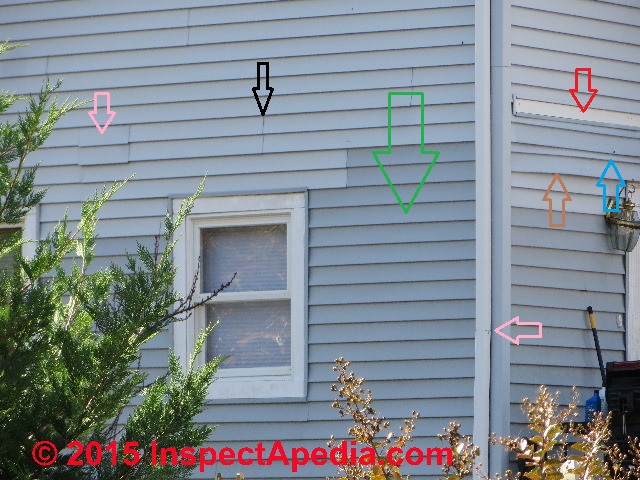
At above left is discolored vinyl siding on a New York home while at above right is a stunning example of a poor vinyl siding installation that we discuss in more detail
at VINYL SIDING INSPECTION & REPAIR.
Watch out: early vinyl siding suffered from weathering, cracking, impact damage, and buckling from heating. While modern vinyl siding products are very durable, impact and dent and weather resistant, the material will still buckle if it is not properly installed (nailed too tightly to the building).
- For a detailed photo guide to vinyl siding defects see our separate document
VINYL SIDING INSPECTION & REPAIR - Also see the detailed Vinyl Sidinglinks listed at the ARTICLE INDEX the bottom of this article .
- Readers should also
see SIDING TYPES, INSTALLATION, DEFECTS and
see ALGAE, FUNGUS, LICHENS, MOSS for algae and stains on vinyl building siding and on vinyl exterior trim.
Review and technical comments about "Sizing Up Vinyl Siding", ASHI Reporter:
"Sizing up vinyl siding," by Mark Cramer, on p. 17 of the Jan 94 ASHI Reporter, with annotations from letter, MC to DJF 01/11/1994 and later annotations and updates about the requirement for and function of house wrap or other barriers below vinyl siding on buildings.
Mark Cramer's article on the need for a moisture barrier beneath vinyl siding was of considerable interest. It was particularly helpful that he included a "building code citation Section 1702.3."
The reference to an authoritative source is the quickest way to distinguish between personal opinion and authority.
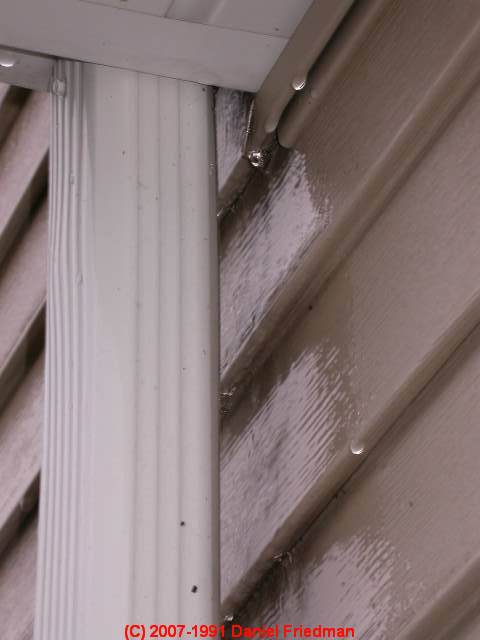
Our vinyl siding photo (left) shows water running out from behind vinyl siding on a new home.
Building Code Requirement for Building Siding Air, Moisture, & Water Barriers, including for Vinyl Siding
The requirement for weather-resistive barriers behind building sidings is detailed
Additional remarks on housewrap or weather barriers for vinyl siding are provided just below.
In addition to VAPOR BARRIERS & HOUSEWRAP, readers should see these articles on vapor barriers:
- VAPOR BARRIERS, VINYL SIDING - details of U.S. & Canadian requirements for a moisture barrier behind vinyl siding
- VAPOR BARRIERS & CONDENSATION in buildings
- WATER BARRIERS, EXTERIOR
- AIR SEALING STRATEGIES
In conversation, home inspection educator Mark Cramer has provided some additional information about the requirements for weather-resistive barriers behind vinyl siding:
- The "code" citation was from the Standard Building Code, published by SBCCI. Similar language is in the Uniform Building Code (UBC) Sec. 1708.(a)
"All weather-exposed surfaces shall have a weather-resistive barrier to protect the interior wall covering."
The code goes on to permit building paper ("red rosin paper") and felt. It makes no mention of newer building "wraps" such as "Tyvek(TM)" which are an excellent wind and water barrier, but permit water vapor to pass (from inside the house wall to outside). - According to these codes, the weather-resistive barrier can be omitted
- when exterior covering is of approved weatherproof panels
- in back-plastered construction
- when there is no human occupancy
- over water-repellent panel sheathing (UBC) ... including [weather-resistant exterior grade] plywood (SBC)
- under approved paper backed metal or wire fabric lath
- behind lath and portland cement plaster applied to the underside of roof and eave projections.
- The same paragraph requires "... exterior openings exposed to weather be flashed in such a manner as to make them weatherproof." Mark and I
agree that problems associated with water leaks into siding are often at window and door penetrations, and at abutments of roofs to building sidewalls.
We had trouble understanding how the presence of felt in these areas, also having to be cut around the opening, would in typical construction application, increase resistance to water entry (for example at t he corners of windows). Many new windows come with pre-fab metal or plastic flashing which surrounds the corners. - Since our readers may refer to Mark's article in supporting their field observations, it's important to distinguish between "weather-resistive" barrier and "vapor barrier." The latter, of which plastic and foil are examples, should not be placed on the outside of walls, as it threatens to entrap condensation (from the conditioned interior) inside the walls.
- Mr. Cramer offered other citations of authority for this matter, including the Aluminum Association of Florida's "AAF Standards for the construction of
aluminum and allied products," Std. 112 Siding, Soffit, & Fascia, which says:
"An approved membrane to protect against water intrusion shall be provided when installed over any non-waterproof surface, or the cladding shall be designed and constructed with an approved continuous edge, interlock, overlap, or seam to prevent water intrusion."
Much new construction uses exterior-grade plywood sheathing. I interpret 2.d (which is Section 1708.(a)4. in the UBC) to mean that the barrier is not needed in these cases.
This authority also requires that siding shall be installed to the requirements of the SBC, AA incorporated/AAMA Aluminum Siding Application Manual and/or the Rigid Vinyl Siding Application Manual of VSI, in addition to the manufacturer's recommended procedures.
Here's where the topic of weather barriers and building siding got interesting:
First, the AAF's actual siding manual provided no details on flashing except to say "flash as required."
And regarding the requirement of a moisture barrier, the text goes on to say that some manufacturers require it and some do not.
I'd like to know of any code jurisdictions where you know that the requirement for a moisture barrier is being monitored or enforced by local officials.
*** ANS: (Letter M Cramer to Daniel Friedman 1/11/94) Rev to 1988 SBC, (1990?) which was code in effect when subject house was constructed. Exceptions in this revision included water repellent panel sheathing but did not mention plywood or other products, as does the 1991 version.
Two questions seem to me to bear on this matter: First, the material behind siding is not normally visible.
However from several means one might know or suspect that the moisture barrier was omitted in some areas. Second, whether present or absent, the material does not excuse the inspector from looking for evidence of water damage to building components.
*** Comment: (ibid) The issue of felt under siding can be looked at as one of common sense.
The felt is a dry-in layer just like the felt under the shingles on a roof. When a leak occurs, the felt serves to direct the moisture down the wall to the bottom where it can run off. As to the contention that leakage may still occur at penetrations such as windows, this is no different than a penetration in the roof, except that the sealing done at a window penetration would generally be better than what is done on the roof.
*** Comment: (Ibid) Vinyl siding is considered a water shedding material rather than a water-tight material.
The tremendous expansion and contraction with temperature changes has a tendency to open things up when at the contracted state. Wind can blow rain between the laps at the ends of individual pieces of siding and at the ends of pieces at J-moldings. You would be surprised where wind can blow rain when velocities get up around 75 mph or so!
*** One source of water entry that just occurred to me is the laps at ends of pieces of siding when you have a sidewall flashed roof above with no gutter. (Common here [Florida].) Water shooting off the roof at an angle close to horizontal could easily get behind the siding at the laps.
*** Installation of flashings around windows and doors is typically not done correctly. In talking with people in the business I have found that there is a specific head flashing that manufacturers recommend [but] that is never used.
Other installation defects are common, such as installing corner trim pieces with the upper piece beneath [lapped inside] the lower piece. In the real world you have to accommodate the [full range of training level of the] person who is installing the product.
These are more reasons for the installation of a moisture barrier. You have to look at it as the underwear for the siding. NOt absolutely necessary at all times, but very handy under certain conditions.
*** I don't agree with the logic that because you have an opening in the felt you are going to have a leak anyway. If the felt is installed reasonably well, the chances of leaking are reduced. By reasonably well I mean install strips around and lapped into the opening, install the windows, caulking the flanges to the strips, and then install the felt over the wall, lapping it over the strips at he windows. This arrangement will be water tight.
[Comment DJ Friedman: the above caulking details during construction would be very rare - I've never seen it during any new construction, nor seen it specified in siding installation manuals. The detail that most prevents leaks in at windows is proper installation details of the J-flashing above and around the window, caulking at the sill, and assuring that siding below the sill does not protrude nor otherwise permit water entry.]
*** Regarding code enforcement, I supervised the construction of a 5000 sq.ft. custom home this year, with an acre of brick veneer on the front of the house. Portions of walls were wood frame. When the brick was 3/4 the way up the walls, I stopped by and noticed that there was no moisture barrier under the brick. I insisted that one be installed. The local building inspector backed me up. (Rare occasion.) There is enforcement of this requirement in most municipalities around here.
[Comment DJF: this points up the fundamental reality and problem that inspection of every construction detail (moisture barrier behind brick) is rarely achieved since the builders are simply not able to stop construction at every phase to wait for the off-site inspector to come on-site. Inexperienced or certain other crews are often pressured by time and cost to take shortcuts or leave out materials, the importance of which they may not really believe.]
*** I agree with not quoting code. I rarely do in a home inspection for the same reasons you provide, and others. But when you are telling a seller they have a multi-thousand dollar problem, your opinion is often questioned. That's an occasion when I will quote codes.
ASHI inspectors should be alert for evidence of damage or other problems associated with water penetration of siding. I'd like to know where you're finding damage, and what you can see as the apparent path of water entry - that is, what's the real source of the problem? Otherwise we have a "standard" that is more confusing than helpful.
It's always important for us to know the authoritative source for our assertions, just as it's important for us to identify when something is our opinion. Mr. Cramer is a licensed building code official and as such can state that something is a "violation." As a non-code official myself, I have less trouble when I express the opinion that something is a good or bad construction practice.
That wording gives me considerable latitude to include many non "code" sources as well as the experienced of ASHI inspectors who study in-service field conditions.
Thanks again to Mark Cramer for the discussion and details about the requirements for a weather barrier behind vinyl wall siding. -- Daniel Friedman
Research on Vinyl Siding & Health Concerns
- American Conference of Governmental Industrial Hygienists (ACGIH). 1999 TLVs and BEIs. Threshold Limit Values for Chemical Substances and Physical Agents, Biological Exposure Indices. Cincinnati, OH. 1999.
- ATSDR, Medical Management Guidelines for VINYL CHLORIDE(C2H3Cl) - PDF from the US ATSDR, Department of health and Human Services, Agency for Toxic substances and Disease Registry, atsdr.cdc.gov/MHMI/mmg20.html. ATSDR can tell you where to find occupational and environmental health clinics. Agency for Toxic Substances and Disease Registry, Division of Toxicology and Environmental Medicine, 1600 Clifton Road NE, Mailstop F-32, Atlanta, GA 30333, 800-CDC-INFO • 888-232-6348 (TTY), Email: cdcinfo@cdc.gov
- CertainTeed VINYL & POLYMER SIDING INSTALLATION GUIDE [PDF] (2020) Certainteed Corporation P.O. Box 860 Valley forge, Pa 19482 USA, Tel: Professional: 800-233-8990 Consumer: 800-782-8777 www.certainteed.com
- Certainteed Weatherboard fiber cement siding and trim products - see certainteed.com/ or see certainteed.com/resources/sidingandtrimspecsheet.pdf
- EPA, "Vinyl Chloride, Hazard Summary-Created in April 1992; Revised in January 2000," US EPA, available at epa.gov/ttn/uatw/hlthef/vinylchl.html
- Asthma Citation: Bornehag, CG, et al. “Allergic symptoms and asthma among children are associated with phthalates in dust from their homes: a nested casecontrol study,” Environmental Health Perspectives. 15 July 2004
- HCL (hydrochloric acid) Toxicity Citation: OEHHA(CA Office of Environmental Health Assessment) Acute Toxicity Summary: Hydrogen Chloride March 1999
- Gold, Dan & Julie Parker, BLUE VINYL, (movie), BLUE VINYL TOXIC COMEDY PICTURES, 77 Bleecker St #C218, New York, NY 10012 Phone: 212.875.0456 Fax: 646.290.9274
Screening information: email: screenings@bluevinyl.org, Co-Director/Co-Producer Judith Helfand Judith@bluevinyl.org, Co-Dir/Co-Producer/D.P.
Dan Gold, Dan@bluevinyl.org, Co-Producer Julie Parker, Julie@bluevinyl.org - from the film's website: http://www.bluevinyl.org/
A Toxic Comedy Look at Vinyl, The World's Second Largest Selling Plastic. With humor, hope and a piece of vinyl siding firmly in hand, Peabody Award-winning filmmaker Judith Helfand and co-director Daniel B. Gold travel from Helfand’s hometown to America’s vinyl manufacturing capital and beyond in search of answers about the nature of polyvinyl chloride (PVC).
Her parents’ decision to “re-side” their house with this seemingly benign cure-all for many suburban homes turns into a toxic odyssey with twists and turns that most ordinary homeowners wouldnever dare to take.
The result is a humorous but sobering and uniquely personal exploration of the relationship between consumers and industry in the feature-length documentary BLUE VINYL, which won the cinematography award in the documentary competition at the 2002 Sundance Film Festival
BLUE VINYL also poses a refreshingly simple question: “Is it possible to make products that never hurt anyone at any point of their life cycle—when manufactured, when used, or when disposed of?" - Masonite, MASONITE WOODRUF® ROOFING OR MASONITE OMNIWOOD® SIDING LAWSUIT SETTLEMENT NOTICE [PDF]
- Myers, John H. & Gary L. Hume (Rev) ALUMINUM AND VINYL SIDING ON HISTORIC BUILDINGS [PDF] (1984) U.S. National Park Service, Technical Preservation Services, retrieved 2022/10/02, original source: https://www.nps.gov/tps/how-to-preserve/briefs/8-aluminum-vinyl-siding.htm
- NIH, CARCINOGENICITY of Vinyl Bromide Exposure, NIH, ntp.niehs.nih.gov/ntp/roc/eleventh/profiles/s185viny.pdf
- OSHA Vinyl acetate information: not to be confused with vinyl chloride
- information from OSHA: see osha.gov/SLTC/healthguidelines/vinylacetate/recognition.html includes exposure limits and hazard description.
- data sheet from DOW chemical: see dow.com/productsafety/finder/vinyl.htm
- "STANDARD SUPPORT and Environmental Impact Statement: Emission Standard for Vinyl Chloride" - original source U.S. Environmental Protection Agency US EPA, National Center for Environmental Publications (NSCEP) at http://www.epa.gov/nscep/ordering.html
- VINYL CHLORIE EXPOSURE QUESTIONNAIRE [PDF]
- US DOE, WEATHER-RESISTIVE BARRIERS [PDF] how to select and install housewrap and other types of weather resistive barriers, U.S. DOE
- VSI, SIDING with VINYL [PDF] , Vinyl Siding Institute, a vinyl building products industry association, National Housing Center, 120115th Street NW, Suite 220, Washington, DC 20005 - www.vinylsiding.org
- See also theReferences or Citations On each page for sources & citations for the content of this and other InspectApedia.com articles.
Reader Comments, Questions & Answers About The Article Above
Below you will find questions and answers previously posted on this page at its page bottom reader comment box.
Reader Q&A - also see RECOMMENDED ARTICLES & FAQs
Question:
Why is water ”pooling” on bottom corners of our newly installed vinyl chimney? - Shell 2/13/12
Reply:
I need clarification. Perhaps you are discussing condensation or perhaps rainfall or what ?
...
Continue reading at VINYL SIDING INSPECTION & REPAIR or select a topic from the closely-related articles below, or see the complete ARTICLE INDEX.
Or see these
Recommended Articles
- FLASHING on BUILDINGS - home
- HOUSEWRAP AIR & VAPOR BARRIERS - home
- SIDING TYPES, INSTALLATION, DEFECTS - home
- SIDING VINYL - home
- VAPOR BARRIERS, VINYL SIDING
- VINYL SIDING BUCKLED RIPPLED COMBINED EFFECTS?
- VINYL SIDING BUCKLED WARPED
- VINYL SIDING COEFFICIENT of LINEAR EXPANSION
- VINYL SIDING CLEANING METHODS
- VINYL SIDING CLEARANCE TO GROUND
- VINYL SIDING DEFORMED by SUNLIGHT
- VINYL SIDING FIRE DAMAGED
- VINYL SIDING GAPS, HOLES, CRACKS
- VINYL SIDING GRILL COOKER DAMAGE
- VINYL SIDING HOOK to REMOVE & REPLACE
- VINYL SIDING IMPACT DAMAGE
- VINYL SIDING INSPECTION & REPAIR
- VINYL SIDING INSTALLATION
- VINYL SIDING INSTALLATION MANUALS
- VINYL SIDING INSTALLATION PROCEDURES
- VINYL SIDING LEAKS
- VINYL SIDING LOOSE, BLOW-OFFS
- VINYL SIDING MOVEMENT DAMAGE
- VINYL SIDING STAINS
- VINYL SIDING STAIN CLEANING METHODS
- VINYL SIDING or WINDOW PLASTIC ODORS
- VINYL CHLORIDE HEALTH INFO
Suggested citation for this web page
VINYL SIDING at InspectApedia.com - online encyclopedia of building & environmental inspection, testing, diagnosis, repair, & problem prevention advice.
Or see this
INDEX to RELATED ARTICLES: ARTICLE INDEX to BUILDING SIDING
Or use the SEARCH BOX found below to Ask a Question or Search InspectApedia
Ask a Question or Search InspectApedia
Questions & answers or comments about vinyl siding: installation, inspection, defects, repairs, environmental & health questions.
Try the search box just below, or if you prefer, post a question or comment in the Comments box below and we will respond promptly.
Search the InspectApedia website
Note: appearance of your Comment below may be delayed: if your comment contains an image, photograph, web link, or text that looks to the software as if it might be a web link, your posting will appear after it has been approved by a moderator. Apologies for the delay.
Only one image can be added per comment but you can post as many comments, and therefore images, as you like.
You will not receive a notification when a response to your question has been posted.
Please bookmark this page to make it easy for you to check back for our response.
Our Comment Box is provided by Countable Web Productions countable.ca
Citations & References
In addition to any citations in the article above, a full list is available on request.
- Steve Bliss's Building Advisor at buildingadvisor.com helps homeowners & contractors plan & complete successful building & remodeling projects: buying land, site work, building design, cost estimating, materials & components, & project management through complete construction. Email: info@buildingadvisor.com
Steven Bliss served as editorial director and co-publisher of The Journal of Light Construction for 16 years and previously as building technology editor for Progressive Builder and Solar Age magazines. He worked in the building trades as a carpenter and design/build contractor for more than ten years and holds a masters degree from the Harvard Graduate School of Education. Excerpts from his recent book, Best Practices Guide to Residential Construction, Wiley (November 18, 2005) ISBN-10: 0471648361, ISBN-13: 978-0471648369, appear throughout this website, with permission and courtesy of Wiley & Sons. Best Practices Guide is available from the publisher, J. Wiley & Sons, and also at Amazon.com - Mark Cramer Inspection Services Mark Cramer, Tampa Florida, Mr. Cramer is a past president of ASHI, the American Society of Home Inspectors and is a Florida home inspector and home inspection educator. Mr. Cramer serves on the ASHI Home Inspection Standards. Contact Mark Cramer at: 727-595-4211 mark@BestTampaInspector.com
- John Cranor [Website: /www.house-whisperer.com ] is an ASHI member and a home inspector (The House Whisperer) is located in Glen Allen, VA 23060. He is also a contributor to InspectApedia.com in several technical areas such as plumbing and appliances (dryer vents). Contact Mr. Cranor at 804-873-8534 or by Email: johncranor@verizon.net
- Thanks to reader Uri Dekel, Ph.D. for discussing PVC hazards and building odors 4/12/2010
- In addition to citations & references found in this article, see the research citations given at the end of the related articles found at our suggested
CONTINUE READING or RECOMMENDED ARTICLES.
- Carson, Dunlop & Associates Ltd., 120 Carlton Street Suite 407, Toronto ON M5A 4K2. Tel: (416) 964-9415 1-800-268-7070 Email: info@carsondunlop.com. Alan Carson is a past president of ASHI, the American Society of Home Inspectors.
Thanks to Alan Carson and Bob Dunlop, for permission for InspectAPedia to use text excerpts from The HOME REFERENCE BOOK - the Encyclopedia of Homes and to use illustrations from The ILLUSTRATED HOME .
Carson Dunlop Associates provides extensive home inspection education and report writing material. In gratitude we provide links to tsome Carson Dunlop Associates products and services.
 | HOME | ABOUT | ASK a QUESTION | CONTACT | CONTENT USE POLICY | DESCRIPTION | POLICIES | PRIVACY | |
| © 2024 - 1985 Publisher InspectApedia.com - Daniel Friedman | |||||||||