
InspectAPedia® FREE Encyclopedia of Building & Environmental Construction, Diagnosis, Maintenance & Repair |
Question? Just ask us! InspectAPedia
|
 Inspecting or Installing Storm Window Weep Holes
- POST a QUESTION or COMMENT about storm window drainage weep holes
Window frame or storm window drainage & weep hole requirements:
Storm windows, particularly metal-framed storms and screens are secured to a window opening outdoors using screws through a metal flange.
Many installers and homeowners proceed to make their storm windows as air-tight as possible - which makes sense. But if the weep openings at the bottom storm window flange are sealed by caulk, sealant, or just junk and debris you're asking for trouble.
This article series explains why weep holes or drainage are needed in storm windows and in some site-built fixed glazed windows.
InspectAPedia tolerates no conflicts of interest. We have no relationship with advertisers, products, or services discussed at this website.
Guide to Weep Holes in Windows, Storm Windows, Window Frames

[Click to enlarge any image]
Question: Why do we need those open air weep holes in storm windows?
One thing that seems bizarre to me is status/need for open air weep holes.
Would think they’d reduce air sealing quite a bit. Am surprised no one uses a semi-permeable membrane covering larger weep holes. - G.K., New York
Reply: To avoid rotted window sills, walls, insects, mold
Storm windows are additional windows, fixed or operable, that are hung or installed over the main window sash to reduce heat loss through the window.
A "triple-track" storm window incorporates a movable screen and upper and lower window sashes. Each layer of glazing added to a window cuts heat loss through the window glass by about one third, but if the window is drafty any energy savings will be lost until the drafts are found and sealed.
All factory-built storm window frames will include some sort of weep opening to make certain that any water entering the space between window sash and storm sash can drain safely to the building exterior.
But unfortunately folks who don't recognize what these openings are, or even that they are present, often seal them with caulk. The ultimate result is window sill rot and in severe cases wall rot, insect damage, and mold contamination of the wall cavity below.
At WINDOW / DOOR ENERGY EFFICIENT, DOE we read:
Exterior-mounted storm windows must have "weep holes" at the bottom of the frame to allow any moisture that collects between the primary window and the storm window to drain out. Even though these drainage holes subtract from energy savings, not having them will eventually cause the primary window frame to rot, and possibly make them impossible to operate.
Our OPINION is that the energy lost through two tiny weep holes in a storm window bottom frame is trivial compared with the energy savings from adding this additional layer of glazing and stopping outdoor air from blowing across the primary window sash glass.
And we're afraid that the permeable membrane you suggest won't adequately pass the large volume of water that is often found in the space between main sash and storm window bottom frame.
How Water Gets Between the Window Sash and Storm Window
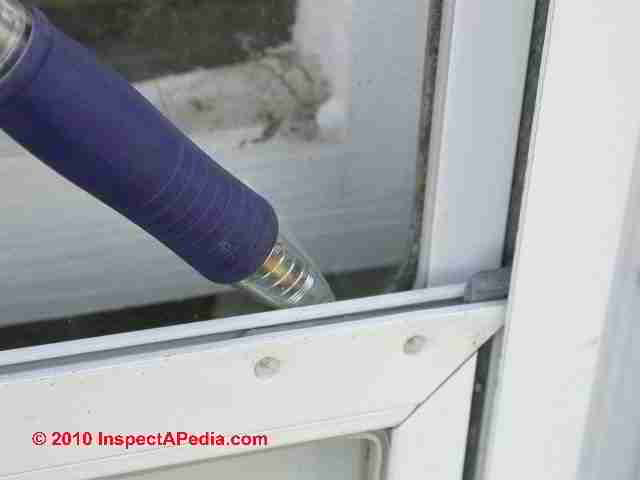
So where does this must-drain water between storm window and principal window sash come from?
[Click to enlarge any image]
- Condensation between the two windows:
if the primary window itself is more leaky than the storm window, interior air and moisture can leak into the interstitial space, accumulating considerable moisture. Condensate may form on the outside surface of the primary sash, or on the inside surface of the storm window sash. It depends. - Condensation indoors
on the primary window can also be so extensive that spilling condensate runs down the window sash frame and below the sash into the sill space. - Storm window rain leaks:
particularly if someone leaves the storm window upper or lower sash open (a typical triple-track storm window has two movable glass sashes and a screen) wind-blown rain easily enters the window space, forming a little lake between the primary window sash and the storm window frame if that frame is not drained at its bottom. - Storm window sashes in wrong position (photo above):
on occasion we find that someone has raised the wrong storm window sash to the uppermost position even though both storm window sections are "closed".
The outermost storm window is the one that should be in the fully "up" position, and the innermost storm window (innermost means towards the building interior) should be the one left in the "down" position when the storm window is closed.
If you do this backwards rain will run down the sash in the upper position and pass onto the inside surface of the lower storm sash, making another sash lake. We mean "lake" too, not just "leak". Our photo (above) shows how water will pass down the upper sash and behind the lower sash into the window interior space.
- Ice dam leaks into the window space from the roof above.
For a dramatic example of ice dam leaks into a window sill
see ICE DAM LEAK EMERGENCY REPAIRS
Examples of Storm Window Weep Holes
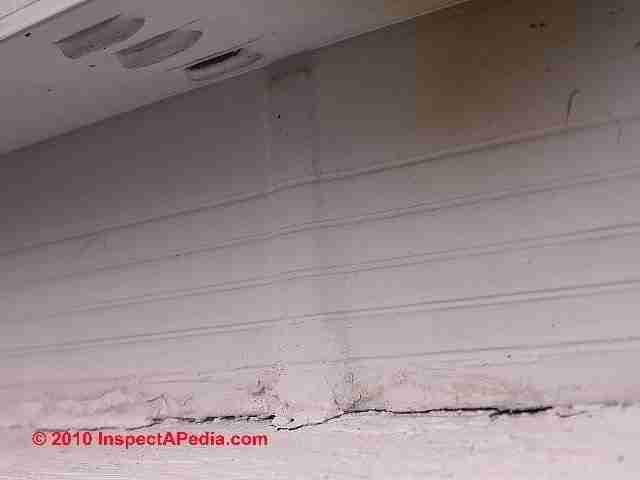
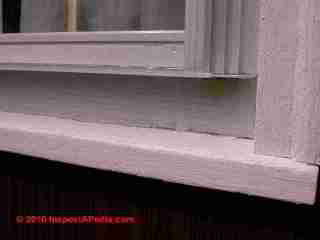
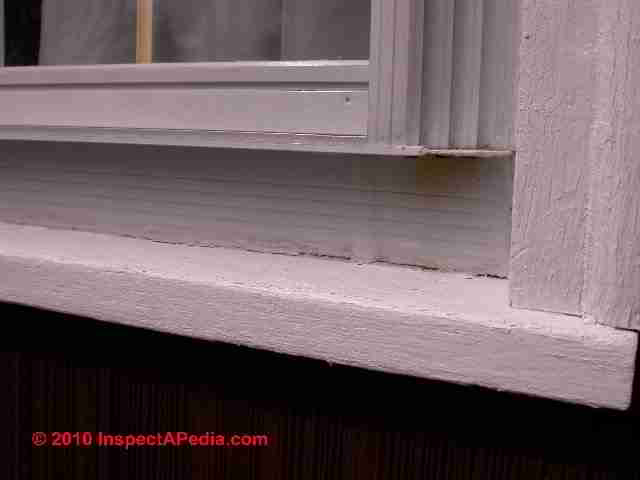
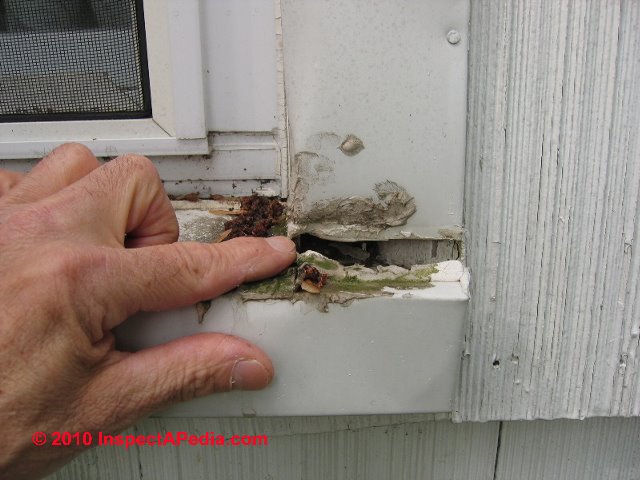
Our storm window weep opening photo (left) is a close-up of the same window shown at the top of this article.
In this design the manufacturer intends that that outwards vertical "U" shaped bulge or stamping in the aluminum storm window frame (just above the "A" in "InspectAPedia") is intended to drain water out of the sill area between the sash and storm.
But you can also see that over the life of the home it's easy for someone enthusiastically caulking along to spread their sealant right over the outlet intended to drain water.
At this home the outside storm window caulk had cracked away, permitting the interior sill area to drain.
Retrofitting Weep Holes into Caulked Storm Window Frames
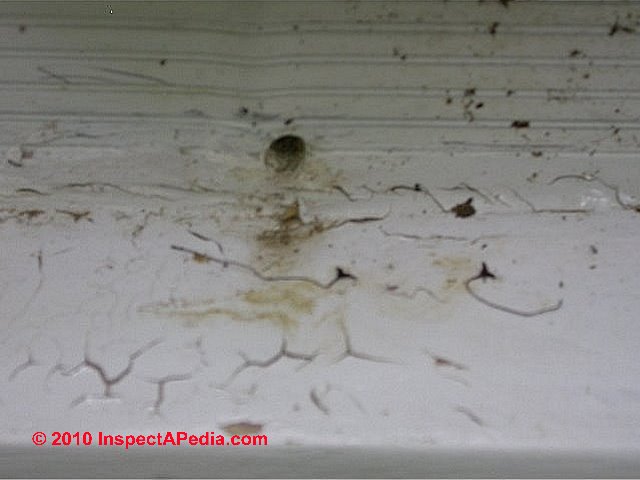
This is what we do if the storm windows have been totally caulked along the bottom edge of their frame.
Drilling a pair of 1/4" holes through the aluminum storm window frame bottom vertical edge, working from outside the window (or inside if you're on a higher floor), make each hole about 4" in from the sides of the storm window. In our photo the sill needs painting, but the weep hole is working properly despite the owner-applied caulk.
Watch out: do not drill into the wood of the window sill in either direction - aim your drill so that when it penetrates the aluminum frame into the storm-sash interstitial space, the drill bit is just flush with, not cutting into the window sill surface.
That way water trapped in that space can drain out readily, but you haven't compromised the wood. We have seen weep hole attempts that drilled right through the wooden sill - leading to rot.
If the weep hole you drilled is too large and your window-storm space is being invaded by insects, you might want to screen the opening as this owner did.
Watch out: do not use a weep hole screening material that won't readily drain water - doing so will defeat the purpose of the weep hole.
Photos of Rot & Damage from Missing or Clogged Storm Window Weep Holes
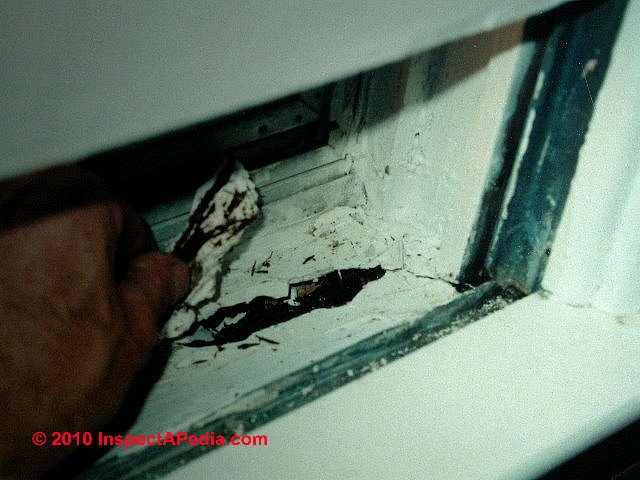
Here we see what an astute home inspector often finds: a history of leaks rotted the window sill, no one understood why, and the rot was "patched" with wood filler and paint, but the damage just continued.
This particular window was installed on a silo converted to living space at a country home. Poor window installation permitted water to leak into the space between window sash and storm window.
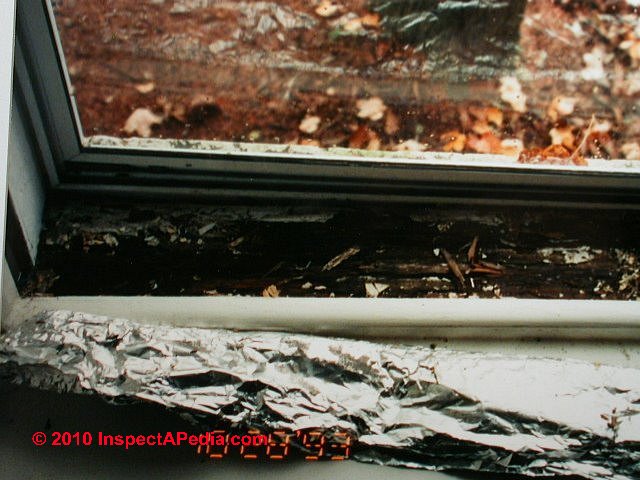
Our window rot photo (above left) shows severe window sill rot found at a home inspection back in 1993.
Water entered the space between the main window sash and the storm.
Water was trapped between the window sash and the storm window frame where it sat until the sill became so rotted that water leaked into the wall cavity below.
How to Avoid Leaks and Rot Damage at Aluminum Wrapped Window Sills & Trim
This photo shows that it's possible to cover up rotted window sills and trim with aluminum wrap-around trim.
But if the window structure is still trapping water between sash and storm, water leaks into the aluminum-wrapped space, and rot or perhaps insect damage continue to increase.
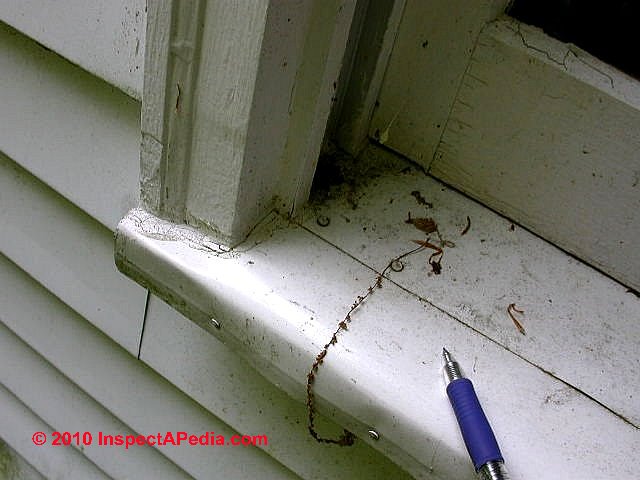
Careful detailing in installing the aluminum window trim wrap combined with proper sealing can reduce the outside sources of water leaks and rot, but if the storm window lacks weep openings that drain outside and on to the upper surface (not below) the new aluminum trim wrap, you're going to have trouble.
Our photo shows (above our pen) an extra piece of aluminum stock that was tacked onto the window sill before we completed storm window installations on this home. We added this upper aluminum covering because in his first attempt our contractor wrapped a piece of aluminum just big enough to pass under the storm window frame but not under the bottom edge of the primary window sash.
That mistake meant that any water entering the space between storm and sash would run under rather than over the aluminum stock, rotting our window.
By adding the upper piece of aluminum (we also sealed the nail heads), water in this space will be conducted safely outside when the storm window is added.
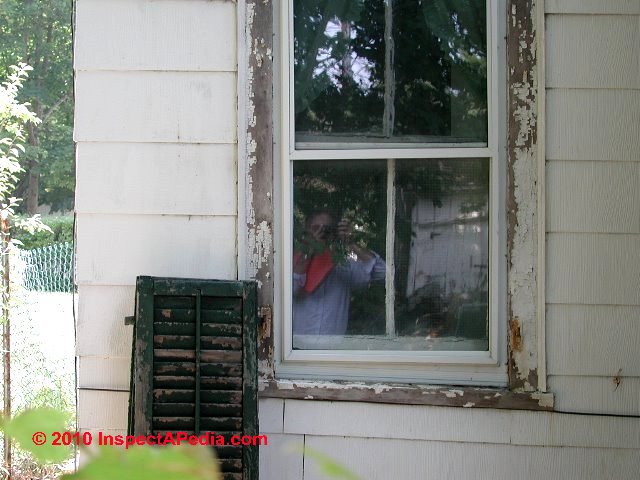
- FLASHING MEMBRANES PEEL & STICK and FLASHING WALL DETAILS include additional details to avoid leaks at building windows
Reader Comments, Questions & Answers About The Article Above
Below you will find questions and answers previously posted on this page at its page bottom reader comment box.
Reader Q&A - also see RECOMMENDED ARTICLES & FAQs
Reader Question: reader disagrees with sill profile image
(June 21, 2015) DonDownUnder said:
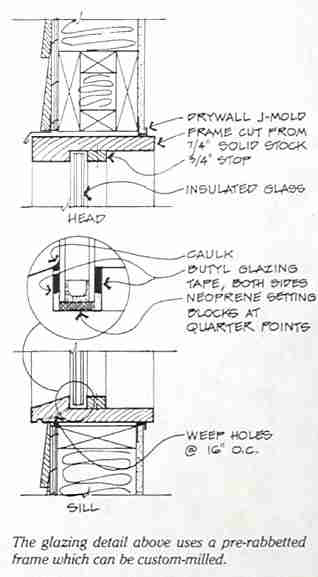
First, I have to comment that the detail for vertical glazing (inspectapedia.com/Energy/Vertical_Glazing_2c.jpg) is well,,, kind of defective in that the sill profile is generally reversed in all cases of window joinery I have seen. The thicker part of the sill is usually inside and the stop is outside.
Regardless if you have to drill weep holes through an existing sill a solution to avoiding the rot problem is as follows:
1.) Obtain small diameter (1/4" to 3/8") brass or aluminum tube. Hobby Shops Sell K&N brand in up too 36" Lengths. Another option might be fuel line or brake line tubing but if you put in steel tubing it will probably rust over time and clog or leak.
2.) Get another small length of rod or tube that fits inside weep tube (telescoping) for use in installation only. Call this the plunger. You will re-use this repeatedly for installation.
3.) Drill Slightly over sized holes through sill to accommodate tubing plus a slight gap for sealant. Making sure bottom of inside of tube will be at or below bottom of glazing pocket.
4.) Put a small glob of sealant in inside end of hole and push it through to the outside and push through with the plunger. You want to try and coat the entire inside of the hole you have drilled through the sill.
5.) Clean off the plunger.
6.) Insert plunger into Weep tube and Coat the outside of the weep tube with sealant and slide it into the hole.
7.) Remove plunger. Insure inside and outside edge of weep tube are fully sealed to sill.
8.) Check after sealant drying and clean weeps with plunger.
Example NTS s14.postimg.org/ahfa8f1u9/Weep_Detail_Page_1.jpg
other01@pafam.net
This question was originally posted at VERTICAL GLAZING DETAILS
Reply:
Don
Thanks for the comments and suggestions.
At STORM WINDOW WEEP HOLES (source of the weep opening photos above) we include details about weep openings in the bottom of storm window frames.
I'm unclear on the application of your suggestions to storm windows as a simple 1/4' hole in the bottom of the storm window frame just above the surface of the sill works well and does not need tubes nor sealants. I suspect you're discussing drain openings for a different type of window.
Can you clarify?
(June 22, 2015) DonDownUnder said:
Sure,
My suggestions are particularly addressed at VERTICAL GLAZING DETAILS and the detail which appears twice on that page (also referenced below)
[Click to enlarge any image]
In particular at the bottom sill detail it appears to show weep holes drilled at 16"o.c. down through the sill (which appears to have the wider portion of the section on the outside which would cause the rotting problem referenced on your storm window fix page.
On the referenced detail the stop is shown on the inside (which I have never seen) but if one where to run into that condition the weep solution I provided would help avoid rotting inside the walls.
And yes, the weep solution and recommendations for the storm fix are right on the mark! It's just that detail floating around I was concerned with because if someone where to try it, rot would probably follow in short order.
On 2017-10-15 by Joe H
Our condo faces the ocean at Melbourne Beach and we had water intrusion thru our aluminum slider window weep hole flaps during Irma. Appears that even with our storm shutters down the rain that collected in the tracks couldn't exit because the wind held the flaps closed. Does anyone have a solution?
On 2017-09-18 by (mod) - When Hurricane Irma passed by the weep holes allowed enough water in the condo that ruined the floors.
Thank you for making an important point. I'll do some investigation and Report further on details that can avoid water entry through the storm weep openings and also research what the standards are for Hurricane and storm areas. If you can provide any details or your friend can provide photos you can also use the page top or bottom contact link to find her email thanks again
In sum, weep holes must be properly sized and located so as to drain out while blocking significant wind-blown rain or water entry during storms.
In a high wind area using a storm window drain or weephole that incorporates a flapper or block against in-blowing water is probably essential.
On 2017-09-17 by NIck
I had a friend who rents a condo on Fort Lauderdale Beach, they have hurricane windows. When Hurricane Irma passed by the weep holes allowed enough water in the condo that ruined the floors.
On 2017-08-04 by (mod) -
Barbara,
That should be fine; plenty of homes with older storm windows don't have a sophisticated flapper valve, just an indentation or hole that allows any water in the window space between storm and sash to drain out.
On 2017-08-04 by barbara
Noticed when cleaning my windows that the weep holes are constantly open. The flaps look to be broken off. Is this a problem that they are always open?
On 2016-09-30 by (mod) -
Anon THat's what I'd do, so as to minimize air drafts and leaks.
On 2016-09-29 by Anonymous
Does it mean that only the holes or weep holes should not be caulked but we should caulk the bottom of the window sill or under the window sill
On 2016-08-14 by (mod) -
Scott:
Your photos (later we'll see if we can post them here for you and other readers to comment) show the lower area of a metal storm window that seems to have been pried away from the window sill. Certainly someone might have done that as an emergency move to let the sill drain, as suggested by your question.
A problem with making a big long gap along the storm bottom is that you may reduce its efficiency as an energy saver - draft-reducer on the home. A better solution, part of which you've done includes:
1. find and fix the sources of water leaking into the storm window space (wrong storm sash in raised or lowered position, gutter overflows, leaks down building walls from ice dams, etc).
2. Then seal all sides of the storm window, but
3. Then provide 1/4" diameter drain holes or weep holes just above the wooden sash - as illustrated in the article above.
On 2016-08-14 by (mod) -
Re-Posting
Scott Buchanan said:
We recently purchase an old house (the part in question was built in 1840) that at some point was fitted with aluminum storm windows. One of the windows was routinely filling up with water between the storm window and the regular window, causing water to leak into the wall.
This was primarily due to a gutter issue and the storm window sashes being backwards, but it was enabled by the lack of any open weep holes. Looking at the outside of the window, I can see what look like the exit holes, but there was no inside opening. I removed all the old caulk in case they were just covered up, but I didn't find anything.
Below is a URL to a photo gallery showing the inside and outside views. Would you take a look at the photos and see if you have any ideas on how the weep holes are supposed to work? Would it be worth drilling new weep holes in the aluminum? (Note that the gap between the frames was formerly stuffed with caulk; I will eventually refill it again for better air sealing.)
On 2016-02-28 by (mod) -
Dan
Please use our page bottom CONTACT link to send me some sharp photos of your storm windows and the weep openings. I've not seen a weep opening that opens and closes in response to wind. I'll comment further when I have researched just what you have installed. If there is a window brand and model that'd be helpful to know as well.
On 2016-02-28 by Dan
I have a new construction home and we just moved in. These weep hole covers make a rattling noise when it's windy because they open and close really fast. Are here covers I can replace them with that won't do this?
Question: plastic smell from aluminum storms
(Feb 26, 2012) Anonymous said:
We experience a plastic / metallic smell that occurs when our aluminum exterior mounted storm windows are closed and the sun hits them. It is a distinct odor. Is it common? Windows have been installed for 12 years.
Reply: check for odors from plastic screen material
(July 30, 2012) steve said:
Wow, talk about cobbling it up. That pic of the metal pieced into the sill looked terrible. It was just bent over the sill, not even fitted to it. Looked like a half assed job to me. I would have tore it all out and replaced the entire sill & what ever framing was rotted then installed new metal instead of piecing it together.
Reply: peanut-butter approach to construction: spread and collect
Steve, thanks for the comments - we agree.
Too often people go through the motions of fixing a problem or installing something, with no real understanding of or concern for avoiding future trouble
I call it the "peanut butter" school of construction - the installer thinks of his/her job as "buying stuff and spreading it like peanut butter, anywhichway on the building, and getting paid and leaving" - the job is guaranteed until the contractor's truck leaves the driveway.
Question: which storm window sash should be uppermost?
(Jan 12, 2013) Jason said:
For winter weather, should three-track storm windows have the outside glass storm up and middle down? Or, the other way around? We seem to have moisture (even with weep holes cleaned out) on the storm windows.
Reply:
Jason picture the direction of water running down a storm window. The uppermost storm window should be the outermost sash too so as to prevent water from the upper sash from entering inside the lower one.
Question: air conditioner condensate leaks into window sill with clogged storm weep holes
(Nov 11, 2014) Ron said:
I own a home I used to live in and now am renting it out. It is 1 1/2 story - there is a bedroom over the living room with a dormer window with 3 track exterior storm window. I cleaned the space between the inside window and storm, including weep holes 6 months ago.
Recently after several days of heavy rain I was notified that a sticky black ooze dripping down the living room wall in the area under the dormer. 3 different contractors told me it was not the gutters or the roof.
One contractor noted dirt in the weep holes of the upstairs window. He cleaned it and told the tenants that this is what caused the ooze. A few days later I noted water damage to the ceiling, with in a week a 3.5' x 9' area of the ceiling had fallen in and the wall and ceiling paint is pealing in a much larger area. The ceiling is plaster, with fiber board directly under it and filled with cellulose.
The tenants had been using an air conditioner in the upper window. The air conditioner was removed when I got there, neither the storm window or screen had been replaced. I also noted window air conditioners in two other windows, both were tilting in toward the house, rather than out. I have owned that house for over 20 years and never had a problem like this. It is important to understand why this happened to prevent it in the future.
After the weep holes were opened a cup of water was poured into the window sill and some of the water escaped through the weep hole but much of it leaked into the Living room.
My understanding is that the weep holes are intended to drain a small amount of water, not large amounts that would be come from a pouring rain when both the screen and storm are removed. Even the screen would deflect rain, minimizing the amount of water filling that space.
Given what I saw with the other air conditioners it is highly probable that water from the air conditioner leaked into this space as well. Hoping someone will share their knowledge and experience or point to a Reference on this topic. THANK YOU!
Reply:
Ron
Sounds like any or all of several problems
- leaks in the window sill allow water into the wall cavity from any of several possible indoor or even outdoor points
- weep openings clogged and or undersized
- draining air conditioner condensate into the window sill
I'd have to see the window from inside and out.
And now I suspect a mold reservoir in the wall and ceiling below.
...
Continue reading at SITE BUILT DOUBLE GLAZED WINDOWS or select a topic from the closely-related articles below, or see the complete ARTICLE INDEX.
Or see these
Recommended Articles
- STORM WINDOW GUIDE - home
- SPONTANEOUS GLASS BREAKAGE NiS
- STORM WINDOW INTERIOR - energy savings from interior storm windows, how to calculate energy savings from retrofit interior storm windows
- STORM WINDOW PLASTIC CHOICES
- STORM WINDOW WEEP HOLES
- SUNGAIN, FILMS, LOW-E GLASS - for reducing un-wanted window glazing heat gain or heat loss
- VINYL SIDING or WINDOW PLASTIC ODORS
- WINDOW / DOOR AIR LEAK SEALING HOW TO
- WINDOW INSULATION OPTIONS
- WALL / WINDOW LEAK DIAGNOSIS - leaks at windows rot home
- WINDOWS & DOORS - home
Suggested citation for this web page
STORM WINDOW WEEP HOLES at InspectApedia.com - online encyclopedia of building & environmental inspection, testing, diagnosis, repair, & problem prevention advice.
Or see this
INDEX to RELATED ARTICLES: ARTICLE INDEX to DOORS & WINDOWS
Or use the SEARCH BOX found below to Ask a Question or Search InspectApedia
Ask a Question or Search InspectApedia
Try the search box just below, or if you prefer, post a question or comment in the Comments box below and we will respond promptly.
Search the InspectApedia website
Note: appearance of your Comment below may be delayed: if your comment contains an image, photograph, web link, or text that looks to the software as if it might be a web link, your posting will appear after it has been approved by a moderator. Apologies for the delay.
Only one image can be added per comment but you can post as many comments, and therefore images, as you like.
You will not receive a notification when a response to your question has been posted.
Please bookmark this page to make it easy for you to check back for our response.
Our Comment Box is provided by Countable Web Productions countable.ca
Citations & References
In addition to any citations in the article above, a full list is available on request.
- Basic Housing Inspection, US DHEW, S 352.75 U48, p.144, out of print, but is available in most state libraries; New York State version, ca 1955, source of our window parts and window repair sketches.
- Mark Cramer Inspection Services Mark Cramer, Tampa Florida, Mr. Cramer is a past president of ASHI, the American Society of Home Inspectors and is a Florida home inspector and home inspection educator. Mr. Cramer serves on the ASHI Home Inspection Standards. Contact Mark Cramer at: 727-595-4211 mark@BestTampaInspector.com
- John Cranor [Website: /www.house-whisperer.com ] is an ASHI member and a home inspector (The House Whisperer) is located in Glen Allen, VA 23060. He is also a contributor to InspectApedia.com in several technical areas such as plumbing and appliances (dryer vents). Contact Mr. Cranor at 804-873-8534 or by Email: johncranor@verizon.net
- Our recommended books about building & mechanical systems design, inspection, problem diagnosis, and repair, and about indoor environment and IAQ testing, diagnosis, and cleanup are at the InspectAPedia Bookstore. Also see our Book Reviews - InspectAPedia.
- WEATHER RESISTIVE BARRIERS [PDF] U.S. Department of Energy, ", how to select and install housewrap and other types of weather resistive barriers
- MASONITE WOODRUF® ROOFING OR MASONITE OMNIWOOD® SIDING LAWSUIT SETTLEMENT NOTICE - PDF file
- In addition to citations & references found in this article, see the research citations given at the end of the related articles found at our suggested
CONTINUE READING or RECOMMENDED ARTICLES.
- Carson, Dunlop & Associates Ltd., 120 Carlton Street Suite 407, Toronto ON M5A 4K2. Tel: (416) 964-9415 1-800-268-7070 Email: info@carsondunlop.com. Alan Carson is a past president of ASHI, the American Society of Home Inspectors.
Thanks to Alan Carson and Bob Dunlop, for permission for InspectAPedia to use text excerpts from The HOME REFERENCE BOOK - the Encyclopedia of Homes and to use illustrations from The ILLUSTRATED HOME .
Carson Dunlop Associates provides extensive home inspection education and report writing material. In gratitude we provide links to tsome Carson Dunlop Associates products and services.
 | HOME | ABOUT | ASK a QUESTION | CONTACT | CONTENT USE POLICY | DESCRIPTION | POLICIES | PRIVACY | |
| © 2024 - 1985 Publisher InspectApedia.com - Daniel Friedman | |||||||||