
InspectAPedia® FREE Encyclopedia of Building & Environmental Construction, Diagnosis, Maintenance & Repair |
Question? Just ask us! InspectAPedia
|
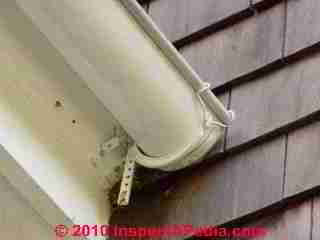 Guide to Roof Gutter Hangers & Attachments
- POST a QUESTION or COMMENT about roof gutter hangers, straps, & supports: installation & repair
This article explains how gutters are attached to or supported on buildings, describing different sorts of gutter hangers and their pros and cons. We also discuss the recommended sized or capacity of roof gutters as a function of the size of roof area being drained. This article series discusses how to choose, install, diagnose & maintain roof gutters & downspouts, & roof drainage systems to prevent building leaks and water entry.
InspectAPedia tolerates no conflicts of interest. We have no relationship with advertisers, products, or services discussed at this website.
How Are Gutters Attached to the Building? Types of Gutter Hangers
[Click to enlarge any image]
Gutters won't survive the occasional extra weight of water, wet leaves, ice or snow that weigh down gutters when they have not been kept cleaned. But you can increase the durability of the building's roof gutter system by using enough connections to fasten the gutters to the structure so that those occasional extra stresses can be endured.
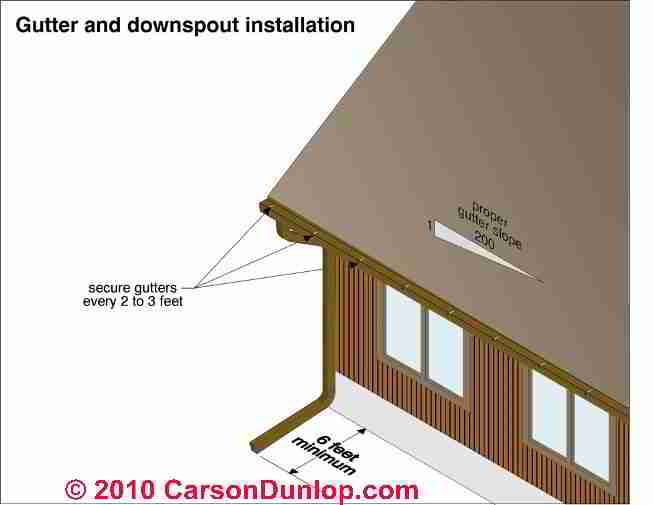
The sketch at left informs us that
- Roof gutters should slope at least 1-inch in every 200 inches of run
- Roof gutters should be secured to the building every 2-3 feet.
Sketch courtesy of Carson Dunlop Associates, a Toronto home inspection, education & report writing tool company [ carsondunlop.com ].
Gutter attachments to the building vary by gutter materials and design as we illustrate below.

For metal gutters and most plastic gutters, the gutter is secured to the fascia board, or to structural members such as the tails of rafters, using
- an exposed bracket and strap (works well but it's easy to knock off the strap when cleaning the gutters),
- a spike and ferrule (cheap, easy, but tend to work loose and pull out) or
- hidden gutter fasteners (work well and are secure provided proper fasteners are used and are screwed to sound building surfaces).
Sketch courtesy of Carson Dunlop Associates, a Toronto home inspection, education & report writing tool company [ carsondunlop.com ].

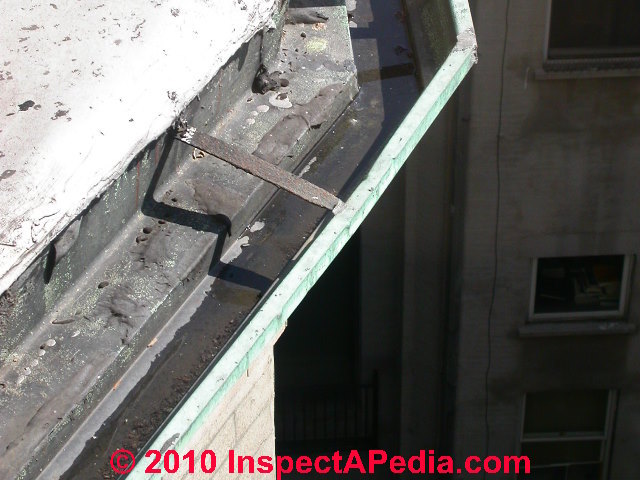
In these two photos we show the type of gutter hanger used for half-round gutters (below left) and hidden gutter hangers (below-right).
Recommended Roof Gutter Sizes
As Carson Dunlop Associates points out in their Home Reference Book
Four-inch gutters are good for relatively small roof areas; however, five-inch gutters are preferred because of their additional capacity. Five-inch gutters are also less likely to allow water to overshoot the gutters when the water is draining off a steeply pitched roof.
While "rules of thumb" for both gutter size and number of downspouts needed often are based simply on the length of roof edge that is being drained, this approach is flawed in that it fails to consider the total roof area that is being drained.
A roof that is very small in total area, even if very long, may get along just fine with a smaller 4-inch gutter, while a much larger roof area with the same length of roof eaves needs a 5-inch gutter or larger.
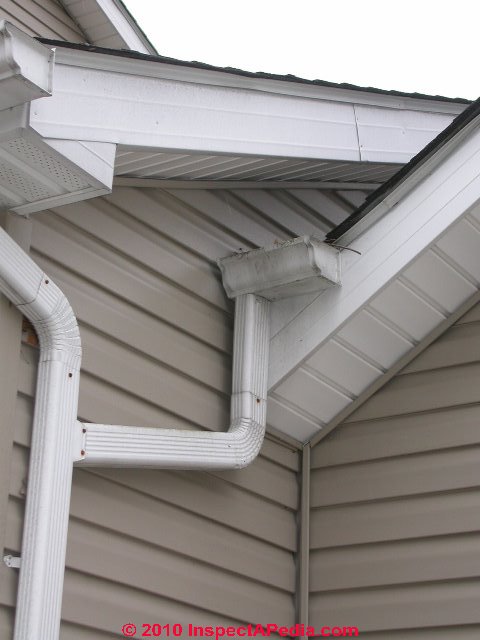
Also, as our photographs illustrate, odd roof shapes or complex multiple roof designs may end up sending a large volume of water from multiple surfaces into a relatively short gutter length that cannot possibly handle that volume. The result will be spillage by the building foundation and a high risk of a wet basement.
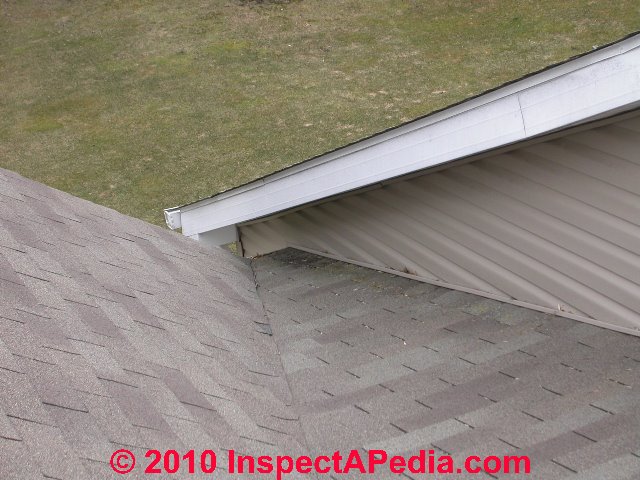
Some homeowners install larger gutters and leaders not because of difficulty handling the volume of water being drained, but because they believe that they'll have to clean the gutters less often. Nevertheless, it doesn't take a much larger handful of leaves or debris to clog a large downspout than a smaller one.
Overflowing Gutters?
Before Installing a Larger Gutter System: Things to Check if Your Gutters are Overflowing
- Be sure the gutters are not clogged -
see CLOGGED GUTTERS - Check that the gutters are properly sloped
towards the downspout or gutter drain
Roof gutters should slope at least 1-inch in every 200 inches of run;
See SLOPE INADEQUATE, GUTTER and also s
ee SAGGING GUTTERS - Check that the downspouts are not clogged -
see CLOGGED BURIED DOWNSPOUTS - Double check that the overflow is not gutter back-flow
due to a gutter or roof drip edge installation error - Check that the gutters are not loose
and pulled away from the roof edge - Check that water is not "overshooting"
the gutter, especially at or below roof valleys
In sum, if the area of roof being drained is larger than usual and there are no defects in the gutter or downspout system, then if gutters still overflow during heavy rainfall you may need to install a larger gutter system.
...
Continue reading at GUTTER REPAIR, LEAKY JOINT or select a topic from the closely-related articles below, or see the complete ARTICLE INDEX.
Or see these
Recommended Articles
- DOWNSPOUT / LEADER DEFECTS
- DRIP LINES INDICATE OVERFLOW - ground-level visual clues that tell the story of the history and location of gutter overflows at a building.
- GUTTER CAPS
- GUTTER DEFECTS LIST
- GUTTER HANGERS
- GUTTER REPAIR, LEAKY JOINT
- GUTTER SCREENS
- GUTTER SIZES
- GUTTER TYPES
Suggested citation for this web page
GUTTER HANGERS at InspectApedia.com - online encyclopedia of building & environmental inspection, testing, diagnosis, repair, & problem prevention advice.
Or see this
INDEX to RELATED ARTICLES: ARTICLE INDEX to GUTTERS & DOWNSPOUTS
Or use the SEARCH BOX found below to Ask a Question or Search InspectApedia
Ask a Question or Search InspectApedia
Questions & answers or comments about roof gutter hangers, straps, & supports: installation & repair.
Try the search box just below, or if you prefer, post a question or comment in the Comments box below and we will respond promptly.
Search the InspectApedia website
Note: appearance of your Comment below may be delayed: if your comment contains an image, photograph, web link, or text that looks to the software as if it might be a web link, your posting will appear after it has been approved by a moderator. Apologies for the delay.
Only one image can be added per comment but you can post as many comments, and therefore images, as you like.
You will not receive a notification when a response to your question has been posted.
Please bookmark this page to make it easy for you to check back for our response.
Our Comment Box is provided by Countable Web Productions countable.ca
Citations & References
In addition to any citations in the article above, a full list is available on request.
- Mark Cramer Inspection Services Mark Cramer, Tampa Florida, Mr. Cramer is a past president of ASHI, the American Society of Home Inspectors and is a Florida home inspector and home inspection educator. Mr. Cramer serves on the ASHI Home Inspection Standards. Contact Mark Cramer at: 727-595-4211 mark@BestTampaInspector.com
- John Cranor [Website: /www.house-whisperer.com ] is an ASHI member and a home inspector (The House Whisperer) is located in Glen Allen, VA 23060. He is also a contributor to InspectApedia.com in several technical areas such as plumbing and appliances (dryer vents). Contact Mr. Cranor at 804-873-8534 or by Email: johncranor@verizon.net
- In addition to citations & references found in this article, see the research citations given at the end of the related articles found at our suggested
CONTINUE READING or RECOMMENDED ARTICLES.
- Carson, Dunlop & Associates Ltd., 120 Carlton Street Suite 407, Toronto ON M5A 4K2. Tel: (416) 964-9415 1-800-268-7070 Email: info@carsondunlop.com. Alan Carson is a past president of ASHI, the American Society of Home Inspectors.
Thanks to Alan Carson and Bob Dunlop, for permission for InspectAPedia to use text excerpts from The HOME REFERENCE BOOK - the Encyclopedia of Homes and to use illustrations from The ILLUSTRATED HOME .
Carson Dunlop Associates provides extensive home inspection education and report writing material. In gratitude we provide links to tsome Carson Dunlop Associates products and services.
 | HOME | ABOUT | ASK a QUESTION | CONTACT | CONTENT USE POLICY | DESCRIPTION | POLICIES | PRIVACY | |
| © 2024 - 1985 Publisher InspectApedia.com - Daniel Friedman | |||||||||