
InspectAPedia® FREE Encyclopedia of Building & Environmental Construction, Diagnosis, Maintenance & Repair |
Question? Just ask us! InspectAPedia
|
 Guide to Electromagnetic Field Surveys
Details of a Recommended EMF Measurement Procedure
- POST a QUESTION or COMMENT about how to make an accurate measurement of EMF electromagnetic field exposure at or inside buildings
How to make EMF measurements:
This paper discusses a recommended procedure for performing electromagnetic field (EMF) or electro-magnetic radiation EMR measurements either by engaging a professional or by consumers using low-cost instruments which measure EMF exposure levels in gauss or milligauss.
We discusses sources of error and variation in EMF measurements and we review and make suggestions for using several low-cost EMF measurement devices to determine the instantaneous electromagnetic field exposure.
InspectAPedia tolerates no conflicts of interest. We have no relationship with advertisers, products, or services discussed at this website.
Electromagnetic Field EMF Radiation Measurement at buildings
 The information provided here is for research and study purposes. The author makes no representation of unique
expertise on this topic, other than having field experience in EMF measurement, having studied technical literature and
having conversed with other experts and authors in the field for a number of years.
The information provided here is for research and study purposes. The author makes no representation of unique
expertise on this topic, other than having field experience in EMF measurement, having studied technical literature and
having conversed with other experts and authors in the field for a number of years.
Health professionals, epidemiological experts, and in the case of EMF, electrical engineers can offer competent, expert advice which should be considered before any costly or risky actions are taken regarding this or other environmental topics.
This information is has not been sanctioned nor technically reviewed by the American Society of Home Inspectors. Use it at your own risk.
Readers are urged to consult expert sources and to give any suggestions regarding these notes to the author.
Readers may want to see our EXCEL Spreadsheet EMS_Survey_Sample1.xls for an example of common locations and measurement points.
This spread sheet includes computations necessary to produce mathematically valid measurement results for those who are using position-sensitive instruments.
 Some studies by some experts have suggested a possible link between exposure to electromagnetic fields and various
cancers or other health problems. Other studies suggest that no definite correlation could be demonstrated. It is
likely that the jury will be out on this matter for some time, for both economic and political reasons.
Some studies by some experts have suggested a possible link between exposure to electromagnetic fields and various
cancers or other health problems. Other studies suggest that no definite correlation could be demonstrated. It is
likely that the jury will be out on this matter for some time, for both economic and political reasons.
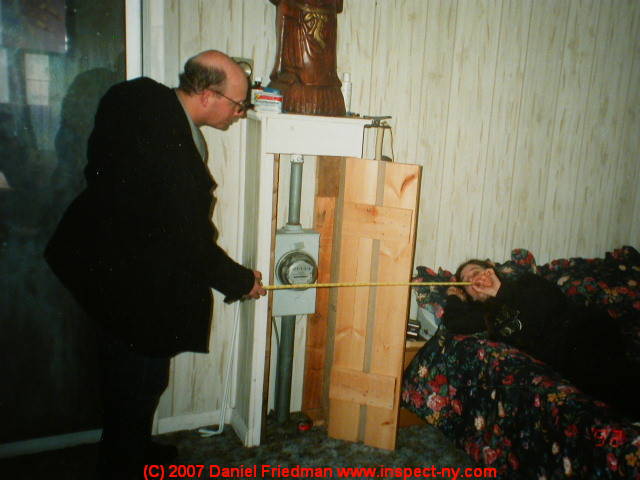
Our photo shows an uncommon exposure to an electrical field: the electrical meter and service entry cable produce a field which can be detected up to perhaps two to four feet away. But the history of construction at a building can bring surprises.
An outside porch first enclosed this electrical meter; later the porch was enclosed and converted to a bedroom.
Our model shows that someone sleeping on the side of the bed next to the electrical meter was likely to be sleeping in an EMF that could easily have been avoided: move the bed to an opposite wall.
Small absolute health risk from EMF: Most researchers indicate that where a risk is present, the absolute risk level from EMF is likely to be small, and less than other less obscure hazards. (Automobile accidents, trip and fall, fire, and shock hazards, smoking and other health risks.) Consumers should not let focus on a specific emotionally-charged hazard distract them from these other more mundane but more dangerous concerns.
Electromagnetic Field EMF Radiation & Impact on Real Estate Property Values
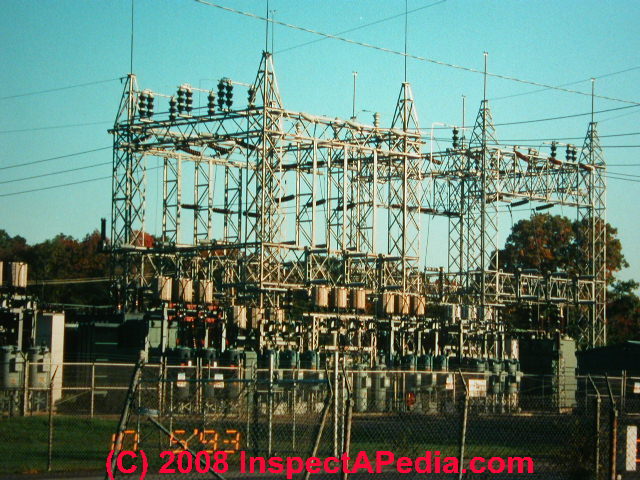
Property valuation impact of EMF: However our experience with a number of environmental issues is that economic and other risks (property marketability, stress-related illness, legal concerns) pertain for all "potential" environmental health issues, regardless of the legitimate, demonstrated health exposure.
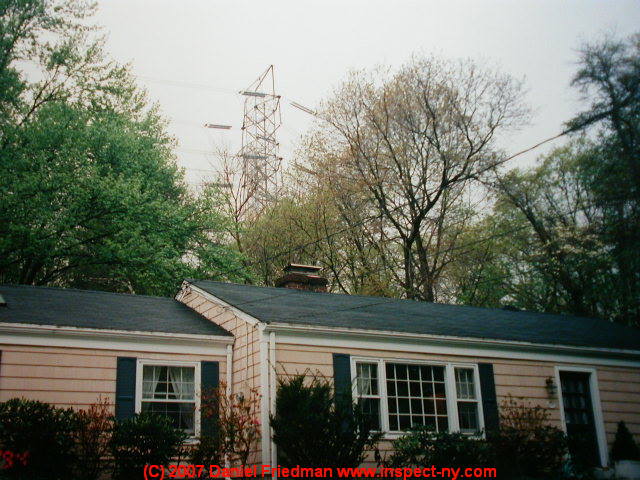
If homes or schools were immediately adjacent to a power sub-station such as the one shown in our photo from Dutchess County, NY the nearest properties may show a strong EMF. This power substation is of the sort discussed in sensationalist and scary books on this topic.
This particular power substation does not have homes adjoining its property; but nonetheless, some buyers of homes in the neighborhood may be nervous about this facility.
Property owners and consumers would be wise to be as accurately and calmly informed as possible. The emotional fear that motivates some consumers subjects them to risk of economic profiteering by less than totally scrupulous "investigators" in some instances. A professional hazard investigator should be personally committed to being as informed and professionally neutral as possible.
The EMF Field strength at any given moment depends on the load on the power line: A serious problem has limited research and conclusions regarding possible hazards of electromagnetic fields in the U.S.: the lack of publicly available load data. EMF field strength varies depending on the load on the system/conductors. Measurements made at different times and under different conditions will vary widely.
Additional explanation of the causes of variation and error in measurements of electromagnetic fields can be found at my article on Enviro-Scare and EMF this website.
In our opinion if you can establish any field measurement at a property it is likely that under some conditions the field strength will be greater than the time of your measurement. Further, even if you measure no field effects, if the property is close to large power transmission or some power distribution lines, it is possible that at some times and conditions it's in a measurable field.
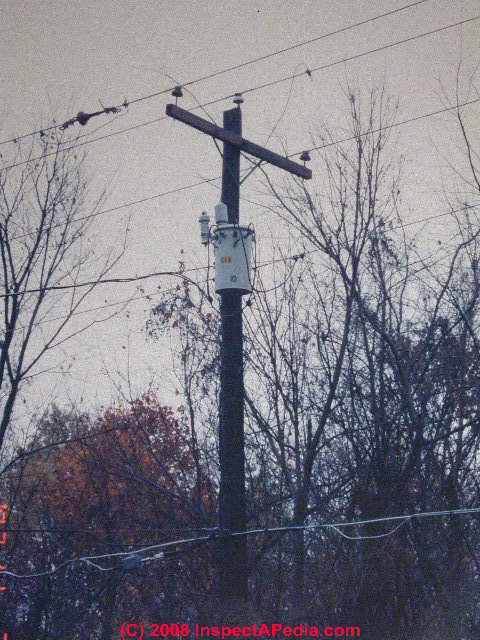
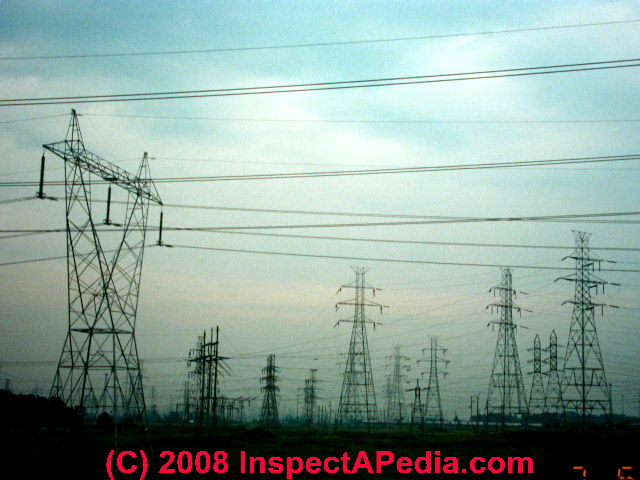 Distances from power lines and EMF field strength: The distances for common field strengths and power lines are available in a number of EPA documents, such as
"Evaluation of the Potential Carcinogenicity of Electromagnetic Fields," EPA/600/6-90-005B October 1990 (DRAFT review
copy), page 2-21.
Distances from power lines and EMF field strength: The distances for common field strengths and power lines are available in a number of EPA documents, such as
"Evaluation of the Potential Carcinogenicity of Electromagnetic Fields," EPA/600/6-90-005B October 1990 (DRAFT review
copy), page 2-21.
For example, the field strength of a 500 KV Transmission line begins to fall off measurably at 50 meters, but does not fall off below 1 mG until distances nearing 1000 meters.
Keep in mind that independent of proximity to power transmission facilities, a careful survey of conditions in any building may reveal other devices like home appliances or electrical service entry cabling: areas where strong EMF can be measured from distances of a few inches to several feet away.
Also keep in mind that based on our own field experience, we note that it would be unusual in any urban or suburban environment to find ambient EMF levels below one or two milligauss.
Often but not always, the relative strength of such fields falls off in much shorter distance than that from power transmission facilities. However in some instances where occupants wish to maintain prudent avoidance, it is possible to make a significant reduction in exposure by small changes in arrangement of devices or locations of working or sleeping areas.
Power companies in the US have been singularly uncooperative in providing actual load data, making it difficult to establish a dose-exposure relationship between exposure to EMF and occurrence of disease. This is why the Swedish studies are so important. There the government cooperated with researchers in providing load data, permitting clear establishment of exposure to occurrence relationships.
Instead of contacting us with a request to perform EMF Electromagnetic or RF Radio Frequency Field Strength measurements, in most cases it is more economical and convenient for a property owner to purchase their own instrument, making measurements under varying conditions. In this series of articles we describe how to make measurements using a consistent approach and using good documentation.
See Recommended EMF Measurement Procedure for details of how to collect EMF measurement data.
Following good procedure and using instruments properly are two steps towards making accurate, repeatable EMF measurements. But because the signal transmission for RF sources such as radio, TV, or cell towers, the load on a power transmission line is not under control of an individual property owner, and because the EMF strength varies as the power transmission line load varies, it is important to have an idea of that condition as well when attempting to characterize EMF exposure at a specific location.
In contrast, EMF measurements are quite accurate and repeatable at other EMF sources such as close to electrical appliances and service entry cables.
Please do not contact us with a request buy EMF or RF measuring equipment. We do not sell anything. To do so would be a conflict of interest for this website. These devices are readily available from many electrical equipment and home inspection equipment suppliers.
A clear summary of EMF risks and characteristics is at "Magnetic Field Exposure and Cancer: Questions and Answers [ copy on file as /emf/EMF_Fact_Sheet_NCI_NIH.pdf ] - ," National Cancer Institute, U.S. National Institutes of Health.
Research on EMF Survey Procedures
- Stewart, Harold F., Ph.D., Richard W. Peterson, M.S., Wilbur F. Van Pelt, M.S., MICROWAVE HAZARD EVALUATION (A Field Survey Form) [PDF] (1970) Southwestern Radiological Health Laboratory, U.S. Department of Health, Education and Welfare, Public Health Services for some old history on this topic.
...
Continue reading at EMF SURVEY REPORT INTERPRETATION or select a topic from the closely-related articles below, or see the complete ARTICLE INDEX.
Or see these
Recommended Articles
- CELL PHONE RADIATION
- DEFINITIONS of EMF RF FIELD & FREQUENCY
- DEFINITIONS of HERTZ, KHz MHz GHz THz
- ELECTROMAGNETIC FIELD EMF ELF & RF DETECTION
- EMF ELECTROMAGNETIC FIELDS & HUMAN EXPOSURE
- EMF CANCER SCARE
- EMF CANCER RISK
- EMF/EMR MEASUREMENT OVERVIEW
- EMF LOCAL SOURCES MAY EXCEED POWER LINE STRENGTH
- EMF MEASUREMENT DISTANCE AFFECTS STRENGTH
- EMF MEASUREMENT INSTRUMENTS
- EMF MEASUREMENT INSTRUMENT ACCURACY
- EMF MEASUREMENT INSTRUMENT USE TIPS
- EMF MEASUREMENT PROCEDURES
- EMF MEASUREMENT STEP BY STEP
- EMF REFERENCES
- EMF SURVEY PROCEDURE
- EMF SURVEY REPORT INTERPRETATION
- EMF WORKSHEET for EMF MEASUREMENTS
- EMF WORKSHEET Example
- EMF WORKPLACE EXPOSURE
- ENVIRONMENTAL HAZARDS at BUILDINGS - home
- ENVIRO-SCARE - PUBLIC FEAR CYCLES
- HAZARD vs RISK
- RF RADIO FREQUENCY DETECTION METERS
Suggested citation for this web page
EMF SURVEY PROCEDURE at InspectApedia.com - online encyclopedia of building & environmental inspection, testing, diagnosis, repair, & problem prevention advice.
Or see this
INDEX to RELATED ARTICLES: ARTICLE INDEX to BUILDING ENVIRONMENT
Or use the SEARCH BOX found below to Ask a Question or Search InspectApedia
Ask a Question or Search InspectApedia
Try the search box just below, or if you prefer, post a question or comment in the Comments box below and we will respond promptly.
Search the InspectApedia website
Note: appearance of your Comment below may be delayed: if your comment contains an image, photograph, web link, or text that looks to the software as if it might be a web link, your posting will appear after it has been approved by a moderator. Apologies for the delay.
Only one image can be added per comment but you can post as many comments, and therefore images, as you like.
You will not receive a notification when a response to your question has been posted.
Please bookmark this page to make it easy for you to check back for our response.
Our Comment Box is provided by Countable Web Productions countable.ca
Citations & References
In addition to any citations in the article above, a full list is available on request.
- Electric Power Lines, Electromagnetic Fields, Cancer Risk, & "Enviro-Scare" - The Normal Curve Cycle of Public Fear About Environmental Issues - online document by DF
- A Procedure for Measuring EMF electromagnetic fields online document by DF
- "Questions and Answers about Biological Effects and Potential Hazards of Radiofrequency Electromagnetic Fields", Federal Communications Commission, Office of Engineering and Technology, US FCC, OET Bulleting 56, 4th Edition, August 1999
" Many consumer and industrial products and applications make use of some form of electromagnetic energy. One type of electromagnetic energy that is of increasing importance worldwide is radiofrequency (or "RF") energy, including radio waves and microwaves, which is used for providing telecommunications, broadcast and other services. In the United States the Federal Communications Commission (FCC) authorizes or licenses most RF telecommunications services, facilities, and devices used by the public, industry and state and local governmental organizations. Because of its regulatory responsibilities in this area the FCC often receives inquiries concerning whether there are potential safety hazards due to human exposure to RF energy emitted by FCC-regulated transmitters. Heightened awareness of the expanding use of RF technology has led some people to speculate that "electromagnetic pollution" is causing significant risks to human health from environmental RF electromagnetic fields. This document is designed to provide factual information and to answer some of the most commonly asked questions related to this topic." - original source: U.S. Federal Communications Commission Office of Engineering and Technology, http://www.fcc.gov/Bureaus/Engineering_Technology/Documents/bulletins/oet56/oet56e4.pdf
CONTINUE READING or RECOMMENDED ARTICLES.
- Carson, Dunlop & Associates Ltd., 120 Carlton Street Suite 407, Toronto ON M5A 4K2. Tel: (416) 964-9415 1-800-268-7070 Email: info@carsondunlop.com. Alan Carson is a past president of ASHI, the American Society of Home Inspectors.
Thanks to Alan Carson and Bob Dunlop, for permission for InspectAPedia to use text excerpts from The HOME REFERENCE BOOK - the Encyclopedia of Homes and to use illustrations from The ILLUSTRATED HOME .
Carson Dunlop Associates provides extensive home inspection education and report writing material. In gratitude we provide links to tsome Carson Dunlop Associates products and services.
 | HOME | ABOUT | ASK a QUESTION | CONTACT | CONTENT USE POLICY | DESCRIPTION | POLICIES | PRIVACY | |
| © 2024 - 1985 Publisher InspectApedia.com - Daniel Friedman | |||||||||