
InspectAPedia® FREE Encyclopedia of Building & Environmental Construction, Diagnosis, Maintenance & Repair |
Question? Just ask us! InspectAPedia
|
 Interpreting Electromagnetic Field Strength EMF Survey Results
- POST a QUESTION or COMMENT about the meaning of EMF field strength survey reports
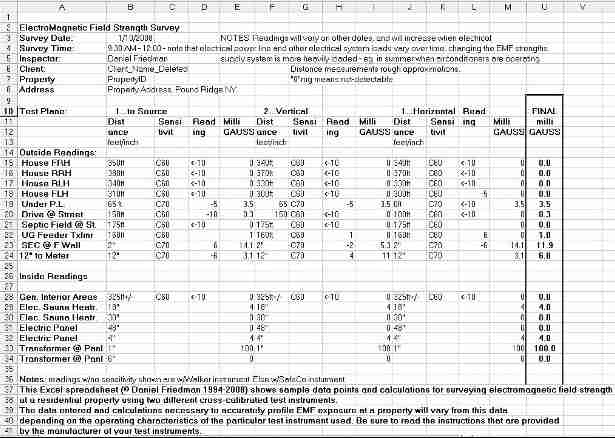
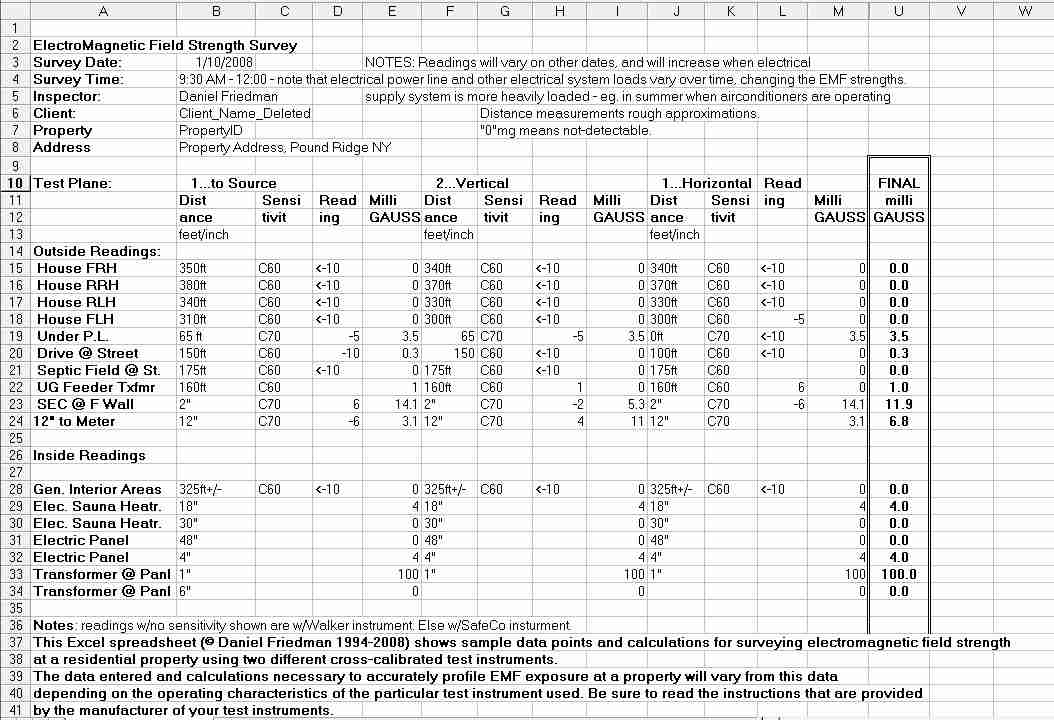
EMF Survey report interpretation: how do we make sense of the numbers given in an electromagnetic field measurement or survey report?
This article explains how to interpret the results of an electromagnetic field (EMF) or electro-magnetic radiation EMR measurement survey.
InspectAPedia tolerates no conflicts of interest. We have no relationship with advertisers, products, or services discussed at this website.
Guide to Interpreting Electromagnetic Field Strength EMF Survey Results
Readers are urged to consult expert sources and to give any suggestions regarding these notes to the author. Some studies by some experts have suggested a possible link between exposure to electromagnetic fields and various cancers or other health problems. Other studies suggest that no definite correlation could be demonstrated. It is likely that the jury will be out on this matter for some time, for both economic and political reasons.
It is risky and may be misleading for untrained personnel to express opinions for which they have no scientific basis. There are very few standards for allowable exposure to EMF.
See Definitions of Gauss vs Milligauss for details about gauss and milligauss and definitions of these terms
The health studies are, according to some experts, inconclusive. Some health studies showed an increase in childhood leukemia and other diseases at long exposure to field strengths as low as 1 or 2 mG. However, keep in mind that "doubling" the risk of a disease may in some cases be doubling a number that was extremely small to start with. Doubling a very small number yields still a very small number. If your clients are worried about EMF but smoke, or don't fasten seat belts, or have dangerous stair or railings, their attention has been misdirected.
Pending acceptance of conclusive research by the scientific and engineering community at large, the most accurate position which can be taken by a consultant is that this is a controversial subject.
There may be a health risk from EMF exposure, but regardless of the real level of health risk, there are definitely economic risks because of fear felt by some property buyers.
Building owners and occupants should not let this topic distract them from attending to other high risks that may be at a given property such as tripping hazards, fire hazards, shock hazards, and carbon monoxide hazards.
While the health risks remain under argument, with some recent studies suggesting that there may really be a risk, it is possible to infer whether or not a given property is likely to be exposed to EMF:
- Any property which uses electrical devices will have at least some measurable electromagnetic fields. If the fields are continuous and close to people the people may be exposed. (EG. sleeping with head 8" from the electric meter-- you can move away, or sleeping in a building 50 ft from a 500KV power transmission line--you cannot move away within the building to escape the field).
- If you do not find any EMF levels at a property that is served by electricity and has electrical power turned on and some devices in operation (even an electrical clock) then you should doubt your instruments.
- If we measure any detectable electromagnetic field outside and all around a building attributable to a nearby power line, it is very likely that at times the building and its interior are exposed to more powerful fields (when load on the line is greater)
- If we can measure no EMF at a given property (attributable to a power line which is nearby) but if the line is within 1000 meters of the building (at 500KV) then it's still quite possible that under some conditions (of heavy load) the building will be in a field.
- As EMF field strength falls off with the square of the distance, and as field strengths are less for smaller transmission and distribution lines, this 1000 meters is not a sacred distance.
- The effect on property value and resale-time for properties located close to power transmission lines should be confirmed by frank conversation with real estate sales people (unless the conversant has a conflict of interest), is real, and is in our opinion rather independent of any demonstrable health hazard.
Small absolute health risk from EMF:
Most researchers indicate that where a risk is present, the absolute risk level from EMF is likely to be small, and less than other less obscure hazards. (Automobile accidents, trip and fall, fire, and shock hazards, smoking and other health risks.) Consumers should not let focus on a specific emotionally-charged hazard distract them from these other more mundane but more dangerous concerns.
The EMF Field strength at any given moment depends on the load on the power line:
A serious problem has limited research and conclusions regarding possible hazards of electromagnetic fields in the U.S.: the lack of publicly available load data. EMF field strength varies depending on the load on the system/conductors. Measurements made at different times and under different conditions will vary widely.
Additional explanation of the causes of variation and error in measurements of electromagnetic fields can be found at my article on Enviro-Scare and EMF this website.
In our opinion if you can establish any field measurement at a property it is likely that under some conditions the field strength will be greater than the time of your measurement. Further, even if you measure no field effects, if the property is close to large power transmission or some power distribution lines, it is possible that at some times and conditions it's in a measurable field.
This material represents research thinking. Anyone having any comment, content correction or suggestion is welcome to contact the author.
See EMF MEASUREMENT STEP BY STEP for the gritty details of how to collect EMF measurement data.
Recommended Articles
- CELL PHONE RADIATION
- DEFINITIONS of EMF RF FIELD & FREQUENCY
- DEFINITIONS of HERTZ, KHz MHz GHz THz
- ELECTROMAGNETIC FIELD EMF ELF & RF DETECTION
- EMF ELECTROMAGNETIC FIELDS & HUMAN EXPOSURE
- EMF CANCER SCARE
- EMF CANCER RISK
- EMF/EMR MEASUREMENT OVERVIEW
- EMF LOCAL SOURCES MAY EXCEED POWER LINE STRENGTH
- EMF MEASUREMENT DISTANCE AFFECTS STRENGTH
- EMF MEASUREMENT INSTRUMENTS
- EMF MEASUREMENT INSTRUMENT ACCURACY
- EMF MEASUREMENT INSTRUMENT USE TIPS
- EMF MEASUREMENT PROCEDURES
- EMF MEASUREMENT STEP BY STEP
- EMF REFERENCES
- EMF SURVEY PROCEDURE
- EMF SURVEY REPORT INTERPRETATION
- EMF WORKSHEET for EMF MEASUREMENTS
- EMF WORKSHEET Example
- EMF WORKPLACE EXPOSURE
- ENVIRONMENTAL HAZARDS at BUILDINGS - home
- ENVIRO-SCARE - PUBLIC FEAR CYCLES
- HAZARD vs RISK
- RF RADIO FREQUENCY DETECTION METERS
...
Continue reading at EMF WORKSHEET for EMF MEASUREMENTS or select a topic from the closely-related articles below, or see the complete ARTICLE INDEX.
Suggested citation for this web page
EMF SURVEY REPORT INTERPRETATION at InspectApedia.com - online encyclopedia of building & environmental inspection, testing, diagnosis, repair, & problem prevention advice.
Or see this
INDEX to RELATED ARTICLES: ARTICLE INDEX to BUILDING ENVIRONMENT
Or use the SEARCH BOX found below to Ask a Question or Search InspectApedia
Ask a Question or Search InspectApedia
Try the search box just below, or if you prefer, post a question or comment in the Comments box below and we will respond promptly.
Search the InspectApedia website
Note: appearance of your Comment below may be delayed: if your comment contains an image, photograph, web link, or text that looks to the software as if it might be a web link, your posting will appear after it has been approved by a moderator. Apologies for the delay.
Only one image can be added per comment but you can post as many comments, and therefore images, as you like.
You will not receive a notification when a response to your question has been posted.
Please bookmark this page to make it easy for you to check back for our response.
Our Comment Box is provided by Countable Web Productions countable.ca
Citations & References
In addition to any citations in the article above, a full list is available on request.
- Electric Power Lines, Electromagnetic Fields, Cancer Risk, & "Enviro-Scare" - The Normal Curve Cycle of Public Fear About Environmental Issues - online document by DF
- A Procedure for Measuring EMF electromagnetic fields online document by DF
- "Questions and Answers about Biological Effects and Potential Hazards of Radiofrequency Electromagnetic Fields", Federal Communications Commission, Office of Engineering and Technology, US FCC, OET Bulleting 56, 4th Edition, August 1999
" Many consumer and industrial products and applications make use of some form of electromagnetic energy. One type of electromagnetic energy that is of increasing importance worldwide is radiofrequency (or "RF") energy, including radio waves and microwaves, which is used for providing telecommunications, broadcast and other services. In the United States the Federal Communications Commission (FCC) authorizes or licenses most RF telecommunications services, facilities, and devices used by the public, industry and state and local governmental organizations. Because of its regulatory responsibilities in this area the FCC often receives inquiries concerning whether there are potential safety hazards due to human exposure to RF energy emitted by FCC-regulated transmitters. Heightened awareness of the expanding use of RF technology has led some people to speculate that "electromagnetic pollution" is causing significant risks to human health from environmental RF electromagnetic fields. This document is designed to provide factual information and to answer some of the most commonly asked questions related to this topic." - original source: U.S. Federal Communications Commission Office of Engineering and Technology, http://www.fcc.gov/Bureaus/Engineering_Technology/Documents/bulletins/oet56/oet56e4.pdf
CONTINUE READING or RECOMMENDED ARTICLES.
- Carson, Dunlop & Associates Ltd., 120 Carlton Street Suite 407, Toronto ON M5A 4K2. Tel: (416) 964-9415 1-800-268-7070 Email: info@carsondunlop.com. Alan Carson is a past president of ASHI, the American Society of Home Inspectors.
Thanks to Alan Carson and Bob Dunlop, for permission for InspectAPedia to use text excerpts from The HOME REFERENCE BOOK - the Encyclopedia of Homes and to use illustrations from The ILLUSTRATED HOME .
Carson Dunlop Associates provides extensive home inspection education and report writing material. In gratitude we provide links to tsome Carson Dunlop Associates products and services.
 | HOME | ABOUT | ASK a QUESTION | CONTACT | CONTENT USE POLICY | DESCRIPTION | POLICIES | PRIVACY | |
| © 2024 - 1985 Publisher InspectApedia.com - Daniel Friedman | |||||||||