
InspectAPedia® FREE Encyclopedia of Building & Environmental Construction, Diagnosis, Maintenance & Repair |
Question? Just ask us! InspectAPedia
|
 Inspection & Repair Guide for Low Voltage Building Wiring & Lighting Systems
- POST a QUESTION or COMMENT about low-voltage wiring, relays, switches, transformers, transverters & devices
How to install, diagnose, and repair of low voltage wiring controlling home lighting and fixtures:
Llow voltage electrical wiring repair, parts substitution, parts replacement, and repair warnings. We describe the properties of low-voltage-controlled switches that operate 120V lights and receptacles in homes dating from the 1960's to the present.
We compare that low-voltage-switching electrical system and its wiring and fusing requirements to contemporary low-voltage circuits used in buildings to power low-voltage devices such as downlights. The wiring sizes, lengths, and fusing requirements differ among these. We include a table of low voltage circuit wire sizes for different run lengths and circuit amperage load.
InspectAPedia tolerates no conflicts of interest. We have no relationship with advertisers, products, or services discussed at this website.
Guide to Inspection, Repair, and Replacement of Low-Voltage GE, Remcon, Touchplate or Other Low-Voltage Building Electrical Wiring & Switches
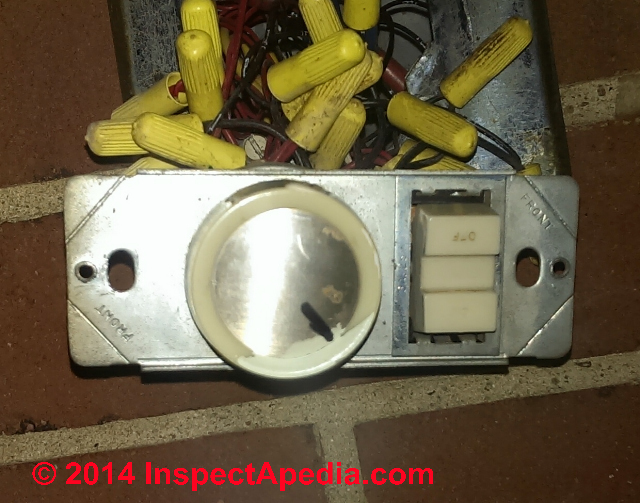 [Click to enlarge any image]
The low voltage GE switch at left was provided courtesy of reader JJ and discussed below.
Low voltage electrical wiring was installed in some homes beginning in about 1946's. This system was popular and was installed in many homes between 1960 a nd 1985, and it continues in use today, often in the form of 12-V low-voltage lighting and downlight fixtures.
For an example of currently popular low-voltage wiring used in contemporary construction and retrofit installations, see LIGHTING, EXTERIOR GUIDE.
The low-voltage wiring system uses small-gauge copper wires connected to low-voltage switches to switch on and off relays which in turn control the operation of lights and where desired, electrical receptacles, and other 120-Volt equipment in homes.
1960's Low-Voltage Wiring Properties
A power supply or transformer, often called a "transverter" is fed 120V and outputs 28V to the switching system. Pressing the low-voltage switch operates a relay which in turn switches on or off a 120V light or other device in the home.
The low-voltage electrical wiring system popularized in the United States by GE® and Remcon permits the use of less-costly and easier-to-install wiring between the relays and the switches in the home. The switching relay, or a group of them, is often located in an electrical box in the building's attic, garage, or basement.
At least one supplier continues to design, sell, and service low-voltage home wiring systems: Touch-Plate Lighting Controls, in Fort Wayne IN. Some of the suggestions and opinions in this article are quoted from or paraphrase advice offered by that company. We provide contact information for Touch-Plate® Lighting Controls below.
Many original GE® or Remcon® low voltage lighting systems are still in use today. But owners of buildings with the original systems installed may find themselves faced with low-voltage switches, relays, or transformers that no longer operate.
Warning About Repairing Low-Voltage Lighting Systems
Owners of such buildings should be careful to perform any repairs or replacements of components in low-voltage electrical systems using only the proper devices. Installing a conventional 120-V switch or an arbitrary push switch, or a conventional transformer/voltage converter may not work, and worse, it could be unsafe, causing a risk of fire or shock.
Low-Voltage-Switched, 120V Electrical Devices Used in Buildings
Lights, receptacles, other: these are the same conventional electrical lights or electrical receptacles
found in buildings.
In the United States most electrical lighting and electrical receptacles are wired to carry 120 Volts A. C.
(electric lights and electric receptacles used to power TV's, computers, etc.)
or in special cases, 220V A. C. (such as for electric stoves, electric water heaters, and some air conditioning systems.)
Guide to Low Voltage Switch Troubleshooting
 Diagnosing & Repairing Low Voltage Switch Problems
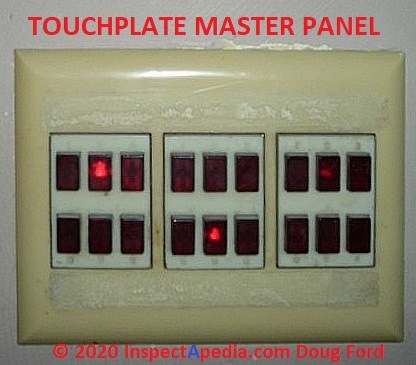
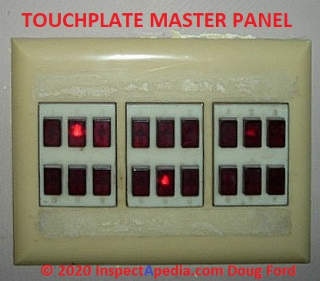
Low-voltage electrical system switches originally made by GE® or Remcon can be replaced with newer ones from Touch Plate but with some provisos which we explain below.
Photo: a TouchPlate™ master switching panel, courtesy of Doug Ford.
Low-voltage system relays originally made by GE® or Remcon cannot be replaced individually with newer ones from Touch Plate - there are electrical design differences that mean the products are not interchangeable.
A home or an entire circuit can, however, be converted over to the new Touch-Plate® product line. This offers the advantage of permitting the building to continue to use the existing low-voltage wiring that is already in place between the transformers and switches.
This approach should be substantially less costly and troublesome than attempting to convert all of the switches in the home to 120V design - that would require re-wiring those areas in the home with new 120V wires.
An old GE® or Remcon® system will work with the Touch-Plate® replacement switches. The GE® and Remcon® systems operate on a three-wire system. One wire is common, one wire is for turning the relay on, and the last wire is for turning the relay off.
Touch-Plate® switches only have two wires. One being the common wire and the other being the switch wire, and because of our single coil relay, the same button is used to turn the relay on and off.
You can use Touch-Plate® switches in place of three-wire switches, but you will need two Touch-Plate® buttons for every one three-wire switch. See Three-wire to Touch-Plate® Wiring Diagram.
Other Low Voltage Switching Notes
Multi-way switching is supported since multiple switches can all connect to a single relay that controls a single 120V device.
Touch-Plate® says that 3-Way, 4-Way and even 5-Way switching is a standard feature of low voltage control systems and almost all old Touch-Plate® installations have multiple switches that control the same relay.
Watch out: Do NOT ever attempt to replace a momentary action, low voltage Touch-Plate® switch with an off-the-shelf high voltage toggle switch (maintain / latching style). This will definitely cause an immediate failure of the system.
Painted switch plate covers, cracked covers, and wall-papered covers all are likely sources of producing a stuck switch.
Low Voltage Relay Troubleshooting
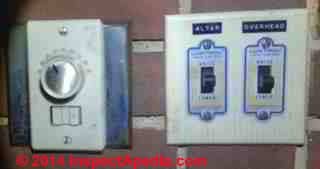 Guide to Diagnosing & Repairing Low Voltage Wiring Relays
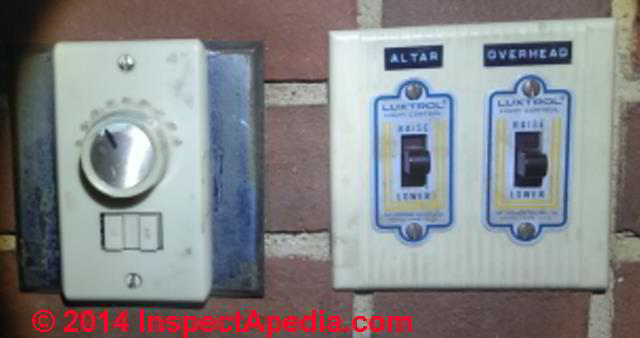
Reader Question: how can I fix 1950's era GE low voltage relays and switches that no longer work?
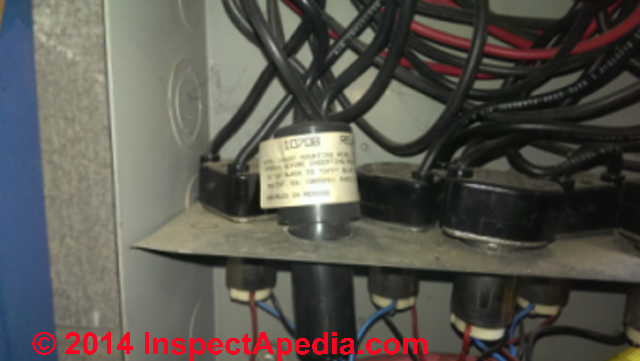
I am sending some pictures of the Low Voltage GE system I have in a church I am taking care of. I posted on your web site under the Low Voltage page. I am thinking I have a bad relay and maybe needing some replacement. I will try to zip about 6 pictures to you .
Please reply via email , and also on your web site and post any pictures you wish. This was installed around 1950. Thanks - J. J. 3/16/2014
Reply:
JJ: You can either re-wire that entire individual circuit to use Touch-Plate® components, or, as Touch-Plate Lighting recommends, replace all of the older GE® or Remcon® relays in the home with Touch-Plate® relays.
This may not be as horrible as it sounds: you're not replacing wiring, just devices. themselves.
...
Switching Relays that work intermittently?
If sometimes when you operate the switch to control a light or receptacle or other device it works just fine, but at other times it fails to operate, giving difficulty in turning the light or receptacle "on" or "off" we could have a problem with the switch itself, or the problem may be with the relay that the switch controls.
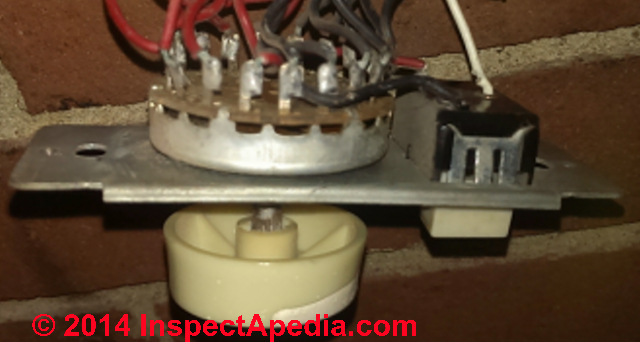
Check the building first for for sticking low-voltage switches. If all of the switches appear to be working normally, then find the switching relays that are misbehaving, and check for temperature exposure problems.
Switching relays that are too hot or too cold may not work properly. Low voltage relays may not operate reliably if exposed to below freezing temperatures, or to temperatures above 120 degrees.
Depending on where the building is located, these conditions can certainly be encountered in an attic, and cold conditions may be encountered in a garage or crawl space.
Touch-Plate offers a trivial fix for the cold temperature problem: place a light bulb close to the relay panel. Turning the light bulb on during the cold period will usually produce sufficient warmth to keep the switching relays working.
Touch-Plate® also advises "The best solution is to contact the factory for assistance in upgrading the whole system to current technology and relocating the panels to a garage, a basement, a mechanical room, or closet that will avoid this altogether."
Low Voltage Electrical Wiring Switching Relay Burn-up?
This can happen with age and use. But if the relays are burning up after replacement or other repairs to the system, check the low voltage transformer.
The voltage transformer must be one designed for this application. Some generic voltage transformers do not sense that a switch is stuck (or being held depressed for some reason) and lack a limiting function to protect the relay from burn-up.
Replacement relays for existing Touch-Plate® installations can be installed
without this worry. But this is not the case if your relays are the older GE® or Remcon® brand. First, for Touch-Plate® installations,
If the relay you are replacing has two wires coming out of the cylinder the relay is a 1550 series and it can be replaced by the Touch-Plate® 2500-B.
If the old relay has four wires coming out of the cylinder of the relay it can be replaced by a Touch-Plate® 2500-BPL.
But what about homes using older GE® or Remcon® relays? Touch-Plate® relays cannot be used to replace individual GE® or Remcon® relays.
The switching relays made by these manufacturers work differently from those designed and sold today by Touch-Plate lighting.
For example, Touch-Plate informs us that he Touch-Plate® relay (2500-B) is a single coil, 28VDC latching relay, whereas the the GE® relay (RR-7) is a dual coil, 24VAC latching relay, and the Remcon® relays (depending on the style) are a single or dual coil relay with an internal power supply for each relay.
Also, two switching relays will not operate from a single button press in older systems prior to 1986, they were designed to operate one at a time.
But you can forget the details of just how your relays work if you just remember that you cannot substitute a Touch-Plate® relay for either GE® or Remcon® relays.
So what to do with a GE® or Remcon® relays that no longer work?
You can either re-wire that entire individual circuit to use Touch-Plate® components, or, as Touch-Plate Lighting recommends, replace all of the older GE® or Remcon® relays in the home with Touch-Plate® relays.
This may not be as horrible as it sounds: you're not replacing wiring, just devices. themselves.
- See details about LV Relays at LOW VOLTAGE LIGHTING & CONTROL RELAYS where we discuss how these relays work, how they are wired, repaired, used, and what replacements are available.
- For LV Relay repair parts see LOW VOLTAGE WIRING REPAIR PARTS SOURCES.
Suggestions for Upgrading Low Voltage Building Electrical Wiring Switches, Relays, and Transformers
Upgrading an Older Low Voltage Switching System in a Home
(Naturally) Touch-Plate® recommends a complete upgrade for older homes having a GE® or Remcon® low voltage system, citing cleanup of confusing (modified over the years) wiring and malfunctioning relays or switches.
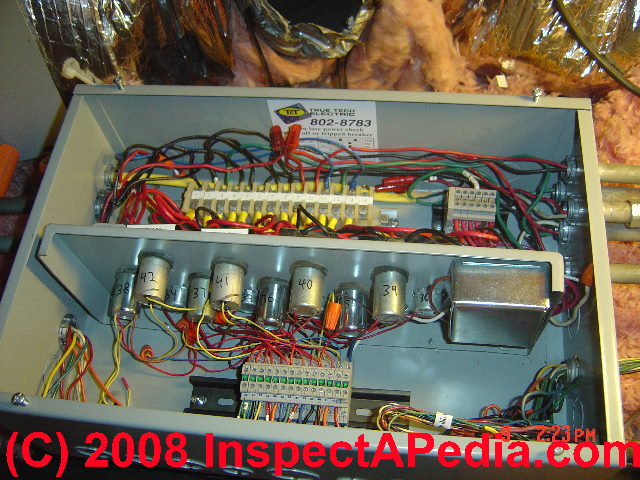
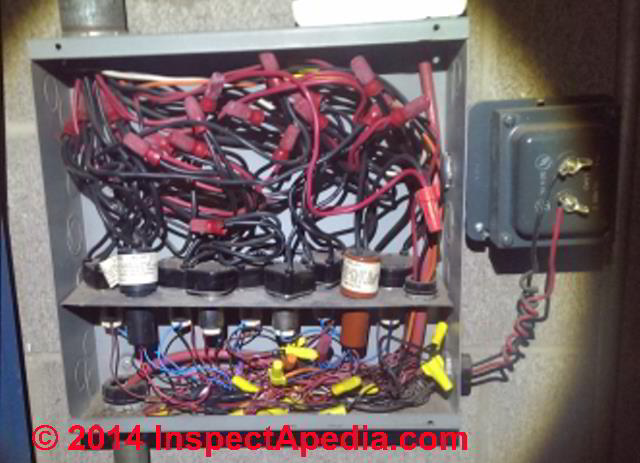
The photo at left shows the GE low voltage relay box having been re-wired. Photo courtesy of True Tech Electric cited at REVIEWERS
Above we already pointed out that the chief reason for such an upgrade is that an owner can leave in place and continue to use the existing low voltage wiring between switches and relay stations.
Otherwise we'd have to install new, much heavier gauge #14 or #12 electrical wires to support 120V switching directly.
If a home has already been wired to have an electrical control center or many-way switching of lights or outlets (say 4 or 5 way switching) the wire cost of converting to 120V would be substantial.
For help in planning an upgrade from an old system to a current system it is necessary to make a count of all the loads controlled by Touch-Plate® relays. It is also necessary to know how many different locations there are with relay panels.
Many new features and benefits are gained when upgrading.
Two Improvements May be Made when Upgrading Low Voltage Electrical Systems
- add LED's (if free wires are available, else you will have to run additional wires)
- add centralized control, from one location, of many or even all lights and electrical features
in the home
Repair Parts Sources for Low Voltage Home Wiring Systems
InspectAPedia.com is an independent publisher of building, environmental, and forensic inspection, diagnosis, and repair information provided free to the public - we have no business nor financial connection with any manufacturer or service provider discussed at our website. We do not sell products nor services.
- All Test Equipment: rocker switches that may fit or can be made to fit in the GE® triple-rocker-switch gangs Website: www.alltestequipment.com
- Kyle Switch Plates, Kyle Switch Plates, 468 Lindbergh Ave., Livermore, CA 94551 USA, (Sorry, no order pick up from offices.)
Tel: 800-551-5953 Website: https://www.kyleswitchplates.com/remcon-low-voltage-lighting/
Kyle provides low low voltage switches, switch plates, transformers, and low voltage relays control low voltage lighting, including replacement parts for Remcon low voltage lighting systems.
Kyle provides both TouchPlate and Remcon switching relays and parts, and explains that older low voltage switching and lighting systems that used Remcon relays can update their system using newer TouchPlate relays.
Kyle also provides replacement parts for Pyramid brand low voltage switching relays. The company explains that production of Pyramid light switches, wall plates, and controls were later replaced by Remcon products: both were discontinued by 2011 but compatible relays are available. - Touch-Plate Lighting supplies low voltage switches, transformers, and low voltage relays for building electrical systems. The company also provides both website support and for-pay telephone support.
Touch-Plate® Lighting Controls - 1830 Wayne Trace - Fort Wayne IN, 46803 USA. Tel: 260.426.1565 Fax: 260.426.1442
Sale Support Email: sales@touchplate.com,
Website: www.touchplate.com 800-227-5154.
Reader Comments, Questions & Answers About The Article Above
Below you will find questions and answers previously posted on this page at its page bottom reader comment box.
Reader Q&A - also see RECOMMENDED ARTICLES & FAQs
2024/01/27 Joe said: desperately looking to find an old Remcon R115 relay
I'm desperately looking to find an old Remcon R115 relay to repair our lights (older home, vaulted/no attic, low voltage switching).
The relay is broken. Perhaps you have access to another or can message me if you can? Thanks so much for any help. Joe.
Moderator reply:
Rather than try to find a no longer made and long out of production low voltage wiring relay to replace the one that has failed in your system, what other repair people do is to replace the relay with a substitute.
Take a look at this source article and also at the recommended articles given there where we discuss the problem of replacing low voltage relays. [Above on this page]
https://inspectapedia.com/electric/Low_Voltage_Home_Wiring_Repair.php#LVBuy
Reader follow-up:
All low voltage owners have seen those sites. They're just schlepping WAY overpriced LV systems to replace (and who knows where any of them will be down the road).
Forums of users have been raking them over the coals for a while now.
Plus it's one set of lights here.I know the relay is the problem and I'd rather try and find (or repair) a working relay option first.
Otherwise I'll be tearing out some drywall in a tough to access area and run standard switching. A lot of work but would rid this issue for good.
So please if you know a good route in possibly finding a working/good-used relay that can work please let me know.
Moderator reply: Inexpensive sources of generic low voltage relay replacements
Your comments (and criticism) are helpful and important information that I should add to our article on this topic. If you can add specifics and details I'd like to include that.
I think that in general these low voltage relays are not repairable, and I think that the old ones will be in short supply, though they might come up on occasion when people are converting or removing old low voltage controls.
I've posted your request here, keeping you anonymous; - you can include name or contact information if you want.
And I'll see what else I can find. In general, you should be able to find a generic low voltage relay at a reasonable price.
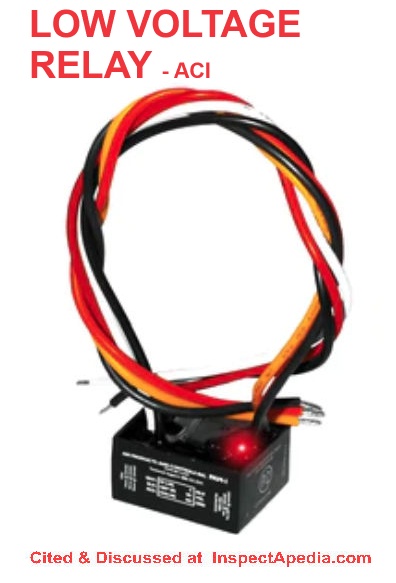
I'm surprised that you found excessive prices from low voltage relay suppliers. For example, shown below is an ACI low voltage relay that retails from local and online vendors for about $15. USD. I found these ACI multi-voltage and low voltage control relays at blackhawksupply.com .
See these examples:
- LOW VOLTAGE RELAY WIRING INSTRUCTIONS PAM-APC [PDF] (2016) PAM Series, from Air Producvts & Controls - API - retrieved 2024/01/31, original source: workaci.com/media/706/download?inline
- MULTI-VOLTAGE CONTROL RELAYS, PAM SERIES, from Automation Components, Inc., ACI - - retrieved 2024/01/31, original source: workaci.com/media/705/download?inline
And I think that there are less-sophisticated and still less-costly alternatives also available.
Watch out: even if you are permitted to do electrical wiring where you live, if you're not familiar with safe and proper electrical wiring practices you can be shocked or killed or you could set the building on fire.
Even though low-voltage wiring is itself not much of a shock hazard you need to understand that its wiring and it's devices connect to line voltage.
On 2021-09-01 by Cliff Evans - want to replace the whole Remcon low voltage wiring system with 120V wiring
I am not a professional electrician. I have a home with a Remcon low voltage system. Have experienced many problems. I wish to remove entire system and replace with new. I have started my research.
Can anyone give me advice regarding, price, product quality and compatibility. I know there are several modern systems I can convert to, but am looking for the smart, easy, cost efficient process. I will attempt this project myself.
On 2021-09-01 by inspectapedia.com.moderator (mod) - all new wiring and possibly some new fixtures are needed
@Cliff Evans,
Please clarify the question as I may have misunderstood.
If you're replacing the entire Remcon low-voltage system with a 120VAC wiring system, then your electrician is going to run all new wires from every lighting fixture that was switched by low-voltage down to every wall switch.
That's conventional wiring and there are not significant cost differences; in fact the cost of the switches and wire will be small compared with that of the labor.
Watch out: you need to confirm that your actual light fixtures are operating on 120VAC; if your lights are themselves low-voltage fixtures then converting to 120V you'll also have to replace every light fixture and you'll need new properly-sized electrical boxes at every fixture and control.
Or are you saying you want to stay with low-voltage wiring controlling lights but want to use a different transformer and relay product?
On 2020-02-24 by Stanley - electrician that said the system was "dangerous" has NEVER heard of CLASS 2 wiring.
Obviously the electrician that said the system was "dangerous" has NEVER heard of CLASS 2 wiring. VERY legal and listed in the NEC book.
Otherwise doorbells and thermostats would be "dangerous" also.
CLASS 2 wiring is current limited and as long as the original wiring used was CLASS 2 wiring , thermostat or bell wiring it is safe.
Other types of wiring has the voltage rating listed ON the side of the cable. 18 gauge is the correct gauge for doorbells, thermostats, low voltage control circuits.
The output of the power supply is current limited ALSO. I had the SAME type experience when i was involved in a church construction. We used GE RR7 latching power relays and thermostat wiring thats turned on by momentary switches for sanctuary light control. 31 years later its still working JUST FINE !!! The power rating of the relay is 20 amps which is 5 amps more than "normal" light switches.
On 2020-02-24 by danjoefriedman (mod) - electrician NEVER heard of CLASS 2 wiring.
Thank you Stanley, for the comment.
That "dangerous wiring" report was unprofessional, unethical, and inompetent in my view because it offered no specifics, thus putting occupants at risk of simply shooting in the dark at an unknown safety target. If there even was a target.
Search inspectapedia.com for "other people's money " to see an explanation of what may have been going on.
On 2019-11-03 by Brian - selling a low voltage wired home
I am selling a home that has a "low Voltage" wiring system installed. I believe in the mid 80s. We have been in the home for 3 years and haven't had a problem with the system at all.
We did a fair amount of remodeling in the home but decided to leave the system in because of the connivence of the system and it worked really well, allowing us to turn on and off lights in the whole house from the entry and bedroom.
We are currently selling the house and the buyer had an electrician come to inspect the unit. They are saying the system is dangerous and needs to be replaced.
Even with my limited knowledge of electrical work, how can it be dangerous. From what I can tell it works like this. (the low voltage sends a low current to the relay box that acts as a switch to turn the lights on and off.
Other than that the lights are wired exactly the same as any other lights.). What about that could have danger? (considering that this has worked for 30 years). I know most electricians haven't see a lot of these systems, how do we find someone that can truly verify the safety of the unit?
On 2019-11-03 by (mod) - selling a home that has a "low Voltage" wiring system installed
Brian
How interesting.
I think it's perfectly fair for you to say that if the buyer or their inspector has found something dangerous in the house that they are putting your life in jeopardy if they won't be kind enough to tell you exactly what the danger is.
I look forward to hearing that detail.
For example low-voltage wiring is not inherently dangerous and in fact in some regards it might be considered safer than modern high voltage wiring to and from switches.
On 2019-06-07 by Chuck - Bryant low voltage rocker switch troubleshooting
On a Bryant lv rocker switch I' m getting 24 v on the black and red wire checking it to the common on the switch whether I toggle it to the on or off position. Shouldn't one side go to 0 volts when I toggle?
Also the relay to turn light on does not engage to close contact on relay. Can you help me out on this one?
On 2019-06-08 - by (mod) -
I'd like to help but I'm confused by the question. Perhaps you could make a drawing or show me a photo of the wiring.
I suspect the low voltage rocker switch is damaged internally, or it's mis-wired.
What are the Components of Low Voltage Lighting Systems?
This discussion is now found at LOW VOLTAGE WIRING SYSTEM COMPONENTS
Low Voltage Wiring Sizes & Overcurrent Protection
This topic has moved to LOW VOLTAGE WIRING SIZES & OVERCURRENT PROTECTION
Guide to Low Voltage Building Wiring Transformers or Transverters
Moved to LOW VOLTAGE TRANSFORMERS, TRANSVERTERS, CONVERTERS
Diagnosing & Repairing or Replacing Low Voltage Wiring Transformers or Transverters
Moved to LOW VOLTAGE TRANSFORMER, TRANSVERTER DIAGNOSIS
Basics of Wiring Low Voltage Transformers
Moved to LOW VOLTAGE TRANSFORMER WIRING GUIDE
...
Continue reading at LOW VOLTAGE BUILDING WIRING home, on low voltage home wiring inspection, diagnosis, repair parts, repair options, or select a topic from the closely-related articles below, or see the complete ARTICLE INDEX.
Or see these
Recommended Articles
- LOW VOLTAGE BUILDING WIRING - home
- COMMON WIRE at THERMOSTATS
- LOW VOLTAGE WIRING SYSTEM COMPONENTS
- LOW VOLTAGE LIGHTING & CONTROL RELAYS
- LOW VOLTAGE TRANSFORMERS, TRANSVERTERS, CONVERTERS
- LOW VOLTAGE TRANSFORMER, TRANSVERTER DIAGNOSIS
- LOW VOLTAGE TRANSFORMER TEST
- LOW VOLTAGE TRANSFORMER WIRING GUIDE
- LOW VOLTAGE WIRING REPAIR or UPGRADE - you are on this page
- LOW VOLTAGE WIRING REPAIR PARTS SOURCES
- THERMOSTAT WIRE CONNECTIONS
- THERMOSTAT WON'T TURN OFF
- THERMOSTAT WON'T TURN ON
- ZONE DAMPERS
- ZONE VALVES, HEATING
Suggested citation for this web page
LOW VOLTAGE WIRING REPAIR or UPGRADE at InspectApedia.com - online encyclopedia of building & environmental inspection, testing, diagnosis, repair, & problem prevention advice.
Or see this
INDEX to RELATED ARTICLES: ARTICLE INDEX to ELECTRICAL INSPECTION & TESTING
Or use the SEARCH BOX found below to Ask a Question or Search InspectApedia
Ask a Question or Search InspectApedia
Questions & answers or comments about low-voltage wiring, relays, switches, transformers, transverters & devices.
Try the search box just below, or if you prefer, post a question or comment in the Comments box below and we will respond promptly.
Search the InspectApedia website
Note: appearance of your Comment below may be delayed: if your comment contains an image, photograph, web link, or text that looks to the software as if it might be a web link, your posting will appear after it has been approved by a moderator. Apologies for the delay.
Only one image can be added per comment but you can post as many comments, and therefore images, as you like.
You will not receive a notification when a response to your question has been posted.
Please bookmark this page to make it easy for you to check back for our response.
Our Comment Box is provided by Countable Web Productions countable.ca
Citations & References
In addition to any citations in the article above, a full list is available on request.
- David Goldstein - contributor and technical review. Mr. Goldstein is a principal of Ambic Home Inspection in Downingtown, PA 19335 610-269-7365
- Touchplate Corporation: Diagnosing Low Voltage Wiring System Problems See http://www.touchplate.com/standardSupport.php
- [14] "Downlights, Recessed Downlight Housings - Installation", Lucifer Lighting Company, 414 Live Oak St., San Antonio TX 78202, Tel: 210-227-7329, www.luciferlighting.com
- In addition to citations & references found in this article, see the research citations given at the end of the related articles found at our suggested
CONTINUE READING or RECOMMENDED ARTICLES.
- Carson, Dunlop & Associates Ltd., 120 Carlton Street Suite 407, Toronto ON M5A 4K2. Tel: (416) 964-9415 1-800-268-7070 Email: info@carsondunlop.com. Alan Carson is a past president of ASHI, the American Society of Home Inspectors.
Thanks to Alan Carson and Bob Dunlop, for permission for InspectAPedia to use text excerpts from The HOME REFERENCE BOOK - the Encyclopedia of Homes and to use illustrations from The ILLUSTRATED HOME .
Carson Dunlop Associates provides extensive home inspection education and report writing material. In gratitude we provide links to tsome Carson Dunlop Associates products and services.
 | HOME | ABOUT | ASK a QUESTION | CONTACT | CONTENT USE POLICY | DESCRIPTION | POLICIES | PRIVACY | |
| © 2024 - 1985 Publisher InspectApedia.com - Daniel Friedman | |||||||||