
InspectAPedia® FREE Encyclopedia of Building & Environmental Construction, Diagnosis, Maintenance & Repair |
Question? Just ask us! InspectAPedia
|
 False Ground Detection on Electrical Receptacles
Definition of False Electrical Ground & False Neutral Electrical
- POST a QUESTION or COMMENT about false electrical grounds: definition, detection, hazards, repair methods
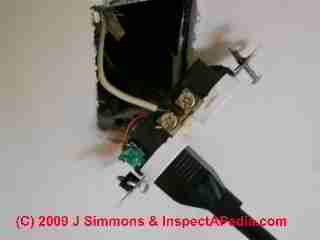
False electrical ground inspection & detection: this article answers basic questions about false grounds and their related safety concerns. Page top photo is courtesy of Jim P. Simmons - Mr. Electric.
InspectAPedia tolerates no conflicts of interest. We have no relationship with advertisers, products, or services discussed at this website.
Knob & Tube Wiring Usually Means no Electrical Ground
 Article Contents
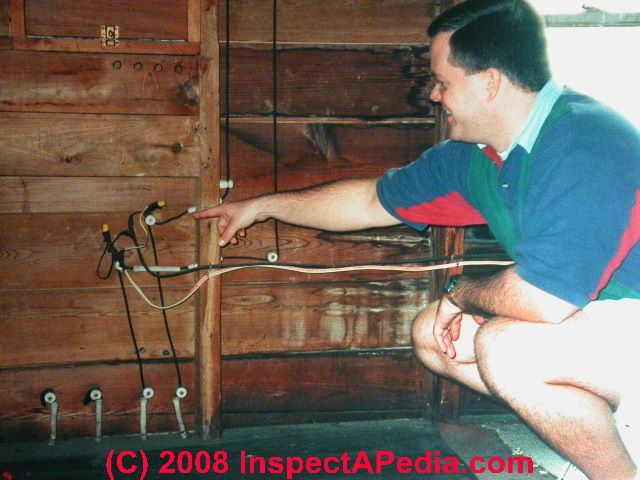
Our photo at left shows a home wired with knob-and-tube circuitry. A knob and tube circuit does not include a grounding conductor or "ground wire" so any receptacles or other devices powered by such a circuit will normally lack the added safety of electrical grounding.
But electrical wiring errors combined with hasty inspection and testing may lead an inspector or homeowner to think that a device such as an electrical receptacle on such a circuit is "grounded" when it is not. Here we provide photos and discussion of such a case.
Older homes often have electrical receptacles and fixtures that are ungrounded, and many local codes do not require that they be rewired so they're grounded.
Still, grounding is worth adding to your system because it adds protection against electrical shock.
Grounding provides a third path for electricity to travel along, so if there is a leak of any sort, it will flow into the earth rather than into the body of a person who touches a defective fixture, appliance, or tool.
An electrical system is grounded with a local grounding rod driven at least 8 feet into the ground outside the house or by connecting to a cold water pipe.
Each individual branch circuit must be grounded as well, either with a separate wire that leads to the neutral bar of the service panel or with metal sheathing that runs without a break from each outlet to the panel. (In theory, electrical outlets can be grounded individually, but this is impractical.)
Three Slot Electrical Receptacles with False Ground
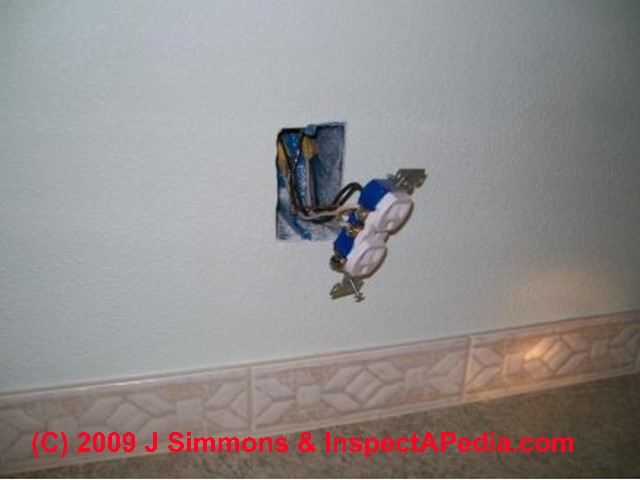
In some older homes we find incorrectly installed "grounded" electrical outlets that have the opening for the grounded plug ground connector, but the electrical system has no ground path present. If you are replacing an electrical receptacle on an ungrounded circuit you should use two-slot non-grounded electrical receptacles.
But worse than installing a "grounded-type" electrical receptacle on an electrical circuit where no ground is present, is the dangerous step that a few amateurs take of connecting the receptacle's ground screw to the neutral or white wire in the circuit.
Jim Simmons is a professional and licensed electrician who studies electrical field failures and unsafe electrical wiring.
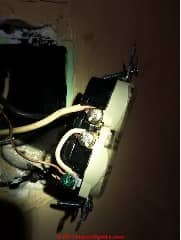
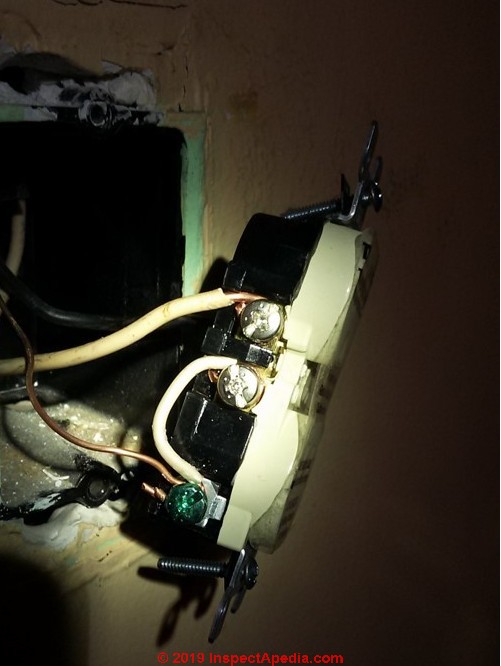
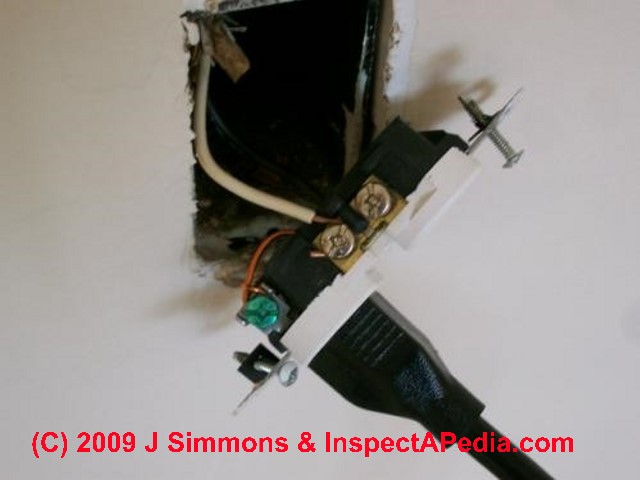 His photos at left and below show an improperly wired electrical circuit that provides a "false ground" by making a connection from the neutral wire to the ground screw.
This connection may make it appear that the circuit is "grounded" since a test that connects the hot side of the receptacle to the ground port will show current flowing, but this is incorrect.
Not only does a "false ground" electrical receptacle lack an actual safe alternative path to earth through a separate ground path or grounding conductor, but worse, the "ground" connection, by being wired to the neutral side of the circuit, can cause dangerous electrical shock as well as damage to equipment plugged into such an electrical outlet.
A safer repair would be to install new electrical wiring that provided a ground path along with grounded electrical receptacles.
Mr. Simmons wrote "A simple $7 tester will test this outlet as OK.
The Ideal tester I use clearly shows FG on the display, or False Ground. I have seen it many times over the years but this is the first time I got good pictures of it. You can see the copper jumper from the ground terminal to the neutral."
See ELECTRICAL GROUND SYSTEM INSPECTION for details about how to inspect the electrical grounding system at a building.
Ungrounded, and False-Neutral Electrical Circuits in Older Homes
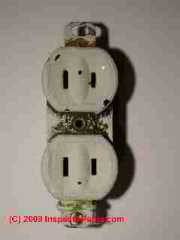 Ungrounded "two prong" Electrical Outlets - Two Slot Electrical Receptacles with No Ground
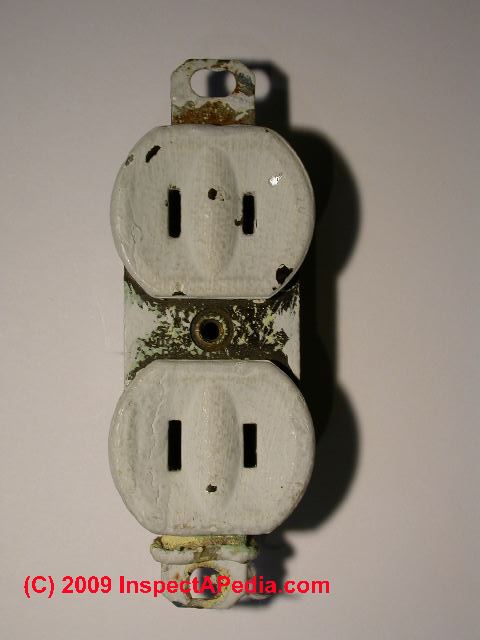
Our photo (left) shows a polarized electrical outlet that does not provide a ground connection for a grounded plug. You can see that the two slots are of different sizes. This is an un-grounded outlet.
If your outlets have two slots that are the same size, then they are neither polarized nor grounded.
These are non-polarized or un-polarized, un-grounded electrical receptacles. You should not install grounded electrical outlets on circuits where no ground path is actually present (such as knob and tube wiring).
To provide a grounded outlet where no ground is present is dangerous.
Some locations in your house- especially where the outlet and/or appliances may become wet- require ground-fault circuit-interrupter (GFCI) receptacles.
Older, ungrounded circuits usually are protected by polarization, which is less effective than grounding but better than nothing. Grounded and polarized receptacles work only if they are wired correctly.
False Neutral: Electrical Receptacle Wiring Connects Neutral Screw to Ground Path
If you look closely at bottom connecting strap below the face the electrical outlet show above, just above our red (C) notice, you'll see a white-painted wire wrapped around the metal strap used to mount this connector in the electrical box.
 Our photo at left shows the back of this same electrical outlet.
Unlike the earlier "False Ground" case, this electrical receptacle was wired with a "false neutral" using bell wire or telephone wire.
The receptacle was mounted in a metal junction box and wired with two-wire armored cable (BX) that contained a hot and neutral wire. But a fault in the neutral wiring in this building caused the receptacle to stop working.
A previous owner or handyman "fixed" this problem by making a flimsy connection between the neutral screw on the receptacle and the receptacle's mounting ("ground") strap.
Since the circuit wire was armored cable, a path to ground was provided by the metal jacket of the wire itself.
But when the amateur electrician wired the receptacle as we found it, plugging anything into the receptacle completes a circuit from the hot side of the receptacle through the powered device (say a vacuum cleaner), back to the neutral side of the receptacle, and through that telephone wire off to the mounting strap which connects to the metal junction box and the BX metal jacket that completes a circuit to earth, rather than through the proper neutral wire.
What happens when you use this unsafe electrical receptacle? Well when that vacuum cleaner is running the return current is traveling on the armored cable jacket - the metal "BX" exterior as well as other components in the electrical system become live.
Just touching the "BX" wire jacket and grounding yourself, say to a radiator, can give a nasty shock - which is how the author discovered this erroneously wired device.
Question: electrician frequently "solved problems" by connecting the receptacle neutral screw to the ground terminal and grounding conductor
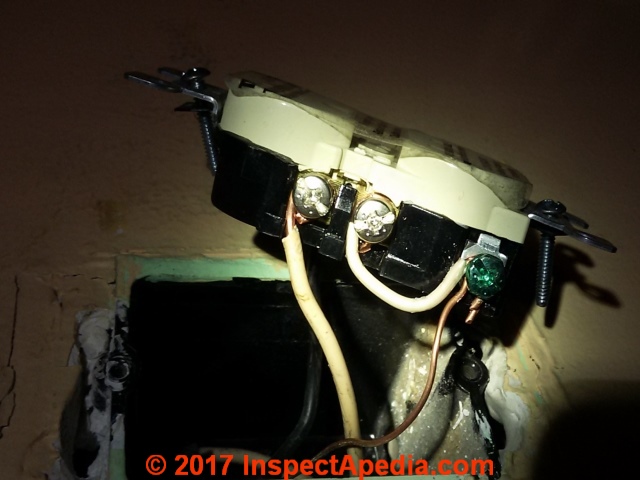 Watch out: The danger of connecting neutral to ground anywhere but in the panel is that when the circuit is active current is flowing on the grounding conductor or for BX / armored cable it's flowing in the metal BX jacket.
Those are not intended to carry normal operating current. Someone can be shocked, even killed from that condition. It's not just theory, those shocks have actually happened, even in cases I've seen personally. - excerpted from InspectApedia.com and private correspondence with the reader 3/29/17
[Click to enlarge any image]
So you are saying this [connecting the neutral to ground at a receptacle] is dangerous?
The neutral is connected to one screw at receptacle and at the other end in the panel box it’s either connected to the same slot or different one on the same grounding/neutral bus bar.
The ground wire is on it’s ground screw at receptacle with a jumper from the other screw on the same side of receptacle neutral [shown in the reader's photograph above]
The current will travel first or simultaneously to the neutral and ground bar at box via neutral or ground. Does this pose a hazard while under load with something plugged in and on or not?
Does someone have to touch the metal receptacle bracket to get shocked, Under load or not? This is scary because I don’t know how many jobs I did this on. There is only that I can recall done just recently.
I don’t think many because I just decided and learned how to do it not so long ago.
The picture [above] is the one that I did at my house.
I took the picture and then decided to undo it and leave it without the neutral to ground jump wire because I could never get a ground continuity beep, it’s buried somewhere in a junction. I was unsure.
So this would be deemed as a 2 wire 2 prong receptacle, only and should never have a 3 prong installed.
The job I just did I had to replace a GFCI and I did this procedure. Any more help would greatly be appreciated in assisting me to clear up this confusion and get me to go back to that job to correct it for safety reasons. Thank you. - Anonymous by private email 2017/03/29
Reply:
Yes, connecting ground to neutral ANYWHERE downstream from the main panel (that means not permitted in sub panels)
is dangerous, and is prohibited by electrical codes. The reasoning is as I described.
I understand that it's not obvious to someone not more familiar with electrical wiring codes and principles. I made the same mistake myself back in 1976 during an early wiring job - and I was called to task by the electrical inspector.
It seemed odd that if wires are joined in the main panel, that there would be something wrong with joining them downstream from the panel - until the problem was explained to me as I did to you.
And of course later that mistake was underscored when I saw a homeowner knocked right down onto the floor by electric shock from touching the exterior of a BX cable that wrapped exactly such an improperly-wired circuit.
- Editor
Examples of False Electrical Ground or Neutral Wired to Ground
 Jumping neutral to ground - handyman thinks its ok?
Re-posting from private email from M. 15 April 2018
I have a picture that i'd like to share but can't cause there isn't an option here.so I will have to explain.any 15 or 20 amp 3 prong receptacle.
i sometimes have to jump an insulated piece of white wire to the ground screw off of the neutral side terminal because since the neutral and ground go to the same ground bus bar in most of if not all boxes I've worked in including my own 2 panel boxes.
either there isn't a path through to ground by mc shielding or a ground wire I have no choice but to do this procedure.
i've just stumbled upon this trick on my own in the field to fool the quick receptacle testers and in thinking that this will ground the user from shock.
i wonder if this is a safe work around here in the NE,lol!..
Codes might frown upon it but like many cancer causing substances can only give you cancer in the state of California and not anywhere else. Electric is electric in any part of the world it's just looks different.
Moderator reply:
Watch out: What you are doing - connecting neutral at the receptacle to ground at the receptacle - could kill someone or set a building on fire.
The danger of connecting neutral to ground anywhere but in the panel is that when the circuit is active current is flowing on the grounding conductor or for BX/armored cable it's flowing in the metal BX jacket.
Those are not intended to carry normal operating current. Someone can be shocked, even killed from that condition.
You are also violating the electrical code in just about any country in the world.
It's not just theory, those shocks have actually happened, even in cases I've seen personally.
Joe Orawczyk said: Besides dangerous, hot-neutral wiring & false ground wiring is fraud and grand theft.
Some general building contractors who flip real estate are intentionally installing these bootleg ground jumper wire from the ground terminal screw to the neutral terminal for the purpose of fooling home inspectors who rely on the cheap three light GFCI circuit tester.
This gives the home buyer the erroneous belief their wiring was upgraded/replaced and is safe.
This justifies an increased sales price and profit, but the home buyer ends up paying to rewire the home.
Besides dangerous, this is fraud and grand theft. 2018/10/18
Moderator reply:
Thanks Joe for a very important post.
To protect our website and readers from malware, the Comments Box software security does not permit reader-posted links.
But I would much welcome your re-posting of the details you know about right here; you can also post still images, or if you own the video rights to the clip at the post you cited I can either provide that manually for our readers or if you prefer I can include still snapshots of its content.
Thanks again,
Daniel - Editor
Reader Comments, Questions & Answers About The Article Above
Below you will find questions and answers previously posted on this page at its page bottom reader comment box.
Reader Q&A - also see RECOMMENDED ARTICLES & FAQs
On 2020-10-03 by Anonymous
David:
You'd need to run a grounding conductor from the electrical panel's ground bus to the light location.
On 2020-10-03 by David Davis
I have a two wire 1952 built house and I bought a LED ceiling light for my kitchen that wont work without the ground wire connected.
Is there a way to wire this type of light so that it works without the ground wire or do i have to go back to an incandescent fixture?
On 2014-03-30 - by (mod) -
Anon,
There is no question that depending on how a test is conducted the receptacles might look grounded or correctly wired when they were not. One wonders if the fellow hired was the original installer?
For example depending on how a test is conducted a receptacle might look grounded but only be "grounded" through the metal mounting strap connection to a metal junction box - which is hardly an acceptable NEC ground - we want a ground wire from the receptacle screw to the circuit grounding conductor.
Also, using the GFCI's internal test button does not perform the same test as using a plug-in circuit tester. The built-in "test" button on the GFCI internally tests the trip mechanism itself; the external test instrument plugged into the receptacle can actually simulate a short hot to neutral, a short hot to ground, or a short neutral to ground - not all of which are detected by the "test button" on the device.
A line-load mis-wiring can also give some of these snafus.
On 2014-03-29 by Anonymous
I inspected a 1960's house that had a GFCI receptacle installed in every outlet box in the living room. One tested correctly with a three prong - three light circuit tester. The others tested "open ground". the electrician secured to fix the situation reported to the real estate agent that he found the boxes properly grounded. I am to meet them all in a few days to jointly inspect the condition. I'm trying to figure out what might be at issue here. Any suggestions?
On 2012-11-19 by Lou
Ok, so I need to run the ground wire all the way to the breaker box?
Can I gang the ground wires for 2 or more outlets, then run to the main panel, or do they each need to go directly?
On 2012-11-15 - by (mod) -
Cheap:
You may be able to get your wiring to work, but it is illegal and dangerous. It is certainly not the case that ALL of the metallic exterior of your BX is covered and safe from contact - it will be exposed at least when it approaches the electrical panel.
The ground path does not normally carry current, but lots of snafu's end up sending current along that path, such as a wiring mistake or a device with an internal short. In that circumstance, someone standing on a damp basement floor and touching the BX can get zapped.
Furthermore, using any metal material not designed for use as an electrical grounding conductor is not only a code violation, and not only a shock hazard, it is also an unreliable ground - thus the very purpose of the ground (assuring that a fuse blows or breaker trips) is subverted.
There may also be a fire risk - arcing in hidden spaces (where you point out no one can see nor touch the wire) in event of a short to ground.
Overall, it's a dangerous and bad idea, even though it's understandably tempting to use the BX sheathing as a grounding conductor.
We would not expect such wiring to be done by a licensed electrician and it certainly would not be approved by an informed code compliance inspector.
Finally, while personal experience is too narrow a sample to draw broad conclusions, we personally witnessed a homeowner zapped and knocked to the floor from touching just such a wiring installation. We had pointed out the hazard to a home buyer and had actually measured voltage between the BX sheathing and a solid ground. The owner pooh-pooed the warning as nonsense, and to prove it, licked his knuckles and touched between the hot "ground" path and a nearby water pipe.
He was knocked flat.
On 2012-11-15 by CheapElectrical
Yup, I use the sheath on BX wiring as ground all the time in older homes. It saves the owner money since you don't need a to run new wires all the way back to the box. It's inside the walls anyway so it's not like someone will get shocked. I've never had any complaints.
On 2012-11-05 - by (mod) -
Lou,
Please don't use the BX sheath as a ground path. That is improper and dangerous. Should the ground actually carry current in an emergency, someone could get shocked.
The circuit would test ok but is hazardous.
On 2012-11-05 by Lou
Is it OK to replace a 2 slot BX outlet with a 3 slot outlet by adding ground wire and attaching to the metal BX sheath? The sheath is grounded all the way to the main box.
I did this on one outlet and the tester showed the outlet grounded. I've got about 10 more outlets, but don't want to create a safety problem.
On 2011-07-30 - by (mod) - Look for any incorrect connection of the grounded conductor (Neutral wire) to the grounded wire (EGC or Safety Ground) at any place other than on the service side of the load center/breaker-fuse panel.
good comments below
On 2011-07-29 by Anonymous
Regarding installation of upgraded residential wiring (e.g. 2-wire knob & tube to 3wire installation.
Look for any incorrect connection of the grounded conductor (Neutral wire) to the grounded wire (EGC or Safety Ground) at any place other than on the service side of the load center/breaker-fuse panel.
The neutral must be bonded to the EGC at the main bonding jumper/grounding Bus. Neutral is never to be bonded to the grounding conductor on the load side of the overcurrent protection devices (Circuit breakers or fuses)
. Example defect: At rented house in xxx IL, when the house wiring was upgraded to 3-conductor system, the neutral (grounded conductor) was connected to the grounding conductor (equipment grounding conductor (EGC)) on the load side of service panel overcurrent protective devices (CBs).
This was discovered by me upon inspection after wife received a shock when contacting both refrigerator and freezer at same time.
Measured voltage between these appliance exterior was 120V AC. The wiring upgrade was done over a year prior to my occupancy.
The electrical contractor was contacted and immediately took corrective action. In this case it is obvious that the electrical contractor and municipal inspector failed to conduct a thorough check.
...
Continue reading at FALSE NEUTRAL CONNECTIONS explained or select a topic from the closely-related articles below, or see the complete ARTICLE INDEX.
Or see these
Recommended Articles
- AFCI GFCI WIRING, TESTING & SAFETY
- ELECTRIC PANEL INSPECTION
- ELECTRICAL GROUNDING in OLDER HOMES
- GROUND SYSTEM INSPECTION - home
- FALSE GROUND at RECEPTACLES
- FALSE GROUND, BOOTLEG & FLICKERING LIGHTS
- FALSE NEUTRAL CONNECTIONS
- GAS PIPING GROUND BOND
- LIGHTNING PROTECTION SYSTEMS
- LOST ELECTRICAL GROUND
- LOST NEUTRAL SHOCKS HOMEOWNER
- SERVICE GROUNDING DEFECTS
- GROUND SYSTEM REQUIREMENTS
- KNOB & TUBE WIRING
- LIGHTNING PROTECTION SYSTEMS
- SAFETY for ELECTRICAL INSPECTORS
- TEST EQUIPMENT, ELECTRICAL GUIDE
- UNDERGROUND SERVICE LATERALS
Suggested citation for this web page
FALSE GROUND at RECEPTACLES at InspectApedia.com - online encyclopedia of building & environmental inspection, testing, diagnosis, repair, & problem prevention advice.
Or see this
INDEX to RELATED ARTICLES: ARTICLE INDEX to ELECTRICAL INSPECTION & TESTING
Or use the SEARCH BOX found below to Ask a Question or Search InspectApedia
Ask a Question or Search InspectApedia
Questions & answers or comments about false electrical grounds: definition, detection, hazards, repair methods
Try the search box just below, or if you prefer, post a question or comment in the Comments box below and we will respond promptly.
Search the InspectApedia website
Note: appearance of your Comment below may be delayed: if your comment contains an image, photograph, web link, or text that looks to the software as if it might be a web link, your posting will appear after it has been approved by a moderator. Apologies for the delay.
Only one image can be added per comment but you can post as many comments, and therefore images, as you like.
You will not receive a notification when a response to your question has been posted.
Please bookmark this page to make it easy for you to check back for our response.
Our Comment Box is provided by Countable Web Productions countable.ca
Citations & References
In addition to any citations in the article above, a full list is available on request.
- Jim P. Simmons, Licensed Electrician, 360-705-4225 Mr. Electric, is a Licensed Master Electrician in Olympia, Washington. Contact Jim P. Simmons, Licensed Master Electrician, Mr. Electric, 1320 Dayton Street SE Olympia, WA 98501, Ph 360-705-4225, Fx 360-705-0130 mrelectricwa@gmail.com
- Mark Cramer Inspection Services Mark Cramer, Tampa Florida, Mr. Cramer is a past president of ASHI, the American Society of Home Inspectors and is a Florida home inspector and home inspection educator. Mr. Cramer serves on the ASHI Home Inspection Standards. Contact Mark Cramer at: 727-595-4211 mark@BestTampaInspector.com
- John Cranor [Website: /www.house-whisperer.com ] is an ASHI member and a home inspector (The House Whisperer) is located in Glen Allen, VA 23060. He is also a contributor to InspectApedia.com in several technical areas such as plumbing and appliances (dryer vents). Contact Mr. Cranor at 804-873-8534 or by Email: johncranor@verizon.net
- "Electrical System Inspection Basics," Richard C. Wolcott, ASHI 8th Annual Education Conference, Boston 1985.
- "Simplified Electrical Wiring," Sears, Roebuck and Co., 15705 (F5428) Rev. 4-77 1977 [Lots of sketches of older-type service panels.]
- "How to plan and install electric wiring for homes, farms, garages, shops," Montgomery Ward Co., 83-850.
- "Simplified Electrical Wiring," Sears, Roebuck and Co., 15705 (F5428) Rev. 4-77 1977 [Lots of sketches of older-type service panels.]
- "Home Wiring Inspection," Roswell W. Ard, Rodale's New Shelter, July/August, 1985 p. 35-40.
- "Evaluating Wiring in Older Minnesota Homes," Agricultural Extension Service, University of Minnesota, St. Paul, Minnesota 55108.
- "Electrical Systems," A Training Manual for Home Inspectors, Alfred L. Alk, American Society of Home Inspectors (ASHI), 1987, available from ASHI. [DF NOTE: I do NOT recommend this obsolete publication, though it was cited in the original Journal article as it contains unsafe inaccuracies]
- "Basic Housing Inspection," US DHEW, S352.75 U48, p.144, out of print, but is available in most state libraries.
- In addition to citations & references found in this article, see the research citations given at the end of the related articles found at our suggested
CONTINUE READING or RECOMMENDED ARTICLES.
- Carson, Dunlop & Associates Ltd., 120 Carlton Street Suite 407, Toronto ON M5A 4K2. Tel: (416) 964-9415 1-800-268-7070 Email: info@carsondunlop.com. Alan Carson is a past president of ASHI, the American Society of Home Inspectors.
Thanks to Alan Carson and Bob Dunlop, for permission for InspectAPedia to use text excerpts from The HOME REFERENCE BOOK - the Encyclopedia of Homes and to use illustrations from The ILLUSTRATED HOME .
Carson Dunlop Associates provides extensive home inspection education and report writing material. In gratitude we provide links to tsome Carson Dunlop Associates products and services.
 | HOME | ABOUT | ASK a QUESTION | CONTACT | CONTENT USE POLICY | DESCRIPTION | POLICIES | PRIVACY | |
| © 2024 - 1985 Publisher InspectApedia.com - Daniel Friedman | |||||||||