
InspectAPedia® FREE Encyclopedia of Building & Environmental Construction, Diagnosis, Maintenance & Repair |
Question? Just ask us! InspectAPedia
|
 Local Electrical Grounding System Inspection Procedures & Safety
- POST a QUESTION or COMMENT about electrical grounding electrode, wiring, inspection & safety
Electrical ground system inspection safety:
This article discusses safety suggestions when inspecting the grounding system at residential electrical systems and suggests safety procedures for the electrical inspector, home inspector, or other professionals who examine residential electrical systems.
Safe electrical inspection procedures and safe use of volt meters, DMMs, multimeters, and similar electrical test equipment is discussed at the end of the article.
InspectAPedia tolerates no conflicts of interest. We have no relationship with advertisers, products, or services discussed at this website.
Inspect the Local Electrical Grounding Electrode or Grounding Connections - electrical ground system defects & safety hazards
 ...
... 
Here we discuss safety considerations when inspecting the building electrical ground system. Readers of this article should also
see ELECTRICAL GROUND SYSTEM INSPECTION - on how to inspect the electrical grounding system and what common defects may be present.
These electrical inspection suggestions are not a complete inventory of all electrical safety procedures nor of all electrical components that should be inspected; these notes focus on identification of conditions that may present special electrical hazards for the electrical inspector. Contact Us by email to suggest changes, corrections, and additions to this material.
Fatal Shock Hazard Warning: Inspecting electrical components and systems risks death by electrocution as well as serious burns or other injuries to the inspector or to others. Do not attempt these tasks unless you are properly trained and equipped.
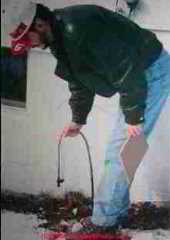
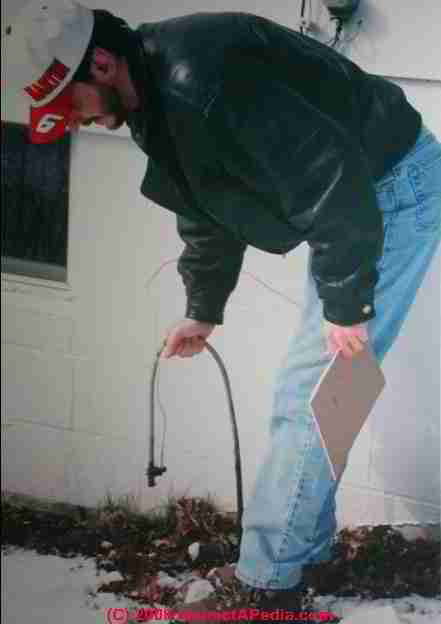
- Do not assume that the grounding electrode is a real one. Kick it. We find short scraps driven into the ground that can sometimes just be pushed over or pulled out, as our client is demonstrating. Often ground connections have come loose, were never connected, or have corroded away. The ground connection shown here is not reliable. The inspector has easily lifted the short ground rod out of the ground. (Photo above left)
- Do not assume that the utility company's ground (back at the pole) is connected and working. Sometimes that ground has been lost and only the local ground is present - a very dangerous condition.
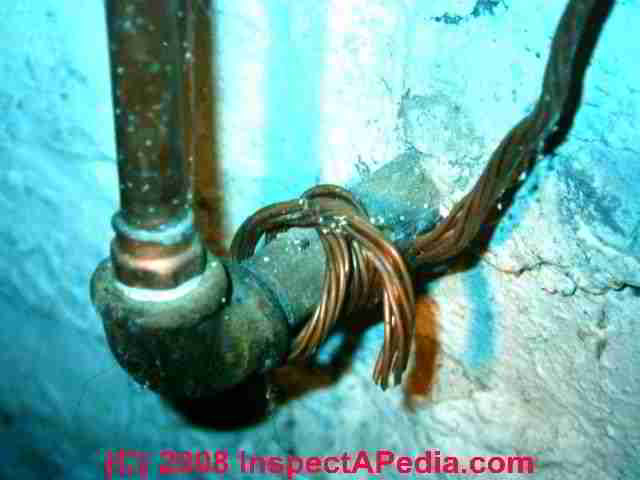
See DOUBLE FAULT, LOSS OF ELECTRICITY for an account of loss of both local ground and utility company ground at a property. - Do not assume that water pipes form a good ground - original metal pipes extending into the soil may have been replaced with plastic. (Photo above right)
- Do not assume that grounding connections you see are actually secure and making good electrical contact.
Using a Neon Tester, a DMM or VOM to Check Grounding Connections
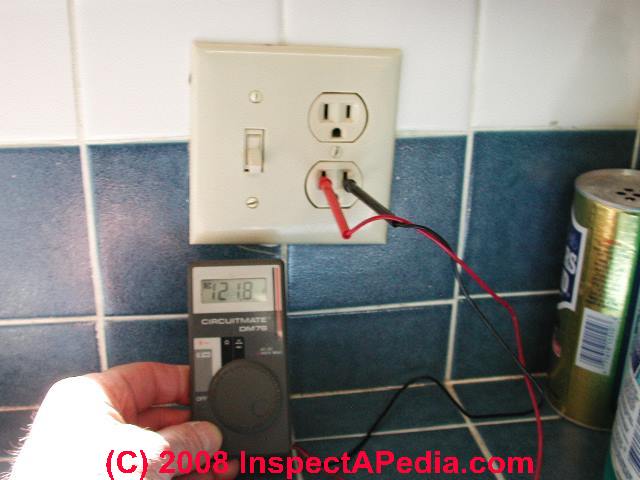 A simple volt ohm meter volt-ohm meter (VOM) such as the TriplettTM 310
or our little mini digital multimeter (DMM) shown at left can be used to test for unexpected and unsafe voltage at a component.
A simple volt ohm meter volt-ohm meter (VOM) such as the TriplettTM 310
or our little mini digital multimeter (DMM) shown at left can be used to test for unexpected and unsafe voltage at a component.
Testing for live voltage: this procedure describes a method for checking for the presence of live voltage.
During electrical work when we want to know if a metal part is connected to the grounded conductor (neutral) or to ground, we might use a neon tester to create a connection between a point of live voltage and the item which is being tested for grounding.
Be careful: this is not a reliable nor a complete test. For example, a weakly-grounded wire or electrode may look just fine when tested with a VOM, a DMM, or a neon tester, but when subject to higher current flow the ground may be completely inadequate.
For a case study which found exactly this problem,
see DOUBLE FAULT, LOSS OF ELECTRICITY..
- Never touch metal plumbing or gas system pipes while you're working around electricity.
- Never touch electrical equipment while standing on a damp or wet surface. [Unless you are trained and are wearing appropriate protective gear.]
For example, if the meter indicates more than 1or 2 volts between a service panel cover and ground, there's a safety problem. Most low-cost analog-type meters such as the one described provide additional ranges used to read lower voltages with more sensitivity.
Some VOM models provide alligator clips for the ends of the test probes. These clips permit measuring high voltage without handling the probes. Always shut off the power before connecting the alligator clips.
Details on safe use of DMM's and VOMs are at DMMs VOMs SAFE USE OF.
ELECTRICAL INSPECTOR SAFETY PROCEDURES describes important basic safety procedures, clothing, and equipment for home inspectors and electrical inspectors.
These electrical inspection suggestions are not a complete inventory of all electrical components that should be inspected; these notes focus on identification of conditions that may present special electrical hazards for the electrical inspector. Contact Us by email to suggest changes, corrections, and additions to this material
Handling Immediate Threats to Life and Safety at a Building Inspection
If in the inspector's judgment equipment is an immediate threat to life and property, such as a boiler whose flue connection has fallen off, we recommend that dangerous equipment be shut down and the appropriate people notified.
See SHUTTING DOWN UNSAFE EQUIPMENT. In some cases "appropriate people" includes not only the client and building owner, but also building occupants.
In some instances such as sparking electrical panels, gas leaks, or evidence of a fire, the inspector and everyone else should leave the building immediately and from outside, call the fire department and as appropriate, the gas company, police, or rescue personnel.
...
Continue reading at ELECTRICAL GROUND REQUIREMENTS or select a topic from the closely-related articles below, or see the complete ARTICLE INDEX.
Or see these
Recommended Articles
- ELECTRIC PANEL INSPECTION
- ELECTRICAL SERVICE ENTRY DAMAGE
- GROUND SYSTEM INSPECTION - home
- Watch out: for safety, also review SAFETY HAZARDS & SAFE ELECTRICAL INSPECTION PROCEDURES for Inspectors examining Residential Electrical Systems
Suggested citation for this web page
ELECTRICAL GROUND INSPECTION SAFETY at InspectApedia.com - online encyclopedia of building & environmental inspection, testing, diagnosis, repair, & problem prevention advice.
Or see this
INDEX to RELATED ARTICLES: ARTICLE INDEX to ELECTRICAL INSPECTION & TESTING
Or use the SEARCH BOX found below to Ask a Question or Search InspectApedia
Ask a Question or Search InspectApedia
Questions & answers or comments about shock and electrocution hazards when touching electrical equipment during an inspection.
Try the search box just below, or if you prefer, post a question or comment in the Comments box below and we will respond promptly.
Search the InspectApedia website
Note: appearance of your Comment below may be delayed: if your comment contains an image, photograph, web link, or text that looks to the software as if it might be a web link, your posting will appear after it has been approved by a moderator. Apologies for the delay.
Only one image can be added per comment but you can post as many comments, and therefore images, as you like.
You will not receive a notification when a response to your question has been posted.
Please bookmark this page to make it easy for you to check back for our response.
Our Comment Box is provided by Countable Web Productions countable.ca
Citations & References
In addition to any citations in the article above, a full list is available on request.
- Electrical shock injury statistics: www.healthatoz.com - September 2008;
High-tension current generally causes the most serious injuries, although fatal electrocutions may occur with household current (e.g., 110 V in the United States and Canada and 220 V in Europe, Australia, and Asia). Contact with alternating current at 60 cycles per second (the frequency used in most US household and commercial sources of electricity) may cause tetanic skeletal muscle contractions, preventing self-release from the source of the electricity and thereby leading to prolonged exposure. The repetitive frequency of alternating current also increases the likelihood of current flow through the heart during the relative refractory period (the "vulnerable period") of the cardiac cycle. This exposure can precipitate ventricular fibrillation (VF), which is analogous to the R-on-T phenomenon.-- circ.ahajournals.org - September 2008
- Mark Cramer Inspection Services Mark Cramer, Tampa Florida, Mr. Cramer is a past president of ASHI, the American Society of Home Inspectors and is a Florida home inspector and home inspection educator. Mr. Cramer serves on the ASHI Home Inspection Standards. Contact Mark Cramer at: 727-595-4211 mark@BestTampaInspector.com
- John Cranor [Website: /www.house-whisperer.com ] is an ASHI member and a home inspector (The House Whisperer) is located in Glen Allen, VA 23060. He is also a contributor to InspectApedia.com in several technical areas such as plumbing and appliances (dryer vents). Contact Mr. Cranor at 804-873-8534 or by Email: johncranor@verizon.net
- "Frequency of Occurrence and Sources of Rust and Corrosion in Electrical Panels," Daniel Friedman, IEEE HOLM Conference, Philadelphia PA, 1992 - see ELECTRIC PANEL RUST for an online version of this article.
- Jim Simmons: Personal communication, J. Simmons to Daniel Friedman, 9/19/2008. Photographs contributed to this website by Jim P. Simmons, Licensed Electrician, 360-705-4225 Mr. Electric, Licensed Master Electrician, Olympia, Washington Contact Jim P. Simmons, Licensed Master Electrician, Mr. Electric, 1320 Dayton Street SE
Olympia, WA 98501, Ph 360-705-4225, Fx 360-705-0130 mrelectricwa@gmail.com - Kenneth Kruger: Original author of the sidebar on testing VOM DMM condition: Kenneth Kruger, R.A., P.E. AIA ASCE, is an ASHI Member and ASHI Director in Cambridge, MA. He provided basis for this article penned by DJ Friedman.
- "How to Use DMM's Safely," Leonard Ogden, CEE News, 888 Seventh Ave., New York, NY 10106, Dec 1990 p.10.
- Dr. Jess Aronstein, consulting engineer, Poughkeepsie NY, 1991 protune@aol.com
- Rex Cauldwell, master electrician and contributor to the Journal of Light ConstructionOn electrical topics
- New York State Central Hudson Gas and Electric Company, G&E/1-2/85 consumer safety pamphlet
- American Society of Home Inspectors, ASHI Training Manual, Al Alk -[obsolete, and includes unsafe practices-DF]
- "Electrical System Inspection Basics," Richard C. Wolcott, ASHI 8th Annual Education Conference, Boston 1985.
- "Simplified Electrical Wiring," Sears, Roebuck and Co., 15705 (F5428) Rev. 4-77 1977 [Lots of sketches of older-type service panels.]
- "How to plan and install electric wiring for homes, farms, garages, shops," Montgomery Ward Co., 83-850.
- "Simplified Electrical Wiring," Sears, Roebuck and Co., 15705 (F5428) Rev. 4-77 1977 [Lots of sketches of older-type service panels.]
- "Home Wiring Inspection," Roswell W. Ard, Rodale's New Shelter, July/August, 1985 p. 35-40.
- "Evaluating Wiring in Older Minnesota Homes," Agricultural Extension Service, University of Minnesota, St. Paul, Minnesota 55108.
- "Electrical Systems," A Training Manual for Home Inspectors, Alfred L. Alk, American Society of Home Inspectors (ASHI), 1987, available from ASHI. [DF NOTE: I do NOT recommend this obsolete publication, though it was cited in the original Journal article as it contains unsafe inaccuracies]
- "Basic Housing Inspection," US DHEW, S352.75 U48, p.144, out of print, but is available in most state libraries.
- In addition to citations & references found in this article, see the research citations given at the end of the related articles found at our suggested
CONTINUE READING or RECOMMENDED ARTICLES.
- Carson, Dunlop & Associates Ltd., 120 Carlton Street Suite 407, Toronto ON M5A 4K2. Tel: (416) 964-9415 1-800-268-7070 Email: info@carsondunlop.com. Alan Carson is a past president of ASHI, the American Society of Home Inspectors.
Thanks to Alan Carson and Bob Dunlop, for permission for InspectAPedia to use text excerpts from The HOME REFERENCE BOOK - the Encyclopedia of Homes and to use illustrations from The ILLUSTRATED HOME .
Carson Dunlop Associates provides extensive home inspection education and report writing material. In gratitude we provide links to tsome Carson Dunlop Associates products and services.
 | HOME | ABOUT | ASK a QUESTION | CONTACT | CONTENT USE POLICY | DESCRIPTION | POLICIES | PRIVACY | |
| © 2024 - 1985 Publisher InspectApedia.com - Daniel Friedman | |||||||||