
InspectAPedia® FREE Encyclopedia of Building & Environmental Construction, Diagnosis, Maintenance & Repair |
Question? Just ask us! InspectAPedia
|
 Estimate the Electrical Capacity or Size of an Electrical Panel
Determine the Electrical Panel
Amps Rating
- POST a QUESTION or COMMENT about how to estimate the electrical panel size or capacity - amperage rating of an electrical panel
Electrical Panel Amps:
How to determine the residential electrical service panel age, type, and size or capacity in Amps & Voltage:
This article explains how to estimate the electrical service size, ampacity rating, (or "electrical power" or "service amps") at a building by visual examination of the electrical service panel, main switch, and other details.
In this article series we describe how to recognize different vintages, ages, types of electrical panels and how to find the components that define the ampacity rating of the service equipment.
Visual inspection and use of digital multimeters(DMMs), Volt-ohm meters (VOMs), neon testers, and electrical inspection safety are also discussed.
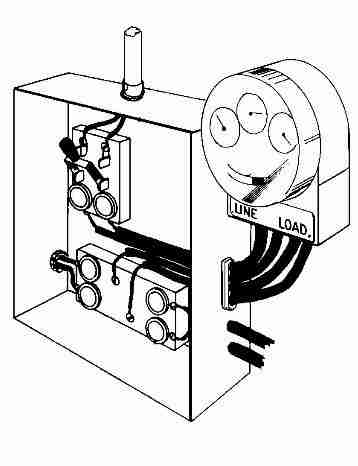
We include photographs and sketches illustrate electrical panels, meter bases, and electric meters.
InspectAPedia tolerates no conflicts of interest. We have no relationship with advertisers, products, or services discussed at this website.
Electrical Panel Ampacity - Guide to Inspecting Electrical Service Panels for their Ampacity Rating
 A frequently asked question at home inspection education conferences is "How do I determine the electrical service amperage or size?"
This article describes inspecting the ampacity or size of the main disconnect and/or main electrical panel.
Safety concerns attend any electrical system inspection. See SAFETY for ELECTRICAL INSPECTORS at Residential Electric Panels.
[Click to enlarge any image]
Watch out: Do not attempt to open an electric panel without making yourself familiar with safe procedures.
Watch out: Do not open or even touch electrical equipment if you find dangerous conditions, or simply uncertain conditions which give cause for alarm.
If you elect not to examine a component, indicate to your client that you did not inspect the component, explain why, and recommend appropriate steps to make access and inspection safe and possible. Document this information in your report.
Home inspectors or electrical inspectors who touch electrical wires or move them in order to better read the data tag are performing a dangerous act.
Determine the Electric Service Panel Ampacity, Age & Type by Visual Inspection
We look for an electrical panel brand, model & data tag (usually paper) or embossed rating (on fuse pull outs) on the panel itself which often includes the amperage rating of the panel.
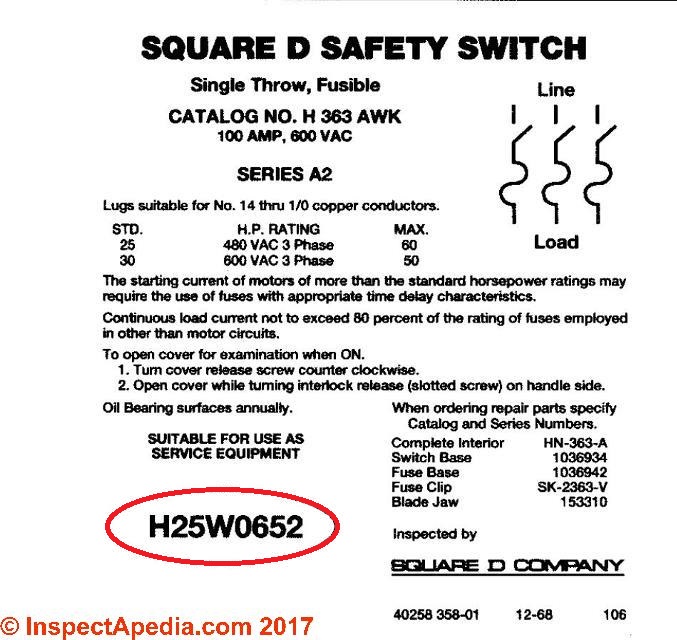 This information is usually present in newer panels on a panel side, or on the panel cover.
This data tag or one of multiple tags usually found inside the electrical panel door or cover but sometimes also found inside the electrical panel enclosure itself, perhaps on the interior surface of a the load center or panel side typically provides several categories of information including
- UL listing
- Electrical Panel or load center manufacturer
- Electrical Panel or load center AMPS rating
- Electrical Panel or load center model number and serial number.
To decode a serial number to find the age of an electrical panel
see ELECTRICAL PANEL AGE.
Actual dimensions of an electric panel are not a reliable determinant of ampacity. For example, many larger panels can be fitted with a variety of bus-bar and main switch assemblies of varying ampacity.
How to Recognize an Older 30- 60- & 100 Amp Fuse Panels
Older 30-amp fuse panels typically have round 15-amp or 20-amp fuses installed on both hot and neutral conductors,[Figure at above left] and sometimes a separate main fuse switch.
There are safety issues with ELECTRICAL PANEL FUSED NEUTRAL WIRE HAZARDS that risk fire or shock. Look for fuses on the neutral wires in old fuse panels or fuse blocks.
Simpler 30-amp panels or sub-panels
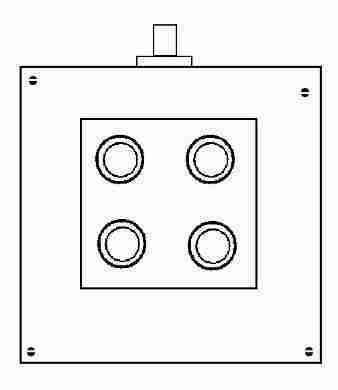
Simpler 30-amp panels or sub-panels like the smaller four-fuse panel shown at immediate left are usually auxiliary rather than main service panels in most buildings.
An exception which the author's have found is that this panel was used as a main service for small lake and other remote cottages.
Where such buildings have in more recent years had additional electrical circuits installed, for use of electric heaters, for example, such panels are often overcrowded and very often the individual circuits are over fused - a fire hazard.
Identify Older 60-amp Fuse Panels
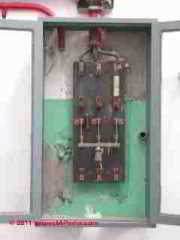
Older 60-amp fuse panels [first panel shown above] and some 100-amp panels [Figure at left] often have a single or a pair of BakeliteTM fuse holders, one marked "main," the other marked "range."
Also see ASBESTOS in PLASTICS
In typical installations, the "main" fuse pullout shuts off power in the panel except the range circuit.
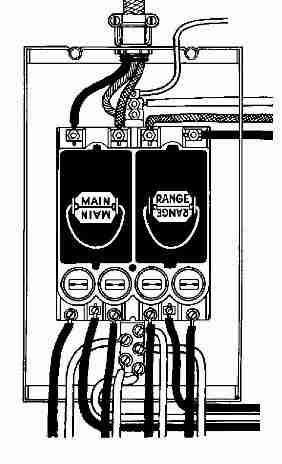
This main should contain 60-amp or smaller fuses. Both main and "range" pullouts must be removed to cut all power.
The example at left used a 60A fuse supplying the lighting circuits (fuses in row along the panel bottom) and a 40A 240V appliance circuit is supplied by the "range" fuse pair.
Identify Single-Pull-Out 100A Fused Electrical Panels
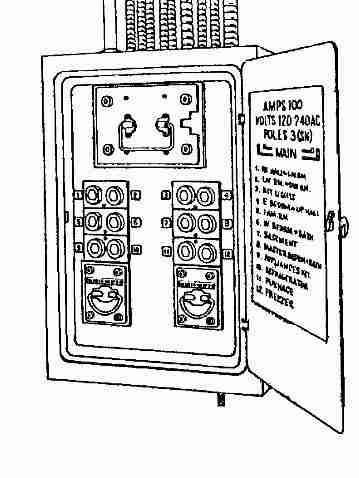
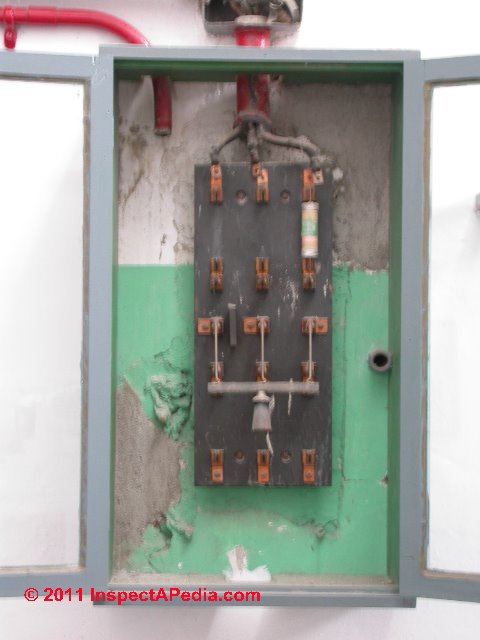
100-Amp fuse panels: The next panel shown above is a 100-amp (or larger) fuse panel using a main fuse holder centered in the top of the panel.
The two fuse holders for two 240V circuits at the panel bottom are not mains and were often used to supply a range circuit and clothes dryer circuit, or range and sub panel circuits.
125-amp CB panels are often fitted with a 100-amp main disconnect CB or fuse-pair.
In this case the electrical inspector should ignore the larger equipment panel size (perhaps indicated by an inside-panel label) and instead s/he should rate the electrical service ampacity based on the main CB or fuse-pair.
Readers of this article should also be sure to review SAFETY HAZARDS & SAFE ELECTRICAL INSPECTION PROCEDURES for examining Residential Electrical Panels.
Identify 100-Amp Circuit Breaker Panels
Based only on apparent panel size and provision for 24 circuits, this larger panel at left, showing a modern main CB at the top and two 12-breaker columns is at least a 100 Amp box, maybe 150 Amps.
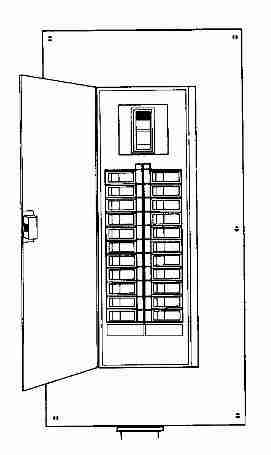
Better check the service conductors, main CB, and panel label.
Identify Multi-Pull-out 100-Amp Fuse Panels, Split Bus
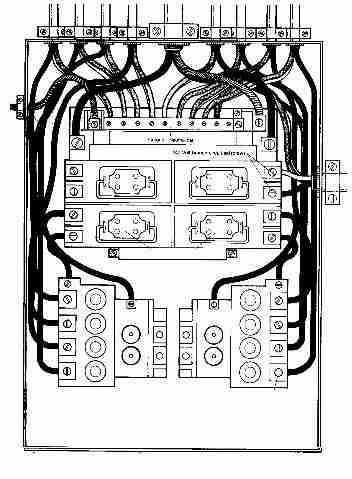
In the multi-pullout 100-amp fuse panel shown next at left, all four of the top pullouts are mains.
The top two switch 240-volt appliances and the bottom two power the left and right hand groups of screw-in type fuses in the bottom of the panel. (The upper left-hand 240 V appliance circuit's fuse is not connected so is not in use.)
All four should be labeled mains.
This is a tougher one since, as Hansen points out, [Hansen, op. cit.] the sum of the ratings of the different disconnects may exceed the capacity of the conductors.
For example you can have a 125A service with two main disconnects, one rated at 100 amps and one rated at 50 amps. In this case we'd look at the rating of the service conductor and the service equipment (panel) for help.
Details about split-bus electrical panels are
at SPLIT BUS ELECTRICAL PANEL HAZARDS
Reader Comments, Questions & Answers About The Article Above
Below you will find questions and answers previously posted on this page at its page bottom reader comment box.
Reader Q&A - also see RECOMMENDED ARTICLES & FAQs
On 2020-10-06 - by (mod) -
You could try identifying the circuit breakers by brand and look at electrical panels of that brand of the physical dimensions of yours. Also look at the main circuit breaker and the service entry cable size.
On 2020-10-06 by Michael
The electrical inspector is asking me to verify the amperage rating of my service box and there are no tags or anything on it how do I do that
On 2020-01-21 - by (mod) -
do I have to have a to have a primary panel rated at 500 amps or can I derate the feeders.Great question, ES. I don't know an authoritative answer, but in general I think the answer depends on how the panels are fed.
For example it's common to see on service entry feed multiple electrical panels at a building or complex.
Her are some useful excerpts of the US NEC (If you are a U.S. reader) pay particular attention to Exception No. 2 below. Let me know what your local code inspector says.
225.31 Disconnecting Means.
Means shall be provided for disconnecting all ungrounded conductors that supply or pass through the building or structure.
225.32 Location.
The disconnecting means shall be installed either inside or outside of the building or structure served or where the conductors pass through the building or structure. The disconnecting means shall be at a readily accessible location nearest the point of entrance of the conductors. For the purposes of this section, the requirements in 230.6 shall be utilized.
225.33 Maximum Number of Disconnects.
(A) General. The disconnecting means for each supply permitted by 225.30 shall consist of not more than six switches or six circuit breakers mounted in a single enclosure, in a group of separate enclosures, or in or on a switchboard. There shall be no more than six disconnects per supply grouped in any one location.
And the exceptions to NEC 230.40 on Service Entrance Conductors may be helpful
[230.40], there are five exceptions:
Exception No. 1: A building with more than one occupancy can have service entrance conductors for each occupancy. This exception commonly applies to strip malls and even to duplexes, triplexes, and other multiple-family buildings (e.g., apartment houses) to allow locating metering equipment at or near the end of the service drop or service lateral instead of at multiple locations. The rules on the location and grouping of service disconnecting means in 230.71 and 230.72 still apply.
Exception No. 2: Service entrance conductors can supply two to six service disconnecting means as permitted in 230.71(A).
Exception No. 3: A single-family dwelling unit with a separate structure, such as a garage, can have one set of service entrance conductors run to each structure from a single service drop or lateral.
Exception No. 4: A two-family dwelling or multifamily dwelling can have one set of service entrance conductors installed to supply the circuits covered in 210.25.
Exception No. 5: One set of service entrance conductors connected to the supply side of the normal service disconnecting means can supply standby power systems, fire pump equipment, fire and sprinkler alarms, and alternate power sources like fuel cells and solar photovoltaic systems [230.82(5) and (6)].
On 2020-01-21 by ES
I have 4, 125 amp panels in a larger office trailers. do I have to have a to have a primary panel rated at 500 amps or can I derate the feeders.
On 2019-01-31 - by (mod) -
AJ
If your existing electrical panels of 200A and 400A are powering the whole building then they cannot be entirely dedicated to your bank of 68 chargers (that draw a total of over 1000A) unless you split up the chargers into banks that are operated by timers to assure that only a limited subset can operate at one time.
Keep in mind that you also need to run lighting, other electrical receptacles, circuits, appliances, etc.
On 2019-01-31 by aj
I have 68 chargers in a wear house with 3phase 480 the existing chargers pull 6 amp and the new chargers that will be installed pull 14.4amp.
the feeds come from a 200 amp panel and a 400 amp panel
is there any way to use the existing panels without adding a new 600 amp panel to feed the new chargers.
replaceing 68 with 68
On 2018-10-27 - by (mod) -
Donna
If all of the breakers in the main electrical panel are ON, then
next
Look for a GFCI - ground fault circuit interrupter electrical receptacle (wall outlet or "plug" receptacle) in the bath and laundry - try the RESET button on that device.
On 2018-10-27 by Donna
my electric is off in main bathroom and laundry room where do i turn back on in a 2001 fleetwood manor
On 2017-10-21 - by (mod) -
age encoded in GE Panel Serial Number?Good question, Tim.
IF your electrical panel data tags include a GE serial number (as do GE appliances), then you can translate a GE serial number to month and year of manufacture using the following procedure:
GE serial number: first alphabetic character = month of manufacture, in this order:
A - January, D - February, F - March, G - April, H - May, L - June, M - July, R - August, S - September, T - October, V - November, Z - December
GE serial number: second alphabetic character = year of manufacture, in this order
F = 1991, 2003, or 2015
G = 1980, 1992, 2004, 2016
H = 1981, 1993, 2005, 2017
L = 1982, 1994, 2006
M = 1983, 1995, 2007
R = 1984, 1996, 2008
S = 1985, 1997, 2009
T = 1986, 1998, 2010
V = 1987, 1999, 2011
Z = 1988, 2000, 2012
A = 1989, 2001, 2013
D = 1990, 2002, 2014
On 2017-10-21 by Tim
How to determine the manufactured date of a GE panel? Date code for GE panel board.
On 2016-04-22 - by (mod) -
Fusing at a LOWER amperage is generally a safe step, understanding that the fuse is protecting what is electrically "downstream" from that point. So, for example, if you have 200A coming in at a meter and a 125A main panel with a 125A main breaker, as long as the cable connecting the meter outlet to the main panel/breaker inlet is rated for 125A or more, you're ok.
On 2016-04-22 1 by Mike Burchfield
i have a 200 amp service and my main panel rating is 125 amp max. Is this ok?
...
Continue reading at MAIN DISCONNECT AMPACITY or select a topic from the closely-related articles below, or see the complete ARTICLE INDEX.
Or see these
Recommended Articles
- AMPS VOLTS DETERMINATION - home
- AMPS, LIMITING FACTORS
- AMPS & SEC SIZES
- AMPS & VOLTS, DETERMINE VISUALLY
- AMPS MEASUREMENT AUTOMOTIVE DC
- AMPS MEASUREMENT METHODS
- AMPACITY, MAIN DISCONNECT
- DEFINITIONS AMPS VOLTS WATTS
- ELECTRIC METERS & METER BASES
- ELECTRIC MOTOR HORSEPOWER & CIRCUIT WIRE SIZE
- ELECTRICAL PANEL AMPACITY
- VOLTAGE at the SEC
- UNDERGROUND SERVICE LATERALS
- AMPS MEASUREMENT AUTOMOTIVE DC
- AMPS MEASUREMENT METHODS
- ELECTRICAL INSPECTOR SAFETY PROCEDURES important basic safety procedures, clothing, and equipment for home inspectors and electrical inspectors
- ELECTRICAL PANEL AGE - how to decode panel data tags to obtain the age of a load center or electrical panel
- VOLTS / AMPS MEASUREMENT EQUIP
Suggested citation for this web page
ELECTRIC PANEL AMPACITY at InspectApedia.com - online encyclopedia of building & environmental inspection, testing, diagnosis, repair, & problem prevention advice.
Or see this
INDEX to RELATED ARTICLES: ARTICLE INDEX to ELECTRICAL INSPECTION & TESTING
Or use the SEARCH BOX found below to Ask a Question or Search InspectApedia
Ask a Question or Search InspectApedia
Questions & answers or comments about how to estimate the electrical panel size or capacity - amperage rating of an electrical panel.
Try the search box just below, or if you prefer, post a question or comment in the Comments box below and we will respond promptly.
Search the InspectApedia website
Note: appearance of your Comment below may be delayed: if your comment contains an image, photograph, web link, or text that looks to the software as if it might be a web link, your posting will appear after it has been approved by a moderator. Apologies for the delay.
Only one image can be added per comment but you can post as many comments, and therefore images, as you like.
You will not receive a notification when a response to your question has been posted.
Please bookmark this page to make it easy for you to check back for our response.
Our Comment Box is provided by Countable Web Productions countable.ca
Citations & References
In addition to any citations in the article above, a full list is available on request.
- The Original Authors: Alan Carson is an ASHI Member, national home inspection educator, author and building failures researcher in Toronto, Ontario. Daniel Friedman, an original author of this article and the editor and producer of InspectAPedia where this article now appears is an ASHI Member, first ASHI Technical Committee chairman, editor and publisher of the ASHI Technical Journal, licensed home inspector, educator, and building failures researcher in Poughkeepsie, NY. Robert Klewitz is a licensed professional engineer, a professional home inspector, an ASHI Member, and has served on the ASHI Technical Committee as well as in other ASHI activities. His practice is in Issaquah, WA.
- ASHI Technical Journal, Vol. 2. No. 1, January 1992, "Determining Service Ampacity," Dan Friedman and Alan Carson, and the
- ASHI Technical Journal, Vol. 3. No. 1, Spring, 1993, "Determining Service Ampacity - Another Consideration," Robert L. Klewitz, P.E., with subsequent updates and additions to the original text ongoing to 2/19/2006. Reprints of the originals and reprints of the Journal are available from ASHI, the American Society of Home Inspectors www.ashi.com.
- Mark Cramer Inspection Services Mark Cramer, Tampa Florida, Mr. Cramer is a past president of ASHI, the American Society of Home Inspectors and is a Florida home inspector and home inspection educator. Contact Mark Cramer at: 727-595-4211 mark@BestTampaInspector.com 11/06
- Douglas Hansen, Robert Stead. Mark Cramer. Photographs: Daniel Friedman.
- N. Srinivasan, MSEE, is a senior member of IEEE with 30 years experience in the electrical industry. Mr. Srinivasan is in Vienna VA.
- Louis P. Babin generously contributed technical editing about the effects of doubling ampacity in an electrical circuit (September 2007)
- "Electrical System Inspection Basics," Richard C. Wolcott, ASHI 8th Annual Education Conference, Boston 1985.
- "Simplified Electrical Wiring," Sears, Roebuck and Co., 15705 (F5428) Rev. 4-77 1977 [Lots of sketches of older-type service panels.]
- "How to plan and install electric wiring for homes, farms, garages, shops," Montgomery Ward Co., 83-850.
- "Simplified Electrical Wiring," Sears, Roebuck and Co., 15705 (F5428) Rev. 4-77 1977 [Lots of sketches of older-type service panels.]
- "Home Wiring Inspection," Roswell W. Ard, Rodale's New Shelter, July/August, 1985 p. 35-40.
- "Evaluating Wiring in Older Minnesota Homes," Agricultural Extension Service, University of Minnesota, St. Paul, Minnesota 55108.
- "Electrical Systems," A Training Manual for Home Inspectors, Alfred L. Alk, American Society of Home Inspectors (ASHI), 1987, available from ASHI. [DF NOTE: I do NOT recommend this obsolete publication, though it was cited in the original Journal article as it contains unsafe inaccuracies]
- "Basic Housing Inspection," US DHEW, S352.75 U48, p.144, out of print, but is available in most state libraries.
- In addition to citations & references found in this article, see the research citations given at the end of the related articles found at our suggested
CONTINUE READING or RECOMMENDED ARTICLES.
- Carson, Dunlop & Associates Ltd., 120 Carlton Street Suite 407, Toronto ON M5A 4K2. Tel: (416) 964-9415 1-800-268-7070 Email: info@carsondunlop.com. Alan Carson is a past president of ASHI, the American Society of Home Inspectors.
Thanks to Alan Carson and Bob Dunlop, for permission for InspectAPedia to use text excerpts from The HOME REFERENCE BOOK - the Encyclopedia of Homes and to use illustrations from The ILLUSTRATED HOME .
Carson Dunlop Associates provides extensive home inspection education and report writing material. In gratitude we provide links to tsome Carson Dunlop Associates products and services.
 | HOME | ABOUT | ASK a QUESTION | CONTACT | CONTENT USE POLICY | DESCRIPTION | POLICIES | PRIVACY | |
| © 2024 - 1985 Publisher InspectApedia.com - Daniel Friedman | |||||||||