
InspectAPedia® FREE Encyclopedia of Building & Environmental Construction, Diagnosis, Maintenance & Repair |
Question? Just ask us! InspectAPedia
|
 Electrical Wire Splice Basics for Homeowners
- POST a QUESTION or COMMENT about electrical wiring splices, connections, connectors
How to make proper & safe electrical wiring splices & connections:
This article answers basic questions about how splices (connections between two or more electrical wires) are made to connect & secure electrical wires together in residential or commercial building electrical wiring systems. We also discuss the use of electrical splices or wiring connectors outside of electrical boxes.
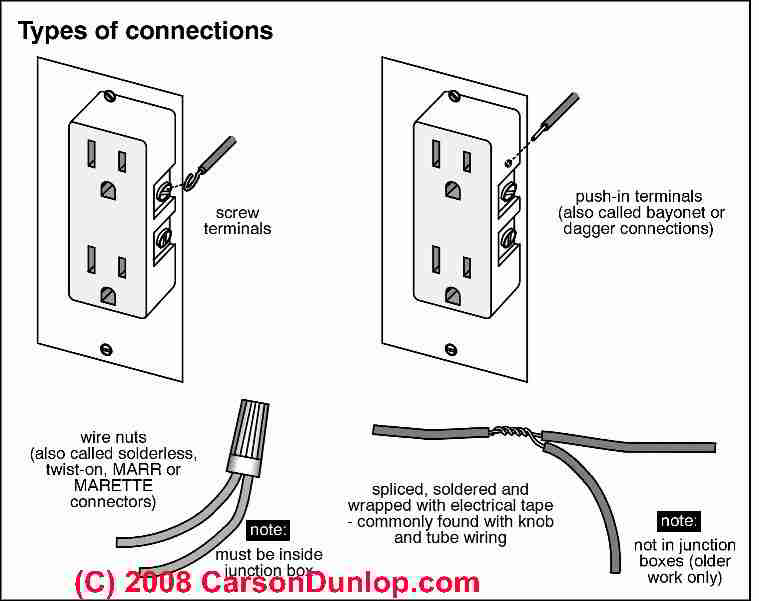
We describe different types of connectors used to join two or more electrical wires, and we include installation details inclucing use of electrical tape. Sketch at page top courtesy of Carson Dunlop Associates, a Toronto home inspection, education & report writing tool company [ carsondunlop.com ].
InspectAPedia tolerates no conflicts of interest. We have no relationship with advertisers, products, or services discussed at this website.
Electrical Wire Splicing Guide for Homeowners & DIY Repairs
Article Contents
- ELECTRICAL SPLICES, HOW TO MAKE
- ELECTRICAL SPLICE WIRING DETAILS
Electrical Wire Splice Basics & Definitions
Splicing electrical wires - that is, the electrical connection or joining of two or more wires that conduct electricity in a building - is a task that can be learned easily, but if the splice is not made correctly, the electrical system will be unreliable and unsafe, risking fire or shock hazards.
We introduce the proper connectors used for aluminum wire below.
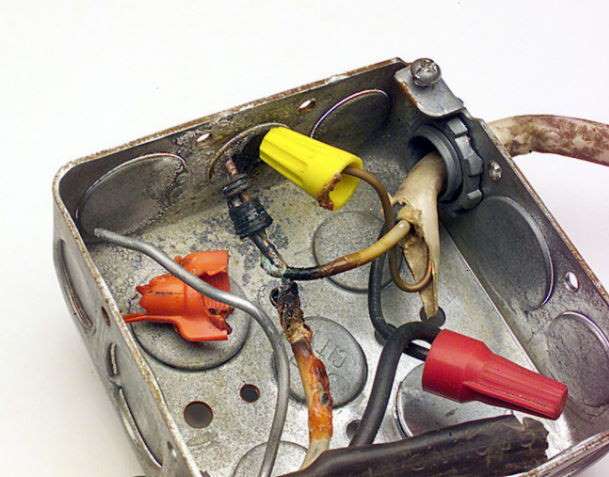
This photo shows how electrical connections can burn up if you use the wrong device or do not make the connection properly.
The proper way of making safe, secure splices is to make a good mechanical and electrical joint-that is, strong enough not to pull apart and tight enough so there is no loss of voltage. As this is tricky work, a continuous run of new wire is always better than any splice.
Watch Out: Do not attempt to work on your electrical wiring, switches, or outlets unless you are properly trained and equipped to do so. Electrical components in a building can easily cause an electrical shock, burn, or even death.
Even when a hot line switch is off, one terminal on the switch is still connected to the power source. Before doing any work on the switch, the power source must be turned off by setting a circuit breaker to OFF or removing a fuse.
See SAFETY for ELECTRICAL INSPECTORS
and ELECTRICAL WIRING BOOKS & GUIDES
Splices in electrical wire that carries electrical current in a building (such as for lights or electrical outlets) must be completed using an approved mechanical connector and must be enclosed in an approved junction box which itself is secured to the structure.
In addition, the NEC and other electrical codes specify lots of precise details describing the number of wires of various sizes that can be enclosed in junction boxes of various sizes, where these boxes must be located, how they can be covered, etc.
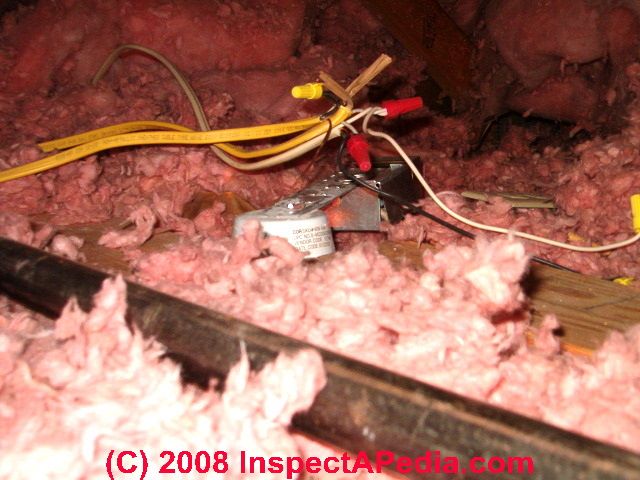
Our photo above shows an improper and certainly not code-compliant mess of pigtail splices in electrical wires. - Photo courtesy of Tim Hemm.

Electrical wires that connect appliances, lamps, stereo equipment, etc to wall outlets should never be spliced for permanent use, but occasionally, it may be necessary to splice these wires when repairing or modifying appliances or for emergency repairs.
Our photo shows an improper, unsafe, and certainly not code-compliant splice in lamp cord used to wire a wall-mounted light fixture. Exposed electrical connections like this are a fire and shock hazard.
Further, this is an un-approved use of lamp cord or "zip cord" to replace what should have been approved electrical wire, a junction box, etc.
When we see exposed electrical work like this we know that someone un-trained has been doing electrical work on the building and we need to be alert for other faulty electrical wiring practices.
How to make a Pigtail Splice in Electrical Wire Using a Twist-on Connector
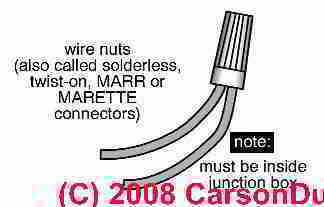
Our our enlargement above and our page top photo shows a pigtail splice at the lower left of the drawing.
Strip off at about 1 an inch of insulation from the end of each wire.
When you are joining electrical wires used to carry current in a home you'll be using a solderless twist-on connector such as we show at left. In this case the length of wire from which you need to strip insulation depends on the number of wires being joined together and the size of the twist-on connector you're going to use.
In good practice you don't want to strip off too much insulation - when the splice has been completed and the twist-on connector has been installed, you should not see any bare wire exposed extending beneath the bottom edge of the mechanical connector.
If you are stripping wires that are not part of the building's electrical system, such as speaker wires, you may not be using a mechanical connector, just tape, and the length of wire that you need to strip depends on the number of wires being joined and your ability to twist them securely together.

[Click to enlarge any image]
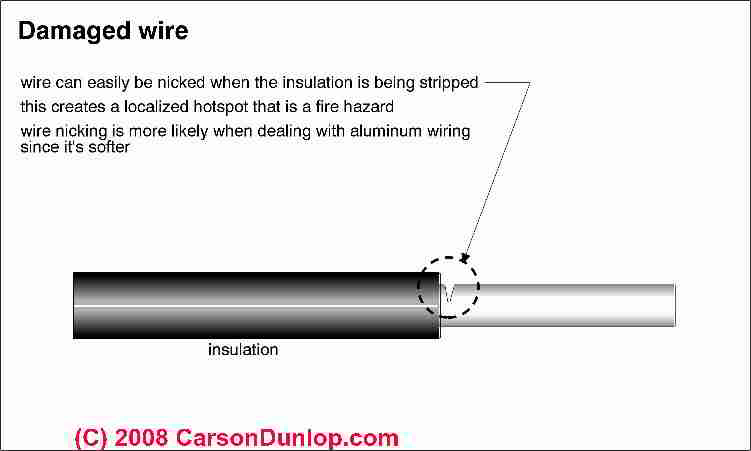
Don't damage the wire during stripping of insulation: Be careful that you don't nick the metal wire when cutting the insulation in preparation to strip it off.
If you do nick the wire, as shown in my photo (above left) and in Carson Dunlop Associates' sketch above, the risk is that the nicked end will later break off, destroying your connection, and perhaps also becoming unsafe.
OK to be honest, the nicked copper wire shown in the photo above had taken a beating during our stripping and insertion of the wire into a push-in type back-wired electrical receptacle discussed separately
at RECEPTACLE WIRE-TO-CONNECTOR CONTACT AREA SIZES
and in a companion articled
at BACK-WIRED ELECTRICAL DEVICES.
Twist the electrical wires together tightly starting at or near the first bit of exposed wire. Always twist the wires in a clockwise direction. That way when you screw on a twist-on connector (which also is tightened by turning it clockwise) you won't be un-twisting your wires. We describe just how we twist wires together for a twisted splice just below in this article.
Trim off sharp points protruding from the end of the twist. Solder the twisted wires at the point where the twist began.
Secure the completed electrical wire splice with an approved twist-on connector as we discuss below.
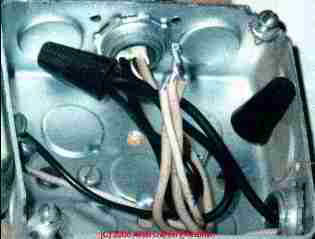
Our photo above shows some pigtail splices inside of a metal junction box - in this case, because the wires are aluminum, the connectors shown are not the proper ones, and these splices are a fire hazard.
Splicing three or more wires together
The pigtail type of splice is best when joining three or more wires. The thing to guard against when more than two wires are involved in the twist is the tendency for one or more of the wires to remain fairly straight while the others are wrapped around it.
When this happens the straight conductors can be pulled free of the splice fairly readily.
The way to prevent this is to make certain the twist is started with all the wires bent at approximately a right angle. (Don't bend current-conducting electrical wires at a sharp angle however.) Then if the bent wires are interlocked and held with pliers, the twist will continue as started.
- Starting a three-wire pigtail splice. To interlock all three wires bend each one at a right angle when you make the first twist. A straight wire will pull out under relatively little stress.
- Testing a three-wire pigtail splice. Check that all of your wires participated in the twist by pulling each individually. Make this check before applying your mechanical connector such as a twist-on or MAAR.
- Finish the three-wire pigtail splice by securing it with a mechanical connector as we discuss below.
How to Twist Electrical Wires Together When Making a Splice
For light wire, such as stereo speaker wires, when two wires are joined, cross about two inches of each end of prepared wire. Bend the ends of the wires over each other at right angles and twist them around each other.
For intermediate-sized electrical wires such as #14 copper wire (a 15-Amp electrical circuit) or #12 copper wire (a 20-Amp electrical circuit), you can usually strip about 3/4" of bare wire (special stripping tools are available that won't damage the wire or you can work carefully with wire cutters or a knife), and you can twist your wires together (clockwise) by holding the wires in one hand and twisting the bare ends using a single pair of pliers.
For heavy-gauge wire, two pairs of pliers are needed to make sure the connection is tight. Use one pair of pliers to hold the wires at the beginning of the twist.
Use the other pliers to twist the wires. Use wire cutters to trim off the excess wire so that no sharp ends can penetrate the tape. Solder the wires
The twist-splice in electrical circuit wires in a building must be capped or mechanically secured using an approved wiring connector.
Also see SPLICING WIRES When Adding a Receptacle.
Use an approved connector to secure your electrical splice
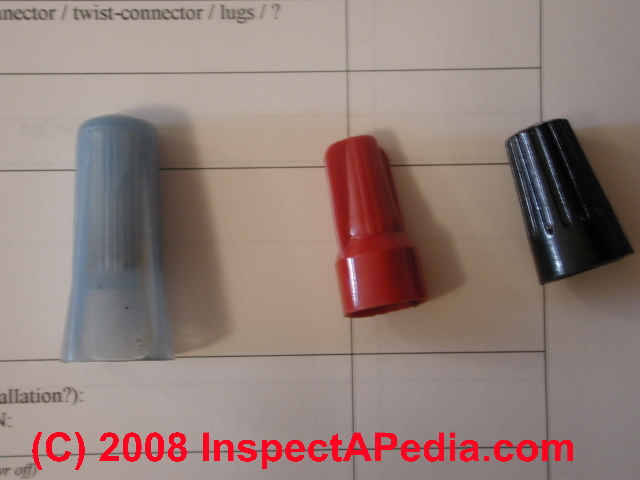
Twist-on Electrical Connectors - "wire nuts" & MAAR Connectors
Splices in an building's electrical circuit must be connected using an approved wiring connector, such as a twist-on connector ("Wire Nut" is a trademarked name for a brand of twist-on connectors.)
Twist-on connectors come in different color-coded sizes, and you must choose the proper twist-on connector, depending on the thickness (gauge) of the wire and the number of wires you're combining in your splice.
The connector is placed over the end of your twisted splice, pressed onto the wires, and turned clockwise until it is tight. Be careful when pushing an electrical splice back into the junction box - don't loosen the connector you've installed or your connection will be poor and possibly unsafe.
Using the wrong type of electrical splice connector, or one for which studies have shown poor performance, can lead to a melted or failed electrical connection, possibly risking shock or fire.
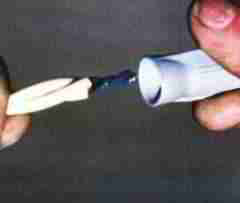
Our photo at above left shows an expert using a Scotchlok 3M electrical connector to cap a splice which was also coated with an antioxidant. We discuss this connector (now obsolete for aluminum wire repair) in more detail
at HOW to REDUCE the RISK of ALUMINUM WIRING
Other Types of Electrical Wire Splices & Wire Connectors: AlumiConn, AMP COPLAUM and other crimp connectors, Romex Splice Kits, Wago Wall Nuts
AllumiConn Connector for Aluminum Wiring Repair

Electrical wires in a building are sometimes joined without twisting wires together. Instead we use special approved connectors.
The AlumiConn TM connector shown here is used to splice a copper "pigtail" wire together with one or two aluminum wires as a step in reducing the fire hazard associated with aluminum electrical wiring.
This connector performs well provided that the wires are properly secured in the connector. We discuss this connector in more detail
at HOW to REDUCE the RISK of ALUMINUM WIRING
Amp COPALUM Connector for Aluminum Wiring Repair
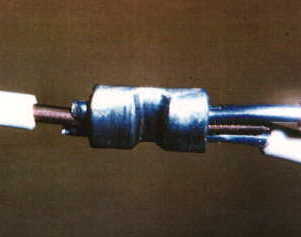
The AMP COPALUM connector (now sold by TYCO) is also used to connect copper to aluminum wiring, and is also discussed
at HOW to REDUCE the RISK of ALUMINUM WIRING
This connector must be installed by a an expert trained in aluminum wire repair and using a special crimping tool which forms a cold weld between the metals.
Romex Wire Splice Kits for Wiring Connections Outside of Electrical Boxes

Romex Splice Kits are plug-type devices that are designed to permit tapping and splicing of non-metallic electrical wire (NMC or "Romex" wire) outside of an electrical box.
Among the building electrical wiring connectors discussed in this article, this is the only wiring device that is permitted for use outside of electrical boxes, as we elaborate below.
Reader Question: Is it safe to use Romex splice kits sold at Home Depot?
2015/11/05 Robert Weisberg said:
Is it safe to use romex splice kits sold at home depot, so that 6 receptacles in a kitchen back splash can be lowered about 4" and realigned from vertical to horizontal?
This question was posted originally at ELECTRICAL JUNCTION BOX TYPES
Reply:
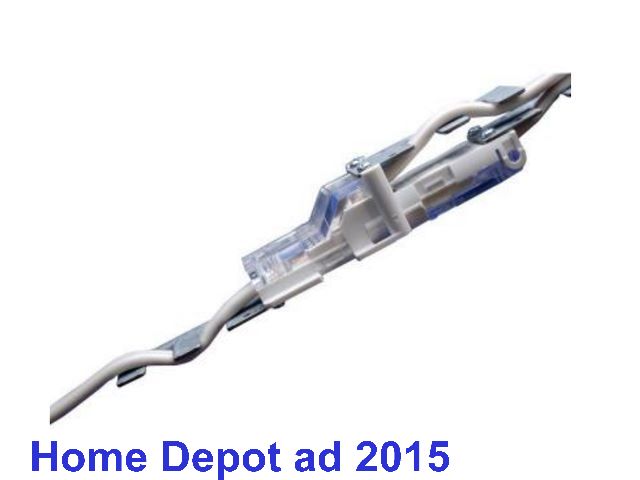
Thanks for the question, Robert. While I have not used the NMC wire splice kits you describe I've certainly seen them very widely used, particularly in modular construction where pre-wired home sections are set in place and then their electrical circuits need to be joined.
The two images above illustrate two of Tyco's NMC splice kit models.
You'll notice that in addition to the plug connectors that contain the wire ends, each splice kit carries a strain relief at either end. These devices are permitted by the U.S. NEC (National Electrical Code) - see these code sections:
300.15 Where boxes or fittings are required, (H) Insulated Devices As permitted in 334.40(B), a box or conduit body shall not be required for insulated devices supplied by nonmetallic-sheathed cable.
334.40 (B) Devices of Insulating Material Switch, outlet, and tap devices of insulating material shall be permitted to be used without boxes in exposed cable wiring and for rewiring in existing buildings where the cable is concealed and fished.
Openings in such devices shall form a close fit around the outer covering of the cable, and the device shall fully enclose the part of the cable from which any part of the covering has been removed.
My understanding is shared by other commentators I reviewed including over at my friends at the JLC forum who noted in discussion that this connector was "legal" for use at least btginning in 2002 (with the 2002 NEC articles 334-40B, 545, 550, and 551. and continuing through the 2005 and 2008 NEC update cycles where these provisions were not changed.
"Safe" is a more broad term used in your question than "legal". My OPINION is that the connectors are "safe" in the general meaning of that word provided that they are installed in accordance with the manufacturer's instructions and the NEC.
Tyco Electronics produces non-metallic electrical wiring splice and tap kits for splicing and tapping "romex" electrical wire, specifically 2-wire with ground and for splicing 3-wire with ground circuits with ground on non metallic electrical wiring cable for systems up to 300V. Here is what Home Depot's product overview says about these connectors (selling for about $7.50 U.S.D. each): [minor spelling edits - Ed.]
Tyco Electronic's Non-metallic splice and tap kits provide a fast and reliable method for splicing or tapping 2 wire w/ ground and splicing 3 wire w/ground non-metallic cables up to 300 volts. They are designed and approved for use in rework within existing structures.
Splice and Tap Kits also eliminate wire nuts for installation and replace the conventional method for adding a splice or tap for non-metallic cable without the need for exposed and unsightly junction boxes. NEC approved Article 334-40b.
- 2 Wire Connection
- For Use On 12 or 14 AWG (300 Volt) 2 wire NM cable with ground
- Eliminates junction boxes and wire nuts
- Fast & simple to install
- NEC compliant - article 334-40b, 2005 & 2008 NEC
- UL & CSA listed - Home Depot website cited below, 2015/11/05
Sources
- "Tyco Electronics Model # CPGI-1116377-2 Internet # 202204326 Store SKU # 302061 Romex Splice Kit 2 Wire, 1/Clam", Home Depot Stores, - retrieved 2015/11/05, original source: http://www.homedepot.com/p/Tyco-Electronics-Romex-Splice-Kit-2-Wire-1-Clam-CPGI-1116377-2/202204326
Wago Wiring Connectors
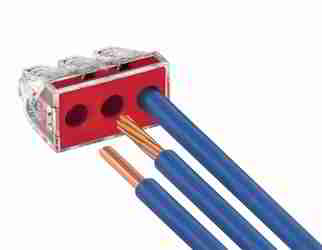
The Wago Wall Nut is a device which connects several wires of different gauges and types, as you can see in this photo.
Lugs which use a screw to bind wire into a holding device, and bus-bars which use a similar approach are used inside of electrical panels to join multiple neutral or ground wires together or to secure large-diameter wires.
Screw terminals are used on circuit breakers to secure electrical wires to these overcurrent protection devices.
WALL-NUTS [New U.S. product application, Not UL Listed, undergoing testing before UL application] spring-clamp terminal blocks available from Wago Corporation have is being tested by that company for
a connector for aluminum-to-copper pigtailing for aluminum wiring repair.
The company informs us that a similar product
use with aluminum wire conductors has been approved and used in Europe for over 20 years.
The company is conducting further testing before submitting the product to UL to obtain a listing. Significantly, the company indicates that
this connector is suitable for connecting multi-stranded (copper) as well as solid conductor
conductors.
If approved by UL and if test results are satisfactory, this product would, in addition to providing
standard solid CU to solid AL connections, address the wiring of a twisted-copper-wire light fixture to a solid conductor aluminum
branch circuit wire. This connector has not
been recommended, nor recommended against, by the US CPSC, and is currently undergoing testing.
Wago "Wall Nut" Product description information for the copper to copper wire connection use of this connector WAS available at the Wago website. http://www.wago.us/products/150.htm but that page is no longer available (June 2021 - Ed.)
Results will be reported here if they ever become available.
Editor's note: no data on "Wago Wall Nuts" found as of 2021/06/07
However the company manufactures a wide rage of push in wiring connectors under the PUSH WIRE® brand (shown below).
The product specifications for this item as listed at the company's website states that it can be used with aluminum conductors.
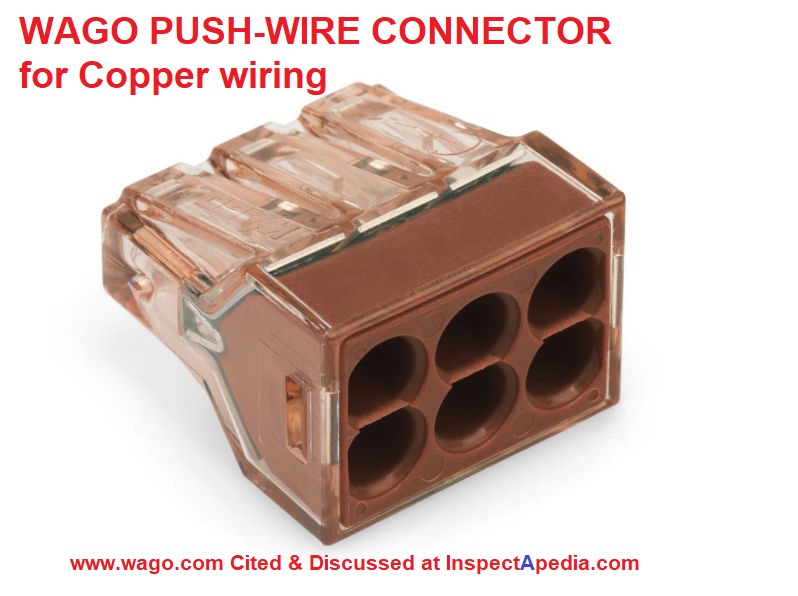
See
- WAGO PUSH-WIRE CONNECTOR DATA SHEET [PDF] retrieved 2021/06/07 original source:WAGO Corporation Germantown, WI 53022 USA Tel: 1-800-DIN-RAIL (346-7245) Email: info.us@wago.com Web: www.wago.us www.wago.com/773-606
Excerpts
Data sheet Item Number: 773-606: PUSH WIRE® connector for junction boxes; for solid conductors; max. 4 mm2; 6-conductor; brown clear housing; brown cover; surrounding air temperature: max 60C; 2,50 mm2
Note: Terminating Aluminum Conductors
WAGO spring clamp terminal blocks are suitable for solid aluminum conductors up to 4 mm²/12 AWG if WAGO “Alu-Plus” Contact Paste is used for termination.
- Automatically destroys the oxide film during clamping.
- Prevents fresh oxidation at the clamping point.
- Prevents electrolytic corrosion between aluminum and copper conductors (in the same terminal block).
- Provides long-term protection against corrosion.
Watch out: For spring clamp connections with PUSH WIRE® connection technology, WAGO recommends that the aluminum conductor first be cleaned and then immediately inserted into the clamping unit filled with “Alu-Plus” contact paste.
[Editor's note: separately based on independent research Aronstein recommended that the aluminum conductor be abraded through the anti-oxidant coating to preclude even small amounts of surface oxidation that occur as soon as the otherwise "cleaned" or sanded aluminum conductor is exposed to air. See details
at COPPER PIGTAILING for ALUMINUM WIRE - Aronstein but
Watch out: The US CPSC and Aronstein no longer recommend that type of copper pigtailling and recommend instead using only the connectors that are both UL listed and CPSC approved for aluminum wiring repair - see those details
at ALUMINUM WIRING REPAIR METHODS. ]
It is also possible to apply WAGO “Alu-Plus” additionally on the whole surface of the aluminum conductor before termination.
Watch out: Please note that the nominal currents must be adapted to the reduced conductivity of the aluminum conductors;
Subject to changes. Please also observe the further product documentation!
Watch out: The data sheet shown above includes various approvals for this connector including
IEC - for copper wire - that is, no approvals are listed for use with aluminum conductors.
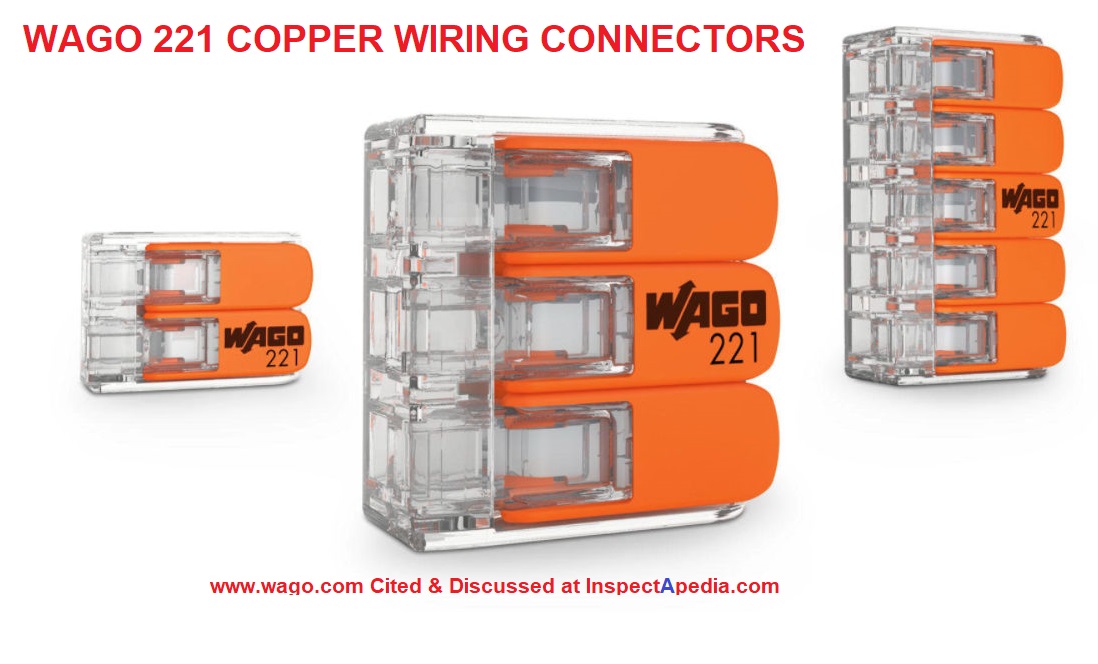
Wago also produces the Wago 221 Splicing Connector shown below.
Watch out: we have no product specifications for the item below; it may beintended for use only with copper wires.
See also
- WAGO CERTIFICATE OF COMPLIANCE [PDF] (2020, othe document dates 2008) Issued to WAGO Kontakttechnik GmbH & Co. KG
Hansastrasse 27, 32423 Minden GERMANY
Excerpts:
This certificate confirms that representative samples of COMPONENT - TERMINAL BLOCKS - See Addendum Page
Have been investigated by UL in accordance with the component requirements in the Standard(s) indicated on this Certificate.
UL Recognized components are incomplete in certain constructional features or restricted in performance capabilities and are intended for installation in complete equipment submitted for investigation to UL LLC.
UL1059 - Terminal Blocks - See the UL Online Certifications Directory at https://iq.ulprospector.com for additional information.
Reader Comments & Q&A on Wago Splicing Connecors
On 2018-01-29 by JaCo
Can the replace Wago connector with wire nut connector. Am replacing a canned ceiling light with a LED flat light.
The new light fixture has Wago connectors. Can I clip off the Wago connector and twist nut connect the black, white and ground wires light the original with the house set up? Thank you.
On 2018-01-31 by (mod) - Can I use a Quick Splice Connector on led lighting
you could, but I don't understand why you wouldn't make the copper wiriing splice right into the Wago wire splice device provided by the manufacturer,
Unless the wire is of a size or type that is not listed, approved, and manufactuer recommended for use with that connector.
See details just above on this page.
How to Make Tap Splices in Wires - Older Knob & Tube Wiring
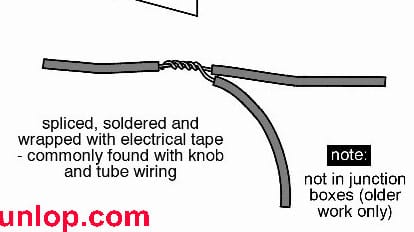
Sometimes it is desirable to join one wire to another at some midpoint without cutting the second conductor.
The tap splice can be used in this case. What characterizes a tap splice is that one wires to be joined is not cut, but rather is kept continuous.
Remove insulation from about two inches of the continuous run wire.
Wrap the joining wire tightly around the continuous wire. Solder and tape the spliced wires.
A tap splice is shown in our page top sketch at lower right and again here. If the joining wire is stranded, such as speaker wire, the strands may be separated into two bunches and then wrapped in opposite directions along the continuous wire to form a more secure connection.
Tap splices are not used in home electrical circuit wiring except for older knob-and-tube electrical wiring.
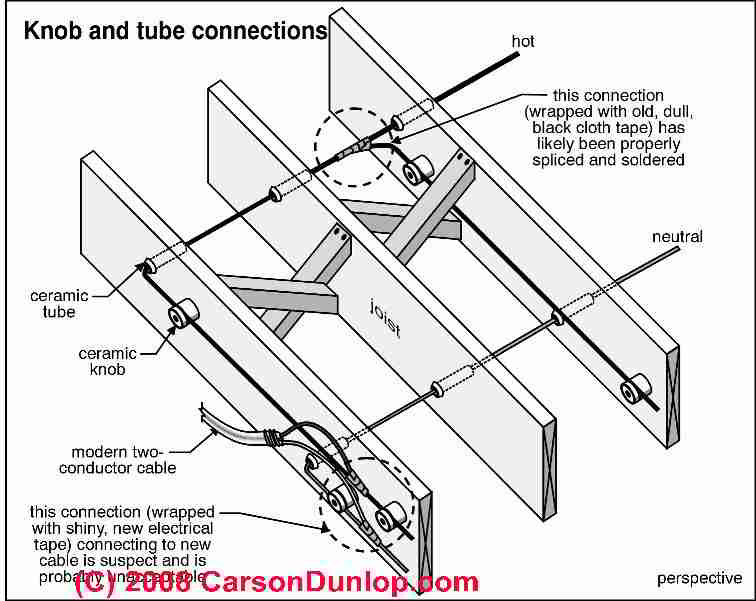
Our sketch at left, courtesy of Carson Dunlop Associates, shows the usual ways that knob and tube electrical wiring is connected in homes.
Knob and tube wiring connections were made outside of electrical junction boxes. In normal practice knob and tube wiring splices are soldered and also taped.
We do not use plastic electrical tape on these installations, but rather the heavier cloth-based black electrical tape.
Review our discussion below to see when you can just tape electrical wire splices.
Splices to Use When Extending Knob and Tube Electrical Wiring
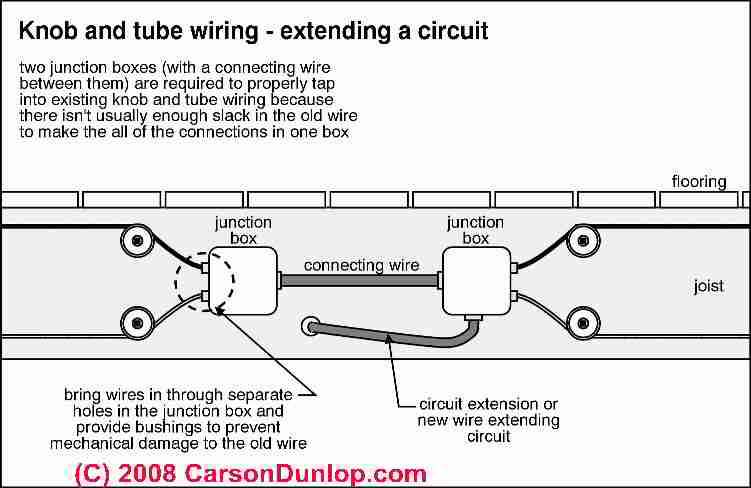
In some jurisdictions (especially in the U.S.) knob and tube electrical wiring was code-approved and used into the 1970's or later.
In most jurisdictions there is no requirement that knob and tube wiring be removed or replaced, but it is not permitted to extend a knob and tube electrical circuit - say by adding wires to connect additional devices like receptacles.
If the knob and tube wiring system is not in good repair it may need to be replaced for fire safety.
In a jurisdiction where it is permitted to extend a knob and tube electrical circuit, it's necessary to change from open soldered and tape-wrapped electrical wire splices to splices contained in electrical junction boxes, as we show in Carson Dunlop's sketch.
Watch out: in most jurisdictions it is not permitted to extend or add-on to existing knob and tube electrical wiring.
And OLD HOUSE ELECTRICAL SYSTEMS
When can you just "tape" electrical wires that have been spliced?
Wires used in the electrical circuit of a home are not normally joined using simple twist-together+ taping nor soldering + taping except where knob and tube wiring has been installed. These joints are taped as described above.
Instead, current carrying wires should be joined using one of the approved connectors discussed beginning
at USE ONLY APPROVED WIRE CONNECTORS
and unless you're
using ROMEX SPLICE CONNECTORS the connection should be within an electrical box.
If your wires are not carrying any meaningful electrical current, such as stereo speaker wires, you can simply bend the wires parallel to one of the conductors and tape the bare splice from the end of the insulation on one side to the beginning of the insulation on the other side.
Spliced and soldered wire splices such as in stereo wires should always be taped. The right amount of tape to use on a joint is the amount that will provide insulation about as thick as the original insulation on the wire.
A good brand of plastic electrical tape is best for wire joints.
How do we apply tape to a wire splice?
Apply the tape by wrapping it diagonally along the joint starting on the insulation at one end
Plastic tape sticks best if it is kept taut while wrapping. Continue the tape for an inch or so on the insulation at the other end.
Make as many wraps as necessary to build the tape to the proper thickness. Cut or tear the tape at the end of the last wrap and press it smooth around itself.
U.S. Building Electrical Wiring Color Codes & Conventions for 120V or 240V A/C Circuits
For our complete electrical wiring color code guides
see ELECTRICAL WIRING COLOR CODES. Excerpts for the U.S. only are given just below.
120V / 240V A/C Electrical Wiring Color Codes & Conventions: U.S. |
||||
| Wire Insulation Color | Alternative Wire Colors | Label | Function | Comments |
| Black |
|
Line voltage, single phase |  |
|
| Black | Brown | Line voltage, 3-phase |  |
|
| Red |
|
Line voltage, single phase, second "hot" wire |  Often used to indicate switched power |
|
| Red | Orange | Line voltage, 3-phase |  |
|
| White | Gray |
|
Neutral |  In wiring a switch the electrican may use the white wire as a second hot conductor and will mark each end of the wire with black electrical tape. |
| Blue | Yellow |
|
Line voltage, 3-phase |  |
| Green | |
 Protective ground wire |
||
| Green + Yellow | |
 Protective ground wire Protective ground wire |
||
| Bare |  Protective ground wire |
|||
| Orange | Yellow |
|
"Excepted voltage", these wires may be hot when main disconnect is switched off" |
|
Notes to the table above
Notes & wiring color code standard sources:
1. National Electrical Code 2011 (NEC) - see http://www.nfpa.org/ (adopted in all 50 U.S. states)
2. UL508A, Section 66.5.3 & 66.9
3. NFPA 79, Chapter 13 - see http://www.nfpa.org/
Some sources include red with white tracer line = switched neutral
This website provides information about a variety of electrical hazards in buildings, with articles focused on the inspection, detection, and reporting of electrical hazards and on proper electrical repair methods for unsafe electrical conditions. Critique and content suggestions are invited. Credit is given to content editors and contributors.
Reader Comments, Questions & Answers About The Article Above
Below you will find questions and answers previously posted on this page at its page bottom reader comment box.
Reader Q&A - also see RECOMMENDED ARTICLES & FAQs
On 2020-12-04 by (mod) - GFCI Nuisance Tripping solved by pigtailing
Brian
Please find your question and my detailed reply now at the Reader Q&A section near the bottom
of GFCI DEVICE SELECTION & WIRING.
You may need to clear or refresh your browser cache to see the updated page. We welcome your further photos, comments, questions.
On 2020-12-01 by Brian
GFCI receptacle in kitchen with vent fan on wall above. Feed runs from basement to line terminals on GFCI. Fan, also on line side, causes GFCI to trip when turned on. Not clear why this happens when all is on line side -- thought GFCI shouldn't react to things on line side? ... [remaining text provided at GFCI DEVICE SELECTION & WIRING - link above]
On 2020-11-29 - by (mod) -
The final authority is your local electrical inspector, Bill, but most likely she'll be perfectly fine with an appropriately-sized weatherproof junction box to make the wire connections to extend to the new home location.
And of course my sympathy on losing your home during the Campfire wildfire. Those hazards are only going to increase in frequency and severity as our climate continues to heat up.
Watch out: despite no obvious fire damage such as burn marks at the electrical service drop at the pole, ask your electrician to inspect for heat damage as heat alone, even without flame, can damage electrical wiring.
On 2020-11-29 by Bill Shields
My home burned during the Campfire that burned in California on 2018. I have no fire damage at the service pole. My new home is about 50 feet farther from the pole than the original home. Can I make a connection to extend the service 2/0 2/0 4/0 cables to the breaker panel in the new home safely and permanently.
On 2020-11-22 - by (mod) -
Essentially yes, Gary but not exactly. A box is always required - of some form; we don't just run wires out of a wall and right into a device.
But "cover" bears some elaboration.
For example, a 110V / 120VAC wire splice must be in a listed enclosure but that might be inside of a light fixture such as a wall-mounted floodlight that includes a box but at which the light base forms the cover;
SImiilarly a ceiling fan is wired out of an electrical box but the fan base may form the box cover.
The fact that the light or fan is "listed" and wired as per the manufacturer's instructions should be sufficient.
On 2020-11-22 by gary shamblen
does the residential wiring code for the Usa require all wire nut junctions(110 v.) to be enclosed in an approved box with cover?
On 2020-07-12 - by (mod) -
Anon
By "naked electrical wire" I assume you are referring to the bear or uninsulated conductor. That's the grounding conductor and it should never in normal circumstances be carrying electrical current. If you're finding voltage on that wire that you have a wiring error which is extremely dangerous risking a fire or death by electrocution.
Watch out: if you're not familiar with safe and proper electrical wire you could be shocked or killed. It would be time to get expert help.
On 2020-07-12 by Anonymous
There is current in the naked wire but it is not coming to the sucket
On 2020-05-07 by (mod) - Can you splice copper wires and aluminum wires together?
Patrick,
You should not connect copper directly to aluminum wire or the connection is likely to overheat and fail. You need to use an approved connector.
If you look in the ARTICLE INDEX that are articles on aluminum wiring repair and
at HOW to REDUCE the RISK of ALUMINUM WIRING you will see the recommended and approved repair methods.
On 2020-05-07 by Patrick
Can you splice copper wires and aluminum wires together?
On 2020-03-13 - by (mod) -
JD
Electrical splices are permitted in such circuits provided proper sized box, type, connectors, etc. are used.
However you need to look at the current rating of the circuit and wire size vs. total circuit length. You may need to go to a larger sized electrical wire.
The type of connector that's most-appropriate will also depend on the wire size. A twist-on connector (what you call a "wire nut") may not have the capacity for the necessary wire size.
If you're following US Codes take a look at NEC 110.14 on splice connections.
Watch out: while many electrical wiring tasks are not complicated and shouldn't be considered intimidating, because of the risks of fire or shock or worse, any electrical work needs to be done by someone properly trained and, depending on regulations where one lives, work must be performed by a licensed electrician. (Some jurisdictions permit homeowner wiring provided the wiring is inspected and approved.)
On 2020-03-13 by jdavee
Would like to relocate an outside AC condenser. Feed to this unit from the electrical panel is a three conductor (black/red/white) with ground, which terminates in a exterior disconnect box next to the outside unit.
Can I replace the disconnect box and replace it with a junction box (weather tight of course) and splice new wires from here to the new location of the outside unit? It is moving ~40'.
Restated, does an outside AC unit require a single, unjunctioned run from the panel or can it be spliced? If spliced, what works best or is preferred - wire nuts, wiring block, solder?
Thanks!
On 2020-03-05 - by (mod) -
I can't imagine justifying rewiring an entire house just because some wires got cut.
However the repair of those cut wires needs to be in an accessible junction box.
On 2020-03-05 by Ramesh
I am renovating my home, in the process some of wires got cut. Is it necessary that I should go for new wiring for enair house as suggested by electrician or can have a safe joints ? All wiring was done with Finolex, three years back. Kindli suggest.
On 2020-01-12 - by (mod) -
Gbg
BURNDY CRIMP CONNECTOR CATALOG [PDF] https://inspectapedia.com/electric/Burndy-crimp-connector-catalog.pdf
On 2020-01-12 by Gbg
Crimps for main power lines from meter to breaker box
On 2020-01-04 - by (mod) -
Sam
There are piercing type splice connectors that can work online cord and some other types of electrical wiring. However personally I would never use them.
The concern that I have is that a multi-strand wire may be damaged by the piercing at a single strand wire with a piercing connector may have very poor contact area. The risk that is an overheated connection that could become unsafe.
Experienced electrician sometimes work on live wires. I can't recommend it for someone else.
On 2020-01-03 by Sam
Hi im trying to splice an outlet into an existing line, normally not a big deal, but in this case i have to leave the power on. I would love avoiding having to strip or cut the existing live wires, so what can i do?
Can i use connectors with power still on, or can i use alligator clips to clip onto live wires, to avoid stripping for the allugators to bite could i maybe melt small sections for alligator clips to bite onto bare copper, and then when im done usr silicone and shrink tube to protect it? This does not have to be up to code. Any and all help is appreciated, thank you
On 2019-10-17 - by (mod) -
Jesse
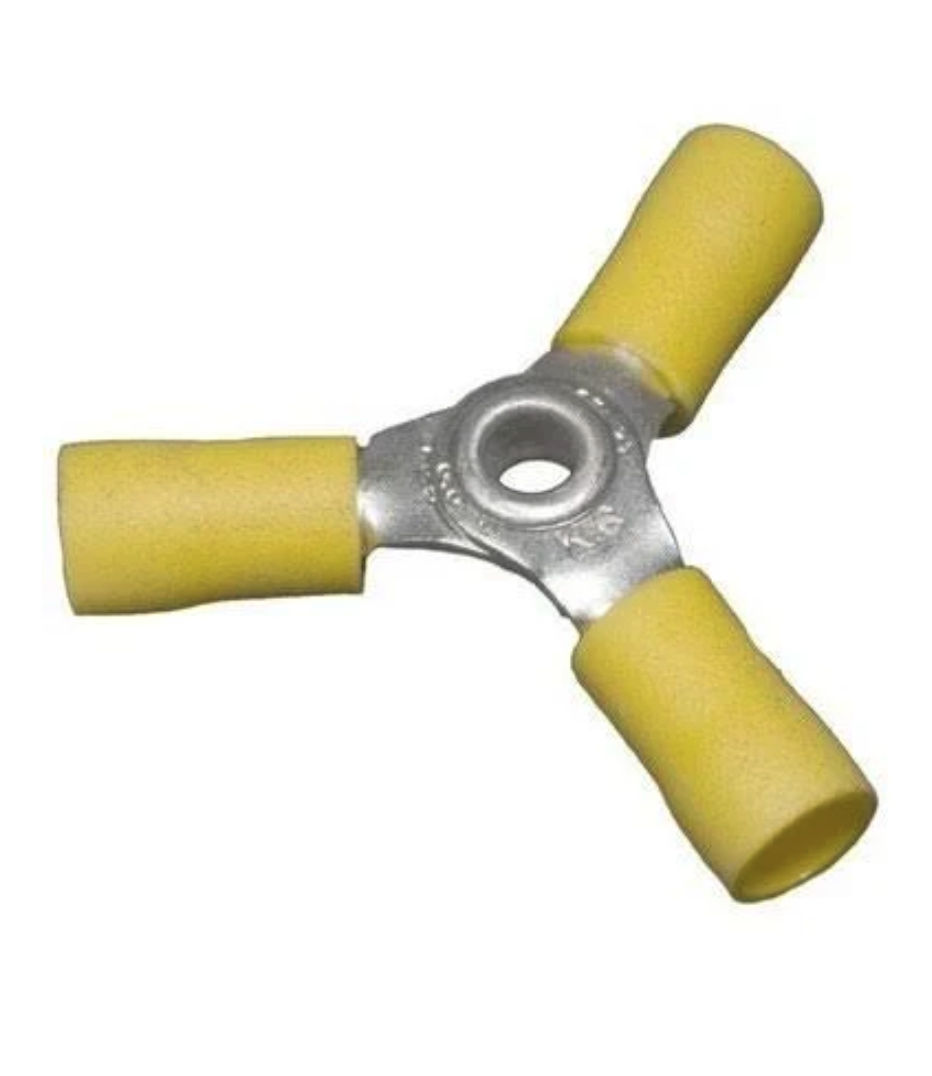
Here is a crimp-type T-connector rated for 12/10 that connects 3 wires - from Morris Products
On 2019-10-17 by Jesse
Do they make a T connector for residential 12/3 electrical wiring ...
On 2019-01-19 by Scootz - ALL in-wall wiring (whether high voltage or "low") MUST be rated for "in wall use"
Speaker wire...
Since you mention speaker wires (and b/cthis is such a great resource) I'll throw in the comment that ALL in-wall wiring (whether high voltage or "low") MUST be rated for "in wall use". Non-rated materials are accelerants in event of fire.
And while I'm on my rant, the in-wall speakers must be rated for such use, and unless explicitly exempted they must be installed in a "box" (drywall box or designated enclosure), and the wires must pass through a panel/plate.
I mention this because I've seen so many handiman jobs where people run "regular" speaker wire (lamp cord) or networking cables through walls, and carve out large holes in drywall, then say it's fine because "it's never been a problem".
On 2019-01-20 by (mod) - in-wall wiring MUST be rated for "in wall use"
Scootz
Thank you for making some excellent points I'll be sure to keep them with this article.
I agree that the claim never had a problem is a ridiculous one both because it has no statistical basis
And because it ignores the problems our experts have already discovered that have led to the codes and standards it served as our guide.
An analogy I use is driving around in your 65 Mustang convertible with a seatbelt that's worn to a mere thread.
But the thread is under the seat where you don't see it.
You buckle your seatbelt and you think it's perfectly fine. After all it's been fine up to now. But then you've never been in an accident. Yet.
On 2015-02-16 - by (mod) -
Bernard
it sounds as if one of your splices or wires is broken.
Watch out for fire and shock hazards.
On 2015-02-12 by Bernard
I have 2 lines in bathroom coming into a receptacle. I spliced into 1 of the lines and ran a separate line to other side of bathroom to add another receptacle. The NEW receptacle is working fine, but the original receptacle AND another receptacle connected to the original are not working all of a sudden. I have tried changing connections on original receptacle >
for instance hot/ neutral 1 line on top -
hot/ neutral other line on bottom ------ hot top/ neutral bottom 1 line-hot top - neutral bottom other line. Either way i'm not getting electric to the 2 original receptacles, but I am getting electric to the spliced receptacle. Do I need to splice the other line coming into the original receptacle or
what ?
Thanks,
Bernard
On 2014-09-25 0 - by (mod) -
Gene
I'm doubtful that the switch alone has the required ground, hot and neutral wires all there.
On 2014-09-19 by gene
I have an existing wire running into a light swith in my attic. I am installing a high hat in a closset right by that wire can I splice into the existing wire to get juice to the new light ? Thank you
On 2014-03-12 - by (mod) -
Willie, no doubt there are exceptions by application, country, etc. the color codes published here are simply the most broadly accepted I could find.
On 2013-01-04 by Willie
Can I use inline splice kits inside a breaker box? I have aluminum splice kits to go from 4/0 wire down to # 2 wire. The kit is an aluminum connector that is sealed inside a hard plastic case with gelly (type) filling. Or do I need to put those splice kits outside of the breaker box.
...
Continue reading at ELECTRICAL WIRE STRIPPING TIPS or select a topic from the closely-related articles below, or see the complete ARTICLE INDEX.
Or see ELECTRICAL SPLICE WIRING FAQs - questions & answers about making electrical wire splices
Or see these
Recommended Articles
- ELECTRICAL DEFINITIONS, ELECTRICAL CODE BASICS
- ELECTRICAL OUTLET, HOW TO ADD & WIRE
- ELECTRICAL SPLICES, HOW TO MAKE
- ELECTRICAL SPLICE WIRING DETAILS
- ELECTRICAL WIRE TYPES CODES USES
- GFCI DEVICE SELECTION & WIRING
- SAFETY for ELECTRICAL INSPECTORS
Suggested citation for this web page
ELECTRICAL SPLICES, HOW TO MAKE at InspectApedia.com - online encyclopedia of building & environmental inspection, testing, diagnosis, repair, & problem prevention advice.
Or see this
INDEX to RELATED ARTICLES: ARTICLE INDEX to ELECTRICAL INSPECTION & TESTING
Or use the SEARCH BOX found below to Ask a Question or Search InspectApedia
Ask a Question or Search InspectApedia
Try the search box just below, or if you prefer, post a question or comment in the Comments box below and we will respond promptly.
Search the InspectApedia website
Note: appearance of your Comment below may be delayed: if your comment contains an image, photograph, web link, or text that looks to the software as if it might be a web link, your posting will appear after it has been approved by a moderator. Apologies for the delay.
Only one image can be added per comment but you can post as many comments, and therefore images, as you like.
You will not receive a notification when a response to your question has been posted.
Please bookmark this page to make it easy for you to check back for our response.
Our Comment Box is provided by Countable Web Productions countable.ca
Citations & References
In addition to any citations in the article above, a full list is available on request.
- The 2008 NEC National Electrical Code (ISBN 978-0877657903) Online Access LINK (you'll need to sign in as a professional or as a visitor)
- The 2008 Residential Wiring Code, a subset of the 2008 NEC, can be understood through Mastering the NEC at http://www.2008nec.com/shopping/pgm-more_information.php?id=18
- "Electrical System Inspection Basics," Richard C. Wolcott, ASHI 8th Annual Education Conference, Boston 1985.
- "Simplified Electrical Wiring," Sears, Roebuck and Co., 15705 (F5428) Rev. 4-77 1977 [Lots of sketches of older-type service panels.]
- "How to plan and install electric wiring for homes, farms, garages, shops," Montgomery Ward Co., 83-850.
- "Simplified Electrical Wiring," Sears, Roebuck and Co., 15705 (F5428) Rev. 4-77 1977 [Lots of sketches of older-type service panels.]
- "Home Wiring Inspection," Roswell W. Ard, Rodale's New Shelter, July/August, 1985 p. 35-40.
- "Evaluating Wiring in Older Minnesota Homes," Agricultural Extension Service, University of Minnesota, St. Paul, Minnesota 55108.
- "Electrical Systems," A Training Manual for Home Inspectors, Alfred L. Alk, American Society of Home Inspectors (ASHI), 1987, available from ASHI. [DF NOTE: I do NOT recommend this obsolete publication, though it was cited in the original Journal article as it contains unsafe inaccuracies]
- "Basic Housing Inspection," US DHEW, S352.75 U48, p.144, out of print, but is available in most state libraries.
- In addition to citations & references found in this article, see the research citations given at the end of the related articles found at our suggested
CONTINUE READING or RECOMMENDED ARTICLES.
- Carson, Dunlop & Associates Ltd., 120 Carlton Street Suite 407, Toronto ON M5A 4K2. Tel: (416) 964-9415 1-800-268-7070 Email: info@carsondunlop.com. Alan Carson is a past president of ASHI, the American Society of Home Inspectors.
Thanks to Alan Carson and Bob Dunlop, for permission for InspectAPedia to use text excerpts from The HOME REFERENCE BOOK - the Encyclopedia of Homes and to use illustrations from The ILLUSTRATED HOME .
Carson Dunlop Associates provides extensive home inspection education and report writing material. In gratitude we provide links to tsome Carson Dunlop Associates products and services.
 | HOME | ABOUT | ASK a QUESTION | CONTACT | CONTENT USE POLICY | DESCRIPTION | POLICIES | PRIVACY | |
| © 2024 - 1985 Publisher InspectApedia.com - Daniel Friedman | |||||||||