
InspectAPedia® FREE Encyclopedia of Building & Environmental Construction, Diagnosis, Maintenance & Repair |
Question? Just ask us! InspectAPedia
|
 Dead End Flues or Dead Base Chimney Flue Hazards

- POST a QUESTION or COMMENT about the inspection procedure & hazards of dead end chimneys & flues
Definition & hazards of dead end chimneys & flues.
This article describes dead base or dead end flues and explains why they can cause heating equipment operating difficulties or why they may be unsafe.
A dead end flue is one in which the flue vent connector joins at the very base of a chimney.
Debris falling down the chimney can quickly block the flue, prevent proper removal of exhaust gases from the building heating equipment, and can be dangerous. We describe how to spot dead end chimneys, how to recognize trouble signs, and what to do about dead end chimney venting systems.
InspectAPedia tolerates no conflicts of interest. We have no relationship with advertisers, products, or services discussed at this website.
Dead End Flues or Dead Base Chimney Flue Hazards
 Dead-end flues, chimneys whose flue stops right at the point of entry of a thimble
for a woodstove or heating appliance are inherently more dangerous than a conventional flue
which extends several feet further past the thimble. Dead end flues are quickly and easily
blocked by any debris that might fall down a chimney.
Dead-end flues, chimneys whose flue stops right at the point of entry of a thimble
for a woodstove or heating appliance are inherently more dangerous than a conventional flue
which extends several feet further past the thimble. Dead end flues are quickly and easily
blocked by any debris that might fall down a chimney.
[Click to enlarge any image]
If a chimneys venting a gas-fired appliance
becomes partly or totally blocked, the appliance is likely to rapidly produce very dangerous,
potentially fatal carbon monoxide (CO).
Be sure that chimneys of this type are inspected and cleaned annually and be sure that you have working CO detectors as well as smoke detectors in the building.
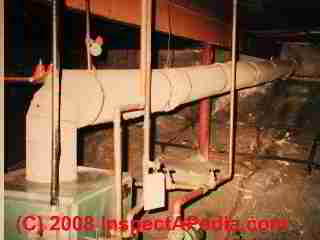
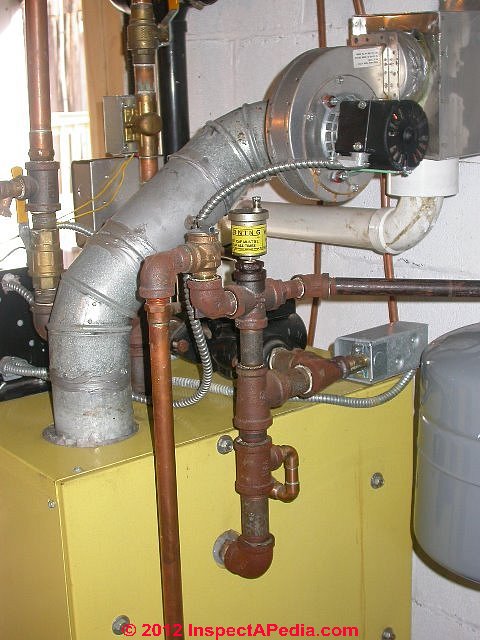
The dead end flue in this photo (above) can be determined because we're venting that long run from a heating boiler into the bottom of a chimney that's just above ground level in a crawl space.
Looks as if we've got some asbestos paper wrapping the flue - another matter to be addressed.
These articles on chimneys and chimney safety provide detailed suggestions describing how to perform a thorough visual inspection of chimneys for safety and other defects. Chimney inspection methods and chimney repair methods are also discussed.
Dead End Chimney Flue Clues & Examples
- Absence of a chimney cleanout - the chimney may stop right where the flue vent connector enters the chimney.
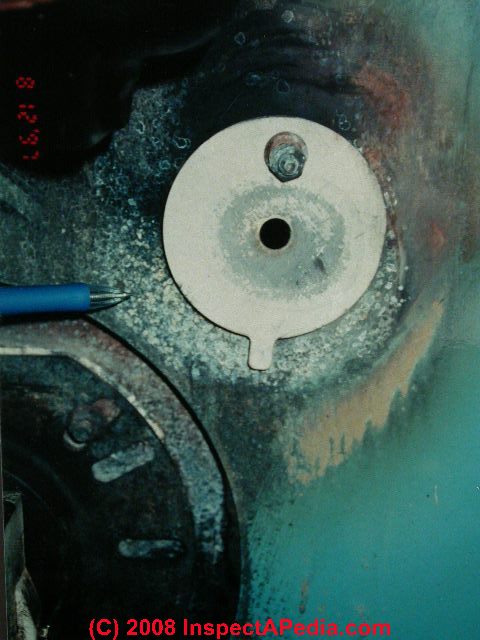
- Combustion chamber backpressure burns on the heating equipment (photo at left) may indicate that the chimney is blocked (or there are other draft problems such as an open chimney cleanout door)
- Old houses built on stone foundations with no original central heating.
Often when a basement was later excavated or deepened to install a heating boiler or furnace, the only connection into a chimney flue was an entry point at or close to ground level above the basement because the original chimney flue did not extend below ground level.
Look for a chimney that sits atop a stone foundation.
- Flue vent connectors (stack pipes or smoke pipes) routed through crawl spaces often enter the bottom of a chimney flue. (Photos above on this page).
- Masonry fragments in the cleanout: if you open a chimney cleanout-door or pull the flue vent connector
from a dead end chimney flue, in either case you are looking at the very bottom of the chimney
flue.
If you are inspecting a masonry chimney, be alert for discovery of masonry fragments when inspecting or cleaning the bottom of the flue. If a piece of brick, masonry block, concrete, or clay flue tile liner is pulled out of your chimney, ask "where do you suppose this came from?"
If the masonry scrap fell during construction of the chimney it may mean nothing.
But if it fell because the chimney has been damaged, perhaps by water, frost, or during cleaning, then you probably have an unsafe chimney flue - more investigation is in order, promptly.
Certainly if you believe that the masonry scrap found at the bottom of a flue fell during original construction, and if you remove it during cleaning, you should never find another piece in the flue bottom. If you do, the flue has been damaged anew and it is unsafe.
- Chimney use history: if a chimney has been used for a variety fuels, coal, oil, wood, there may be a greater accumulation of debris at the chimney bottom, a mixture of creosote, soot, or even masonry fragments from a flue damaged by corrosive gases and condensate in the flue.
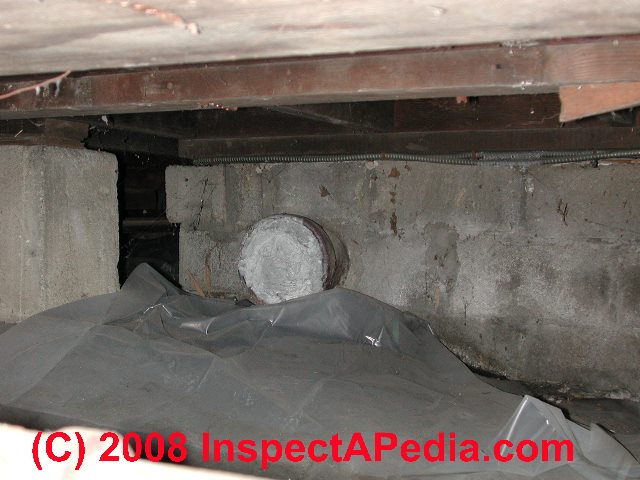
Our photo (left) shows a truly abandoned dead end flue chimney. We changed this building to a direct-vent heating boiler and abandoned the chimney entirely rather than continue to face chimney blockage problems. - Chimney draft problems: if someone has installed a draft inducer fan because they couldn't get enough draft, the problem could be a blocked flue.
Look for back-pressure burns on the combustion chamber. Look for a defeated or sealed-up barometric damper.
See details
at DRAFT REGULATOR, DAMPER, BOOSTER. - Chimney leak history: leak stains inside the building attic or on any floor, if they
are traceable to leaks at a chimney, are reason to be concerned for possible water damage to the
chimney as well as to the building.
Further investigation may be warranted. - Chimney cap history: if a chimney has spent part of its life with no cap installed,
there is extra risk of water damage to the flue interior. In a masonry chimney damage may appear
as frost cracking of the upper flue liners or masonry.
In any chimney, there may also be water damage to the heating appliances being vented by that chimney.
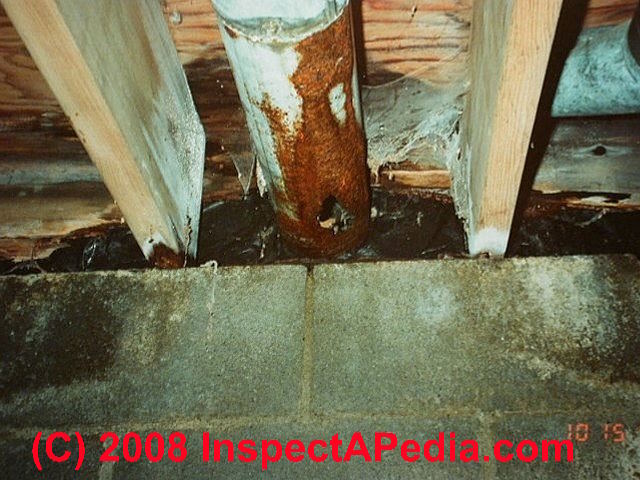
Dead end chimney flues are likely to lead to the rusted-out flue vent connector such as we show here.
We suspect that the root cause of this unsafe metal heating flue is that it was routed out of the building at or below ground level - into a dead-end chimney.
Water from roof spillage or surface runoff have rusted out the flue vent connector.
This is an unsafe installation even before we think about the added hazards of fire clearances and adequate draft.

Experienced heating service technicians are expected to be well aware of the hazards of dead base chimneys & flues, and as our client points out in our photograph (left), the service tech may leave a note to tip off the technician who arrives for the next service call.
To the heating service tech a dead base chimney means
- Watch out for blockage at the chimney - be sure to open and clean it out
- Watch out for draft problems on the heating equipment
Below we illustrate another clue that may indicate a dead base chimney - no visible cleanout door below the chimney thimble where the flue vent connector attaches to the flue, and water leak stains directly below the thimble.

Watch out: Just below we illustrate another scary problem often found in deep, hard to access crawl areas: a dead base chimney and a fallen-off or disconnected flue vent connector or "flue pipe" - presenting a fire hazard, a flue gas poisoning hazard, improper heating operation, generally an unsafe heating system.
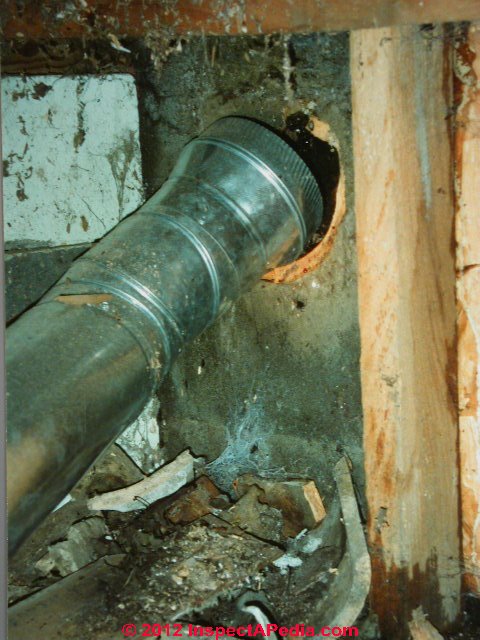
Why would this problem be more likely here? Because the connection of the flue vent connector to the dead base chimney is deep into a hard-to-access crawl space where nobody wants to go.
Be sure to inspect such locations with care.
Photo below: the partial blockage of the bottom of this thimble entry into a chimney flue shows why model codes and chimney standards require at least 12" of clearance between the bottom of the thimble opening into a flue and the bottom of the flue itself.
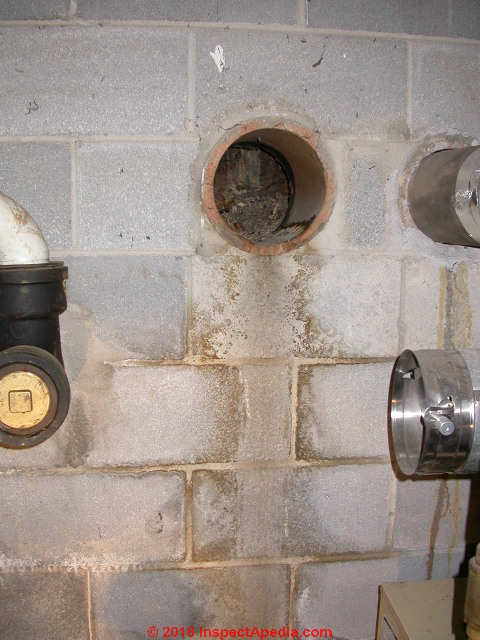
The leak stains below this thimble tell us of another concern: water leaks down the flue.
International Fuel Gas Code (2015) Chapter 5 Chimneys and Vents
501.9 Chimney Entrance
Connectors shall connect to a masonry chimney flue at a point not less than 12 inches (305 mm) above the lowest portion of the chimney flue.
503.10.10 Chimney connection.
Where entering a flue in a masonry or metal chimney, the vent connector shall be installed above the extreme bottom to avoid stoppage.
Where a thimble or slip joint is used to facilitate removal of the connector, the connector shall be firmly attached to or inserted into the thimble or slip joint to prevent the connector from falling out.
Means shall be employed to prevent the connector from entering so far as to restrict the space between its end and the opposite wall of the chimney flue (see Section 501.9).
Solutions for the Dead End Chimney or Dead Base Flue Problem
- Safe chimney maintenance: regular annual maintenance must include opening and cleaning the chimney base as well as checking/cleaning the flue vent connector where a dead end flue chimney is in use.
Also monitor heating equipment operation for signs of blocked flue passages such as indications of inadequate chimney draft. - Relocate the flue vent connector connection point to higher on the chimney:
Where feasible, move the flue vent connector to a higher entry entry point in the chimney, replacing the original dead base entry point with a chimney cleanout door.
This option will rarely be feasible or no one in their right mind would have connected the heater to the chimney bottom in the first place. - Eliminate use of the dead base chimney entirely by converting the heating equipment's venting system to a direct through wall power vent system.
See our photo and for details of this approach
see DIRECT VENTS / SIDE WALL VENTS.
...
Continue reading at CHIMNEY CLEANING PROCEDURE - topic home, or select a topic from the closely-related articles below, or see the complete ARTICLE INDEX.
Or see these
Recommended Articles
- ABANDONED CHIMNEYS
- CHIMNEY FLUE INSPECTION CAMERA
- CHIMNEY INSPECTION DIAGNOSIS REPAIR - home
- DIRECT VENTS / SIDE WALL VENTS
Suggested citation for this web page
DEAD END CHIMNEY FLUE HAZARDS at InspectApedia.com - online encyclopedia of building & environmental inspection, testing, diagnosis, repair, & problem prevention advice.
Or see this
INDEX to RELATED ARTICLES: ARTICLE INDEX to CHIMNEYS & FLUES
Or use the SEARCH BOX found below to Ask a Question or Search InspectApedia
Ask a Question or Search InspectApedia
Questions & answers or comments about the inspection procedure & hazards of dead end chimneys & flues.
Try the search box just below, or if you prefer, post a question or comment in the Comments box below and we will respond promptly.
Search the InspectApedia website
Note: appearance of your Comment below may be delayed: if your comment contains an image, photograph, web link, or text that looks to the software as if it might be a web link, your posting will appear after it has been approved by a moderator. Apologies for the delay.
Only one image can be added per comment but you can post as many comments, and therefore images, as you like.
You will not receive a notification when a response to your question has been posted.
Please bookmark this page to make it easy for you to check back for our response.
Our Comment Box is provided by Countable Web Productions countable.ca
Citations & References
In addition to any citations in the article above, a full list is available on request.
- Mark Cramer Inspection Services Mark Cramer, Tampa Florida, Mr. Cramer is a past president of ASHI, the American Society of Home Inspectors and is a Florida home inspector and home inspection educator. Mr. Cramer serves on the ASHI Home Inspection Standards. Contact Mark Cramer at: 727-595-4211 mark@BestTampaInspector.com
- John Cranor [Website: /www.house-whisperer.com ] is an ASHI member and a home inspector (The House Whisperer) is located in Glen Allen, VA 23060. He is also a contributor to InspectApedia.com in several technical areas such as plumbing and appliances (dryer vents). Contact Mr. Cranor at 804-873-8534 or by Email: johncranor@verizon.net
- Thanks to Luke Barnes for suggesting that we add text regarding the hazards of shared chimney flues. USMA - Sept. 2008.
- Arlene Puentes [Website: www.octoberhome.com ] , an ASHI member and a licensed home inspector in Kingston, NY, and has served on ASHI national committees as well as HVASHI Chapter President. Ms. Puentes can be contacted at ap@octoberhome.com
- Roger Hankeyis principal of Hankey and Brown home inspectors, Eden Prairie, MN, technical review by Roger Hankey, prior chairman, Standards Committee, American Society of Home Inspectors - ASHI. 952 829-0044 - hankeyandbrown.com
- NFPA 211 - Standards for Chimneys & Fireplaces, NFPA 211: Standard for Chimneys, Fireplaces, Vents, and Solid Fuel-Burning Appliances, 2006 Edition (older editions and standards are found at the same bookstore)
- NFPA #211-3.1 1988 - Specific to chimneys, fireplaces, vents and solid fuel burning appliances.
- NFPA # 54-7.1 1992 - Specific to venting of equipment with fan-assisted combustion systems.
- GAMA - Gas Appliance Manufacturers' Association has prepared venting tables for Category I draft hood equipped central furnaces as well as fan-assisted combustion system central furnaces.
- National Fuel Gas Code, an American National Standard, 4th ed. 1988 (newer edition is available) Secretariats, American Gas Association (AGA), 1515 Wilson Blvd., Arlington VA22209, and National Fire Protection Association (NFPA), Batterymarch Park, Quincy MA 02269. ANSI Z223.1-1988 - NFPA 54-1988. WARNING: be sure to check clearances and other safety guidelines in the latest edition of these standards.
- Fire Inspector Guidebook, A Correlation of Fire Safety Requirements Contained in the 1987 BOCA National Codes, (newer edition available), Building Officials and Code Administrators International, Inc. (BOCA), Country Club HIlls, IL 60478 312-799-2300 4th ed. Note: this document is reissued every four years. Be sure to obtain the latest edition.
- Uniform Mechanical Code - UMC 1991, Sec 913 (a.) Masonry Chimneys, refers to Chapters 23, 29, and 37 of the Building Code.
- New York 1984 Uniform Fire Prevention and Building Code, Article 10, Heating, Ventilating, and Air Conditioning Requirements
- New York 1979 Uniform Fire Prevention & Building Code, The "requirement" for 8" of solid masonry OR for use of a flue liner was listed in the One and Two Family Dwelling Code for New York, in 1979, in Chapter 9, Chimneys and Fireplaces, New York 1979 Building and Fire Prevention Code:
- "Top Ten Chimney (and related) Problems Encountered by One Chimney Sweep," Hudson Valley ASHI education seminar, 3 January 2000, contributed by Bob Hansen, ASHI
- Our recommended books about building & mechanical systems design, inspection, problem diagnosis, and repair, and about indoor environment and IAQ testing, diagnosis, and cleanup are at the InspectAPedia Bookstore. Also see our Book Reviews - InspectAPedia.
- Ceramic Roofware, Hans Van Lemmen, Shire Library, 2008, ISBN-13: 978-0747805694 - Brick chimneys, chimney-pots and roof and ridge tiles have been a feature of the roofs of a wide range of buildings since the late Middle Ages. In the first instance this ceramic roofware was functional - to make the roof weatherproof and to provide an outlet for smoke - but it could also be very decorative.
The practical and ornamental aspects of ceramic roofware can still be seen throughout Britain, particularly on buildings of the Victorian and Edwardian periods. Not only do these often have ornate chimneys and roof tiles but they may also feature ornamental sculptures or highly decorative gable ends. This book charts the history of ceramic roofware from the Middle Ages to the present day, highlighting both practical and decorative applications, and giving information about manufacturers and on the styles and techniques of production and decoration.
Hans van Lemmen is an established author on the history of tiles and has lectured on the subject in Britain and elsewhere. He is founder member and presently publications editor of the British Tiles and Architectural Ceramics Society. - Chimney Inspection Checklist, Carson Dunlop, Associates, Toronto, Ontario
- Chimney & Stack Inspection Guidelines, American Society of Civil Engineers, 2003 - These guidelines address the inspection of chimneys and stacks. Each guideline assists owners in determining what level of inspection is appropriate to a particular chimney and provides common criteria so that all parties involved have a clear understanding of the scope of the inspection and the end product required. Each chimney or stack is a unique structure, subject to both aggressive operating and natural environments, and degradation over time. Such degradation may be managed via a prudent inspection program followed by maintenance work on any equipment or structure determined to be in need of attention. Sample inspection report specifications, sample field inspection data forms, and an example of a developed plan of a concrete chimney are included in the guidelines. This book provides a valuable guidance tool for chimney and stack inspections and also offers a set of references for these particular inspections.
- In addition to citations & references found in this article, see the research citations given at the end of the related articles found at our suggested
CONTINUE READING or RECOMMENDED ARTICLES.
- Carson, Dunlop & Associates Ltd., 120 Carlton Street Suite 407, Toronto ON M5A 4K2. Tel: (416) 964-9415 1-800-268-7070 Email: info@carsondunlop.com. Alan Carson is a past president of ASHI, the American Society of Home Inspectors.
Thanks to Alan Carson and Bob Dunlop, for permission for InspectAPedia to use text excerpts from The HOME REFERENCE BOOK - the Encyclopedia of Homes and to use illustrations from The ILLUSTRATED HOME .
Carson Dunlop Associates provides extensive home inspection education and report writing material. In gratitude we provide links to tsome Carson Dunlop Associates products and services.
 | HOME | ABOUT | ASK a QUESTION | CONTACT | CONTENT USE POLICY | DESCRIPTION | POLICIES | PRIVACY | |
| © 2024 - 1985 Publisher InspectApedia.com - Daniel Friedman | |||||||||