
InspectAPedia® FREE Encyclopedia of Building & Environmental Construction, Diagnosis, Maintenance & Repair |
Question? Just ask us! InspectAPedia
|
 Explanation of Chimney Wet Time & Metal Chimney Corrosion
- POST a QUESTION or COMMENT about the definition of chimney wet time & about metal chimney corrosion hazards
Chimney wet time:
Definition of chimney wet time.
Modern metal chimneys, regardless of the metal used or other chimney construction details,have a significant potential for condensation and corrosion - conditions that can make a chimney unsafe and that lead to need for costly repairs.
Here we give an explanation of hidden safety hazards caused by rust and corrosion of metal chimneys and flues.
These articles on chimneys and chimney safety provide detailed suggestions describing how to perform a thorough visual inspection of chimneys for safety and other defects. Chimney inspection methods and chimney repair methods are also discussed.
InspectAPedia tolerates no conflicts of interest. We have no relationship with advertisers, products, or services discussed at this website.
Wet time and Corrosion in Chimneys and Vents
 Recommended venting systems with draft hood appliances were
developed in the 50's for atmospheric aspirated appliances. The efficiencies
were low and approximately 35% of the energy input was wasted.
Recommended venting systems with draft hood appliances were
developed in the 50's for atmospheric aspirated appliances. The efficiencies
were low and approximately 35% of the energy input was wasted.
Newer mid-efficiency Category I appliances have a much lower flue gas temperature and reduced off-cycle losses.
These new furnace designs alter the vent gas temperature, dew point temperature, flow rate and dilution air in the vent.
The result is that in modern metal chimneys, regardless of the metal used or other chimney construction details, there is much greater potential for condensation and corrosion.
Factors that control the degree and duration of wet conditions in metal chimneys and vent systems are critical to the life of the appliance.
The Gas Research Institute Venting Project reported (and subsequently published in the 1996 National Fuel Gas Code) the following venting occurrences:
- The reduced dilution air increases the chances of more condensate to form in the vent.
- Reduced flue gas temperatures result in oversized vents not heating quickly which contribute to increased condensation.
- Reduced dilution air increases the maximum capacity of a vent.
Wettime or "wet time" is the time measured after start up that the flue wall temperature is below the dew point The "Wettime" of a mid-efficiency appliance is double that of a draft hood appliance.
Therefore, during the flue heat up time condensation forms inside the connector or flue. This moisture can dislodge soot products inside the flue which will fall to the bottom of the chimney or connector and become a corrosive media.
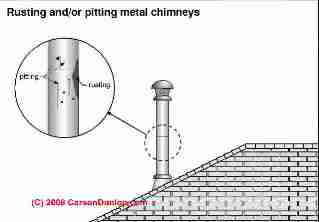
Rust and pitting: While rust is not as likely on a stainless steel chimney, corrosion can occur because of the corrosives in flue gases and in moisture that may develop inside of a chimney.
Carson Dunlop Associates [at REVIEWERS] sketch (above) warns us to inspect metal chimneys (of all types) for signs of rust and pitting.
Because metal flues corrode from the inside out, and because we on occasion find leaks between the layers of multiple-wall metal chimneys, discovery of these damage signs is important in evaluating chimney safety.
we have observed leaks and corrosion of metal chimneys from interior corrosion (described above) and also on occasion we have found exterior leaks into the interstitial space between the chimney walls due to loss of the rain cap or improper exterior installation or flashing.
Even a small amount of visible pitting on the exterior of a metal chimney or flue is likely to mean that the components are unsafe and need replacement.
Thanks to home inspector Arlene Puentes for technical editing - 4/2014
Reader Comment: Why B-Vents & other Gas Appliance Chimneys Rust & Corrode Near the Chimney Top
30 August 2015 Gregh said:
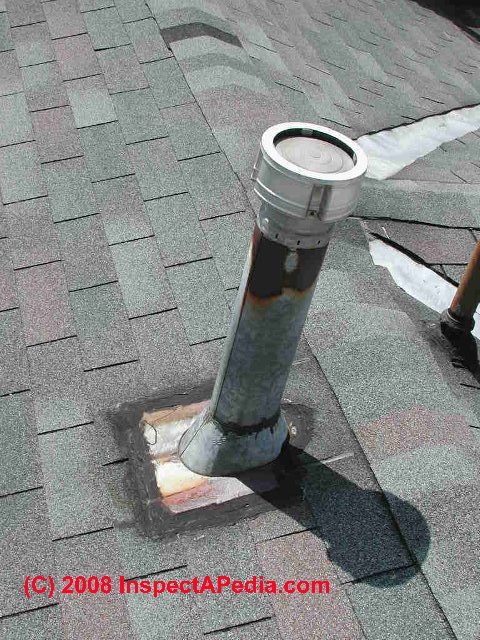
Many experts seem confused as to why some B vent pipes tend to rust near the top under the rain cap. The rust has absolutely nothing to do with the age or condition of the gas appliance.
The rust is a result of the flue gas coming in contact with the outer shell of the B vent which is a type of galvanized metal. This outer shell is generally cool to the touch , so when the warm flue gasses contact the outer shell and condense on it over a long period of time rust will result as the flue gasses are highly corrosive.
Several manufactures became aware of this 40 years ago. Selkirk designed a rain cap around 1971 which incorporated a lower ring shield to direct flue gas away from the b vent pipe.
Both Selkirk and Ecco manufacturing sold a painted termination pipe from 1973-1985. By this time most cap designs used some type of shield to keep flue gas from drifting down onto the b vents outer surface. Also mid efficient furnaces are terrible for creating more corrosive vapor in flue gas as these appliances don't have a draft hood to introduce dilution air which would help dry the flue gas somewhat.
This comment was originally posted at TYPE B-VENT CHIMNEYS
Reply:
Greg, thank you. Indeed condensate from gas fired appliances is quite corrosive. Understanding just where the corrosion shows up is both diagnostic and interesting. We'll edit your comments into the article on chimney wet time.
Reader Comments, Questions & Answers About The Article Above
Below you will find questions and answers previously posted on this page at its page bottom reader comment box.
Reader Q&A - also see RECOMMENDED ARTICLES & FAQs
Question:
(Nov 15, 2014) A said:
How often do new metal (with aluminum lining) chimney flues from-gas-furnace-to-chimney- cap need to be inspected for condensation-related corrosion/damage? We just had one installed 1 week ago, and we already hear drip noises all the way down the house when the thermostat is raised?
Reply:
A:
I would ask for a prompt diagnostic inspection from a certified chimney sweep or your heating service technician to understand the condensation going on in the chimney you describe. Chimney condensate is quite corrosive, and corrodes aluminum even faster than stainless steel. We want to be sure the chimney is properly sized, insulated, and matched to the fuel and BTUs of the appliance you are venting. Otherwise it could be unsafe, even risking a carbon monoxide hazard.
(Some condensation is normal during initial chimney heat-up time).
I'm unclear on what you're venting or just what kind of chimney you've installed.
A good source of chimney safety information is CSIA the Chimney Safety Institute of America, from who we quote:
"Metal chimney liners, usually of stainless steel or aluminum, are primarily used to upgrade and repair existing chimneys. These liner systems are U.L. tested and listed, and if properly installed and maintained are extremely safe and durable. Stainless steel is suitable for woodburning, gas, or oil applications, while the aluminum is an inexpensive alternative for certain medium efficiency gas applications only. It is usually required that high temperature insulation be used in conjunction with the liners for safety and performance considerations." - retrieved 15 Nov 14, original source: www.csia.org/homeowner-resources/about_chimney_liners.aspx
...
Continue reading at CHIMNEY DAMAGE by LEAKS & FROST or select a topic from the closely-related articles below, or see the complete ARTICLE INDEX.
Or see these
Recommended Articles
- CONDENSING BOILERS/FURNACES DAMAGE
- CONDENSING BOILER/FURNACE CONDENSATE DRAIN
- METAL CHIMNEY CONNECTIONS - home
Suggested citation for this web page
CHIMNEY WET TIME & CORROSION at InspectApedia.com - online encyclopedia of building & environmental inspection, testing, diagnosis, repair, & problem prevention advice.
Or see this
INDEX to RELATED ARTICLES: ARTICLE INDEX to CHIMNEYS & FLUES
Or use the SEARCH BOX found below to Ask a Question or Search InspectApedia
Ask a Question or Search InspectApedia
Try the search box just below, or if you prefer, post a question or comment in the Comments box below and we will respond promptly.
Search the InspectApedia website
Note: appearance of your Comment below may be delayed: if your comment contains an image, photograph, web link, or text that looks to the software as if it might be a web link, your posting will appear after it has been approved by a moderator. Apologies for the delay.
Only one image can be added per comment but you can post as many comments, and therefore images, as you like.
You will not receive a notification when a response to your question has been posted.
Please bookmark this page to make it easy for you to check back for our response.
Our Comment Box is provided by Countable Web Productions countable.ca
Citations & References
In addition to any citations in the article above, a full list is available on request.
- Arlene Puentes [Website: www.octoberhome.com ] , an ASHI member and a licensed home inspector in Kingston, NY, and has served on ASHI national committees as well as HVASHI Chapter President. Ms. Puentes can be contacted at ap@octoberhome.com
- Thanks to Luke Barnes for suggesting that we add text regarding the hazards of shared chimney flues. USMA - Sept. 2008.
- Roger Hankey is principal of Hankey and Brown home inspectors, Eden Prairie, MN, technical review by Roger Hankey, prior chairman, Standards Committee, American Society of Home Inspectors - ASHI. 952 829-0044 - hankeyandbrown.com
- Gas Research Institute Venting Project is cited at www.energyd.com/gas_vent.htm and its results are reflected in the National Fuel Gas Code cited just below.
- New York 1984 Uniform Fire Prevention and Building Code, Article 10, Heating, Ventilating, and Air Conditioning Requirements
- New York 1979 Uniform Fire Prevention & Building Code, The "requirement" for 8" of solid masonry OR for use of a flue liner was listed in the One and Two Family Dwelling Code for New York, in 1979, in Chapter 9, Chimneys and Fireplaces, New York 1979 Building and Fire Prevention Code:
- "Top Ten Chimney (and related) Problems Encountered by One Chimney Sweep," Hudson Valley ASHI education seminar, 3 January 2000, contributed by Bob Hansen, ASHI
- Chimney Inspection Checklist, Carson Dunlop, Associates, Toronto, Ontario
- "Rooftop View Turns to Darkness," Martine Costello, Josh Kovner, New Haven Register, 12 May 1992 p. 11: Catherine Murphy was sunning on a building roof when a chimney collapsed; she fell into and was trapped inside the chimney until rescued by emergency workers.
- "Chimneys and Vents," Mark J. Reinmiller, P.E., ASHI Technical Journal, Vol. 1 No. 2 July 1991 p. 34-38.
- "Chimney Inspection Procedures & Codes," Donald V. Cohen was to be published in the first volume of the 1994 ASHI Technical Journal by D. Friedman, then editor/publisher of that publication. The production of the ASHI Technical Journal and future editions was cancelled by ASHI President Patrick Porzio. Some of the content of Mr. Cohen's original submission has been included in this more complete chimney inspection article: CHIMNEY INSPECTION DIAGNOSIS REPAIR . Copies of earlier editions of the ASHI Technical Journal are available from ASHI, the American Society of Home Inspectors.
- Natural Gas Weekly Update: http://tonto.eia.doe.gov/oog/info/ngw/ngupdate.asp Official Energy Statistics from the U.S. Government
- US Energy Administration: Electrical Energy Costs http://www.eia.doe.gov/fuelelectric.html
- Our recommended books about building & mechanical systems design, inspection, problem diagnosis, and repair, and about indoor environment and IAQ testing, diagnosis, and cleanup are at the InspectAPedia Bookstore. Also see our Book Reviews - InspectAPedia.
- Ceramic Roofware, Hans Van Lemmen, Shire Library, 2008, ISBN-13: 978-0747805694 - Brick chimneys, chimney-pots and roof and ridge tiles have been a feature of the roofs of a wide range of buildings since the late Middle Ages. In the first instance this ceramic roofware was functional - to make the roof weatherproof and to provide an outlet for smoke - but it could also be very decorative.
The practical and ornamental aspects of ceramic roofware can still be seen throughout Britain, particularly on buildings of the Victorian and Edwardian periods. Not only do these often have ornate chimneys and roof tiles but they may also feature ornamental sculptures or highly decorative gable ends. This book charts the history of ceramic roofware from the Middle Ages to the present day, highlighting both practical and decorative applications, and giving information about manufacturers and on the styles and techniques of production and decoration.
Hans van Lemmen is an established author on the history of tiles and has lectured on the subject in Britain and elsewhere. He is founder member and presently publications editor of the British Tiles and Architectural Ceramics Society. - Chimney Inspection Checklist, Carson Dunlop, Associates, Toronto, Ontario
- Chimney & Stack Inspection Guidelines, American Society of Civil Engineers, 2003 - These guidelines address the inspection of chimneys and stacks. Each guideline assists owners in determining what level of inspection is appropriate to a particular chimney and provides common criteria so that all parties involved have a clear understanding of the scope of the inspection and the end product required. Each chimney or stack is a unique structure, subject to both aggressive operating and natural environments, and degradation over time. Such degradation may be managed via a prudent inspection program followed by maintenance work on any equipment or structure determined to be in need of attention. Sample inspection report specifications, sample field inspection data forms, and an example of a developed plan of a concrete chimney are included in the guidelines. This book provides a valuable guidance tool for chimney and stack inspections and also offers a set of references for these particular inspections.
- Fireplaces, a Practical Design Guide, Jane Gitlin
- Fireplaces, Friend or Foe, Robert D. Mayo
- NFPA 211 - Standards for Chimneys & Fireplaces, NFPA 211: Standard for Chimneys, Fireplaces, Vents, and Solid Fuel-Burning Appliances, 2006 Edition (older editions and standards are found at the same bookstore)
- Principles of Home Inspection: Chimneys & Wood Heating, in (Principles of Home Inspection), Carson Dunlop, Associates, Toronto, Ontario
- NFPA 211 - 3-1.10 - Relining guide for chimneys
- NFPA 211 - 3-2 - Construction of Masonry Chimneys
- NFPA 211 - 3-3 - Termination Height for chimneys
- NFPA 211 - 3-4 - Clearance from Combustible Material
- NFPA 54 - 7-1 - Venting of Equipment into chimneys
- Brick Institute of America - Flashing Chimneys
Brick Institute of America - Proper Chimney Crowns
Brick Institute of America - Moisture Resistance of Brick - American Gas Association - New Vent Sizing Tables
- Chimney Safety Institute of America - Chimney Fires: Causes, Effects, Evaluation
- National Chimney Sweep Guild - Yellow Pages of Suppliers
- In addition to citations & references found in this article, see the research citations given at the end of the related articles found at our suggested
CONTINUE READING or RECOMMENDED ARTICLES.
- Carson, Dunlop & Associates Ltd., 120 Carlton Street Suite 407, Toronto ON M5A 4K2. Tel: (416) 964-9415 1-800-268-7070 Email: info@carsondunlop.com. Alan Carson is a past president of ASHI, the American Society of Home Inspectors.
Thanks to Alan Carson and Bob Dunlop, for permission for InspectAPedia to use text excerpts from The HOME REFERENCE BOOK - the Encyclopedia of Homes and to use illustrations from The ILLUSTRATED HOME .
Carson Dunlop Associates provides extensive home inspection education and report writing material. In gratitude we provide links to tsome Carson Dunlop Associates products and services.
 | HOME | ABOUT | ASK a QUESTION | CONTACT | CONTENT USE POLICY | DESCRIPTION | POLICIES | PRIVACY | |
| © 2024 - 1985 Publisher InspectApedia.com - Daniel Friedman | |||||||||