InspectAPedia.com InspectAPedia®
Google
InspectAPedia
 

Free Encyclopedia of Building & Environmental Inspection, Testing, Diagnosis, Repair

Ask a Question or Search InspectAPedia

  • HOME
  • AIR CONDITIONING
  • DAMAGE ASSESSMENT
  • ELECTRICAL
  • EXTERIORS
  • HEATING
  • HOME INSPECTION
  • INTERIORS
  • PLUMBING
  • ROOFING
  • SEPTIC SYSTEMS
  • STRUCTURE
  • WATER SUPPLY
  • ENERGY SAVINGS
  • ENVIRONMENT
  • INDOOR AIR IAQ
  • INSULATION
  • MOLD INSPECT TEST REMOVE
  • NOISE
  • ODORS
  • SOLAR ENERGY
  • VENTILATION
  • EXPERTS DIRECTORY
  • CONTACT US


InspectAPedia ® Home

CHIMNEY INSPECTION DIAGNOSIS REPAIR

Abandoned Chimneys - Indoor Inspection
Abandoned Chimneys: Outdoors
Angled Chimney Flues
ARCHITECTURE & BUILDING COMPONENT ID
Attic Chimney Inspection

BACKDRAFTING HEATING EQUIPMENT
BAROMETRIC DAMPERS
Blocked Chimney Flues
Bracket Chimney Collapse & Fire Risks
B-Vent Chimneys
B-Vent Clearances Table
CARBON DIOXIDE - CO2
CARBON MONOXIDE - CO

CHIMNEY CAP & CROWN
  Missing Chimney Rain Cap
  Damaged Masonry Chimney Cap or Crown
  Masonry Chimney Top Damage
  Separation of Chimney Flues - Chimney Top
  Soot at the Chimney Top
  UNLINED FLUE INSPECTIONS

CARPENTER ANTS
CARPENTER BEES
CHIMNEY CHASE Construction & Defects
Chimney Cleaning Advice, Procedures
Chimney Cleaning Fraud Warning
CHIMNEY CLEANOUT DOORS

Chimney Components Definitions

CHIMNEY COLLAPSE Risks, Repairs
Chimney Crack Detection & Diagnosis

Chimney Draft & Performance

CHIMNEY FIRE ACTION / PREVENTION
CHIMNEY FLASHING Mistakes & Leaks

CHIMNEY HEIGHT & CLEARANCE CODE
Chimney Height Extensions

Chimney Inspection Checklist
Chimney Inspection: Flue Interiors
CHIMNEY INSPECTION CAMERA
Chimney Inspection Indoor Procedures
Chimney Inspection Outdoors From Ground
Chimney Inspection Outdoors at Rooftop
  Angled Chimney Flues
  Blocked Chimney Flues
  CHIMNEY CAP & CROWN
  Chimney Crack Detection & Diagnosis
  Chimney Exterior Spalling
  CHIMNEY FLASHING Mistakes & Leaks
  Chimney Shoulder Leaks
  Flue Tile Damage in Chimneys
  Masonry Chimney Top Damage
  Soot at the Chimney Top
  UNLINED FLUE INSPECTIONS

Chimney Leaning, Separation, Movement
Chimney Repair Fraud Warning
Chimney Repair Methods

CHIMNEY SAFETY - CPSC Alert
CHIMNEY SHOULDER LEAKS
CHIMNEY SHROUD, Decorative
CHIMNEY SPALLING
CHIMNEY STAINS & LEAKS
CHIMNEY SWEEPS

Chimney Types & Materials

CO2 TOXICITY
COALSTOVE SAFETY
COMBUSTION AIR DEFECTS
COMBUSTION AIR for TIGHT buildings
COMBUSTION GASES & PARTICLE HAZARDS
COMBUSTION PRODUCTS & IAQ
COMPLETE COMBUSTION, Stoichiometric
CREOSOTE FIRE HAZARDS
Curved Brick Chimneys - Sulphation

Dead End Chimney Flue Hazards
Definitions of Chimney Types & Parts
DIRECT VENTS / SIDE WALL VENTS
DRAFT HOODS - gas fired
DRAFT MEASUREMENT, CHIMNEYS & FLUES
DRAFT REGULATORS, DAMPERS, BOOSTERS

EFFLORESCENCE, Salts & White / Brown Deposits
EMERGENCY RESPONSE, IAQ, GAS, MOLD

FIRE CLEARANCES INDOORS
Fire Clearances for Masonry Chimneys
Fire Clearances for Metal Chimneys
FIRE CLEARANCES, Single-Wall Metal Flues
FIRE CLEARANCE WOOD & COAL STOVE FLUES
FIREPLACES & HEARTHS
FIRE STOPPING in BUILDINGS

FLAME COLOR, BLUE vs YELLOW COMBUSTION
FLASHING, CHIMNEY Mistakes & Leaks
FLUE SIZE SPECIFICATIONS
Flue Separation Requirements
Flue Tile Damage in Chimneys

Flue Vent Connectors - Boilers, Furnaces

Fuel Changes for Heating ApplianceS

HEATING COST FUEL & BTU Cost Table
HEATING INSPECTIONS
HOME HEATING SAFETY
HEATING SYSTEMS

INDOOR AIR EMERGENCY RESPONSE

Lennox SAFETY WARNING

Metal Chimneys & Flues
Moisture / Frost Damaged Chimney

Nanomaterials Hazards
NOISE / SOUND DIAGNOSIS & CURE

ODORS & SMELLS DIAGNOSIS & CURE
ODORS FROM HEATING SYSTEMS
OIL HEAT SAFETY INSPECTIONS

PLASTIC HEATER VENTS

ROOF STAINS from CHIMNEYS

Safety Recalls, Chimneys, Vents, Heaters
Shared Chimney & Shared Flue Hazards
STAIN DIAGNOSIS on BUILDING EXTERIORS
STAINS on/near CHIMNEYS

Three-Sided Chimneys: Problems
Transite Pipe Chimneys & FlueS

UNLINED FLUE INSPECTIONS

WOOD, COAL STOVES & FIREPLACES

More Information

Photograph of a damaged masonry chimney. Chimney & Flue Inspection, at the Rooftop
     

  • CHIMNEY INSPECTION at ROOFTOP - How should we inspect a chimney when we have access from the rooftop?
    • What chimney defects can be seen and addressed from a rooftop inspection point?
    • Chimney inspection procedures on the rooftop: rooftop chimney defects
    • Detailed Inspection & Photo Guide to chimney defects visible at the rooftop
  • Questions & Answers about how to inspect the chimney at the rooftop
  • References

Click to Show or Hide Related Topics

  • CHIMNEY INSPECTION DIAGNOSIS REPAIR - home
  • ABANDONED Chimneys
  • ANGLED Chimneys
  • BRACKET Chimneys
  • BACKDRAFTING HEATING EQUIPMENT
  • BLOCKED CHIMNEY FLUES
  • B-VENT CHIMNEYS
  • B-VENT CHIMNEY CLEARANCES
  • CHIMNEY CAP & CROWN
  • CHIMNEY CHASE
  • CHIMNEY CLEANING PROCEDURE
  • CHIMNEY CLEANING FRAUD
  • CHIMNEY CLEANOUT DOOR
  • CHIMNEY COLLAPSE Risks, Repairs
  • CHIMNEY CRACK DIAGNOSIS
  • CHIMNEY DRAFT & PERFORMANCE
  • CHIMNEY FIRE ACTION / PREVENTION
  • CHIMNEY HEIGHT & CLEARANCE CODE
  • CHIMNEY INSPECTION CHECKLIST
  • CHIMNEY INSPECTION: FLUE INTERIOR
  • CHIMNEY INSPECTION INDOORS
  • CHIMNEY INSPECTION from GROUND
  • CHIMNEY INSPECTION at ROOFTOP
  • CHIMNEY LEANING, SEPARATION, MOVEMENT
  • CHIMNEY REPAIR METHODS
  • CHIMNEY SAFETY - CPSC Alert
  • CHIMNEY SHOULDER LEAKS
  • CHIMNEY SHROUD, Decorative
  • CHIMNEY SPALLING
  • CHIMNEY STAINS & LEAKS
  • CHIMNEY STAINS, INDOORS
  • CHIMNEY SWEEPS
  • CHIMNEY TYPES & MATERIALS
  • COMBUSTION AIR DEFECTS
  • COMBUSTION AIR for TIGHT BUILDINGS
  • CREOSOTE FIRE HAZARDS
  • CURVED BRICK CHIMNEYS - Sulphation
  • DEAD END CHIMNEY FLUE HAZARDS
  • DEFINITIONS OF CHIMNEY TYPES & PARTS
  • DIRECT VENTS / SIDE WALL VENTS
  • DRAFT HOODS - gas fired
  • DRAFT MEASUREMENT, CHIMNEYS & FLUES
  • DRAFT REGULATORS, DAMPERS, BOOSTERS
  • EARTHQUAKE DAMAGED CHIMNEYS
  • EFFLORESCENCE, Salts & White / Brown Deposits
  • FIRE CLEARANCES INDOORS
  • FIRE DAMAGED BUILDINGS - home
  • FIRE SAFETY Checklist, CPSC
  • FIRE STOPPING at CHIMNEY PASSAGES
  • FIREPLACES & HEARTHS
  • FLAME COLOR, BLUE vs YELLOW COMBUSTION
  • FLASHING, CHIMNEY Mistakes & Leaks
  • FLUE SIZE SPECIFICATIONS
  • FLUE SEPARATION REQUIREMENTS
  • FLUE TILE DAMAGE in CHIMNEY
  • FLUE VENT CONNECTORS - Boilers, Furnaces
  • FUEL CHANGES for Heating Appliances
  • METAL CHIMNEYS & FLUES
  • PLASTIC HEATER VENT
  • SHARED CHIMNEY & FLUE Hazards
  • THREE-SIDED Chimneys
  • TRANSITE PIPE CHIMNEYS & FLUES
  • UNLINED FLUE INSPECTIONS
  • WOOD, COAL STOVES & FIREPLACES
  • WOOD STOVE SAFETY
InspectAPedia tolerates no conflicts of interest. We have no relationship with advertisers, products, or services discussed at this website.

This article describes chimney defects that can best be spotted and diagnosed by on-roof access. These include inspection of the chimney cap and crown or top seal, the condition of the uppermost chimney flue, the separation of multiple chimney flues. Additional rooftop chimney inspection details are provided in subsequent sections of this article. These articles on chimneys and chimney safety provide detailed suggestions describing how to perform a thorough visual inspection of chimneys for safety and other defects. Chimney inspection methods and chimney repair methods are also discussed.

Green links show where you are. © Copyright 2013 InspectAPedia.com, All Rights Reserved. Author Daniel Friedman.

Rooftop Chimney Inspection at the Rooftop
Improper chimney flue construction risks hidden damage (C) Daniel FriedmanWatch out: Climbing ladders and accessing roofs is inherently dangerous and was the cause of the first home inspector death recorded to have occurred during a home inspection.

Home inspectors are not required to climb onto a roof which for any reason the inspector feels is unsafe or too fragile for direct access. However this article describes describes chimney defects which may be difficult or impossible to detect from a ground-level inspection. If you have not done so, see Chimney Inspection Outdoors From Ground. Readers should also see CHIMNEY COLLAPSE Risks, Repairs.

Watch out: at the same time, there are many rooftop defects, including potentially costly or dangerous problems, that cannot be discovered by a from-ground-level inspection, even using high powered binoculars. At left is an example: an improperly-constructed chimney flue and cap that risk leaks and hidden damage to the chimney flue. More examples of chimney flue damage are at Flue Tile Damage in Chimneys.

An on-roof inspection of the chimney allows inspecting the upper portion of the flue lining, cap and roof flashing, chimney top seal or "crown", and it permits a closer inspection of masonry chimneys for cracking or other damage that might not be visible from a more remote "from ground" inspection.

Summary of Inspection Points at Chimney Caps & Crowns
Chimney cap (C) Daniel Friedman

See CHIMNEY CAP & CROWN for details about chimney caps & crowns where we detail the various types of covers & terminations found at the top of chimneys and flues & their common defects. There we also cite pertinent chimney top cap / crown building codes & standards.

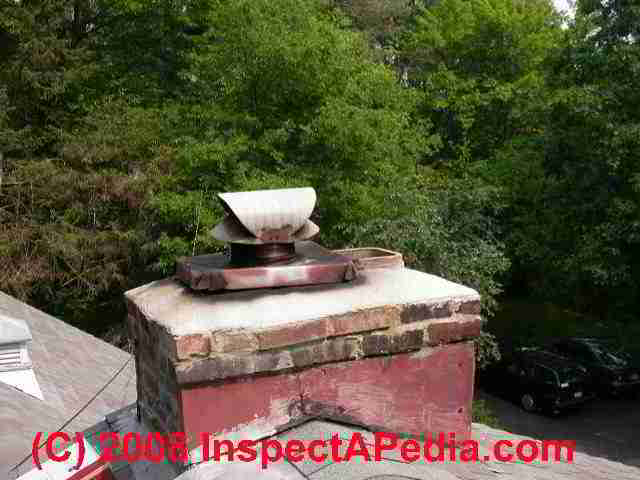
Rain Cap: a rain cover on top of a chimney flue designed to keep out rain (which can damage the flue or appliances it vents) and intended to reduce downdrafts in the chimney in windy conditions. The metal cover shown in our photo at left is a metal "rain cap".

This interesting chimney has a metal cap on one flue and not the other. The metal chimney cap looks home-made and perhaps not functional.

Chimney Cap: on a masonry chimney the chimney cap is a pre-cast concrete or poured in place concrete seal around the flue tile (on a modern masonry chimney). In our photo (above left) the chimney cap, also called a mortar cap, is the white concrete visible around the projecting flue tiles at the top of the chimney. Some of us call the mortar cap or concrete chimney cap the chimney crown. The Masonry Institute of America calls this the "chimney cap" - we're following their terminology.
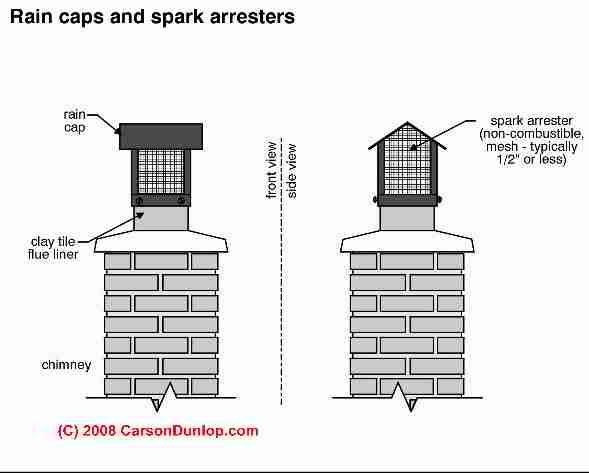

Chimney cap and spark arrestor (C) Carson DunlopThe purpose of the chimney cap [chimney crown] is to close off the space between the flue liner and chimney wall, to shed water clear of the chimney and generally prevent moisture entry.

The rain rain cap has the job of keeping rain and wind down-drafts out of the chimney. The rain cap or hood may also be charged with preventing sparks from leaving the chimney - a fire safety measure shown in Carson Dunlop's Sketch.

The Brick Institute of America (BIA) recommends chimney caps of pre cast or cast-in- place concrete a minimum of 2-inch thick with a projection of 2 1/2-inch beyond the face of the masonry surround so that water shed from the top will not run down the face of the brick.
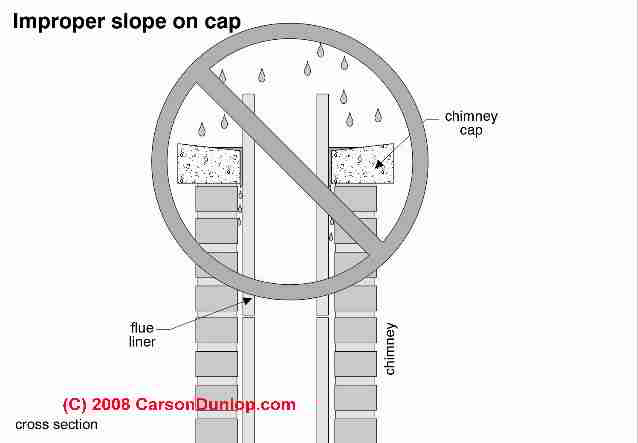

Chimney cap slope (C) Carson DunlopChimney cap slope: The chimney "cap" [or crown] should slope away from the flue at a good rate of about 3-inches per foot.

The chimney cap should not be bonded to the flue liner or top of the chimney in order to allow for thermal expansion of the liner. The space between the cap and the flue liner must be closed with a flexible sealant.

Mortar chimney "caps" are prone to cracks and allow water to drain over the face of the chimney masonry leading to spalling, loss of mortar and leakage to the interior spaces. Corrosion at the chimney base cleanout doors are common to those types of chimneys.

Check the chimney top for damaged masonry (or rusted metal), a missing cap, damaged, cracked, or missing top seal or crown on the top of a masonry flue, and here, an important discovery (at least in some jurisdictions) is whether or not the chimney is single wythe or thicker masonry and whether or not the chimney has (or perhaps needs) a chimney liner.


Lost rain cap (C) Carson Dunlop

Missing Chimney Rain Cap

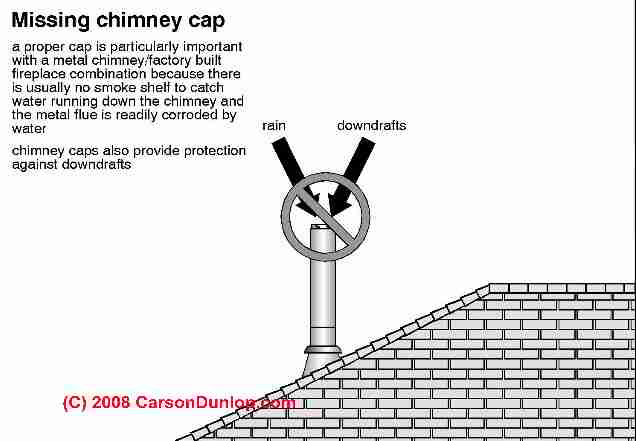
If we want proof that people don't spend a lot of time looking at their chimney, ask a home inspector or chimney sweep how often they find that the rain cap or spark arresting chimney cap has been completely lost from a chimney.

As Carson Dunlop's sketch shows, a missing cap invites water damage to the chimney and the equipment it vents, draft problems, and unsafe operation. Water entering the chimney can cause enough corrosion in a metal flue that the chimney needs replacement.


Chimney top missing drop edge (C) Carson Dunlop

Chimney crown/cap damage or missing drip edge

In Carson dunlop Associates' sketch at left the chimney crown looks recently installed and does not drain past the chimney sides. There has been water damage covered up with painted metal on the chimney side facing us.This chimney needs some safety inspection and probably new caps on the flues.

As Carson Dunlop's sketch shows (left), a good drip edge at the chimney top cap helps reduce water and frost damage to the chimney sides and structure. Watch out particularly for flat or even in-sloping metal caps on wood-framed chimney chases built around metal chimneys - these are often a source of hidden leaks into the structure and potentially dangerous rust or corrosion damage to fireplace inserts and flues as well as damage to heating equipment.
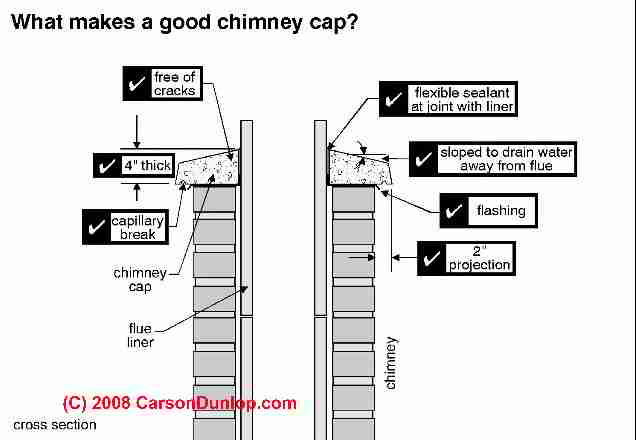

Chimney top cap construction details (C) Carson Dunlop

Carson Dunlop's sketch (left) shows some details of good chimney crown/cap construction. The object of these details is to avoid water and frost damage to the flue or to the chimney itself.

Chimney crown/cap history: if a chimney has spent part of its life with no rain cap installed, or if the masonry cap is poorly constructed, there is extra risk of water damage to the flue interior.

In a masonry chimney damage may appear as frost cracking of the upper flue liners or masonry.

In any chimney, there may also be water damage to the heating appliances being vented by that chimney, such as rust, formation of corrosive condensate, or creosote.

Damaged Masonry Chimney Cap or Crown
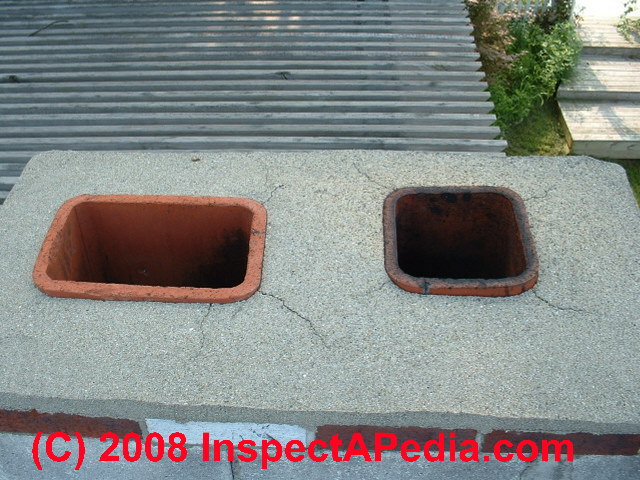
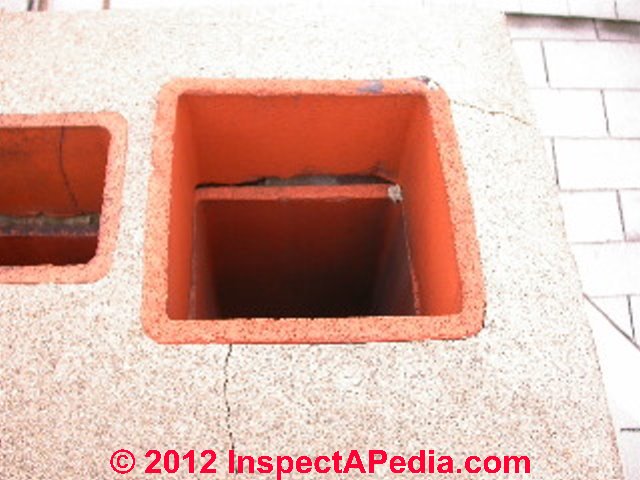
Photograph of a cracked chimney top crown and no cap installed.

Chimney Cap/crown: shown here is the concrete seal around the top of a chimney, sealing the upper chimney surface around the projecting chimney flue (clay flue tiles in this photo) in order to close off the space between the flue liner and chimney wall, to shed water clear of the chimney and generally prevent moisture entry.

Here is a chimney with a mortar cap but no rain cap. The design would have been better if one of the clay flue liners projected several inches higher than its neighbor, and if the concrete cap had been pre-cast or otherwise constructed to give an overhang past the sides of the chimney so that runoff would not wet and damage the brick masonry below.

Installation of this chimney cap would also have been better if there were an expansion gap and sealant permitting the flue tiles to expand without cracking the surrounding concrete cap.

See CHIMNEY CAP & CROWN for definitions of chimney rain cap, chimney cap, chimney crown, and for more examples of chimney top defects that may be visible from the ground or from an on-roof inspection.


Frequently Asked Questions (FAQs)

...

Ask a Question or Search InspectApedia

Use the search box below to ask a question or to search the InspectApedia.com website.

Ask a Question or Enter Search Terms in the InspectApedia search box just below.

Technical Reviewers & References

Related Topics, found near the top of this page suggest articles closely related to this one.

  • Mark Cramer Inspection Services Mark Cramer, Tampa Florida, Mr. Cramer is a past president of ASHI, the American Society of Home Inspectors and is a Florida home inspector and home inspection educator. Mr. Cramer serves on the ASHI Home Inspection Standards. Contact Mark Cramer at: 727-595-4211 mark@BestTampaInspector.com
  • John Cranor is an ASHI member and a home inspector (The House Whisperer) is located in Glen Allen, VA 23060. He is also a contributor to InspectApedia.com in several technical areas such as plumbing and appliances (dryer vents). Contact Mr. Cranor at 804-747-7747 or by Email: johncranor@verizon.net
  • Carson, Dunlop &
Associates Ltd., TorontoCarson, Dunlop & Associates Ltd., 120 Carlton Street Suite 407, Toronto ON M5A 4K2. (416) 964-9415 1-800-268-7070 info@carsondunlop.com. The firm provides professional home inspection services & home inspection education & publications. Alan Carson is a past president of ASHI, the American Society of Home Inspectors. Thanks to Alan Carson and Bob Dunlop, for permission for InspectAPedia to use text excerpts from The Home Reference Book & illustrations from The Illustrated Home. Carson Dunlop Associates' provides:
    • Commercial Building Inspection Courses - protocol ASTM Standard E 2018-08 for Property Condition Assessments
    • Home Inspection Education Courses including home study & live classes at eleven colleges & universities.
    • Home Inspection Education Home Study Courses - ASHI@Home Training 10-course program.
      Special Offer: Carson Dunlop Associates offers InspectAPedia readers in the U.S.A. a 5% discount on these courses: Enter INSPECTAHITP in the order payment page "Promo/Redemption" space. InspectAPedia.com editor Daniel Friedman is a contributing author.
    • The Home Reference Book, a reference & inspection report product for building owners & inspectors.
      Special Offer: For a 10% discount on any number of copies of the Home Reference Book purchased as a single order. Enter INSPECTAHRB in the order payment page "Promo/Redemption" space. InspectAPedia.com editor Daniel Friedman is a contributing author.
    • The Home Reference eBook, an electronic version for PCs, the iPad, iPhone, & Android smart phones.
      Special Offer: For a 5% discount on any number of copies of the Home Reference eBook purchased as a single order. Enter inspectaehrb in the order payment page "Promo/Redemption" space.
    • The Illustrated Home illustrates construction details and building components, a reference for owners & inspectors.
      Special Offer: For a 5% discount on any number of copies of the Illustrated Home purchased as a single order Enter INSPECTAILL in the order payment page "Promo/Redemption" space.
    • The Horizon Software System manages business operations,scheduling, & inspection report writing using Carson Dunlop's knowledge base & color images. The Horizon system runs on always-available cloud-based software for office computers, laptops, tablets, iPad, Android, & other smartphones.
  • Thanks to Luke Barnes for suggesting that we add text regarding the hazards of shared chimney flues. USMA - Sept. 2008.
  • Arlene Puentes, an ASHI member and a licensed home inspector in Kingston, NY, and has served on ASHI national committees as well as HVASHI Chapter President. Ms. Puentes can be contacted at ap@octoberhome.com
  • Roger Hankey is principal of Hankey and Brown home inspectors, Eden Prairie, MN, technical review by Roger Hankey, prior chairman, Standards Committee, American Society of Home Inspectors - ASHI. 952 829-0044 - hankeyandbrown.com
  • Residential Masonry Fireplace and Chimney Handbook, James E. Amrhein, S.E., MIA, Masonry Institute of America, 2d. Ed., 1995, ISBN 0-940116-29-4. The MIA is in Los Angeles, CA 213-388-0472. This manual reflects the 1994 Uniform Building Code, Energy Conservation Requirements of California, and the U.S. Department of Housing and Urban Development - HUD. The complete UBC is available from the International Conference of Building Officials (ICBO), Whittier CA 310-699-0541.
  • NFPA 211 - Standards for Chimneys & Fireplaces, NFPA 211: Standard for Chimneys, Fireplaces, Vents, and Solid Fuel-Burning Appliances, 2006 Edition (older editions and standards are found at the same bookstore)
  • NFPA #211-3.1 1988 - Specific to chimneys, fireplaces, vents and solid fuel burning appliances.
  • NFPA # 54-7.1 1992 - Specific to venting of equipment with fan-assisted combustion systems.
  • GAMA - Gas Appliance Manufacturers' Association has prepared venting tables for Category I draft hood equipped central furnaces as well as fan-assisted combustion system central furnaces.
  • National Fuel Gas Code, an American National Standard, 4th ed. 1988 (newer edition is available) Secretariats, American Gas Association (AGA), 1515 Wilson Blvd., Arlington VA22209, and National Fire Protection Association (NFPA), Batterymarch Park, Quincy MA 02269. ANSI Z223.1-1988 - NFPA 54-1988. WARNING: be sure to check clearances and other safety guidelines in the latest edition of these standards.
  • Fire Inspector Guidebook, A Correlation of Fire Safety Requirements Contained in the 1987 BOCA National Codes, (newer edition available), Building Officials and Code Administrators International, Inc. (BOCA), Country Club HIlls, IL 60478 312-799-2300 4th ed. Note: this document is reissued every four years. Be sure to obtain the latest edition.
  • Uniform Mechanical Code - UMC 1991, Sec 913 (a.) Masonry Chimneys, refers to Chapters 23, 29, and 37 of the Building Code.
  • New York 1984 Uniform Fire Prevention and Building Code, Article 10, Heating, Ventilating, and Air Conditioning Requirements
  • New York 1979 Uniform Fire Prevention & Building Code, The "requirement" for 8" of solid masonry OR for use of a flue liner was listed in the One and Two Family Dwelling Code for New York, in 1979, in Chapter 9, Chimneys and Fireplaces, New York 1979 Building and Fire Prevention Code:
  • "Top Ten Chimney (and related) Problems Encountered by One Chimney Sweep," Hudson Valley ASHI education seminar, 3 January 2000, contributed by Bob Hansen, ASHI
  • Chimney Inspection Checklist, Carson Dunlop, Associates, Toronto, Ontario
  • "Rooftop View Turns to Darkness," Martine Costello, Josh Kovner, New Haven Register, 12 May 1992 p. 11: Catherine Murphy was sunning on a building roof when a chimney collapsed; she fell into and was trapped inside the chimney until rescued by emergency workers.
  • "Chimneys and Vents," Mark J. Reinmiller, P.E., ASHI Technical Journal, Vol. 1 No. 2 July 1991 p. 34-38.
  • "Chimney Inspection Procedures & Codes," Donald V. Cohen was to be published in the first volume of the 1994 ASHI Technical Journal by D. Friedman, then editor/publisher of that publication. The production of the ASHI Technical Journal and future editions was cancelled by ASHI President Patrick Porzio. Some of the content of Mr. Cohen's original submission has been included in this more complete chimney inspection article: InspectAPedia.com/chimneys/chimneys.htm. Copies of earlier editions of the ASHI Technical Journal are available from ASHI, the American Society of Home Inspectors.
  • Natural Gas Weekly Update: http://tonto.eia.doe.gov/oog/info/ngw/ngupdate.asp Official Energy Statistics from the U.S. Government
  • US Energy Administration: Electrical Energy Costs http://www.eia.doe.gov/fuelelectric.html
  • Fireplace & Chimney Design, Repair Books - Fireplaces, Chimneys: design, repair
  • Fireplace & Chimney Inspection Books - Inspecting and diagnosing chimney problems, fireplace problems, chimney & fireplace standards
  • Ceramic Roofware, Hans Van Lemmen, Shire Library, 2008, ISBN-13: 978-0747805694 - Brick chimneys, chimney-pots and roof and ridge tiles have been a feature of the roofs of a wide range of buildings since the late Middle Ages. In the first instance this ceramic roofware was functional - to make the roof weatherproof and to provide an outlet for smoke - but it could also be very decorative. The practical and ornamental aspects of ceramic roofware can still be seen throughout Britain, particularly on buildings of the Victorian and Edwardian periods. Not only do these often have ornate chimneys and roof tiles but they may also feature ornamental sculptures or highly decorative gable ends. This book charts the history of ceramic roofware from the Middle Ages to the present day, highlighting both practical and decorative applications, and giving information about manufacturers and on the styles and techniques of production and decoration. Hans van Lemmen is an established author on the history of tiles and has lectured on the subject in Britain and elsewhere. He is founder member and presently publications editor of the British Tiles and Architectural Ceramics Society. Also available at the InspectAPedia Bookstore.
  • Chimney Inspection Checklist, Carson Dunlop, Associates, Toronto, Ontario
  • Chimney & Stack Inspection Guidelines, American Society of Civil Engineers, 2003 - These guidelines address the inspection of chimneys and stacks. Each guideline assists owners in determining what level of inspection is appropriate to a particular chimney and provides common criteria so that all parties involved have a clear understanding of the scope of the inspection and the end product required. Each chimney or stack is a unique structure, subject to both aggressive operating and natural environments, and degradation over time. Such degradation may be managed via a prudent inspection program followed by maintenance work on any equipment or structure determined to be in need of attention. Sample inspection report specifications, sample field inspection data forms, and an example of a developed plan of a concrete chimney are included in the guidelines. This book provides a valuable guidance tool for chimney and stack inspections and also offers a set of references for these particular inspections.
  • Fireplaces, a Practical Design Guide, Jane Gitlin
  • Fireplaces, Friend or Foe, Robert D. Mayo
  • NFPA 211 - Standards for Chimneys & Fireplaces, NFPA 211: Standard for Chimneys, Fireplaces, Vents, and Solid Fuel-Burning Appliances, 2006 Edition (older editions and standards are found at the same bookstore)
  • Principles of Home Inspection: Chimneys & Wood Heating (Principles of Home Inspection), Carson Dunlop
  • U.S. vs. Canadian Unlined Masonry Chimney Flue Requirements & Case Study
  • NFPA 211 - 3-1.10 - Relining guide for chimneys
  • NFPA 211 - 3-2 - Construction of Masonry Chimneys
  • NFPA 211 - 3-3 - Termination Height for chimneys
  • NFPA 211 - 3-4 - Clearance from Combustible Material
  • NFPA 54 - 7-1 - Venting of Equipment into chimneys
  • Brick Institute of America - Flashing Chimneys
    Brick Institute of America - Proper Chimney Crowns
    Brick Institute of America - Moisture Resistance of Brick
  • American Gas Association - New Vent Sizing Tables
  • Chimney Safety Institute of America - Chimney Fires: Causes, Effects, Evaluation
  • National Chimney Sweep Guild - Yellow Pages of Suppliers

Books & Articles on Building & Environmental Inspection, Testing, Diagnosis, & Repair

  • Our recommended books about building & mechanical systems design, inspection, problem diagnosis, and repair, and about indoor environment and IAQ testing, diagnosis, and cleanup are at the InspectAPedia Bookstore. Also see our Book Reviews - InspectAPedia.
  • Home Reference Book - Carson DunlopThe Home Reference Book - the Encyclopedia of Homes, Carson Dunlop & Associates, Toronto, Ontario, 25th Ed., 2012, is a bound volume of more than 450 illustrated pages that assist home inspectors and home owners in the inspection and detection of problems on buildings. The text is intended as a reference guide to help building owners operate and maintain their home effectively. Field inspection worksheets are included at the back of the volume. Special Offer: For a 10% discount on any number of copies of the Home Reference Book purchased as a single order. Enter INSPECTAHRB in the order payment page "Promo/Redemption" space. InspectAPedia.com editor Daniel Friedman is a contributing author.

    Or choose the The Home Reference eBook for PCs, Macs, Kindle, iPad, iPhone, or Android Smart Phones. Special Offer: For a 5% discount on any number of copies of the Home Reference eBook purchased as a single order. Enter INSPECTAEHRB in the order payment page "Promo/Redemption" space.

  • GO TO Carson Dunlop's Home Study Course Information - How to Become a Home Inspector: Carson Dunlop's nationally recognized Home Study Course, selected by ASHI the American Society of Home Inspectors and other professionals and associations. This website author is a contributor to this course.
  • GO TO Carson Dunlop's Home Study Course Information - How to Become a Home Inspector: Carson Dunlop's nationally recognized Home Study Course, selected by ASHI the American Society of Home Inspectors and other professionals and associations. This website author is a contributor to this course.
  • GO TO Carson Dunlop's Home Study Course Information - How to Become a Home Inspector: Carson Dunlop's nationally recognized Home Study Course, selected by ASHI the American Society of Home Inspectors and other professionals and associations. This website author is a contributor to this course.
    Building inspection education & report writing systems from Carson, Dunlop & Associates Ltd
  • Carson Dunlop, Associates, Toronto, have provided us with (and we recommend) Carson Dunlop Weldon & Associates' Technical Reference Guide to manufacturer's model and serial number information for heating and cooling equipment
    Special Offer
    : Carson Dunlop Associates offers InspectAPedia readers in the U.S.A. a 5% discount on any number of copies of the Technical Reference Guide purchased as a single order. Just enter INSPECTATRG in the order payment page "Promo/Redemption" space.

  • ...

HOME ABOUT CONTACT COPYING DESCRIPTION POLICIES PRINTING PRIVACY © 2013 Copyright InspectAPedia.com