
InspectAPedia® FREE Encyclopedia of Building & Environmental Construction, Diagnosis, Maintenance & Repair |
Question? Just ask us! InspectAPedia
|
 Inspection & Assessment of Abandoned Chimneys in buildings
- POST a QUESTION or COMMENT about abandoned chimney detection, inspection, hazards, removal or repair
This article describes the discovery, inspection, and significance of abandoned chimneys in buildings.
By "abandoned chimney" we do not mean simply a chimney that is not in use.
InspectAPedia tolerates no conflicts of interest. We have no relationship with advertisers, products, or services discussed at this website.
Inspection & Assessment of Abandoned Chimneys in buildings
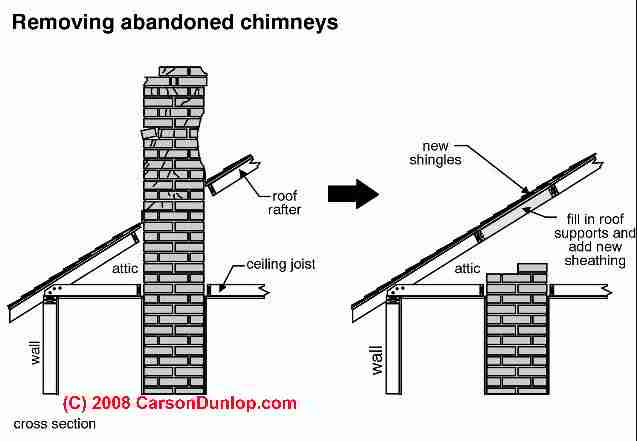 A greater concern are chimneys that have been only partially removed, may not be adequately supported, and risk collapse, fire spread, heat loss, and other building concerns.
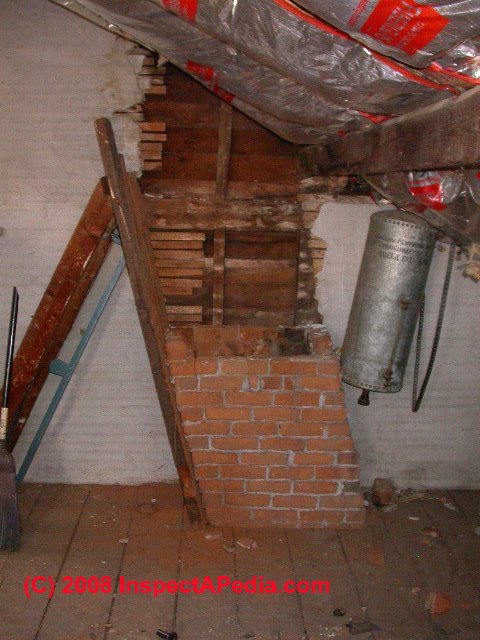
Our photo (at page top) shows the abandoned chimney in the attic below the corrugated metal roof in the photo shown in our
separate ABANDONED CHIMNEYS, OUTDOORS article.
[Click to enlarge any image]
Happily this chimney was not in use at the time of our inspection. Do you suppose someone might some day try to use this flue without checking it out first?
Carson Dunlop Associates [at REVIEWERS] sketch (left) demonstrates the need to repair the roof and add support where a through-roof chimney is removed above the roof line.
Abandoned chimneys may be discovered in an attic, basement, or even in the middle of a structure, and can be a big surprise. We often wonder what's holding up all this weight.
 Someone may have eliminated a fireplace or an entire chimney on the
lower floors, but neglected to remove the chimney from the attic out through the roof, perhaps
because they didn't want to repair the ensuing hole in the roof left if the chimney were removed.
Someone may have eliminated a fireplace or an entire chimney on the
lower floors, but neglected to remove the chimney from the attic out through the roof, perhaps
because they didn't want to repair the ensuing hole in the roof left if the chimney were removed.
Point loads from unanticipated weight or even a sudden collapse can be a real hazard
if chimney bricks suddenly come through an upper floor bedroom ceiling.
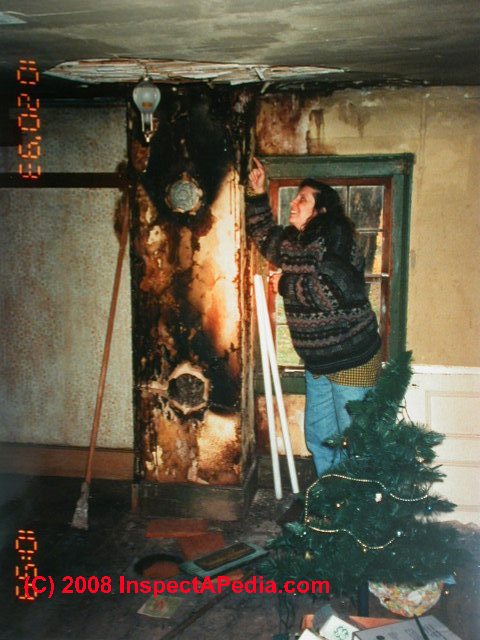
Our photo (above) shows an unsupported chimney in the top floor of a pre-1900 home.
This chimney has it all (bad): the masonry chimney rests on floorboards between floor joists - it does not support its own weight. The chimney is cracked, damaged, and has evidence of a fire.
There is also danger of chimney collapse, damaging the structure and injuring building occupants should masonry chimney parts fall through floors or ceilings below.
The hole in the floor at the base of the chimney was a passage for a woodstove flue vent connector (with no fire protection or clearance) that connected into the upper opening in the chimney.
and
at FLUE VENT CONNECTORS, HEATING EQUIPMENT we show a closeup of the lower cleanout opening - which was blocked by falling debris.
Fire & Gas Hazards of Abandoned Chimney Flue Openings
Look for unsupported or inadequately supported masonry left in the building, sagging floors, or worse, on occasion you may find that the chimney was only "abandoned" above the roof, and that it continues to vent into the building attic. We found just that condition in a chimney trying to vent a gas fired furnace.
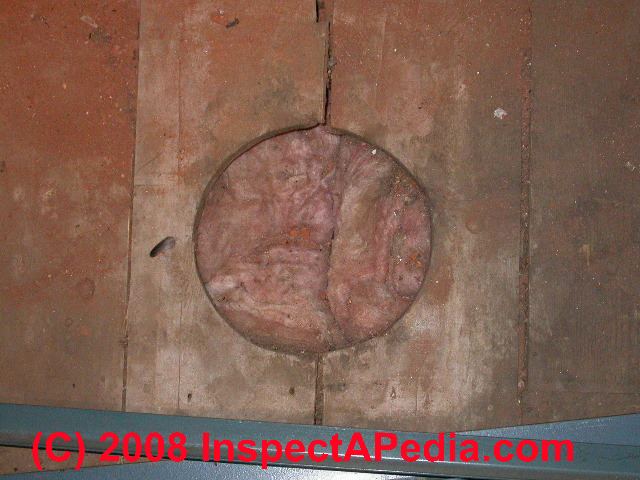
Our photo (above left) shows fiberglass stuffed into a round hole in a building surface. [Click to enlarge any image]
Regardless of whether you see this clue in a floor, ceiling, or wall, some investigation for the presence of a chimney behind the opening is an important safety check. Older homes were sometimes constructed with a single flue chimney that served appliances on multiple floors - an unsafe practice that is prohibited by modern building and fire codes.
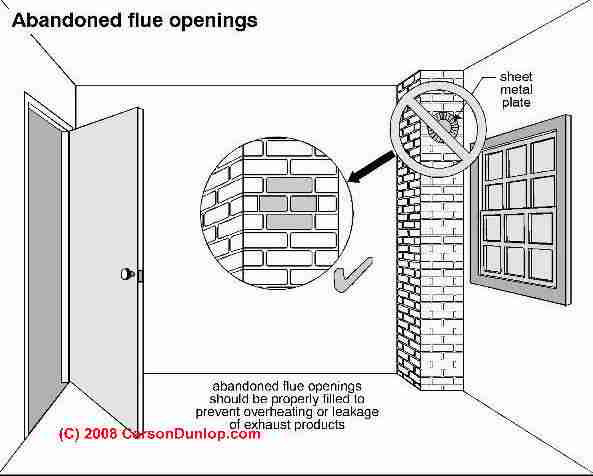
Carson Dunlop Associates [at REVIEWERS] sketch (above right) shows a common "pie plate" cover over an un-used chimney opening. For safety the opening should be filled in with masonry. Be sure the repair leaves masonry flush with the chimney interior, not just the chimney's exterior side. Otherwise the repair may interfere with draft and it may make cleaning the flue difficult or impossible.
When an upstairs woodstove is removed the hole left in the chimney is best sealed with masonry material, not a metal cover plate, not insulation, not wood or drywall. Closing a chimney opening with those less durable materials leave a fire and flue gas leakage risk in the building.
A List of Abandoned Chimney Hazards on buildings
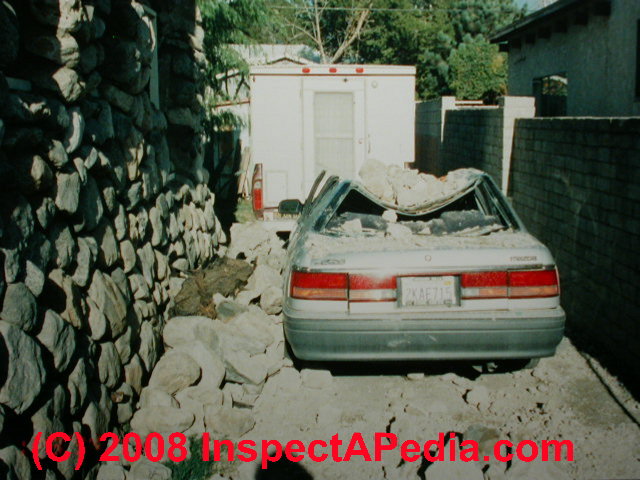 Some of the hazards associated with incomplete removal of a masonry or even a metal chimney in a building include the items listed below.
Photo: a collapsed unreinforced stone fell on and smashed the family car. (In this case it was an earthquake, not a chimney abandonment).
- Fire spread in the building: an un-sound chimney may speed the spread of a building fire between floors
- Abandoned flue openings, not properly sealed, become a fire or fatal carbon monoxide hazard
- Air quality and air safety: an un-used chimney may increase the flow of toxic gases from a problem area upwards into other building rooms, such as a smoke, soot, or potentially fatal carbon monoxide generated by heating appliance that is malfunctioning in a lower building area. Drafts can also move moisture and toxic mold spores or allergens and other problematic particles in a building.
- Bracket chimneys: old incomplete and possibly inadequately supported masonry chimneys in buildings -
see BRACKET CHIMNEYS & GALLOWS BRACKETS for details. - Structural collapse: an old chimney may collapse causing damage or even injury to people at lower floors in the building.
See CHIMNEY COLLAPSE Risks, Repairs - Flue gas hazards: in buildings with shared party walls any work done must protect the structural, fire, and flue-gas safety of neighbours sharing a party wall.
- Leaks, water damage, mold contamination when a chimney is not properly abandoned, removed, sealed at rooftop or along a building exterior wall
- Strucural collapse, injury, or worse if a masonry chimney is not properly abandoned or partly-abandoned
Reader Comments, Questions & Answers About The Article Above
Below you will find questions and answers previously posted on this page at its page bottom reader comment box.
Reader Q&A - also see RECOMMENDED ARTICLES & FAQs
On 2021-05-23 by (mod) - Building codes & standards for abandoned or abandoning chimneys
 @charlie cocca,
Thank you for a helpful question.
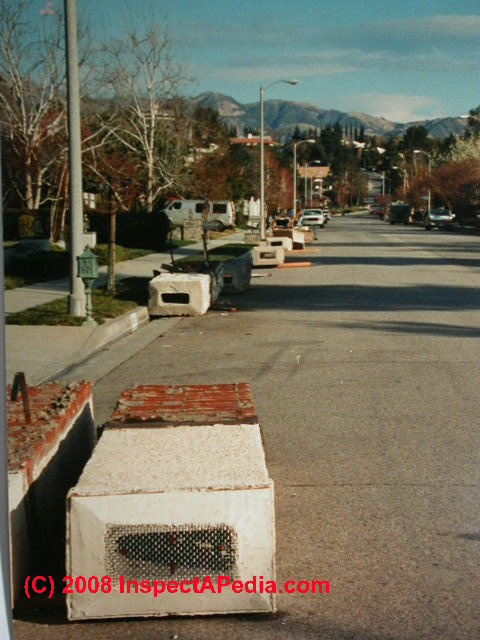
Sometimes chimneys are not removed on purpose. Our photo shows masonry chimney remains lined up in the street after the 1994 Northridge Earthquake in California.
[Click to enlarge any image]
Permits for Complete Chimney Removal
In most countries and jurisdictions you will need a building permit and approvals from local authorities (such as building council in the U.K.) to remove an existing masonry (and some other) chimmey.
I have not found building codes that explicitly discuss
- the complete removal of a chimney
- the abandonment of a chimney left entirely in place
There are regulations concerning
- partial abandonment of a chimney, that is, removing parts of a fireplace or chimney in a building.
- abandonment of inlet openings to chimneys
I include examples of these below.
Codes & Regulations for Abandonment by Partial Removal of Fireplaces or Chimneys
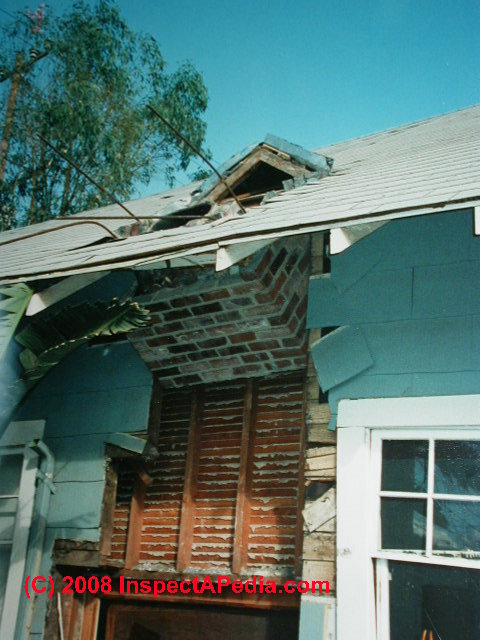 Where part of a fireplace or chimney is to be removed there are serious conerns for
- structural safety: avoiding risk of collapsing masonry structures, walls or structures affecting party walls
- fire and flue gas safety: where there are shared walls, party walls, close neighbours, avoiding creating a risk of flue gases, sparks or potentially fatal carbon monoxide gas between neighbours
Partially-abandoned and removed chimneys and the possible dangerous effects on structures and building code requirements (in the U.K.) are discussed in detail
at BRACKET CHIMNEYS & GALLOWS BRACKETS
Codes & Regulations for Abandonment of Chimney Openings
In adopted and model building codes such as the IFGC International Fuel Gas Code (Chapter 5), and in model mechanical codes such as the two adopted mechancal code examples given below.
2015 CHAPTER 5, CHIMNEYS AND VENTS, SECTION 501 (IFGC), [PDF] (2015) Seattle building code, Retrieved 2017/07/22, original source: http://www.seattle.gov/dpd/cs/groups/pan/@pan/documents/web_informational/p2622099.pdf
we have:
- 501.5 Abandoned inlet openings.
Abandoned inlet openings in chimneys and vents shall be closed by an approved method.
This same requirement appears under other code numbers in other model or adopted fireplace and chimney codes such as the New York City Mechanical Code (2014) Chapter 8, Chimneys and Vents
- 801.8 Abandoned Inlet Openings
Abandoned inlet openings in chimneys and vents shall be closed by an approved method, sealed air-tight and permanently labeled as abandoned.
Codes & Regulations for Removal of Chimney Breast or Chimeys
- BRACKET CHIMNEYS & GALLOWS BRACKETS - extensive detail
- BRITISH STANDARD BS 5440 CHIMNEY INSTALLATION CLEARANCES MAINTENANCE [PDF] (2000) Installation and maintenance of flues and ventilation for gas appliances of rated input not exceeding 70 kW net (1st, 2nd and
3rd family gases) — Part 1: Specification for installation and maintenance of flues
From the British standard as well as from building regulations throughout the U.K. we have more details like the following:
Chimney pot removal:
If the chimney pot is removed and it is intended to slab over the chimney and continue to use the chimney,
by providing side outlets, then an area of at least 12 000 mm2 !per flue" on each of the opposite sides
should be provided in accordance with the dimensional requirements for non-proprietary terminals in 5.1.5. The outlets should be suitably protected to prevent bird entry.
Preservation of Shared Flues
A typical label that should be attached to an appliance should state “This appliance is fitted to a shared flue system and must not be removed or replaced without reference to the person responsible for the building, phone or contact details are ................. Further advice is given in BS 5440-1:2000.”
Let me see what else I can find in addition to what's listed above.
On 2021-05-21 by charlie cocca - what building code number or section deals with the regulations of abandoning a residential chimney ? t
what building code number or section deals with the regulations of abandoning a residential chimney ? thank you
On 2019-02-08 by (mod)
For the air movement issue I'd try packing the open chimney top with fiberglass - that ought to slow down the air.
But really we want to get the water out of the house, and I worry that there's a larger problem here with a wet crawl area that as I suggested can cause a range of troubles.
The spray foam, IF it was closed cell foam, would form a water and moisture barrier that would indeed stop a lot of air and moisture movement upwards through the floor.
On 2019-02-08 by Paul
Definitely no other sources of moisture or leaks possible in that area of the house. It can only be coming in from the ground/air in the crawl space.
I'll look to see if it is actually capped off rather than just cut off, and if not I'll see about stopping any air movement. Do you think adding a little insulation inside the chimney in the attic and capping it is sufficient, or do you think I should try to insert insulation further down into the chimney before capping?
I don't believe that the air is condensing on the chimney as the latex paint on is not wet on the surface and near the baseboard it is bubbling up, but I suppose it is possible.
The brick is covered with the original 1920s plaster which looks to have been steadily deteriorating over the course of the last 100 years. In another room I'm renovating, the brown coat of the plaster where it meets the chimney near the baseboard is turning to dust but higher up in the room the plaster is firm and dry.
Not sure if it matters one way or another, but in that part of the house the underside of the floor has been covered with spray foam insulation at some point.
I'll read through the crawl space dryout pages. Thanks for the tips so far!
On 2019-02-08 by (mod)
Paul
Is the moisture really "wicking up" ?
That may make a lot of sense if your outdoor drainage problems are sending water into the base of the chimney. If that's the root cause you really need to start at the problem source.
If you have a wet crawl space that's a moisture source that will continue to affect the building even when the chimney moisture transport issue is solved.
Search InspectApedia.com for WET CRAWL SPACE DRYOUT to see a sickeningly long list of suggestions.
Back to "wicking up moisture" to be sure we're on the same page:
In my lexicon "wicking up moisture" would be coming from a water source such as wet soil - at ground level.
If you are seeing moisture signs higher in the building and on or around and attributed to the chimney I would be looking for
1. air drafts up through the chimney, bringing moisture from some lower source such as a damp basement or crawl area
2. un-wanted moisture sources, leaks, water somewhere in the building
3. less likely - plumbing leaks in the same areas.
You can of course stop updrafts in an un-used flue by sealing its top - even fiberglass may do the job.
But you want to also look for the moisture and draft sources and address those.
I would not add a power fan and exhaust to stop updrafts and moisture as you describe - you'd actually be increasing the air movement up through the chimney, and if we are indeed bringing up moisture from some lower level, perhaps seeing it condense in the masonry, you'd be making that worse.
The other direction of thinking is to look at temperature differences.
Moisture in building air will condense out on cooler masonry surfaces.
On 2019-02-07 by Paul
I have a single story circa 1925 house with a chimney in the center of the 4 front rooms (each room houses one face of the chimney diagonally in the central corner). It is no longer used for any exhaust purposes and has been taken down about 5 feet below the roof line, so there is no danger of it leaking rainwater into the house.
I am experiencing moisture wicking up the chimney though. I added battens and sheetrock over one face of the chimney in one room as I remodeled and have noticed that this has caused efflorescence at the base plaster wall directly adjacent to the chimney. Also, I'm not certain but it is possible that this chimney provides structural support to the center of these four rooms.
Knowing that removing the chimney completely would be both costly and difficult (logistically speaking) and that crawl space access is nearly non-existent in that area, what can be done to mitigate the moisture wicking issue?
I am addressing some of the lot drainage issues which should help dry out the crawlspace, but what else can be done to dry out this chimney? Would placing some sort of ventilation fan at the top (exhausted through the roof) help? Any other suggestions?
On 2016-04-08 by (mod)
Len: I'm not quite clear on your comment. If a chimney was removed above the rooftop
1. the roof itself must be repaired to avoid leaks
2. the chimney below can usually be left in place unless it's a bracket chimney - see https://inspectapedia.com/chimneys/Bracket_Chimneys.php
or if the interior or even exterior chimney is severely cracked, bulged, leaning, (See "Severe Cracking" at https://inspectapedia.com/chimneys/Chimney_Crack_Diagnosis.php) or otherwise in danger of collapse (see https://inspectapedia.com/chimneys/Chimney_Collapse_Hazards.php ) , I'd agree that safest is to completely remove it.
On 2016-04-08 by Len
Existing chimney was taking down to the roof peak and appears to be unsealed. The heating system is direct vent and inlet combustion air. Water heater is electric.
I recommend that the chimney be inspected for structual integrity.
Question: smells traced to chimneys
(Aug 2, 2014) ElaineS926@aol.com said:
I have a problem with an odor in one room, second floor, on the wall of the chimney, however we had a direct vent boiler installed to bypass chimney thinking the chimney was the problem of this odor like a burnt out match or moldy.
Can an unused chimney be the cause?
I also had all vents cleaned and air cond cleaned. Keep the room closed and unused.
Reply:
Yes Elaine, creosote and other materials such as animals, dead animals, nests, can still be an odor source in an otherwise un-used chimney.
Try hiring a chimney sweep to inspect and clean the chimney interior. Then be sure there is a weather and invader-proof cap atop the flue.
...
Continue reading at ABANDONED CHIMNEYS, OUTDOORS or select a topic from the closely-related articles below, or see the complete ARTICLE INDEX.
Or see these
Recommended Articles
- ABANDONED CHIMNEYS
- ABANDONED FLUE OPENINGS
- BLOCKED CHIMNEY FLUES
- BRACKET CHIMNEYS & GALLOWS BRACKETS
- CHIMNEY CODES
- CHIMNEY COLLAPSE RISKS, REPAIRS
- CHIMNEY CODES & STANDARDS
- CHIMNEY HEIGHT & CLEARANCE CODE
- CHIMNEY INSPECTION DIAGNOSIS REPAIR - home
- CHIMNEY REPAIR: ABANDON & USE DIRECT VENT
- EARTHQUAKE DAMAGED CHIMNEYS
- FIREPLACE HEARTH DIMENSIONS & SUPPORT
- FIREPLACE INSPECTIONS
Suggested citation for this web page
ABANDONED CHIMNEYS at InspectApedia.com - online encyclopedia of building & environmental inspection, testing, diagnosis, repair, & problem prevention advice.
Or see this
INDEX to RELATED ARTICLES: ARTICLE INDEX to CHIMNEYS & FLUES
Or use the SEARCH BOX found below to Ask a Question or Search InspectApedia
Ask a Question or Search InspectApedia
Try the search box just below, or if you prefer, post a question or comment in the Comments box below and we will respond promptly.
Search the InspectApedia website
Note: appearance of your Comment below may be delayed: if your comment contains an image, photograph, web link, or text that looks to the software as if it might be a web link, your posting will appear after it has been approved by a moderator. Apologies for the delay.
Only one image can be added per comment but you can post as many comments, and therefore images, as you like.
You will not receive a notification when a response to your question has been posted.
Please bookmark this page to make it easy for you to check back for our response.
Our Comment Box is provided by Countable Web Productions countable.ca
Citations & References
In addition to any citations in the article above, a full list is available on request.
- Mark Cramer Inspection Services Mark Cramer, Tampa Florida, Mr. Cramer is a past president of ASHI, the American Society of Home Inspectors and is a Florida home inspector and home inspection educator. Mr. Cramer serves on the ASHI Home Inspection Standards. Contact Mark Cramer at: 727-595-4211 mark@BestTampaInspector.com
- John Cranor [Website: /www.house-whisperer.com ] is an ASHI member and a home inspector (The House Whisperer) is located in Glen Allen, VA 23060. He is also a contributor to InspectApedia.com in several technical areas such as plumbing and appliances (dryer vents). Contact Mr. Cranor at 804-873-8534 or by Email: johncranor@verizon.net
- Thanks to Luke Barnes for suggesting that we add text regarding the hazards of shared chimney flues. USMA - Sept. 2008.
- Roger Hankeyis principal of Hankey and Brown home inspectors, Eden Prairie, MN, technical review by Roger Hankey, prior chairman, Standards Committee, American Society of Home Inspectors - ASHI. 952 829-0044 - hankeyandbrown.com
- NFPA 211 - Standards for Chimneys & Fireplaces, NFPA 211: Standard for Chimneys, Fireplaces, Vents, and Solid Fuel-Burning Appliances, 2006 Edition (older editions and standards are found at the same bookstore)
- NFPA #211-3.1 1988 - Specific to chimneys, fireplaces, vents and solid fuel burning appliances.
- NFPA # 54-7.1 1992 - Specific to venting of equipment with fan-assisted combustion systems.
- GAMA - Gas Appliance Manufacturers' Association has prepared venting tables for Category I draft hood equipped central furnaces as well as fan-assisted combustion system central furnaces.
- National Fuel Gas Code, an American National Standard, 4th ed. 1988 (newer edition is available) Secretariats, American Gas Association (AGA), 1515 Wilson Blvd., Arlington VA22209, and National Fire Protection Association (NFPA), Batterymarch Park, Quincy MA 02269. ANSI Z223.1-1988 - NFPA 54-1988. WARNING: be sure to check clearances and other safety guidelines in the latest edition of these standards.
- Fire Inspector Guidebook, A Correlation of Fire Safety Requirements Contained in the 1987 BOCA National Codes, (newer edition available), Building Officials and Code Administrators International, Inc. (BOCA), Country Club HIlls, IL 60478 312-799-2300 4th ed. Note: this document is reissued every four years. Be sure to obtain the latest edition.
- Uniform Mechanical Code - UMC 1991, Sec 913 (a.) Masonry Chimneys, refers to Chapters 23, 29, and 37 of the Building Code.
- New York 1984 Uniform Fire Prevention and Building Code, Article 10, Heating, Ventilating, and Air Conditioning Requirements
- New York 1979 Uniform Fire Prevention & Building Code, The "requirement" for 8" of solid masonry OR for use of a flue liner was listed in the One and Two Family Dwelling Code for New York, in 1979, in Chapter 9, Chimneys and Fireplaces, New York 1979 Building and Fire Prevention Code:
- "Top Ten Chimney (and related) Problems Encountered by One Chimney Sweep," Hudson Valley ASHI education seminar, 3 January 2000, contributed by Bob Hansen, ASHI
- Chimney Inspection Checklist, Carson Dunlop, Associates, Toronto, Ontario
- "Rooftop View Turns to Darkness," Martine Costello, Josh Kovner, New Haven Register, 12 May 1992 p. 11: Catherine Murphy was sunning on a building roof when a chimney collapsed; she fell into and was trapped inside the chimney until rescued by emergency workers.
- "Chimneys and Vents," Mark J. Reinmiller, P.E., ASHI Technical Journal, Vol. 1 No. 2 July 1991 p. 34-38.
- "Chimney Inspection Procedures & Codes," Donald V. Cohen was to be published in the first volume of the 1994 ASHI Technical Journal by D. Friedman, then editor/publisher of that publication. The production of the ASHI Technical Journal and future editions was cancelled by ASHI President Patrick Porzio. Some of the content of Mr. Cohen's original submission has been included in this more complete chimney inspection article: CHIMNEY INSPECTION DIAGNOSIS REPAIR . Copies of earlier editions of the ASHI Technical Journal are available from ASHI, the American Society of Home Inspectors.
- Natural Gas Weekly Update: http://tonto.eia.doe.gov/oog/info/ngw/ngupdate.asp Official Energy Statistics from the U.S. Government
- US Energy Administration: Electrical Energy Costs http://www.eia.doe.gov/fuelelectric.html
- Our recommended books about building & mechanical systems design, inspection, problem diagnosis, and repair, and about indoor environment and IAQ testing, diagnosis, and cleanup are at the InspectAPedia Bookstore. Also see our Book Reviews - InspectAPedia.
- Chimney Inspection Checklist, Carson Dunlop, Associates, Toronto, Ontario
- NFPA 211 - 3-1.10 - Relining guide for chimneys
- NFPA 211 - 3-2 - Construction of Masonry Chimneys
- NFPA 211 - 3-3 - Termination Height for chimneys
- NFPA 211 - 3-4 - Clearance from Combustible Material
- NFPA 54 - 7-1 - Venting of Equipment into chimneys
- Brick Institute of America - Flashing Chimneys
Brick Institute of America - Proper Chimney Crowns
Brick Institute of America - Moisture Resistance of Brick - American Gas Association - New Vent Sizing Tables
- Chimney Safety Institute of America - Chimney Fires: Causes, Effects, Evaluation
- National Chimney Sweep Guild - Yellow Pages of Suppliers
- In addition to citations & references found in this article, see the research citations given at the end of the related articles found at our suggested
CONTINUE READING or RECOMMENDED ARTICLES.
- Carson, Dunlop & Associates Ltd., 120 Carlton Street Suite 407, Toronto ON M5A 4K2. Tel: (416) 964-9415 1-800-268-7070 Email: info@carsondunlop.com. Alan Carson is a past president of ASHI, the American Society of Home Inspectors.
Thanks to Alan Carson and Bob Dunlop, for permission for InspectAPedia to use text excerpts from The HOME REFERENCE BOOK - the Encyclopedia of Homes and to use illustrations from The ILLUSTRATED HOME .
Carson Dunlop Associates provides extensive home inspection education and report writing material. In gratitude we provide links to tsome Carson Dunlop Associates products and services.
 | HOME | ABOUT | ASK a QUESTION | CONTACT | CONTENT USE POLICY | DESCRIPTION | POLICIES | PRIVACY | |
| © 2024 - 1985 Publisher InspectApedia.com - Daniel Friedman | |||||||||