
InspectAPedia® FREE Encyclopedia of Building & Environmental Construction, Diagnosis, Maintenance & Repair |
Question? Just ask us! InspectAPedia
|
 Return Air Registers & Ducts
HVAC Return Air Duct Install, Inspect, Troubleshoot

- POST a QUESTION or COMMENT about HVAC system return air or "makeup air" and its effect on warm or cool air delivery in the building
Heating or air conditioning return air supply ducts & registers:
Discussed here: HVAC return air duct installation, inspection, specifications, troubleshooting guide. Defects in return air ducts & registers for heating or cooling systems. Return air adequacy. Air Conditioning (or Heating) Return Air & Duct Defects.
This HVAC ductwork article describes the inspection of the defects in return air registers & ducts for heating or cooling systems (HVAC) to help detect duct defects like missing air conditioning cool air supply or return air registers, undersized air conditioning duct openings, improper cooling duct routing, cooling (or heating) air duct corrosion, leaky air duct connections, defective heating or cooling ductwork materials.
InspectAPedia tolerates no conflicts of interest. We have no relationship with advertisers, products, or services discussed at this website.
Steps to Inspect, Diagnose, & Improve Heating or Cooling Return Air Flow
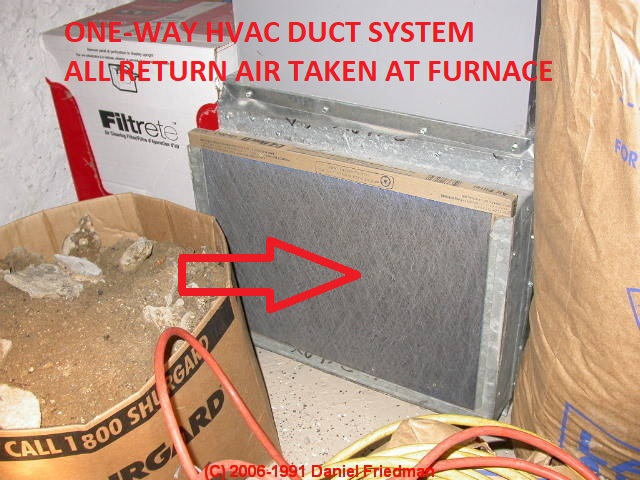 The photograph at page top shows a single central return air duct located outside of the
apartment which the duct system intends to serve.
The photograph at page top shows a single central return air duct located outside of the
apartment which the duct system intends to serve.
This installation prevents recirculating of air through the air handler for heating or cooling and results in poor air flow and increased heating and cooling costs for the apartment owners.
At our photo shown here is a "one-way" cooling system: all of the return air is being taken from a basement. This is a bad HVAC design that is the most-costly to operate, and it can also be unsafe as we explain below.
Basement Air Handler, No Return Air Ducts, All Return Air Taken at Air Handler
One-Way Cooling or Heating Systems
Some retrofit HVAC installers simply cannot figure out where to place return ducts, so they are just omitted such as shown in the two photographs here. For example a basement or crawl space air handler may be found with no return duct connections at all.
Rather you'll see that the return plenum is simply open to the basement or crawl space.
The photograph below confirms that wet, possibly moldy debris enters the HVAC system at this single point basement air return to the blower unit. In the foreground of the photograph you can see our Burkard (TM) air sampling machine being used to take a look at what the basement is sending into the home's ductwork and living space.
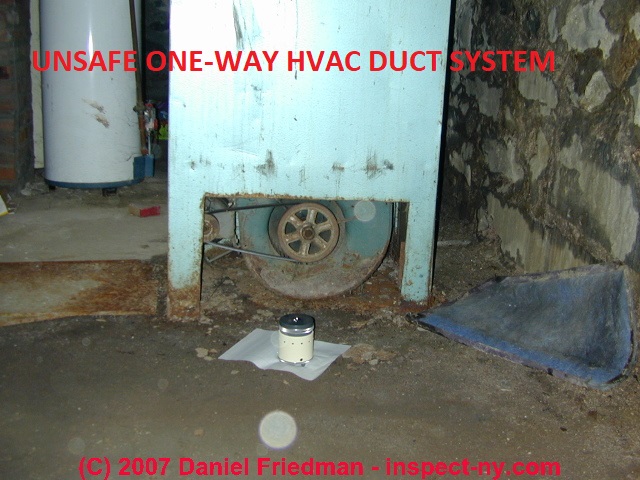
This forms a "one way" cooling or heating system - 100% of the air is drawn from the area around the air handler, cooled (or heated) and blown "one way" into the occupied space. This is the most inefficient design possible as well as possibly a dangerous one (see "Flue Gases" above).
Preferably return air is drawn from the heated or cooled space. Taking "new" makeup air from an unheated space, heating it, and blowing it "one way" into the heated area has to be a more costly way to heat a building.
For better indoor air quality and as recommended by ASHRAE, commercial and large residential heating and cooling systems may include apportion of outdoor fresh air input to the duct system as well.
Also see our safety warnings
Attic Air Handler Air Conditioner Return Duct Defects
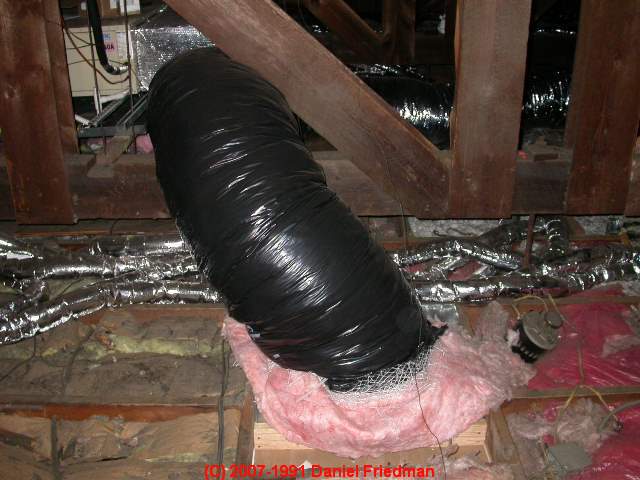
This photograph shows a typical black, large-diameter return flex-duct moving building air to the air conditioning system air handler unit located in an attic.
Notice the loose fiberglass insulation around the base of the large-diameter black flex-duct carrying return air? Poor connections at this location were pulling loose fiberglass insulation fragments and attic dust and debris into the air handler system.
In addition, this poor return duct connection, by leaking attic air into the duct system, increased the air conditioning operating cost by feeding it hot attic air instead of building living space air.
This photograph has a couple of other interesting details. Notice that the return duct is partly crimped and thus obstructed as it passes through the site-built building truss?
Also, what's that electric motor doing lying askew in the insulation next to the flex-duct? Perhaps the central air return, located in the ceiling of the space below, was placed where previously there had been a ceiling-mounted whole house fan, for which we see the motor, abandoned in the attic floor.
Understanding the history of changes made to a building can help interpret the meaning of clues about the building condition. It would be a safer practice to remove the still-connected but un-used fan motor.
Either remove the un-used fan circuit wiring completely, or enclose the termination of the un-used wires in a junction box.
HVAC Return Air Duct Leaks & Obstructions - Theory & Practice
 Pressure losses due to friction in the air duct system
Technical note: The D'Arcy-Weisbach equation for pressure and head loss can be used to calculate the actual pressure loss due to friction in a building piping or air duct system
. The Engineering Toolbox provides the D'Arcy-Weisbach formula:
Δp = λ (l / dh) (ρ v2 / 2)
where
Δp = pressure loss (Pa, N/m2)
l = length of duct or pipe (m)
dh = hydraulic diameter (m) and finally, ρ = density (kg/m3)
These Practical Considerations May Overcome Calculated HVAC Duct Pressures
Watch out: But keep in mind that even this apparently accurate calculation of the effect of piping on air pressure and airflow loss will not include the effects of obstructions in the building return air or supply air duct system such as the duct defects listed below.
- Air filter or other item that has been sucked into the duct system will block air flow and can risk a fire if drawn into the blower assembly fan, Dirty Air Filter Problems are perhaps the most common cause of unsatisfactory airflow in an HVAC system.
See DIRTY AIR FILTER PROBLEMS - Blower Fan: dirty blades on a squirrel cage blower assembly fan significantly reduce the blower fan's ability to move air into the HVAC system from the return-air side as well as reducing its ability to push conditioned air into the occupied space.
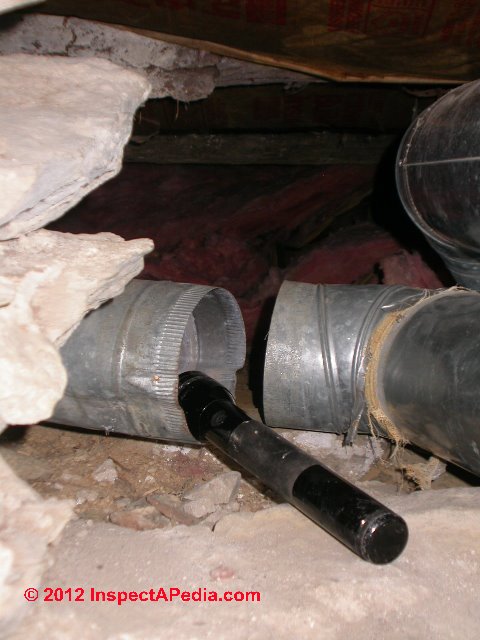
See DIRTY A/C BLOWERS - Disconnected HVAC ducts (photo at left) can cause very great losses in supply air and contamination in return air without discovery when the errors occur in hard-to-access spaces such as this tight crawl space that we inspected.
- Fire damper that has become stuck in the closed or partly-closed position interferes with proper airflow through the system
See FIRE & SMOKE DAMPERS, AUTOMATIC - Flex duct defects: Collapsed, crimped,or crushed sections of flex duct block or stop airflow in either supply or return air systems
See DUCT ROUTING & SUPPORT - Improperly sized air ducts or HVAC ducts that have become bent, crimped, or are of unnecessary length restrict airflow through the system.
See UNDERSIZED RETURN DUCTS. - Insulation loose in air ducts: Collapsed duct interior insulation,
See FIBERGLASS DUCT, RIGID CONSTRUCTION - Leaks in the supply air duct system or in the return air duct system are a very common HVAC duct defect that results in poor heating or cooling air flow.
See RETURN DUCT AIR LEAKS
and SUPPLY DUCT AIR LEAKS
and LEAKY DUCT CONNECTIONS
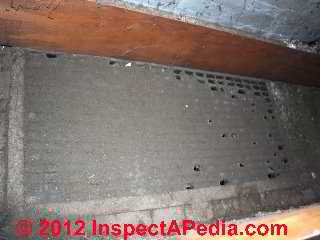
- Return air inlets: Return air inlet grilles that are obstructed with dirt, debris, or furniture or that are improperly located or are just too small mean that because the heating or cooling system is "starved for air", the supply air flow into occupied spaces will also be reduced.
Our photo (left) of a severely blocked return air inlet register was provided by Mark Berton.[3]
See REGISTER & DUCT LOCATION
and see RETURN AIR, INCREASE - Transite air ducts: Crushed or collapsed transite duct
TRANSITE PIPE AIR DUCTS can block air flow or may release asbestos dust into the building air supply. - Zone dampers that are stuck partly closed obstruct air supply into that building area, or if stuck "open" when the zone damper should be closed, airflow to other building areas will be reduced.
See ZONE DAMPER CONTROLS
Suspended Ceilings & Drop Ceilings Used as Return Air Plenums
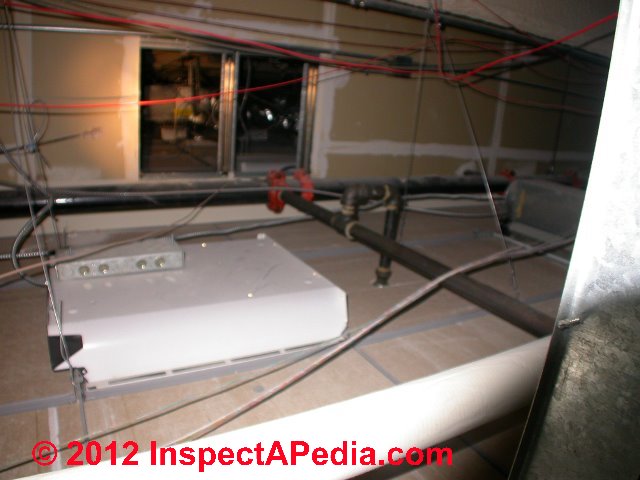
A suspended ceiling is often used as a huge return-air plenum in commercial HVAC installations as well as in some older homes in which HVAC ducts were added as a retrofit project and/or where high ceilings were "lowered" in an effort to reduce heating or cooling costs and to provide a passageway for supply air ducts.
But concerns arise in the suspended-ceiling return air plenum design, including
- Forgotten or unattended openings between building areas may be hidden in the suspended ceiling space. Our photo (above left) shows our discovery of an open fire/door passage between two building sections of a New York City office space.
The client's space (foreground) had its own air conditioning system installed but their system was pulling return air from a neighboring office suite - not only fouling up everyone's air conditioning delivery balance, but risking odors and contaminants from other areas in the building.
Worse, the neighboring space included ceiling openings over a stairwell, sending air from even lower building floors into this upper ceiling air plenum.
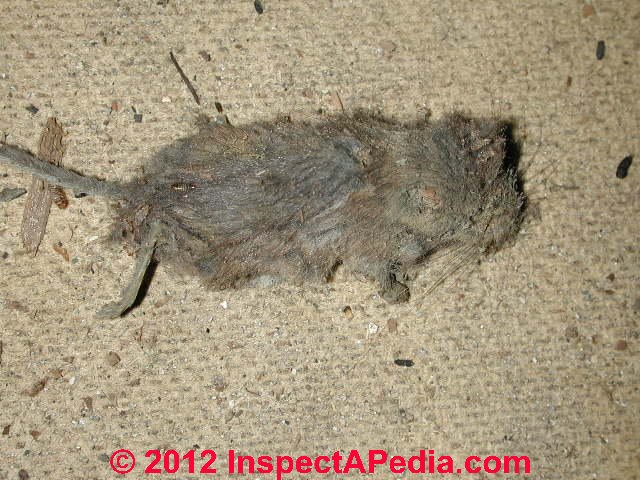
- Dirt, debris, falling plaster, asbestos, lead paint, mold, rodents and similar hazards often lurk in hidden spaces above suspended ceilings or in other building areas from which return air may be pulled into a heating or air conditioning system.
When return air is routed through these areas it may become contaminated.
The mouse and mouse droppings shown above were among the debris found on the upper side of a suspended ceiling that enclosed a space being used to serve as a return air plenum over offices we inspected.
Probably more serious are such spaces where we encounter asbestos heating pipe insulation in poor, damaged, friable condition, or large mold contamination reservoirs.
Debris or contaminants in the suspended ceiling cavity, particularly when building heating or cooling air flow through that space, are readily transported to other building areas and into the occupied space.
Watch out: at STAINS HUMAN OCCUPANTwe report a case of "brown stains" and "brown dust" blamed on previous occupants who were "heavy smokers". The stains were traced to an unsafe gas-fueled furnace that took its return air from the dirt floor of a crawl area. Subsequently dangerous carbon monoxide hazards were also found to be present.
Reader Comments, Questions & Answers About The Article Above
Below you will find questions and answers previously posted on this page at its page bottom reader comment box.
Reader Q&A - also see RECOMMENDED ARTICLES & FAQs
On 2019-02-20 by Kenneth
i have a air handlers in a closet with a 8ft x25" lover door is this enough space for sufficient air flow
On 2019-01-13 by (mod) -
Robertt:
Watch out: an air filter sucked into the duct system can jam the blower fan, cause overheating, and even an electrical fire.
Watch out: you need to turn off the system and if you can't find and retrieve the filter right at the air handler, you'll need an HVAC tech who has a duct inspetion camera to find the runaway air filter.
Keep me posted. What you find may help other readers.
On 2019-01-11 by Robert
I have a central heating and all components such as ductwork and intake are in the ceiling. Today, I went up the ladder to change the filter. It fits
into a 20x20x1 flanged opening with a vented door. To the left "wall" at a 90deg from the filter is the actual duct. It is wide open.
When I looked, I found the old filter missing. About a week ago, my wife stated that the heater sounded like a Mack truck when it came on......
I fear that the filter has been sucked into the intake system.
How do I find it and how do I retrieve it without too much damage? The ducts are like big aluminum tunnels. Please, I am a 74 yr old man
and need to know. I am very handy, but afraid to damage system. Thank you
On 2018-07-06 6 by Anonymous
Thank you very much for the reply. I will definitely be going through those articles and try a more systematic approach to finding the culprit(s). I found, earlier this year, a number of leaks around the air handler that I sealed up with mastic and that helped with the heating.
By the way, the house was built in 1997. We bought it in 2002. We have since learned that the builder, also responsible for most of the homes in the development, was keen on taking short cuts and shoddy work. So much so that he was even murdered by someone for whom he had built a house because they were so upset over his work.
I did want to mention that while heating and cooling have BOTH been an issue, the A/C has always been the bigger problem. In winter the heat is not the best upstairs but only about 2° degrees cooler. Enough to notice the drop when you walk upstairs but nothing that required any type of lifestyle change. With the A/C it is more in the 6° to 7° warmer, on average, and while the air coming through the registers is cold it does not seem to displace the heat. We have tried a window exhaust fan in the window in the warmest room and that does help.
Again, thank you for the suggestions.
Jim
On 2018-07-06 by (mod) -
Jim,
I agree that if a large vertical cavity intended to function as a return air duct in cooling mode is filled with warm air it can be almost impossible to push warm air DOWN from an upper floor to a basement or lower floor air handler, and I agree that it's possible that smaller air ducts inserted in that chase might give the air handler a chance at "sucking" warm air down.
But I'm doubtful from your note that that's the best approach.
It was common in homes in North America from the 1930's to 1960s to use spaces between floor or ceiling joists and sometimes between wall studs as passages for return air.
You report that your home never had great heating AND cooling upstairs and suspect the design of the return ducts - which is entirely plausible though we don't yet know the exact duct and air flow problem.
Cooling and heating air flow problems based on duct design are, however, different in some important ways.
It is more difficult to push warm air down than up and more difficult to push cool air up than down, due to the differences in the buoyancy between warm air (wants to rise) and cool air (wants to fall).
So it is innately difficult to push warm air down two floors in your home's design when the air conditioner is running.
You'd be best served by an on-site HVAC expert (not just an opinionated arm-waver) who can examine your home's duct layout, air handler, filter condition and location and other determinants.
That's because aside from trouble pushing warm air down (one could try adding a booster fan pushing air down from upstairs - at each of those two returns) there are other problems that impede both heating and cooling air flow.
Since you say the problem are BOTH heating and cooling, I'd want to look at those. They range from something as simple as room doors that are kept closed and dirty air filters, to more subtle hidden problems like dirty blades on an air handler blower assembly squirrel cage fan.
I recommend a careful look at these InspectApedia.com articles:
RETURN AIR, INCREASE https://inspectapedia.com/aircond/Return-Air-Improvement.php
AIR FLOW IMPROVEMENT, HVAC - https://inspectapedia.com/aircond/Duct_Air_Flow.php that addresses supply air
DUCT & AIR FLOW PROBLEMS https://inspectapedia.com/aircond/Air_Duct_Problems.php a general diagnostic approach
On 2018-07-06 by Jim
Hi,
The upstairs of our house has never had great heating/cooling. There are only 2 returns on the upper floor that has 3 bedrooms and a bathroom. The bathroom has a return as well as one bedroom that has an adjoining wall to the bathroom.
It turned out that both returns were simply vents placed between 16" on center studs. So each return has a stud on either side and drywall on either face. These both lead into a large void in the first floor walls that has an inside dimension, between the studs and drywall, of 18" x 24" x 108".
At the base of this void is a smaller return that leads to a 6" diameter duct that goes to the return in the basement.
There is also a 16" x 16" return on the side of the void that connects to the first floor. I've attached a picture looking down from near the top of the void to the bottom where there is the hole cut in to the floor that leads to the duct.
The duct that you see in the corner of the void is an air feed to the bathroom upstairs. This feed is the only feed to the upper floor that uses ducting and it is the strongest air flow upstairs as well.
How sound is it to have the return just be between the studs and the drywall? The builder used drywall nails instead of screws so it is not uncommon for the drywall to pull away from the studs in places. I'm worried that beyond the air leak there is insulation and dirt getting in to the system. This was also done to feed air to some of the rooms upstairs.
Also, is the giant void possibly causing an issue? I'm wondering if we inserted a 6" or 8" duct down the center if that would help in cooling/heating the upstairs since the pressure of the return air would increase.
We had actually planned to use some of this void for shelves when we discovered that it was part of the air return.
Any guidance would be greatly appreciated. Thanks!
Jim
IMAGE LOST by older version of Comments code - now fixed. Please re-post the image if you can. Sorry. Mod.
On 2018-05-25 by (mod) -
Karen
There are fiberglass-based insulating panels used to construct or to line HVAC ducts. Those are perfectly functional IF they haven't been damaged by efforts at mechanical cleaning, flooding, or other such forces.
But if the interior of your HVAC ducts including the return inlet are lined with conventional building insulation, that's the wrong material, one that sheds fiberglass quite easily into the air stream (perhaps reduced downstream by an air filter), one that is easily dust contaminated, and one that cannot be cleaned.
Add an Image or two to comments to let us see what you've got and we can comment further.
See details at FIBERGLASS HVAC DUCTS - https://inspectapedia.com/Fiberglass/Fiberglass_Air_Ducts.php
On 2018-05-25 by karen brennan
Inside my return AC duct grill is coated with about 6 inch pink fiberglass insulation (like the insulation inside the walls). Is this improper? There are particles blowing out my vents.
On 2018-01-17 by (mod) -
Look for
disconnected or leaky or crushed supply air ducts
supply registers with closed louvers
dampers in the ductwork that are partly closed, needing re-balancing, adjustment.
On 2018-01-17 by Tammy
Heat blows strong in one room but not the others
On 2017-10-08 by (mod) -
Craig, I'm reluctant to guess about optimal return register location for a building I don't know anything about. The "right" answer depends on several things: are we returning air to a heating only or heating and cooling system? Do the locations for return air pick up air from the same areas being heated or cooled? Or are those areas blocked off when their doors are closed? those more basic questions would come before the height question you raise.
On 2017-10-08 by Craig Swayne
The commercial HVAC System in our office is located above a corridor, approximately 10 feet above the floor. The return air duct are also approximately 10 feet above the floor. Would the system perform better if the return duct was moved to the floor level, which would require a 90 degree turn near the HVAC Unit, and then a straight (vertical) duct to a box mounted on the floor, with the grill facing out on one of the vertical surfaces of the box? In other words, would the HVAC system have enough strength to pick up air 10 feet below the Unit?
Please advise. Many Thanks!
...
Continue reading at AIR LEAKS in RETURN DUCTS or select a topic from the closely-related articles below, or see the complete ARTICLE INDEX.
Or see RETURN AIR REGISTER & DUCT FAQs - Q&A posted originally at this pagbe
Or see these
HVAC Return Air Improvement Articles
Suggested citation for this web page
RETURN AIR REGISTERS & DUCTS at InspectApedia.com - online encyclopedia of building & environmental inspection, testing, diagnosis, repair, & problem prevention advice.
Or see this
INDEX to RELATED ARTICLES: ARTICLE INDEX to HVAC DUCT SYSTEMS
Or use the SEARCH BOX found below to Ask a Question or Search InspectApedia
Ask a Question or Search InspectApedia
Try the search box just below, or if you prefer, post a question or comment in the Comments box below and we will respond promptly.
Search the InspectApedia website
Note: appearance of your Comment below may be delayed: if your comment contains an image, photograph, web link, or text that looks to the software as if it might be a web link, your posting will appear after it has been approved by a moderator. Apologies for the delay.
Only one image can be added per comment but you can post as many comments, and therefore images, as you like.
You will not receive a notification when a response to your question has been posted.
Please bookmark this page to make it easy for you to check back for our response.
Our Comment Box is provided by Countable Web Productions countable.ca
Citations & References
In addition to any citations in the article above, a full list is available on request.
- [1] Thanks to Mark Cramer, Tampa Florida, for assistance in technical review of the "Critical Defects" section and for the photograph of the deteriorating gray Owens Corning flex duct in a hot attic. Mr. Cramer is a Florida home inspector and home inspection educator.
- [2] Thanks to Jon Bolton, an ASHI, FABI, and otherwise certified Florida home inspector who provided photos of failing Goodman gray flex duct in a hot attic.
- [3] Thanks to Mark A Berton, an editor & photographer who has provided InspectApedia with photographs of old house conditions from a 1907 Pennsylvania home.
- [4] Air Diffusion Council, 1901 N. Roselle Road, Suite 800, Schaumburg, Illinois 60195, Tel: (847) 706-6750, Fax: (847) 706-6751 - Email: info@flexibleduct.org - www.flexibleduct.org/ -
"The ADC has produced the 4th Edition of the Flexible Duct Performance & Installation Standards (a 28-page manual) for use and reference by designers, architects, engineers, contractors, installers and users for evaluating, selecting, specifying and properly installing flexible duct in heating and air conditioning systems.
Features covered in depth include: descriptions of typical styles, characteristics and requirements, testing, listing, reporting, certifying, packaging and product marking.
Guidelines for proper installation are treated and illustrated in depth, featuring connections, splices and proper support methods for flexible duct. A single and uniform method of making end connections and splices is graphically presented for both non-metallic and metallic with plain ends."
The printed manual is available in English only. Downloadable PDF is available in English and Spanish. - [5] Engineering toolbox properties of water - http://www.engineeringtoolbox.com/water-thermal-properties-d_162.html and email: editor.engineeringtoolbox@gmail.com web search 09/16/2010
- [6] Owens Corning Duct Solutions - www.owenscorning.com/ductsolutions/ - provides current HVAC ductwork and duct insulating product descriptions and a dealer locator. Owens Corning Insulating Systems, LLC, One Owens Corning Parkway, Toledo, OH 43659 1-800-GET-PINK™
- [7] "Flexible Duct Media Fiberglas™ Insulation, Product Data Sheet", Owens Corning - see owenscorning.com/quietzone/pdfs/QZFlexible_DataSheet.pdf
"Owens Corning Flexible Duct Media Insulation is a lightweight, flexible, resilient thermal and acoustical insulation made of inorganic glass fibers bonded with a thermosetting resin."
CONTINUE READING or RECOMMENDED ARTICLES.
- Carson, Dunlop & Associates Ltd., 120 Carlton Street Suite 407, Toronto ON M5A 4K2. Tel: (416) 964-9415 1-800-268-7070 Email: info@carsondunlop.com. Alan Carson is a past president of ASHI, the American Society of Home Inspectors.
Thanks to Alan Carson and Bob Dunlop, for permission for InspectAPedia to use text excerpts from The HOME REFERENCE BOOK - the Encyclopedia of Homes and to use illustrations from The ILLUSTRATED HOME .
Carson Dunlop Associates provides extensive home inspection education and report writing material. In gratitude we provide links to tsome Carson Dunlop Associates products and services.
 | HOME | ABOUT | ASK a QUESTION | CONTACT | CONTENT USE POLICY | DESCRIPTION | POLICIES | PRIVACY | |
| © 2024 - 1985 Publisher InspectApedia.com - Daniel Friedman | |||||||||