
InspectAPedia® FREE Encyclopedia of Building & Environmental Construction, Diagnosis, Maintenance & Repair |
Question? Just ask us! InspectAPedia
|
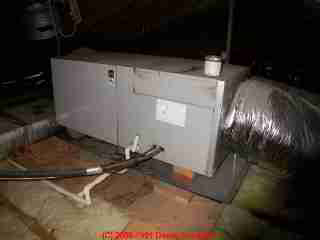 Air Handler Diagnosis & Repair
Weak or No Air Flow: Blower Fan, Cooling Coil, Air Filter
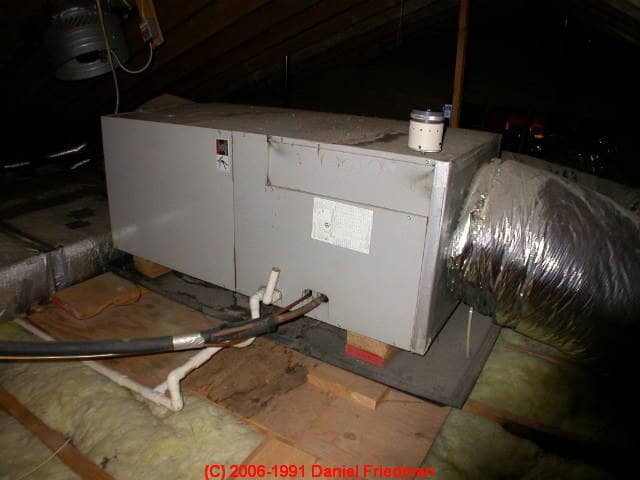
- POST a QUESTION or COMMENT about how to diagnose & repair problems with the air handler or blower unit / fan assembly in a warm air furnace or air conditioning system
Troubleshoot the indoor air handler or blower unit for A/C or heat pump or furnace system.
How to inspect & repair the indoor components of air conditioners and heat pumps: the air conditioning system indoor air handler units, blower units, or AHU's, (also called fan coil units) including the air conditioner blower fan, the indoor cooling coil or "evaporator coil", air conditioning system filters, and the causes, cures, and prevention of air handler leaks that lead to rust, damage, and mold contamination in the air conditioning system.
Quick troubleshooting guide for air handling units or blower assemblies in air conditioners, heat pumps, some furnaces. Dirty, contaminated air conditioner blower fans, reduced air output, fan cleaning advice. Air Conditioning air handler unit (AHU) leaks. Causes & Photographs of Mold Growth in Air Conditioning Blower Fans. How to Keep the HVAC Blower Assembly Clean.
Air Conditioning Blower Fan, Cooling Coil, Fan Coil Unit Leaks, Mold, and Filter Problems &: Repairs.
InspectAPedia tolerates no conflicts of interest. We have no relationship with advertisers, products, or services discussed at this website.
Air Handling Unit Troubleshooting - Quick Checks to fix no air flow or weak air flow
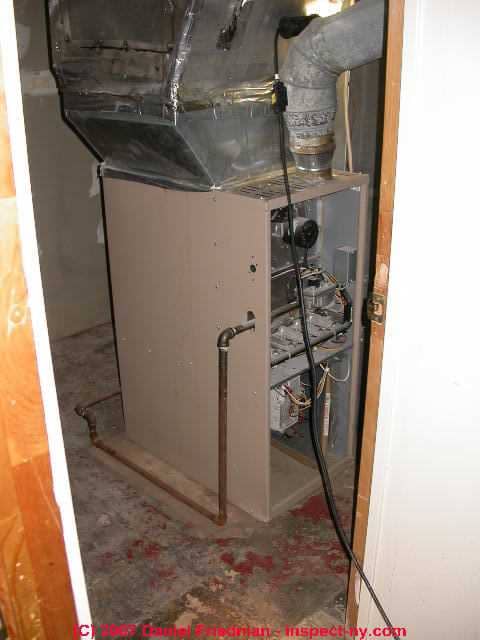 [Click to enlarge any image]
Article Series Contents
- AIR HANDLER TROUBLESHOOTING CHECKS
- DIRTY blower fans, reduced air output
- LEAKY Air Conditioning air handler unit (AHU)
- MOLDY Growth in Air Conditioning Blower Fans
- BLOWER FAN ASSEMBLY CLEANING
- BLOWER FAN OPERATION & TESTING - a series of diagnostic steps
- BLOWER FAN SPEED SETTINGS
- BLOWER LEAKS, RUST & MOLD
- DIRTY A/C BLOWERS
- DIRTY COOLING COIL / EVAPORATOR COIL - blocks air flow
- DIRTY HVAC COIL CLEANING PROCEDURES
- FROST BUILD-UP on AIR CONDITIONER COILS - blocks air flow
- RETURN AIR, INCREASE
Basic air handler unit or blower unit troubleshooting checks
Here we provide air handler unit or blower assembly troubleshooting by expanded annotated information from the US EPA [5] who provided suggestions for investigating the air handling unit during an indoor air quality investigation.
- Is the system turned on? Check thermostat to see that it is calling for heat or cooling, service switches at the equipment, check fuses or circuit breakers serving the equipment; for cooling systems check for a condensate drip tray overflow switch that may have turned off the system.
- If your air conditioning or heat pump system has lost its cooling capacity or won't start
see REPAIR GUIDE for AIR CONDITIONERS.
If all of the controls are calling for system operation but the blower motor won't run,
see ELECTRIC MOTOR DIAGNOSTIC GUIDE.
See COOLING CAPACITY, RATED of air conditioning equipment if the system seems to be working but is inadequate to cool your building. - Is air flowing from the air supply registers?
see DUCT SYSTEM DESIGN SIZE & DEFECTS - also check for a clogged or dirty filter or blocked air return.
Initial, simple diagnostic checks of the air handler system are also described
at Ducts & Air Handler diagnosis: Basic checks of the indoor air handler (blower), air ducts, and filter systems. - Is the blower assembly fan operating? You should hear the fan motor running and the fan assembly should be spinning. If the blower fan motor won't run
If the fan won't run at all
See FURNACE FAN WONT START
Also
See BLOWER FAN OPERATION & TESTING
See ELECTRIC MOTOR DIAGNOSTIC GUIDE
If the fan won't stop running
See
FAN WONT STOP - LIMIT SWITCH
FAN WONT STOP - THERMOSTAT SWITCH - Is the blower fan cutting on or off when you think it shouldn't ?
SeeCASE 1: the furnace BURNER cycles ON-OFF during a call for heat, BLOWER remains ON - high limit rocking
CASE 2: the furnace BLOWER FAN cycles ON-OFF while BURNER remains ON - blower short-cycling
CASE 3: the furnace BLOWER FAN cycles ON-OFF AFTER a call for heat, BURNER remains OFF - residual heat purge problem
Also see FURNACE FAN STOPS EARLY
- Are the air filters installed, proper size, clean?
See AIR FILTERS for HVAC SYSTEMS - Are the duct dampers working? Some HVAC systems use manual or automatic duct dampers
or ZONE DAMPER CONTROLS to open or close airflow through individual duct system sections.
Commercial and large building duct systems may include fire dampers that could be closed. - Is the air handler or its condensate drip tray dirty? Are there moisture, debris, visible mold, or other contaminants (rodents, birds) in or around the air handler or blower assembly?
See DIRTY A/C BLOWERS below in this article. - Are the coils dirty or iced or blocked? Are the evaporator coils (cooling coils or heating coils) clean?
See DIRTY COOLING COIL / EVAPORATOR COIL
and see FROST BUILD-UP on AIR CONDITIONER COILS
see COOLING COIL or EVAPORATOR COIL for a description of diagnosis and repair of cooling coil problems since this component is normally located within the air handler chassis as well. A cooling coil which is blocked by debris or ice and frost can obstruct air flow and reduce air conditioning system output - Is the condensate pan clean and is condensate draining out of the pan?
See CONDENSATE HANDLING, HVAC - Is the heating combustion equipment venting properly and does it have adequate combustion air supply?
See CHIMNEY INSPECTION DIAGNOSIS REPAIR
and BACKDRAFTING HEATING EQUIPMENT
Outdoor components: For a discussion of the outdoor components of an air conditioning or heat pump system
see COMPRESSOR / CONDENSER REPAIR.
Also see our complete HVAC cooling and heat pump diagnostic guide beginning
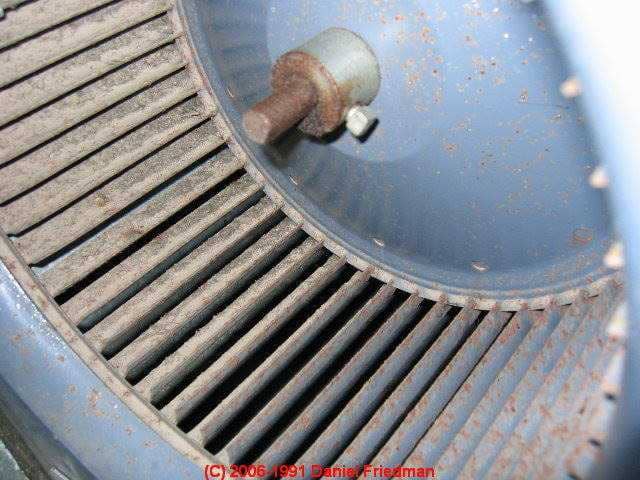
Dirty A/C or Heat Pump Blower Units - Dirt-blocked air conditioner air handler fans
We also discuss how to improve indoor air quality by installing a cascaded air filter system at the air conditioning (or heating system) air handler to provide optimal air particle filtration for people with asthma, allergies, or indoor mold or other IAQ concerns.
Filters protect the blower assembly: The typical A/C system circulates air through the building duct work using a "squirrel cage" blower fan. It is very important for you to check and change air filters at least monthly when the system is in use to protect the blower fan from dirt clogging.
Cupped fan blades can become blocked by debris: The blades of a squirrel-cage fan are cupped in order to cause the spinning cage to move air.
Dirt accumulation on the blades fills-in this cupped area, ultimately changing the "cup" to a simple flat area. The fan will spin just fine. I've seen the cubic feet per minute of air conditioning air-flow literally double when a very dirty squirrel cage fan fan of this type was cleaned or replaced.
Cleaning an air conditioner squirrel cage fan with compressed air? If the blower fan blades have significant dirt accumulation, you should have the system professionally cleaned. While this is a fairly costly service call (requiring blower disassembly and removal for cleaning) it can make a dramatic improvement in system performance.
Do not permit a simple "blow out" of the blower by compressed air if the air handler/blower are in the living area. Some HVAC service companies use a foaming cleaner for removing debris from an evaporator coil. That same material might assist in cleaning a squirrel cage fan.
Otherwise we recommend removing the fan and cleaning it thoroughly outside. Clean the remainder of the fan cabinet and housing before returning the air handler to service.
See BLOWER FAN ASSEMBLY CLEANING - separate article>
Leaks, Dirt, Rodents Getting Into HVAC Blowers, Blower Compartments, Air Plenums
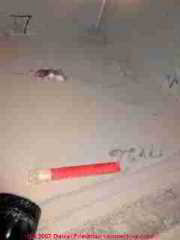
Very dirty, wet, leaked-into, or rodent-infested blower compartments risk indoor air quality and health issues in buildings. The air handler unit in the photo at left needs cleaning and a check for unsafe wiring due to leaks.
Leaks into the blower compartment of an HVAC air handler invite mold problems too.
The return air plenum in the photo at right has both a dead mouse and some other sort of trash that probably fell down a return air floor grille.
Mice in HVAC systems are a potential viral or bacterial hazard as well as an indicator of poor housekeeping. These conditions suggested that there had not been regular inspections of this equipment.
Causes & Photographs of Mold Growth in Air Conditioning Blower Fans
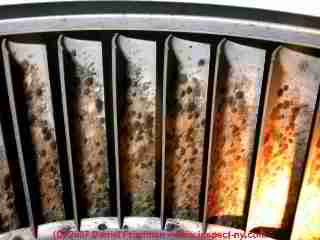
Notice the multiple colors and textures of mold growing on this air conditioner squirrel cage blower fan. Mold, depending on its genera/species, moisture conditions, and growth substrate material, can grow on many different surfaces where some organic material is available for "food".
We might find mold growing in an air conditioner on plastic, on air cabinet or duct insulation facing, hidden in fiberglass insulation, or on other materials.
Most likely the mold growing on this blower fan found a home in some of the organic constituents of common house dust: skin cells and dust mite fecals.
Very often the mold we sample and identify in air conditioner blower cabinets is a very common genera, Cladosporium sp. - a mold so common it's called "the king of molds." Kicking up leaves outdoors exposes you to more Cladosporium sp. than the mold on this blower fan.
But we also find some genera/species of more toxic molds that will grow right on top of other molds that are already present. So while air cabinet conditions may start by producing one mold of not too much concern, other more highly allergenic or even toxic molds could be present.
The fact that the mold in this photograph includes multiple colors and textures of material suggests that more than one genera or species of mold is present.
How to Handle Small Areas of HVAC System Mold Contamination
If the total area of moldy material is small (say less than 30 sq.ft. of contiguous mold) we would not bother to take a mold sample back to our lab for identification. Instead we'd suggest that the moldy surfaces be cleaned or non-cleanable material like insulation, replaced, and the cause for its growth corrected. We might, however, sample even a small amount of visible mold as part of a larger building diagnostic program if there were illness or air quality complaints associated with the building.
Examples of condensate spill-over inside of an air handler blower compartment, a condition creating a risk of mold growth inside the HVAC system are
at BLOWER LEAKS, RUST & MOLD
See WHY DOES MOLD GROW in INSULATION? for examples of mold growth on the interior surface of fiberglass-lined HVAC ducts.
More information about the potential of toxic mold growth in fiberglass ducts or fiberglass HVAC duct insulation as well as other fiberglass insulation products and more example photographs of that condition are
at FIBERGLASS INSULATION MOLD.
How to Keep the HVAC Blower Assembly Clean
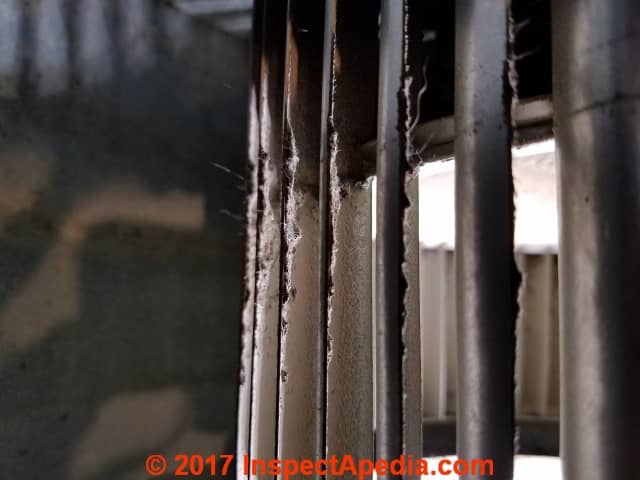 We noted at DIRTY A/C BLOWERS that a dirty blower fan reduces the blower assembly air flow rate, increasing heating and cooling costs, and sometimes leading to actual system operating failures such
as FROST BUILD-UP on AIR CONDITIONER COILS that forms not just frost but solid ice if the air flow rate across even a clean cooling coil is just too slow.
At BLOWER FAN ASSEMBLY CLEANING we describe and illustrate a detailed, thorough cleaning of the blower assembly in an air handler that is used for both heating and air conditioning.
BLOWER OPERATION: For effective operation of this system it is essential that it never be operated without air filters in place.
See AIR FILTERS for HVAC SYSTEMS.
If you permit the filters to become very dirty you may need expensive special cleaning or other repairs.
See BLOWER FAN OPERATION & TESTING.
COOLING MAINTENANCE TIP: The HVAC blower assembly should be serviced every two years. Without proper service the system may have no more than a five year lifetime.
ENERGY CONSERVATION: Keeping the fireplace flue closed (if you have one) when not in use will improve both heating and cooling efficiency in all buildings. or select a topic from the closely-related articles below, or see the
complete ARTICLE INDEX.
Reader Comments, Questions & Answers About The Article Above
Below you will find questions and answers previously posted on this page at its page bottom reader comment box.
Reader Q&A - also see RECOMMENDED ARTICLES & FAQs
Question: track down source of moisture, rust, corrosion in air handler
JL 2021/07/01
I have Unico mini-duct system in my attic. Every winter, the fan motor and shaft accumulate rust. I live in a very cold climate in winter (Vermont). Last year, I had the motor replaced and this spring, there was rust on the motor again (no visible rust last Fall when I closed the unit up for the winter).
...
My technician agreed to problem cannot be caused by the dryer venting back up into the attic.
The Unico system is pretty air tight due to it being a high velocity system.
He also did not think the two outlets that I never open would be the source of condensation for the winter months. Nor did he think running the fan in October just before I close it up could cause excess moisture to accumulate since the air is pretty dry in Vermont (low humidity) in October.
So we still have a mystery. He said the unit was completely dry inside today despite the fact it was hot and very humid here yesterday. - JL
So we still have a mystery. Thanks for your suggestions and comments though. If we ever figure this out, I’ll let you know.
Moderator reply: sources of water in the duct system
Thanks for the follow-up, do keep us posted, as what you find will certainly help other people too.
In investigating, start at the point of most-concern such as rust or corrosion, and follow the water or water indicators, stains, signs, rust patterns, etc.
See our full conversation now found
On 2020-08-08 by Alvin
The air handlers is a Goodman
Brand new air handlers changed out board and transformer and contactor new thermostat system still won't come on
On 2020-07-21 - by (mod) - low refrigerant
George
Low freon may lead to loss of actual cooling, but not a refusal of the unit to turn on.
On 2020-07-21 by George
Have an outside air handler won't come on could it be low freon.
On 2020-06-14 - by (mod) - condensate system problem
Mike
Check the condensate collection and drain system for leaks.
On 2020-06-11 by Mike
Air handler new. Twice now a considerable amount of water
Has been dumper on the floor. Air conditioning has only been in use 2 months. This is trans heat pump system
On 2020-06-03 by Philip
Should any electrical boxes be screwed to the side of the air handler . I am worried about damage to the insulation and condensation getting out to the electrical boxes. Thanks
On 2020-05-29 - by (mod) - seized blower motor hums
From what you describe the motor is seized; but first we'd want to check the supply voltage.
Watch out: you know you could be shocked or killed working on electrical components, right?
On 2020-05-29 by Ed
1/3 hp direct drive blower motor with capacitor checked good. Motor hums and won't start. Fan turns freely until powered then locks up. Manual spin is no help to get it to run. Any ideas? Thank you!
On 2020-04-25 - by (mod) - York HVAC Manual
Josue
See if this manual helps you out
https://inspectapedia.com/aircond/Unitary-York-Manual-036-21002-001-b-0600.pdf
as from a quick look at the equipment table that guide, now from Unitary Products, includes your York MODEL G+FD060S24A
On 2020-04-25 by JOSUE ROJAS
Hi, I´m working in a small project, but I need the diagram pdf for an Air Handling Unit (heating)
the model that I could find is:
YORK
MODEL G+FD060S24A
SERIAL NUMBER: EGHS622778
5005 YORK DRIVE
If you can provide me with this information, I´ll be so grateful
Thanks
On 2020-02-19 - by (mod) - cooling coil replacement?
The coil can be replaced.
Compare the cost of the replacement job to the cost of whole unit replacement.
On 2020-02-19 by lowell
can the coils in the air handler be replaced or do you need to replace the whole unit?
On 2020-02-09 - by (mod) - why does the thermostat switch itself from AUTO to OFF?
Perhaps
a loose power wire connection,
Overloaded transformer
Intermittent power liss to the hvac system
Bad internal battery
On 2020-02-09 by user6244
3 month old system air handler with ac unit.
Installed a ecobee thermostat set thermostat to auto.
Seemed to work fine.
Intermittently I have noticed the thermostat has turned off.
Any ideas why a thermostat would change from auto to off without manual input?
...
Continue reading at BLOWER LEAKS, RUST & MOLD or select a topic from the closely-related articles below, or see the complete ARTICLE INDEX.
Or see AIR HANDLER / BLOWER UNIT FAQs - questions & answers posted originally on this page
Or see these
Recommended Articles
- AIR HANDLER / BLOWER UNITS - home
- AIR HANDLER BLOWER DOORS
- AIR FLOW TOO WEAK
- BLOWER FAN ASSEMBLY CLEANING
- BLOWER FAN OPERATION & TESTING
- BLOWER LEAKS, RUST & MOLD
- DIRTY A/C BLOWERS
- DIRTY COOLING COIL / EVAPORATOR COIL
- DIRTY HVAC COIL CLEANING PROCEDURES
- FAN, AIR HANDLER BLOWER UNIT
- FAN, COMPRESSOR / CONDENSER UNIT
- FAN LIMIT SWITCH TROUBLESHOOTING
- FAN MOTOR START CAPACITORS
- FAN NOISES, HVAC
- FAN ON AUTO MAN THERMOSTAT SWITCH
- FAN WONT STOP - THERMOSTAT SWITCH
- FROST BUILD-UP on AIR CONDITIONER COILS
- MANUALS & PARTS GUIDES - HVAC - home
- RETURN AIR, INCREASE
- WET CORRODED DUCT WORK
Suggested citation for this web page
AIR HANDLER / BLOWER UNITS at InspectApedia.com - online encyclopedia of building & environmental inspection, testing, diagnosis, repair, & problem prevention advice.
Or see this
INDEX to RELATED ARTICLES: ARTICLE INDEX to AIR CONDITIONING & HEAT PUMPS
Or use the SEARCH BOX found below to Ask a Question or Search InspectApedia
Ask a Question or Search InspectApedia
Try the search box just below, or if you prefer, post a question or comment in the Comments box below and we will respond promptly.
Search the InspectApedia website
Comments & Questions are Welcome Here
If you posted comments here and no longer see what you wrote, please check for your comment in the Reader Q&A found above on this page.
Citations & References
In addition to any citations in the article above, a full list is available on request.
- Thanks to Mark Cramer, Tampa Florida, for assistance in technical review of the "Critical Defects" section and for the photograph of the deteriorating gray Owens Corning flex duct in a hot attic. Mr. Cramer is a Florida home inspector and home inspection educator.
- Thanks to Jon Bolton, an ASHI, FABI, and otherwise certified Florida home inspector who provided photos of failing Goodman gray flex duct in a hot attic.
- Wikipedia Web: https://www.wikipedia.org/ provided background information about the definition of HEPA and airborne particle interception.
- [5] US EPA - Mold Remediation in Schools and Commercial Building [ copy on file as /sickhouse/EPA_Mold_Remediation_in_Schools.pdf ] - US EPA
- Modern Refrigeration and Air Conditioning, A. D. Althouse, C.H. Turnquist, A. Bracciano, Goodheart-Willcox Co., 1982
- Principles of Refrigeration, R. Warren Marsh, C. Thomas Olivo, Delmar Publishers, 1979
- Refrigeration and Air Conditioning Technology, 5th Ed., William C. Whitman, William M. Johnson, John Tomczyk, Cengage Learning, 2005, ISBN 1401837654, 9781401837655 1324 pages
- In addition to citations & references found in this article, see the research citations given at the end of the related articles found at our suggested
CONTINUE READING or RECOMMENDED ARTICLES.
- Carson, Dunlop & Associates Ltd., 120 Carlton Street Suite 407, Toronto ON M5A 4K2. Tel: (416) 964-9415 1-800-268-7070 Email: info@carsondunlop.com. Alan Carson is a past president of ASHI, the American Society of Home Inspectors.
Thanks to Alan Carson and Bob Dunlop, for permission for InspectAPedia to use text excerpts from The HOME REFERENCE BOOK - the Encyclopedia of Homes and to use illustrations from The ILLUSTRATED HOME .
Carson Dunlop Associates provides extensive home inspection education and report writing material. In gratitude we provide links to tsome Carson Dunlop Associates products and services.
 | HOME | ABOUT | ASK a QUESTION | CONTACT | CONTENT USE POLICY | DESCRIPTION | POLICIES | PRIVACY | |
| © 2024 - 1985 Publisher InspectApedia.com - Daniel Friedman | |||||||||