
InspectAPedia® FREE Encyclopedia of Building & Environmental Construction, Diagnosis, Maintenance & Repair |
Question? Just ask us! InspectAPedia
|
 Refrigerant Charging Procedure Details
How to add or replace refrigerant in an air conditioner or heat pump
- POST a QUESTION or COMMENT about refrigerant charging of air conditioners, heat pumps, refrigeration equipment
How to add or replace air conditioner or heat pump refrigerant:
This article describes the procedures for charging an air conditioner, heat pump, refrigerator, freezer, or similar equipment - how does an HVAC service tech put the proper amount of refrigerant into the system?
We describe use of a traditional charging cylinder, vaporizing connectors for low-side charging, and modern refrigerant recovery, charging, and vacuum equipment.
We discuss the following: Procedure for evacuating or "pulling a vacuum" on air conditioners & heat pumps or refrigeration equipment, Procedure for Charging the HVAC System or Appliance with Refrigerant Using a Gauge Set,
Current refrigeration service standards including charging precision and refrigerant recovery, Procedure for filling & using a refrigerant charging cylinder, Robinair® example.
Procedure for using a vaporizing connector for low-side refrigerant charging, Kwik-Charge™ example & Using a refrigerant line sight glass or listening for refrigerant line gurgling to indicate charge level.
InspectAPedia tolerates no conflicts of interest. We have no relationship with advertisers, products, or services discussed at this website.
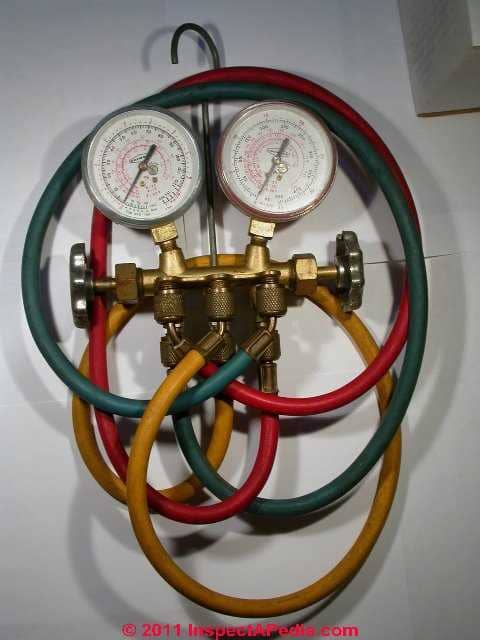
Procedure for Charging the HVAC System or Appliance with Refrigerant Using a Gauge Set
 Evacuating The Refrigeration System Before Charging
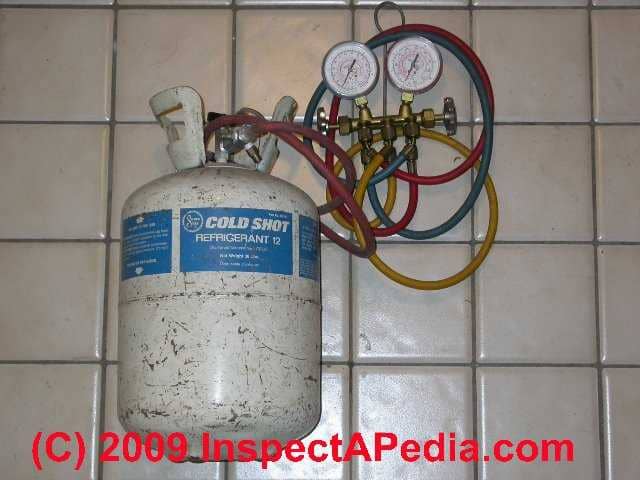
As we've explained, charging an empty system will require evacuating it first. For a typical household equipment this takes about 15 minutes but for a larger commercial refrigeration system this process can take an hour.
On residential equipment we always leave our evacuator pump running for at least 1/2 hour to be sure we've evacuated as much moisture and contaminants as possible.
[Click to enlarge any image]
On commercial systems being installed or having major service it would be preferable to leave the evacuator pump running for 12 hours - the longer you evacuate the system the cleaner it will be.
That's because as the system warms up moisture in the system will vaporize further and thus be removed.
Low Side Refrigerant Charging
Low side charging is also referred to as vapor charging - that is we allow ONLY refrigerant vapor or gas to enter the system.
This is an easy but time consuming method of system charging. The canister supplying refrigerant is connected to the gauge service port and opened, and the HVAC equipment or appliance is run (which pumps refrigerant gas from the supply source in parallel with pumping from the outlet of the evaporator coil).
The refrigerant canister is kept upright so that only gas leaves the canister.
A step by step example of low-side charging of refrigerant on an older R22 system can be seen
at SPLIT SYSTEM AC / HEAT PUMP REPAIRS
High Side Refrigerant Charging
When charging an air conditioner, heat pump, or refrigeration appliance from the high side, the system being serviced is turned OFF. The refrigerant gas canister is placed upside down so that only pure liquid refrigerant leaves the canister.
Note that once you start the system running you will not be able to charge on the high side because the head pressure out of the compressor will be higher than the evaporation pressure in the canister - it would push refrigerant back into the canister.
Methods for Measuring a Refrigerant Charge
With critically-charged HVAC or appliance refrigeration systems, such as a household refrigerator or air conditioner, you must measure the refrigerant entering the system.
Typically the technician uses a scale that registers in ounces to measure a weighed charge, though we also used other devices such as a charging cylinder that actually shows the volume of liquid refrigerant in the cylinder on a temperature-compensating scale.
A charging board (or charging cylinder just mentioned) that is connected to the high side can accurately measure the liquid refrigerant charge going into the system.
In this case the charging board (Dial-a-Charge charging cylinder produced by Robinaire, Montpelier OH) is loaded with the proper refrigerant charge from the gas cylinder, and the outlet from the charging board is then connected into the high side (perhaps through the gauge service port).
A Vaporizing Connector is an accessory you can add to a charging cylinder or charging board.
The refrigerant vaporizing connector (such as Imperial's Kwik-Charge, assures that liquid refrigerant passing through the device will convert to gas as it exits the device.
This will let you add a measured refrigerant charge to the low side of the system while still making an accurate measurement of the refrigerant measured in ounces.
Liquid refrigerant charging is always faster than low side vapor charging. On the low side you have to charge, then wait for the system pressures to balance, then reexamine the frost line etc.
An alternative to measuring the refrigerant charge when charging air conditioners or heat pumps
As an alternative to making refrigerant measurements by weight or temperature-corrected volume using a scale or charging cylinder, some HVAC service technicians may adjust the refrigerant charge by watching the low side pressure and the exact location of the frost line at the evaporator coil (blower fan not running).
Watch out: do not overcharge or extend the frost line to the compressor or you risk sending liquid refrigerant into the compressor motor - assuring its damage or destruction.
Guessing at Refrigerant Charge Level by Watching the Sight Glass or Listening for Refrigerant Gurgling
On small refrigeration systems such as a home refrigerator or window air conditioner the refrigerant charge needs to be accurately measured or the system will not work properly.
But on larger HVACR systems and on commercial units that use a liquid refrigerant receiver (a sort of buffer that stores extra liquid refrigerant), you might find a sight glass on the refrigerant piping downstream from the condensing coil.
Some techs add refrigerant while watching that sight glass, adding refrigerant until the gas bubbles just stop. If you see bubbles there either the system is badly contaminated or more likely the refrigerant charge is short. We warned just above - don't overcharge the system - you can damage the equipment.
Technical Note: if you see bubbles in the sight glass, or if you hear gurgling in the refrigerant lines indeed those can be indicators that the refrigerant charge in the system is low.
Pulling a vacuum to evacuate refrigeration systems
Note that a reading of "zero" on these pressure gauges is not really zero, it's 14 psi or 1 atmosphere.
Also if you look closely at your gauges you 'll see that one permits pressure readings in the "negative" direction - used when pulling a vacuum on the system using an evacuator pump - a step necessary before charging a system that has been opened for service or repair.
To remove all moisture or refrigerant from an air conditioner, heat pump, refrigerator, or other refrigeration equipment your evacuator pump needs therefore to pump past "zero" on the gauge (14 psi) to absolute zero or 29.9" Hg vacuum.
The evacuator pump is attached to the center port or "service port" on the gauge set.
Using a Refrigerant Charging Cylinder - Robinair® examples
 Current refrigeration service standards
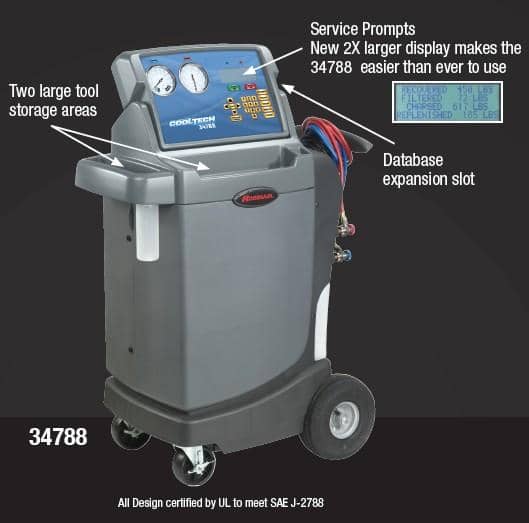
SAE J-2788, requires that all service equipment manufactured after December 31, 2007, must recover 95% of the refrigerant and recharge to within 1/2 ounce.
Charging cylinders such as the 1980's vintage equipment described below are often supplanted now (2011) by refrigerant charging scales and by larger, more sophisticated refrigerant charging machines that combine refrigerant charge measurement, refrigerant evacuation and recovery/recycling, and other service functions.
Newer refrigeration service equipment can automatically recover refrigerant (such as R134A) from a system to be serviced, vacuum test and clean the system to prepare it for a charge, leak test the system, and insert the proper refrigerant charge, all automatically.
These improved refrigeration management functions were required by a combination of legislation and standards that stop the discharge of refrigerants into the environment, and by improvements in refrigeration system design that produced equipment that uses a smaller, but more precisely-measured charge of refrigerant.
Quoting from Robinair's description of their current refrigerant management equipment line:
Robinair 34988, 34788 & 34288 recover up to 20% more refrigerant, which means it will cost less to recharge the system. The best charge accuracy that could be claimed by older generation service machines was +/- 1 ounce, a 3% error on a two-pound system.
That same charge accuracy on a 14-ounce system is over twice the error (7%). Early R-134a systems could still provide some cabin cooling when they were 4-6 ounces (12-18%) low on refrigerant.
However, new designs are so efficient, they do not have reserve refrigerant, and charge accuracy is critical. The 34988, 34788 & 34288 will recharge the vehicle to within 1/2 ounce of the charge capacity, and you will avoid the dreaded “come back”. [1]
How traditional Charging Cylinder Worked to Put a Measured Refrigerant Charge into Refrigeration Equipment
While the new refrigeration system testing and charging equipment described above is fully automatic, to understand the problems that the newer equipment has to solve (and automate), it is useful to review how, traditionally, we inserted a precisely measured refrigerant charge into air conditioners and other refrigeration equipment.
We used the Robinair® Dial-a-Charge® charging cylinder for many years as a way to install an accurate charge of refrigerant into air conditioners, heat pumps, and refrigerators and freezers undergoing service or repair.
As an aid to service technicians who may have lost their instruction sheet we include and comment on the charging cylinder instructions here, using the Robinaire® Dial-a-Charge charging cylinder system as an example.
Robinair offered the following explanation of charging cylinder use along with our 1980's vintage equipment.
With an increase in temperature in any cylinder filled with refrigerant, there is a corresponding increase in pressure and a change in the volume of liquid refrigerant in the cylinder.
To measure out an accurate charge by weight from a cylinder using the liquid level in a sight glass as a point of measurement, it is absolutely necessary to compensate for liquid volume variations caused by temperature variations.
These temperature variations are directly related to pressure variations and accurate measurements by weight can be calibrated in relation to pressure.
The Dial-a-Charge Charging Cylinder is designed to meter out a desired amount of a specific refrigerant by weight. Compensation for temperature variations is accomplished by reading the pressure on the gauge of the cylinder and dialing the plastic shroud, with the calibrated chart, to the corresponding pressure reading for the refrigerant being used.
When charging a refrigeration or air-conditioning system with refrigerant, often the pressure in the system reaches a point where it is equal to the pressure in the [charging] cylinder from which the system is being charged.
In order to get more refrigerant into the system to complete the charge, heat must be applied to the cylinder.
Robinair's Heated Dial-a-Charge Charging Cylinder eliminates the problem caused by equalization of pressure between the cylinder and the system being charged. The [Robinaire] charging cylinder has a heating element installed in the base of the cylinder.
The male plug of the heating element can be plugged into any 110-115 volt AC outlet. [Note that if you want to charge the system on the low side using vapor only, you can safely do so using a refrigerant vaporizer attachment instead of heat to assure that no liquid goes where it's not wanted.]
Due to the variety of 220V. receptacles throughout the world, a male plug must be field-added to the 220V heating element in order to fit the particular style in your area [outside the U.S., Canada, Mexico]. Either voltage heating element will work on 50 or 60 Hz power.
Watch out: CAUTION: Heating elements can be destroyed if plugged into an electrical outlet when the [charging] cylinder is empty [of refrigerant].
The heating element is of the correct wattage to increase [refrigerant] pressure sufficiently in a relatively short time, to a level that is above the equalization pressure between the cylinder and the system [being charged]. The higher the pressure in the cylinder, the less time it takes to force the refrigerant into the system.
The heating element should be turned off before the pressure is above the highest pressure on the Dial-a-Charge® shroud of the refrigerant being used.
EXAMPLE: Refrigerant R22 is being used - the pressure at no time should exceed 230 psi.
The Robinair Dial-a-Charge® has a relief valve, for added protection, set to relieve the refrigerant at approximately 320 psi.- [1]
Procedure for Filling & Using a Refrigerant Charging Cylinder - Using the Refrigerant Line Sight Glass
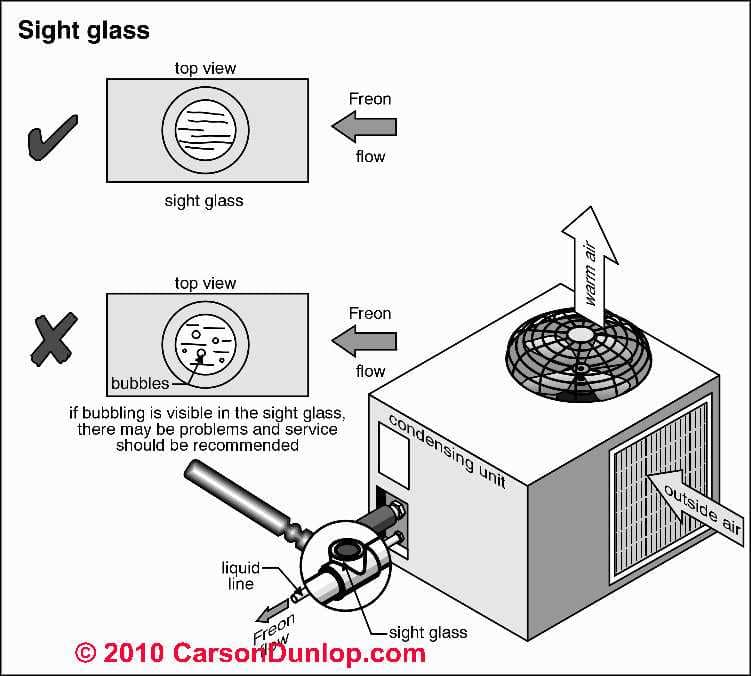
Carson Dunlop Associates' sketch illustrates a very simple check that can indicate a problem with an air conditioner, heat pump, or other refrigeration equipment: visible gas bubbles seen in the sight glass. The sight glass, if present, is usually located in the condenser unit on the liquid refrigerant line.
Watch out: CAUTION: When working with refrigerants, goggles should always be worn. Contact with refrigerants may cause injury.
- Connect the charging hose from valve at bottom of charging cylinder to valve on refrigerant supply tank. Invert refrigerant tank so the valve is down. In this position, liquid refrigerant will flow from the tank [into the charging cylinder when the valves are opened].
Watch out: be sure to follow proper refrigeration gauge set connection procedures, including purging air out of any empty refrigerant gauge hoses before connecting them to the HVACR system. Otherwise you may inject air or debris into the system. - Open the bottom valve on the charging cylinder and the valve on the refrigerant tank. When the liquid refrigerant appears in the sight glass, observe the pressure on the gauge at the top of the cylinder.
Dial the plastic shroud to column where its pressure heading for the refrigerant being used corresponds with the gauge pressure and is in line with the sight glass.
EXAMPLE: if the pressure on the gauge at the top of the [charging] cylinder reads 70 psi, find the column with the pressure heading of "70" and line this column up with the sight glass.
NOTE: On models which are calibrated for various types of refrigerants, be certain that the pressure heading corresponds to the refrigerant being used. Located at the bottom of the plastic shroud are the listings of types of refrigerant. - When the pressure in the cylinder equalizes with the pressure in the tank [of refrigerant], th refrigerant will stop rising in the sight glass.
At this point, intermittently, open the valve at the top of the cylinder to relieve head pressure. This will allow refrigerant to continue filling the cylinder. - When refrigerant reaches the desired level in the sight glass [ this is the precise measured refrigerant quantity with which you want to charge the system], close the valve on the refrigerant tank and then the valve on the charging cylinder.
Be certain that the valve at the top of the cylinder is fully closed. - Connect the heating element to the proper voltage source to allow the refrigerant to heat and build up pressure. This pressure build-up will allow the pressure of the cylinder to be higher than that of the [refrigeration] system [being charged] and force the refrigerant into the system.
[Note that when charging a refrigeration system on the low side it will be easier to insert the refrigerant charge because you're not fighting head pressure]. - Re-dial the plastic shroud to match the [charging cylinder] gauge pressure whenever a pressure change occurs. - [1]
Using a Refrigerant Vaporizing Connector for Low-Side Refrigerant Charging: Imperial Kwik-Charge as example
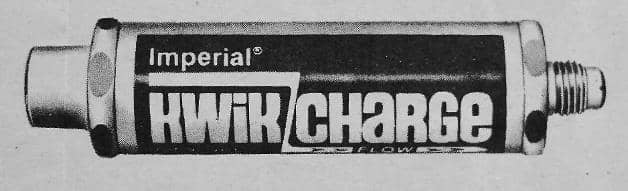
As we introduced above at Measuring the Refrigerant Charge, a vaporizing connector is an accessory connected to the refrigerant canister, refrigerant gauge set, to a charging cylinder or charging board to provide a safe, fast way of low-side refrigerant charging without any risk of slugging the air conditioning compressor with liquid refrigerant - an event likely to damage the compressor.
The refrigerant vaporizing connector (such as Imperial's Kwik-Charge illustrated here), converts liquid refrigerant to a gas as the refrigerant flows through the vaporizing device, thus making sure that liquid refrigerant passing through the device will convert to gas as it exits the device.
This will let you add a measured refrigerant charge to the low side of the system while still making an accurate measurement of the refrigerant measured in ounces.
Reader Question: difference between vapour charging and liquid charging
(Aug 28, 2012) Usman ibro said:
Distinquish between vapour charging and liquid charging
Reply:
Usman:
If we are charging a refrigeration system from its low-pressure side we ONLY want to send a gas or vapour into the system. That's because sending liquid refrigerant into the suction side of a compressor motor is likely to destroy the motor in seconds - liquids are not very compressible and motor parts or valves are likely to be damaged in most motor designs.
When we are charging a refrigeration system from its high pressure side we can safely introduce liquid refrigerant into the piping or reservoir (the receiver) on that side of the system without damaging it.
Some refrigerant charging systems including one that I used metered the liquid refrigerant into a charging cylinder so that we can see the precise charge volume to be introduced - a measured refrigerant charge - into the refrigeration system.
The charging cylinder uses tables and scales for different refrigerants at different temperatures so that we can make a very accurate refrigerant charge. This is critical for cooling or heat pump systems that do not use a receiver and that must be charged with exactly the refrigerant volume specified by the manufacturer.
In this case we add a vaporizing device like the Kwik Charge - described here - on the outlet of the charging cylinder that converts liquid refrigerant into gas as it exits the charging cylinder and before it enters the HVAC equipment on the low side, thus guaranteeing that we don't damage anything.
Vaporizing Connector Description
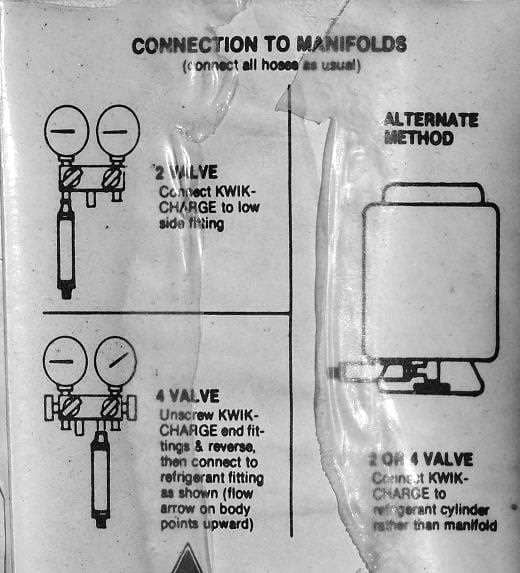
[Quoting and paraphrasing][3], Using the Kwik-Charge™ vaporizing connector provides a safest, faster method of charging fluorinated hydrocarbon refrigerants into the low pressure side of a refrigeration system.
Vapor charging is also within the capacity of this unit, although it is primarily intended for liquid charging - that is, liquid refrigerant is fed into the vaporizing connector, and only refrigerant vapor exits the device.
The Kwik-Charge™ vaporizing connector may remain attached to the low-side port of the charging manifold while performing the usual refrigeration equipment service and diagnostic operations involved in maintaining a refrigeration system, such as pulling a vacuum to clean the system and test it for leaks.
An automatic bypass valve inside of the vaporizing connector permits full flow during any reverse-cycle operation such as pulling a vacuum or removing refrigerant that is already in the system.
As an example for technicians unfamiliar with vaporizing connectors we quote from the Kwik Charge instructions for the device we illustrate here. [3]
Advantages of using a vaporizing connector for low-side charging of air conditioning, heat pump, and other refrigeration systems
[Quoting and paraphrasing] [3],
This device provides fast, safe refrigerant charging when using tracing dye [or not] with these properties:
- Up to eight times faster refrigerant charge insertion than when using unassisted vapor charging
- No pressure drop in the charging cylinder (avoids chilling and speeds the charging process)
- No need to heat the refrigerant charging cylinder
- One charger services both large and small HVAC systems and refrigeration equipment
- Built-in check valve opens for drawing unrestricted vacuum - this means you don't need to remove the vaporizer to pull a test vacuum on the equipment
- Can be used with all fluorinated hydrocarbon refrigerant systems
Instructions for using the Kwik Charge liquid low-side charger for air conditioning and refrigeration systems
- The Kwik-Charge may be used with a charging manifold, a calibrated charging cylinder, or with any other charging equipment. Installation can be made by any of the methods illustrated [see sketch above]. After installing the vaporizing attachment, connect all hoses as usual
- When pulling a vacuum, do so in the normal manner. The vacuum will activate the automatic bypass inside the Kwik-Charge and provide a full flow path for rapid evacuation of the HVAC system or refrigeration appliance
- Isolate the refrigeration unit from the vacuum pump after the desired degree of evacuation has been reached. Then slightly pressurize the system with refrigerant vapor (approximately to 5 psi).
- Put the refrigeration system into operation - this means the compressor should begin running.
- With the system running, proceed to charge the refrigeration unit - by opening the refrigerant supply valve to meter refrigerant out of the measured charge device, passing refrigerant through the vaporizing attachment and into the low-side of the air conditioner, heat pump, refrigerator or other appliance being charged.
- Charge each system according to the system manufacturer's recommendation
Watch out: CAUTION: a minimum hose length of three feet should be maintained between the Kwik-Charge and the low side charging port on the refrigeration system. Be sure to observe all safety practices regarding handling of refrigerants, including the wearing of eye protection.
Reader Comments, Questions & Answers About The Article Above
Below you will find questions and answers previously posted on this page at its page bottom reader comment box.
Reader Q&A - also see RECOMMENDED ARTICLES & FAQs
On 2021-03-14 - by (mod) -
@asjun,
When cleaning an evaporator coil, an external process using foam or other cleaners, no refrigerant charge is being admitted and the refrigerant cylinder is not part of that process.
Perhaps we've not understood your question. Are you in the middle of an exam?
On 2021-03-14 by asjun
why is it that refrigerant cylinder is inverted while cleaning the evaporator.
On 2020-12-07 by Syed Saqlain Ali Zaidi
Why the gas charge must be done with the refrigerating gas in liquid state?
On 2019-11-09 - by (mod) -
No, not safely, Prince.
On 2019-11-09 by Prince
Is possible to fix gas bottle when is damage
On 2019-07-10 by Tom
Good Morning,
I am struggling to keep an Industrial Ice Machine running. R22 refrigerant. I will be flying in service techs for the 5th time...
We recently installed a new compressor, and all of the solinoids, check valves, TXE etc. New refrigerant and oil
When it does intermittently run, suction is approx 31, head pressure when the fans kick in sits around 235 and oil pressure around 61.
For some reason we keep losing oil to the system and its not returning properly. Currently I've be down for 5 days with constant oil cut out.
Any thoughts on why oil would get trapped in the system and not return? Any thoughts on how to get the oil back when it gets trapped?
As a side note, I have no training at all just picked up enough information to be dangerous over the last three months!
Thanks
Tom
On 2019-05-17 - by (mod) -
Typically at or near the compressor motor
On 2019-05-17 by Anonymous
Where charging connection in refer plant
On 2018-12-05 by Anonymous - worried a repairman is trying to take advantage
RE-posting discussion by private email:
Anonymous said:
I am worried a repairman is trying to take advantage. Mt heat pump is under warranty and alll work should be covered but when we were outside i heard a hissing sound (for the first time) then the repairman said where is that cap , then found it, screwed it back on and the hissing stopped.
He then went on to tell me that the there was a defective part that broke off and caused the feon to leak out and although the broken part is covered it is going to be $1200 for the freon. I think he let it out in order to make money on this job. Any help would be appreciated.
Moderator Reply:
I think that your AC tech is being honest and correct.
I am GUESSING since I can't see your compressor/condenser unit nor what the repair person did, that the "cap" is a cover cap that is fitted atop one of the refrigerant gauge test ports on the compressor condenser unit.
YOu can see what these look like in photos in this article: GAUGE, REFRIGERATION PRESSURE TEST at inspectapedia.com/aircond/Refrigeration_Test_Gauge_Guide.php
The gauge test port contains a small valve - much like the Schrader valve inside of an automobile or bicycle tire air valve - that is normally closed (keeping refrigerant in) but is opened by pressing on a center pin by the attachment end of the pressure gauge.
If that valve leaks indeed you lose refrigerant. The valve may leak by being defective OR the refrigerant test port gauge might leak if dirt was forced into the valve - by leaving the cap off or by attaching a dirty test instrument.
Typical compressor/condenser warranties will cover parts but not labor for repairs.
The cost of to replace lost refrigerant seems steep at $1200 since the cost of the refrigerant itself in the quantity needed to fill a home air conditioner system is around $20. (You can buy a whole canister of R410A for about $100 - for example).
However there's more to it than that. There are two approaches to replacing refrigerant in your system.
In my OPINION
the Quick-and-Easy refrigerant re-charge method:
that is nearly universal in the industry, is to avoid a lot of time and trouble by simply connecting up the refrigerant canister through a gauge set and a charging device that sends refrigerant gas into the low pressure side of the system slowly while the tech monitors the temperature on the suction line or return line to the compressor.
When the line gets cold enough the refrigerant charge is "sufficient" for the system to work and the tech stops.
And may bill you whatever. I'd have charged the hourly rate + materials, including 2 trips to the home if 2 were needed.
But some service techs might accomplish this in minutes and some might bill more than $1000. for "the refrigerant", even specifying a refrigerant quantity in pounds even though in fact there was no measurement of quantity made.
the High Class refrigerant recharge position:
This approach is technically most-correct and most-reliable and involves more time and trouble, possibly considerably more time and trouble, and for this work $1200. would be a bargain. In this approach the technician would
1. remove any remaining refrigerant into a recovery device - it is illegal to discharge it into the atmosphere
2. possibly cut the refrigerant line and add a filter drier if none is installed. This is definitely necessary if a compressor was replaced, for example, or if there is reason to think the system refrigerant piping is contaminated.
3. attach a vacuum pump and pull a vacuum on the system
4. leave that vacuum long enough to confirm that there are no leaks elsewhere
5. put a *measured* quantity of refrigerant into the system so that the liquid charge matches the manufacturer's specifications. This will be a bit more refrigerant (probably) than in the el cheapo method but the added refrigerant quantity cost is insignificant. The measured charge quantity may need to be adjusted or increased to account for extra lengths of refrigerant piping in the whole system.
6. return the system to operation, run it long enough to reach stable conditions and monitor that it's working properly.
...
Continue reading at REFRIGERANT DRIERS & FILTERS or select a topic from the closely-related articles below, or see the complete ARTICLE INDEX.
Or see REFRIGERANT CHARGING PROCEDURE FAQs - questions & answers posted originally at this article
Or see these
Recommended Articles
- LOST COOLING CAPACITY
- PRESSURE CONTROLS & SAFETY SWITCHES
- REFRIGERANT GASES & PIPING - home
- CAR / TRUCK AC PRESSURE SWITCH
- FROST BUILD-UP on AIR CONDITIONER COILS
- GAS DETECTION INSTRUMENTS
- GAS EXPOSURE EFFECTS, TOXIC
- GAS LAWS & CONSTANTS
- GAUGE, REFRIGERATION PRESSURE TEST
- REFRIGERANT CHARGING PROCEDURE
- REFRIGERANT DRIERS & FILTERS
- REFRIGERANT FLOODBACK, LIQUID SLUGGING
- REFRIGERANT LEAK DETECTION
- REFRIGERANT LEAK REPAIR
- REFRIGERANT METERING DEVICES TEVs & EEVs
- REFRIGERANT METERING CAPILLARY TUBES
- REFRIGERANT PIPING INSTALLATION
- REFRIGERANT PIPING GURGLING
- REFRIGERANT PRESSURE DIAGNOSIS
- REFRIGERANT PRESSURE READINGS & CHARTS
- REFRIGERANT PROBLEM TYPES
- REFRIGERANT UNDERCHARGE EFFECTS
- REFRIGERANT SIGHT GLASS
- AIR CONDITIONING & HEAT PUMP SYSTEMS - home
- SPLIT SYSTEM AC / HEAT PUMP REPAIRS
Suggested citation for this web page
REFRIGERANT CHARGING PROCEDURE at InspectApedia.com - online encyclopedia of building & environmental inspection, testing, diagnosis, repair, & problem prevention advice.
Or see this
INDEX to RELATED ARTICLES: ARTICLE INDEX to AIR CONDITIONING & HEAT PUMPS
Or use the SEARCH BOX found below to Ask a Question or Search InspectApedia
Ask a Question or Search InspectApedia
Try the search box just below, or if you prefer, post a question or comment in the Comments box below and we will respond promptly.
Search the InspectApedia website
Note: appearance of your Comment below may be delayed: if your comment contains an image, photograph, web link, or text that looks to the software as if it might be a web link, your posting will appear after it has been approved by a moderator. Apologies for the delay.
Only one image can be added per comment but you can post as many comments, and therefore images, as you like.
You will not receive a notification when a response to your question has been posted.
Please bookmark this page to make it easy for you to check back for our response.
Our Comment Box is provided by Countable Web Productions countable.ca
Citations & References
In addition to any citations in the article above, a full list is available on request.
- TIF Instruments, Inc., 9101 NW 7th Avenue, Miami, Florida 33150 (This is where we've sent our TIF 8800 and TIF 5000 for repairs).
- Air Conditioning, Heating, & Refrigeration Institute, [industry association], Air-Conditioning, Heating, and Refrigeration Institute (AHRI) 2111 Wilson Blvd, Suite 500 Arlington, VA 22201 USA, Tel: 703-524-8800, Email: ahri@ahrinet.org,
- [1] Robinair® Robinair Manufacturing Corporation, Robinair Way, Montpelier OH 43543-9990 or more currently: OTC/SPX 655 Eisenhower Drive Owatonna, MN 55060 USA Phone (507) 455-7000 Fax (507) 455-8354. Customer service Tel: 800-628-6496. Technical support: 800-822-5561. Robinair provides a wide range of refrigerant charging equipment including gauges, hoses, automatic charging scales, and refrigerant recovery/recycling equipment.
- [2] Robinair® Dial-a-charge charging cylinder description and instructions, Kent-Moore Robinair Manufacturing Corporation, Robinair Way, Montpelier OH 43543-9990 or more currently: OTC/SPX 655 Eisenhower Drive Owatonna, MN 55060 USA Phone (507) 455-7000 Fax (507) 455-8354. Customer service Tel: 800-628-6496. Technical support: 800-822-5561. Robinair provides a wide range of refrigerant charging equipment including gauges, hoses, automatic charging scales, and refrigerant recovery/recycling equipment.
- [3] "Instructions for Kwik-Charge" ™ provided by Imperial Clevite, Inc., Fluid Components Division, 6300 West Howard St., Chicago IL 60468 (July 1982 device instructions)
- [6] REFRIGERANT PIPING GUIDE [PDF] , Application Guide AG-31-011, McQuay Air Conditioning, Daikin McQuay International Equipment, 13600 Industrial Park Blvd., Minneapolis, Minnesota 55441 USA Tel: 800-432-1342 (Toll Free), Website: http://www.daikinmcquay.com/, [Copy on file as https://inspectapedia.com/aircond/AC_Guide_McQuay.pdf ]
- In addition to citations & references found in this article, see the research citations given at the end of the related articles found at our suggested
CONTINUE READING or RECOMMENDED ARTICLES.
- Carson, Dunlop & Associates Ltd., 120 Carlton Street Suite 407, Toronto ON M5A 4K2. Tel: (416) 964-9415 1-800-268-7070 Email: info@carsondunlop.com. Alan Carson is a past president of ASHI, the American Society of Home Inspectors.
Thanks to Alan Carson and Bob Dunlop, for permission for InspectAPedia to use text excerpts from The HOME REFERENCE BOOK - the Encyclopedia of Homes and to use illustrations from The ILLUSTRATED HOME .
Carson Dunlop Associates provides extensive home inspection education and report writing material. In gratitude we provide links to tsome Carson Dunlop Associates products and services.
 | HOME | ABOUT | ASK a QUESTION | CONTACT | CONTENT USE POLICY | DESCRIPTION | POLICIES | PRIVACY | |
| © 2024 - 1985 Publisher InspectApedia.com - Daniel Friedman | |||||||||