
InspectAPedia® FREE Encyclopedia of Building & Environmental Construction, Diagnosis, Maintenance & Repair |
Question? Just ask us! InspectAPedia
|
 Sunspace / Greenhouse Glazing for Sun Tanning
- POST a QUESTION or COMMENT about the best glass or glazing to use in a greenhouse or sunspace intended for suntanning
Design of sun tanning spaces & greenhouses or sunspaces in buildings:
This article discusses glazing materials used to permit suntanning in greenhouses or sunspaces. The accompanying text is reprinted/adapted/excerpted with permission from Solar Age Magazine - editor Steven Bliss.
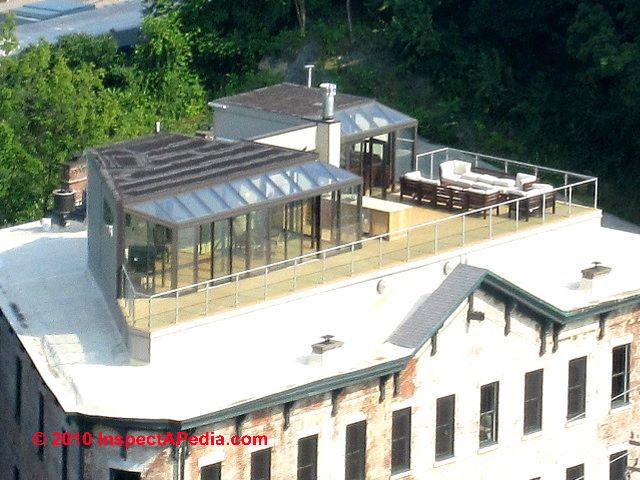
Our page top photo shows a small sunspace designed into a New York City apartment. You will notice that the walls to the left of the sunspace had been opened to expose the structural brick wall - a step necessary during removal of mold contamination caused by skylight and exterior wall leaks.
InspectAPedia tolerates no conflicts of interest. We have no relationship with advertisers, products, or services discussed at this website.
Advice for Insulating a Greenhouse or Solarium Against Night Time Heat Loss
- Q&A: Suntan in Sunspaces - original PDF version; use your browser's back button to return to this page
The question-and-answer article about greenhouses or solariums, quotes-from, updates, and comments an original article from Solar Age Magazine and written by Steven Bliss.
Question about greenhouse or sunspace glazing that will allow suntanning:
Does any greenhouse manufacturer make a unit with glazing that transmits the tanning rays of the sun?
If not, what materials would one substitute for standard glazing if we want to sunbathe and tan inside of a sunspace?
Answer: Suntanning glazing using acrylic sheet material
 We know of no sunspace systems that are intentionally glazed with a material that passes ultraviolet rays that you would need to obtain a suntan while inside a greenhouse, sunspace, or solarium.
But Cryo Industries [Woodcliff Lake NJ] makes a special acrylic sheet designated as OP-4 for the suntanning industry.
This glazing material does just what you require - passing UV rays from sunlight.
Except for a possibly higher cost, there is no reason this material couldn't be used in sunspaces or greenhouses or a solarium intended for suntanning, according to Cryo technologist Peter Colburn.
The ultraviolet band of solar radiation tans your skin.
The range between .285 and .380 microns in light wavelength triggers the release of melanin, and the next sunlight wavelength band, .315 to .380 microns, continues the tanning process, Colburn says.
Glass and most common sunspace glazings transmit only from 5 to 10 percent of the sun-tanning range of light (but admit enough UV light to fade fabrics).
Low-e coated glass such as we discuss at x blocks most of these rays. So you do not want to use Low-e Glass if your purpose of the sunspace or solarium is to obtain a suntan or to get your daily required Vitamin D from sunlight.
Here we include solar energy, solar heating, solar hot water, and related building energy efficiency improvement articles reprinted/adapted/excerpted with permission from Solar Age Magazine - editor Steven Bliss.
...
Continue reading at SOLAR SHADES & SUNSCREENS or select a topic from the closely-related articles below, or see the complete ARTICLE INDEX.
Or see these
Recommended Articles
- GLASS vs HEAT MIRROR SOLAR GAIN/Loss
- GREENHOUSE DESIGN for SOLAR HEATING
- GREENHOUSE / SUNSPACE GLARE
- PATIO AWNING INSTALLATION
- SOLAR COLLECTOR FILMS more up to date information about the performance of films to increase solar collector efficiency
- SOLAR GAIN CALCULATION
- SOLAR SHADES & SUNSCREENS
- SOLAR SHADES, LOW-E EFFECTIVENESS
- SPONTANEOUS GLASS BREAKAGE NiS
- SUNGAIN, FILMS, LOW-E GLASS for details about use of Sungain film on windows and window film selection and installation
- SUNSPACE GLAZING for SUNTANNING
Suggested citation for this web page
SUNSPACE GLAZING for SUNTANNING at InspectApedia.com - online encyclopedia of building & environmental inspection, testing, diagnosis, repair, & problem prevention advice.
Or see this
INDEX to RELATED ARTICLES: ARTICLE INDEX to SOLAR ENERGY
Or use the SEARCH BOX found below to Ask a Question or Search InspectApedia
Ask a Question or Search InspectApedia
Try the search box just below, or if you prefer, post a question or comment in the Comments box below and we will respond promptly.
Search the InspectApedia website
Note: appearance of your Comment below may be delayed: if your comment contains an image, photograph, web link, or text that looks to the software as if it might be a web link, your posting will appear after it has been approved by a moderator. Apologies for the delay.
Only one image can be added per comment but you can post as many comments, and therefore images, as you like.
You will not receive a notification when a response to your question has been posted.
Please bookmark this page to make it easy for you to check back for our response.
Our Comment Box is provided by Countable Web Productions countable.ca
Citations & References
In addition to any citations in the article above, a full list is available on request.
- Solar Age Magazine was the official publication of the American Solar Energy Society. The contemporary solar energy magazine associated with the Society is Solar Today. "Established in 1954, the nonprofit American Solar Energy Society (ASES) is the nation's leading association of solar professionals & advocates. Our mission is to inspire an era of energy innovation and speed the transition to a sustainable energy economy. We advance education, research and policy. Leading for more than 50 years. ASES leads national efforts to increase the use of solar energy, energy efficiency and other sustainable technologies in the U.S. We publish the award-winning SOLAR TODAY magazine, organize and present the ASES National Solar Conference and lead the ASES National Solar Tour – the largest grassroots solar event in the world."
- Steve Bliss's Building Advisor at buildingadvisor.com helps homeowners & contractors plan & complete successful building & remodeling projects: buying land, site work, building design, cost estimating, materials & components, & project management through complete construction. Email: info@buildingadvisor.com
Steven Bliss served as editorial director and co-publisher of The Journal of Light Construction for 16 years and previously as building technology editor for Progressive Builder and Solar Age magazines. He worked in the building trades as a carpenter and design/build contractor for more than ten years and holds a masters degree from the Harvard Graduate School of Education. Excerpts from his recent book, Best Practices Guide to Residential Construction, Wiley (November 18, 2005) ISBN-10: 0471648361, ISBN-13: 978-0471648369, appear throughout this website, with permission and courtesy of Wiley & Sons. Best Practices Guide is available from the publisher, J. Wiley & Sons, and also at Amazon.com - Mark Cramer Inspection Services Mark Cramer, Tampa Florida, Mr. Cramer is a past president of ASHI, the American Society of Home Inspectors and is a Florida home inspector and home inspection educator. Mr. Cramer serves on the ASHI Home Inspection Standards. Contact Mark Cramer at: 727-595-4211 mark@BestTampaInspector.com
- John Cranor [Website: /www.house-whisperer.com ] is an ASHI member and a home inspector (The House Whisperer) is located in Glen Allen, VA 23060. He is also a contributor to InspectApedia.com in several technical areas such as plumbing and appliances (dryer vents). Contact Mr. Cranor at 804-873-8534 or by Email: johncranor@verizon.net
- ACTIVE SOLAR HEATING SYSTEMS [PDF] , U.S. Department of Energy, including
- Our recommended books about building design, inspection, and repair, and about indoor environment testing, diagnosis, and cleanup are at the InspectAPedia Bookstore.
- Best Practices Guide to Residential Construction, by Steven Bliss. John Wiley & Sons, 2006. ISBN-10: 0471648361, ISBN-13: 978-0471648369, Hardcover: 320 pages, available from Amazon.com and also Wiley.com. See our book review of this publication.
- Decks and Porches, the JLC Guide to, Best Practices for Outdoor Spaces, Steve Bliss (Editor), The Journal of Light Construction, Williston VT, 2010 ISBN 10: 1-928580-42-4, ISBN 13: 978-1-928580-42-3, available from Amazon.com
- Energy Savings Methods: Whole House Systems Approach, U.S. Department of Energy
- Historic Preservation Technology: A Primer, Robert A. Young, Wiley (March 21, 2008) ISBN-10: 0471788368 ISBN-13: 978-0471788362
- In addition to citations & references found in this article, see the research citations given at the end of the related articles found at our suggested
CONTINUE READING or RECOMMENDED ARTICLES.
- Carson, Dunlop & Associates Ltd., 120 Carlton Street Suite 407, Toronto ON M5A 4K2. Tel: (416) 964-9415 1-800-268-7070 Email: info@carsondunlop.com. Alan Carson is a past president of ASHI, the American Society of Home Inspectors.
Thanks to Alan Carson and Bob Dunlop, for permission for InspectAPedia to use text excerpts from The HOME REFERENCE BOOK - the Encyclopedia of Homes and to use illustrations from The ILLUSTRATED HOME .
Carson Dunlop Associates provides extensive home inspection education and report writing material. In gratitude we provide links to tsome Carson Dunlop Associates products and services.
 | HOME | ABOUT | ASK a QUESTION | CONTACT | CONTENT USE POLICY | DESCRIPTION | POLICIES | PRIVACY | |
| © 2024 - 1985 Publisher InspectApedia.com - Daniel Friedman | |||||||||