
InspectAPedia® FREE Encyclopedia of Building & Environmental Construction, Diagnosis, Maintenance & Repair |
Question? Just ask us! InspectAPedia
|
 Energy Savings from Acrylic Interior Storm Windows
- POST a QUESTION or COMMENT about choosing, buying, installing or repairing acrylic interior storms, including the anticipated energy savings you may expect.
Interior stormw indows, acrylic:
This article discusses the energy savings from retrofit interior acrylic plastic interior storm windows to control heat gain, heat loss, heat transmission. We list and discuss choices among window glazing energy-saving products. We explain : the Differences in Function & Use Among Low-Transmission Films, Low-E glass, Coated Reflective Films & High Transmission, Low Emissivity Films or Reduced-Iron-Content Glass? Solar Age Magazine Articles on Renewable Energy, Energy Savings, Construction Practices
InspectAPedia tolerates no conflicts of interest. We have no relationship with advertisers, products, or services discussed at this website.
How to Calculate the Energy Savings from Retrofit Interior Acrylic Storm Windows
The question-and-answer article below paraphrases, quotes-from, updates, and comments an original article from Solar Age Magazine and written by Steven Bliss.
Storm Window Savings
Question:
Is there a fast way to calculate savings from an interior acrylic storm window retrofit? - Franklin Ellingwood, Honeoye NY
Answer:
The Architectural Aluminum Manufacturers Association (AAMA) in the 1980's developed and printed many nomographs for exterior storm windows. These should also apply to an interior storm window retrofit.
A "rule of thumb" that is popular among building inspectors is that each layer of glazing on an existing window will cut heat loss through that window by about 1/3.
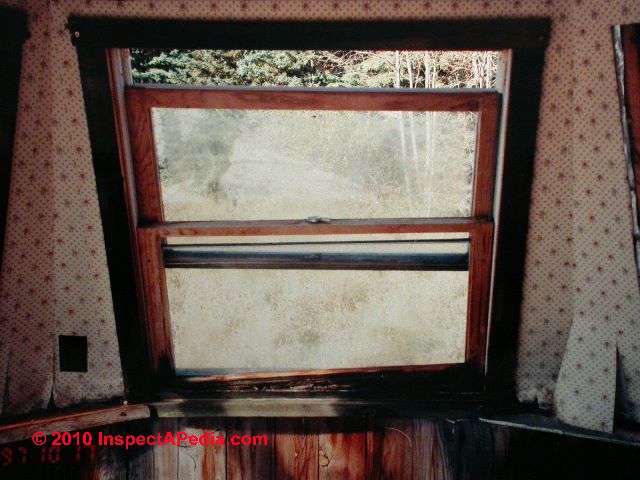
Our photo (above-left) shows a leaky interior window installed in the sloping exterior wall of a silo converted to living space in the Hudson Valley of New York. An interior storm window won't help much if the main window is in such poor condition as this one.
Where an interior storm window is particularly appropriate is for an energy improvement retrofit over casement or awning windows. Because these windows open by swinging "out", an exterior storm window can't be installed. Many older casement and awning windows provide for an interior storm window that fits inside the movable sash - but that won't do anything to reduce heat loss if the sash or window frame is leaky.
Watch out: the energy savings effectiveness of any storm window, installed inside or outside, can vary enormously. Here are some factors we have observed in the field [DJF]:
- Is the exterior or interior storm window properly installed, mounted, sealed so as not to be leaky?
- If the exterior storm window is a double-hung unit, or a "triple track" storm and screen unit, are the storm windows actually closed properly? We often find that a forgetful building occupant has left storm windows partly open, or that an individual window was broken and removed entirely.
- If the exterior storm window is a double hung unit, is the right sash in the "up" and "down" position? The outermost sash should be "up" on an exterior mounted double hung storm window so that wind-blown rain won't enter the window.
- Are there drafts around the storm window, around the window frame itself? This problem may be more common on older homes using sash weights and a rope and pulley system to raise and lower sashes.
According to the U.S. Department of Energy, the most effective way to improve a home's energy efficiency is to install new energy efficient windows. [See WINDOW / DOOR ENERGY EFFICIENT, DOE]. But where your budget does not allow that costly improvement, some types of storm windows are a good option, such as for people living in apartments. The DOE continues:
Even though storm windows add little to the insulating performance of single-glazed windows (that are in good condition,) field studies have found that they can help to reduce air movement into and out of existing windows. Therefore, they help reduce heating and cooling costs.
...
For the most part, interior storm windows offer greater convenience than exterior storm windows. They're easier to install and remove; they require less maintenance because they're not exposed to the elements; and, because they seal tightly to the primary window, they're more effective at reducing air infiltration. Interior storm windows also are often the best choice for apartments and houses with more than one floor. If you can afford exterior storm windows, you can probably afford some newer, more energy-efficient windows, which will be a better investment.
Glass pane types offer better visibility and longer life than plastic pane types, but glass is heavy and fragile. In general, plastics are most economical for people with small budgets or who live in apartments. However, while inexpensive and relatively easy to install, they are easy to damage. Plastic panels, such as Plexiglas and acrylics are tougher and lighter than glass, but may scratch easily. Some may turn yellow over time as well. Some plastic films may significantly reduce visibility and degrade over time when exposed to sunlight.
Wood, aluminum, and vinyl are the most common storm window frame materials. There are advantages and disadvantages to all types of frame materials. Although very strong, light, and almost maintenance free, aluminum frames conduct heat very rapidly. Because of this, aluminum makes a very poor insulating material.
Wood frames insulate well, but they weather with age. They also expand and contract according to weather conditions. Wood-frame storm windows installed during the winter may not close easily during the summer, and those installed during the summer may fit loosely in the winter. They can also be quite heavy and thicker than metal frames. This can make storage difficult, reduce the view out the window, and reduce the amount of natural light in the room. Wood frames also require the most maintenance. There are, however, aluminum- or vinyl-clad wood frames that reduce maintenance requirements.
Vinyl frames are usually made of polyvinyl chloride (PVC) with ultraviolet light (UV) stabilizers to keep sunlight from breaking down the material. They, however, may expand and warp at high temperatures, and crack in extremely low temperatures. Also, if sunlight hits the material for many hours a day, colors other than white will tend to fade over time.
For information on using nomographs see Solar Age 12/84, p. 48. For information on the nomographs, contact AAMA Technical INformation Center.
For more up to date information about the performance of films to increase solar collector efficiency, see SOLAR COLLECTOR FILMS
The question-and-answer article above quotes-from, updates, and comments an original article from Solar Age Magazine and written by Steven Bliss.
Readers interested in constructing storm windows should also see STORM WINDOW PLASTIC CHOICES. Readers interested in reducing un-wanted window glazing heat gain or heat loss should also see SUNGAIN, FILMS, LOW-E GLASS.
The link to the original Q&A article in PDF form immediately below was preceded by an expanded/updated online version of this article.
- Q&A on Interior Storm Window Savings - how to calculate the energy savings - PDF version, use your browser's back button to return to this page
Storm Window Articles
- STORM WINDOW GUIDE - home
- SPONTANEOUS GLASS BREAKAGE NiS
- STORM WINDOW INTERIOR - energy savings from interior storm windows, how to calculate energy savings from retrofit interior storm windows
- STORM WINDOW PLASTIC CHOICES
- STORM WINDOW WEEP HOLES
- SUNGAIN, FILMS, LOW-E GLASS - for reducing un-wanted window glazing heat gain or heat loss
- WINDOW / DOOR AIR LEAK SEALING HOW TO
- WINDOW INSULATION OPTIONS
...
Continue reading at WINDOW EFFICIENCY FEATURES & RATINGS or select a topic from the closely-related articles below, or see the complete ARTICLE INDEX.
Or see these
Recommended Articles
ENERGY SAVINGS in BUILDINGS articles on ways to cut heating and cooling costs in buildings.
WINDOW SHADING, SCREENING and also see WINDOW GLAZING BASED on CLIMATE
WINDOWS & DOORS - home
WINDOW / DOOR ENERGY EFFICIENT, DOE
Suggested citation for this web page
STORM WINDOW INTERIOR at InspectApedia.com - online encyclopedia of building & environmental inspection, testing, diagnosis, repair, & problem prevention advice.
Or see this
INDEX to RELATED ARTICLES: ARTICLE INDEX to DOORS & WINDOWS
Or use the SEARCH BOX found below to Ask a Question or Search InspectApedia
Ask a Question or Search InspectApedia
Questions & answers or comments about choosing, buying, installing or repairing acrylic interior storms, including the anticipated energy savings you may expect. .
Try the search box just below, or if you prefer, post a question or comment in the Comments box below and we will respond promptly.
Search the InspectApedia website
Note: appearance of your Comment below may be delayed: if your comment contains an image, photograph, web link, or text that looks to the software as if it might be a web link, your posting will appear after it has been approved by a moderator. Apologies for the delay.
Only one image can be added per comment but you can post as many comments, and therefore images, as you like.
You will not receive a notification when a response to your question has been posted.
Please bookmark this page to make it easy for you to check back for our response.
Our Comment Box is provided by Countable Web Productions countable.ca
Citations & References
In addition to any citations in the article above, a full list is available on request.
- Solar Age Magazine was the official publication of the American Solar Energy Society. The contemporary solar energy magazine associated with the Society is Solar Today. "Established in 1954, the nonprofit American Solar Energy Society (ASES) is the nation's leading association of solar professionals & advocates. Our mission is to inspire an era of energy innovation and speed the transition to a sustainable energy economy. We advance education, research and policy. Leading for more than 50 years. ASES leads national efforts to increase the use of solar energy, energy efficiency and other sustainable technologies in the U.S. We publish the award-winning SOLAR TODAY magazine, organize and present the ASES National Solar Conference and lead the ASES National Solar Tour – the largest grassroots solar event in the world."
- Steve Bliss's Building Advisor at buildingadvisor.com helps homeowners & contractors plan & complete successful building & remodeling projects: buying land, site work, building design, cost estimating, materials & components, & project management through complete construction. Email: info@buildingadvisor.com
Steven Bliss served as editorial director and co-publisher of The Journal of Light Construction for 16 years and previously as building technology editor for Progressive Builder and Solar Age magazines. He worked in the building trades as a carpenter and design/build contractor for more than ten years and holds a masters degree from the Harvard Graduate School of Education. Excerpts from his recent book, Best Practices Guide to Residential Construction, Wiley (November 18, 2005) ISBN-10: 0471648361, ISBN-13: 978-0471648369, appear throughout this website, with permission and courtesy of Wiley & Sons. Best Practices Guide is available from the publisher, J. Wiley & Sons, and also at Amazon.com - AAMA, Architectural Aluminum Manufacturers' Association, now American Architectural Manufacturers Association, an " advocate for manufacturers and professionals in the fenestration industry" - website: http://www.aamanet.org/ - Watch out: a search for "what is the effectiveness of storm windows" produced no data although the website suggests that an article is available - web search 06/19/2010.
- U.S. Department of Energy, "Energy Efficiency & Renewable Energy - Storm Windows", web search 06/19/2010 - original source: http://www.energysavers.gov/your_home/windows_doors_skylights/index.cfm/mytopic=13490
- "Wonder Windows, Two Let In More Sun, Two Keep In More Heat", V. Elaine Smay, Popular Science, April 1982
- In addition to citations & references found in this article, see the research citations given at the end of the related articles found at our suggested
CONTINUE READING or RECOMMENDED ARTICLES.
- Carson, Dunlop & Associates Ltd., 120 Carlton Street Suite 407, Toronto ON M5A 4K2. Tel: (416) 964-9415 1-800-268-7070 Email: info@carsondunlop.com. Alan Carson is a past president of ASHI, the American Society of Home Inspectors.
Thanks to Alan Carson and Bob Dunlop, for permission for InspectAPedia to use text excerpts from The HOME REFERENCE BOOK - the Encyclopedia of Homes and to use illustrations from The ILLUSTRATED HOME .
Carson Dunlop Associates provides extensive home inspection education and report writing material. In gratitude we provide links to tsome Carson Dunlop Associates products and services.
 | HOME | ABOUT | ASK a QUESTION | CONTACT | CONTENT USE POLICY | DESCRIPTION | POLICIES | PRIVACY | |
| © 2024 - 1985 Publisher InspectApedia.com - Daniel Friedman | |||||||||