
InspectAPedia® FREE Encyclopedia of Building & Environmental Construction, Diagnosis, Maintenance & Repair |
Question? Just ask us! InspectAPedia
|
 Solar Energy Payback Analysis
How Solar is My House ?
- POST a QUESTION or COMMENT about how to determine the extent to which a house is making use of solar energy
This article discusses solar houses: this solar energy payback analysis explains how to evaluate the extent to which your house makes use of solar energy & renewable energy, discussing solar fraction, heat loss coefficient, and auxiliary heat use in buildings. S
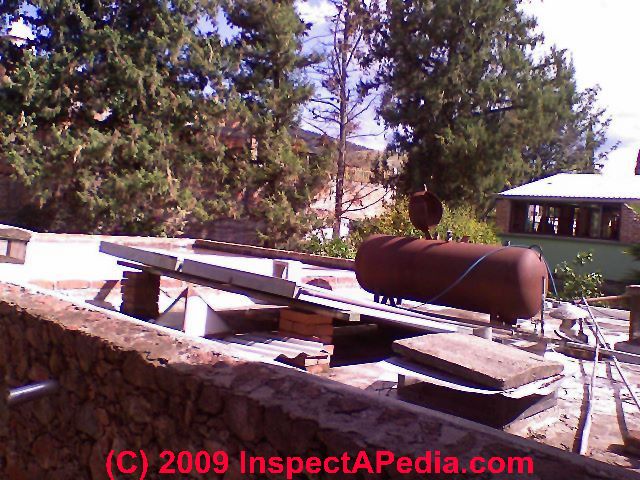
Sketch at page top and accompanying text are reprinted/adapted/excerpted with permission from Solar Age Magazine - editor Steven Bliss. Our photograph of solar collectors and water tank (below) show a typical home solar hot water system in Guanajuato, Mexico.
InspectAPedia tolerates no conflicts of interest. We have no relationship with advertisers, products, or services discussed at this website.
How Solar is My House?
"How Solar is My House? Gauging passive solar performance can be confusing unless you understand the measures used" -
This article is reprinted/adapted/excerpted with permission from Solar Age Magazine - editor Steven Bliss.
Gauging passive solar performance can be confusing unless you understand the measures used. A lot of numbers get tossed around in evaluating, comparing, and marketing solar homes. Just as a bucket of water can be described as either 40 percent empty or 60 percent full, different numbers can rate the same house while giving very different impressions.
What is Solar Fraction? What does Percent Solar Mean?
In passive solar homes, an often misleading, though widely used index of solar performance is the solar fraction in any of its various forms. In a retrofit project, a percent solar calculation is relatively straightforward, since a reduction in fuel use, all other things being equal, can be attributed to solar energy. Of course, if conservation measures are taken first, as they should be, the savings from conservation must be accounted for.
When calculated from the new, lower heating load after tightening up the house, the percent solar savings will be higher than if it were derived from the original heating load. For most purposes, it is wiser to quantify the savings in BTUs, or their dollar equivalents, and forget about percentages altogether.
in new construction of solar homes the numbers get more slippery still. A solar firm is often asked to design a home that is, say, 50 percent solar "like our neighbor's house." The designer must ask, "fifty percent of what?" One method of computing a solar fraction, now in disfavor, compares the house to itself if the sun never shone or to itself it if were flipped around to face the north. It counts as solar gain all the heat that actually escapes out the south glazing from whence it came.
In large aperture designs, this loss thro8ugh the south glazing is substantial, often accounting for one quarter to one third of the building's gross heat loss. The resulting solar percentage might appear high but offers no clue about the thermal performance or the wisdom of the design. Calculated this way, a leaky house with oversized south glazing is likely to attain a high solar fraction and high fuel bills as well.
Definition of Solar Savings Fraction
The Los Alamos National Laboratory developed another solar percentage figure for use in estimating solar and auxiliary contributions in passive solar design. The Solar Savings Fraction (SSF) represents the ratio of the useful solar contribution to the net heating load of the building, that is, the load assuming the south aperture is thermally neutral with no losses and no gains. While the SSF constitutes a more conservative and realistic index of solar performance, it should be used only to compare one system to another in the same house or two different houses with the same net heating load.
For marketing purposes, one might want to compare the thermal performance of a solar versus a non-solar home of comparable size and insulating value. Still, it would be more accurate to say that the solar home will produce a 30 percent savings in fuel costs compared with the conventional home rather than to say that the house is 30 percent solar.
Definition of Heat Loss Coefficient
The number frequently used to compare the thermal effectiveness of the building shell is the annual BTU heat loss normalized for the square footage of the building and the heating degree days. The heat loss coefficient of a standard, contemporary home typically ranges from 8 to 10 BTUs/(degreeF-day ft2). This number is useful for design purposes, but tends to show large aperture passive buildings as poor performers because of the high losses through the glazing.
To make sense of this number you must know what assumptions were made. Was nighttime insulation used? What were the air change rates and thermostat set points in the building? Were the data measured, or calculated, or obtained by some combination?
Auxiliary Heat Use in Solar Home Evaluation
For most purposes the bottom line in quantifying thermal performance of a solar or other energy-efficient home design is the auxiliary heat use. How much is it going to cost to keep warm? To make comparisons easy, the annual fuel use in BTUs is often normalized for building area and heating degree days.
Auxiliary heat requirements from 1 to 3 BTUs/(degreeF-day ft2) were reported in the mid 1980's from top-performing monitored houses. To interpret these figures, the assumptions, measurement techniques, and conditions (internal gains, thermostat set points) must be known. The building's shape and size also affect this measure, since these parameters affect the ratio of floor area to surface area of the building's shell. If height is held constant, larger buildings tend to perform better than smaller ones - at least on a square-foot basis.
Incremental Costs for Adding Solar Features to a Home
Since costs ultimately decide the fate of most building projects, economic analysis must be done carefully. Few people buy a pair of shoes strictly on the basis of cost efficiency (dollars spent vs. steps taken). Appearance, comfort, and fit are just as important. In the housing market, people purchase homes, and living space, not just heating systems.
The gross cost of adding glass and mass should not be counted as the incremental cost of solar if the homeowner enjoys the added views, light, and masonry surfaces. If a greenhouse is used as living space, the added space should be factored into any cost or performance per-square-foot calculations.
In passive solar and superinsulated homes, the real cost of the "solar" or "conservation" package is the incremental cost added to the project to attain a certain energy savings. For a multi-use conservation or solar feature, the calculation of an incremental cost must take into account the costs of the building components replaced by energy-related components.
For example, a masonry storage wall may replace a conventional wood-frame/drywall partition or it may replace a wall with elegant (expensive) hardwood detailing. Similarly, the real cost of adding an airlock entry might equal the simple cost of adding a trimmed doorway and a weatherstripped door - if the owners wanted a mudroom anyway.
Choosing a reference cost for a wall that is never built is somewhat arbitrary. If the homeowner desired a brick accent wall anyway, the incremental cost of adding thermal storage might be zero, involving merely putting the wall in the right place.
As a general rule, any passive solar feature will appear more cost-effective if it replaces an essential building component and adds an architectural amenity to the home. At the least, it should not represent an architectural cost, that is, an eyesore.
Solar Home Payback Analysis
Partly as a response to energy-saving marketing, clients often focus on the payback of a solar project to the exclusion of more traditional concerns. The comfort, enjoyment, and added space that is provided may equal or surpass that of the den they added, or bathroom they remodeled last year at a similar cost. More importantly, the economic value added to the house is roughly equal to the dollars spent on the project - whether solar or not.
In a very real sense, the payback is immediate and recoverable upon the sale of the house. Looked at this way, the energy savings that accrue, whether they are the result of reduced fuel bills or a freely-heated living space, could be considered frosting on the cake - and in this case, a gift that keeps on giving.
Conclusions about Solar Home Evaluation
Whether you are a designer, buyer, or seller of solar homes, it behooves you to understand the numbers you use. For marketing purposes, a projection of fuel costs addresses the energy issue squarely. It's a rare consumer who is not painfully aware of the cost of keeping warm.
Some builders have gone so far as to guarantee an upper limit on fuel bills, agreeing to kick in any overage. Lending institutions (in the 1980's) began to mix a home-energy-use factor into their mortgage brews, thereby qualifying lower income borrowers for energy-efficient homes.
For the designer, thermal and solar performance numbers are indispensible tools for achieving desirable and predictable results - to know what's achievable and what makes sense economically.
And finally, for the consumer, when all is said and done - education is the best defense, or as we say in commerce, "caveat emptor."
Here we include solar energy, solar heating, solar hot water, and related building energy efficiency improvement articles reprinted/adapted/excerpted with permission from Solar Age Magazine - editor Steven Bliss.
For better accuracy in calculating solar energy gains also see PASSIVE SOLAR HEAT PERFORMANCE. Contact us to suggest text changes and additions and, if you wish, to receive online listing and credit for that contribution.
Links to the original article in PDF form immediately below are followed by an expanded/updated online version of this article.
- SOLAR HOUSE EVALUATION - from Solar Age Magazine - use your browser's back button to return to this page
- SOLAR HOUSE EVALUATION page 2- from Solar Age Magazine - use your browser's back button to return to this page
...
Continue reading at SOLAR MODULE MANUFACTURERS or select a topic from the closely-related articles below, or see the complete ARTICLE INDEX.
Suggested citation for this web page
SOLAR HOUSE EVALUATION at InspectApedia.com - online encyclopedia of building & environmental inspection, testing, diagnosis, repair, & problem prevention advice.
Or see this
INDEX to RELATED ARTICLES: ARTICLE INDEX to SOLAR ENERGY
Or use the SEARCH BOX found below to Ask a Question or Search InspectApedia
Ask a Question or Search InspectApedia
Try the search box just below, or if you prefer, post a question or comment in the Comments box below and we will respond promptly.
Search the InspectApedia website
Note: appearance of your Comment below may be delayed: if your comment contains an image, photograph, web link, or text that looks to the software as if it might be a web link, your posting will appear after it has been approved by a moderator. Apologies for the delay.
Only one image can be added per comment but you can post as many comments, and therefore images, as you like.
You will not receive a notification when a response to your question has been posted.
Please bookmark this page to make it easy for you to check back for our response.
Our Comment Box is provided by Countable Web Productions countable.ca
Citations & References
In addition to any citations in the article above, a full list is available on request.
- Solar Age Magazine was the official publication of the American Solar Energy Society. The contemporary solar energy magazine associated with the Society is Solar Today. "Established in 1954, the nonprofit American Solar Energy Society (ASES) is the nation's leading association of solar professionals & advocates. Our mission is to inspire an era of energy innovation and speed the transition to a sustainable energy economy. We advance education, research and policy. Leading for more than 50 years. ASES leads national efforts to increase the use of solar energy, energy efficiency and other sustainable technologies in the U.S. We publish the award-winning SOLAR TODAY magazine, organize and present the ASES National Solar Conference and lead the ASES National Solar Tour – the largest grassroots solar event in the world."
- Steve Bliss's Building Advisor at buildingadvisor.com helps homeowners & contractors plan & complete successful building & remodeling projects: buying land, site work, building design, cost estimating, materials & components, & project management through complete construction. Email: info@buildingadvisor.com
Steven Bliss served as editorial director and co-publisher of The Journal of Light Construction for 16 years and previously as building technology editor for Progressive Builder and Solar Age magazines. He worked in the building trades as a carpenter and design/build contractor for more than ten years and holds a masters degree from the Harvard Graduate School of Education. Excerpts from his recent book, Best Practices Guide to Residential Construction, Wiley (November 18, 2005) ISBN-10: 0471648361, ISBN-13: 978-0471648369, appear throughout this website, with permission and courtesy of Wiley & Sons. Best Practices Guide is available from the publisher, J. Wiley & Sons, and also at Amazon.com - PASSIVE SOLAR DESIGN HANDBOOK VOLUME I [PDF], the Passive Solar Handbook Introduction to Passive Solar Concepts, in a version used by the U.S. Air Force - online version available at this link and from the USAF also at wbdg.org/ccb/AF/AFH/pshbk_v1.pdf
- PASSIVE SOLAR DESIGN HANDBOOK VOLUME II [PDF], the Passive Solar Handbook Comprehensive Planning Guide, in a version used by the U.S. Air Force - online version available at this link and from the USAF also at wbdg.org/ccb/AF/AFH/pshbk_v2.pdf [This is a large PDF file that can take a while to load]
- PASSIVE SOLAR HANDBOOK VOLUME III [PDF], the Passive Solar Handbook Programming Guide, in a version used by the U.S. Air Force - online version available at this link and from the USAF also at wbdg.org/ccb/AF/AFH/pshbk_v3.pdf
- The Passive Solar Design and Construction Handbook, Steven Winter Associates (Author), Michael J. Crosbie (Editor), Wiley & Sons, ISBN 978-047118382 or 0471183083
- "PASSIVE SOLAR HOME DESIGN [PDF] ", U.S. Department of Energy, describes using a home's windows, walls, and floors to collect and store solar energy for winter heating and also rejecting solar heat in warm weather.
- SOLAR WATER HEATERS [PDF] , U.S. Department of Energy article on solar domestic water heaters to generate domestic hot water in buildings, explains how solar water heaters work. Solar heat for swimming pools is also discussed.
- HEAT EXCHANGERS for SOLAR WATER HEATING SYSTEMS [PDF], U.S. DOE describes the types of solar water heater heat exchange methods between the sun and the building's hot water supply
- HEAT-TRANSFER FLUIDS for SOLAR WATER HEATING SYSTEMS [PDF] , U.S. DOE, describes the types of fluids selected to transfer heat between the solar collector and the hot water in storage tanks in a building. These include air, water, water with glycol antifreeze mixtures (needed when using solar hot water systems in freezing climates), hydrocarbon oils, and refrigerants or silicones for heat transfer.
- SOLAR WATER HEATING SYSTEM MAINTENANCE & REPAIR [PDF] , U.S. DOE
- SOLAR WATER HEATING SYSTEM FREEZE PROTECTION [PDF] , U.S. DOE,using antifreeze mixture in solar water heaters (or other freeze-resistant heat transfer fluids), as well as piping to permit draining the solar collector and piping system.
- "Scaling and Corrosion in Solar Water Heating Systems", U.S. DOE
- www.energysavers.gov/your_home/water_heating/index.cfm/mytopic=12850 is the base U.S. DOE website for these articles
- ACTIVE SOLAR HEATING SYSTEMS [PDF] , U.S. Department of Energy, including
- "Radiant Heating Systems" U.S. DOE
- ABSORPTION HEAT PUMPS & COOLERS [PDF] , U.S. DOE
- SOLAR AIR HEATING [PDF] U.S. DOE also referred to as "Ventilation Preheating" in which solar systems use air for absorbing and transferring solar energy or heat to a building
- SOLAR LIQUID HEATING [PDF] U.S. DOE, systems using liquid (typically water) in flat plate solar collectors to collect solar energy in the form of heat for transfer into a building for space heating or hot water heating. The term "solar liquid" is used for accuracy, rather than "solar water" because the water may contain an antifreeze or other chemicals.
- Our recommended books about building & mechanical systems design, inspection, problem diagnosis, and repair, and about indoor environment and IAQ testing, diagnosis, and cleanup are at the InspectAPedia Bookstore. Also see our Book Reviews - InspectAPedia.
- In addition to citations & references found in this article, see the research citations given at the end of the related articles found at our suggested
CONTINUE READING or RECOMMENDED ARTICLES.
- Carson, Dunlop & Associates Ltd., 120 Carlton Street Suite 407, Toronto ON M5A 4K2. Tel: (416) 964-9415 1-800-268-7070 Email: info@carsondunlop.com. Alan Carson is a past president of ASHI, the American Society of Home Inspectors.
Thanks to Alan Carson and Bob Dunlop, for permission for InspectAPedia to use text excerpts from The HOME REFERENCE BOOK - the Encyclopedia of Homes and to use illustrations from The ILLUSTRATED HOME .
Carson Dunlop Associates provides extensive home inspection education and report writing material. In gratitude we provide links to tsome Carson Dunlop Associates products and services.
 | HOME | ABOUT | ASK a QUESTION | CONTACT | CONTENT USE POLICY | DESCRIPTION | POLICIES | PRIVACY | |
| © 2024 - 1985 Publisher InspectApedia.com - Daniel Friedman | |||||||||