
InspectAPedia® FREE Encyclopedia of Building & Environmental Construction, Diagnosis, Maintenance & Repair |
Question? Just ask us! InspectAPedia
|
 Smoke Pens: Where to Buy Smoke Pencils, Smoke Puffers & Smoke Generating Tools
- POST a QUESTION or COMMENT about choosing, buying, & using smoke pens, smoke pencils and related HVAC and building air movement test tools. Solar Age Magazine Articles on Renewable Energy, Energy Savings, Construction Practices
Smoke test tools & smoke generators:
Where to choose & buy smoke test equipment for HVAC & air movement tests in buildings: This article provides sources of smoke pencils and air leak detection tools for building energy savings. Smoke generators of a variety of types have a wide range of diagnostic uses including finding building air flow studies, air leaks or heat loss points, HVAC duct air leaks, heat exchanger leaks, testing for air movement around ventilation hoods, checking for indoor air ventilation in office or test lab spaces, operation of exhaust fans, even leaks in drainage and drain piping systems.
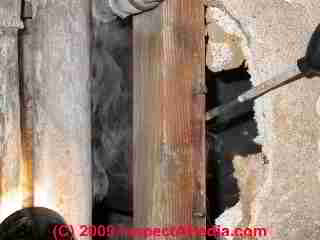
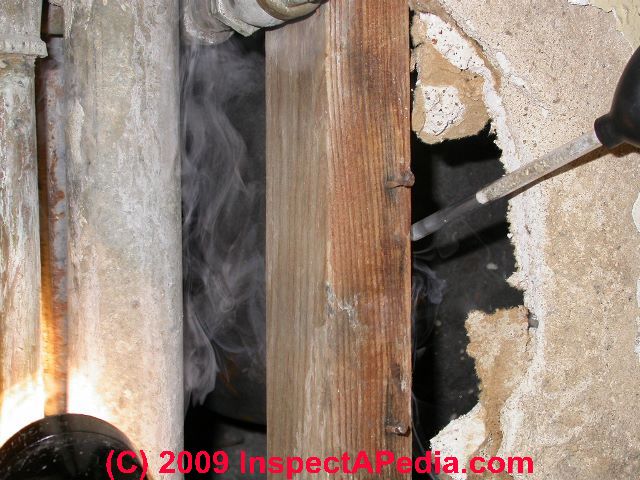
The mechanics and chemistry of smoke pens and smoke generators vary widely and some include irritating or even toxic fumes and chemicals while others are safer to operate. We discuss and compare all of those features and uses in this article. Our page top photo shows the website author using a smoke tester to view air movement into an un-insulated wall cavity.
InspectAPedia tolerates no conflicts of interest. We have no relationship with advertisers, products, or services discussed at this website.
Where to Find & Buy Smoke Pencils for Tracing Air Leaks in buildings
 Article Contents
Reader Question: what is a source to purchase smoke testing equipment?
Where can I buy a smoke pencil ? -- Jerry Fry, Monterey CA
Reply:
Immediately below we provide a list of companies providing smoke guns, pencils, bombs, emitters, puffers and similar HVAC and building air movement test equipment. We also provide links to MSDS and other safety and usage guides for smoke emitting and test equipment.
Our photo (at page top and again at below left) shows a simple smoke generating "pencil" in use to test for air leaks at an opening in an icynene foam insulated crawl space. The glass tube is filled with a chemical that generates a chemical "smoke" when the tube ends are broken off and air is pushed through the tube by the rubber bulb in the website author's hand.
List of Companies Producing & Distributing Smoke Pens, Pencils, Bottles, Powder Puffers & other Smoke Generating Equipment for Various Test Purposes
- BJÖRNAX smoke products is the original producer of many of the smoke emitting products listed here and distributed by a wide range of suppliers including Regin in the U.S.. Contact: Björnax AB, Stråssa Företagsby, 71177 Stråssa Sweden, Tel: +46 (0)581 431 50, Fax: +46 (0)581 432 06, Website: http://www.bjornax.se
- Fire Systems Services, an Australian company, is a large distributor of smoke generators and other fire and fire-fighting-related equipment
Contact: Fire System Services, Unit 1, 16 Glasgow Street, Wingfield, South Australia 5013, Mail to: P.O. Box 16, Prospect SA 5082, Tel: +61 8 8445 6300, Website: http://www.firesys.com.au/
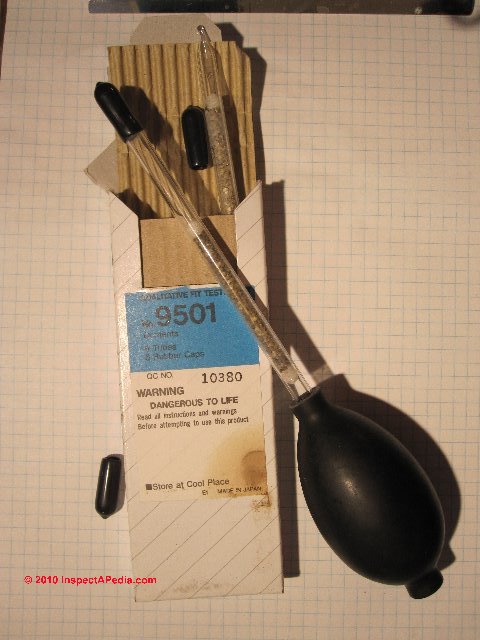
- Gastec, produces a wide range of gas detector tubes. Using the same technology Gastec produces a tube, the Gastec Irritant Smoke Qualitative Fit Testing Kit No. 9501 that operates as a smoke emitter, producing an ultra-fine white tracer smoke" that can be used to observe air movement.
See GAS DETECTION INSTRUMENTS for a discussion of how this equipment is used. - Kitagawa produces gas detector tubes (for example used with Sensidyne gas detector pumps). their product line may include smoke emitter tubes for use with different instruments.
- National Draeger, the Dräger Air Current Test Kit is described by the manufacturer - details are in the article below
- Regin Products for Heating, Air Conditioning, & Special Effects, Regin HVAC Products, Inc. 315 Riggs Street, Unit 1 Oxford, CT 06478 USA, Tel: (203) 881-2600 or (800) 394-2739
- Smoke Puffer Pencil - see http://www.chimneyballoon.us
- HVAC equipment & test tool suppliers: check with your local heating, ventilation, and air conditioning contractor suppliers. Some of these are listed following the list of page links, below atReferences or Citations .
- Home inspection equipment suppliers: check with any home inspection equipment supplier
Smoke test equipment manufacturers can refer you to local distributors for smoke pencils or other smoke testing and air testing or air movement testing equipment.
Also many home inspectors have and use this equipment, as do home energy auditors and "house doctors".
See DIRECTORY of PROFESSIONALS
and MOLD INSPECTORS & MOLD TESTERS.
At Basement Energy Losses- IR & Visual we show additional photographs of using a smoke generator tube (smoke pencil) to check building air flow and building air leaks at a basement wall.
At AIR LEAK DETECTION TOOLS we show using a smoke pencil to determine the direction of air flow (under a door) when evaluating return air supply adequacy for an air conditioning system
Table of Properties, Chemicals, Operating Mechanisms of Smoke Generating & Smoke Testing Equipment & DevicesFor a list of specific smoke test products, properties, and suppliers see CATALOG of Types of Smoke in the next section of this article. |
|||
|---|---|---|---|
| Smoke Device Type | Key Ingredients | Mechanism | Comments |
| Air current test kit | Various | Chemicals in one or a series of sealed glass tubes; tube ends are broken open to permit air, moisture etc. to pass through tube, chemical reaction creates "smoke" | E.g. see Air Current Test Kit — Dräger Cat. No. 800-216 (replacement tube 800-25301 ) or the Airflow Indicator Kit — GASTEC Cat. No. 810-500 (replacement tube 810-501 ) Potentially hazardous, not suitable for respirator fit testing |
| FP Smoke | Dimethyl silicone reaction product with silica, Calcium Carbonate |
Mechanical: a plastic bottle of powder is squeezed to produce a puff of white particles. Bottle orifice determines the size or volume of the puff of test smoke. Rubber bulb squeeze pump device is available from Regin Co. | BJÖRNAX AB & Regin Co. Not classified as hazardous |
| Gas tubes | Various | Rubber squeeze bulb or pump to which a glas tube is attached. Chemicals in one or a series of sealed glass tubes; tube ends are broken open to permit air, moisture etc. to pass through tube, chemical reaction creates "smoke" |
E.g. see Gastec & see GAS DETECTION INSTRUMENTS & see air current test kits listed earlier in this table Potentially hazardous |
| Qualitative Fit Testing Kit | Tin tetrachloride or Stannic chloride (irritating smoke) | Tube (ampoule) is broken (flexible plastic tube) and either contains its own bulb-pump at one end, or is inserted into a rubber bulb or hand pump to emit puffs of test smoke for respirator fit testing. | Respirator fit testing. See Nextteq & VeriFit™ Irritant Smoke Generators for Respirator Fit Testing |
| Smoke Bottles | Titanium tetrachloride, releasing Hydrogen chloride (HCl) gas | Mechanical: ampoule contained inside a plastic bottle is broken by squeezing the bottle, to emit dense smoke. Stop smoke emission by capping the bottle. | Smoke generation can continue for 24 hours. Highly toxic, hazardous |
| Smoke Cans | Butane/Propane hydrocarbon blend | Aerosol spray used to test smoke alarms; | Home inspection, HVAC testing; typically 300 tests per can; E.g. SmokeCheck™ from HSI Fire & Safety Group LLC. Potentially hazardous |
| Smoke Candles, smoke emitter cartridges | Titanium tetrachloride ampoules, ( or Potassium chlorate and/or Ammonium Chloride or Hydrated zinc chloride, water condensate, carbon monoxide |
Chemical reaction, may require ignition, white to gray smoke, burn time varies, as short as 3 minutes. | Operate for 24-hours per ampoule, corrosive irritating smoke. E.g. Superior® Signal 3C Smoke Candles (sold through Grainger et als) can produce as much as 40,000 cu.ft. of smoke. Potentially hazardous |
| Smoke Emitter Bottles | Titanium tetrachloride ampoules, (or Potassium chlorate and/or Ammonium Chloride) | Mechanical, chemical; Ampoule is crushed within a plastic bottle | Operate for 24-hours per ampoule, corrosive irritating smoke Potentially hazardous |
| Smoke Guns | Various, | Typically a rubber bulb attached to a glass tube or vial containing a chemical that reacts with air or moisture in air to emit smoke as "puffs" | Potentially hazardous |
| Smoke Matches | Potassium chloride & Ammonium Chloride | Solid cartridge is ignited mechanically or chemically; | Short burning, 20 seconds typica. Potentially hazardous |
| Smoke Pens, Smoke Pencils | Various including: Butane/Propane hydrocarbon blend, Particle size 0.3 to 2.5 microns |
A smoke-emitting wick is inserted into the clutch pencil & ignited. Operating like a "mechanical pencil" the wick is adjusted to expose about 3/8" of wick that is ignited to provide a continuous stream of light gray to white smoke. | 6 wicks provide up to 3 hours of continuous smoke or 360 - 30 second tests. E.g. HSI SmokeCheck™ Potentially hazardous |
| Smoke Pencil Puffer Stick | Propylene glycol, glycerine, distilled water | Battery powered hand-held device puffs vaporized "smoke fluid" or "super fog fluid" chemical. Smoke Pencil Puffer Stick includes a trigger on the smoke stick to release puffs of smoke (instead of squeezing a bottle) to show the direction of air movement. | Low toxicity |
| Smoke Powders | Silica, calcium carbonate | Finely ground silica or CaCO3, typically in a plastic squeeze bottle, emits a white puff of "smoke", typically heavier than and shorter airborne time than some other smoke types . | Low toxicity |
| Smoke Wicks | See smoke pens, smoke pencils | Potentially hazardous | |
Catalog of Types of Smoke Bottles, Smoke Emitters, Smoke Pens & Pencils, Guns, Smoke Puffers
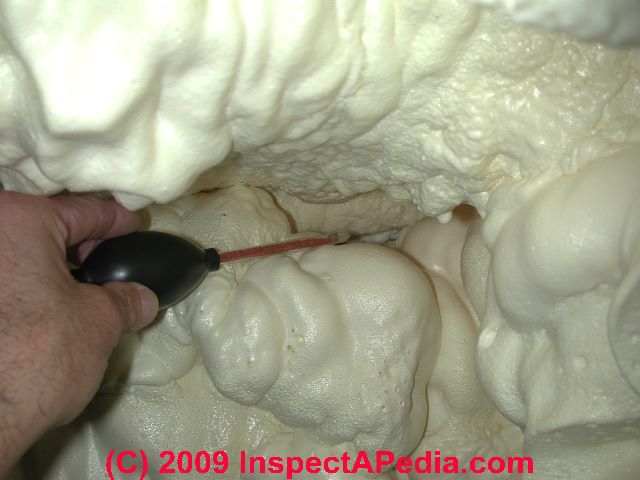
Smoke pencils, smoke guns, smoke matches, canned smoke, and fine powder smoke "puffers" are valuable for detecting where air infiltrates (leaks in) or exfiltrates (leaks out) of buildings or HVAC ducts, can be purchased from a variety of building and environmental test equipment suppliers including those listed below.
Above: we used this simple smoke puff test to show air leaks through closed cell foam that had been applied un-evenly in a crawl space.
Watch out: some smoke tracing emitters produce highly toxic fumes (such as sulfuric acid H2SO4) that can injure lungs, eyes, skin, or even cause death if used at high concentrations in an enclosed space.
- FP Smoke, a white powder produced by BJÖRNAX AB, (Dimethyl silicone reaction product with silica, Calcium Carbonate) is classified as non-hazardous and produces an airborne white tracer "smoke". Dispensed via a squeeze bottle (choose the bottle top orifice for the smoke application), one bottle can provide up to 300 cubic feet of white "smoke" for tracing air movement.
- Gas detector tubes include smoke-emitting tubes. Using the same colorimetric gas detector tube technology Gastec produces a tube, the Gastec Irritant Smoke Qualitative Fit Testing Kit No. 9501 that operates as a smoke emitter, producing an ultra-fine white tracer smoke" that can be used to observe air movement.
See GAS DETECTION INSTRUMENTS for a discussion of how this equipment is used.
The Gastec irritant smoke qualitative fit testing kit No. 9501 is designed to meet and be used in accordance with OSHA 29 CFR 1910.134.
When the ends of the glass tube are cut off, the reagent in the tube reacts with air (squeezed through the tube with a rubber bulb) to produce visible and highly irritating smoke.
Rubber caps are provided to seal the open tube so that it can be re-used later, but be sure to see our warnings about the corrosivity of these materials discussed below under National Draeger and the Dräger "smoke tube" # CH16631
Watch out: according to the warnings published by Gastec and included with these tubes, the smoke emitted by these tubes is dangerous to life. Read all instructions and warnings before attempting to use this product.
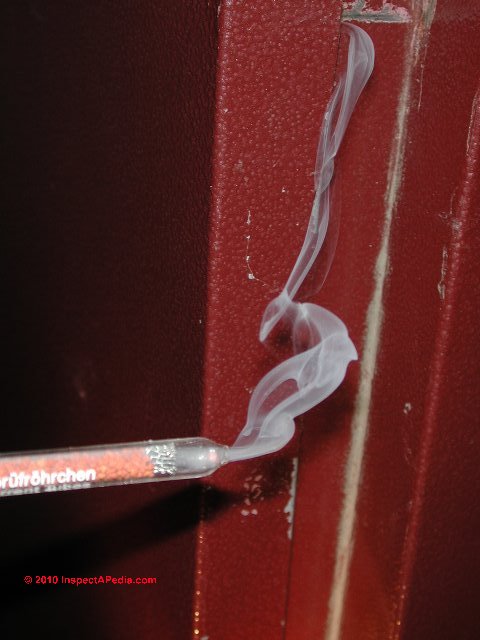
- National Draeger, the Dräger Air Current Test Kit is described by the manufacturer:
Often the determination of airflow in HVAC ducts, fume hoods and other ventilation systems is necessary to locate problems. This Air Current Test Kit is a quick and inexpensive way to help make these determinations. It works by creating a highly visible non-irritating dense white smoke that can be followed to determine the airflow direction.
To use, simply open the ends of the glass tubes with the supplied opener. Insert one end into the aspirator bulb. Squeeze the aspirator bulb to release a plume of smoke. Tubes are re usable until the medium has been extinguished. Caps are provided to cover the tube ends between uses.
The Dräger Flow Check Airflow Indicator (much more costly), is described by the manufacturer as follows:
The Dräger Flow Check system produces harmless clouds of smoke for use in detecting the flow of air currents. The system consists of a handheld instrument and a disposable ampoule containing smoke generating fluid.
The ampoule fluid is a special mixture of alcohols developed at Dräger that when heated in the instrument, it condenses on contact with the ambient air creating a harmless, environmentally safe cloud of smoke. The flow check is compact and easy to use. Small, single clouds of smoke can be generated with a short press of a button. Continuous production of smoke is possible by locking the button in the on position.
Contact:National Draeger, PO Box 120, Pittsburgh PA 15230 - 412-787-8383 - 866-905-9793
See Use of a Drager pump for a discussion of how Draeger equipment is used in the field. Also see Warnings re instruments for detection of gases.
Watch out: the Dräger "smoke tube" # CH16631 produces a sulfuric acid gas sulfuric acid H2SO4 /SO3 that is dangerous to life and is highly corrosive. Take a look at our copy of the Dräger MSDS for their CH25301 Air Current Tubes. We stored this MSDS in the box with the rubber bulb and tube cutter provided by Dräger.
These air current monitoring tubes are provided with rubber caps so that the tube can be "stopped" or shut down when not in use. But the sulfuric acid was so corrosive that it not only caused the rubber caps to disintegrate, it actually "burned" or oxidized our copy of the MSDS paper form!
Dräger MSDS for Dräger CH25301 [PDF] Air Current Tubes, Page 1
and Dräger MSDS for Dräger CH25301 Air Current Tubes , Page 2 [PDF] - Nextteq irritating smoke fit testing & airflow or air current analysis kits use the Gastec Irritant Smoke Qualitative Fit Testing Kit No. 9501 discussed above.
Nexteq, 877-312-2444 website: www.nextteq.com email: info@nextteq.com. Nextteq explains the use of irritating smoke for [respirator] fit testing as quick, easy to use, economical, and intrinsically safe and ready to use. "Irritating smoke is the only OSHA-accepted qualitative fit testing method that does not rely on the test subject's subjective response. Qualitative fit tests such as banana oil (isoamyl acetate), saccharin, or Bitrex may cause false negative results."
Watch out: some smoke tracing emitters produce highly toxic fumes (such as sulfuric acid H2SO4) that can injure lungs, eyes, skin, or even cause death if used at high concentrations in an enclosed space. Read all instructions and warnings before attempting to use this product. - Smoke bottles: e.g. Regin's Smoke Bottle RFA, S101, Air-Check, 4911C, using Titanium tetrachloride, releasing Hydrogen chloride (HCl) gas, produce a colorless to pale yellow fuming liquid with an irritant odor, very reactive with water, reacts to moisture, extremely toxic if ingested or inhaled, eye and skin contact, toxic to lungs, mucous membranes.
Personal protective equipment including MSHA/NIOSH approved respirator, neoprene gloves, splash goggles, use under an approved fume hood or equivalent, wash after handling; - Smoke cans: canned smoke: e.g. Smoke Check™ SAT-1, used to test smoke alarms, produced by HSI Fire & Safety Group, sold by home inspection tool suppliers & HVAC suppliers
- Smoke candles: typically using titanium tetrachloride ampoules, (or Potassium chlorate and/or Ammonium Chloride) operate for 24-hours per ampoule, corrosive irritating smoke (see our MSDS references below).
E.g. Miniax™ 45-second, 150cuft. "non-toxic smoke emitter" (gets hot, place on a safe surface, can, or sand) and Fire System Services Smoke Emitter candles, matches, powders including Miniax, Ventilax, Brandax, Datax, white smoke emitter candles discussed above, and coloured smoke emitters such as their AAX18, AX60, and Brandax KSO. Regin Smoke Emitters produce a large volume of "smoke" at a constant rate, using Potassium chlorate and/or Ammonium Chloride. - Smoke emitter bottles: As with the smoke candles above,, smoke emitter bottles typically use titanium tetrachloride ampoules, (or Potassium chlorate and/or Ammonium Chloride) operate for 24-hours per ampoule, corrosive irritating smoke (see our MSDS references below).
Regin Smoke Emitters produce a large volume of "smoke" at a constant rate, using Potassium chlorate and/or Ammonium Chloride.
Other examples: Miniax™ 45-second, 150cuft. "non-toxic smoke emitter" (gets hot, place on a safe surface, can, or sand) and Fire System Services Smoke Emitter candles, matches, powders including Miniax, Ventilax, Brandax, Datax, white smoke emitter candles discussed above, and coloured smoke emitters such as their AAX18, AX60, and Brandax KSO. - Smoke guns: E. Vernon Hill, Inc., PO Box 14248, San Francisco CA 94114 - 415-665-6628
Because smoke guns and smoke equipment are widely used by and produced by people involved in both HVAC and indoor air quality work, companies providing those services or who sell equipment to those practitioners can supply smoke testing equipment in a variety of forms such as ultra-fine powder that is "puffed" into the air to detect air movement direction, chemical tubes that generate smoke when opened, and capsules used to generate smoke to test for leaks in furnace heat exchangers.
We (D Friedman) use smoke generating tubes and other gas sampling equipment provided by the two most reliable companies in the world, Draeger-Safety's detector-tubes and Drager accuro™ bellows pump, the Gastec™ cylinder pump and detector-tube system produced by Gastec or Sensidyne, and we also use Sensidyne's Gilian air pump.
For broad screening for combustibles and a number of other toxic gases and for leak tracing we also use Amprobe's Tif8850. All of these instruments, their applications, and sensitivities (minimum detectable limits) for specific gases are described in our Gas Sampling Plan online document.
- Smoke matches: short burning, perhaps 20 seconds, low cost, can be a bit awkward. Suppliers: PH Gas Smatch, container of 75, in U.K., under £4. , Splintax (Regin HVAC Products & Fire System Services in the U.S., & Bjornax AB in Europe and other world locations)[6][9][11]. Smoke matches such as Bjornax's Splintax use Potassium chloride and Ammonium Chloride as a solid cartridge. The company's MSDS warns of this special risk:
Explosive when mixed with combustible material; harmful by inhalation and if swallowed. - Smoke pens & Smoke Pencils: an ignited wick burns 30 minutes, e.g. produced by BJÖRNAX AB. Quoting from the manufacturer:
The Bjornax reusable Smoke Emitter Pen is the perfect tool to dispense just the right amount of test smoke, when and where it is needed. A patented smoke-emitting wick is inserted into the clutch pencil and ignited. You can adjust the wick to provide a continuous stream of a light gray to white smoke. The Smoke Pen can be easily extinguished by simply replacing the protective cover. Wick diameter is 5.6mm and will burn for approximately 30 minutes each. Distributed by Bjornmax, FireSystemServices & Regin. [6][9][11]
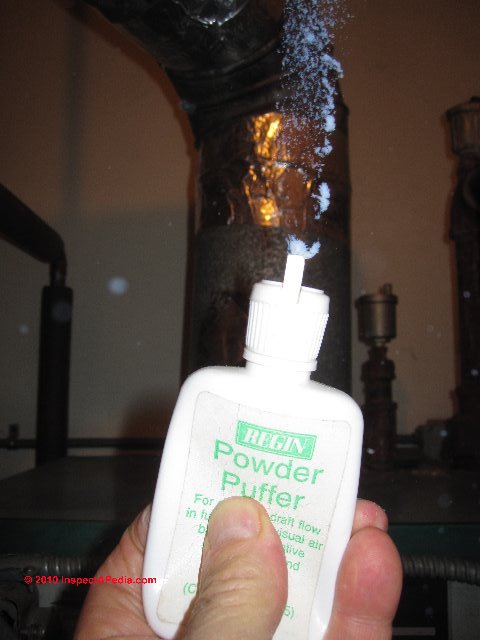
- Smoke powders - powder puffer bottle: Ultra-fine powders and smoke-powder puffers: e.g. Micro-Powder Puffer, (pulverized silica and Calcium carbonate powder) from BJÖRNAX AB, & Powder-Puff Silica Smoke S201 from Regin in the U.S. or from Bjornax in Europe,
Also distributed by Fire System Services. Smoke powders are typically emitted by squeezing a plastic bottle or using a rubber bulb attached to a specially-designed emitter-bottle. From the Bjornax MSDS:
Harmful if inhaled. May be harmful if swallowed. Cause eye irritation. Irritating to mucous membranes and upper respirator tract. May cause skin irritation.
Our photo (left) shows a Regin Powder Puffer "smoke" No. S201 air current tester that uses finely-ground silica (CAS 112945-52-5). Instructions include - Smoke Puffer Pen or Smoke Puffer Pencils: (Propylene glycol, glycerine, distilled water), a battery-operated "pen" or "smoke puffer pencil" vaporizes the ingredients listed to produce, on trigger pull of the "pen", a puff of vaporized glycol and glycerine and water. Low toxicity. Source: Chimney Balloon LLC 706 Brooks Rd Mauldin, SC 29662, Website: http://www.chimneyballoon.us, Tel: (608) 467-0229
- Smoke wicks: as smoke generators, see smoke pen & smoke pencil just above
Shake well
Squeeze the center of the bottle with a quick firm motion
Not edible. Do not inhale. Keep out of reach of children. Use only as Directed.
Also see the smoke pen or smoke puffer products listed below at Smoke Gun & Smoke Pencil System Safety, Hazards, MSDS Sheets just below
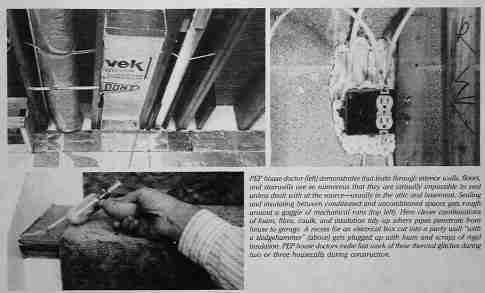
The question-and-answer article about buying smoke pencils to test for air movement in buildings, quotes-from, updates, and comments an original article from Solar Age Magazine and written by Steven Bliss.
The importance of setting priorities for sealing these points of energy wasted is emphasized and discussed, and sketches as well as photographs of common points of building heat loss, or unwanted heat gain, and air leaks are provided in the following articles:
Building Heat Loss & Air Leaks - [PDF]
Building Heat Loss & Air Leaks - part 2 - [PDF]
Building Heat Loss & Air Leaks - part 3 - [PDF]
Building Heat Loss & Air Leaks - part 4 - [PDF]
Here we include solar energy, solar heating, solar hot water, and related building energy efficiency improvement articles reprinted/adapted/excerpted with permission from Solar Age Magazine - editor Steven Bliss.
Smoke Gun & Smoke Pen or Smoke Pencil System Safety, Hazards, MSDS Sheets
Watch out: some smoking or fogging equipment uses highly irritating or even toxic gases or chemicals (tetrachloride acid or Titanium tetrachloride, or Hydrogen chloride HCL gas) that can cause eye or respiratory problems or may be poisonous if swallowed. Be sure that you use your smoke product only after having read (and followed) the manufacturer's directions.
See the example smoke pen, smoke pencil, and smoke emitter MSDS sheets below and see our full list at Smoke Generator Chemicals Powders MSDS. The MSDS sheets for these smoke candles, pens, powders, sticks, etc. include hazard warnings, intended usage, and the original manufacturer. Our original source links indicate suppliers who distribute these products in various countries.
- Brandax VS smoke for airflow studies, leakage testing, original source: http://www.firesys.com.au/Bjornax%20brandax%20vs%20msd.pdf, producer BJÖRNAX AB
- Datax "pure smoke" generator for airflow studies & leakage testing, original source:
http://www.firesys.com.au/Bjornax%20pure%20datax%20msd.pdf, producer BJÖRNAX AB - Dräger MSDS for Dräger CH25301 Air Current Tubes, Page 1 of 2.
Dräger MSDS for Dräger CH25301 Air Current Tubes, Page 2 of 2.
Watch out: the Dräger air current tube or "smoke tube" # CH16631 produces a sulfuric acid gas sulfuric acid H2SO4 /SO3 that is dangerous to life and is highly corrosive. Take a look at our copy of the Dräger MSDS for their CH25301 Air Current Tubes.
We stored this MSDS in the box with the rubber bulb and tube cutter provided by Dräger. These air current monitoring tubes are provided with rubber caps so that the tube can be "stopped" or shut down when not in use. But the sulfuric acid was so corrosive that it not only caused the rubber caps to disintegrate, it actually "burned" or oxidized our copy of the MSDS paper form! - FP-Smoke, powder smoke for airflow studies, leakage tests, BJÖRNAX AB,. STRÅSSA FÖRETAGSBY, S-711 77 STRÅSSA SWEDEN, web search 08/31/2010, original source: http://www.bjornax.com/MSDS/MSDS_fp_smoke.pdf
- Gastec Irritant Smoke Qualitative Fit Testing Kit No. 9501 four-pages of 30 safety warnings for respirator fit test
- Gastec Irritant Smoke Qualitative Fit Testing Kit No. 9501 MSDS (Nextteq Corporation copy)
- HSI Fire & Safety Group LLC, Smoke Check™ MSDS, HSI Fire & Safety Group LLC, 107 Garlisch Drive, Elk Grove Village IL 60007-1322, 847-427-8340, Manufactured for HSI at Shield Packaging Co., Inc., 50 Oxford Dr., Dudley MA 01571-3262, Tel: 508-949-0900, 24-Hour Emergency Tel: 800-424-9300 (Chemtrec) or 24-hour emergency Tel: 703-527-3887 (Chemtrec)
- Miniax white smoke MSDS (by Fire System Services)
- Powder-Puff smoke powder silica powder puffer, using &quo/hazmatilica" E.g. Powder Puffer S201, Regin HVAC Products, Inc., 315 Riggs Street Unit 1A Oxford, CT 06478, Tel: (203) 881-2600, Emergency Phone: (800) 424-9300, International 2024837616,
- Pure-AX:3 & Pure-AX:9 "pure smoke" generators for airflow studies, leakage tests, original source: http://www.firesys.com.au/Bjornax%20pure%20AX3%20AX9%20msd.pdf, producer BJÖRNAX AB
- Regin HVAC Products, 203-323-0115, and Regin Products for Heating, Air Conditioning, & Special Effects, Regin HVAC Products, Inc.
315 Riggs Street, Unit 1
Oxford, CT 06478
USA, Tel: (203) 881-2600 or (800) 394-2739 [11]
The Regin smoke generator is also discussed in the FAQs section of this article- MSDS for Regin's Smoke Bottle(Titanium tetrachloride, liberates HCL gas) for smoke testing, Smoke Bottle RFA, S101, Air-Check, 4811C. 11/01/2007
- MSDS for Regin's Smoke Emitter test material (PotassiumChlorate & Ammonium Chloride), 11/05/07
- MSDS for Bjornax AB's FP Smoke distributed also by Regin, 2010/01/15, "not classifed as dangerous according to Directive 1999/45/EC (EU), (Dimethyl silicone reaction product with silica & Calcium carbonate (CaCO3) [See first aid measures in the MSDS]
- MSDS for Bjornax AB's Smoke Match (Splintax) distributed also by Regin, 2008/08/03
- MSDS for Bjornax AB's Smoke Pen, generator for airflow studies and leakage tests, 2007/07/30
- MSDS for Bjornax AB's Powder Puffer silica "smoke" generator, produced by Bjornax AB, 11/01/07
- Splintax Smoke Match, original source: http://www.firesys.com.au/Bjornax%20splintax%20msd.pdf, producer BJÖRNAX AB
- Smoke Check: canned smoke for smoke detector testing, HSI Fire & Safety Group, web search 08/31/2010, original source: http://inspectusa.com/HSI/MSDS/MSDS_25s_smoke_check.pdf - see the warnings!
- Smoke Powder - AX-Powder Smoke, original source: http://www.firesys.com.au/Bjornax%20ax%20smoke%20powder%20msd.pdf, producer BJÖRNAX AB
- Superior Signal Smoke Candle, Smoke Cartridge 3C MSDS, screening smoke produced by Superior Signal, PO Box 96, Spotswood NJ 08884, Tel: 201-251-0800, web search 10/5/12, original source: https://www2.itap.purdue.edu/msds/docs/7967.pdf; & http://www.superiorsignal.com/smoke-products/smoke-candles, smoke volume depends on model: Superior#1A - 4,000 cu.ft., Superior #2B - 8,000 cu.ft., Superior #3C & W3C - 40,000 cu.ft.,
- FP-Smoke, powder smoke for airflow studies, leakage tests, BJÖRNAX AB,.
STRÅSSA FÖRETAGSBY
S-711 77 STRÅSA, Sweden, Tel: 0046-581-43150, 0046-581-43206 - FP-Smoke, powder smoke for airflow studies, leakage tests, BJÖRNAX AB
- Regin Smoke-Pen, Smoke Stick, Smoke Wick MSDS (produced by Bjornax AB, Sweden)
- Regin Powder Puffer bottle (silica) MSDS (produced by Bjornax AB, Sweden)
- Smoke Stick (smoke pen) for airflow studies, original source: http://www.firesys.com.au/Bjornax%20smoke%20pen%20msd.pdf, producer BJÖRNAX AB
- Smoke pencil MSDS: Super Fog Fluid water based fogging fluid, web search 08/31/2010, original source: http://www.smokepencil.com/ an example of a food-grade glycol/glycerine-based fogging fluid that appears low in risk, distributed by The ChimneyBalloon
- Smoke Pen MSDS: BJÖRNAX AB,. STRÅSSA FÖRETAGSBY, S-711 77 STRÅSSA SWEDEN, original source: http://www.bjornax.com/ ISO 14001 Certified with 30 minute burn time per wick.
- Titanium tetrachloride smoke emitter bottles (manufacturer ID TBD), web search 08/31/2010, original source: http://inspectusa.com/smoke_candles/SmokeBottles-MSDS.pdf Note: this supplier appears to have cut off the page top of the MSDS that may contain manufacturer ID. Hydrogen chloride gas (HCL)
- Titanium tetrachloride MSDS, Sciencelab.com, 14025 Smith Rd., Houston TX 77396, 800-901-7247, Websearch 08/31/2010, original source: http://www.sciencelab.com/msds.php?msdsId=9925270
- Ventilax smoke emitter for air flow studies (by Fire System Services), producer: BJÖRNAX, original source: http://www.firesys.com.au/Bjornax%20ventilax%20msd.pdf
- VeriFit® Irritant Smoke Generator (P/N 50811000-310N), MSDS Nextteq LLC, 8406 Benjamin Rd., Suite J, Tampa, Florida 33634 USA Tel: (877)312-2333 / (813)249-5888,
The link to the original Q&A article in PDF form immediately below is the original article that has since been replaced by an expanded/updated online version of this article (found above).
- Q&A on buying Smoke Pencils or smoke guns for air leak testing - PDF version, Use your browser's back button to return to this page
The question-and-answer article above paraphrases, quotes-from, updates, and comments an original article from Solar Age Magazine and written by Steven Bliss.
Also see the previous section of the article series HEAT LOSS DETECTION TOOLS that article explains how to survey a building for air and heat loss or gain points in basements and crawl spaces and how to correct them.
Beyond simple caulking and weatherstripping, it is important to look at the whole building - moisture and moisture sources, air quality, heating and ventilation equipment, and other energy sources and energy loss or unwanted gain points.
Reader Q&A about Using Smoke Tests, Smoke Guns, Smoke Testers
Question: The Regin Smoke Pen for home use
Do you have information on the Regin Smoke Pen S220? This is for home use. -
Thanks. K.N.
Reply:
Sure K. The Regin smoke pen is produced by BJORNAX AB in Sweden and is intended for use in tracing air movement such as in HVAC systems or, used with some expertise, possibly in tracing air leaks in buildings. The pen incorporates a stearic acid wick that is lit by a match or cigarette lighter and extinguished by replacing the pen cap.
We haven't tested the product but from Regin's product literature and photographs it seems that the trace smoke emitted by the pen is suitable for checking direction of air movement such as we discuss in these InspectAPedia articles and useful for checking for air leaks at HVAC systems as well as checking the direction of air flow at building openings, cracks or leaks.
No smoke emitting device is intended to provide a wide-area general building survey for heat loss. For that you'd need to look at IR and similar approaches (HOUSE DOCTOR, how-to be) using thermography and at blower door tests (BLOWER DOORS & AIR INFILTRATION).
Also see THERMAL TRACKING & HEAT LOSS for a guide to visual clues that point to air movement in buildings.
Here is what Regin says about this recently-released test device:
The Smoke-Pen ($39. U.S.D.) works like a mechanical pencil. A patented smoke-emitting wick is inserted into the convenient to use pen, adjust the wick to provide 3/8” of exposed wick, light the wick with a match or lighter. The smoke pen will provide a continuous trail of smoke.
The Smoke-Pen can be easily extinguished by simply replacing the protective cover. The Smoke-Pen can now be stored and re-used for the next test. The smoke and the wick itself are non-toxic, with no shipping regulations. This cool burning, non-toxic emitter is ideal for air balancing, verifying ventilation, testing smoke alarms, test for negative or positive air pressure. [11]
Like other responsible manufacturers of test equipment, Regan, through their website, provide an MSDS sheet for the smoke pen explaining that the active ingredient is stearic acid. The product is described by Regan as non-toxic. The MSDS warns of eye and inhalation exposures: "Prolonged exposure or misuse can cause irritation."
The Smoke Pen™ by Regan also includes safety advice that in our OPINION was written by lawyers but that is unlikely to describe a problem encountered by most users:
At improper ventilation use a particle filter mask class P2. All kinds of generated smoke consists of solid or liquid particles, why it is recommended to use a particle mask at longer participation in smoke filled rooms. [11] [12]
Question: can we use incense instead of smoke to find HVAC leaks and trace air movement?
What about using incense instead of these dangerous smoking devices? - Paul - 7/8/2011
Reply:
Paul,
Incense might give an olfactory clue about certain HVAC leaks but it won't produce enough visible smoke for a visual leak test.
I agree that some smoke pens and smoke generation devices can be dangerous and so ought to be used with care.
Question: Information about the Regin Smoke Pen S220
Do you have info on the Regin Smoke Pen S220? - KJ 12/1/11
Reply:
KJ,
Regin smoke pens lead to the company's explanation that they are the U.S. distributor for products made by BJORNAX AB in Sweden, one of the worlds largest manufacturer of smoke products for technical purposes - see footnote [11] below. MSDS for various Regin smoke generating products are listed in the article above beginning at x.
The product you ask about, the REgin Smoke Pen S220 is a Bjornax product and the MSDS is at MSDS for Bjornax AB's Splintax smoke pen, generator.
Question: Is the Regin Smoke Pencil a suitable device in your estimation for putting smoke into bubbles for entertaining children
I am a soap bubble performer for kids. Is the Regin Smoke Pencil a suitable device in your estimation for putting smoke into bubbles without myself having to light up a cigarette and blow through a straw?? - Rick Findley fingerinthenose2004 - 10/5/2012
Reply:
Rick,
I wouldn't use any smoke generating product for entertaining children except one whose MSDS makes perfectly clear that there are not only no chemical or toxic hazards, but no potential irritants to eyes, skin, etc.
Also, even relatively harmless products generally include a warning to keep them away from children, especially tots who may try eating or tasting something they shouldn't. Finally, for older kids, and remembering my own playing with matches, cigarettes, fire and smoke as a child, I'd be wary of giving risky ideas to kids in the audience. Something that looks easy and fun like blowing smoke into a bubble makes me worry about what a kid might make of that performance - but then, I'm a paid, professional worrier.
The Regin Smoke Pen (see the MSDS listings in the article above) is described in sales literature as "safe" and "non-toxic" but read the MSDS and you'll be better informed. For example, you'll read that the product uses stearic acid and that "prolonged exposure or misuse can cause irritation" of eyes or skin. Also, quoting:
All kinds of generated smoke consists of solid or liquid particles, why it is recommended to use a particle mask at longer participation in smoke filled rooms. [6,m 1st MSDS]
Which I take to be a poor translation of a statement intended to read:
All types of generated smoke consists of solid or liquid particles or droplets; this is why use of a respirator or other respiratory protection device is recommended for longer exposure or in dense smoke.
My own experience is that some parents or school officials, charged with being cautious, can become quite alarmed, even if actual risks to which their children were exposed were very low or even zero.
If you are going to proceed regardless of my OPINION, there are products listed in our table above as well as in our list of smoke generating products that may be potentially less hazardous or less irritating, such as products that use finely ground silica, dimethyl silicone, calcium carbonate, or propoylene glycol and water. But almost any airborne aerosol or particulate product is potentially irritating and could raise issues.
Above I've made sure that our links to Regin Smoke Pencil information includes links to the MSDS (Material Safety Data Sheet) for these products. Take a look for yourself.
...
Continue reading at SMOKE GUNS for AIR LEAK DETECTION where we discuss the use of smoke generators, and smoke guns or smoke pencils in buildings, or select a topic from the closely-related articles below, or see the complete ARTICLE INDEX.
Or see these
Recommended Articles
- AIR LEAK SEALING STRATEGIES - home
- AIR MOVEMENT in BUILDINGS
- BLOWER DOORS & AIR INFILTRATION
- CONVECTIVE LOOPS & THERMAL BYPASS LEAKS
- HOUSE DOCTOR, how-to be
- INSULATION AIR & HEAT LEAKS
- SECURITY SYSTEMS
- SMOKE GUNS for AIR LEAK DETECTION
- SMOKE PENCIL / SMOKE GUN SOURCES
- THERMAL IMAGING, THERMOGRAPHY
- THERMAL TRACKING & HEAT LOSS
Suggested citation for this web page
SMOKE PENCIL / SMOKE GUN SOURCES at InspectApedia.com - online encyclopedia of building & environmental inspection, testing, diagnosis, repair, & problem prevention advice.
Or see this
INDEX to RELATED ARTICLES: ARTICLE INDEX to BUILDING ENERGY SAVINGS
Or use the SEARCH BOX found below to Ask a Question or Search InspectApedia
Ask a Question or Search InspectApedia
Try the search box just below, or if you prefer, post a question or comment in the Comments box below and we will respond promptly.
Search the InspectApedia website
Note: appearance of your Comment below may be delayed: if your comment contains an image, photograph, web link, or text that looks to the software as if it might be a web link, your posting will appear after it has been approved by a moderator. Apologies for the delay.
Only one image can be added per comment but you can post as many comments, and therefore images, as you like.
You will not receive a notification when a response to your question has been posted.
Please bookmark this page to make it easy for you to check back for our response.
Our Comment Box is provided by Countable Web Productions countable.ca
Citations & References
In addition to any citations in the article above, a full list is available on request.
- [1] Solar Age Magazine was the official publication of the American Solar Energy Society. The contemporary solar energy magazine associated with the Society is Solar Today. "Established in 1954, the nonprofit American Solar Energy Society (ASES) is the nation's leading association of solar professionals & advocates. Our mission is to inspire an era of energy innovation and speed the transition to a sustainable energy economy. We advance education, research and policy. Leading for more than 50 years. ASES leads national efforts to increase the use of solar energy, energy efficiency and other sustainable technologies in the U.S. We publish the award-winning SOLAR TODAY magazine, organize and present the ASES National Solar Conference and lead the ASES National Solar Tour – the largest grassroots solar event in the world."
- Steve Bliss's Building Advisor at buildingadvisor.com helps homeowners & contractors plan & complete successful building & remodeling projects: buying land, site work, building design, cost estimating, materials & components, & project management through complete construction. Email: info@buildingadvisor.com
Steven Bliss served as editorial director and co-publisher of The Journal of Light Construction for 16 years and previously as building technology editor for Progressive Builder and Solar Age magazines. He worked in the building trades as a carpenter and design/build contractor for more than ten years and holds a masters degree from the Harvard Graduate School of Education. Excerpts from his recent book, Best Practices Guide to Residential Construction, Wiley (November 18, 2005) ISBN-10: 0471648361, ISBN-13: 978-0471648369, appear throughout this website, with permission and courtesy of Wiley & Sons. Best Practices Guide is available from the publisher, J. Wiley & Sons, and also at Amazon.com - [5] Maintenance of Fire Protection Systems and Equipment, the New Australian Standard, What does it Mean for Owners, Occupiers, and Service Providers, White Paper, Australian Standard AS1851:2005, original source: http://www.firesys.com.au/AS1851WhitePaper.pdf, Fire Protection Association, Australia, Steven Kip, Warrington Fire Research
- [6] Björnax AB, Stråssa Företagsby, 71177 Stråssa Sweden, Tel: +46 (0)581 431 50, Fax: +46 (0)581 432 06, Website: http://www.bjornax.se
- [7] National Draeger, PO Box 120, Pittsburgh PA 15230 - 412-787-8383, - 866-905-9793
Website: http://www.buydraegersafety.com/ - [8] Nextteq LLC., 8406 Benjamin Rd. Suite J.,, Tampa FL 33634 USA, 877-312-2333, 877-312-2444 website: www.nextteq.com email: info@nextteq.com.
Nextteq MSDS for the Nextteq Irritant Smoke Tube Kit (using Gastec Irritant Smoke Tubes P/N 9500), using Stannic Chloride (CAS No. 7646-78-8, UN No. 1827), air flow indicator tube, irritant smoke generator - [9] Fire System Services, Unit 1, 16 Glasgow Street, Wingfield, South Australia 5013, Mail to: P.O. Box 16, Prospect SA 5082, Tel: +61 8 8445 6300, Website: http://www.firesys.com.au/, Fire System Services distributes a wide range of smoke emitters used for monitoring air movement patterns or testing smoke detectors (and other fire protection or fire extinguisher related equipment) including the Miniax, Ventilax, Brandax, Datax, white smoke emitter candles discussed above, and coloured smoke emitters such as their AAX18, AX60, and Brandax KSO.
- [10] The Chimney Balloon LLC, 2123 N Pontiac Drive, Janesville, WI 53545, Tel: (608) 467-0229 M-F 9am - 5:00pm (CST), distributes smoke pencils at www.smokepencil.com
- [11] Regin Products for Heating, Air Conditioning, & Special Effects, Regin HVAC Products, Inc.
315 Riggs Street, Unit 1
Oxford, CT 06478
USA, Tel: (203) 881-2600 or (800) 394-2739, web search 11/30/2011, original source: http://www.regin.com Comment from the company's website:
REGIN HVAC Products are exclusive distributor of smoke cartridges manufactured by company BJORNAX AB in Sweden, one of the worlds largest manufacturer of smoke products for technical purposes, and with the increasing emphasis on environmental and safety issues, their products are finding an ever-widening range of applications such as: Leak testing of duct-work, pipelines, heat-exchanges, tanks etc. Study make up and exhaust air systems, smoke stacks, chimneys etc. Air balancing from grills, draft in fume hoods, negative air pressure testing, equipment testing, HEPA filter testing, smoke alarms, fire drills, film and photography and much more.- [12]
- MSDS for Regins' Smoke Bottles smoke generator, Smoke Bottle RFA, S101, Air-Check, 4811C, 11/01/2007
- MSDS for Bjornax AB's Splintax smoke pen, generator for airflow studies and leakage tests, 2007/07/30, Smoke Pen, Smoke Stick, Smoke Wick products.
- MSDS for Bjornax AB's Powder Puffer silica "smoke" generator, produced by Bjornax AB, 11/01/07, Powder Puffer S201
- MSDS for Regin's - Bjornax AB's Splintax smoke-match for airflow studies and leakage tests, 2007/07/30,
- MSDS for Regin's Smoke Emitter test material, using PotassiumChlorate & Ammonium Chloride, 11/05/07, Smoke Emitters sold as S102, S103, S104, S105, S107
- [13] Sampling for gases in air such as VOC's, MVOC's, toxic chemicals, and combustion products.
Unfortunately no single test or tool can detect all possible building contaminants. We use methods and equipment which can test for common contaminants. If the identity of a specific contaminant is known in advance we can also test for a very large number of specific contaminant gases in buildings.
We use gas sampling equipment provided by the two most reliable companies in the world, Draeger-Safety's detector-tubes and Drager accuro� bellows pump, the Gastec� cylinder pump and detector-tube system produced by Gastec or Sensidyne, and we also use Sensidyne's Gilian air pump. For broad screening for combustibles and a number of other toxic gases and for leak tracing we also use Amprobe's Tif8850. All of these instruments, their applications, and sensitivities (minimum detectable limits) for specific gases are described in our Gas Sampling Plan online document. - [14] Zefon Corporation, 1-800-282-0073, website: http://www.zefon.com, distributes a wide range of gas testing equipment including Gastec detector tubes.
- [15] HSI Fire & Safety Group LLC, 107 Garlisch Drive, Elk Grove Village IL 60007-1322, 847-427-8340, Manufactured for HSI at Shield Packaging Co., Inc., 50 Oxford Dr., Dudley MA 01571-3262, Tel: 508-949-0900, 24-Hour Emergency Tel: 800-424-9300 (Chemtrec) or 24-hour emergency Tel: 703-527-3887 (Chemtrec) - Product Name: SmokeCheck™
- [16] Superior Signal Smoke Candle, P.O. Box 96 Spotswood NJ 08884 Tel: 732-251-0800 Fax: 732-251-9442 info@superiorsignal.com, Smoke Cartridge 3C screening smoke produced by Superior Signal, PO Box 96, Spotswood NJ 08884, Tel: 201-251-0800, web search 10/5/12, original source: https://www2.itap.purdue.edu/msds/docs/7967.pdf; & http://www.superiorsignal.com/smoke-products/smoke-candles, smoke volume depends on model: Superior#1A - 4,000 cu.ft., Superior #2B - 8,000 cu.ft., Superior #3C & W3C - 40,000 cu.ft.,Superior Signal Smoke Candle, Smoke Cartridge 3C MSDS, screening smoke produced by Superior Signal, PO Box 96, Spotswood NJ 08884, Tel: 201-251-0800, web search 10/5/12, original source: https://www2.itap.purdue.edu/msds/docs/7967.pdf; & http://www.superiorsignal.com/smoke-products/smoke-candles, smoke volume depends on model: Superior#1A - 4,000 cu.ft., Superior #2B - 8,000 cu.ft., Superior #3C & W3C - 40,000 cu.ft.,
- Nextteq LLC, 8406 Benjamin Rd., Suite J, Tampa, Florida 33634 USA Tel: (877)312-2333 / (813)249-5888, VeriFit® Irritant Smoke Generator (P/N 50811000-310N), & VeriFit Irritant Smoke MSDS, web search 10/5/2012, original source http://www.nextteq.com/productDetails.aspx?id=6556
- Our recommended books about building & mechanical systems design, inspection, problem diagnosis, and repair, and about indoor environment and IAQ testing, diagnosis, and cleanup are at the InspectAPedia Bookstore. Also see our Book Reviews - InspectAPedia.
- In addition to citations & references found in this article, see the research citations given at the end of the related articles found at our suggested
CONTINUE READING or RECOMMENDED ARTICLES.
- In addition to citations & references found in this article, see the research citations given at the end of the related articles found at our suggested
CONTINUE READING or RECOMMENDED ARTICLES.
- Carson, Dunlop & Associates Ltd., 120 Carlton Street Suite 407, Toronto ON M5A 4K2. Tel: (416) 964-9415 1-800-268-7070 Email: info@carsondunlop.com. Alan Carson is a past president of ASHI, the American Society of Home Inspectors.
Thanks to Alan Carson and Bob Dunlop, for permission for InspectAPedia to use text excerpts from The HOME REFERENCE BOOK - the Encyclopedia of Homes and to use illustrations from The ILLUSTRATED HOME .
Carson Dunlop Associates provides extensive home inspection education and report writing material. In gratitude we provide links to tsome Carson Dunlop Associates products and services.
 | HOME | ABOUT | ASK a QUESTION | CONTACT | CONTENT USE POLICY | DESCRIPTION | POLICIES | PRIVACY | |
| © 2024 - 1985 Publisher InspectApedia.com - Daniel Friedman | |||||||||