
InspectAPedia® FREE Encyclopedia of Building & Environmental Construction, Diagnosis, Maintenance & Repair |
Question? Just ask us! InspectAPedia
|
 Indoor Use of Foil Faced Polyisocyanurate Foam Insulation
Possible IAQ or health
hazards when using polyisocyanurate foam indoors?
- POST a QUESTION or COMMENT about using polyisocyanurate foam insulation in buildings
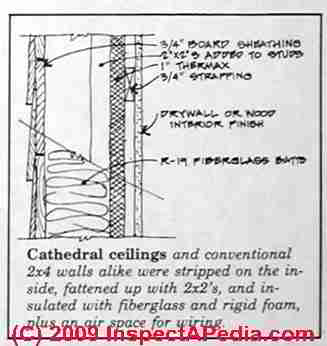
This article discusses the question: are there any health hazards associated with applying rigid foil-faced insulating foam (polyisocyanurate insulation) on the interior side of walls? Sketch at page top and accompanying text are reprinted/adapted/excerpted with permission from Solar Age Magazine - editor Steven Bliss.
InspectAPedia tolerates no conflicts of interest. We have no relationship with advertisers, products, or services discussed at this website.
Indoor use of foil faced polyisocyanurate foam insulating board
- Q&A on use of Rigid Foam Insulating Board - original text. Use your browser's back button to return to this page
The question-and-answer article about the indoor use of foil faced insulating foam found just board below paraphrases, quotes-from, updates, and comments an original article from Solar Age Magazine and written by Steven Bliss.
Is Foil Faced Polyisocyanurate Foam Insulation Hazardous when Used Indoors?
Are there any health hazards associated with applying rigid foil-faced polyisocyanurate insulation on the inside of the existing walls of a living space?
I am aware that these insulations give off toxic gases as they burn. The question in my mind is whether they are safe on a day-to-day basis within the building envelope with an air change rate of say 0.75 ACH per hour? -- R.H. Mendocino CA
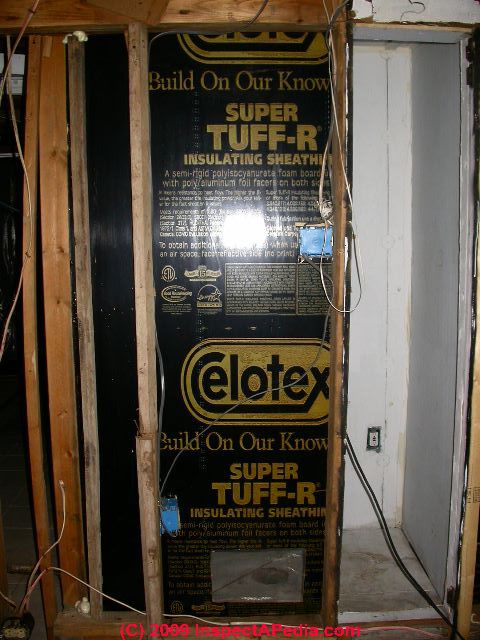
Our photograph (above left) shows Celotex Super Tuff-R® polyisocyanurate insulating board used indoors.
Answer:
Rigid polyisocyanurate insulation is foamed from freon gas, a fluorinated hydrocarbon often used as a refrigerant and until the early 1980's, as a propellant in aerosols. [Currently non HFC gases are used for foam insulation production --DF]
The earlier-used Freon gas family and modern refrigerants are inert gases and are considered non-toxic, except in very high concentrations of over 1000 ppm [at which point even an inert gas can cause asphyxiation].
The small quantities of gas that will be released from this foam insulating board [until it has "cured" and stopped outgassing] by diffusion or rupture are not considered a health hazard by the several health authorities we contacted. The upper-limit service temperature for this type of foam is 250 degF.
In uncontrolled combustion, all flammable building materials release high levels of toxic fumes. The National Fire Protection Association (NFPA) recommends that all insulation products be contained behind drywall or a suitable fire retarder. A check with your local building officials is almost certainly going to confirm that foam insulation products may not be left exposed in the living area.
In our sketch at page top you will see that the solid foam insulating board in that illustration is placed on the building interior wall surface, but it has been covered with furring strips and then drywall. The furring strips provide a dead air space, increasing the wall's R-value, and the space is in some conditions also used for routing wiring.
The hazard with foam insulation products is of production of toxic fumes or smoke release during a building fire, not outgassing during normal building conditions.
Here we include solar energy, solar heating, solar hot water, and related building energy efficiency improvement articles reprinted/adapted/excerpted with permission from Solar Age Magazine - editor Steven Bliss.
Reader Question: using polyisocyanurate form insulation in the roof (ceiling) of our out door sauna
(Aug 6, 2011) Diane said: Hello great article.
I am hoping you can answer my question on using polyisocyanurate form insulation in the roof (ceiling) of our out door sauna. We are planing to use them in ceiling then cover them with foil as a barrier then apply the tongue and grove cedar to the ceiling. Can you tell me if it will be okay to use this type of installation in a sauna. My concern is the heat generated by the sauna and off gassing. Please let me know if it is safe to use this product. Thanks for your assistance.
(Aug 7, 2011) Diane said: Thanks for your opinion and information. I will send this web site to our builder to review. And we will be installing a metal roof for the sauna. But I am still unsure about the off gasing of this product. Do you know anything about that aspect of this product?
Reply: Air leaks as a moisture source in roofs versus need for a vapor barrier
DanJoeFriedman (mod) said:
Diane my OPINION is that the installation of a foil vapor barrier forms a perfect vapor barrier - foil has a perm rating close to zero - except if it's cut or penetrated. (It's probably fine for the ceiling covering nails to penetrate the foil where it crosses over ceiling joists).
There are fire code and fire barrier standards that make sense to apply to any occupied building, not just your home, but also outbuildings like a sauna. Check with your building department to ask if the fire barrier formed by the T&G cedar ceiling is adequate to meet the code requirement for covering foam insulation. If it's not, you can add a layer of fire-rated drywall before installing the ceiling boards.
Finally, while I like the energy efficiency of foam insulation installations, I'd take extra care to inspect and maintain the building roof - from outside. A foam-insulated ceiling without ventilation and without inspection access (say a foamed cathedral ceiling) can't be inspected for leaks from inside. Any damage to the roof that causes a leak can result in very extensive damage to the insulated ceiling before you'd notice it indoors.
On a recent foam-insulated ceiling project we opted for a standing seam metal roof for these reasons.
Reader Comments, Questions & Answers About The Article Above
Below you will find questions and answers previously posted on this page at its page bottom reader comment box.
Reader Q&A - also see RECOMMENDED ARTICLES & FAQs
On 2017-12-24 - by (mod) -
Its heat loss through the foundation thst can reduce frost push damage. So any steps, insulation in either scheme, increase the risk.
A more costly approach of insulating the foundation exterior provides a compressible surface that resists damage.
Current approaches convert ctaelspaces to a dry, heated, insulated and conditioned space, combined with steps to keep water away from the foundation exterior so as to reduce frost push.
On 2017-12-20 by Pollo Rey
I don't have any water entry issues.
I am aware of the risk in some locations for foundation buckling...I am therefore not suggesting insulating the entire height of the foundation wall, by using a 4' piece of insulation from the basement ceiling I would limit heat loss half way to the 48" frost line but maintain some heating/heat loss at the bottom 2.5' of foundation wall (80" ceiling).
Which method (wall or ducting insulating) would be least risky to the foundation?
Thanks,
On 2017-12-19 - by (mod) -
Pollo
Its the heat loss through the foundation that can reduce frost push damage. So any step that make the foundation wall colder, such as insulation in either of your schemes can increase the risk of frost damage.
A more costly approach of insulating the foundation exterior provides a compressible surface that resists damage while reducing heat loss - that's what we'd do in new construction. But excavating around the foundation outside is a costly retrofit job.
Current approaches convert both basements and crawl spaces to a dry, heated, insulated and conditioned space, combined with steps to keep water away from the foundation exterior so as to reduce frost push.
Take a look at BUCKLED FOUNDATIONS due to INSULATION? at https://inspectapedia.com/Energy/Buckled_Foundation_Insulation.php before proceeding.
Then see WET BASEMENT PREVENTION https://inspectapedia.com/Energy/Wet_Basement_Prevention.php f
or other exterior treatments of building foundation walls to combine foundation insulation with basement waterproofing membranes and drainage systems.
On 2017-12-18 by Pollo Rey
Upstate NY, clay soil, the soil is ~2' from top of foundation, frost line is 48".
The question really hinges on what is easiest way to minimize heating loss in the basement. I have large metal rectangular network of heating ducts and the loss is considerable. Is it better to insulate the ducting or the foundation.
Which one is least risky/detrimental to the foundation? The thickness of the insulation hasn't been decided. I was thinking 2".
I can't see adding external insulation as a project I want to get into. It would also negatively impact the looks of the place (brick exterior).
Thanks,
On 2017-12-18 by Anonymous
Not necessarily, since the answer would depend on the climate where you live, the frost depth, the amount of insolation, and where the top of the soil is in relation to the top of your foundation. There's also the question of whether you're placing it on the best side of the foundation wall.
On 2017-12-18 by Pollo Rey
If installing POLYISOCYANURATE FOAM BOARD in a basement, a 48" vertical dimension from the ceiling down part of the way to the floor, would that provide the necessary protection from frost heave/foundation issues? It would be covered with drywall.
Thanks
On 2017-03-15 - by (mod) -
Sorry Eric but I don't understand enough of your design, applications, needs, to have a useful opinion.
If you search Inspectapedia.com for "EVAPORATIVE COOLING" you'll see more about that system and its design for cooling buildings
On 2017-03-15 by ERICAH
I am in need of constructing an evaporative cooling facility which combines both inleting of cooled air at the bottom and humidity at top floor, is there any thing wrong with that.
On 2015-11-29 - by (mod) -
Wow. In my OPINION you may have made some ultra-fine particles that could be harmful; MOreso if the foil faced foam insulation was reinforced with fiberglass.
At this point if there's noticeable dust around I'd damp wipe and HEPA vac wherever you're seeing the problem. Do not run a normal household vacuum as you may simply increase the level of fine airborne particles.
Search InspectApedia.com for FIBERGLASS hazards to read about that possible concern;
I have not found research on ultra-fine particle hazards (to human in short term) from the foam iteslf; of course any scan of recent media report, including the NY Times in the last few days, will turn up articles about a serious concern for the release of ultra-fine plastics (and perhaps including foam) into the environment.
Searc
On 2015-11-29 by Anonymous
With regards to using foil faced insulation indoors... We ran a bunch thru the table saw and applied indoors. There is a very fine dust that has a static charge that gets everywhere. How bad is this dust compared to wood dust
On 2015-03-11 by Blory
Can polyisocyanurate ridged foam board foil faced be used in a vented crawl space installed on the underside of the joists the cavities of which are filled with batt insulation? Is there a fire rating suitable for use in 4 ft. open ventilated crawl space that can be used for this purpose?
On 2013-01-02 by David
Can I glue drywall directly on top of polyiso ? Ios glued to plaster wall and drywall glued to the iso. Cheers, and thank you.
On 2011-09-07 - by (mod) -
Suzanne,
It makes sense to do a sniff test - some of the plastic vapor barriers I've seen used by building remediators were virtually odorless; In other cases we placed the poly outdoors in the sun for a few days to help it complete its outgassing before putting it down in a crawl area.
But a damp dirt floor crawl space could have led to a mold problem or there could be other health and IAQ issues coming from that location or even elsewhere in the building.
at MOLD INFORMATION CENTER (article link at page left) you can find an article titled MOLD EXPERT, WHEN TO HIRE - that might help you decide if it's appropriate to bring in an expert for a more thorough building inspection and perhaps some tests. I'd be reluctant to ONLY blame the plastic odors (though those have bothered me too at times).
I've added and elaborated on this reply in our article on crawl spaces where we discuss dryout procedures, ground covers, etc.
On 2011-09-07 by Suzanne
I have a dirt crawl space under my bedroom floor which is causing me some health problems. I am extremely allergic to mold and my husband put 6 ply visqueen on dirt floor & 2 vents in block. I became extremely sick from visqueen order and I removed it, still feeling sick but not as bad. I am closing off the 2 vents to avoid anymore air flow in crawl space. However, I want to put something down overtop the dirt floor and adhere it to the concrete walls to avoid any further allergy problems plus have cleaner air flow in our bedroom....but the plastic's are mostly made of polyurethene which might be sensitive too also or with the combinations and exposure to the dirt floor caused more airborne mold spores & allergies. Even in the middle of the night I feel like something is crawling & biting me....and my husband is coughing something awful and we both have headaches & sinus, breathing problems too, nausea, disoriented and confusion. I am very worried about this and want it repaired ASAP before its too late. I am looking for something to cover & seal the dirtflooring but want something that is chemical free. I would also like to know if it would be wise to put insulation up underneath the bedroom floor to help prevent from coming up thru the floor into the bedroom? Any information, suggestions, ideas would be greatly appreciated. thank you!
On 2011-08-21 by wendy
when using the super tuff r 1 sided foil face insulation in the attic bedroom ceiling...do i use the wood strips there as well...? and which way would the foil face...the roof or the inside of the bedroom..?
On 2011-08-08 2 - by (mod) -
Diane re new blown in foam insulation outgassing / offgassing: take a look at
1. the installation instructions for your particular product. The manufacturer will tell you how long to wait before the drywall should be installed on the ceiling or walls where the foam has been installed. Typically it's 24 hours.
2. take a look at the chemicals, mix, propellant, etc. in your particular foam product. A good place to read accurate information is in the MSDS sheet for the particular product. Those are usually available from the manufacturer, often from the foam installer, and usually online too. Many of them are also posted at this website.
On 2011-08-07 by Diane
Thanks DanJoeFridman for your opinion and information. I will send this web site to our builder to review. And we will be installing a metal roof for the sauna. But I am still unsure about the off gasing of this product. Do you know anything about that aspect of this product?
On 2011-08-06 - by (mod) -
Diane my OPINION is that the installation of a foil vapor barrier forms a perfect vapor barrier - foil has a perm rating close to zero - except if it's cut or penetrated. (It's probably fine for the ceiling covering nails to penetrate the foil where it crosses over ceiling joists).
There are fire code and fire barrier standards that make sense to apply to any occupied building, not just your home, but also outbuildings like a sauna. Check with your building department to ask if the fire barrier formed by the T&G cedar ceiling is adequate to meet the code requirement for covering foam insulation. If it's not, you can add a layer of fire-rated drywall before installing the ceiling boards.
Finally, while I like the energy efficiency of foam insulation installations, I'd take extra care to inspect and maintain the building roof - from outside. A foam-insulated ceiling without ventilation and without inspection access (say a foamed cathedral ceiling) can't be inspected for leaks from inside. Any damage to the roof that causes a leak can result in very extensive damage to the insulated ceiling before you'd notice it indoors.
On a recent foam-insulated ceiling project we opted for a standing seam metal roof for these reasons.
On 2011-08-06 by Diane
Hello great article. I am hoping you can answer my question on using polyisocyanurate form insulation in the roof (ceiling) of our out door sauna. We are planing to use them in ceiling then cover them with foil as a bearier then apply the tonge and grove cedar to the ceiling. Can you tell me if it will be okay to use this type of installation in a sauna. My concern is the heat generated by the sauna and off gasing. Please let me know if it is safe to use this product. Thanks for your assistance.
...
Continue reading at POLYISOCYANURATE FOAM BELOW SLABS or select a topic from the closely-related articles below, or see the complete ARTICLE INDEX.
Or see these
Recommended Articles
- CELOTEX HISTORY & PRODUCTS
- FLOOR, CONCRETE SLAB CHOICES choice of finish floor materials to preserve use of thermal mass of a concrete floor slab.
- INSULATION LOCATION for BASEMENT WALLS
- ENERGY SAVINGS PRIORITIES
- INSULATION INSPECTION & IMPROVEMENT
- POLYISOCYANURATE FOAM BELOW SLABS
- POLYISOCYANURATE FOAM and IAQ
- POLYISOCYANURATE FOAM BOARD - Celotex, Dow, & other polyisocyanurate foam board insulation products, properties, history
- POLYSTYRENE FOAM INSULATION, INSULATION LOCATION for PASSIVE SOLAR FLOOR SLAB
- POLYSTYRENE FOAM INSULATION
- RIGID FOAM USE INDOORS
- SLAB INSULATION, RADIANT / PASSIVE SOLAR
Suggested citation for this web page
POLYISOCYANURATE FOAM and IAQ at InspectApedia.com - online encyclopedia of building & environmental inspection, testing, diagnosis, repair, & problem prevention advice.
Or see this
INDEX to RELATED ARTICLES: ARTICLE INDEX to BUILDING INSULATION
Or use the SEARCH BOX found below to Ask a Question or Search InspectApedia
Ask a Question or Search InspectApedia
Try the search box just below, or if you prefer, post a question or comment in the Comments box below and we will respond promptly.
Search the InspectApedia website
Note: appearance of your Comment below may be delayed: if your comment contains an image, photograph, web link, or text that looks to the software as if it might be a web link, your posting will appear after it has been approved by a moderator. Apologies for the delay.
Only one image can be added per comment but you can post as many comments, and therefore images, as you like.
You will not receive a notification when a response to your question has been posted.
Please bookmark this page to make it easy for you to check back for our response.
Our Comment Box is provided by Countable Web Productions countable.ca
Citations & References
In addition to any citations in the article above, a full list is available on request.
- Solar Age Magazine was the official publication of the American Solar Energy Society. The contemporary solar energy magazine associated with the Society is Solar Today. "Established in 1954, the nonprofit American Solar Energy Society (ASES) is the nation's leading association of solar professionals & advocates. Our mission is to inspire an era of energy innovation and speed the transition to a sustainable energy economy. We advance education, research and policy. Leading for more than 50 years. ASES leads national efforts to increase the use of solar energy, energy efficiency and other sustainable technologies in the U.S. We publish the award-winning SOLAR TODAY magazine, organize and present the ASES National Solar Conference and lead the ASES National Solar Tour – the largest grassroots solar event in the world."
- Steve Bliss's Building Advisor at buildingadvisor.com helps homeowners & contractors plan & complete successful building & remodeling projects: buying land, site work, building design, cost estimating, materials & components, & project management through complete construction. Email: info@buildingadvisor.com
Steven Bliss served as editorial director and co-publisher of The Journal of Light Construction for 16 years and previously as building technology editor for Progressive Builder and Solar Age magazines. He worked in the building trades as a carpenter and design/build contractor for more than ten years and holds a masters degree from the Harvard Graduate School of Education. Excerpts from his recent book, Best Practices Guide to Residential Construction, Wiley (November 18, 2005) ISBN-10: 0471648361, ISBN-13: 978-0471648369, appear throughout this website, with permission and courtesy of Wiley & Sons. Best Practices Guide is available from the publisher, J. Wiley & Sons, and also at Amazon.com - Tuff-R™ and Super Tuff-R™, Dow Building Solutions, have an R-value of R 6.5 per inch. Note that the R-value of this insulating board is increased to R-9.3 per inch if construction includes a 3/4" air space. These are closed-cell polyisocyanurate insulating foam core board products. The foam core is sandwiched between a choice of exterior faces including aluminum foil, tri-plex aluminum foil, or polyester kraft paper combined with reinforced aluminum foil. One board side is blue, the other is radiant aluminum foil. These products must be covered with a minimum of 1/2" drywall or equivalent thermal barrier in building applications.
- Our recommended books about building & mechanical systems design, inspection, problem diagnosis, and repair, and about indoor environment and IAQ testing, diagnosis, and cleanup are at the InspectAPedia Bookstore. Also see our Book Reviews - InspectAPedia.
- In addition to citations & references found in this article, see the research citations given at the end of the related articles found at our suggested
CONTINUE READING or RECOMMENDED ARTICLES.
- Carson, Dunlop & Associates Ltd., 120 Carlton Street Suite 407, Toronto ON M5A 4K2. Tel: (416) 964-9415 1-800-268-7070 Email: info@carsondunlop.com. Alan Carson is a past president of ASHI, the American Society of Home Inspectors.
Thanks to Alan Carson and Bob Dunlop, for permission for InspectAPedia to use text excerpts from The HOME REFERENCE BOOK - the Encyclopedia of Homes and to use illustrations from The ILLUSTRATED HOME .
Carson Dunlop Associates provides extensive home inspection education and report writing material. In gratitude we provide links to tsome Carson Dunlop Associates products and services.
 | HOME | ABOUT | ASK a QUESTION | CONTACT | CONTENT USE POLICY | DESCRIPTION | POLICIES | PRIVACY | |
| © 2024 - 1985 Publisher InspectApedia.com - Daniel Friedman | |||||||||