
InspectAPedia® FREE Encyclopedia of Building & Environmental Construction, Diagnosis, Maintenance & Repair |
Question? Just ask us! InspectAPedia
|
 Thermal Mass Trade-Offs: Heating vs Cooling, Insulated vs Un-insulated Floor Slabs
- POST a QUESTION or COMMENT about climactic design, including insulating under floor slabs and thermal mass used with radiant heating systems
Thermal mass in buildings - trade-offs:
This article discusses the pros and cons of insulating under floor slabs where a radiant floor heating system is to be installed. We address the question of finding the balance between obtaining a building cooling benefit through an un-insulated floor slab and the heating costs for an in-slab radiant heat design without under-slab insulation.
InspectAPedia tolerates no conflicts of interest. We have no relationship with advertisers, products, or services discussed at this website.
Radiant floor heating vs cooling: what about a balance between summer cooling and winter heating
 Discussed here: How to use thermal mass with radiant heating systems. When or in what climates should we insulate below the slab of a radiant heat floor design? When or in what climates is it better not to insulate below the floor slab in a radiant heat design?
What is the "mass effect" in buildings or "mass-enhanced R-value?" How does thermal mass interact with or balance out against thermal insulation in buildings?
Compare high thermal mass and low thermal mass wall designs of the same R-value.
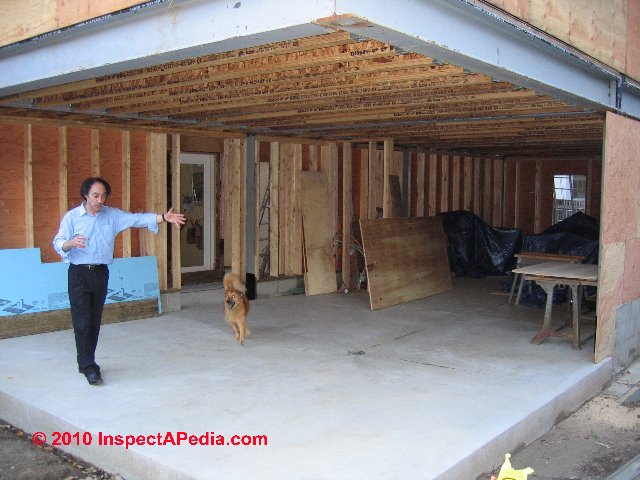
Our page top photo (above) shows our friend Steve and his dog as they were explaining the radiant heat tubing layout in the new garage floor slab of a Minneapolis MN home.
These radiant heat and thermal mass design articles describe how to substantially reduce building energy usage and costs: building heating and cooling costs, electric bills, and heating fuel bills.
Questions & answers about thermal mass and radiant heated floors.
Radiant floor heating and cooling: what about a balance between summer cooling and winter heating?
When is it good design to omit insulation below a radiant-heated floor slab?
In south central Tennessee near Alabama we are building a small 1700 ft2 home. Three sides and the roof are completely enclosed in hillside soil with a 2 feet of soil over roof. We are installing radiant floor heating with an air handler back-up. Both will be hot water heated via wood burning boiler.
We have an annual temperature range from the low teens to the high nineties (degrees F). Our intention is to employ edge insulation but NOT floor insulation on the concrete slab floor. Our thinking is this will allow for radiant cooling in the summer and we will “pay” a manageable cost in performance during the winter.
We are pouring in two weeks and would greatly appreciate a response to this question: ARE WE ABOUT TO MAKE A BIG MISTAKE? Thanks. Sincerely Jim and Larry - Homeowners doing the work.
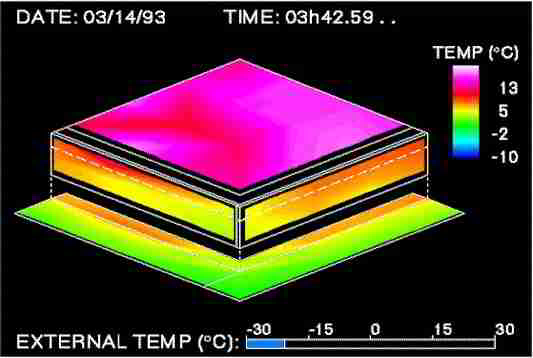
Our illustration (above left) gives "A corner perspective view of one quadrant of a frost-protected shallow foundation showing filled experimental temperature contours on the slab surface; on the exterior stem wall surface (underneath the vertical insulation); and, on a plane containing the base of the stem wall and the underside of the horizontal wing insulation." (Image & quotation courtesy of Energy Systems Design Program, University of Minnesota [6], used with permission.)
Reply: Match the building insulation plan and heating and cooling design to the climate
Steven Bliss & Daniel Friedman
Jim and Larry, your project is far enough south that the benefit from cooling, using the earth as a heat sink or a source of cooling in hot weather may outweigh the cost of heating in cool weather.
I [DF] have been very critical of uninsulated slabs in cold climates where the heating load is significant (see RADIANT HEAT FLOOR MISTAKES) . But I did not intend to suggest that in a climate where cooling costs are high that the data works out to the same conclusion nor that all buildings should have the same design regardless of climate.
Radiant Heating vs Radiant Cooling Floor Design Contrasts
Just to get a technical point out of the way, while we may speak of "radiant heating," it does not quite work the same way to speak of "radiant cooling". That is, a warm floor surface may heat surrounding objects by radiant heat and slowly heat the entire room - a method that many homeowners say is quite comfortable. But during hot weather a cooler floor doesn't "radiate" coolness - it won't blow cool air as does a conventional air conditioner or heat pump, and more importantly, it won’t dehumidify which is as important for comfort as the air temperature in hot, humid climates.
A large, warm floor surface has an easy time radiating heat to other objects in the room, and also slowly heats air near the floor surface which circulates naturally due to convection.
The other warmed surfaces also heat air, slowly raising the rooms air temperature. In addition, the warm floor radiates heat directly to the people in the room, making them feel warmer – the same way you feel warmer in the sunshine vs. than in the shade with the same air temperature.
This effect of radiant warmth is quantified as a room’s “mean radiant temperature,” independent of the air temperature. Direct warming of your feet also adds to the comfort of radiant floor heat.
Conversely, a large cool surface lowers the radiant temperature in a room. You can experience this radiant cooling effect by walking by a large cool rock in the shade on a hot day. In this case, you are radiating body heat to the rock. A cool surface under your feet can also make you feel cooler (like walking on cold bathroom tiles on a hot day). Also, if the floor is cool enough, heat radiating from hot or warm objects in the room will find some absorption by the cooler floor surface. So the room is radiating heat back to the floor, though I suspect with less efficiency in cooling mode than in heating mode. Why?
One reason is that air cooled by contact with the floor will not circulate upward by convection, but tend to sit on the floor – that’s why the supermarket can have open-top coolers for many items.
Cool air near the floor also raises the relative humidity of air near the floor, possibly leading to condensation and mold growth on the floor – especially if there is carpeting. Whenever the dew point of the air is below the temperature of the floor surface, condensation will occur – a likely scenario in a humid climate such as yours. In addition, having cold under your feet, but warm, humid air in the room does not sound all that comfortable. You would most likely need to dehumidify the air for both comfort and condensation control.
Floor coverings are also an issue for both radiant heating and cooling. They insulate the floor surface and reduce the effectiveness of both radiant heating and cooling. They require higher water and slab temperatures for heating and colder for cooling. Generally slab temperatures are limited to 85°F for heating as hotter floors are uncomfortable and cause problems with some floor coverings – especially wood.
For cooling, experts suggest that the floor temperature should not go below 66°F, assuming people are wearing shoes or socks. Conductive floors such as tile should be warmer, especially where people will be barefoot as in bathrooms.
For these reasons, radiant slab cooling is not widely used and is probably not appropriate for humid climates.
Where it is done, chilled water is circulated through the slab. The effectiveness of an earth-cooled slab is very difficult to calculate and would depend on a number of variables such as earth temperatures, soil conductivity (a function largely of its water content), and how much heat the soil has absorbed from the radiant slab in the heating season. My guess is that it would not be very effective.
In theory at least, the thermal mass of the soil above more roof may be more useful for cooling than a radiant floor. The cooled air will circulate more effectively into the room and the better air circulation and lack of coverings, such as carpeting, will increase the efficiency of the mass and reduce the likelihood of condensation and mold problems.
Since you are in a humid climate with about 3,000 heating degree days and 2,000 cooling degree days, I suspect that you would be better off building a tight, well-insulated house and insulating the slab. That would ensure low heating costs in winter, and reduce cooling and dehumidification costs in summer. In summer, air leakage into the house will increase both the sensible (air temperature) and latent (humidity) cooling loads.
For a tutorial on using thermal mass and radiant heat together see these two updated Solar Age articles: THERMAL MASS in BUILDINGS - Remember Thermal Mass?
The tools for understanding thermal mass may lie in the beer cooler, King Tut's tomb, and the refrigerator, and see RADIANT HEAT - usage guide, Radiant Heat: how it works and when to use it - for a description of strategies for using radiant heat
Compare Construction Costs vs. Energy Costs to Heat & Cool over Building Life
You'll want to estimate cooling and heating costs including anticipated energy cost rises in the future as well as energy cost comparisons between electric and fossil fuels, depending on how you are going to heat vs cool the home.
One could certainly compare two designs:
A: Summer cooling making use of the heat-absorbing properties of an uninsulated floor slab in good thermal contact with the cooler earth below, paying higher heating costs during the heating season due to heat losses through the floor.
B. Summer cooling making use of the heat-absorbing properties of a the thermal mass of an insulated floor slab, still insulating the slab from the earth below, making use of the same slab as a heat sink and reservoir during the heating season. This approach may save on energy costs but will have a higher build cost.
However, since you will probably need some mechanical cooling and dehumidification in either scenario, the advantages of an uninsulated slab will be modest and probably not worth the heating penalty.
Since calculating the effects of thermal mass and earth sheltering is so complex, however, you will have to rely on guesstimates and perhaps the experience of others who have built earth-sheltered homes in your area.
In sum, my OPINION is that you are considering a design that has appeal for simplicity and lower installation cost. But given the uncertain efficiency of the thermal mass for cooling and the potential problems with condensation, I’d recommend building a tight, well-insulated home and insulating the slab as well to predictably reduce your long-term heating and cooling loads.
Thermal Mass and Building Energy Costs: reduced cooling loads in some climates
High-mass houses have been studied extensively by the log home industry and concrete industry through sophisticated computer modeling and field testing.
They were intent on proving that the “mass effect” of high-mass buildings helped save energy independent of the R-value of the components. Their goal was to prove that log homes or, in the case of the concrete industry, concrete homes were inherently energy-efficient.
Their efforts were somewhat successful in that ASHRAE, the organization that sets standards for the thermal performance of buildings now recognizes that thermal mass plays a modest role in a building’s performance (see ASHRAE Standard 90.1).
The benefit is mainly to reduce cooling loads in climates with hot days and cold nights. It does this by damping the temperature swing inside the space. Think adobe buildings in the high, arid Southwest where it may be 90°F during the day and 40°F at night. The high mass walls will keep the indoor temperature closer to the average of these two temperatures and thus more comfortable – reducing or eliminating the need for mechanical cooling, especially in arid areas where dehumidification is not needed.
When the outdoor temperatures are above the human comfort level, both day and night, such as in Florida in summer, thermal mass has much less value. It will cause a lag in the indoor peak temperature, relative to outdoors, but that may and may not be beneficial.
Thermal mass has less benefit for heating, and probably no benefit in cold climates when the winter temperature stays below the comfort level all day and night -- as in the northern U.S. in winter. One effect of a high-mass home, is that it is difficult to quickly heat up the house – which is why setback thermostats are not recommended in homes with radiant slabs.
It’s also why direct-gain passive solar homes perform poorly in cold, cloudy weather. If the thermal mass is allowed to cool off during these periods, it takes a long time to heat up the building and the mass provides radiant cooling – when you need it the least!
Balanced Temperature Swings & Thermal Mass Benefits
One can observe that at locations where average day and night temperatures swing just about the same around a comfortable indoor temperature range, thermal mass alone can provide significant comfort in buildings and much less outside energy may be needed to heat or cool the home.
At PASSIVE SOLAR HEAT PERFORMANCE and at PASSIVE SOLAR HOME, LOW COST we illustrate homes located at an elevation of about 6300 ft. in central Mexico. Although it's not quite in perfect balance, a home in San Miguel de Allende (described at x) has been considered by its occupants (DF & family) to be comfortable enough as to not require central heating nor air conditioning.
The structure, built of plastered adobe and concrete, has a high thermal mass. Passive solar gain warms the structure during the day, providing heat that is returned in cooler evenings; during warmer parts of the day the still-cool mass of the structure helps keep indoor temperatures comfortable.
At Technical Reviewers &References or Citations we include references to other sources on this topic. Reference [2] seems to contain an error, in the section: “Nearly all areas with significant cooling loads can benefit from thermal mass in exterior walls. The sunny Southwest, particularly high-elevation areas of Arizona, New Mexico and Colorado, benefit the most from the mass effect for heating.” I think they meant to say “cooling.” Reference [3], a blog posting of the same information, gets this right.
What is Mass-Enhanced "R" Value?
In a thoughtful article about mass-enhanced R-value, BuildCentral reports that while thermal mass can outperform low-mass building walls (or in your case floors) of the same R-value, deciding if a particular building will benefit from this design requires some careful thought. Quoting:
The mass effect is real. High-mass walls really can significantly outperform low-mass walls of comparable steady-state R-value--i.e., they can achieve a higher "mass-enhanced R-value." BUT (and this is an important "but"), this mass-enhanced R-value is only significant when the outdoor temperatures cycle above and below indoor temperatures within a 24-hour period. Thus, high-mass walls are most beneficial in moderate climates that have high diurnal (daily) temperature swings around the desired indoor setpoint. [4]
Thermal Mass & Passive Solar Energy Systems for Heating, Cooling, or Both
We discuss thermal mass in building floors in passive solar designs at SLAB INSULATION, RADIANT / PASSIVE SOLAR and at BLOCKBED RADIANT FLOORS - SOLAR DESIGN.
And at FLOOR, CONCRETE SLAB CHOICES we illustrate a floor slab (with incomplete under-slab insulation) that provides thermal mass helping to stabilize temperatures in a cabin in northern Minnesota.
Incidentally, experts no longer recommend solar rock bins as thermal mass or for thermal storage. These were largely discredited by Solar Age and others as ineffective, expensive, and prone to all manner of problems with mold, poor airflow, etc.
As for modeling thermal mass effects and earth-sheltering, it’s usually done on mainframes using DOE BLAST, so it’s not for the faint hearted or anyone else who does not have a PhD in physics.
Thermal Mass & Active Solar Energy Systems for both Heating & Cooling
Take a look at RADIANT HEAT for a discussion of the nature or radiant heat, how it works, and when/where to use it.
And you may also want to review Active Solar Rock-bed Heat Storage Design Details: Active Solar Energy Systems, and also Active Solar Blockbed Floor Design for examples of using thermal mass to control both heating and cooling cost, and in the case of the second article, including active cooling by routing building air through passages in the thermal-mass of a cool floor.
Steven Bliss adds:
I [Steve Bliss] did a follow-up where-are-they-now study once at Solar Age, looking at well-known solar and alternative houses including a couple of earth-sheltered houses built by Malcolm Wells, one of the widely published proponents of living underground. To make a long story short, I contacted the owners who had recently removed all the earth from their roof due to mysterious pinhole leaks in the rubber roof, which maybe was not designed to have tons on earth overhead.
Living underground is not for everyone – anymore than everyone would want to live in someone’s basement unless they could not afford to live upstairs. In sum, there are much more reliable ways to cut heating and cooling costs.
Thermal mass and its effects on building heating and cooling is a complicated topic -- and earth coupling is even more complicated due to deep earth temperatures, seasonal storage of heat/coolness from the building itself, the interplay of mass and thermal conductivity, and the complexity of heat movement through three dimensions.
Back in the 1980's there was an outfit at the University of Minnesota called the Underground Space Center (currently the Energy Systems Design Program [6]) That advocated earth-sheltered buildings and modeled them using mainframes (probably had the computing power of your cell phone today). They published a number of academic papers and manuals on the subject. Kenneth Labs [5] was the lead author of many of these and we include links to several books on Climactic Design authored or co-authored by Mr. Labs in ourReferences or Citations section below. But interest waned and you don’t hear much about underground houses today.
The Bottom Line on Thermal Mass Tradeoffs and Building Heating & Cooling Designs - Climactic Design
High mass walls are good in sunny, high-arid climates, as we pointed out above.
Thermal mass is needed in direct-gain passive-solar homes with large amounts of south-facing glass. (Doug Balcomb was a physicist at Los Alamos who did a lot of the seminal work on passive solar design – working across the hall from people developing better nuclear bombs.)
Of course these heavily glazed homes perform very poorly in the cloudy northeast where the sun shines about half as much as they do in Los Alamos, a point lost on many of the early builders of passive solar homes. This resulted in a large number of “solar freezers and cookers” being built in the Northeast in the ‘70s and ‘80s.
Mass only made these buildings worse as you couldn’t heat easily or quickly them once the mass cooled off during cold, cloudy weather.
If you keep the south-facing glass to less than about 7 percent of the floor area, you generally don’t need to add thermal mass beyond the normal mass that the building provides. That, combined with a tight shell and good insulation, (and the wonders of modern low-E windows) is the ticket for most folks today – sometimes referred to as “sun tempered.” It’s a simple formula that simply works.
...
Continue reading at THERMAL MASS in BUILDINGS or select a topic from the closely-related articles below, or see the complete ARTICLE INDEX.
Or see these
Recommended Articles
Suggested citation for this web page
THERMAL MASS TRADEOFFS, HEATING vs COOLING at InspectApedia.com - online encyclopedia of building & environmental inspection, testing, diagnosis, repair, & problem prevention advice.
Or see this
INDEX to RELATED ARTICLES: ARTICLE INDEX to SOLAR ENERGY
Or use the SEARCH BOX found below to Ask a Question or Search InspectApedia
Ask a Question or Search InspectApedia
Try the search box just below, or if you prefer, post a question or comment in the Comments box below and we will respond promptly.
Search the InspectApedia website
Note: appearance of your Comment below may be delayed: if your comment contains an image, photograph, web link, or text that looks to the software as if it might be a web link, your posting will appear after it has been approved by a moderator. Apologies for the delay.
Only one image can be added per comment but you can post as many comments, and therefore images, as you like.
You will not receive a notification when a response to your question has been posted.
Please bookmark this page to make it easy for you to check back for our response.
Our Comment Box is provided by Countable Web Productions countable.ca
Citations & References
In addition to any citations in the article above, a full list is available on request.
- Solar Age Magazine was the official publication of the American Solar Energy Society. The contemporary solar energy magazine associated with the Society is Solar Today. "Established in 1954, the nonprofit American Solar Energy Society (ASES) is the nation's leading association of solar professionals & advocates. Our mission is to inspire an era of energy innovation and speed the transition to a sustainable energy economy. We advance education, research and policy. Leading for more than 50 years. ASES leads national efforts to increase the use of solar energy, energy efficiency and other sustainable technologies in the U.S. We publish the award-winning SOLAR TODAY magazine, organize and present the ASES National Solar Conference and lead the ASES National Solar Tour – the largest grassroots solar event in the world."
- Steve Bliss's Building Advisor at buildingadvisor.com helps homeowners & contractors plan & complete successful building & remodeling projects: buying land, site work, building design, cost estimating, materials & components, & project management through complete construction. Email: info@buildingadvisor.com
Steven Bliss served as editorial director and co-publisher of The Journal of Light Construction for 16 years and previously as building technology editor for Progressive Builder and Solar Age magazines. He worked in the building trades as a carpenter and design/build contractor for more than ten years and holds a masters degree from the Harvard Graduate School of Education. Excerpts from his recent book, Best Practices Guide to Residential Construction, Wiley (November 18, 2005) ISBN-10: 0471648361, ISBN-13: 978-0471648369, appear throughout this website, with permission and courtesy of Wiley & Sons. Best Practices Guide is available from the publisher, J. Wiley & Sons, and also at Amazon.com - [3] Wilson, Alex, "Thermal Mass and R-value:
Making Sense of a Confusing Issue", Environmental Building News, Vol 7 No. 4, http://www.buildinggreen.com/auth/article.cfm/1998/4/1/Thermal-Mass-and-R-value-Making-Sense-of-a-Confusing-Issue/ Quoting:
High-mass building materials can offer significant energy benefits in exterior walls. The benefit may be primarily in the shifting of peak load conditions or in an actual reduction in overall heat gain or loss. These benefits are highly dependent upon where the building is located, how it is designed, and how it is operated. How we should give credit—in terms of energy performance—for high-mass building materials is still very much open for debate. Until standardized procedures for determining the regional significance of the mass effect are widely applied, there will likely be continued confusion and continued exaggeration regarding the energy benefits of thermal mass. Oak Ridge researchers and companies such as Agriboard Industries are helping to bring these issues into public awareness, but a great deal of work remains to be done. - [4] "Mass-Enhanced R Value", Green Building Talk, Build Central, web search 09/01/2011, original source: http://www.greenbuildingtalk.com/Forums/tabid/53/aff/4/aft/59047/afv/topic/Default.aspx
- [5] Labs, Kenneth: Kenneth Labs, who as a senior editor of Progressive Architecture (P/A) remade the magazine’s Technics department, died on September 19, 1992 of mesothelian cancer in a Branford, Connecticut, hospice. As a visiting lecturer, Mr. Labs taught environmental technology at the Yale School of Architecture, and he wrote a number of published documents on planning, underground construction, and energy-efficient design, including the 1983 book Climatic Design: Energy-Efficient Building Principles and Practices, which he coauthored with Donald Watson. Ken often said that, in order to be taken seriously, the architecture profession needed a refereed journal like those of the medical profession, where papers are submitted to peer review before publication. Establishing such a journal was one of his long-term goals; in the meantime, he did his best to push our Technics department in that direction. Web search 09/02/2011, original source: http://www.waynelabs.com/KenLabs/KenLabsEulogy.htm
- Carmody, John, Labs, Kenneth, Builders Foundation Handbook, University Press of the Pacific, 2005, ISBN-10: 1410220885, ISBN-13: 978-1410220882
- Labs, Kenneth Labs, Watson, Donald, Climatic Design: Energy-Efficient Building Principles and Practices
- Labs, Kenneth, Watson, Donald, Climatic Building Design: Energy-Efficient Building Principles and Practices, Mcgraw-Hill, 1993, ISBN-10: 007068488X, ISBN-13: 978-0070684881
- Knowles, Ralph, Ritual House: Drawing on Nature's Rhythms for Architecture and Urban Design, ISBN-10: 1597260509, ISBN-13: 978-1597260503, Island Press 2006
- [6] Underground Space Center, research undertaken at the University of Minnesota pertaining to building foundations in a broad sense. The research described has been carried out since 1980, at the Underground Space Center, the Minnesota Building Research Center, the College of Design and the Department of Bioproducts and Biosystems Engineering. Current Energy Systems Design program director at U. Minnesota is Louise F. Goldberg Ph.D. (Eng). Web search 09/02/2011, original source: http://www.buildingfoundation.umn.edu/.
- [7] "Monitored Thermal Performance of ICF Walls in MURBs". Canada Mortgage and Housing Corporation report: Technical Series 07-119, Canada Mortgage and Housing Corporation
700 Montreal Road
Ottawa, Ontario
K1A 0P7
Phone: 1-800-668-2642. This study of insulated concrete form wall design monitored a seven story building with sensors at various places in the Insulating Concrete Forms (ICF) wall system and found no benefit from the thermal mass.
The study did find energy savings from improved resistance to air leakage. Web search 09/02/2011, original source http://www.cmhc-schl.gc.ca/odpub/pdf/65863.pdf Quoting:
The ICF wall assembly studied in this research project had an insulating value that was fairly close to the nominal insulation value of the polystyrene layers of insulation. While minor thermal bridges through the wall system were detected, the more severe bridges that were found were due to penetrations through the ICF system and did not represent a weakness in the ICF wall system. No thermal mass impact or higher effective insulation value was observed. However, the air leakage testing found the building to be relatively airtight and this can, for the most part, be attributed to the ICF wall system. The energy savings associated with the reduced air leakage alone are significant and would continue to accrue over the life of the building as the amount of air leakage through the ICF wall section would not be expected to increase to any great extent over time. - Advanced Energy Design Guides for Commercial buildings, developed by ASHRAE, DOE, AIA, IESNA, USGBC
- The ASHRAE Advanced Energy Design Guide for Small Office buildings—Office buildings up to 20,000 sq.ft.2
- The ASHRAE Advanced Energy Design Guide for Small Retail buildings—Retail Spaces up to 20,000 sq.ft.2
- ASHRAE Design Guide, Advanced Energy Design Guide for K-12 School buildings, 6/11/2008, This is an ASHRAE Design Guide. Design Guides are developed under ASHRAE’s Special Publication procedures and are not consensus documents. This document is an application manual that provides voluntary recommendations
for consideration in achieving greater levels of energy savings relative to minimum standards. American Society of Heating, Refrigerating and Air-Conditioning Engineers, The American Institute of Architects, Illuminating Engineering Society of North America, U.S. Green Building Council, U.S. Department of Energy - The ASHRAE 30% Advanced Energy Design Guide for Small Warehouses and Self-Storage buildings—Warehouses up to 50,000 ft.2 and self-storage buildings that use unitary heating and air-conditioning.
- Technical Support Document: Development of the Advanced Energy Design Guide for Medium Box Retail—50% Energy Savings - original source: http://www.nrel.gov/docs/fy08osti/42828.pdf
- Technical Support Document: Development of the Advanced Energy Design Guide for Grocery Stores—50% Energy Savings, E.T. Hale, D.L. Macumber, N.L. Long, B.T. Griffith, K.S. Benne, S.D. Pless, and P.A. Torcellini, NREL Technical Report TP-550-42820 September 2008 - original source http://www.nrel.gov/docs/fy08osti/42829.pdf
- "Updated ASHRAE 90.1 Energy Code May Help
Maximize The Benefits Of Energy Efficient
Technologies", Lindsay Audin, Building Operating Management, May 2005, discusses ASHRAE Standard ASHRAE 90.1-2004, the latest version of ASHRAE's energy code, encompassing updates to the ASHRAE 90.1-2001 standard. "Written to allow easy incorporation into specifications for new buildings and renovations, 90.1-2004 lays
out minimum requirements for a building’s envelope, electrical power systems and equipment, lighting,
heating, Ventilation and air conditioning, service, water heating, and energy management.
Under the 1992 federal Energy Policy Act (EPAct), ASHRAE 90.1 was mandated as the basis for all
state building codes as they affect energy use, starting with ASHRAE 90.1-1989. Under EPAct, the 1999
version became law in July 2004, but has yet to be adopted by all states. Since the 1999 version was
somewhat dated by the time it became a requirement, some states, especially those having high energy
prices, have already updated their building codes to the 2001 version. Some states and cities, such as Phoenix, are now going further by leapfrogging the 2001 edition and enacting part or all of the 2004 edition instead." - Desmex Solar, Blvd. José Ma. Morelos 3649, Col. Purísima de Jerez, León, Gto. C.P.37290 Tel. +52 (477) 788 06 00, Fax. +52 (477) 771 10 02, e-mail: leon@desmexsolar.com: website http://www.desmexsolar.com/ Additional offices in San Miguel de Allende, Guanajuato, Mexico - Carretera a Celaya Km. 1, Plaza Alhóndiga Local 14 (1M), Frente a Mega Comercial Mexicana, San Miguel de Allende, Gto. Tel: +52 (415) 150 73 12 e-mail: sanmiguel@desmexsolar.com, Guadalajara, Mexico - +52 (33) 3165-2454 e-mail: guadalajara@desmexsolar.com, Monterrey Mexico - Tel. +52 (818) 356 43 30 e-mail: monterrey@desmexsolar.com, and Mexico City - Tel. +52 (55) 2643 26 29, Fax. +52 (477) 771 10 02 e-mail: mexico@desmexsolar.com
- "Energy Efficient Lab Design", Nicolas Lemire, Eng., Member ASHRAE, and Roland Charneux, Eng., Fellow ASHRAE, American Society of Heating, Refrigerating and Air-Conditioning Engineers, Inc. (www.ashrae.org). Reprinted by permission
from ASHRAE Journal, (Vol. 47, No. 5, May 2005). ©ASHRAE - Energy Star Program - see the Energy Star website at energystar.gov/index.cfm?c=bldrs_lenders_raters.energy_efficient_mortgage
- Habitat for Humanity, for the U.S. and Canada: http://www.habitat.org/ also has offices in other countries including supporting Latin America.
- Renewable Energy Sources, US EPA List: original source - see "Onsite Renewable Technologies", U.S. EPA at http://www.epa.gov/greeningepa/energy/renewtech.htm
- Best Practices Guide to Residential Construction, by Steven Bliss. John Wiley & Sons, 2006. ISBN-10: 0471648361, ISBN-13: 978-0471648369, Hardcover: 320 pages, available from Amazon.com and also Wiley.com. See our book review of this publication.
- Decks and Porches, the JLC Guide to, Best Practices for Outdoor Spaces, Steve Bliss (Editor), The Journal of Light Construction, Williston VT, 2010 ISBN 10: 1-928580-42-4, ISBN 13: 978-1-928580-42-3, available from Amazon.com
- Energy Savings Methods: Whole House Systems Approach, U.S. Department of Energy
- In addition to citations & references found in this article, see the research citations given at the end of the related articles found at our suggested
CONTINUE READING or RECOMMENDED ARTICLES.
- Carson, Dunlop & Associates Ltd., 120 Carlton Street Suite 407, Toronto ON M5A 4K2. Tel: (416) 964-9415 1-800-268-7070 Email: info@carsondunlop.com. Alan Carson is a past president of ASHI, the American Society of Home Inspectors.
Thanks to Alan Carson and Bob Dunlop, for permission for InspectAPedia to use text excerpts from The HOME REFERENCE BOOK - the Encyclopedia of Homes and to use illustrations from The ILLUSTRATED HOME .
Carson Dunlop Associates provides extensive home inspection education and report writing material. In gratitude we provide links to tsome Carson Dunlop Associates products and services.
 | HOME | ABOUT | ASK a QUESTION | CONTACT | CONTENT USE POLICY | DESCRIPTION | POLICIES | PRIVACY | |
| © 2024 - 1985 Publisher InspectApedia.com - Daniel Friedman | |||||||||