InspectAPedia.com InspectAPedia®
Google
InspectAPedia
 

Free Encyclopedia of Building & Environmental Inspection, Testing, Diagnosis, Repair

Ask a Question or Search InspectAPedia

  • HOME
  • AIR CONDITIONING
  • DAMAGE ASSESSMENT
  • ELECTRICAL
  • EXTERIORS
  • HEATING
  • HOME INSPECTION
  • INTERIORS
  • PLUMBING
  • ROOFING
  • SEPTIC SYSTEMS
  • STRUCTURE
  • WATER SUPPLY
  • ENERGY SAVINGS
  • ENVIRONMENT
  • INDOOR AIR IAQ
  • INSULATION
  • MOLD INSPECT TEST REMOVE
  • NOISE
  • ODORS
  • SOLAR ENERGY
  • VENTILATION
  • EXPERTS DIRECTORY
  • CONTACT US


InspectAPedia ® Home

INSULATION INSPECTION & IMPROVEMENT

ACOUSTICAL SEALANT CHOICES
AIR LEAK MINIMIZATION
ASBESTOS IDENTIFICATION IN BUILDINGS
ATTIC VENTILATION

BASEMENT CEILING VAPOR BARRIER
BASEMENT HEAT LOSS
BUCKLED FOUNDATIONS due to INSULATION?

CATHEDRAL CEILING INSULATION
CATHEDRAL CEILING VENTILATION
CEILINGS, DROP or SUSPENDED PANEL
CRAWL SPACES

DEHUMIDIFICATION PROBLEMS
DEW POINT TABLE - CONDENSATION POINT
DUCT INSULATION, ASBESTOS PAPER

FIBERGLASS PARTICLE CONTAMINATION
Fiberboard Insulation Sheathing Mold
FIBERGLASS INSULATION MOLD
Fireproofing containing Asbestos
FRAMING DETAILS for BETTER INSULATION
FRAMING DETAILS for DOUBLE WALL HOUSES
FRAMING METAL STUD PERFORMANCE
FREEZE-PROOF A BUILDING

HEAT LOSS in BUILDINGS
HEAT LOSS PREVENTION PRIORITIES
HEAT LOSS R U & K VALUE CALCULATION
HOUSEWRAP AIR & VAPOR BARRIERS
HOUSE DOCTOR, how-to be
HUMIDITY LEVEL TARGET

ICE DAM PREVENTION
INSULATION AIR & HEAT LEAKS
INDOOR AIR QUALITY & HOUSE TIGHTNESS
INSULATION CHOICES
INSULATION FACT SHEET- DOE
INSULATION INSPECTION & IMPROVEMENT
INSULATION MOLD
INSULATION R-Values & Properties

LEED GREEN BUILDING CERTIFICATION
LOG HOME ENERGY EFFICIENCY

MOLD in FOAM INSULATION, RESISTANCE
MOISTURE CONTROL in BUILDINGS

NOISE / SOUND DIAGNOSIS & CURE

PASCAL CALCULATIONS

RADIANT BARRIERS
REFLECTIVE INSULATION
RIGID FOAM USE INDOORS

SHEATHING, FOIL FACED - VENTS
SLAB INSULATION, PASSIVE SOLAR
STAINS on & in BUILDINGS, CAUSES & CURES
STRAW BALE CONSTRUCTION
STUCCO WALL METHODS & INSTALLATION
STUCCO OVER FOAM INSULATION
SWEATING (CONDENSATION) on PIPES, TANKS

Thermal Expansion Cracking of Brick
THERMAL IMAGING, THERMOGRAPHY
THERMAL MASS in BUILDINGS
THERMAL TRACKING Indicates Heat Loss
TRUSS UPLIFT, ROOF

VAPOR BARRIERS & CONDENSATION in BUILDINGS
VENTILATION in BUILDINGS

WALL CONSTRUCTION BARRIER vs CAVITY
WIND WASHING INSULATION At EAVES
WINTERIZE A BUILDING

More Information

  (C) Daniel Friedman Is it Necessary to Insulate Under a Slab in a Superinsulated House?
     

  • Here we answer the question: do I need to insulate under my basement slab in a super-insulated house?
    • Do we insulated just the slab perimeter or the whole floor?
    • Can we use uninsulated floor slabs to help with cooling?
    • Critical insulation under radiant floors & passive solar floors
    • Advice for building insulation priorities
  • Questions & Answers about floor slab insulation guidelines & specifications or requirements
  • References

Click to Show or Hide Related Topics

  • INSULATION IDENTIFICATION GUIDE - home
  • INSULATION INSPECTION & IMPROVEMENT - home
  • INSULATION LOCATION - WHERE TO PUT IT - home
  • AIR LEAK SEALING PROCEDURE
  • BASEMENT HEAT LOSS
  • BLOWN-IN INSULATION
  • BUCKLED FOUNDATIONS due to INSULATION?
  • CATHEDRAL CEILING INSULATION
  • CEILINGS, DROP or SUSPENDED PANEL
  • CRAWL SPACE INSULATION RETROFIT
  • FRAMING DETAILS for BETTER INSULATION
  • FREEZE-PROOF A BUILDING
  • HEAT LOSS in BUILDINGS - home
  • ICE DAM PREVENTION
  • INSULATION LOCATION - WHERE TO PUT IT - home
    • INSULATION LOCATION & QUANTITY for ATTICS
    • INSULATION LOCATION for BASEMENT FLOORS
    • INSULATION LOCATION for BASEMENT WALLS
    • INSULATION LOCATION for BRICK or BLOCK WALL CAVITY
    • INSULATION LOCATION for BRICK VENEER WALLS
    • INSULATION LOCATION for CAPES, CRAWLSPACES
    • INSULATION LOCATION for CATHEDRAL CEILINGS
    • INSULATION LOCATION for CRAWL SPACES
    • INSULATION LOCATION for GREENHOUSE or SOLARIUM
    • INSULATION LOCATION for PASSIVE SOLAR FLOOR SLAB
    • INSULATION LOCATION & EXTENT for SLABS
    • INSULATION LOCATION for SOUND CONTROL
    • INSULATION LOCATION for SUSPENDED PANELS
    • INSULATION LOCATION for SWIMMING, INDOOR
    • INSULATION on HOT WATER PIPING
    • INSULATION ON HOT WATER TANK
  • INSULATION MOLD
  • INSULATION R-Values & Properties
  • RADIANT BARRIERS
  • REFLECTIVE INSULATION
  • SLAB INSULATION, PASSIVE SOLAR
  • SOUND CONTROL in building
  • THERMAL IMAGING, THERMOGRAPHY
  • THERMAL TRACKING Heat Loss
  • VAPOR BARRIERS & CONDENSATION in BUILDINGS
InspectAPedia tolerates no conflicts of interest. We have no relationship with advertisers, products, or services discussed at this website.

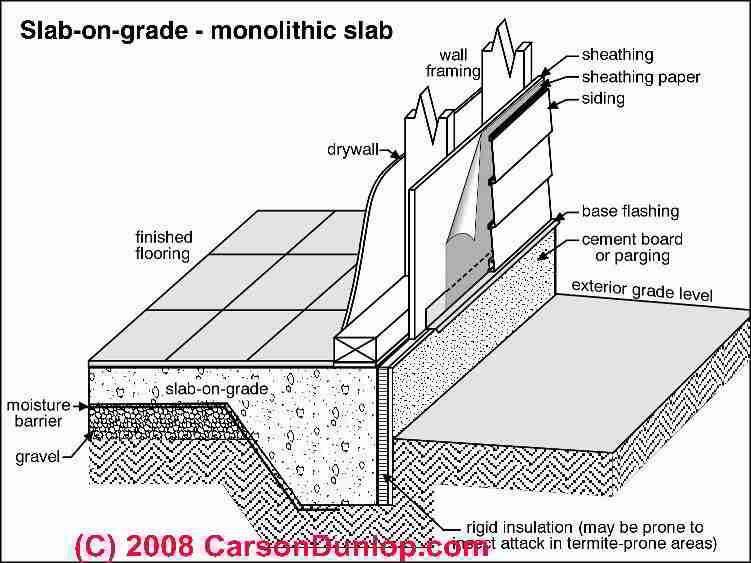
Slab insulation placement guide: this article discusses the question of insulating under a basement floor slab, and just where is the optimum placement of basement insulation. This article explains that the location of building insulation is as important as its quantity. Sketch at page top is courtesy of Carson Dunlop Associates.

Green links show where you are. © Copyright 2013 InspectAPedia.com, All Rights Reserved. Author Daniel Friedman.

Floor Slab Insulation Advice for Well-Insulated Homes
Insulation Advice for Full Basements - Do We Need to Insulate Under the Basement Floor?
The accompanying text is reprinted/adapted/excerpted with permission from Solar Age Magazine - editor Steven Bliss.

Question:

Is it necessary to insulate under a slab in a superinsulated house? I assume an uninsulated slab would help cool the house in summer. -- William Lee, Cave Creerk AZ

Answer:

Heated floor slab insulation detail (C) Daniel FriedmanExperts [in 1985] did not agree as to whether or how much to insulated below a slab. It is most important to insulated the perimeter of a slab down to the bottom of the footing.

Second most important [to insulating the slab perimeter down below the frost line] is to insulate under the first few feet around the edge of the slab.

In [moderate] climates where cooling as well as heating is an issue, it may be best to insulate only the perimeter and leave the underslab uninsulated, as you suggested, for cooling.

Full insulation is indeed recommended under the slab in some situations.

These include radiant heat delivery (see RADIANT HEAT Floor Mistakes to Avoid) or passive solar storage (see INSULATION LOCATION for PASSIVE SOLAR FLOOR SLAB).

Also, if wood flooring or carpeting isn't planned, underslab insulations will make the floor feel warmer to bare feet. See FLOOR, CONCRETE SLAB CHOICES.

And if your concrete floor is a "floating slab" without below-frost-line footings, such as our thoughtless contractor installed in Northern Minnesota, insulation under the entire slab may be critical to avoid pumping most of your heat into the ground during the heating season. If you are installing a radiant heat basement floor system, insulation under the floor slab and the location of the heating tubing are critical - see RADIANT HEAT Floor Mistakes to Avoid. --DF

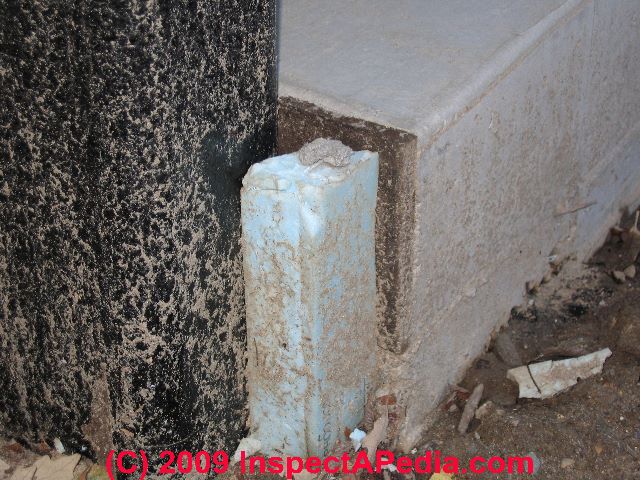
The material of choice for insulating a slab would be high density, closed-cell rigid foam board insulation, such as extruded polystyrene.

Thermally break the interior finish of the basement floor from the concrete (e.g. with wood or solid foam board) to increase comfort and to control condensation if that's a problem in your area during summer months.

If you are installing a radiant heat basement floor system, insulation under the floor slab and the location of the heating tubing are critical - see RADIANT HEAT Floor Mistakes to Avoid.

The link to the original Q&A article in PDF form immediately below is followed by an expanded/updated online version of this article.

  • Q & A: Insulation Under the Slab? - Do I need to insulate under the slab of a superinsulated home? - PDF form

The question-and-answer article about Under-Basement Insulation , quotes-from, updates, and comments an original article from Solar Age Magazine and written by Steven Bliss.

  • Readers should see INSULATION LOCATION for BASEMENT FLOORS and INSULATION LOCATION for PASSIVE SOLAR FLOOR SLAB. Also see POLYISOCYANURATE FOAM INSULATION, POLYISOCYANURATE FOAM BELOW SLABS, INSULATION LOCATION for PASSIVE SOLAR FLOOR SLAB and also RIGID FOAM USE INDOORS.
  • Readers should also see FLOOR, CONCRETE SLAB CHOICES for a discussion of choice of finish floor materials to preserve use of thermal mass of a concrete floor slab. Readers interested in basement insulation improvements should also see INSULATION LOCATION for BASEMENT WALLS and BASEMENT HEAT LOSS.
  • For more general energy savings advice see ENERGY SAVINGS PRIORITIES, and our insulation home page at INSULATION INSPECTION & IMPROVEMENT.
  • If you are going to insulate under a basement or grade-level concrete slab floor, be sure to read SLAB INSULATION, PASSIVE SOLAR.
  • Finally, readers considering adding insulation inside or outside a basement foundation wall should see POLYSTYRENE FOAM INSULATION as well as BUCKLED FOUNDATIONS due to INSULATION? Contact us to suggest text changes and additions and, if you wish, to receive online listing and credit for that contribution.

Frequently Asked Questions (FAQs) about the need to insulate under the floor slab of a well-insulated building

...

Ask a Question or Search InspectApedia

Questions & answers or comments about floor slab insulation guidelines & specifications or requirements

Ask a Question or Enter Search Terms in the InspectApedia search box just below.

Technical Reviewers & References

Related Topics, found near the top of this page suggest articles closely related to this one.

  • Solar Age Magazine was the official publication of the American Solar Energy Society. The contemporary solar energy magazine associated with the Society is Solar Today. "Established in 1954, the nonprofit American Solar Energy Society (ASES) is the nation's leading association of solar professionals & advocates. Our mission is to inspire an era of energy innovation and speed the transition to a sustainable energy economy. We advance education, research and policy. Leading for more than 50 years. ASES leads national efforts to increase the use of solar energy, energy efficiency and other sustainable technologies in the U.S. We publish the award-winning SOLAR TODAY magazine, organize and present the ASES National Solar Conference and lead the ASES National Solar Tour – the largest grassroots solar event in the world."
  • Steve Bliss's Building Advisor at buildingadvisor.com helps homeowners & contractors plan & complete successful building & remodeling projects: buying land, site work, building design, cost estimating, materials & components, & project management through complete construction. Email: info@buildingadvisor.com
    Steven Bliss served as editorial director and co-publisher of The Journal of Light Construction for 16 years and previously as building technology editor for Progressive Builder and Solar Age magazines. He worked in the building trades as a carpenter and design/build contractor for more than ten years and holds a masters degree from the Harvard Graduate School of Education. Excerpts from his recent book, Best Practices Guide to Residential Construction, Wiley (November 18, 2005) ISBN-10: 0471648361, ISBN-13: 978-0471648369, appear throughout this website, with permission and courtesy of Wiley & Sons. Best Practices Guide is available from the publisher, J. Wiley & Sons, and also at Amazon.com
  • Mark Cramer Inspection Services Mark Cramer, Tampa Florida, Mr. Cramer is a past president of ASHI, the American Society of Home Inspectors and is a Florida home inspector and home inspection educator. Mr. Cramer serves on the ASHI Home Inspection Standards. Contact Mark Cramer at: 727-595-4211 mark@BestTampaInspector.com
  • John Cranor is an ASHI member and a home inspector (The House Whisperer) is located in Glen Allen, VA 23060. He is also a contributor to InspectApedia.com in several technical areas such as plumbing and appliances (dryer vents). Contact Mr. Cranor at 804-747-7747 or by Email: johncranor@verizon.net
  • Carson, Dunlop &
Associates Ltd., TorontoCarson, Dunlop & Associates Ltd., 120 Carlton Street Suite 407, Toronto ON M5A 4K2. (416) 964-9415 1-800-268-7070 info@carsondunlop.com. The firm provides professional home inspection services & home inspection education & publications. Alan Carson is a past president of ASHI, the American Society of Home Inspectors. Thanks to Alan Carson and Bob Dunlop, for permission for InspectAPedia to use text excerpts from The Home Reference Book & illustrations from The Illustrated Home. Carson Dunlop Associates' provides:
    • Commercial Building Inspection Courses - protocol ASTM Standard E 2018-08 for Property Condition Assessments
    • Home Inspection Education Courses including home study & live classes at eleven colleges & universities.
    • Home Inspection Education Home Study Courses - ASHI@Home Training 10-course program.
      Special Offer: Carson Dunlop Associates offers InspectAPedia readers in the U.S.A. a 5% discount on these courses: Enter INSPECTAHITP in the order payment page "Promo/Redemption" space. InspectAPedia.com editor Daniel Friedman is a contributing author.
    • The Home Reference Book, a reference & inspection report product for building owners & inspectors.
      Special Offer: For a 10% discount on any number of copies of the Home Reference Book purchased as a single order. Enter INSPECTAHRB in the order payment page "Promo/Redemption" space. InspectAPedia.com editor Daniel Friedman is a contributing author.
    • The Home Reference eBook, an electronic version for PCs, the iPad, iPhone, & Android smart phones.
      Special Offer: For a 5% discount on any number of copies of the Home Reference eBook purchased as a single order. Enter inspectaehrb in the order payment page "Promo/Redemption" space.
    • The Illustrated Home illustrates construction details and building components, a reference for owners & inspectors.
      Special Offer: For a 5% discount on any number of copies of the Illustrated Home purchased as a single order Enter INSPECTAILL in the order payment page "Promo/Redemption" space.
    • The Horizon Software System manages business operations,scheduling, & inspection report writing using Carson Dunlop's knowledge base & color images. The Horizon system runs on always-available cloud-based software for office computers, laptops, tablets, iPad, Android, & other smartphones.
  • ASHRAE resource on dew point and wall condensation - see the ASHRAE Fundamentals Handbook, available in many libraries. The following three ASHRAE Handbooks are also available at the InspectAPedia bookstore in the third page of our Insulate-Ventilate section:
    • 2005 ASHRAE Handbook : Fundamentals : Inch-Pound Edition (2005 ASHRAE HANDBOOK : Fundamentals : I-P Edition) (Hardcover), Thomas H. Kuehn (Contributor), R. J. Couvillion (Contributor), John W. Coleman (Contributor), Narasipur Suryanarayana (Contributor), Zahid Ayub (Contributor), Robert Parsons (Author), ISBN-10: 1931862702 or ISBN-13: 978-1931862707
    • 2004 ASHRAE Handbook : Heating, Ventilating, and Air-Conditioning: Systems and Equipment : Inch-Pound Edition (2004 ASHRAE Handbook : HVAC Systems and Equipment : I-P Edition) (Hardcover)
      by American Society of Heating, ISBN-10: 1931862478 or ISBN-13: 978-1931862479
      "2004 ASHRAE Handbook - HVAC Systems and Equipment The 2004 ASHRAE HandbookHVAC Systems and Equipment discusses various common systems and the equipment (components or assemblies) that comprise them, and describes features and differences. This information helps system designers and operators in selecting and using equipment. Major sections include Air-Conditioning and Heating Systems (chapters on system analysis and selection, air distribution, in-room terminal systems, centralized and decentralized systems, heat pumps, panel heating and cooling, cogeneration and engine-driven systems, heat recovery, steam and hydronic systems, district systems, small forced-air systems, infrared radiant heating, and water heating); Air-Handling Equipment (chapters on duct construction, air distribution, fans, coils, evaporative air-coolers, humidifiers, mechanical and desiccant dehumidification, air cleaners, industrial gas cleaning and air pollution control); Heating Equipment (chapters on automatic fuel-burning equipment, boilers, furnaces, in-space heaters, chimneys and flue vent systems, unit heaters, makeup air units, radiators, and solar equipment); General Components (chapters on compressors, condensers, cooling towers, liquid coolers, liquid-chilling systems, centrifugal pumps, motors and drives, pipes and fittings, valves, heat exchangers, and energy recovery equipment); and Unitary Equipment (chapters on air conditioners and heat pumps, room air conditioners and packaged terminal equipment, and a new chapter on mechanical dehumidifiers and heat pipes)."
    • 1996 Ashrae Handbook Heating, Ventilating, and Air-Conditioning Systems and Equipment: Inch-Pound Edition (Hardcover), ISBN-10: 1883413346 or ISBN-13: 978-1883413347 ,
      "The 1996 HVAC Systems and Equipment Handbook is the result of ASHRAE's continuing effort to update, expand and reorganize the Handbook Series. Over a third of the book has been revised and augmented with new chapters on hydronic heating and cooling systems design; fans; unit ventilator; unit heaters; and makeup air units. Extensive changes have been added to chapters on panel heating and cooling; cogeneration systems and engine and turbine drives; applied heat pump and heat recovery systems; humidifiers; desiccant dehumidification and pressure drying equipment, air-heating coils; chimney, gas vent, fireplace systems; cooling towers; centrifugal pumps; and air-to-air energy recovery. Separate I-P and SI editions."
    • Principles of Heating, Ventilating, And Air Conditioning: A textbook with Design Data Based on 2005 AShrae Handbook - Fundamentals (Hardcover), Harry J., Jr. Sauer (Author), Ronald H. Howell, ISBN-10: 1931862923 or ISBN-13: 978-1931862929
    • 1993 ASHRAE Handbook Fundamentals (Hardcover), ISBN-10: 0910110964 or ISBN-13: 978-091011096
  • Best Practices Guide to Residential Construction, by Steven Bliss. John Wiley & Sons, 2006. ISBN-10: 0471648361, ISBN-13: 978-0471648369, Hardcover: 320 pages, available from Amazon.com and also Wiley.com. See our book review of this publication.
  • Energy Savers: Whole House Systems Approach to Energy Efficient Home Design [copy on file as /interiors/Whole_House_Energy_Efficiency_DOE.pdf ] - U.S. Department of Energy
  • "Energy Savers: Whole-House Supply Ventilation Systems [copy on file as /interiors/Energy_Savers_Whole-House_Supply_Vent.pdf ] - ", U.S. Department of Energy energysavers.gov/your_home/insulation_airsealing/index.cfm/mytopic=11880?print
  • "Energy Savers: Whole-House Exhaust Ventilation Systems [copy on file as /interiors/Energy_Savers_Whole-House_Exhaust.pdf ] - ", U.S. Department of Energy energysavers.gov/your_home/insulation_airsealing/index.cfm/mytopic=11870
  • "Energy Savers: Ventilation [copy on file as /interiors/Energy_Savers_Ventilation.pdf ] - ", U.S. Department of Energy
  • "Energy Savers: Natural Ventilation [copy on file as /interiors/Energy_Savers_Natural_Ventilation.pdf ] - ", U.S. Department of Energy
  • "Energy Savers: Energy Recovery Ventilation Systems [copy on file as /interiors/Energy_Savers_Energy_Recovery_Venting.pdf ] - ", U.S. Department of Energy energysavers.gov/your_home/insulation_airsealing/index.cfm/mytopic=11900
  • "Energy Savers: Detecting Air Leaks [copy on file as /interiors/Energy_Savers_Detect_Air_Leaks.pdf ] - ", U.S. Department of Energy
  • "Energy Savers: Air Sealing [copy on file as/interiors/Energy_Savers_Air_Sealing_1.pdf ] - ", U.S. Department of Energy
  • Fiberglass: Indoor Air Quality Investigations: Health Concerns About Airborne Fiberglass: Fiberglass in Indoor Air from HVAC ducts, and Building Insulation
  • "Insulation: Adding Insulation to an Existing Home [copy on file as/interiors/Insulation_Adding_DOE.pdf ] - ," U.S. Department of Energy - tips on how to do your own check for the presence of absence of insulation in a home
  • Insulation: Selecting Insulation for New Home Construction [copy on file as /interiors/New_Home_Insulation_DOE.pdf ] - , U.S. Department of Energy - "Your state and local building codes probably include minimum insulation requirements, but to build an energy-efficient home, you may need or want to exceed them. For maximum energy efficiency, you should also consider the interaction between the insulation and other building components. This is called the "whole-house systems design approach." [copy on file as /interiors/Whole_House_Energy_Efficiency_DOE.pdf ] -
  • "Insulation Types [copy on file as /interiors/Insulation_Types_DOE.pdf ] - ", table of common building insulation properties from U.S. DOE. Readers should see INSULATION R-Values & Properties our own table of insulation properties that includes links to articles describing each insulation material in more detail.

Books & Articles on Building & Environmental Inspection, Testing, Diagnosis, & Repair

  • Our recommended books about building & mechanical systems design, inspection, problem diagnosis, and repair, and about indoor environment and IAQ testing, diagnosis, and cleanup are at the InspectAPedia Bookstore. Also see our Book Reviews - InspectAPedia.
  • Home Reference Book - Carson DunlopThe Home Reference Book - the Encyclopedia of Homes, Carson Dunlop & Associates, Toronto, Ontario, 25th Ed., 2012, is a bound volume of more than 450 illustrated pages that assist home inspectors and home owners in the inspection and detection of problems on buildings. The text is intended as a reference guide to help building owners operate and maintain their home effectively. Field inspection worksheets are included at the back of the volume. Special Offer: For a 10% discount on any number of copies of the Home Reference Book purchased as a single order. Enter INSPECTAHRB in the order payment page "Promo/Redemption" space. InspectAPedia.com editor Daniel Friedman is a contributing author.

    Or choose the The Home Reference eBook for PCs, Macs, Kindle, iPad, iPhone, or Android Smart Phones. Special Offer: For a 5% discount on any number of copies of the Home Reference eBook purchased as a single order. Enter INSPECTAEHRB in the order payment page "Promo/Redemption" space.
  • Asbestos products and their history and use in various building materials such as asphalt and vinyl flooring includes discussion which draws on Asbestos, Its Industrial Applications, D.V. Rosato, engineering consultant, Newton, MA, Reinhold Publishing, 1959 Library of Congress Catalog Card No.: 59-12535 (out of print).
  • The National Institute of Standards and Technology, NIST (nee National Bureau of Standards NBS) is a US government agency - see www.nist.gov
    • "A Parametric Study of Wall Moisture Contents Using a Revised Variable Indoor Relative Humidity Version of the "Moist" Transient Heat and Moisture Transfer Model [copy on file as/interiors/MOIST_Model_NIST_b95074.pdf ] - ", George Tsongas, Doug Burch, Carolyn Roos, Malcom Cunningham; this paper describes software and the prediction of wall moisture contents. - PDF Document from NIS
  • "Weather-Resistive Barriers [copy on file as /interiors/Weather_Resistant_Barriers_DOE.pdf ] - ", how to select and install housewrap and other types of weather resistive barriers, U.S. DOE
  • ...
HOME ABOUT CONTACT COPYING DESCRIPTION POLICIES PRINTING PRIVACY © 2013 Copyright InspectAPedia.com