
InspectAPedia® FREE Encyclopedia of Building & Environmental Construction, Diagnosis, Maintenance & Repair |
Question? Just ask us! InspectAPedia
|
 Advice on Using Infra Red & Thermal Scanners for Tracing Heat Loss
- POST a QUESTION or COMMENT about using thermography or infra red or IR scanners during building & environmental inspections
- Solar Age Magazine Articles on Renewable Energy, Energy Savings, Construction Practices
Where to buy infrared scanners & thermography equipment: This article discusses sources of thermal scanners, IR scanners, thermography cameras and other tools used for the detection of heat loss or air infiltration in buildings.
InspectAPedia tolerates no conflicts of interest. We have no relationship with advertisers, products, or services discussed at this website.
Suppliers of IR InfraRed Scanners, Thermography, Thermal Scanning Equipment
The accompanying text are reprinted/adapted/excerpted with permission from Solar Age Magazine - editor Steven Bliss. The question-and-answer article below paraphrases, quotes-from, updates, and comments an original article from Solar Age Magazine and written by Steven Bliss.
Information on Thermal Scanners
Question:
I would like some information on the AGA 782 thermal scanner shown on the opening page of "House Doctors with Better Medicine" (Solar Age 9/84 p. 27.) Are there many other companies that sell thermal scanners? -- Leon Grant, Dover NJ
Answer:
- Swedish-based AGA Infrared Systems AB was [in 1984] the world's oldest and largest manufacturer of infrared scanning equipment. In the 1980's the top-of-the-line Model 782 cost around $32,000 and had many features. The hand-held AGA model used by PEP and described in
HEAT LOSS DETECTION TOOLS cost (in 1984) $12,500. In the 1980's Inframetrics also produced hand-held thermal scanners in the U.S. - Currently and for some time we (DF) have made extensive use of a non-imaging low-price, small hand-held IR scanner provided by Exergen - a device costing less than $1000.
- FLIR Thermography - produces IR cameras and scanners
- See THERMAL IMAGING, THERMOGRAPHY for complete details about buying & using thermal imaging, training, and equipment sources including recent innovations that add smartphone attached thermal imaging cameras as well as larger commercial thermal imaging equipment. There we include a complete list of sources of thermal imaging, IR and related equipment.
- Also see LIGHT, GUIDE to FORENSIC USE.
Advice on Using IR Infrared Scanning Equipment for Building Surveys
We have made regular use of small hand-held IR or thermal scanner equipment in building inspection surveys for nearly twenty years. The two most common uses we've made of the equipment include: [-DF]
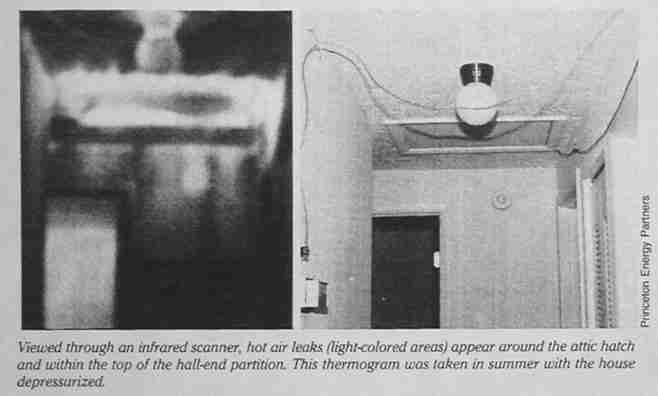
- Heat Loss: Surveying buildings for variations in temperature, indicating areas of heat loss: air bypass leaks, missing insulation. In addition to spotting specific "cold spots", if there is a significant temperature difference between indoors and outside, thermography can quickly identify compare temperatures on interior partitions with exterior walls.
- Leaks: Surveying buildings for evidence of recent leaks, wet insulation in building cavities. Be careful: an old leak into a building cavity may have completely dried out, producing no IR detectable information, but problematic mold, rot, or insect damage could be present. Visual evidence of building leak history and a recording of building details likely to have led to leaks or water entry are important.
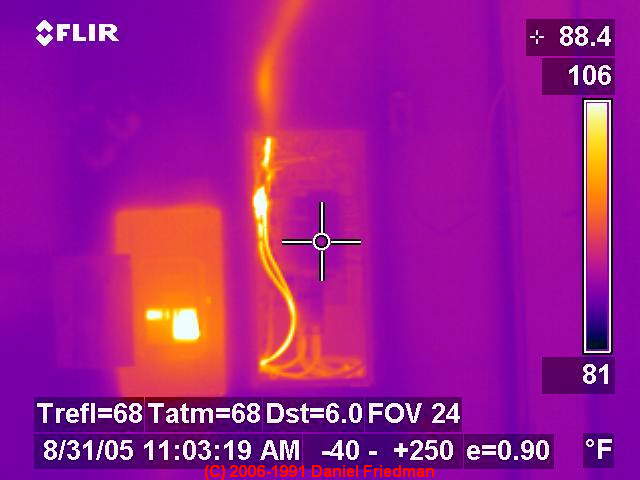
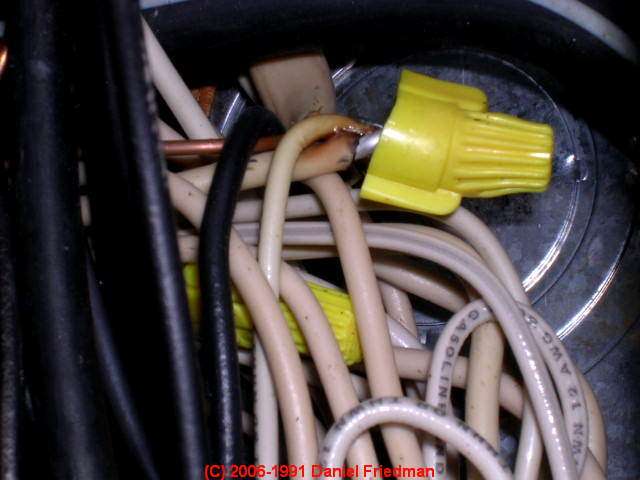
- Electrical overheating: a number of home inspectors have successfully used IR and thermography to identify overheating electrical components at electrical panels, electrical switches or receptacles, at wiring serving electric heating baseboards, and where aluminum branch circuit wiring is installed. Overheating electric motors, compressors, and even blower fan bearings can be observed using these methods as well, provided that you have a baseline of normal temperatures.
See ALUMINUM WIRING HAZARDS & REPAIRS for an example of aluminum wiring overheating shown in the two photographs below.
Thermography Education and Training
Readers wishing training on use of thermography, IR or infra red equipment, for building surveys or other applications, should also contact the Institute of Infrared Thermography.
The question-and-answer article about sources and use of infrared thermal scanners and heat loss detection equipment, quotes-from, updates, and comments an original article from Solar Age Magazine and written by Steven Bliss.
Questionable use of Thermography and IR Scanning
- "Toxic Black Mold Scanner": We investigated in detail a case of ineffective mold remediation at a property in which the mold remediation company used an IR scanner to "tell the building owner where the mold was". This was as unreliable and nonsensical as the window replacement company salesmen who used to use a camera light meter (which pegged its needle whenever exposed to brighter light at any building window) to identify "leaky windows".
See MOLD SANITIZER, SPRAY, BIOCIDE USE GUIDE for details about this case. Like some other practices of questionable honesty, there was an element of truth to the remediator's pitch: if indeed there had been a recent water leak into a building cavity, the IR scanner should be expected to pick up a temperature difference at that location. And since a water leak into a wall can cause mold, there might be a mold risk. But- numerous other building conditions produce temperature differences without growing toxic mold
- a prior leak may have dried, producing no thermal evidence
- other conditions may have produced a problem mold reservoir without any thermal evidence
In fact there was a problem mold reservoir in the building, but it was nowhere near any of the locations where the remediator had, based on his thermal camera results, poked tiny holes and sprayed "mold killer" into the building walls. Also see MOLD KILLING GUIDE for an explanation of the compound error of using an unreliable (but quick and easy) camera to scan for mold combined with spraying to try to kill it.
The link to the original Q&A article in PDF form immediately below is followed by an expanded/updated online version of this article.
- POST a QUESTION or COMMENT about Thermal Scanners [PDF] - information on thermal scanners such as the AGA 782 - PDF version, use your browser's back button to return to this page
...
Continue reading at THERMAL IMAGING, THERMOGRAPHY or select a topic from the closely-related articles below, or see the complete ARTICLE INDEX.
Or see these
Recommended Articles
- AIR LEAK DETECTION TOOLS.
- THERMAL TRACKING BRIDGING GHOSTING for an example of visual clues that identify building air leaks and heat loss with no instruments whatsoever
- THERMAL IMAGING, THERMOGRAPHY
- BASEMENT HEAT LOSS DETECTION - where we discuss the IR thermal imaging photo at the top of this page
Suggested citation for this web page
THERMOGRAPHY IR Infra Red & THERMAL SCANNERS at InspectApedia.com - online encyclopedia of building & environmental inspection, testing, diagnosis, repair, & problem prevention advice.
Or see this
INDEX to RELATED ARTICLES: ARTICLE INDEX to BUILDING ENERGY SAVINGS
Or use the SEARCH BOX found below to Ask a Question or Search InspectApedia
Ask a Question or Search InspectApedia
Try the search box just below, or if you prefer, post a question or comment in the Comments box below and we will respond promptly.
Search the InspectApedia website
Note: appearance of your Comment below may be delayed: if your comment contains an image, photograph, web link, or text that looks to the software as if it might be a web link, your posting will appear after it has been approved by a moderator. Apologies for the delay.
Only one image can be added per comment but you can post as many comments, and therefore images, as you like.
You will not receive a notification when a response to your question has been posted.
Please bookmark this page to make it easy for you to check back for our response.
Our Comment Box is provided by Countable Web Productions countable.ca
Citations & References
In addition to any citations in the article above, a full list is available on request.
- Solar Age Magazine was the official publication of the American Solar Energy Society. The contemporary solar energy magazine associated with the Society is Solar Today. "Established in 1954, the nonprofit American Solar Energy Society (ASES) is the nation's leading association of solar professionals & advocates. Our mission is to inspire an era of energy innovation and speed the transition to a sustainable energy economy. We advance education, research and policy. Leading for more than 50 years. ASES leads national efforts to increase the use of solar energy, energy efficiency and other sustainable technologies in the U.S. We publish the award-winning SOLAR TODAY magazine, organize and present the ASES National Solar Conference and lead the ASES National Solar Tour – the largest grassroots solar event in the world."
- Steve Bliss's Building Advisor at buildingadvisor.com helps homeowners & contractors plan & complete successful building & remodeling projects: buying land, site work, building design, cost estimating, materials & components, & project management through complete construction. Email: info@buildingadvisor.com
Steven Bliss served as editorial director and co-publisher of The Journal of Light Construction for 16 years and previously as building technology editor for Progressive Builder and Solar Age magazines. He worked in the building trades as a carpenter and design/build contractor for more than ten years and holds a masters degree from the Harvard Graduate School of Education. Excerpts from his recent book, Best Practices Guide to Residential Construction, Wiley (November 18, 2005) ISBN-10: 0471648361, ISBN-13: 978-0471648369, appear throughout this website, with permission and courtesy of Wiley & Sons. Best Practices Guide is available from the publisher, J. Wiley & Sons, and also at Amazon.com - Paul Probett, Clinton Craig, Blake Probett, Incodo Ltd, 4/511 Cameron Rd, Tauranga NZ, Email: Paul Probett, mail2us@incodo.co.nz , Tel: 027 28 000 36 (Mobile) Website: https://www.incodo.co.nz/ Mr. Probett and his firm Incodo have contributed technical & forensic engineering content & critique to InspectApedia including their research into micro-drilling for in-situ timber & beam rot & damage assessment - WOOD STRUCTURE ASSESSMENT, Paul Probett, Ph: 0064 7 578 7499 - Office, Post: Incodo Ltd, Box 8202, Cherrywood, Tauranga, New Zealand, is a building expert who has also addressed building moisture investigations, UFFI insulation, and urea formaldehyde outgassing in buildings - FORMALDEHYDE HAZARDS. Also see THERMAL IMAGING, THERMOGRAPHY.
Thermography - Infra Red Inspection Equipment, temperature, heat loss, active leak detection, moisture investigations - Equipment Suppliers
- AGA Infrared Systems, 550 County Ave., Seacaucus NJ 08094. Here is a general product brochure from AGA (minor edits),
History: the AGA Thermovision 750 was produced in the 1970's and was the first individually portable thermography system to reach the market. Here is the AGA Thermovision 750 operating manual from AGA. A used AGA Agema Thermovision 880 800 Infrared Camera Sys FLIR might be purchased typically (2010) for around $2000.
Warning: looking for information about AGA will trip up readers whose web searches will find the American Gas Association AGA. AGA Infrared Systems AB [ca 1981] was a member of the Pharos Group, manufacturer of a complete range of thermal measurement systems, with subsidiaries worldwide. - Headquarters: AGA Infrared Systems AB, S-182 11 Danderyd, Sweden
- Canada: AGAtronics Ltd., 5230 South Service Rd. Suite 125, Burlington Ontario L7L 5K2
- United States: AGA Corporation, PO Box 721, 60 Chapin Rd., Pine Brook NJ 07058
- West Germany: AGA Optronik GmbH, Zimmersmuthlenweg 40, D-6370, Oberursel/T
- Exergen Corporation, portable infra red scanners, 400 Pleasant St. Watertown, MA 02472, 1-800-422-3006 617-923-9900 Fax : 617-923-9911
- Inframetrics Inc., hand held thermal scanners, 25 Wiggins Ave., Bedford Mass, also available from Hughes Aircraft, El Segundo, CA.
- Institute of Infrared Thermography, (the company's website does not provide their mailing address nor telephone number). info@infraredinstitute.com Quoting from the Institute of Infrared Thermography's self-description:
The Institute of Infrared Thermography (IRT) is an organization dedicated to providing Infrared educational programs, seminars, consulting services, program development and support, as well as, research and development to individuals and companies worldwide.The original training organization, the Academy of Infrared Thermography began operation in 1984 in Kamloops BC Canada. The Academy was the largest independent infrared training organization in the world. Today, the original owner, Mr. Ron Newport provides global infrared thermography training under a newly structured organization: The Institute of Infrared Thermography. The head office remains in Canada but there are now branch offices in the UK, Sweden, the Netherlands, Singapore, China, as well as trainers in 4 other countries. IRT provides training in infrared thermography as it applies to the electrical industry, petrochemical, automotive, plastics, steel, electronics, energy conservation and savings, building energy conservation and building audits, building facades, roof thermography, water leak detection, security, medical and many other applications.
- Imaging Systems Inspection Equipment Inc. - 323 Andover Street - Wilmington, MA 01887 [focused on electronics and semiconductor placement systems, not building heat loss/IR thermography for general use]
- FLIR Thermography manufacturer of infrared cameras, thermography testing equipment, and thermal imaging cameras. FLIR provides infrared software as well as infrared training and support
- Asia Pacific: FLIR Thermography Support & contact information:FLIR Systems Co., Ltd. Asia Pacific Head Office, Hong Kong Tel: +852 2792 8955
- United States: FLIR Thermography Support & contact information: FLIR Systems,
America's Main Office, USA
Boston, MA Tel: 1-800-GO-INFRA (464-6372) or 1-978-901-8000 - Canada: FLIR Thermography Support & contact information:FLIR Systems Ltd., Canada's Main Office, Burlington, ON Tel: 1-800-613
- Europe: FLIR Systems International Main Office, Sweden Tel: +46 (0)8 753 25 00
- Latin America:
FLIR Thermography Support & contact information:FLIR Systems Latin America, Sorocaba, Brazil, Tel: +55 15 3238 8075
FLIR offers this comment on use of infrared for building diagnostics:
Thermal Cameras for Building Diagnostics: the building sector offers the largest single potential for improving energy efficiency. Infrared thermography is the easiest and quickest method to detect energy waste, moisture and electrical issues in buildings. An infrared camera shows exactly where the problems are and helps focus the inspectors' attention allowing him or her to properly diagnose areas with energy loss.
- In addition to citations & references found in this article, see the research citations given at the end of the related articles found at our suggested
CONTINUE READING or RECOMMENDED ARTICLES.
- Carson, Dunlop & Associates Ltd., 120 Carlton Street Suite 407, Toronto ON M5A 4K2. Tel: (416) 964-9415 1-800-268-7070 Email: info@carsondunlop.com. Alan Carson is a past president of ASHI, the American Society of Home Inspectors.
Thanks to Alan Carson and Bob Dunlop, for permission for InspectAPedia to use text excerpts from The HOME REFERENCE BOOK - the Encyclopedia of Homes and to use illustrations from The ILLUSTRATED HOME .
Carson Dunlop Associates provides extensive home inspection education and report writing material. In gratitude we provide links to tsome Carson Dunlop Associates products and services.
 | HOME | ABOUT | ASK a QUESTION | CONTACT | CONTENT USE POLICY | DESCRIPTION | POLICIES | PRIVACY | |
| © 2024 - 1985 Publisher InspectApedia.com - Daniel Friedman | |||||||||