
InspectAPedia® FREE Encyclopedia of Building & Environmental Construction, Diagnosis, Maintenance & Repair |
Question? Just ask us! InspectAPedia
|
 Flooring Choices for Use Over Concrete Slabs Using Thermal Mass
- POST a QUESTION or COMMENT about how to choose a finish floor to be installed over a concrete slab where thermal mass is important
This article discusses the best choices for finish flooring to use over a concrete floor slab intended to provide direct solar heat gain and heat storage.
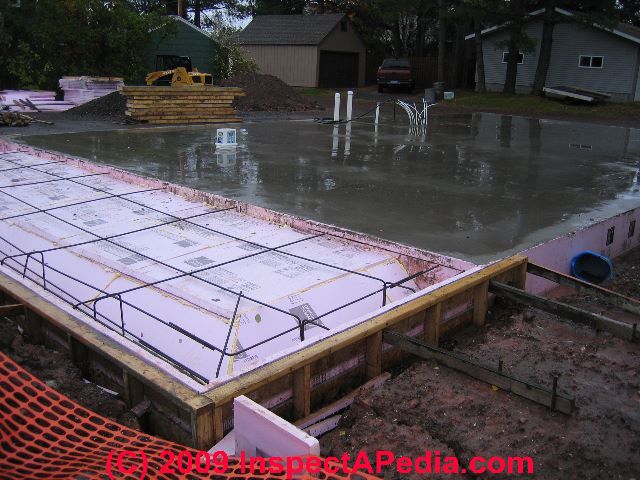
Our page top photograph shows a well-designed radiant-heat floor slab being constructed in Two Harbors, Minnesota where it gets too cold to fool around.
InspectAPedia tolerates no conflicts of interest. We have no relationship with advertisers, products, or services discussed at this website.
What Finish Flooring to Use to Cover a Concrete Floor Slab
 The question-and-answer article below paraphrases, quotes-from, updates, and comments an original article from Solar Age Magazine and written by Steven Bliss.
[Click to enlarge any image]
What Flooring Materials are Best to Use Over a Concrete Floor Slab
Question:
I'm in the process of building a home.
Are there any floor-covering products I can install over a pre cast concrete second floor (see THERMAL MASS in UPSTAIRS)
and a cast-in-place poured concrete first floor slab (see THERMAL MASS in BUILDINGS).
I want a resilient (soft clay, brick?) finish floor that will yet retain the thermal mass properties of the concrete slab below.
I understand the necessity for thermal mass [in my passive solar design home] but I would like to find a more pliable floor covering [than ceramic tile].
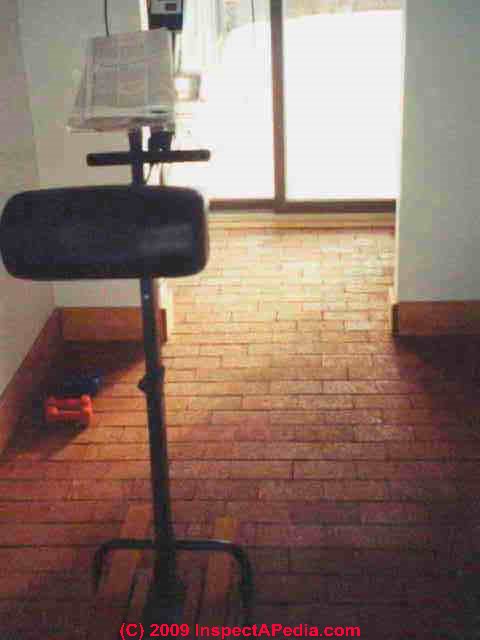
Our photograph (left) shows a passive solar brick interior floor, constructed over a poured concrete slab. This building is on the Vassar College Campus in Poughkeepsie, NY.
Our photograph (above) shows ceramic tile installed over a concrete floor slab intended to provide both passive solar gain and heat storage as well as delivering heat from a backup in-floor radiant heating system. Readers constructing an insulated slab with radiant floor heating, whether by passive solar or any other means, should not fail to read RADIANT HEAT FLOOR MISTAKES.
Answer:
 Assuming you are interested in using these floors for direct-gain passive solar heat storage, we see two possible approaches:
- Try to find a finish flooring material that has a high heat capacity itself
- Look for a finish floor material that has negligible heat capacity but has good absorptive and good thermal conductivity.
Either of these approaches will allow the finish floor covering to transfer heat into the concrete floor slab which itself has a high heat storage capacity.
We know of no soft floor covering with high heat capacity, but the second approach shows some promise. A 1980's study by industry researchers concluded that any floor covering whose thermal conductance exceeded about 10 BTU/hr-ft2 would not impair the thermal storage capability of the concrete slab.
This eliminates using even the thinnest floor carpeting (whose conductance C is about 0.8 BTU/hr-ft2), and some vinyl floor coverings.

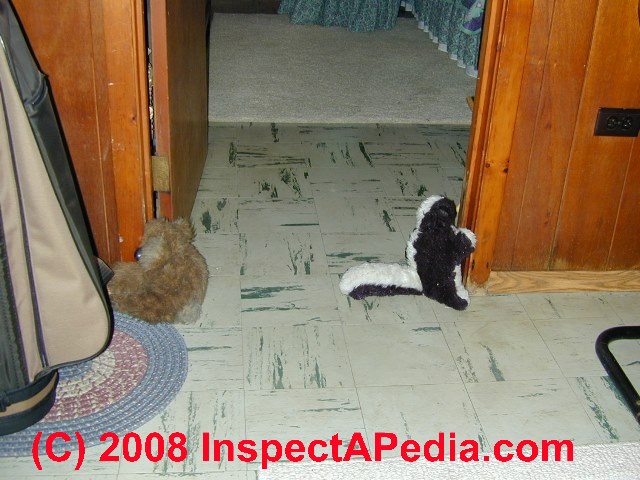
But this criteria permitted use of vinyl-asbestos floor tiles (C = 43 BTU/hr-ft2) until that product was discontinued in buildings, and it probably permits use of the modern replacements of those products. It also permits use of sheet vinyl flooring on felt backing (C = 21.2 BTU/hr-ft2).
Beyond C=10 flooring products, increasing the absorptive does more than increasing the conductivity.
Light flooring materials absorb less solar radiation (heat) and are thus less efficient (as much as 40 percent less for pastel colors).
Also, it is important to install the finish floor covering so that it makes a very good thermal contact through a continuous bond over the floor slab.
Low-density brick and other "soft" masonry materials are not ordinarily considered resilient. If they are well-bonded to the slab, however, they will not reduce its thermal performance much.
Also see FLOOR, CONCRETE SLAB POURED FINISH where we describe pour-on finish flooring for use over thermal mass concrete slabs.
Readers should also see POLYISOCYANURATE FOAM BELOW SLABS
and INSULATION LOCATION for PASSIVE SOLAR FLOOR SLAB
and also RIGID FOAM USE INDOORS.
Here we include solar energy, solar heating, solar hot water, and related building energy efficiency improvement articles reprinted/adapted/excerpted with permission from Solar Age Magazine - editor Steven Bliss.
Original article:
The link to the original Q&A article in PDF form immediately below is preceded by an expanded/updated online version of this article.
- Q&A on Flooring Choices Over a Concrete Slab: Covering the Slab - PDF version, Use your browser's back button to return to this page
...
Continue reading at FLOOR, CONCRETE SLAB POURED FINISH or select a topic from the closely-related articles below, or see the complete ARTICLE INDEX.
Or see these
Recommended Articles
- CONCRETE COLORING & POLISHING
- CONCRETE FOUNDATION, WALL, SLAB DEFECTS
- CONTROL JOINT CRACKS in CONCRETE
- CONTROL JOINT CRACKS in CONCRETE FAQs
- FLOOR, CONCRETE SLAB CHOICES
- FLOOR, CONCRETE SLAB POURED FINISH
- FLOOR TILE INSTALL on CONCRETE
- RADIANT SLAB FLOORING CHOICES
- STAINS on CONCRETE
- STAMPED CONCRETE CLEANING
- THERMAL MASS FLOOR SLABS
Suggested citation for this web page
FLOOR, CONCRETE SLAB CHOICES at InspectApedia.com - online encyclopedia of building & environmental inspection, testing, diagnosis, repair, & problem prevention advice.
Or see this
INDEX to RELATED ARTICLES: ARTICLE INDEX to BUILDING INTERIORS
Or use the SEARCH BOX found below to Ask a Question or Search InspectApedia
Ask a Question or Search InspectApedia
Try the search box just below, or if you prefer, post a question or comment in the Comments box below and we will respond promptly.
Search the InspectApedia website
Note: appearance of your Comment below may be delayed: if your comment contains an image, photograph, web link, or text that looks to the software as if it might be a web link, your posting will appear after it has been approved by a moderator. Apologies for the delay.
Only one image can be added per comment but you can post as many comments, and therefore images, as you like.
You will not receive a notification when a response to your question has been posted.
Please bookmark this page to make it easy for you to check back for our response.
Our Comment Box is provided by Countable Web Productions countable.ca
Citations & References
In addition to any citations in the article above, a full list is available on request.
- Steve Bliss's Building Advisor at buildingadvisor.com helps homeowners & contractors plan & complete successful building & remodeling projects: buying land, site work, building design, cost estimating, materials & components, & project management through complete construction. Email: info@buildingadvisor.com
- John Cranor [Website: /www.house-whisperer.com ] is an ASHI member and a home inspector (The House Whisperer) is located in Glen Allen, VA 23060. He is also a contributor to InspectApedia.com in several technical areas such as plumbing and appliances (dryer vents). Contact Mr. Cranor at 804-873-8534 or by Email: johncranor@verizon.net
- In addition to citations & references found in this article, see the research citations given at the end of the related articles found at our suggested
CONTINUE READING or RECOMMENDED ARTICLES.
- Carson, Dunlop & Associates Ltd., 120 Carlton Street Suite 407, Toronto ON M5A 4K2. Tel: (416) 964-9415 1-800-268-7070 Email: info@carsondunlop.com. Alan Carson is a past president of ASHI, the American Society of Home Inspectors.
Thanks to Alan Carson and Bob Dunlop, for permission for InspectAPedia to use text excerpts from The HOME REFERENCE BOOK - the Encyclopedia of Homes and to use illustrations from The ILLUSTRATED HOME .
Carson Dunlop Associates provides extensive home inspection education and report writing material. In gratitude we provide links to tsome Carson Dunlop Associates products and services.
 | HOME | ABOUT | ASK a QUESTION | CONTACT | CONTENT USE POLICY | DESCRIPTION | POLICIES | PRIVACY | |
| © 2024 - 1985 Publisher InspectApedia.com - Daniel Friedman | |||||||||