
InspectAPedia® FREE Encyclopedia of Building & Environmental Construction, Diagnosis, Maintenance & Repair |
Question? Just ask us! InspectAPedia
|
 Energy Savings Retrofit Options
- POST a QUESTION or COMMENT about building energy conservation retrofit choices & procedures
How to retrofit buildings to cut heating or cooling costs:
This article discusses a selection of energy saving building retrofit steps including using Air Krete ultralightweight concrete building insulation, sealing leaky sash-weight-operated double hung windows, foam foundation forms, and adding soffit intake ventilation for the roof cavity.
Sketch at page top and accompanying text are reprinted/adapted/excerpted with permission from Solar Age Magazine - editor Steven Bliss.
InspectAPedia tolerates no conflicts of interest. We have no relationship with advertisers, products, or services discussed at this website.
Energy Retrofit Tips & Products
Insulating Existing Wall Cavities with Ultra Lightweight Concrete
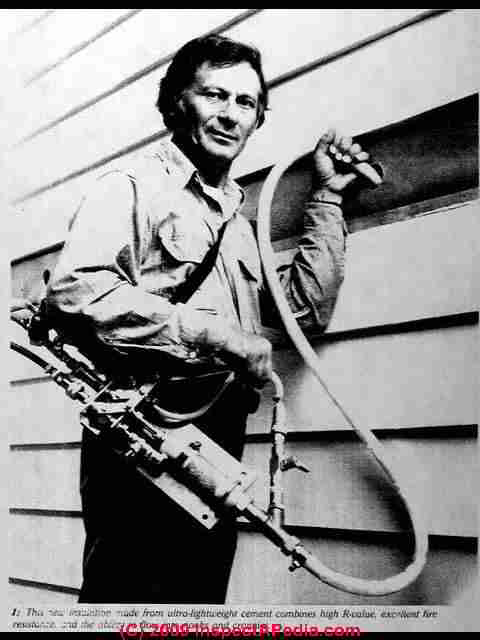
The perfect building insulation for retrofitting cavity walls would be non-toxic, non-shrinking, fire-resistant, high in R-value, non-corrosive, and moisture and mold-resistant. It would also have the ability to flow into irregular spaces behind the walls, and be dense enough to stop air leaks. And it's got to be cheap. A product whose use dates to 1983, Air Krete, appears to fit this tall order well.
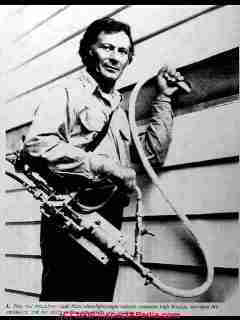
Air Krete (page top photo) is a cement-based product that weighs about the same as extruded polystyrene - 2 pounds per square foot - and has an R-value of 3.9 per inch. Produced on-site from three components plus water, Air Krete installs much the same way as pump-in foam insulating products. When it dries it is lightweight and crumbly.
According to the company, wet Air Krete will flow in and seal the smallest crevices in a wall, but sets up quickly - within 20 seconds. Because Air Krete hydrates like concrete, when drying it gives off less water than some foam products such as the no-longer used urea-formaldehyde foam insulation (UFFI). Independent testing showed that this concrete wall insulating product shrinks less than 0.25 percent and it is virtually fireproof. [At the time of the original article - see links above - product testing for water-vapor permeance and water absorption were incomplete.]
Because this ultra lightweight concrete has over 80 percent closed cells, the company described it (back in 1985) as similar to expanded polystyrene foam insulation in its reaction to water - that is, it should be a moderate water vapor retarder and a slow absorber of actual water.
Air-Krete is available through licensed installers. Doing a good job is not difficult, but requires a close watch of the equipment. On a good day, a three person crew can put in 14,000 board feet of this insulating material. Cleanup is easy since the raw materials are water soluble.
Prime applications of lightweight concrete insulation include brick cavity wall construction and masonry block cores. For wood-framed building walls, lightweight concrete will get tough competition from blown-in chopped fiberglass or cellulose insulation. Those products can be blown into building walls for about half the cost of lightweight concrete. In 1985 Air Krete installed for $1.25 to $1.50 per square foot in a 2x4 wood framed wall. (1985 prices - check for current costs).
But if high R-values are needed or if you are concerned about settling, fire resistance [seems less a concern with masonry walls], or moisture absorption, Air Krete or similar ultra lightweight concrete wall insulating products are worth looking into. Also these products maybe code-approved for fire stops and fire-walls.
Retrofits for Stopping Drafts at Double-Hung Windows & Window Sashes
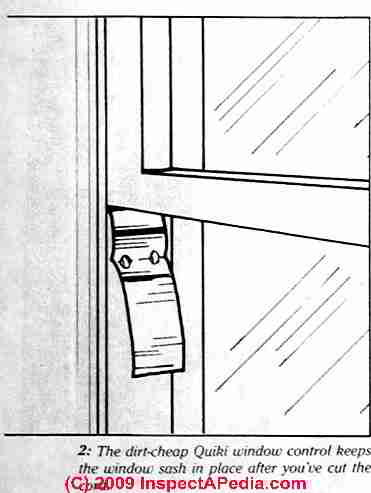
Weathersealing an old double-hung window is no one's idea of a good time. Retrofit contractors have found a cheap and simple device that makes that task easier: the Quiki window control. Other window sash controls include an aluminum track that tacks into the existing window sash opening after you remove the parting strips that will be found between the existing sashes. The Quiki window control, or spring-loaded sides of the window track insert will hold the sashes firmly in any position.
An alternative to the window track, if you're just using the window clip, is the installation of plastic V-strips along the bottom sash at the meeting rail and against the parting strips found between the house-interior faces of the stops and the lower sash. Some retrofitters caulk the top sash in place, but if you use the track insert we have cited, that won't be needed.
These products mean you can remove the window sash cords, pulleys, and sash weights from the wall cavities found on either side of older double-hung window sashes, adding foam or fiberglass insulation in those spaces to eliminate what amounts to an un-insulated building wall area on either side of every window. Adding insulation using foam squirted into the cavity will be most effective in stopping drafts. To avoid springing the sides of some less-rigid window frames it may be necessary to wedge a stick between the window opening sides while the foam cures.
Foam Foundation Forms
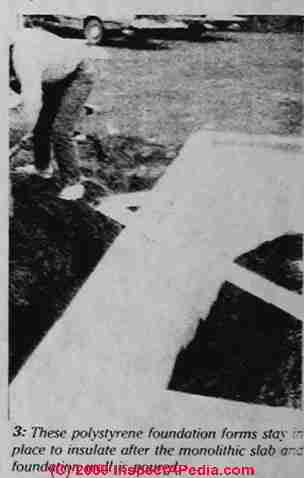
There are presently a wide variety of foam foundation form manufacturers whose products combine fast concrete forms that also insulate the foundation perimeter. Back in 1985 a leader in this approach was Branch River Plastics who used expanded polystyrene to produce Fast Forms.
Polystyrene insulating concrete foundation form products lend themselves to sunspace construction or other small slab-on-grade jobs where you want to get the backhoe and mixer in and out in a hurry. Fast Forms and similar foam foundation insulating forms come in 4 x 8 foot sections that lock together with dovetail keys and special corners.
The foam foundation forms are engineered to work without rebar in normal soils with typical loads. Concentrated point loads go on special pier forms that fit to the standard sections. After pouring the forms are left in place to insulate the perimeter of the concrete slab.
Because the foam foundation forms are left in the ground, the trenches need to be only 18 to 24 inches wide and can be backfilled as soon as the forms are set. Footing, slab, and wall are poured monolithically, so only one concrete delivery is required. The foam foundation forms help the concrete cure well by retarding the heat and water of concrete hydration. The insulation also helps in cold-weather concrete slab pours.
At their introduction in the 1980's these foam foundation forms cost about $10.40 per lineal foot, but they save on concrete and labor.
Adding Soffit Intake Vents
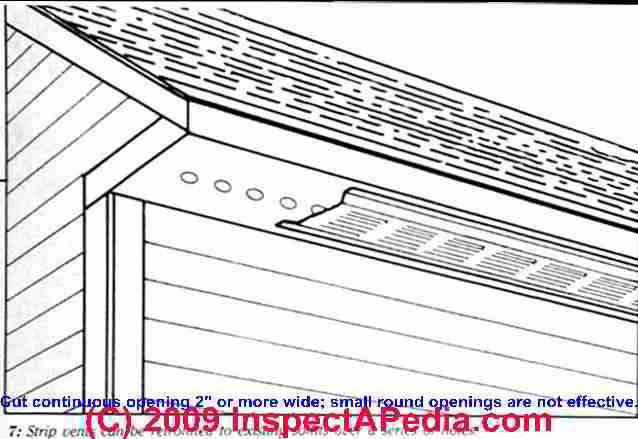
In several InspectAPedia articles we have emphasized the importance of effective under-roof ventilation to prevent moisture and mold in roof cavities as well as to avoid inadvertently sucking heat out of the building (by providing traditional exit vents or gable end vents without intake venting.
ROOF VENTILATION SPECIFICATIONS describes how to correct inadequate attic ventilation, stop attic condensation, and stop ice dam formation, thus avoiding building leaks, mold, and structural damage.
Roof Venting: Soffit Intake Vent-Continuous emphasizes that continuous soffit intake venting is essential for roof ventilation to work properly. In the sketch at left you'll see little round holes drilled through the soffit, covered by a soffit vent strip that can be purchased inexpensively at any building supply house.
DON'T RELY ON LITTLE HOLES in the soffit. Having inspected thousands of homes and seen many attic moisture and ice dam problems on homes where a variety of roof venting systems were installed, we are convinced that what is needed is a continuous opening along the full length of the soffit. Typically the opening is cut about 2" wide - to match the soffit vent strip minus its support flanges. Using a circular saw overhead risks sawdust in the eye, so wear protective goggles. But don't take any shortcuts - it won't work.
ROOF VENTING ENERGY SAVING DETAILS describes roof framing options that permit optimum roof ventilation in new construction.
ROOF VENTING NEEDED? explains why under-roof ventilation is needed, and includes warnings about un-vented and "hot roof" designs.
Original article
"Eight Retrofit Problem Solvers - new products, time tested techniques, and shortcuts make the hard work of insulation or energy retrofitting a little easier" - provided in original PDF form in the links below, and expanded/updated in text just below.
- Energy Conservation Retrofit - Air Krete wall insulation pump-in - PDF form, use your browser's back button to return to this page
- Energy Conservation Retrofit - part 2 Air Krete, continued, double hung window leak cures, foam foundation forms
- Energy Conservation Retrofit - part 3 Soffit intake vent addition using cuts and vent strips
This article is reprinted/adapted/excerpted with permission from Solar Age Magazine - editor Steven Bliss.
Here we include solar energy, solar heating, solar hot water, and related building energy efficiency improvement articles reprinted/adapted/excerpted with permission from Solar Age Magazine - editor Steven Bliss.
...
Continue reading at ENERGY SAVINGS MAXIMIZE RETURNS ON or select a topic from the closely-related articles below, or see the complete ARTICLE INDEX.
Or see these
Recommended Articles
Suggested citation for this web page
ENERGY SAVINGS RETROFIT OPTIONS at InspectApedia.com - online encyclopedia of building & environmental inspection, testing, diagnosis, repair, & problem prevention advice.
Or see this
INDEX to RELATED ARTICLES: ARTICLE INDEX to BUILDING ENERGY SAVINGS
Or use the SEARCH BOX found below to Ask a Question or Search InspectApedia
Ask a Question or Search InspectApedia
Questions & answers or comments about building energy savings retrofit choices. .
Try the search box just below, or if you prefer, post a question or comment in the Comments box below and we will respond promptly.
Search the InspectApedia website
Note: appearance of your Comment below may be delayed: if your comment contains an image, photograph, web link, or text that looks to the software as if it might be a web link, your posting will appear after it has been approved by a moderator. Apologies for the delay.
Only one image can be added per comment but you can post as many comments, and therefore images, as you like.
You will not receive a notification when a response to your question has been posted.
Please bookmark this page to make it easy for you to check back for our response.
Our Comment Box is provided by Countable Web Productions countable.ca
Citations & References
In addition to any citations in the article above, a full list is available on request.
- Solar Age Magazine was the official publication of the American Solar Energy Society. The contemporary solar energy magazine associated with the Society is Solar Today. "Established in 1954, the nonprofit American Solar Energy Society (ASES) is the nation's leading association of solar professionals & advocates. Our mission is to inspire an era of energy innovation and speed the transition to a sustainable energy economy. We advance education, research and policy. Leading for more than 50 years. ASES leads national efforts to increase the use of solar energy, energy efficiency and other sustainable technologies in the U.S. We publish the award-winning SOLAR TODAY magazine, organize and present the ASES National Solar Conference and lead the ASES National Solar Tour – the largest grassroots solar event in the world."
- Steve Bliss's Building Advisor at buildingadvisor.com helps homeowners & contractors plan & complete successful building & remodeling projects: buying land, site work, building design, cost estimating, materials & components, & project management through complete construction. Email: info@buildingadvisor.com
Steven Bliss served as editorial director and co-publisher of The Journal of Light Construction for 16 years and previously as building technology editor for Progressive Builder and Solar Age magazines. He worked in the building trades as a carpenter and design/build contractor for more than ten years and holds a masters degree from the Harvard Graduate School of Education. Excerpts from his recent book, Best Practices Guide to Residential Construction, Wiley (November 18, 2005) ISBN-10: 0471648361, ISBN-13: 978-0471648369, appear throughout this website, with permission and courtesy of Wiley & Sons. Best Practices Guide is available from the publisher, J. Wiley & Sons, and also at Amazon.com - Quiki Window Control, Holmes & Hemphill, 6186 Olson Hwy, Golden Valley MN 55422 800-328-2281
- In addition to citations & references found in this article, see the research citations given at the end of the related articles found at our suggested
CONTINUE READING or RECOMMENDED ARTICLES.
- Carson, Dunlop & Associates Ltd., 120 Carlton Street Suite 407, Toronto ON M5A 4K2. Tel: (416) 964-9415 1-800-268-7070 Email: info@carsondunlop.com. Alan Carson is a past president of ASHI, the American Society of Home Inspectors.
Thanks to Alan Carson and Bob Dunlop, for permission for InspectAPedia to use text excerpts from The HOME REFERENCE BOOK - the Encyclopedia of Homes and to use illustrations from The ILLUSTRATED HOME .
Carson Dunlop Associates provides extensive home inspection education and report writing material. In gratitude we provide links to tsome Carson Dunlop Associates products and services.
 | HOME | ABOUT | ASK a QUESTION | CONTACT | CONTENT USE POLICY | DESCRIPTION | POLICIES | PRIVACY | |
| © 2024 - 1985 Publisher InspectApedia.com - Daniel Friedman | |||||||||