
InspectAPedia® FREE Encyclopedia of Building & Environmental Construction, Diagnosis, Maintenance & Repair |
Question? Just ask us! InspectAPedia
|
 Blown-In Building Insulation
- POST a QUESTION or COMMENT about blown-in building insulation retrofits
Blown-in cellulose, foam, or other retrofit building insulation products:
This blown in insulation retrofit article illustrates and describes the properties of blown-in or pumped-in building insulation materials.
InspectAPedia tolerates no conflicts of interest. We have no relationship with advertisers, products, or services discussed at this website.
Blown-in Building Insulation: settlement, vapor barriers, condensation, R-values, voids
 This document assists building buyers, owners or inspectors who need to diagnose, identify, or improve building insulation for new construction or retrofit and energy savings projects.
The question-and-answer article below paraphrases, quotes-from, updates, and comments an original article from Solar Age Magazine and written by Steven Bliss.
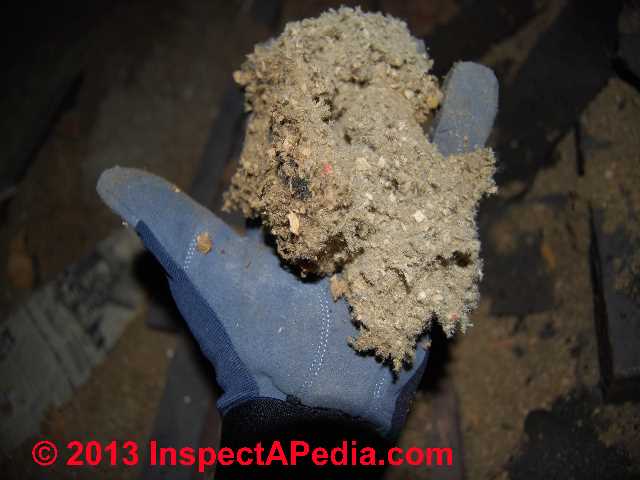
Various materials have been used as poured-in or blown-in building insulation but the two most common are cellulose insulation illustrated in our photo and chopped fiberglass insulation illustrated in our next photo (below).
Blown In Building Insulation Characteristics, Advice, Moisture or Condensation Concerns
Question:
Does blown-in insulation settle and need to be added as time goes by?
Our house doesn't seem as warm as it did at first, though it could be because we are getting old. There is no vapor barrier - the builder said that I didn't need a vapor barrier in this climate. - Carl Whitis, Belen NM
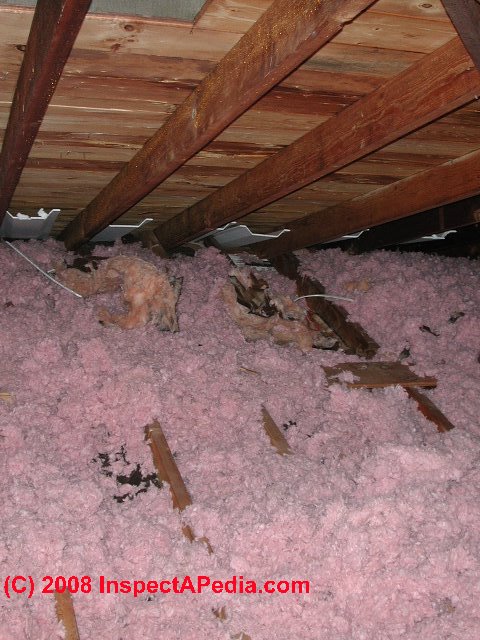
Above: chopped pink fiberglass insulation poured or blown into an attic in a somewhat sloppy uneven installation. This chopped fiberglass insulating material is discussed
at FIBERGLASS INSULATION IDENTIFICATION & PROPERTIES.
Answer:
Settlement in Blown in Building Wall Insulation
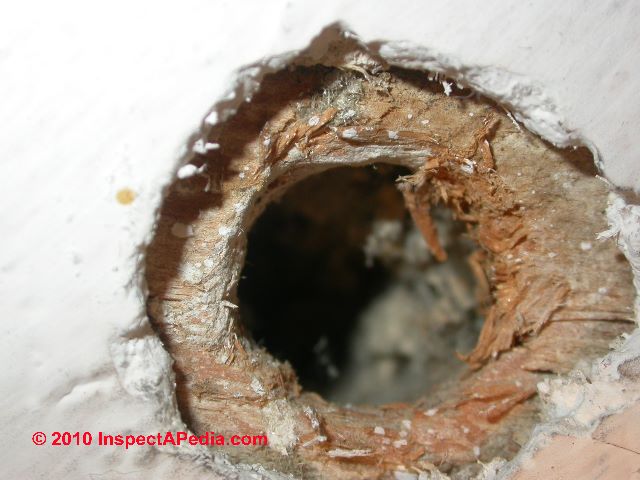 If the building insulation was blown in at the proper density, it shouldn't settle. This is true for both blown-in fiberglass and blown-in cellulose insulation. (Typically we're talking about insulation blown into building wall cavities)
If blown-in insulation has settled however, the gap at the top of the wall may sharply reduce the R-value of the wall.
Assume R-11 blown-in insulation in a wall cavity settles enough to create a void equal to 10 percent of the wall area.
This would drop the effective R-value of the wall from R-13 to R-9.75 or RSI-2.3 down to RSI-1.7 - a 25-percent reduction in insulating value and a 25 percent increase in heat loss through the wall.
You can determine whether or not blown-in wall insulation has settled by a thermograph scan of the building.
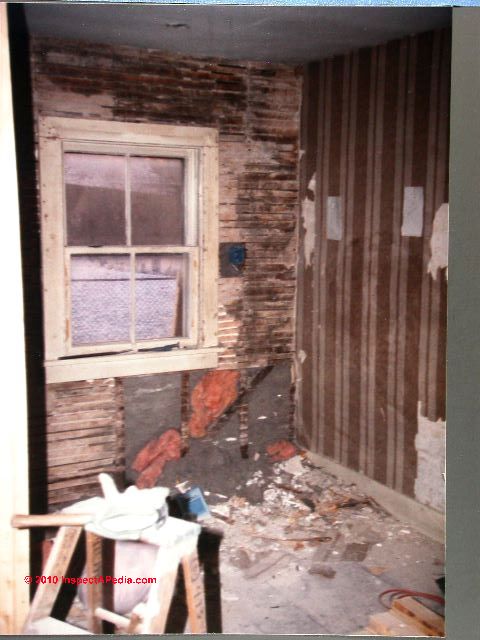
Our photo (above left) shows an inspection test cut to expose blown-in cellulose in a building wall. - DFs
Note: readers can convert North American-used R-values to SI Units to obtain an RSI Value as following:
R-Value / 5.678= RSI
or
RSI x 5.678 = R-Value
See details about insulation settlement causes, effects, extent and other insulation voids at
SETTLEMENT OR VOID PROBLEMS IN INSULATION
Other Voids in Blown-in Building Wall or Ceiling Insulation
Watch out: in some blown-in building insulation retrofit projects we have occasionally found significant insulation voids where the installer was careless, or where the installer did not anticipate BLOCKAGES in the wall cavity formed by diagonal bracing [Image file] or fire blocking.
An infra-red or thermal scan of a heated building during cold weather will make such insulation voids obvious - DF.
[We did indeed observe significant shrinkage, not settlement, in UFFI blown-in insulation in some homes insulated with that product in the 1970's, particularly if the product was not properly mixed in the first place.
See UREA FORMALDEHYDE FOAM INSULATION, UFFI. - DF]
Voids in UFFI Foam Insulation Pumped Into Building Cavities
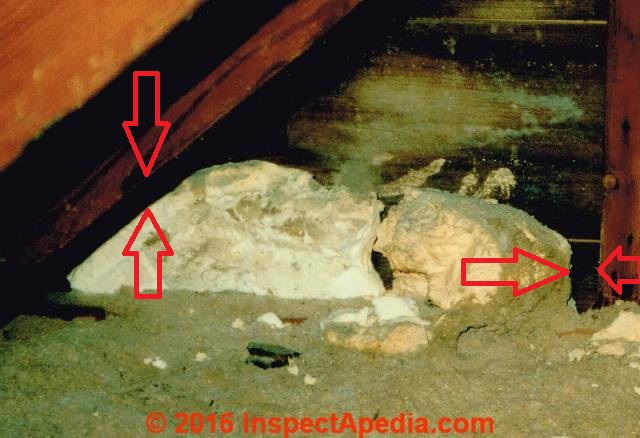
Popular in the U.S. during the Arab Oil Embargo Urea Formaldehyde Foam Insulation was used as a pumped-in insulation retrofit in previously-un-insulated building walls and ceilings, particularly in the northeastern U.S. states and in some areas of Canada. Depending on how the product was mixed and installed, significant shrinkage occurred as the insulation dried and cured, leaving air bypass leaks around the sides and tops of these blocks of foam in building walls and around all sides of UFFI in building ceilings.
Details about UFFI insulation and air leaks at UFFI shrinkage taps are
at UFFI SHRINKAGE, THERMAL BYPASS LEAKS
Happily newer open or closed-cell foam insulating products such
as POLYISOCYANURATE FOAM and IAQ
and ICYNENE FOAM SPRAY INSULATION do not seem to have this shrinkage gap problems.
Why Does our Blown-in Insulated House Now Feel Colder?
Your house may feel cold because the lack of a vapor barrier has let moist air from the house interior (or leaks in the house interior walls) has let moisture enter the walls.
As moisture enters building walls, it cools, causing condensation in the wall cavity. The effect is similar to an actual leak into the building wall but perhaps less severe, and possibly not a problem.
Effects of Moisture in Building Wall Cavities - Do We Need a Vapor Barrier?
If we have a limited amount of moisture in the wall cavity:
- moisture will be absorbed into the wall framing and insulation
- moisture will then diffuse or convect to the outside air or
- moisture will return to the house itself as the indoor relative humidity level drops
Even limited moisture leaking into some building walls can accumulate, leading to mold or other building problems depending on the wall structure and materials. For example leaks into EIFS synthetic stucco walls have led to serious rot and mold problems on some buildings.
See SIDING EIFS & STUCCO. - DF.
Effects of Water Leaks into Wall Cavities
If insulation actually gets wet (from accumulated condensation or from a leak into the wall cavity or ceiling cavity) the insulation becomes less effective, and you may feel the result as a "colder house" or in some unfortunate cases, as a "moldy house" with indoor air quality problems depending on the amount of moldy air moving in and out of building cavities.
If moisture returns to the building interior or exterior (cases 2 and 3 above) then no harm may have been done.
Watch out: building insulation that has been wet from leaks or accumulated moisture may invite mold growth, insect attack, and rot, all of which can eventually lead to the need for costly repairs.
See INSULATION MOLD CONTAMINATION TEST for details.
Effects of Missing Wall Vapor Barrier
Studies of several hundred houses without vapor barriers in Spokane WA and Portland OR, performed in the 1980's by George Tsongas of Portland State University found no structural damage to the buildings and only occasional higher than average moisture levels in the building framing or insulation.
Albuquerque NM (your location) is dryer than Spokane and has fewer degree days, so you should not have in-wall humidity problems unless they originated in building leaks.
Here we include solar energy, solar heating, solar hot water, and related building energy efficiency improvement articles reprinted/adapted/excerpted with permission from Solar Age Magazine - editor Steven Bliss.
Moisture or Water in Sprayed Cellulose Insulation
According to Deborah Fallow, owner of MetroNY Insulation,
"Spray-applied cellulose insulation, which is most often used in new construction, is damp-sprayed, not wet - an important distinction. In the old days, [cellulose insulation] was a wet-applied product, and you could squeeze liquid moisture out of it.
For quite some time now, only a very small amount of moisture is added to damp-sprayed cellulose, definitely not enough to be able to squeeze water out of it. Under normal conditions, the cellulose insulation is ready to be covered by drywall in 24 hours, far less than the time that is routinely scheduled between the insulation and drywall jobs [in new construction]."
Fallow adds,
"In addition, cellulose manages moisture." According to Fallow [we are not sure we agree], "Cellulose insulation requires no vapor barrier in the overwhelming majority of installations. It does an excellent job of limiting air movement, and because it is hygroscopic [definition: hygroscopic means a substance tends to absorb moisture from air], it manages moisture as well.
Some insulations require vapor barriers because they do such a poor job of preventing air movement, air that can carry moisture with it.
The problem is that ... moisture and air don't always move in the same direction thorough a building, depending on the time of year. So what about those products that need a vapor barrier? Effectively half the year it's on the wrong side of the wall. Cellulose [that is blown in without a vapor barrier] doesn't have that problem."
Watch out: In our opinion the views above need some clarification:
It is accurate that building wall cavity insulation can safely "absorb" moisture driven into the wall cavity, store it, and later release it back to the living area as seasons and air and moisture movement direction change. We discuss the safe movement of moisture in and out of building cavities
at MOISTURE in BUILDING WALLS, EFFECTS.
It can also the case that if moisture driven into a wall (usually most severely at wall penetrations such as openings at receptacles or light fixtures) is excessive in amount (such as in a poorly vented bathroom or in a home with water entry troubles) the amount can be enough to saturate the insulation (mold and loss of R-value).
The ability of different building insulation materials to absorb moisture vapor and later return it safely to the building interior varies by insulation product.
Also, depending on the wall or ceiling's total R-value, moisture can pass through the insulation to the exterior sheathing where it condenses back to liquid form. That's a problem that invites mold growth, structural rot, and insect attack.
Fallow's explanation above may confuse some readers who mix up the need for a vapor barrier (keeping moisture out of a wall) and the need for an air barrier (keeping wind effects out of a wall from outside and/or minimizing air movement in and out of a wall from inside the building).
Exterior house wrap is specifically intended to be an air barrier, not a moisture barrier, so that if moisture does pass through a wall's insulation it can continue to pass to the outdoors.
Or more generally, we place a vapor barrier on the "warm side" of a wall (or ceiling or floor) in order to prevent moisture from moving into and accumulating in the building cavity. In northern climates invariably that means the vapor barrier goes inside the building.
In some southern climates where air conditioning is used, the "warm" side of the wall is actually the building exterior and a vapor barrier may be placed there rather than indoors.
An in-depth discussion of how moisture moves in and out of buildings is provided
at MOISTURE PROBLEMS: CAUSE & CURE.
A Few Other Warnings about Blown-In Building Insulation
 Watch out: don't blow ceiling insulation into or around electrical fixtures or wiring that can create an overheating or fire hazard. Examples of problems to avoid when blowing insulation into a building include [-DF]
- Blocking or covering up attic or under-roof ventilation can lead to a building moisture problem where there was none before.
Our photo (left) shows a building ridge-vent that was jammed full of blown-in cellulose insulation during an insulation retrofit job in upstate New York.
The result was a blocked under-roof or attic ventilation exit pathway, moisture accumulation, and a mold problem bad enough that the insulation and ceiling had to be removed and the attic area cleaned. - Blocking or covering-up knob-and-tube electrical wiring. This type of electrical wiring was intended to be hung in open air.
If it is covered by insulation, depending on circuit usage it may overheat, damaging its insulation, becoming unsafe, perhaps a fire hazard. - Blocking or covering up pot lights (recessed ceiling lights) that are not rated to be covered by insulation can lead to overheating and a fire.
The link to the original Q&A article in PDF form immediately below is preceded by an expanded/updated online version of this article.
- Q&A on BLOWN IN INSULATION - original PDF version, use your browser's back button to return to this page
Properly installed insulation, including loose-fill / blown-in insulation, improves the fire safety of buildings
 On 2011-11-27 by (mod)
-
On 2011-11-27 by (mod)
-
FireCaptain,
Thank you for the interesting comment - one that bears much consideration.
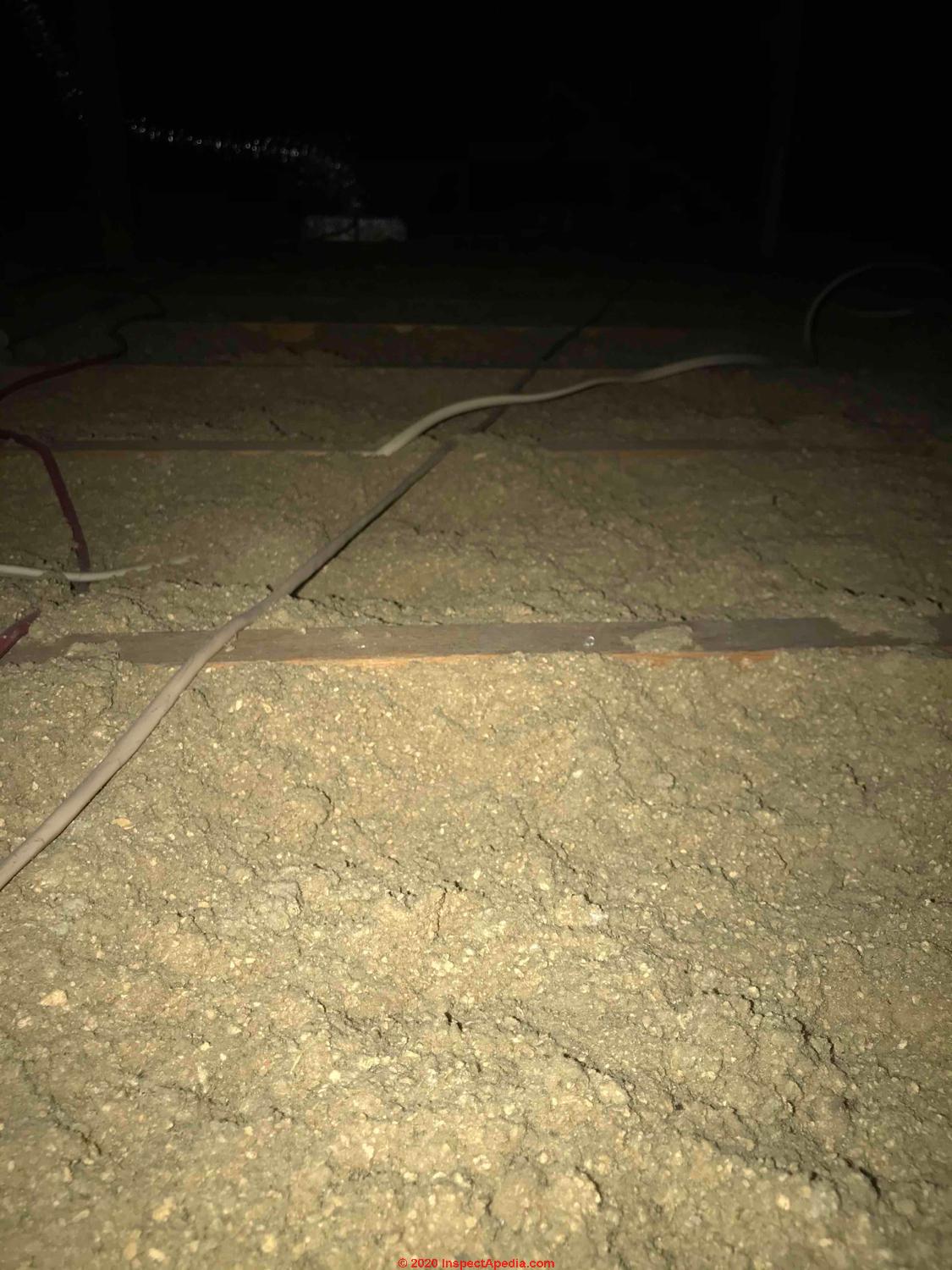
A problem that can occur with any insulation add-on or retrofit is that the installer may blow or install insulation over wiring, recessed ceiling lights, electrical boxes, knob and tube electrical wiring, or other components that were not intended to be covered.
Watch out: 'm very grateful to hear your opinion, here, Firecaptain, and we welcome argument and further comment; but it is criticial for us to distinguish between personal opinion and informed, science-based fact, particularly where life-safety questions are at stake.
It is perhaps an incomplete thought to imagine that loose-fill insulation will hide heat from thermal imaging while batt insulation will not. That's simply not the case. But it is the case that loose-fill insulation may do a more-thorough job of filling irregular building cavities that otherwise show up as points of heat loss in thermal imaging.
Really? Research has not shown much difference in fire-spread-risk nor fire-detection-impedence between loose-fill and batt type insulation except that loose fill insulation may actually improve fire building fire resistance in some situations (Rogowski 1985).
Where fire risks may be increased during insulation retrofit is where any insulating product is added to an existing and already-insulated building if proper procedures are not followed. That is to say a search for "fire safety of blown-in building insulation" did not find such evidence.
An important example is the project of blowing insulation of any type into previously empty building cavities through which knob-and-tube electrical wiring were routed. That wiring was rated for safe use in un-insulated cavities where exposure to air was part of its heat dissipation that made its insulation safe.
In fact, properly-installd building insulation, including loose-fill and blown-in retrofit insulation actually improves the fire-safety of buildings (Al-Homoud 2005) by slowing flame and heat spread and by serving as improved fire-stopping (Patton 1997). And special fire-resistant foam insulation is actually required in some locations such as penetrations in new work (Rood 1980).
Really? Well there are additional fire-safety questions related to insluation in buildings, such as toxic fume off-gassing from some materials (Schiavoni 2016).
See details at FIRE OFF-GASSING HAZARD DETECTION
Research on Fire-Safety of Retrofit Blown-in or Loose fill or Foam Building Insulation
- Al-Homoud, Mohammad S. "Performance characteristics and practical applications of common building thermal insulation materials." Building and environment 40, no. 3 (2005): 353-366.
Excerpt:
Fire protection: If the suitable insulation material is selected and properly installed, it can help in retarding heat and preventing flame immigration into building in case of fire ... - CELLULOSE INSULATION FIRE RESISTANCE [Web article]
- Kleinfelder, W. A. Investigation of the fire performance of building insulation in full-scale and laboratory fire tests. No. ORNL/Sub-79-7863/1. Underwriters Labs., Inc., Northbrook, IL (USA), 1984.
- Patton, Bruce L. "Method for retro-fit forming firestops in existing wall structures with blown insulation." U.S. Patent 5,655,350, issued August 12, 1997.
- Rogowski, Bobbie. "Fire performance of combustible insulation in masonry cavity walls." Fire safety journal 8, no. 2 (1985): 119-134.
Abstract:
The risk of fire spread in buildings, from one room/compartment to another, through cavity walls filled with a range of combustible insulating materials has been investigated. \\
Tests have been carried out on small-scale or storey-high walls having two masonry facings, insulated with typical examples of loose fill, board or in situ foamed plastics products. A small localized penetration of both facings simulating for example an ineffectively sealed air brick was built into the lower part of the experimental wall and two ‘eave’ conditions were investigated viz with the perimeter either sealed or partially open.
A small crib was positioned adjacent to the cavity penetration and the subsequent extent of spread of fire and smoke was noted visually; temperature measurements within the cavity were recorded together with heat flux measurements in the combustion zone.
The experiments showed the dependence of the extent of fire spread on the air supply to the combustion zone; in this type of wall with the upper perimeter sealed, the risk of flame or smoke spread from one area to another is negligible.
With the upper edge partially unsealed, no flame and only negligible smoke spread was noted with in situ foamed insulations.
With granular fill, retained in position within the cavity, some smoke percolated upwards but the risk of eventual spread of fire through the eave opening was restricted to three products, which have subsequently been withdrawn from the market.
Thermoplastic bead flowed through the hole into the fire area contributing to the fuel load but when installed with an adhesive the bead was effectively maintained in position and performed like the in situ foamed products.
It was found with one specific test condition that slow flame spread could be sustained through a continuous cavity adjacent to expanded polystyrene insulating boards provided the eave perimeter of the cavity was unsealed.
Whilst such flame spread is unlikely to affect directly any inhabited areas of the building, sealing of cavities insulated with combustible boards is considered to be essential to prevent smoke spread, possible roof fires and destruction of the insulant.
Excerpt:
... of cavities insulated with combustible boards is considered to be essential to prevent smoke spread, possible roof fires and destruction of ... - Rood, Leonard D. "Fire retardant insulation." U.S. Patent 4,184,311, issued January 22, 1980.
- Schiavoni, Samuel, F. Bianchi, and F. Asdrubali. "Insulation materials for the building sector: A review and comparative analysis." Renewable and Sustainable Energy Reviews 62 (2016): 988-1011.
Excrerpt:
The behavior of insulation materials under fire may be responsible of serious safety issues … Several studies proved that toxic fumes are the most important causes in fire deaths
On 2011-11-20 by FireCaptainGirl - get rid loose fill blown-in insulation ?
Good article blown in, but what they don't tell you is that this stuff is a NIGHTMARE if you ever have a fire in your house. A small electrical fire in the attic can go undetected for hours as it snakes through this stuff, spreading to the structureal members of your home.
Even if you smell smoke, the fire department may have a very difficult time finding the source, even with thermal imagers.
The heat is insulated too, and the thermal imagers don't always reveal the ignition source. Our answer in my department? Take it ALL out when you have a fire in a building with this stuff. Its way too unpredicatble and nefarious for me to sleep at night if we leave it in. You're better off paying for the roll out type.
Blown-In Building Insulation Research
- INSULATIN: ADDING Insulation to an Existing Home [PDF] U.S. Department of Energy - tips on how to do your own check for the presence of absence of insulation in a home
- INSULATION: SELECTING Insulation for New Home Construction [PDF] U.S. Department of Energy - "Your state and local building codes probably include minimum insulation requirements, but to build an energy-efficient home, you may need or want to exceed them. For maximum energy efficiency, you should also consider the interaction between the insulation and other building components.
This is called the WHOLE HOUSE SYSTEMS DESIGN APPROACH [PDF] - INSULATION TYPES [PDF] table of common building insulation properties from U.S. DOE.
Readers should see INSULATION R-VALUES & PROPERTIES our own table of insulation properties that includes links to articles describing each insulation material in more detail.
Reader Comments, Questions & Answers About The Article Above
Below you will find questions and answers previously posted on this page at its page bottom reader comment box.
Reader Q&A - also see RECOMMENDED ARTICLES & FAQs
On 2021-01-19 - by (mod) - include SI units in InspectApedia.com articles!
Thank you Richard, you are absolutely right; in many articles we have included SI units in recognition of our readers from around the world.
The following has been added to the article above and was excerpted from our page:
HEATING, COOLING & INSULATION TERMS, DEFINITIONS https://inspectapedia.com/heat/HVAC_Definitions.php
where we discuss R U K values and provide R-VALUE & RSI VALUE
Conversion Between R-Values & RSI-Values
Note: readers can convert North American-used R-values to SI Units to obtain an RSI Value as following:
R-Value / 5.678= RSI
or
RSI x 5.678 = R-Value
Aside: ironically a very few readers (you know who you are) have griped where we have used metric and other SI units in articles, engaging in the fantasy that InspectApedia.com is provided only for a more-narrow group of folks in the U.S. - not so; our very-welcomed readership is world-wide.
Thank you for your comment; we also welcome any questions or further criticism or suggestions you may have.
Working together makes us smarter, and things go better when we are-so.
On 2021-01-19 by Richard
What an awesome site! Just found it and it's love at first sight. I am keen to improve my home's energy efficiency so this is a great resource -- whether for doing work myself, or just knowing when tradespeople are taking me for a ride!
I'd love to see the site take on a more international approach to measurements and units, as most of the information is relevant worldwide! Since changing over to SI units would be a very big ask, maybe just specifying units where they are currently missing or ambiguous, eg. on R-values (which may be metric or imperial).
On 2020-07-07 - by (mod) -
Chris
I'll be glad to help, but am confused by the description of your wall construction. Perhaps you can use the add image button to post a photo of a sketch of the wall design.
On 2020-07-07 by Chris
I live in OKC, OK and am building a home with a stick detached garage (24x40), 2x6 walls, 7/16 zip and brick outwalls, moist applied cellulose in walls r22 and r38 attic . I applied 7/16 osb on the inside walls and painted that with kilz oil based paint. spoke with the cellulose contractor prior and they said it was fine to apply this way.
I waited 5 days after cellulose was applied to install osb but it was raining through that week. (cellulose contractor said it was plenty of time) after applying osb it started to buckle but contractor said it was ok.
After 30days I painted with kilz and began to notice mold coming through walls so I removed osb and the there was a lot of mold on backside of osb and a lot of moisture in the cellulose. I have spoke with zip, kilz and osb reps and all seem to say you cannot install zip outside and osb inside.
Also reps say the cellulose was probably installed with to much moisture to begin with and got locked in when osb was applied... What do you think? I also have installed a mini split to help with humidity inside building and to keep dry. I guess I'm looking for advice on interior wall covering (drywall?) before I cover this again and have same problem.
On 2020-06-20 by (mod) - don't bury electrical boxes when adding insulation in Canada (nor elsewhere)
David
Thanks, that's an interesting and common problem: it's improper to "bury" an electrical box; I don' think that the answer turns on what kind of insulation is being added.
See what your local electrical inspector advises and let me know and we'll take it from there.
On 2020-06-20 by David Greene
I'm in Toronto, Canada.
My attic has about 6" of cellulose blow-in insulation, but I want to add more blow-in insulation. I was told by the insulation company
that I'd need to have electrical junction boxes moved so they're at least 24" off the floor (or is it above the top of the insulation?).
Someone suggested I blow in fiberglass on top of the existing cellulose insulation. That way, I wouldn't have to move the existing
electrical work. Does anyone know if that's okay and/or up to code? No one seems to be able to even tell me whom to ask about
this in my area.
Thanks
On 2017-05-17 - by (mod) - who can check for leaks into building cavities?
Crystal
At the top of any InspectApedia page you'll see a link to EXPERTS DIRECTORIES where you can find lists of home inspectors, most of whom are familiar with moisture and leak issues in buildings. Discuss your concerns and what the inspector will do and what report or information you'll be given before hiring someone.
On 2017-05-17 by Crystal pindle
Who can I hire to check to see if I have water leaks in my wall cavities.
...
Continue reading at CELLULOSE LOOSE FILL INSULATION or select a topic from the closely-related articles below, or see the complete ARTICLE INDEX.
Or see these
Recommended Articles
- AIR LEAK DETECTION TOOLS - home
- BALSAM WOOL BATT INSULATION
- CAPE COD ROOF & KNEE WALL INSULATION & VENTILATION
- CATHEDRAL CEILING INSULATION
- CELLULOSE LOOSE FILL INSULATION
- CELLULOSE INSULATION FIRE RESISTANCE
- ENERGY SAVINGS in BUILDINGS - home
- FIBERGLASS INSULATION IDENTIFICATION & PROPERTIES
- FOAM SPRAY INSULATION TYPES
- HEAT LOSS in BUILDINGS - home
- INSULATION IDENTIFICATION GUIDE - home
- INSULATION & FIRE SAFETY [PDF]
- INSULATION, FOAM, FIRE SAFETY [PDF]
- INSULATION INSPECTION & IMPROVEMENT - home
- MINERAL WOOL - ROCK WOOL INSULATION
- VERMICULITE INSULATION - home
Suggested citation for this web page
BLOWN-IN INSULATION at InspectApedia.com - online encyclopedia of building & environmental inspection, testing, diagnosis, repair, & problem prevention advice.
Or see this
INDEX to RELATED ARTICLES: ARTICLE INDEX to BUILDING INSULATION
Or use the SEARCH BOX found below to Ask a Question or Search InspectApedia
Ask a Question or Search InspectApedia
Questions & answers or comments about -.
Try the search box just below, or if you prefer, post a question or comment in the Comments box below and we will respond promptly.
Search the InspectApedia website
Note: appearance of your Comment below may be delayed: if your comment contains an image, photograph, web link, or text that looks to the software as if it might be a web link, your posting will appear after it has been approved by a moderator. Apologies for the delay.
Only one image can be added per comment but you can post as many comments, and therefore images, as you like.
You will not receive a notification when a response to your question has been posted.
Please bookmark this page to make it easy for you to check back for our response.
Our Comment Box is provided by Countable Web Productions countable.ca
Citations & References
In addition to any citations in the article above, a full list is available on request.
- Steve Bliss's Building Advisor at buildingadvisor.com helps homeowners & contractors plan & complete successful building & remodeling projects: buying land, site work, building design, cost estimating, materials & components, & project management through complete construction. Email: info@buildingadvisor.com
Steven Bliss served as editorial director and co-publisher of The Journal of Light Construction for 16 years and previously as building technology editor for Progressive Builder and Solar Age magazines. He worked in the building trades as a carpenter and design/build contractor for more than ten years and holds a masters degree from the Harvard Graduate School of Education. Excerpts from his recent book, Best Practices Guide to Residential Construction, Wiley (November 18, 2005) ISBN-10: 0471648361, ISBN-13: 978-0471648369, appear throughout this website, with permission and courtesy of Wiley & Sons. Best Practices Guide is available from the publisher, J. Wiley & Sons, and also at Amazon.com - Deborah K. Falkow is owner of MetroNY Insulation, LLC., a New York insulation contractor. MetroNY Insulation, 60 Commerce St., Suite M, Spring Valley NY 10977, Tel: 845-445-8255, Email: info@metronyinsulation.com web: metronyinsulation.com
- Principles of Heating, Ventilating, And Air Conditioning: A textbook with Design Data Based on 2005 AShrae Handbook - Fundamentals (Hardcover), Harry J., Jr. Sauer (Author), Ronald H. Howell, ISBN-10: 1931862923 or ISBN-13: 978-1931862929
- 1993 ASHRAE Handbook Fundamentals (Hardcover), ISBN-10: 0910110964 or ISBN-13: 978-091011096
- "Energy Savers: Detecting Air Leaks [copy on file as /interiors/Energy_Savers_Detect_Air_Leaks.pdf ] - ", U.S. Department of Energy
- "Energy Savers: Air Sealing [copy on file as /interiors/Energy_Savers_Air_Sealing_1.pdf ] - ", U.S. Department of Energy
- Insulate & Weatherize (Taunton's Build Like a Pro), Bruce Harley. Review quoted:
An engineer who trains builders in energy-efficient construction, Harley offers a wealth of information that will allow readers to improve their home's efficiency, saving both money and natural resources. After an introductory section that explains the underlying principles of heat transfer, insulation, and air quality, Harley demonstrates basics such as weather-stripping and moves forward through advanced projects including insulation and major upgrades. Short "Pro Tips" as well as sections labeled "Trade Secrets," "What Can Go Wrong," and "In Detail" provide a great deal of helpful information. Increasing energy efficiency is one of the easiest ways for homeowners to save money - Super-Insulated Retrofit Book: A Homeowner's Guide to Energy-Efficient Renovation, Robert Argue
- The super-insulated retrofit book: A homeowner's guide to energy-efficient renovation (Sun builders series), Brian Marshall
- WEATHER RESISTIVE BARRIERS [PDF] U.S. Department of Energy, ", how to select and install housewrap and other types of weather resistive barriers
- In addition to citations & references found in this article, see the research citations given at the end of the related articles found at our suggested
CONTINUE READING or RECOMMENDED ARTICLES.
- Carson, Dunlop & Associates Ltd., 120 Carlton Street Suite 407, Toronto ON M5A 4K2. Tel: (416) 964-9415 1-800-268-7070 Email: info@carsondunlop.com. Alan Carson is a past president of ASHI, the American Society of Home Inspectors.
Thanks to Alan Carson and Bob Dunlop, for permission for InspectAPedia to use text excerpts from The HOME REFERENCE BOOK - the Encyclopedia of Homes and to use illustrations from The ILLUSTRATED HOME .
Carson Dunlop Associates provides extensive home inspection education and report writing material. In gratitude we provide links to tsome Carson Dunlop Associates products and services.
 | HOME | ABOUT | ASK a QUESTION | CONTACT | CONTENT USE POLICY | DESCRIPTION | POLICIES | PRIVACY | |
| © 2024 - 1985 Publisher InspectApedia.com - Daniel Friedman | |||||||||