
InspectAPedia® FREE Encyclopedia of Building & Environmental Construction, Diagnosis, Maintenance & Repair |
Question? Just ask us! InspectAPedia
|
 Basement Ceiling/Wall Moisture Barrier Choices & Placement
- POST a QUESTION or COMMENT about Where to Put the Vapor Barrier over a Basement
This article discusses the proper type, location and placement of moisture barriers or vapor barriers in basements to control air and moisture.
Can I use a spray-on basement ceiling barrier?
Does the vapor barrier go "up" towards the warm side or underside of the floor above, or does the vapor barrier go "down" facing basement interior?
InspectAPedia tolerates no conflicts of interest. We have no relationship with advertisers, products, or services discussed at this website.
- Daniel Friedman, Publisher/Editor/Author - See WHO ARE WE?
Choice & Installation of Basement Ceiling Barriers to Control Air Leaks & Moisture
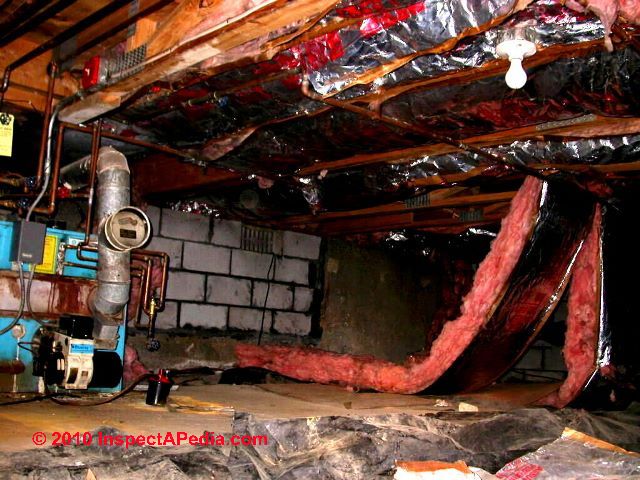
 Our horrible crawlspace (above) shows foil-faced fiberglass insulation installed with the vapor barrier facing "down" towards the wet crawlspace floor - this is an example of backwards, incorrect, "cold-side" vapor barrier installation that invites moisture condensation and even mold contamination inside the fiberglass insulation.
The accompanying text is reprinted/adapted/excerpted with permission from Solar Age Magazine - editor Steven Bliss.
Carson Dunlop Associates, a Toronto home inspection, education & report writing tool company, comments that a dirt crawl can contribute several gallons of moisture per day into a home in the best case.
If the crawl area is actually wet from surface runoff, roof spillage, ground water, or plumbing leaks, the amount of water pumped into the home can be much larger and more harmful.
The question-and-answer article below paraphrases, quotes-from, updates, and comments an original article from Solar Age Magazine and written by Steven Bliss.
How to Install a Vapor Barrier Over an Un-Heated Basement
Question:
We want to insulate the ceiling of an unheated basement and have been thinking about a vapor barrier. I wonder if anyone has had automobile undercoating sprayed on their ceiling as a vapor barrier.
How do you feel about that? Would sheet goods such as flooring be better? - Bill Geary, Belfair WA
Answer:
An insulated floor over an unheated basement (or crawl space) requires an air/vapor barrier4. It belongs on the warm side of the insulation except, perhaps, in a consistently hot, humid climate.
When insulating a floor over a basement, the air/vapor barrier, in addition to its usual job of keeping moisture out of the insulation [thus preserving its insulating R-value], the barrier keeps moist basement air from entering the living area via the stack effect [riding rising warm air currents].
As with other air/vapor barriers, the membrane's air tightness is far more important than its perm rating, since moisture moves through buildings mostly by air leaks.
Placing a Basement Vapor Barrier Over Exposed Bottoms of Overhead Floor Joists Forming the Basement Ceiling
 One option for a floor air/vapor barrier is a polyethylene [plastic] sheet placed over the floor joists and sealed to the wall vapor barrier.
Watch out: But if you are placing insulation between the overhead floor joists that form the basement ceiling, the vapor barrier belongs on the "warm" side not the cool basement room side, so this would be an incorrect installation that risks collecting and trapping moisture between the poly barrier and the underside of the floor above.
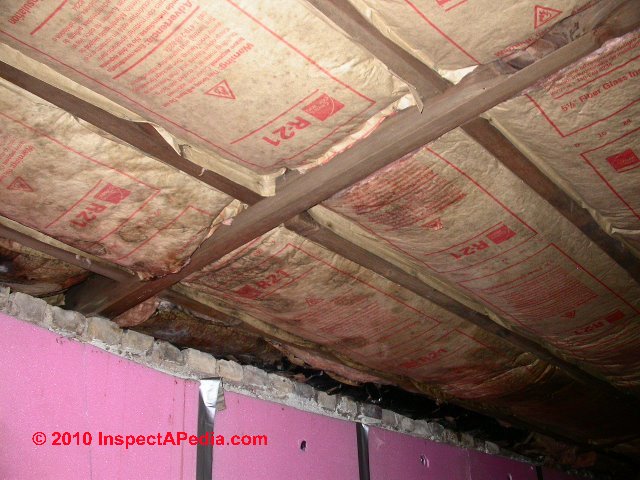
Our photo (left) shows basement ceiling insulation installed the "wrong way" with the vapor barrier facing "down" - in this case over a dirt floor basement.
The insulation near the exterior walls had become wet and moldy.
We [DF] have found homes where poly was simply stapled up to the underside of the basement ceiling joists only to find that through various penetrations into the plastic air leakage led to so much moisture accumulation that there was both mold and rot in the ceiling.
Basement Ceiling Vapor Barrier over Subfloor Above
A better installation if you are installing a basement ceiling poly vapor barrier during new construction is to place the poly either directly atop the first floor joists (dangerously slippery during installation) or to place the poly barrier atop the subfloor and underneath the next layer of flooring underlayment as the first floor is being built.
A third option is to use the subfloor or underlayment (of the first floor surface) as a vapor barrier itself by sealing all the subfloor joints (or underlayment joints) and also sealing at the wall/floor junction.
This is an easier method to accomplish than you may think if you are also using construction adhesive to glue subflooring to floor joists during construction.
Basement Ceiling Vapor Barriers Installed During Insulation Retrofit
In a retrofit job in which you are adding insulation to a basement ceiling by placing it between the joists of the floor above, if you are using foil or kraft-faced insulation, be sure that the insulation is placed with the foil or kraft paper facing "up" towards the heated side of the floor, lest you form another moisture trap.
Or use un-faced insulation in that space, having placed your vapor barrier atop the subfloor above (and below underlayment above) as we just suggested.
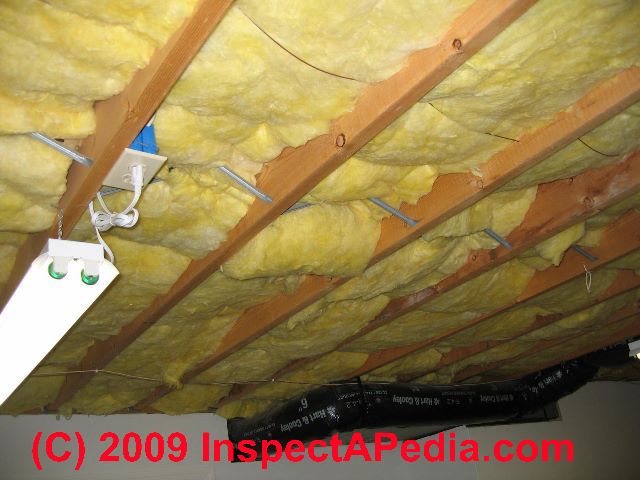
Our photo above shows un-faced fiberglass insulation that has been added between the joists of a basement ceiling. No vapor barrier was installed facing the basement area.
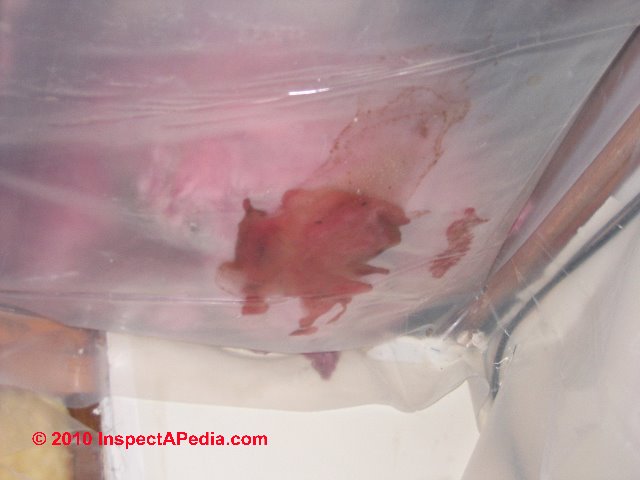
Our second basement ceiling insulation snafu photo (below) shows accumulated water trapped above a poly "vapor barrier" that had been stapled to the underside of basement ceiling joists. This image illustrates a failing of the theory that if we can just make a perfect vapor barrier (the hot roof mistake) in a ceiling we don't have to worry about trapped moisture.
Our OPINION is that both due to errors and omissions during construction by normal workers and leaks into or punctures through building surfaces during its life make a perfect vapor barrier difficult to achieve and risk serious hidden leak or mold damage. - DF
Spray-on Basement Ceiling Vapor Barriers
Watch out: as for using automobile undercoating spray as a basement ceiling vapor barrier, our reasoned opinion is "Yuch!". Health reasons aside [the volatiles and solvents in the undercoating spray], do you really want your basement to smell like the underside of a car?
More seriously, tar and asphaltic coatings are likely to outgas unpleasant organic fumes for some time. [Confirmed: In 2010 we sprayed automotive undercoating on a rust repair on the underside of our pickup truck.
Even with the truck left outdoors for days to "dry" we observed that the undercoating remained soft and tacky for several weeks and continued to outgas (and smell) - DF.]
There are indeed vapor-barrier paints available that can be used as a moisture-resistant primer paint when renovating the interior of an older building, but these products won't seal holes and air leaks in the basement ceiling. And if the first floor subfloor above the basement is plywood or a similar product, except for its seams, it's already forming a rather good air barrier.
Using Sheet Vinyl Flooring as a Basement Ceiling Vapor Barrier?
We see no reason why sheet vinyl couldn't make a perfectly good vapor barrier as long as you are not creating an "insulation sandwich" with air leaks that will trap moisture in the basement ceiling - that is, as long as you carefully seal at all of the penetrations and at the junction of the wall vapor barrier.
But considering that a principal objective of the basement ceiling barrier is to stop air movement into the building above, it's not clear why sheet vinyl flooring would be a better solution than less costly 6-mil polyethylene plastic. - DF.
Explanation of Basement Moisture and Air Movement
Moisture Movement a Basement into the House Interior
In the summer, however, particularly in air-conditioned homes, moisture may be driven from a basement upwards into the house. Although you could stop this by using a vapor barrier below the under-floor insulation (presumably insulation has been placed under the floor over the crawl area), it is more practical to keep the basement RH level down.
If the basement has a dirt floor, this is best done with a polyethylene ground cover , and by making sure that there are no outside water leaks nor plumbing leaks into the crawl space.
(see CRAWL SPACE GROUND COVERS)
In a finished basement with a concrete slab or tile floor, you may find moisture condensing on the basement floor during humid summer months - more argument for correcting the water sources outside the building and running a dehumidifier indoors during this season.
If you see moisture stains on the basement walls, it is at least sometimes a source of un-wanted building moisture. Even if you think your crawlspace is "dry" it might not be.
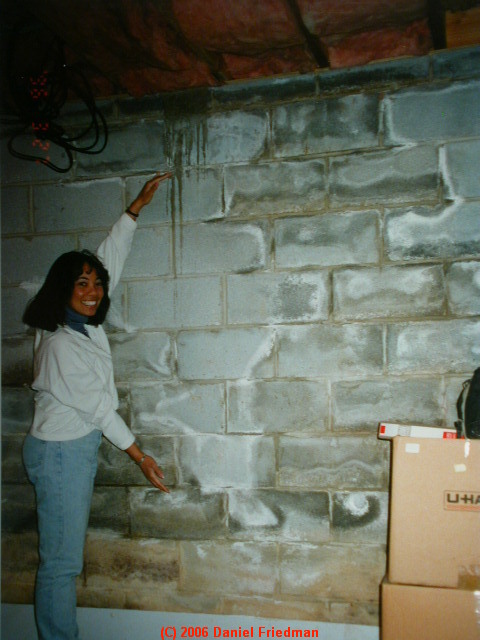
EFFLORESCENCE SALTS & WHITE DEPOSITS provides examples of visual clues that moisture is being pumped through foundation walls or up through a dirt floor into the building even when actual crawlspace flooding is not occurring.
Air Movement from Basement to House Interior
Much of the moisture transport from a basement into house is due to the stack effect (or air convection currents) pulling air up through the house. Warm air tends to rise upwards through a building, and that air movement will be even more rapid if upper floor windows are open or attic or upper floor exhaust fans are in operation.
If a basement is damp, wet, moldy, or contaminated by a sewage spill, all of those undesirable ingredients are easily transported from the crawlspace into the occupied space from the crawl area, riding on rising air convection currents.
In fact we [DF] have found frequent evidence that moisture from a wet basement or crawl space has produced excessive levels of condensation all the way up in a building's attic.
The best way to prevent un-wanted air movement from a basement or from a crawlspace into a building is to seal off all air leaks between the basement (or crawl area) and the house.
See AIR SEALING STRATEGIES for details about sealing building air leaks.
A good ground cover in the crawlspace [image file] will also keep the RH of any crawlspace air that does enter the house reasonably low.
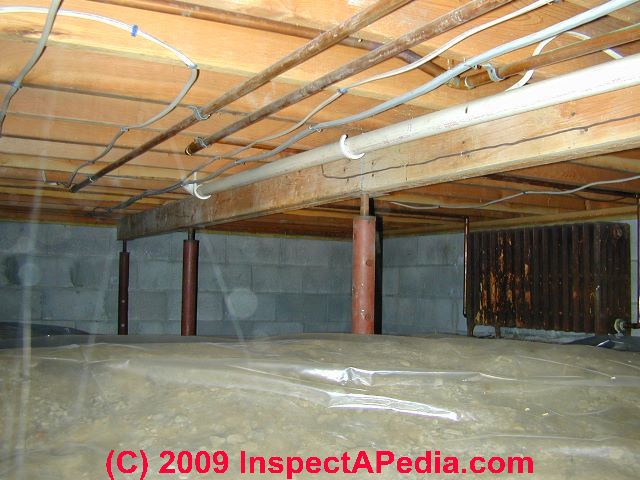
See CRAWL SPACE GROUND COVERS for details on adding crawlspace ground covers that also pertain to some basements.
For a more technical explanation of condensation in buildings, also
see DEW POINT TABLE - CONDENSATION POINT GUIDE
and DEW POINT CALCULATION for WALLS.
The question-and-answer article about use of a plastic barrier on crawl space floors to control crawl space moisture and mold, quotes-from, updates, and comments an original article from Solar Age Magazine and written by Steven Bliss.
Original article:
The link to the original Q&A article in PDF form immediately below is preceded by an expanded/updated online version of this article.
- Barrier_ Grief - Can I Use Automobile Undercoating on the Basement Ceiling? - [PDF] Q&A on the proper material & placement location of vapor barriers or moisture barriers in the ceiling of an unheated basement - PDF version, use your browser's back button to return to this page. Original article, Solar Age Magazine, January 1985, adapted and updated for InspectAPedia.com November 2010.
Suffocating air and basement mold - which way to install the basement ceiling vapor barrier?
 I was reading this page on insulation and vapor barriers for basements and I have a question:
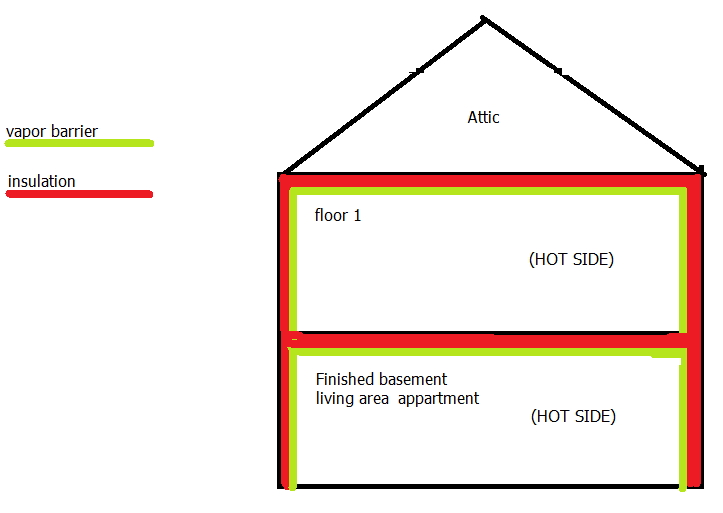
In a finished basement, if you install a vapor barrier on the ceiling (face hot side) + insulation, will the air in the basement be trapped and cause surface mold?
I ask because I saw two [moldy] basements last week and the air was suffocating, and there was mold in all corners of the living area, massive condensation and mold on the windows.
Both homes had a vapor barrier. In the same basement in another area of each home the was no insulation, no vapor barrier and the air was perfect.
In my opinion the only insulation that you can put on the ceiling of a finished basement is for sound proofing and no vapor barrier.
What do you think? - Patrick Massie, pmir inspection, i
Mr. Massie s a professional home inspector and a certified infrared FLIR thermographer [Thermographie Infrarouge] in Quebec.
Note: the vapor barrier illustration above, provided compliments of P.M., is for purposes of discussion and is not necessarily the best moisture barrier placement for all buildings.
DF answer: Vapor barrier goes on the warm side in heating climates; but whether in the right or wrong location it won't prevent mold on exposed ceilings and walls if there is basement water entry, condensation, or high interior moisture.
A competent onsite inspection by an expert usually finds additional clues that help accurately diagnose a problem. That said, here are some things to consider:
I'm not sure I've got it right but if by "hot side" you mean that the vapor barrier is tight up under the floor or subfloor - over the basement - followed by insulation between the basement ceiling joists (floor joists of the floor above), that would be SOP.
If you put the barrier facing "down" stapled to the underside of the ceiling joists, you form a potential moisture trap in the ceiling - where moisture finds a hole and leaks in and can't get out.
I know this is sometimes counterintuitive because we think the basement or crawl area is wet and we're trying to keep moisture from moving "up" into the area above.
Like you, I wouldn't use fiberglass over a damp or wet basement or crawl space area anyway as it becomes a mold trap. But solid foam insulation products that are closed-cell and resist water or moisture movement work better in those locations. [Just remember foam insulation should not be left exposed in occupied spaces - a fire and smoke safety hazard.]
Should you Insulate the Basement Ceiling in the First Place?
J.D. Ned Nisson, an energy consultant and writer on that topic, has pointed out that "Basement ceiling insulation looks good on paper for unheated basements. But because of all the obstructions and penetrations in most basement ceilings, the insulation sysem is usually not very effective." [2] Nisson and other experts prefer to insulate the basement walls.
But people might choose to insulate the ceiling of a finished basement for purposes of sound insulation, as we discuss
at How Effective is Fiberglass as Soundproofing in a Basement Ceiling? and in more detail
at SOUND CONTROL in buildings.
Vapor Barriers Keep Moisture Out of Cavities, They Don't Prevent Mold. Keep Out Basement Moisture!
Watch out: But leaving out the vapor barrier does not prevent a basement mold problem. Leaving out the water is what's needed to do that. Paul Eldrenkamp, a Massachusetts remodeler who has written on basement remodeling [4], J.D. Ned Nisson [3], and Scott Anderson [5], , as well as nearly all other building experts join us in pointing out that keeping un-wanted leaks and moisture out of buildings is a first concern.
Excessive moisture. My first concern is, Can I make this basement dry? At best, the basements in my area have high humidity levels; at worst, there is actually standing water. I carefully assess the level of moisture and figure out the strategies I’ll use to mitigate it. [4]
The presence of visible mold in the basements you inspected is more likely be due to a mix of water entry there and mold-friendly materials - drywall than caused by the placement of moisture barriers in the basement ceilings.
Basement moisture can however, also produce hidden mold, rot, and insect damage problems. If the basements had omitted a moisture barrier, and IF the water was coming in, say at the floor, or just in one area, moisture leaking into the other wall or ceiling cavities at any penetration would be trapped and would be likely to produce additional "hidden" mold there, regardless of which place the vapor barrier had been placed.
Thinking about your specific example, you'd want to trace where water was coming into the structure.
and BASEMENT WATER ENTRY PREVENTION
and CRAWL SPACE DRYOUT - home)
Most Severe Moisture Movement into Building Cavities Rides on Air Leaks
Put another way, my view is that the solution is to prevent (or manage with sump pumps) basement leakage, dehumidify as needed, and put the vapor barrier in the correct location to avoid a moisture trap in the floor cavity. Vapor barrier in heating climates (like Quebec) would be on the "warm" side of the wall or floor - in this case up against the underside of the subfloor would be the usual procedure.
It would be ugly to retrofit the vapor barrier if the ceiling (floor above) are already built, which is why people also like to staple the VB to the underside of the floor joists. I wouldn't do it.
Keep in mind that excepting for a direct water leak into a building cavity, most moisture movement into wall or ceiling cavities is through penetrations, not molecular movement through solid drywall.
Steven Bliss comments:
Faced insulating batts can be pushed up between floor joists with the facing against the subfloor, and held in place with metal retaining clips - or strapping, etc. Since a vapor barrier does not need to be continuous (like an air barrier), this would be adequate.
If there is a plywood subfloor, roofing felt ("tar paper") under strip wood flooring, or vinyl flooring above, any of those could serve as a vapor retarder, so unfaced insulating batts would also be fine in my opinion, so long as there is not a basement moisture problem.
Where Does the Basement Ceiling Vapor Barrier go? Where is the Moisture! Vapor Barrier Sandwiches: Welcome to the Hotel California!
Mr. Massie, further discussing the construction of a finished, heated basement apartment continued the discussion:
So it`s ok to add a vapor barrier if both sides are ''hot''?
Any vapor-barrier sandwich approach makes me nervous. I've inspected and found joist rot in too many basements and crawl spaces that had a vapor barrier stapled to the underside of the floor joists and facing down to the wet area.
While it sounds correct to put the vapor barrier towards the wet area, dreaming that we were keeping water out of the insulated floor cavity above, what often happens is moisture finds a way to leak into the floor cavity where it is trapped, wetting the insulation, encouraging mold growth, and eventually leading to actual wood rot.
Especially below a kitchen or other room whose floor covering is sheet vinyl or ceramic tile, the floor covering forms a second vapor barrier on the normal "warm-side" of the floor. Like the Eagles Lyrics to Hotel California, moisture entering the vapor barrier sandwich is trapped where
we are all just prisoners here, of our own device ... and ... you can check out any time you want, but you can never leave.[1]
Or over the basement, I'd rather see NO vapor retarder/barrier installed in the basement ceiling than to see a trap of vapor barriers installed on its two sides, risking a one-way moisture leak that accumulates in the ceiling as air and moisture movement cycle.
Even if the resilient flooring above part of the basement forms a warm-side vapor barrier, at least with just one barrier in place, as humidity drops on the other side, moisture has a chance of moving back out of the cavity and into the more dry air.
Is it OK to Use Poly Vapor Barriers to "Hold the Insulation in Place"?
How Effective is Fiberglass as Soundproofing in a Basement Ceiling?
Mr. Massie adds, and we agree that:
Do-it-Yourself [DIY] folks often install ceiling insulation for sound proofing a finished basement. And they use the vapor barrier on the "wrong side" of a basement ceiling just to hold the insulation (sometimes cellulose) in place. Now what they don't get is the inadequacy of their soundproofing or the troubles they may be creating with humidity handling :
- Sound proof batt insulation
Steven Bliss comments on basement ceiling soundproofing and basement humidity troubles:
Fiberglass insulation provides a modest amount of soundproofing. I'm not sure if cellulose insulation is better (due to its higher density) or worse. On a basement wall, fiberglass plus two layers of drywall does a pretty good job of soundproofing. To block impact noises through a ceiling requires more sophisticated/expensive approaches. For details about soundproofing in buildings
see SOUND CONTROL in buildings.
I doubt that adding fiberglass to the ceiling would help much with impact noise, which is probably what they are trying to control. My personal experience with basement apartments is that most end up with a musty odor or worse, presumably due to mold growing here and there (under carpeting, in fabric furnishing, within framing cavities, etc.) The fundamental problem is high humidity levels – or worse, occasional water leakage.
In a properly built modern basement with good drainage, sub-slab vapor barrier, damp-proofed or waterproofed walls, maybe all will be fine. In a crummy old basement with high transmission of moisture through the slab and walls and/or water leakage, it’s pretty much impossible to have a mold-free basement without first solving the moisture problem.
Management of runoff, improved drainage, and a sump pump and dehumidifier if needed, are far more important, I think, than where the vapor barrier and insulation are placed. That said, closing in cavities with double vapor barriers is never a good idea and will only make thing worse, possibly changing a nuisance problem to one of structural decay.
- Proper humidity handling
The humidity in the basement stays trapped because the walls and the ceiling are airtight due to the vapor barrier around them. Moisture that gets there stays there. Add a shower, toilet bathtub and cook some pasta and then you have a problem. See HUMIDITY LEVEL TARGET for indoor humidity target levels.
If you can't ventilate - like in winter in our area (Quebec) you'll be getting 2 inches of ice at the bottom of your windows
If you are adding fiberglass batts under a floor over a basement or crawl area and on the "cold" side of the floor, the vapor barrier, if there is one, belongs "up" towards the underside of the floor (or use unfaced fiberglass). To hold the insulation in place use wire springs, not a poly sheet stapled to the underside of the joists.
...
Reader Comments, Questions & Answers About The Article Above
Below you will find questions and answers previously posted on this page at its page bottom reader comment box.
Reader Q&A - also see RECOMMENDED ARTICLES & FAQs
Thanks for pointing out vapor barrier mistakes
I never knew that light plastic sheetings could have a variety of uses, such as vapor barriers and the key areas they should be installed to control air leaks and moisture, so I wanted to thank you for that information.
I never took into account the fact that vapor barriers could have a "wrong" side so it's important to know that they should be installed on the "warm" sire of the ceiling or wall. Reading this article had me thinking about my own house and whether we have these vapor barriers to avoid moulding.
I have to mention this concern to my husband later so we can contact a professional to check it out soon. - On 2021-03-22 - by Angela Waterford -
On 2020-09-23 by Ken S - solving moisture problems from aquariums in a basement
Dear Experts, I also have a different situation. We are buying a ranch where all of the plumbing etc runs below the floor joists in the basement. The basement walls are insulated.
One large room in the basement will have a large number of aquariums in it. In our current house where I have done this, I had wrapped the walls and ceilings with foil faced closed cell foam insulation because the walls were not insulated.
The AC and dehumidifier kept the moisture level at 50% in this fish room and the temperature is kept at 74°. This seemed to work well but it was also easy to do because all utilities were within the joists.
In the new house, the easiest thing to do would be to put in a drop ceiling in this space. If I leave the space above the drop ceiling open to the rest of the basement and continue the use of a dehumidifier, do you think everything will be ok? Or do you recommend something else. Thanks for your help!
On 2020-09-24 by Mod
I'm not sure Ken. But it sounds reasonable in that if you can move air above the drop ceiling through the dehumidifier (maybe boosted with some other fans) then you ought to be able to drop the humidity there.
Since the floor covering on the finished floor over the basement along with the plywood (?) subfloor form somewhat a vapor barrier, I agree that putting a vapor barrier on the underside of that floor, that is up against the bottoms of the floor joists that form the basement ceiling is risky:
Generally we want to avoid a vapor barrier "sandwich" of two layers on two sides of a wall or floor, because any leak of moisture into that area can leave moisture trapped therein, inviting rot or mold damage.
I'd go ahead and try your solution, but I'd also monitor the area over the ceiling, perhaps checking on it monthly through the full range of seasons.
Keep us posted, as what you learn may help others.
On 2018-07-30 - by Anon: how shoud I finish my basement ceiling ?
Re-Posting from private email:
Anonymous said:
I've been trying to find answers on how I should finish my basement ceiling and I've been getting contradicting information both on the interwebs and from local contractors.
I was wondering if you could help.
My subfloor isn't made from plywood (1949 house) but with boards perpendicular with the joists.
That leaves a lot of cracks for air to circulate from basement to first floor. I was planning on spraying the underside of those boards along with the concrete where the joists are embedded with polyurethane foam (barely an inch thick) in order to make it airtight (with regular can sprayfoam to fill the larger gaps where the pipes and electrical wires go through).
I ran a 2x4 with one side wrapped in foam sill gasket along the concrete walls to delimit the ceiling and walls, and sealed the joint with caulk along the wall and foam above.
Then I was planning on stappling some sort of barrier over the joists and filling the cavities with blown cellulose to dampen the sound of my basement workshop. I am unsure of the barrier. I was thinking of clear polyethylene, but I am worried that that moisture might get trapped between the foam and polyethylene. Would it ?
I don't plan on closing the ceiling just yet as I need to have the concrete baseplate redone before I can build walls, insulate them and apply drywall. But I was thinking of stappling foilface paper with the shiny side down so that it costs less to heat the basement in the meantime.
The walls are uninsulated and there is no waterproofing on the outside of the foundations (this is coming soon). It is unheated right now, but the hot water pipes of the first floor heating system run all along the ceiling so it's like 60 degrees in winter. I do plan on installing heating this fall so the basement is heated (although unefficiently). There is a dehumidifier working full time to keep 35% moisture, along with a sump pit making sure no water is pushing against the floor. It does climb to 70% in summer if I don't run the
dehumifier but I keep it under control. The windows are brand new and airtight with proper foam joint.
Is my plan of polyurethane foam, blown cellulose, polyethylene and foilfaced paper sandwich a good idea ? Or will it lead to disaster ?
I was planning on screwing 2X4s to the joists over the house wrap to prevent the cellulose from sagging. If I put them at 16" interval, they will be perfect to screw the drywall and so there is a gap the electrical boxes for light fixtures.
I wanted to spray the closed cellfoam from under so there are no more air leaks. And also to insulate the joist ends. They go through the concrete. And some exit outside for the balconies. And I'm also trying to eradicate a silverfish infestation. I've been having a lot of success with dehumidifier at each floor, but they keep moving from floor to floor to avoid getting dessicated. If they can't get out or into the basement anymore, it would help.
The cellulose was mainly for soundproofing, not really insulation. I was thinking that an inch of sprayfoam would be enough, considering I was going to heat the basement.
Do you recommend InsulWeb or housewrap ? And by housewrap you mean the Tyvek wrap they use on the outside of houses ?
What about the foilfaced paper wrap ? Would it ruin the effect of the the housewrap if I put i over it ? Until I can finish with dry wall and insulate the walls and floor (which might take a few years), I wanted something to reflect heat back into the basement so it doesn't cost so much to heat my workshop.
Moderator reply
Either InsulWeb or housewrap work. You want the vapor barrier on the oppsite side - the upper side of a basement ceiling. You can achieve that if you have, for example, sheet vinyl or something else that seals over the floor above.
You are going to find that an inch of spray foam out of little cans will be quite costly.
Anonymous follow-up
Okay, I understand. Vapour must be able to go through the underside of the basement ceiling, but not through the first floor.
I plan on redoing the floors above. There is a messed up hardwood floor over the creaky underfloor boards. And in the kitchen, there are linoleum tiles above the hardwood, then vynile tiles and another layer of vynile tiles.I planned on stripping all of it back to the subfloor, put a strong plywood (no more squeaky noise !) and tiles in the kitchen, and plywood and floating wooden floors in the other rooms. And make it a single level.
Should I put the vinyle sheets your are talking about over the plywood second sub-floor or under the plywood and onto the boards first sub-floor ? These are 70 years old and very dry roughsawn 1x6s spruce boards.
Moderator reply
Actually I'd like no vapor to go into the ceiling cavity at all, but in a heating climate vapor tends to be driven from the heated space into the cooler space, so your vapor barrier belongs on the warm side or finish floor side of the basement ceiling. Worst is to put an imperfect barrier on the basement side, then have water or moisture enter and get trapped in that space.
If you're removing the flooring above just put poly down before putting the floor back. If you are removing the subfloor put it on the joists. If you're leaving the subfloor put it on the plywood and under the finish floor or its underlayment.
On 2016-08-15 by Chris - do I use faced or unfaced insulatinon in my converted barn?
Here's one for you. I have an old barn whose floor is loose. I am putting a workshop in the old stall area below which has stone walls and cement floor. Due to the dirt falling through the floor I have put plastic ie vapor barrier underneath to keep the dirt out.
Now I would like to use batt insulation as I progress toward insulating the floor and walls and heat the room.
My question is do I buy faced or unfaced insulation?
On 2016-08-15 - by (mod) -
Chris: your vapor barrier needs to be on the warm side of the wall, floor, or ceiling and the insulation on the cold side - else you'll probably have a moisture trap problem. That's reason to use foil faced insulation OR a vapor barrier.
Question: so should we just leave the basement ceiling insulated and un-finished?
(Aug 22, 2011) James said:
From reading this article it seems that the best thing you could do is to just not use basement ceiling insulation in an unfinished basement. Do you agree with this statement?
I also worry about the health effects from fiberglass insulation raining down on you and your family on correctly used (paper backing towards upstairs, pink insulation exposed)insulation in most basements. Any thoughts?
Reply: no
Not quite James. There may be reasons to insulate the basement or crawl space ceiling, depending on building design and use and even noise control requirements.
But IF I were insulating the ceiling over a basement subject to dampness or water entry and certainly over a crawl area, I'd prefer to use an insulation product that does not readily pick up moisture.
A "solution" some folks try is to put the vapor barrier "down" - the wrong way, or to put it "up" against the warm floor surface - the right way - but add a second vapor barrier facing down, to make a "sandwich" - I've seen some horrible structural rot where that design was tried. Water or moisture leaked into the sandwich, and like the Hotel California, it checked in but it couldn't check out.
About your concern for health risks and fiberglass insulation, my answer is ... it depends ....
Particles don't rain down out of fiberglass ceiling insulation. And the actual hazards from inorganic particles like fiberglass fibers depends on their size, volume in the air, and human exposure. Where fiberglass is exposed to damage and thus to the production of a higher level of small fragments the hazard would increase.
Since good building practice won't leave any insulation material exposed in occupied spaces, the worry about particle release there would be quite low.
If you are thinking about an un-finished basement but one that is entered by family for various activities, then either install a finished ceiling OR simply tack up some house-wrap - material that will prevent particle movement but won't trap moisture.
Question: keep rodents out of crawl space insulation with house wrap
(Sept 10, 2011) Patrick said:
I have a kitchen that was extended 6 feet over the foundation creating a "crawl space". I have a problem with humidity (creaking floorboards in summer) and mostly COLD floor. I need to replace the insulation of course, but have a problem with animals always finding a way in and pulling/tearing the insulation. I was thinking of glueing some thin rigid foam insulation sheets to the bottom of the joists after I put in the fiberglass insulation. Will this cause a moisture trap? Any other suggestions? ThanksReply:
I use housewrap on the down-side of the joists to keep critters out while avoiding trapping moisture.
Question: spray-foamed walk-out basement vapor barrier
Aug 20, 2012) Daniel Boon said:
we have an in-law apartment we are building in the walk out basement (80 underground 20 exterior) we have had spray foam on all walls and rim joists. we are using roxul unfaced r-30 on the joists
this is a radiant cement floor that will be heating this living space.
my question is should we have a vapor barrier between the first floor and the basement? and if we should is this going to cause a problem for the air quality in the in-law apartment? air exchanger maybe? i have heard from people to use plastic (I think they are stuck in the 80's) and i have heard to just sheet rock it. please help
Reply:
The only vapor barrier we want in the basement ceiling would want to be on the warm side- against the subflooring above
Question: put up poly to keep out spiders?
(Aug 27, 2012) Alex said:
My question is actually only about mold and humidity damage obliquely.am a tenant in a duplex where my main storage is in the basement (accessible from outside). It is a very old house and the basement is usually wet in certain areas.
The ceiling is unfinished and there are spiders and torn insulation all over the place I was hoping that I could staple up some poly, put some small tears in it and in that why might prevent fiberglass and other nasties from dropping into my face and my gear that I'm storing down there.
However, I REALLY don't want to incite any more gathered water than there already is, let alone pooled right alongside insulation.
Is this a bad idea? How might I cover a small portion of the ceiling to ease my mind without risking damage?
Thanks,
AlexReply:
See my suggestion in these FAQs about using housewrap to avoid a moisture trap
...
Continue reading at BASEMENT HEAT LOSS or select a topic from the closely-related articles below, or see the complete ARTICLE INDEX.
Or see these
House Wrap, Air & Water Barrier Articles
- AIR LEAK MINIMIZATION
- BASEMENT CEILING VAPOR BARRIER
- BASEMENT WATERPROOFING
- CRAWL SPACE GROUND COVERS
- CRAWL SPACE DRYOUT - home.
- CRAWL SPACE VAPOR BARRIER LOCATION
- FELT 15# ROOFING, as HOUSEWRAP/VAPOR BARRIER
- HOUSEWRAP AIR & VAPOR BARRIERS
- HOUSEWRAP at SILLS, SOLES, TOP PLATES
- MOISTURE CONTROL in BUILDINGS
- MOLD on DIRT FLOORS.
- MOLD in FIBERGLASS INSULATION
- PERM RATINGS of BUILDING MATERIALS
- VAPOR BARRIERS & AIR SEALING at BAND JOISTS
- VAPOR BARRIERS & CONDENSATION
- VAPOR BARRIERS & HOUSEWRAP
- VAPOR CONDENSATION & BUILDING SHEATHING
Suggested citation for this web page
BASEMENT CEILING VAPOR BARRIER at InspectApedia.com - online encyclopedia of building & environmental inspection, testing, diagnosis, repair, & problem prevention advice.
Or see this
INDEX to RELATED ARTICLES: ARTICLE INDEX to BUILDING MOISTURE
Or use the SEARCH BOX found below to Ask a Question or Search InspectApedia
Ask a Question or Search InspectApedia
Try the search box just below, or if you prefer, post a question or comment in the Comments box below and we will respond promptly.
Search the InspectApedia website
Note: appearance of your Comment below may be delayed: if your comment contains an image, photograph, web link, or text that looks to the software as if it might be a web link, your posting will appear after it has been approved by a moderator. Apologies for the delay.
Only one image can be added per comment but you can post as many comments, and therefore images, as you like.
You will not receive a notification when a response to your question has been posted.
Please bookmark this page to make it easy for you to check back for our response.
Our Comment Box is provided by Countable Web Productions countable.ca
Citations & References
In addition to any citations in the article above, a full list is available on request.
- In addition to citations & references found in this article, see the research citations given at the end of the related articles found at our suggested
CONTINUE READING or RECOMMENDED ARTICLES.
- Carson, Dunlop & Associates Ltd., 120 Carlton Street Suite 407, Toronto ON M5A 4K2. Tel: (416) 964-9415 1-800-268-7070 Email: info@carsondunlop.com. Alan Carson is a past president of ASHI, the American Society of Home Inspectors.
Thanks to Alan Carson and Bob Dunlop, for permission for InspectAPedia to use text excerpts from The HOME REFERENCE BOOK - the Encyclopedia of Homes and to use illustrations from The ILLUSTRATED HOME .
Carson Dunlop Associates provides extensive home inspection education and report writing material. In gratitude we provide links to tsome Carson Dunlop Associates products and services.
 | HOME | ABOUT | ASK a QUESTION | CONTACT | CONTENT USE POLICY | DESCRIPTION | POLICIES | PRIVACY | |
| © 2024 - 1985 Publisher InspectApedia.com - Daniel Friedman | |||||||||