
InspectAPedia® FREE Encyclopedia of Building & Environmental Construction, Diagnosis, Maintenance & Repair |
Question? Just ask us! InspectAPedia
|
 Hurricane, Storm, & Wind-Resistant Windows & Skylights
- POST a QUESTION or COMMENT about building storm & hurricane protection: how to choose, install, use hurricane-damage-resistant windows
Hurricane-resistant skylights, windows & doors:
Choices, protection methods, construction, standards & codes.
Here we provide a guide to hurricane, storm, and wind resistant windows and skylights, including citing storm resistance standards, building codes, and products.
InspectAPedia tolerates no conflicts of interest. We have no relationship with advertisers, products, or services discussed at this website.
Guide to Hurricane, Wind, & Storm-Resistant Windows
 In this article series we discuss the selection and installation of windows and doors, following best construction and design practices for building lighting and ventilation, with attention to the impact on building heating and cooling costs, indoor air quality, and comfort of occupants.
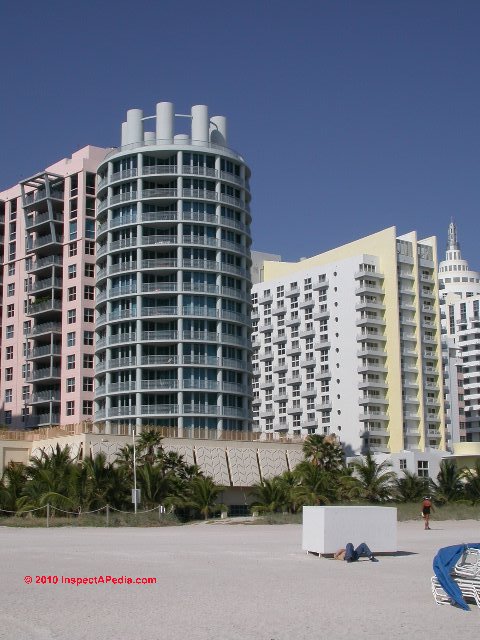
Page top photo: hurricane resistant windows required in Boca Raton, FL and at left in Jupiter Florida.
We review the proper installation details for windows and doors, and we compare the durability of different window and door materials and types.
Article Contents
- HOW TO PROTECT building windows & doors from storm damage
- MIAMI-DADE COUNTY STANDARDS for Storm-Resistant Windows
- IRC, International Residential Code for Impact-Resistant Windows
- CONSTRUCTION of storm resistant windows
- PERFORMANCE GRADE & DESIGN PRESSURES for Windows
- WIND SPEED CALCULATIONS
This article includes excerpts or adaptations from Best Practices Guide to Residential Construction (Steve Bliss, J Wiley & Sons) , by Steven Bliss, courtesy of Wiley & Sons.
In response to the devastating impact of Hurricane Andrew in 1992, Florida enacted stringent codes to protect homes from severe storms.
Other coastal states have followed suit in recent years, and now similar provisions in the International Residential Code (IRC) apply to coastal areas from Texas to Maine.
Protect the Window Openings
Researchers attributed much of Andrew’s destruction to wind penetration into homes through broken doors and windows, leading to extensive water damage and, in many cases, roofs blown off and houses destroyed.
Our photo (left) shows storm-exposed beach-front hotel windows at Boca Raton, FL.
The keys to preventing these problems were strengthening roofs and protecting windows and doors from wind and wind-borne debris. To protect windows, the new code allows three options:
- code-approved storm shutters,
- 9/16-inch plywood panels screwed over windows at 8 inches on-center, or
- impact-resistant windows.
The trend in new home construction is toward impact-resistant windows, sometimes marketed as “storm resistant” or “hurricane-rated.”
Miami-Dade County Standards for Storm-Resistant Windows
Miami-Dade County enacted the most stringent standard and test protocols, subjecting windows (and storm shutters) to a test in which a 9-pound 2x4 is hurled into the glass at 50 feet per second, followed by 4,500 cycles of positive and negative wind loads equivalent to a 146-mph wind.
Miami-Dade also conducts AAMA/NWWDA testing for design pressure and water intrusion, but it conducts the water intrusion test after the structural test is completed rather than on a new window. Windows and doors that pass the Miami-Dade Product Control Standards are required throughout Miami-Dade County and most other coastal areas in Florida.
International Residential Code for Impact-Resistant Windows
The International Residential Code (IRC) requires impact-resistant windows in all hurricane-prone regions along the Gulf and Atlantic coasts from Texas to Maine. Depending on the wind-speed zones established in the IRC, windows need to meet design pressures ranging from 30 to 80 psf, and they must meet impact-resistance standards under ASTM E1886 or E1996.
The design pressure required depends on both an area’s design wind speed, found on IRC maps, and the building’s exposure rating from A to D. Most buildings are rated Exposure B for “urban and suburban areas or wooded areas” or Exposure C for flat, open terrain with scattered obstructions of less than 30 feet. Waterfront buildings exposed to winds flowing over open water for at least a mile are rated Exposure D, the most severe.
Storm-Resistant Window Construction
Under pressure from both the building codes and insurance industry, most major window manufacturers have developed impact-resistant windows for residential applications that feature laminated glass along with heavier frames and hardware. The glass is similar to auto windshields with a plastic interlayer, but it is significantly heavier.
Double-glazed units get a second layer of tempered glass either on the interior or exterior.
Vinyl-framed windows are heavily reinforced with aluminum, and all windows use metal mullion bars anchored to the framing between mulled units. Window-to framing attachment methods are also beefed up to comply with the new codes, and in some cases, metal clips are used to anchor the window to the frame.
Storm-resistant windows cost from two to four times as much as standard windows; but under pressure from code agencies and insurance companies, these windows will soon become standard fare in coastal construction and other storm-prone areas.
Performance Grade and Design Pressure for Windows
How well a window performs when subjected to heavy rains and high winds is indicated by its performance grade and design pressure.
The design pressure is a structural rating only, while the performance grade also indicates that a window has met the water resistance and air infiltration standards for that grade (see Table 3-2 below).

[Click to enlarge any image, photo, or table]
The minimum recommended design pressure for residential doors and windows is 15 psf. A design pressure of 15 means a window has been tested to withstand sustained wind pressures of 22.5 psf, roughly equivalent to a 95-mph wind, applied to either side of the window, simulating both positive and negative wind pressures.
The test pressure is always 150% of the rated design pressure to provide a safety factor. To earn a performance grade of 15, a window must also pass a water pressure test of 2.86 psf, which simulates rainfall of 8 inches per hour with a wind speed of 34 mph. In coastal areas or other areas prone to heavy winds or hurricanes, higher grade windows are recommended and may be required by code.
Industry Associations for Windows & Doors
- American Architectural Manufacturers Association (AAMA) www.aamanet.org
- Efficient Windows Collaborative www.efficientwindows.org
- National Fenestration Rating Council (NFRC) www.nfrc.org Sustainable by Design www.susdesign.com
- Shareware calculators for sun angles, solar heat gain, and shading
- Window and Door Manufacturers Association (WDMA) www.wdma.com
-- Adapted and paraphrased, edited, and supplemented, with permission from Best Practices Guide to Residential Construction (Steve Bliss, J Wiley & Sons) .
Window Storm & Wind Resistance - wind speed calculation approaches & basic formula

The solid stone shutters shown in our photo above are installed on the Church of Santa Fosca on the island of Torcello in the Venetian Lagoon. The original church on this site, the Chiesa Santa Fosca, dates from the ninth century, possibly itself on the site of a structure dating from the sixth century, though in its present form this church is much newer, dating from the twelfth century.
These heavy stone shutters can be used for sun protection but most-likely were primarily intended to protect the interior windows from storms and winds from storms arising on the Adriatic Sea, or perhaps to protect against attack.
The shutters make clear that the use of window closures for protection from both storms and sun has an incredibly-ancient history.
Another photo of these shutters is
Reader question: what is the wind load [on windows or other structural components] at 200 mph
2/9.2014 lw said:
winds at 200 mph and what load ?Reply: wind load calculation references
LW; several government PDFs as well as the Engineering Toolbox convert wind speeds to loading forces. For example a 50 mph wind would impose a load of 2.15 k N/M2. It's not linear so one needs to do the calculation.
There is a host of wind loading calculation approaches but the underlying concept is force x area or F = A x P.
"Uniform Building Code UBC 1997 Div. 3, Section 1620 Wind Design" offers this approach:
Force = A x P
where UBC 1997: Division 3 - Wind Design.
Section 1620: " Design wind pressures for buildings and structures and elements therein shall be
determined for any height in accordance with the following formula:
P = Ce Cq qs Iw kzt (20-1)
where:
The wind exposure type (given UBC in Section 16.16 & described just below) is used to determine the coefficient Ce according to Table 16-G.
Ce = combined height, exposure and gust factor coefficient (Table 16-G)
Cq = pressure coefficient (Table 16-H)
qs = wind stagnation pressure at 33 feet (Table 16-F)
Iw = importance factor (Table 16-K)
kzt = topographic factor
Note that this UBC 97 wind design code assumes (for the sake of low buildings perhaps) that the fastest wind speed is at 33 feet above the ground, not the actual peak sustained wind speed. That wind speed is given by a map included in the code. And the UBC Offers these Wind Exposure Levels:
EXPOSURE B has terrain with buildings, forest or surface irregularities, covering at least 20 percent of the ground level area extending 1 mile (1.61 km) or more from the site.
EXPOSURE C has terrain that is flat and generally open, extending 1/2 mile (.81km) or more from the site in any full quadrant.
EXPOSURE D represents the most severe exposure in areas with basic wind speeds of 80 miles per hour (mph) (129 km/h) or greater and has terrain that is flat and unobstructed facing large bodies of water over 1 mile (1.61km) or more in width relative to any quadrant of the building site. Exposure D extends inland from the shoreline 1/4 mile (.40km) or 10 times the building height, which ever is greater.
But it's worth understanding that wind damage resistance is more complex than just the effectsof loading force from wind itself. First the wind force will vary enormously on different building sides and even different building areas on the same side. Second, wind at high speeds picks up objects and hurls them with tremendous force -sufficient that we've seen a single sheet of paper cut into a tree trunk.
Wind Load on Windows & Doors: Calculations Codes Research including Florida & Texas Hurricane, Flooding, Wind, Storm Damage Resistance & Repair
- ASCE 7-02: Minimum Design Loads for Buildings and Other Structures. American Society of Civil Engineers, 2002.
- Envirometrics, "MEETING THE IBC WIND LOADING STUDY REQUIREMENTS", [PDF], Envirometris, 4803 Freemont Ave., Seattle WA 98103, USA, Tel: 206-633-4456, retrieved 2/10/14 original source: www.envirometrics.com/abstracts/CFDwindloading.pdf
- Kasperski, M., and H-J. Niemann. "The LRC (load-response-correlation)-method a general method of estimating unfavourable wind load distributions for linear and non-linear structural behaviour." Journal of Wind Engineering and Industrial Aerodynamics 43.1 (1992): 1753-1763.
- Dyrbye, Claës, and Svend Ole Hansen. Wind loads on structures. John Wiley & Sons, 1996. [book]
- Holmes, J. D., and R. J. Best. "An approach to the determination of wind load effects on low-rise buildings." Journal of Wind Engineering and Industrial Aerodynamics 7.3 (1981): 273-287.
- International Building Code, 2003. International Code Council, Delmar Publishers.
- Jorgensen, P., J. S. Christensen, and J. O. Tande. "Probabilistic load flow calculation using Monte Carlo techniques for distribution network with wind turbines." Harmonics and Quality of Power Proceedings, 1998. Proceedings. 8th International Conference On. Vol. 2. IEEE, 1998.
- Kasperski, M. "Extreme wind load distributions for linear and nonlinear design." Engineering Structures 14.1 (1992): 27-34.
- Leffler, R. E. "Calculation of wind drift in staggered-truss buildings." Engineering Journal, AISC 1 (1983): 1-28.
- Pierre, LM St, et al. "The UWO contribution to the NIST aerodynamic database for wind loads on low buildings: Part 2. Comparison of data with wind load provisions." Journal of wind engineering and industrial aerodynamics 93.1 (2005): 31-59.
- Rotach, Mathias. Estimation of the Wind Speed at an ‘Urban Reference Height’ from an observation at some other height. COST 715: European Cooperation in the Field of Scientific and Technical Research.
- Smith, Stuart D. "Coefficients for sea surface wind stress, heat flux, and wind profiles as a function of wind speed and temperature." Journal of Geophysical Research: Oceans (1978–2012) 93.C12 (1988): 15467-15472.
- Uniform Building Code, 1997. International Code Council.
- WANG, Hai-chao, et al. "A joint iteration method for load flow calculation of power system containing unified wind farm and its application." Power System Technology 29.18 (2005): 59-62.
- Array Solutions, "Wind Loads", Array Solutions, 2611 North Beltline Rd, Suite 109, Sunnyvale, TX, 75182 USA, Tel: 214 954 7140, Email: info@arraysolutions.comF. For a helpful discussion of approaches for calculating wind loading on features such as antannae, see arraysolutions.com/Products/windloads.htm
Question: should I replace the sliding doors in my 1997 Ft. Lauderdale Beach Condo?
2017/09/12 Steve said:
I live in a high rise condo on Ft. Lauderdale beach which was built in 1997-98. What is the rating of the hurricane sliding doors are they as strong as today's doors? Should I change them out?
Reply: probably not right now
Steve,
Great question,
The Florida Building Code (FBC) requires windows to be impact-resistant or protected if located within one mile of the coast where the wind speed is 110 mph or greater.
Following Hurricane Andrew (Cat 5, August 1992) Florida, (or at least South Florida including Miami-Dade and Brower Counties) adopted more storm-resistant specifications for buildings including windows and doors. As that pre-dates your condo construction (1997-1998) we would expect your sliding doors to be compliant with that significant watershed point in code requirements.
I'm researching more history and dates of that impact-resistance and will reply further. Keep in mind that while there were applicable codes in the 90s the specifics almost certainly will vary by door brand and product.
If you can tell me by comment the brand and model or any info about what specific doors you have installed that'd be helpful. Often there's a sticker in a door jamb or top header or writing on the door latch or handle.
About changing the doors out, other factors in that decision will include whether or not you see that they leaked badly in the recent Irma hurricane windblown rain and water events, how well the doors operate, and also the fact that with so many damaged homes both doors and (IMO) workers are going to be in very short supply - construction workers more than ever now that we've kicked out so many Mexican workers, many of whom will be reluctant to return, risking being sent home again even when their work is needed.
Florida hurricane protection for buildings is expressed by adoption of ASCE 7-98 that requires buildings (including windows and doors) to be able to withstand the forces from high wind speeds.
That translates into a resistance ranging from 150MPH winds along the Keys and the tip of South Florida, stepping down to 140mph along other east and west coasts of the state, and in decrements of 10 mph from that inland from the Florida coasts.
Broward County has a county-wide 140 mph resistance standard and Miami-Dade county 146mph wind resistance requirement standard.
Windborne debris is a separate problem from wind forces against building walls, windows, doors.
Windows and doors must withstand windborne debris (to some standard to be explicated) wherever the windforce requirement (given above) is set by code at 120mph or above AND in the high hurricane resistance codes of the two counties I just mentioned.
Wind gusts can be stronger than wind speed. A wind gust resistance translates in to the codes as resistance in this example: a 3 second wind gust of 150 mph is equivalent to the general requirement to withstand 130mph sustained winds.
Current standards whose adoption dates will speak to your question include
- SSTD12
- ASTM E 1886 and ASTM E 1996
- Miami-Dade PA 201, 202, and 203
- Miami-Dade & Broward:
- Florida Building Code, Section 1619 Wind Load
- ASCE 7-98 Chapter 6
- ASCE 7 - Category C exposure standard
- 3 second gust standard: Broward - 140 mph, Miami-Dade - 146 mph
It's worth noting at the very least that current building codes in Florida will require both new construction and repair or rehabilitation work must comply with the current building standards, although the local building official can decide how strictly those standards must be enforced in specific cases.
It's also worth noting, for buildings suffering major damage during hurricane Irma, that buildings whose repair costs will be equal to or more than 25% of the building value (presumably pre-storm damage) must comply with the current standards. (Chapter 16 of the current FL code).
It's also worth noting that beyond storm resistance, new windows and doors and other repair work on buildings damaged by Irma will have imposed energy code requirements such as E ratios, SEERS for HVAC equipment, duct insulation, water heating equipment efficiency, etc.
Some of these notes are adapted from education and training material provided by www.floridabuilding.org
Florida & National Codes & Standards for Wind, Storm & Hurricane Resistant Windows & Doors - responding to Hurricane Irma
- FLORIDA BUILDING CODE 2015 [PDF]
- FLORIDA DOOR & WINDOW RETROFIT REPAIR GUIDE for HURRICANE & STORM DAMAGE [PDF]
- FLORIDA HIGH VELOCITY WIND ZONE CODES Chapter 24 [PDF]
- FLORIDA WINDOWS & DOORS CODE 1714 [PDF]
- FLORIDA WINDOW SYSTEMS & CODES, IFAS Extension [PDF]
Reader Comments, Questions & Answers About The Article Above
Below you will find questions and answers previously posted on this page at its page bottom reader comment box.
Reader Q&A - also see RECOMMENDED ARTICLES & FAQs
Question:
(Jan 29, 2014) Martin Gage said:
Good post! It isn't only structural integrity we're taking into consideration when it comes to these types of windows.
Reply:
Thanks Martin. We also welcome questions & content suggestions. There is quite a bit more to be said about storm-resistant windows & doors. Daniel
Question:
(Feb 9, 2014) lw said:
winds at 200 mph and what load ?
Reply:
LW please see your question and a detailed reply in the wind speed calculation material added in the article just above. Let us know if you have specific questions. Daniel
...
Continue reading at WINDOW MATERIALS & CONSTRUCTION or select a topic from the closely-related articles below, or see the complete ARTICLE INDEX.
Or see these
Recommended Articles
- FLOOD DAMAGE REPAIR PRIORITIES
- HURRICANE DAMAGED BUILDINGS - home
- WIND DAMAGED BUILDINGS
- WINDOW FLASHING & SEALING GUIDE
- WINDOWS & DOORS - home
Suggested citation for this web page
HURRICANE, WIND, & STORM-RESISTANT WINDOWS at InspectApedia.com - online encyclopedia of building & environmental inspection, testing, diagnosis, repair, & problem prevention advice.
Or see this
INDEX to RELATED ARTICLES: ARTICLE INDEX to DOORS & WINDOWS
Or use the SEARCH BOX found below to Ask a Question or Search InspectApedia
Ask a Question or Search InspectApedia
Try the search box just below, or if you prefer, post a question or comment in the Comments box below and we will respond promptly.
Search the InspectApedia website
Note: appearance of your Comment below may be delayed: if your comment contains an image, photograph, web link, or text that looks to the software as if it might be a web link, your posting will appear after it has been approved by a moderator. Apologies for the delay.
Only one image can be added per comment but you can post as many comments, and therefore images, as you like.
You will not receive a notification when a response to your question has been posted.
Please bookmark this page to make it easy for you to check back for our response.
Our Comment Box is provided by Countable Web Productions countable.ca
Citations & References
In addition to any citations in the article above, a full list is available on request.
- Basic Housing Inspection, US DHEW, S 352.75 U48, p.144, out of print, but is available in most state libraries; New York State version, ca 1955, source of our window parts and window repair sketches.
- Best Practices Guide to Residential Construction, by Steven Bliss. John Wiley & Sons, 2006. ISBN-10: 0471648361, ISBN-13: 978-0471648369, Hardcover: 320 pages, available from Amazon.com and also Wiley.com. See our book review of this publication.
- Our recommended books about building & mechanical systems design, inspection, problem diagnosis, and repair, and about indoor environment and IAQ testing, diagnosis, and cleanup are at the InspectAPedia Bookstore. Also see our Book Reviews - InspectAPedia.
- In addition to citations & references found in this article, see the research citations given at the end of the related articles found at our suggested
CONTINUE READING or RECOMMENDED ARTICLES.
- Carson, Dunlop & Associates Ltd., 120 Carlton Street Suite 407, Toronto ON M5A 4K2. Tel: (416) 964-9415 1-800-268-7070 Email: info@carsondunlop.com. Alan Carson is a past president of ASHI, the American Society of Home Inspectors.
Thanks to Alan Carson and Bob Dunlop, for permission for InspectAPedia to use text excerpts from The HOME REFERENCE BOOK - the Encyclopedia of Homes and to use illustrations from The ILLUSTRATED HOME .
Carson Dunlop Associates provides extensive home inspection education and report writing material. In gratitude we provide links to tsome Carson Dunlop Associates products and services.
 | HOME | ABOUT | ASK a QUESTION | CONTACT | CONTENT USE POLICY | DESCRIPTION | POLICIES | PRIVACY | |
| © 2024 - 1985 Publisher InspectApedia.com - Daniel Friedman | |||||||||