
InspectAPedia® FREE Encyclopedia of Building & Environmental Construction, Diagnosis, Maintenance & Repair |
Question? Just ask us! InspectAPedia
|
 Methods of Window Shading to Reduce Solar Gain & Glare
- POST a QUESTION or COMMENT about methods to shade or otherwise protect windows from glare or from too much solar gain
How to use window shading to reduce un-wanted solar heat gain.
In this article series we discuss methods for shading windows to reduce excessive solar gain or glare.
InspectAPedia tolerates no conflicts of interest. We have no relationship with advertisers, products, or services discussed at this website.
Window Shading to Reduce Solar Gain
 In this article series we discuss the selection and installation of windows and doors, following best construction and design practices for building lighting and ventilation, with attention to the impact on building heating and cooling costs, indoor air quality, and comfort of occupants.
We review the proper installation details for windows and doors, and we compare the durability of different window and door materials and types.
[Click to enlarge any image, table, or photo]
Article Contents
- SPECTRALLY SELECTIVE WINDOW GLAZING
- PLANTINGS for WINDOW SHADING
- WINDOW AWNINGS & SHUTTERS
- SOLAR SCREENS for WINDOWS
- INTERIOR WINDOW SHADES
As described in Best Practices Guide to Residential Construction (Steve Bliss, J Wiley & Sons) Chapter 3, BEST PRACTICES GUIDE: WINDOWS & DOORS:
Shading of glass with overhangs, plantings, or shades will reduce cooling loads and increase comfort in any climate with significant cooling loads.
Shading of windows will also reduce glare ( Figure 3-19, below), fading of furnishings, and localized overheating in rooms with south- or west-facing glass. Window overhangs, plantings, or exterior shades that block the sun before it strikes the glass are the most effective approach since the heat never gets into the building. But light-colored interior shades can also substantially reduce heat gains.
Spectrally Selective Window Glazing
From a shading standpoint, using spectrally selective glass (SHGC below .40) is like having shades or blinds on standard low-E glass.
However, adding good shading to spectrally selective glass can reduce cooling costs by another 10 to 15%.
This would make sense in very hot climates or on houses with large expanses of glass on the south or west side. In
many cases, the shading adds no cost or serves other design needs. For example, a porch on the east or west side of a house provides effective shading as well as outdoor living space.
Plantings for Window Shading
Deciduous trees can provide very effective summer shade on the south side but, depending on the type of tree, may block 20% or more of the solar radiation in winter. Because trees follow the local seasons rather than the calendar, the shading tends to occur when needed most.
For example, leaves appear earlier in the spring and last longer in the fall in warmer climates, which need spring and fall shading. Trees also cool the area around them by their natural evaporative cooling—as water evaporates from the leaves.
Other options for shading south-facing windows include trellises with dense foliage or evergreen trees. Evergreens should be tall enough to block the summer sun but trimmed so their canopies allow the low winter sun to reach the windows.
On the east and west sides of the house, trees or large shrubs can provide very effective shading, since the problem times are morning and afternoon when the sun is low in the sky and easily blocked by a well-placed planting, either deciduous or coniferous. Fixed Overhangs.
 These are commonly used on the
south side of homes with clear glass or high-solar-gain
glass. To be effective, the overhangs must be sized correctly
to reject the high summer sun but allow in the low
winter sun. In most temperate climates, a 1 1/2 - to 2-footwide
overhang is adequate for average size windows.
These are commonly used on the
south side of homes with clear glass or high-solar-gain
glass. To be effective, the overhangs must be sized correctly
to reject the high summer sun but allow in the low
winter sun. In most temperate climates, a 1 1/2 - to 2-footwide
overhang is adequate for average size windows.
However, to provide full shading from March to September in hot climates may require a 3-foot or wider overhang.
One limitation of fixed overhangs is that the shading will be the same on March 21 and September 21, although the heating and cooling needs at these times may be very different.
The following guidelines for shading south facing glass strike a balance between summer and winter performance:
- Guidelines for Shading South Facing
Gass in Cold climates:
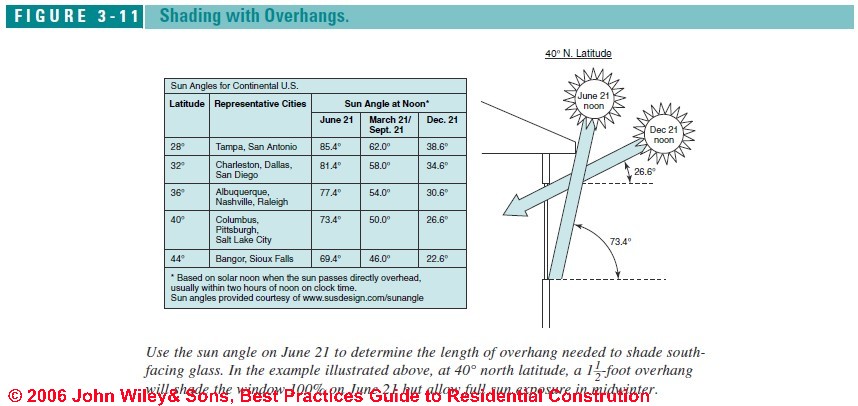
Above 6,000 heating-degree days (HDD), locate the shadow line at mid window, based on the June 21 noon–sun angle (see Figure 3-11 below). This will shade the window 50% in mid-summer and provide full sun penetration from late September to late March. If more shading is required in summer, locate the shadow line closer to the window sill. - Guidelines for Shading South Facing
Gass in CModerate climates:
In climates with less than 6,000 HDD and less than 2,600 cooling-degree days (CDD), locate the shadow line at the window sill based on the June 21 sun angle at noon. This will allow full sun exposure from late October to mid-February. - Guidelines for Shading South Facing
Gass in CHot climates:
Above 2,600 CDD, locate the shadow line at the window sill using the March 21 sun angle at noon. This will provide full shading from late March to late September and about one-third shading in mid-winter.
Guide to Window Awnings and Shutters

Old-fashioned awnings are very effective at blocking solar gain—up to 65% on south facing windows and up to 80% on east and west windows.
Light-colored awnings are more effective, since they will reflect more solar radiation.
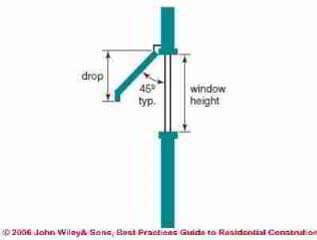
To be most effective, the awning’s “drop” should cover 65 to 75% of an east or west window and 45 to 60% of a south-facing window (see Figure 3-12 at left).
Other low-tech, but very effective exterior options for windows that are difficult to shade include wooden shutters, bamboo shades, and rolling shutters.
- Light-colored interior shades can reduce heat gain by 15 to 20%, depending on the density and reflectivity of the material.
- Interior blinds typically reduce heat gain by 10 to 15%, depending on reflectivity.
- See SOLAR SHADES & SUNSCREENS for details.
Solar Screening for Windows
This dark plastic or fiberglass screening is mounted on the exterior of the window in a frame or retractable roller or, in some cases, applied directly to the glass.
Depending on the weave, it can reduce a window’s solar heat gain by 40 to 70%. Solar screening reduces glare and fading, but it also reduces daylight and obscures views.
Solar screens are best used on difficult to shade areas, such as west-facing glass or skylights. Some are designed to also serve as insect screens.
Interior Shades for Windows
Though not generally as effective as exterior shading, light-colored drapes, shades, or blinds can reduce solar gain by 10 to 50% (for typical curtains or blinds) to as high as 70% for an insulated, reflective shade that seals tightly around the window perimeter.
The performance of an interior shade depends on the reflectivity of its outer face, the density and R-value of the material, and whether it seals around the window. Between-the-glass pleated shades or mini blinds, available from Pella and some smaller manufacturers, are more effective in blocking solar gain than interior shades, because they block the heat before it enters the building interior.
-- Adapted and paraphrased, edited, and supplemented, with permission from Best Practices Guide to Residential Construction (Steve Bliss, J Wiley & Sons) .
Reader Question: sources of pleated window shades between glass panes
(Sept 10, 2012) benjamin said:
Are manufacturers other than Pella offering between the glass pleated shades?
Reply:
Pella's advertising refers to "Exclusive Between-the-Glass Opations" that the company describes as follows:
Designer Series® aluminum-clad wood windows are available with cordless, removable between-the-glass blinds, fabric shades and grilles. They're located between the panes of glass, protected from damage, thus reducing cleaning, maintenance and replacement costs. Between-the-glass blinds and shades available motorized with Pella® InsynctiveTM Technology. - Pella Corporation, retrieved 14 July 2015 original source http://professional.pella.com/windows/features-and-options/between-the-glass
There are other window and door manufacturers offering between-the-glass shades and covers including:
- Duration Windows UK integrated blinds made of aluminum and installed between or inside a double-glazed seal window unit, provided by Qualifalcon Limited, registered in England and Wales, Unit 4, Charfleets Road, Canvey Island, Essex SS8 0PQ, UK, Tel: UK: 01268 681612 , Website: http://www.duration.co.uk/IntegratedBlinds.asp
- Eagle Windows: A between the glass door light (window) from Eagle Windows,
- EcoVue micro venetian blinds, from Royal Group, provides venetian blinds housed between two panes of strengthened glass, sold in Australia, withoffices in Perth and Sydney. Website: http://www.ecovue.com.au/product-range/micro-venetian-blinds/
Expo Home & Showroom, 55 Salvado Road, Subiaco WA 6008 Tel: (08) 9388 1088 Website: homebaseexpo.com.au - Royal-Tech Windows & Blinds, integreated window blinds, Royal-Tech Windows, 22520 Ecorse Road Taylor, MI 48180, USA, Tel: 1-877-795-5548, Website: http://www.royaltechwindows.com/
There are also companies selling add-on between the glass blinds systems
- ODL Incv., Website: http://www.odl.com/doorglass_blinds_addon_wtc.htm ODL products are sold in the USA, Canada, England, Asia, ODL Headquarters 215 East Roosevelt Ave. Zeeland, Michigan 49464 USA 800.253.3900 phone retail_info@odl.com
...
Continue reading at SOLAR SHADES & SUNSCREENS or select a topic from the closely-related articles below, or see the complete ARTICLE INDEX.
Or see these
Recommended Articles
- GREENHOUSE / SUNSPACE GLARE - use of shades and louvers for sunlight glare control in buildings
- PASSIVE SOLAR Roof & Window Overhangs - an alternative to solar shades.
- PATIO AWNING INSTALLATION
- SOLAR SHADES & SUNSCREENS
- SUNGAIN, FILMS, LOW-E GLASS
- WINDOW / DOOR ENERGY EFFICIENT, DOE
- WINDOW GLAZING BASED on CLIMATE
- WINDOWS & DOORS - home
Suggested citation for this web page
WINDOW SHADING, SCREENING at InspectApedia.com - online encyclopedia of building & environmental inspection, testing, diagnosis, repair, & problem prevention advice.
Or see this
INDEX to RELATED ARTICLES: ARTICLE INDEX to DOORS & WINDOWS
Or use the SEARCH BOX found below to Ask a Question or Search InspectApedia
Ask a Question or Search InspectApedia
Questions & answers or comments about methods to shade or otherwise protect windows from glare or from too much solar gain.
Try the search box just below, or if you prefer, post a question or comment in the Comments box below and we will respond promptly.
Search the InspectApedia website
Note: appearance of your Comment below may be delayed: if your comment contains an image, photograph, web link, or text that looks to the software as if it might be a web link, your posting will appear after it has been approved by a moderator. Apologies for the delay.
Only one image can be added per comment but you can post as many comments, and therefore images, as you like.
You will not receive a notification when a response to your question has been posted.
Please bookmark this page to make it easy for you to check back for our response.
Our Comment Box is provided by Countable Web Productions countable.ca
Citations & References
In addition to any citations in the article above, a full list is available on request.
- Basic Housing Inspection, US DHEW, S 352.75 U48, p.144, out of print, but is available in most state libraries; New York State version, ca 1955, source of our window parts and window repair sketches.
- Best Practices Guide to Residential Construction, by Steven Bliss. John Wiley & Sons, 2006. ISBN-10: 0471648361, ISBN-13: 978-0471648369, Hardcover: 320 pages, available from Amazon.com and also Wiley.com. See our book review of this publication.
- Our recommended books about building & mechanical systems design, inspection, problem diagnosis, and repair, and about indoor environment and IAQ testing, diagnosis, and cleanup are at the InspectAPedia Bookstore. Also see our Book Reviews - InspectAPedia.
- Decks and Porches, the JLC Guide to, Best Practices for Outdoor Spaces, Steve Bliss (Editor), The Journal of Light Construction, Williston VT, 2010 ISBN 10: 1-928580-42-4, ISBN 13: 978-1-928580-42-3, available from Amazon.com
- The Journal of Light Construction has generously given reprint permission to InspectAPedia.com for adaptations, quotations, or reproductions used at this website. All rights and contents of the JLC material are ©Journal of Light Construction and may not be reproduced in any form.
- In addition to citations & references found in this article, see the research citations given at the end of the related articles found at our suggested
CONTINUE READING or RECOMMENDED ARTICLES.
- Carson, Dunlop & Associates Ltd., 120 Carlton Street Suite 407, Toronto ON M5A 4K2. Tel: (416) 964-9415 1-800-268-7070 Email: info@carsondunlop.com. Alan Carson is a past president of ASHI, the American Society of Home Inspectors.
Thanks to Alan Carson and Bob Dunlop, for permission for InspectAPedia to use text excerpts from The HOME REFERENCE BOOK - the Encyclopedia of Homes and to use illustrations from The ILLUSTRATED HOME .
Carson Dunlop Associates provides extensive home inspection education and report writing material. In gratitude we provide links to tsome Carson Dunlop Associates products and services.
 | HOME | ABOUT | ASK a QUESTION | CONTACT | CONTENT USE POLICY | DESCRIPTION | POLICIES | PRIVACY | |
| © 2024 - 1985 Publisher InspectApedia.com - Daniel Friedman | |||||||||