
InspectAPedia® FREE Encyclopedia of Building & Environmental Construction, Diagnosis, Maintenance & Repair |
Question? Just ask us! InspectAPedia
|
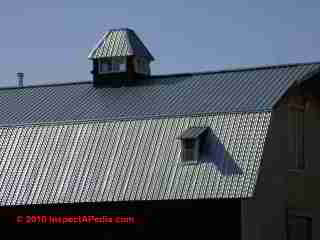 Flashing & Sealing Specifications for Exposed Fastener Metal Roof Systems
- POST a QUESTION or COMMENT about metal roof flashing & sealing
Metal roof flashing best practices:
This article describes metal roof flashing and sealing products and installation details for exposed-fastener metal roof systems: barn roofing, or agricultural building roofing systems.
This article series discusses best practices in the selection and installation of residential roofing.
InspectAPedia tolerates no conflicts of interest. We have no relationship with advertisers, products, or services discussed at this website.
Flashings and Accessories for Exposed-Fastener Metal Roofs
 Adapted/paraphrased with permission from Best Practices Guide to Residential Construction (Steve Bliss, J Wiley & Sons) , chapter on BEST ROOFING PRACTICES:
Most manufacturers supply preformed flashings, drip edges, rake moldings, and ridge caps color-matched to their roofing panels, as well as color-matched coil stock for fabricating custom pieces onsite.
They also provide rubber closure strips or expandable foam tapes to seal panel ends against water and insect intrusion at eaves, valleys, ridges, and other terminations.
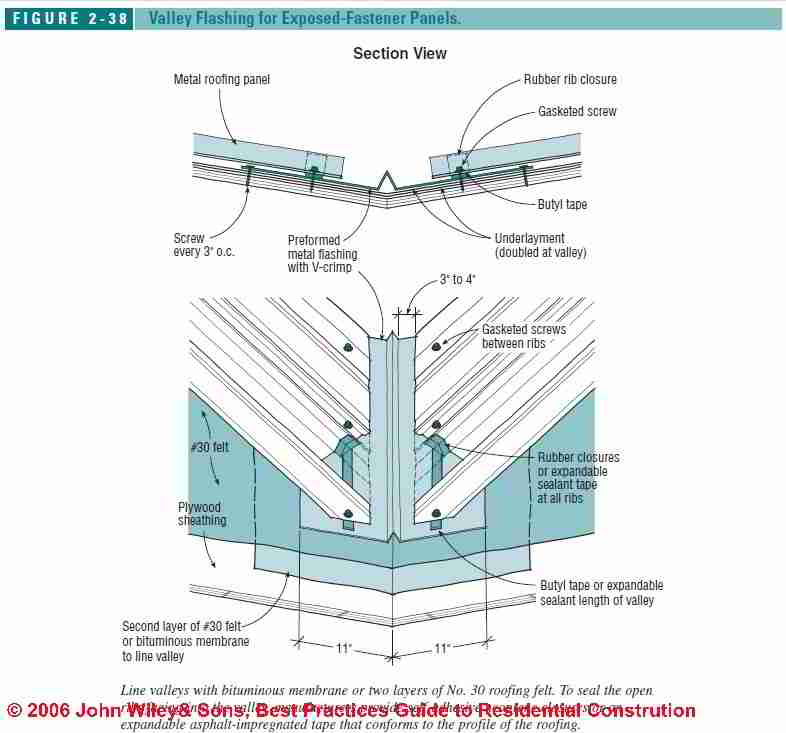
Pay particular attention to panel ends at metal roof valleys. Some manufacturers supply special closures for the angled cuts through ribs, but closures may need to be fashioned by cutting up standard closure strips.
Some manufacturers also provide an expandable foam sealant tape that conforms to the rib pattern for a tight seal up the valley.
Depending on the panel profile, the end treatment will vary, but ends should be fully sealed. Remember to place screws in flat sections and to use extra screws up the valley
(Figure 2-38).
...
If you want to see the original installation details for the plumbing vent being installed at above right, take a look at the photos and text at the bottom of our article
on PLUMBING VENT DEFECTS & NOISES.
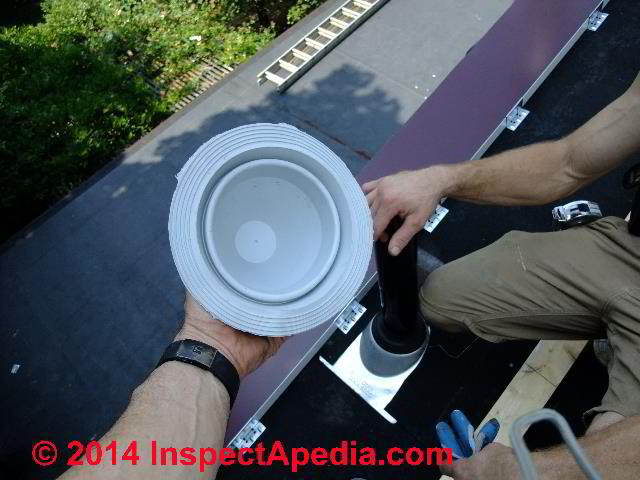
To see what happened later when snow and ice began shoving at the vent stack pipe,
see PLUMBING VENT REPAIR.
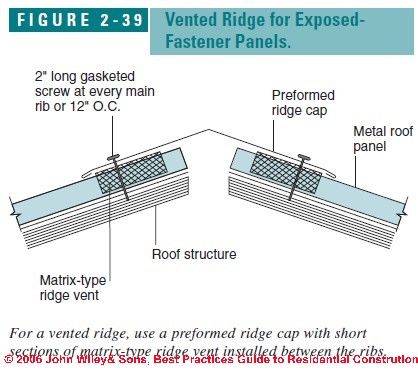
For a metal roof vented ridge, place short sections of a matrix-type ridge vent between the ribs and secure with a preformed metal cap (Figure 2-39).
Also see ROOF VENTILATION SPECIFICATIONS
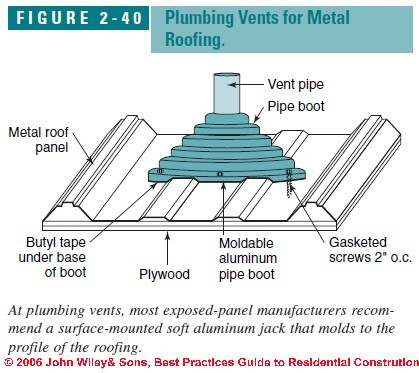 For plumbing vents, most manufacturers recommend
a moldable aluminum jack bent to conform to the profile
of the roofing (Figure 2-40).
For plumbing vents, most manufacturers recommend
a moldable aluminum jack bent to conform to the profile
of the roofing (Figure 2-40).
Rectangular openings, such as skylights and chimneys, typically require both base and counterflashing so roof panels are free to move with changes in temperature.
Depending on the panel profile, either use a pan flashing or an L-flashing sealed to the top surface of the roofing panel with sheet metal screws and butyl tape.
On large openings in metal roofs, a cricket is needed on the up slope to divert water around the penetration. Custom-made, one-piece curbs with built-in diverters simplify this type of installation. All flashing joints should be sealed with butyl tape or a manufacturer- recommended sealant.
Sealing Details for Exposed-Fastener Metal Roofs
For the watertight performance required on homes (as opposed to barns), metal roofs need careful sealing around all penetrations, side laps, and end laps. On side seams and lap joints, the sealant should always go on the uphill, or “dry,” side of any fasteners (Figure 2-41).
Sealant should also be used at ridge caps, valleys, and wherever flashings lap over or under the metal roofing.
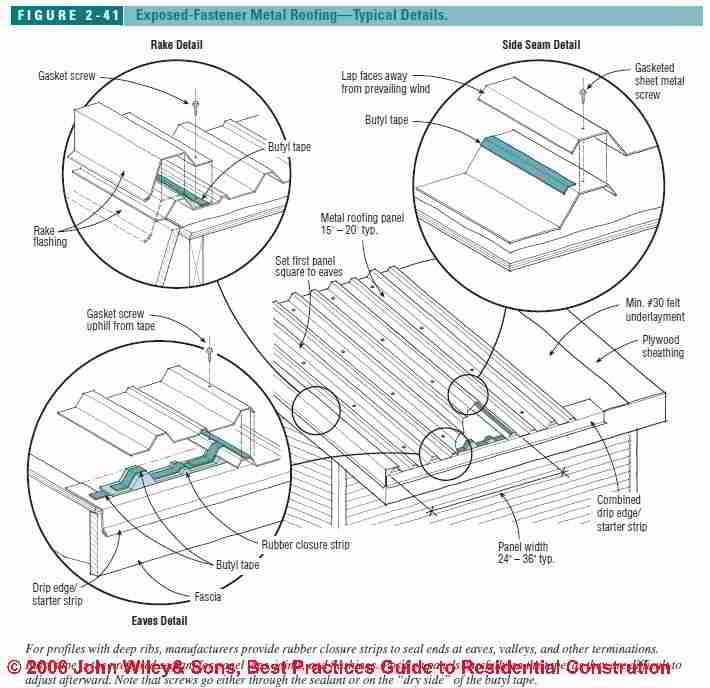
The preferred sealant for most concealed seams in metal roof panels is butyl tape, which absorbs movement and will not shrink. Gunnable terpolymer butyl or urethane caulk can also be used, as specified by the manufacturer.
But never use acid-cure silicone caulking (the common type with vinegar odor) or asphalt roofing cement, as they will damage most metal coatings.
How to Allow for Panel Movement in Exposed Fastener Metal Roof Systems
Metal roof panels were originally designed for installation on purlins that can absorb the normal movement as the panels expand and contract from temperature changes. The thermal movement of a long panel installed over solid plywood, however, can cause problems.
Typically, either the hole in the metal roofing elongates—creating a potential leak—or the screw becomes loosened, making the roof vulnerable to blow-off. The problems are greatest with aluminum, which has 70% more thermal movement than steel and less tensile strength. To avoid problems, experts recommend the following:
- With exposed-fastener panels, avoid lengths over 40 feet for steel or 16 feet for aluminum—less for climates subject to wide temperature swings. Break the run into two panels.
- On long runs of painted roofing, choose lighter shades, preferably white.
- Use screws in the flat part of the panel, not on the ribs. Screws should penetrate the sheathing fully, plus 1/4 to 1/2 inch.
- Where leak-free performance is critical, fasten the roofing to Z-shaped metal purlins screwed horizontally across the plywood sheathing. Or switch to a concealed fastener system.
Also see
- Smith, Thomas L., AIA, CRC, METAL ROOFING: 'FIXING' for THERMAL MOVEMENT [PDF] NRCA, National Roofing Contractors Association
Wavy Metal Panels or Oil-Canning Problems on Metal Roofs: Thermal Expansion
Thermal expansion in light-gauge metal panels can cause a wavy appearance called “oil-canning” in the flat areas. In general, this does not signal a performance problem, but it may be visually objectionable.
Oilcanning tends to be most visible in bright light from a close distance, and it is generally more noticeable on shiny metals, such as Galvalume®, than on colored metal panels.
Oilcanning on metal roofs is primarily a problem in profiles with few ridges to stiffen the panels. To reduce the metal roof rippling or oilcanning effect, some manufacturers provide self-adhesive foam strips that are attached lengthwise to the bottom of metal panels.
- - Adapted with permission from Best Practices Guide to Residential Construction (Steve Bliss, J Wiley & Sons) .
Metal Roofing Manufacturers
- Classic Products www.classicroof.com Modular metal shingle panels and standing seam panels
- Decra Roofing Systems www.decra.com Modular metal shingle, tile, and shake panels
- Dura-Lok Roofing Systems www.duraloc.com Modular metal roofing shingles with granular coating
- Fabral www.fabral.com Exposed fastener and concealed clip metal roofing panels
- Gerard Roofing Technologies www.gerardusa.com Modular metal shake and tile panels with granular coating
- Met-Tile www.met-tile.com Modular metal roof-tile panels
- Atas International www.atas.com Modular metal shingle, tile, and standing-seam panels
- Custom-Bilt Metals www.custombiltmetals.com Modular metal shakes and standing seam panels
- Zappone Manufacturing, website www.zappone.com/
Zappone Manufacturing, 2928 North Pittsburg St. Spokane, WA 99207 1-800-285-2677, Washington State Copper Roofing Supplier of Copper scallop shingles, copper shingles, copper bay windows, vertical walls, aluminum roof shingles
Venting Underlayments
- Benjamin Obdyke www.benjaminobdyke.com Cedar Breather, a 3/8 -in.-thick matrix-type underlayment designed to provide ventilation and drainage space under wood roofing
More Information about Roofing Materials, Methods, Standards
- Metal Roofing Alliance www.metalroofing.com
...
Continue reading at METAL ROOF COATINGS & PAINTS or select a topic from the closely-related articles below, or see the complete ARTICLE INDEX.
Or see these
Recommended Articles
- CHIMNEY FLASHING MISTAKES & LEAKS
- DIVERTER KICK-OUT FLASHING
- FLASHING on BUILDINGS - home
- METAL ROOFING - home
- SNOW GUARDS on METAL ROOFS
Suggested citation for this web page
FLASHING for METAL ROOFS at InspectApedia.com - online encyclopedia of building & environmental inspection, testing, diagnosis, repair, & problem prevention advice.
Or see this
INDEX to RELATED ARTICLES: ARTICLE INDEX to BUILDING ROOFING
Or use the SEARCH BOX found below to Ask a Question or Search InspectApedia
Ask a Question or Search InspectApedia
Try the search box just below, or if you prefer, post a question or comment in the Comments box below and we will respond promptly.
Search the InspectApedia website
Note: appearance of your Comment below may be delayed: if your comment contains an image, photograph, web link, or text that looks to the software as if it might be a web link, your posting will appear after it has been approved by a moderator. Apologies for the delay.
Only one image can be added per comment but you can post as many comments, and therefore images, as you like.
You will not receive a notification when a response to your question has been posted.
Please bookmark this page to make it easy for you to check back for our response.
Our Comment Box is provided by Countable Web Productions countable.ca
Citations & References
In addition to any citations in the article above, a full list is available on request.
- ASTM International, 100 Barr Harbor Drive, PO Box C700, West Conshohocken, PA, 19428-2959 USA The ASTM standards listed below can be purchased in fulltext directly from http://www.astm.org/
- "Metal Roofing: 'Fixing' for Thermal Movement", Thomas L. Smith, AIA, CRC., Professional Roofing, [date pending] p. 72, NRCA
- NRCA, Smith, Thomas L., AIA, CRC, METAL ROOF SYSTEMS: DESIGN CONSIDERATIONS FOR SNOW AND ICE [PDF] Professional Roofing, [date pending] p. 74, NRCA, http://www.nrca.net/
- NRCA, Smith, Thomas L., AIA, CRC, STEEL [ROOF] DECK ISSUES for the 1990s [PDF], NRCA, http://www.nrca.net/
- NRCA, Smith, Thomas L., AIA, CRC, STEEL [ROOF] DECK CORROSION BULLETIN [PDF] Professional Roofing, [date pending] p. 58, NRCA, http://www.nrca.net/
- NRCA, Smith, T. THE MANY ASPECTS of METAL [ROOF] SHINGLES [PDF] Thomas L. Smith, AIA, CRC., Professional Roofing, [date pending] NRCA, Web: nrca.net
- Architectural elements: the technological revolution: Galvanized iron roof plates and corrugated sheets; cast iron facades, columns, door and window caps, ... (American historical catalog collection), Diana S Waite, available used out of Amazon.
- "Choosing Roofing," Jefferson Kolle, January 1995, No. 92, Fine Homebuilding, Taunton Press, 63 S. Main St., PO Box 5506, Newton CT 06470 - 800-888-8286 - see http://www.taunton.com/FineHomebuilding/ for the magazine's website and for subscription information.
- [1] Follansbee Roofing, Follansbee WV 26037, Tel: 800-624-6906, website: www.follansbeeroofing.com and http://www.follansbeeroofing.com/products/TerneII.aspx Quoting Follansbee on TerneII properties:
Follansbee Steel is the only manufacturer of a pre-painted or natural Terne roof and is a leading supplier of metal roofs for new and retrofit commercial, institutional, residential and historic preservation projects.Terne II - Classic Terne-Coated Steel ... is a new and improved version of historic Terne metal, ... Terne II has improved capability for resisting corrosion in all environments ... also has excellent formability, solderability, and affinity for paint ... without compromising mechanical characteristics. It can be used in flatlock, standing seam, vertical wall designs and virtually any other application in which original Terne has been used. It is strong and ductile, having high yield and tensile strengths as well as workability. This new material can easily be formed with conventional roofing tools.
With Terne II roofing, it is advisable to paint the material as soon as conditions permit. Oxide formation is slower than with the original Terne and the wait for proper painting conditions provides substantially less risk. The new material is coated with Follansbee's new ZT® alloy, a combination of zinc and tin. This coating is designed not only as a barrier but also to be anodic to the steel substrate and reduce the potential for oxidation before painting.
The traditional oil-based paints long required on original Terne are not recommended for application on Terne II. Follansbee's Rapidri paint with its faster drying time and ease of application is much superior to the old painting system. The Rapidri acrylic paints are aesthetically pleasing while offering enhanced durability and color retention. ...
- Metal Roofing Alliance, E. 4142 Hwy 302, Belfair, WA 98528, Telephone:(360) 275-6164, Customer Support 410-534-6900, Email: support@metalroofing.com,
Website: www.metalroofing.com. Quoting:
The Metal Roofing Alliance was formed in 1998 by a small group of forward-thinking metal roofing manufacturers with the main goal of educating consumers about the many benefits of metal roofing. Since our inception, we've shown millions of people just how beautiful, durable and money-saving metal roofing can be for them. Over the years, our membership has grown to include paint companies, material suppliers, industry publications and more. Be sure to take advantage of all of the great resources our members offer. - The Metal Initiative, 4700 W. Lake Ave., Glenview, IL 60025, P:847.375.4785 Website: www.themetalinitiative.com/, Email: Louise Ristau lristau@connect2amc.com Quoting:
The Metal Initiative is a coalition of manufacturers, individuals and associations that have come together to provide information on the features and benefits of metal in construction. Carrying its message of metal primarily to the professional building owner community, The Metal Initiative seeks to gather and disseminate useful information for decision-makers. - Metal Roofing, an Illustrated Guide, R.A. Knowlton , [metal shingle roofs],
- Copper Roofing, by CDA
- Copper Roofing, Master specifications for copper roofing and sheet metal work in building construction: Institutional, commercial, industrial, I.E. Anderson, 1961 (hard to find)
- Corrugated Iron, Building on the Frontier, Simon Holloway
- Problems in Roofing Design, B. Harrison McCampbell, Butterworth Heineman, 1991 ISBN 0-7506-9162-X (available used)
- Grapevine Design Guidelines - Web Search 07/12/2010
- NPS, FROM ASBESTOS TO ZINC, ROOFING FOR HISTORIC BUILDINGS, METALS [PDF] chnical Preservation Services, National Park Service, U.S. Department of the Interior, web search 9/29/2010, original source: nps.gov/history/hps/tps/roofingexhibit/metals2.htm
- NPS, FROM ASBESTOS TO ZINC, ROOFING FOR HISTORIC BUILDINGS, METALS-PART II, Coated Ferrous Metals: Iron, Lead, Zinc, Tin, Terne, Galvanized, Enameled Roofs [PDF] Technical Preservation Services, National Park Service, U.S. Department of the Interior, web search 9/29/2010, original source: nps.gov/history/hps/tps/roofingexhibit/metals.htm
- NPS, FROM ASBESTOS TO ZINC, ROOFING FOR HISTORIC BUILDINGS, METALS- ROOFING TODAY [PDF] Technical Preservation Services, National Park Service, U.S. Department of the Interior, web search 9/29/2010, original source: nps.gov/history/hps/tps/roofingexhibit/roofingtoday.htm
- Sweetser, Sarah M., ROOFING for HISTORIC BUILDINGS [PDF] (1978) Preservation Brief 4, Technical Preservation Services, National Park Service, U.S. Department of the Interior, web search 9./29.10, original source: http://www.nps.gov/history/hps/tps/briefs/brief04.htm
- Park, Sharon C., AIA, THE USE OF SUBSTITUTE MATERIALS ON HISTORIC BUILDING EXTERIORS [PDF] Preservation Brief 16, Technical Preservation Services, National Park Service, U.S. Department of the Interior, web search 9./29.10, original source:
http://www.nps.gov/history/hps/tps/briefs/brief16.htm - NRCA, Smith, Thomas L., AIA, CRC, METAL ROOFING: 'FIXING' FOR THERMAL MOVEMENT [PDF] Professional Roofing, [date pending] p. 72, NRCA - Web: http://www.nrca.net/
- NRCA, Smith, Thomas L., AIA, CRC, METAL ROOF SYSTEMS: DESIGN CONSIDERATIONS FOR SNOW AND ICE [PDF] Professional Roofing, [date pending] p. 74, NRCA, http://www.nrca.net/
- NRCA, Smith, Thomas L., AIA, CRC, STEEL [ROOF] DECK CORROSION BULLETIN [PDF] Professional Roofing, [date pending] p. 58, NRCA, http://www.nrca.net/
- "Steel [Roof] Deck Corrosion Bulletin, NRCA [ copy on file as /roof/Steel_Roof_Deck_Corrosion_NRCA.pdf ] - ", Thomas L. Smith, AIA, CRC., Professional Roofing, [date pending] p. 58, NRCA
- NRCA, Smith, Thomas L., AIA, CRC, THE MANY ASPECTS of METAL [ROOF] SHINGLES [PDF] Professional Roofing, [date pending] NRCA, Web: nrca.net
- NRCA - National Roofing Contractors Association, 10255 W. Higgins Road, Suite 600, Rosemont, IL 60018-5607, Tel: (847) 299-9070, Web: nrca.net,
- Best Practices Guide to Residential Construction, by Steven Bliss. John Wiley & Sons, 2006. ISBN-10: 0471648361, ISBN-13: 978-0471648369, Hardcover: 320 pages, available from Amazon.com and also Wiley.com. See our book review of this publication.
- In addition to citations & references found in this article, see the research citations given at the end of the related articles found at our suggested
CONTINUE READING or RECOMMENDED ARTICLES.
- Carson, Dunlop & Associates Ltd., 120 Carlton Street Suite 407, Toronto ON M5A 4K2. Tel: (416) 964-9415 1-800-268-7070 Email: info@carsondunlop.com. Alan Carson is a past president of ASHI, the American Society of Home Inspectors.
Thanks to Alan Carson and Bob Dunlop, for permission for InspectAPedia to use text excerpts from The HOME REFERENCE BOOK - the Encyclopedia of Homes and to use illustrations from The ILLUSTRATED HOME .
Carson Dunlop Associates provides extensive home inspection education and report writing material. In gratitude we provide links to tsome Carson Dunlop Associates products and services.
 | HOME | ABOUT | ASK a QUESTION | CONTACT | CONTENT USE POLICY | DESCRIPTION | POLICIES | PRIVACY | |
| © 2024 - 1985 Publisher InspectApedia.com - Daniel Friedman | |||||||||