InspectAPedia.com InspectAPedia®
Google
InspectAPedia
 

Free Encyclopedia of Building & Environmental Inspection, Testing, Diagnosis, Repair

Ask a Question or Search InspectAPedia

  • HOME
  • AIR CONDITIONING
  • DAMAGE ASSESSMENT
  • ELECTRICAL
  • EXTERIORS
  • HEATING
  • HOME INSPECTION
  • INTERIORS
  • PLUMBING
  • ROOFING
  • SEPTIC SYSTEMS
  • STRUCTURE
  • WATER SUPPLY
  • ENERGY SAVINGS
  • ENVIRONMENT
  • INDOOR AIR IAQ
  • INSULATION
  • MOLD INSPECT TEST REMOVE
  • NOISE
  • ODORS
  • SOLAR ENERGY
  • VENTILATION
  • EXPERTS DIRECTORY
  • CONTACT US


InspectAPedia ® Home

ACOUSTICAL SEALANT CHOICES
AGE of a BUILDING - how to determine
AIR BYPASS LEAKS
AIR LEAK DETECTION TOOLS
AIR LEAK MINIMIZATION
AIR LEAK SEALING PROCEDURE
AIR POLLUTANTS, COMMON INDOOR
AIR TEST FOR MOLD: ACCURACY
AIR TEST SAMPLING CASSETTE STUDY
ALLERGEN TESTS for buildings
ALLERGENS in BUILDINGS, RECOGNIZING
ALLERGY & MOLD IAQ PRODUCTS
ALLERGY TESTS for PEOPLE
ALLERGY TEST ACCURACY
ANIMAL ALLERGENS / PET DANDER

ANTI SCALD VALVES
APPLIANCE EFFICIENCY RATINGS
ARCHITECTURE & BUILDING COMPONENT ID
ASBESTOS IDENTIFICATION IN buildings
ATTIC LEAKS, CONDENSATION & MOLD
ATTIC VENTILATION

BASEMENT CEILING VAPOR BARRIER
BASEMENT HEAT LOSS
BASEMENT LEAKS, INSPECT FOR
BASEMENT WATERPROOFING
BATH & KITCHEN DESIGN GUIDE
BATHROOM VENTILATION
BEST CONSTRUCTION PRACTICES GUIDE
BLOWER DOORS & AIR INFILTRATION
BLOWER FAN CONTINUOUS OPERATION
BLOWER FAN OPERATION & TESTING
BLOWN-IN INSULATION
BOOKSTORE
BRICK LINED WALLS
BRICK VENEER WALL AIR LEAKS
BRICK VENEER WALL Loose, Bulged
BRICK WALL DRAINAGE WEEP HOLES
BUCKLED FOUNDATIONS due to INSULATION?
BUILDING DAMAGE ASSESSMENT & REPAIR
BUILDING SAFETY HAZARDS GUIDE
BUILDING NOISE DIAGNOSIS & CURE

CACTUS FUNGI / MOLD
CAR MOLD CONTAMINATION
CARPENTER ANTS
CARPENTER BEES
CARPET DUST IDENTIFICATION
CARPET MOLD CONTAMINATION
CARPET PADDING ASBESTOS, MOLD, ODORS
CARPET STAIN DIAGNOSIS
CARPET & other STAIN TESTS
CARPET TEST PROCEDURE
CABINETS & COUNTERTOPS
CARPETING & INDOOR AIR QUALITY
CARPETING, SELECTION & INSTALLATION
CASEWORK, CABINETS, SHELVING INSTALLATION
CATHEDRAL CEILING INSULATION
CATHEDRAL CEILING VENTILATION
CEILING FINISHES INTERIOR
CEILINGS, DROP or SUSPENDED PANEL
CEILINGS, PLASTER TYPES
CERAMIC TILE FLOOR, WALL
CERAMIC TILE, ASBESTOS in?
CHIMNEY INSPECTION DIAGNOSIS & REPAIR
CHINESE DRYWALL HAZARDS
CLOGGED DRAIN DIAGNOSIS & REPAIR
COMBUSTION AIR for TIGHT buildings
CONDENSATION or SWEATING PIPES, TANKS
COOLING LOAD REDUCTION by ROOF VENTS
CRAWL SPACES

DEW POINT CALCULATION for WALLS
DEW POINT TABLE - CONDENSATION POINT GUIDE
DOORS, INTERIOR
DRYWALL HAZARDS, CHINESE
DRYWALL INSTALLATION Best Practices
DRYWALL MOLD
DRYWALL MOLD RESISTANT

EARTHQUAKE DAMAGED FOUNDATIONS
EFFLORESCENCE, Salts & White / Brown Deposits
ELDERLY & VETERANS HOME SAFETY
ELECTRICAL INSPECTION, DIAGNOSIS, REPAIR
ENGINEERED WOOD Flooring
ENGINEERED WOOD Products
EXTERIOR WALL SIDING TRIM & FINISHES

FIBERGLASS INSULATION
FIBERGLASS HAZARDS
FIBERGLASS INSULATION MOLD
FLAT ROOF MOISTURE & CONDENSATION
FLOOD DAMAGE ASSESSMENT, SAFETY & CLEANUP
FLOODS IN buildings-mold
FLOOR, CERAMIC TILE
FLOOR, CONCRETE SLAB CHOICES
FLOOR, CONCRETE SLAB POURED FINISH
FLOOR DAMAGE DIAGNOSIS
FLOOR, ENGINEERED WOOD & LAMINATES
FLOOR FRAMING & SUBFLOOR for TILE
FLOOR, KITCHEN & BATH OPTIONS
FLOOR, LAMINATE PLASTIC
FLOOR RADIANT HEAT Mistakes to Avoid
FLOOR, RESILIENT VINYL or CORK
FLOOR, STONE, GRANITE, MARBLE, AGGLOMER
FLOOR & SUBFLOOR MOLD, HIDDEN
FLOOR TYPES & DEFECTS
FLOOR TILE ASBESTOS IDENTIFICATION
FLOOR TILE HISTORY & INGREDIENTS
FLOOR TILE INSTALLATION DETAILS
FLOOR WOOD AGE TYPES HISTORY
FLOOR WOOD, DAMAGE DIAGNOSIS
FLOOR, WOOD ENGINEERED LAMINATES
FLOOR, WOOD FINISHES
FLOOR, WOOD INSTALLATION GUIDE
FLOOR, WOOD MOISTURE
FLOOR, WOOD RADIANT HEAT
FLOOR, WOOD SOLID STRIP, PLANK
FLOOR, WOOD TYPES
FLOORING MATERIALS, Age, Types
FORMALDEHYDE HAZARDS
FOUNDATION BULGE or LEAN MEASUREMENTS
FOOTING & FOUNDATION DRAINS
FOUNDATION CRACKS & DAMAGE GUIDE
FOUNDATION WATERPROOFING
FRAMING DAMAGE, INSPECTION, REPAIR
FRAMING DETAILS for BETTER INSULATION
FREEZE-PROOF A BUILDING
FROST HEAVES, FOUNDATION, SLAB
FUNGICIDAL SPRAY & SEALANT USE GUIDE

GAS DETECTION INSTRUMENTS
GAS EXPOSURE EFFECTS, TOXIC
GAS EXPOSURE LIMITS & STANDARDS
GAS TEST PROCEDURES

HEAT LOSS in BUILDINGS
HEAT LOSS DETECTION TOOLS
HEAT LOSS INDICATORS
HEAT LOSS PREVENTION PRIORITIES
HEAT LOSS R U & K VALUE CALCULATION
HEAT TAPES & CABLES on Roofs for Ice Dams
HEATING COST SAVINGS METHODS
HOT ROOF DESIGNS: Un-Vented Roof Solutions
HOT WATER HEATERS
HOUSEWRAP AIR & VAPOR BARRIERS
HOUSE DOCTOR, how-to be
HUMIDITY LEVEL TARGET

ICE DAM PREVENTION
Ice Dams: Comparing Two Houses
INDOOR AIR QUALITY & HOUSE TIGHTNESS
INDOOR AIR QUALITY IMPROVEMENT GUIDE
INSULATION CHOICES
INSULATION FACT SHEET- DOE
INSULATION for GREENHOUSE or SOLARIUM
INSULATION IDENTIFICATION GUIDE
INSULATION INSPECTION & IMPROVEMENT
INSULATION LOCATION - WHERE TO PUT IT
INSULATION MOLD
INSULATION R-Values & Properties
INTERIOR FINISHES: BEST PRACTICES
INTERIOR FINISHES: DRYWALL

KIT HOMES, Aladdin, Sears, Wards, Others
KITCHEN & BATH DESIGN GUIDE

LIGHTING, EXTERIOR GUIDE
LIGHTING, INTERIOR GUIDE
LOG HOME GUIDE

METAL LATH, PLASTER & STUCCO
MIXING / ANTI-SCALD VALVES
MOBILE HOME INSPECTIONS
MOISTURE CONTROL in BUILDINGS
MOLD in FOAM INSULATION, RESISTANCE
MOLD INFORMATION CENTER

Nanomaterials Hazards
NOISE / SOUND DIAGNOSIS & CURE
NOISE, AIR CONDITIONER COMPRESSOR
NOISE, DUCT VIBRATION DAMPENERS
NOISE CONTROL for HEATING SYSTEMS
NOISE CONTROL for FLOORS
NOISE CONTROL for PLUMBING
NOISE CONTROL for ROOFS
NOISE, PLUMBING DRAIN DIAGNOSIS
NOISE, PLUMBING DRAIN REPAIR
NOISE, PLUMBING CHECKLIST
NOISE, WATER HEATER
NOISES, WATER PUMP

ODORS & SMELLS DIAGNOSIS & CURE

PASCAL CALCULATIONS
PAINT FALURE, DIAGNOSIS, CURE, PREVENTION
PLASTER
PLASTER & BEAVERBOARD & DRYWALL
PLASTER BULGES & PILLOWS
PLASTER LATH, METAL
PLASTER, LOOSE FALL HAZARDS
PLASTER TYPE IDENTIFICATION
PLASTER VENEER Best Practices

RADIANT HEAT
RADIANT HEAT Floor Mistakes to Avoid
RADIANT HEAT TEMPERATURES
RADIANT SLAB FLOORING CHOICES
RADIANT SLAB TUBING & FLUID CHOICES
ROOF VENTILATION SPECIFICATIONS
ROT RESISTANT LUMBER
ROT, TIMBER FRAME
ROT, TIMBER ASSESSMENT

SAFETY HAZARDS & INSPECTIONS
SAFETY: Elderly & Veterans Home Safety
SAFETY for ELECTRICAL INSPECTORS
SEARS KIT HOUSES
SINKHOLES, WARNING SIGNS
SINKING BUILDINGS
SLAB CRACK EVALUATION
SOUND CONTROL in buildings
Splits in Structural Wood Beams
STAIN DIAGNOSIS on BUILDING EXTERIORS
STAIN DIAGNOSIS on BUILDING INTERIORS
STAINS & FINISHES, INTERIOR
STAIRS, RAILINGS, LANDINGS, RAMPS
STONE CLEANING METHODS
STRESS SKIN INSULATED PANELS
STRUCTURAL DAMAGE PROBING
STUCCO WAll FAILURES DUE TO WEATHER
STUCCO WALL METHODS & INSTALLATION
STUCCO OVER FOAM INSULATION
STUCCO PAINT FAILURES
STRUCTURAL DAMAGE PROBING
STRUCTURAL WOOD ASSESSMENT
SUMP PUMPS GUIDE
SWEATING (CONDENSATION) on PIPES, TANKS

Thermal Expansion Cracking of Brick
THERMAL EXPANSION of HOT WATER
THERMAL EXPANSION of MATERIALS
THERMAL IMAGING, THERMOGRAPHY
THERMAL IMAGING MOLD SCANS
THERMAL MASS in BUILDINGS
THERMAL TRACKING Indicates Heat Loss
TILE INSTALLATION DETAILS
TRIM, INTERIOR INSTALLATION
TRAPPED MOLD BETWEEN WOOD SURFACES
TRUSS UPLIFT, ROOF
TRUSSES, Floor & Roof

VAPOR BARRIERS & CONDENSATION in BUILDINGS
VENTILATION in BUILDINGS
VINYL CHLORIDE HEALTH INFO
VINYL SIDING
VINYL Siding or PLASTIC Window ODORS
Volatile Organic Compounds VOCs

WALL SIDING TRIM & FINISHES
WALL FINISHES INTERIOR
WALL CONSTRUCTION BARRIER vs CAVITY
WATER BARRIERS, EXTERIOR BUILDING
WATER ENTRY in buildings
WINDOWS & DOORS
WINTERIZE A BUILDING
WOOD Burning Heaters Fireplaces Stoves
WOOD FLOOR DAMAGE

More Information

Buckled laminate flooring after flooding Best Practices Guide to Engineered Wood Floors: Selection & Installation
     

  • Guide to Choosing & Installing Engineered Wood Floors: Wood Laminates
  • Materials Used in Engineered Wood Floors
  • Bamboo laminated wood flooring properties
  • Installation Procedures for Engineered Wood Floors
  • Floating Floor Installation Methods for Engineered Wood Floors
  • No-Glue Installation Method for Engineered Wood Floors
  • Definition of flooring types: Hardwood flooring, Engineered Wood Flooring, Laminate Flooring
  • Where to buy products for building interiors: manufacturers, industry associations
  • Questions & answers about how to buy, install, inspect, troubleshoot & repair engineered wood flooring
  • References

Click to Show or Hide Related Topics

  • FLOOR TYPES & DEFECTS - home
  • ASBESTOS FLOOR TILE IDENTIFICATION
  • ASBESTOS FLOOR TILE IDENTIFICATION
  • ASBESTOS FLOOR TILE PRODUCT NAMES
  • ASBESTOS FLOORING HAZARD REDUCTION
  • ASBESTOS FLOORING REMOVAL
  • ASBESTOS FLOOR LAB PROCEDURES
  • ASBESTOS REMOVAL WETTING GUIDE
  • CARPET DUST IDENTIFICATION
  • CARPET FUNGICIDAL SPRAY
  • CARPET MOLD CONTAMINATION
  • CARPET PADDING ASBESTOS, MOLD, ODORS
  • CARPET STAIN DIAGNOSIS
  • CARPET STAINS by AIR LEAKS
  • CARPET & other STAIN TESTS
  • CARPET TEST PROCEDURE
  • CARPETING & INDOOR AIR QUALITY
  • CARPETING, SELECTION & INSTALLATION
  • CERAMIC TILE FLOOR, WALL
  • CERAMIC TILE, ASBESTOS in?
  • CONCRETE FLOOR FINISH
  • CONCRETE SLAB CHOICES
  • CONGOLEUM-NAIRN Floor Tile, Linoleum
  • DAMAGE DIAGNOSIS for FLOORS
  • ENGINEERED WOOD & LAMINATES
  • FLOORING MATERIALS, Age, Types
  • FRAMING & SUBFLOOR for TILE
  • HISTORY & INGREDIENTS of FLOORING
  • KITCHEN & BATH FLOOR CHOICES
  • LAMINATE PLASTIC FLOOR
  • LAMINATE WOOD FLOOR
  • LINOLEUM & SHEET FLOORING
  • MASTIC, CUTBACK ADHESIVE
  • MOLD HIDDEN in FLOORING
  • NON-RESILIENT FLOORING
  • PET STAINS on FLOORS
  • RADIANT FLOOR HEAT MISTAKES
  • RESILIENT VINYL or CORK FLOOR
  • SELF-STICK TILES, ASBESTOS
  • SHEET FLOORING, VINYL ASBESTOS
  • STONE, GRANITE, MARBLE, AGGLOMERATE
  • TILE FLOOR INSTALLATION
  • VINYL-ASBESTOS Floor Tile
  • WOOD FLOOR AGE TYPES HISTORY
  • WOOD FLOOR DAMAGE DIAGNOSIS
  • WOOD FLOOR FINISHES
  • WOOD FLOOR INSTALLATION
  • WOOD FLOOR MOISTURE
  • WOOD FLOOR RADIANT HEAT
  • WOOD FLOOR SOLID STRIP, PLANK
  • WOOD FLOOR TYPES
InspectAPedia tolerates no conflicts of interest. We have no relationship with advertisers, products, or services discussed at this website.

This article explains the choices and proper installation of engineered wood flooring and laminated wood floor products.

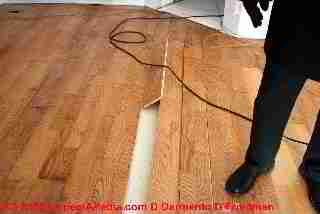
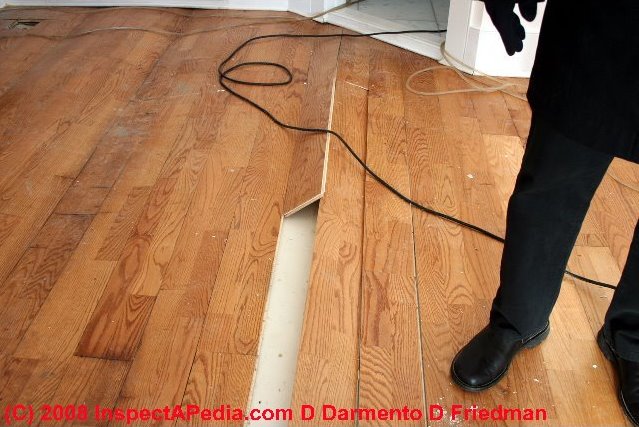
At FLOOR, WOOD ENGINEERED & LAMINATED we define three basic types of flooring products: hardwood flooring, engineered wood flooring, and laminate flooring. This article series discusses and provides a best construction practices guide to the selection and installation of building interior surface materials, carpeting, doors, drywall, trim, flooring, lighting, plaster, materials, finishes, and sound control materials. This article includes excerpts or adaptations from Best Practices Guide to Residential Construction, by Steven Bliss, courtesy of Wiley & Sons. Our page top photo illustrates what can happen to an engineered-wood floor (or any wood floor for that matter) if it is exposed to flooding from a burst plumbing or heating pipe.

Also see INTERIORS of buildings, our home page for information about all topics relating to building interiors.

Green links show where you are. © Copyright 2013 InspectAPedia.com, All Rights Reserved. Author Daniel Friedman.

Guide to Choosing & Installing Engineered Wood Floors: Wood Laminates

As described in the book, Best Practices Guide to Residential Construction Chapter 5, Interior Finish:

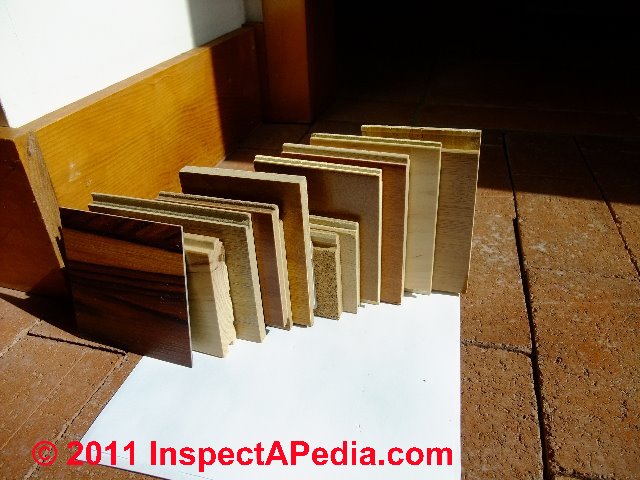
Laminate and engineered wood flooring samples (C) Daniel FriedmanThe main advantage of engineered wood floors is dimensional stability. Because most engineered floors consist of cross-laminated plies of wood, they are less likely to swell, shrink, cup, or warp. This makes them the best choice for applications subject to wide changes in moisture levels— below grade, over radiant heating, or over concrete slabs with poor drainage or no vapor barrier.

Our photo (left) shows a selection of engineered wood and laminate flooring choices that we discuss here. (The first two samples from the left side of the photo are a resilient vinyl floor sample and a solid maple flooring sample and do not belong in the category of laminate nor engineered wood flooring.)

Laminated floors are also the best choice for glue-down applications because of their inherent stability. Another advantage is that engineered wood floors do not require a beveled edge. Most have tight-fitting, square-edged joints.

Materials Used in Engineered Wood Floors

Laminated floors come in a wide variety of sizes, from 1/4 to 3/4-inch thick. In general, the more plies a flooring has, the stronger and more stable it will be. Three plies is typical. Look for a top wear layer of at least 1/8-inch if the floor is to be sanded and refinished in the future.

Typical laminated floors can be sanded and refinished once or twice; the best, up to three or four times.
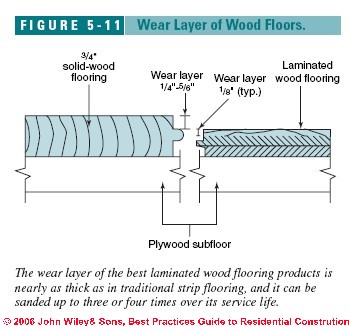
Figure 5-11: (C) J Wiley, S Bliss


The sanding thickness in some laminated flooring is nearly as thick as in traditional hardwood strip flooring, which although 3/4-inch thick, can be sanded down only about 1/4 inch (see Figure 5-11).

Longstrip flooring has several short pieces of strip flooring in the top ply to give the appearance of random length strip flooring. Single panels are as large as 8x96 inches (see Figure 5-12). It is used primarily in floating floors, but some products may also be nailed or glued.

Since each panel is two or three strips wide, the end joints of these strips line up at panel ends, unlike in a true strip floor.

Single-strip products, on the other hand, are visually indistinguishable from a traditional strip floor. Our photo (below right) illustrates an engineered wood floor product sample from Bruce® hardwood floors.
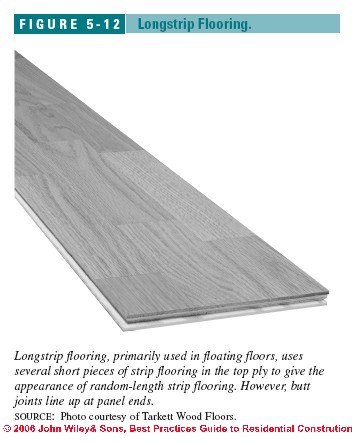
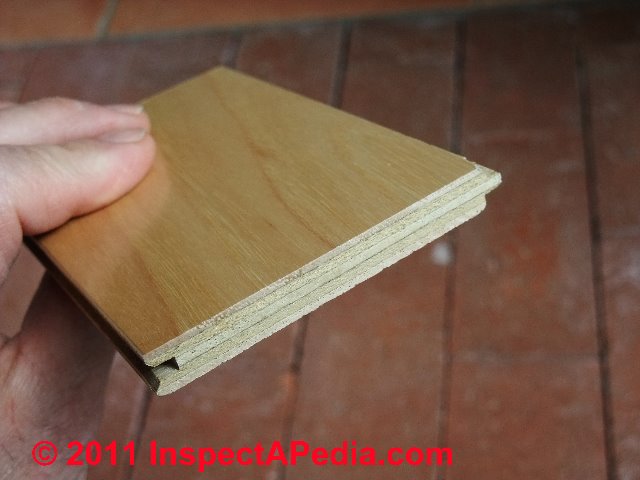
Figure 5-12: (C) J Wiley, S BlissEngineered wood maple floor sample (C) D Friedman

Veneers may be either sliced or rotary cut. Rotary-cut veneers make better use of the tree with less waste, but sliced veneers are harder and less prone to denting. Also, look for interior veneers that are the same wood as the face veneer or at least as hard. Soft interior veneers make a weaker flooring that is more prone to denting.

Installation Procedures for Engineered Wood Floors

Laminated wood floors can be nailed, stapled, or glued with mastic to any dry wood subfloor. Many can also be glued directly to dry concrete (see “Installing over Concrete,” page 168, for how to test dryness). If the concrete is below grade, check with the manufacturer to see if the product is guaranteed for that application. A floating floor may be a better choice for below-grade applications.

In general, glue-down products are 1/4- to 3/8-inch thick parquet tiles, strips, or planks. Strips or planks are generally less than 2 feet long, since longer pieces are too difficult to straighten with glue. The only solid wood flooring that is glued is parquet, which gains stability from the short pieces and different orientations of the grain.

As with unfinished flooring, the building should be closed in, with all wet work completed and dried, before installing engineered wood flooring. Make sure the concrete or subfloor is sufficiently dry and the indoor humidity level is close to the level it will be when the building is occupied. Keep the flooring materials packaged until installation.

Floating Floor Installation Methods for Engineered Wood Floors

Another option is to float the finish flooring. You can float a floor over virtually any stable substrate, including concrete, wood, smooth tile, or even short-nap carpet. With most floating floors, the T&G pieces are edge-glued to one another with PVA wood glue and installed over a thin layer of closed-cell, high-density foam and a vapor barrier.

A floating floor is more resilient underfoot than one glued to concrete, but feels less solid than a nailed or glued floor. Some manufacturers offer a harder premium foam underlayment, which is recommended for those seeking a more solid feel underfoot. Still, customers should be aware that a floating floor will feel different from a nailed or glued floor.
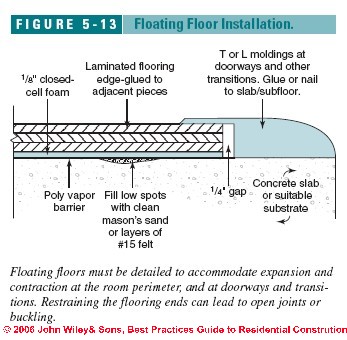
Figure 5-13: (C) J Wiley, S Bliss


Installers must leave a 1/2-inch expansion gap around the edges of floating floors, typically hidden by baseboard, or use special T- or L-shaped moldings at door openings and other transitions to accommodate movement (Figure 5-13).x

Existing door casings can be undercut to allow for movement. Restraining the flooring ends at doorways or the room perimeter can lead to open joints or buckling.

Because there are no mechanical fasteners to the substrate, floating floors rely on good quality flooring and a very flat slab or subfloor to produce a smooth, trouble-free floor. In shopping for the flooring, choose materials that are straight and uniform in thickness, fit together snugly, and lay flat with few visible gaps. The subfloor should be level to within 1/8-inch over 10 feet. If necessary, shim low points with clean mason’s sand or felt or rosin paper layered in the low spots to create a tapered shim (do not use asphalt felt over radiant floors, however, to avoid fumes).

While floating floors cannot tolerate the heavy vibration caused by standard floor sanding equipment, most floating wood floors can be lightly sanded and refinished or coated with sandless finishes. Follow the manufacturer’s recommendations regarding refinishing.

No-Glue Installation Method for Engineered Wood Floors

No-glue longstrip flooring is available from Alloc, Inc. and BHK of America (see Buy Interior Finish Product Resources). Each company uses its own interlocking edge design to snap the 8x48-inch or 8x96-inch panels together in place of adhesive. These products were developed in Europe where people often take their floors with them when they move.
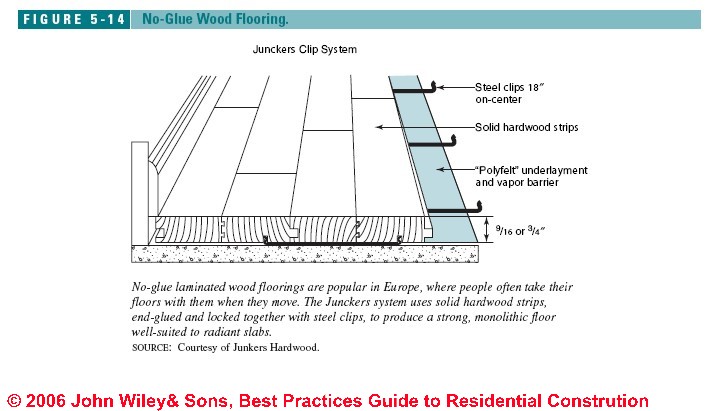
Figure 5-14: (C) J Wiley, S Bliss


The Denmark-based company Junckers Hardwood Inc. manufactures the only solid-hardwood floating floor.

The 6-foot-long strips are held together with special metal clips that snap in place on the underside of the floor (Figure 5-14).

The clips, along with adhesive at butt joints only, work together to create a strong monolithic floor with the appearance of traditional strip flooring but the ability to move with moisture and temperature changes, making it ideal for use over radiant slabs.

The 5-inch-wide boards are either a single plank in width or two strips dovetailed together. The 9/16 -inch product is guaranteed for two sandings, the 3/5-inch for seven.

Bamboo Flooring Sources, Properties, Installation Guide

A recent introduction to the flooring market, bamboo is not really a wood, but a type of grass that matures in three to five years on plantations, making it an environmentally friendly alternative to premium hardwoods.

To make bamboo into flooring, thin strips are laminated to form planks from 3/8 to 3/4 inch thick.

The familiar nodes that separate bamboo stalks into short sections create darker cross markings, giving the product an attractive and unusual appearance.

A more homogenous color is also available from some manufacturers by using laminated strands. Engineered bamboo flooring is as hard as maple and more stable than oak, and comes either unfinished or prefinished with the same types of finishes as used on hardwood flooring.

-- Adapted with permission from Best Practices Guide to Residential Construction.

At FLOOR, WOOD ENGINEERED & LAMINATED we define three basic types of flooring products: hardwood flooring, engineered wood flooring, and laminate flooring. We illustrate each of these floor covering approaches with flooring sample photographs. Excerpts are bgelow

  1. [Solid] Hardwood flooring is illustrated by our photo at below-left. This hardwood flooring sample is Vintage Maple Natural 3/4" thick x 3 1/4" wide tongue and groove flooring produced by Tarkett and has a hardness rating of 4 on a 1 to 5 scale. Solid hardwood flooring is just that - flooring material made out of a single piece of hardwood, usually cut into a tongue-and-groove profile that is installed to the subfloor by nailing through the tongue on a diagonal into the floor board and into the subfloor below.
  2. Engineered wood flooring is illustrated by our second photo at below right. Shown is Click Bamboo-Toast 9/16" flooring available through Home Depot® stores. Engineered wood flooring combines a top layer of wood that is bonded to multiple plies of softwood that affords uniformity and dimensional stability.
  3. Laminate flooring, including laminate wood flooring looks like a hardwood floor, provides a hard surable surface, but is usually less costly per square foot than the solid or engineered wood floor products above.


Resources: Manufacturers, Industry Associations, & Sources of Indoor Engineered Wood and Wood Laminate Flooring Materials

Prefinished Wood Flooring

Alloc Inc. www.alloc.com Snap-together, no-glue long-strip and single-strip laminated flooring

Anderson Hardwood Floors www.andersonfloors.com Laminated strip, nail, glue, and floating

Armstrong World Industries www.armstrong.com Bruce, Hartco, and Robbins prefinished plank and engineered strip

BHK of America www.bhkuniclic.com Snap-together, no-glue laminated wood flooring

Columbia Wood Flooring www.columbiaflooring.com Prefinished solid strip

Duro-Design www.duro-design.com Floating click-lock oak flooring

Gammapar www.gammapar.com Engineered wood strip with oil, UV-cured urethane, or acrylic-impregnated finish

Junkers Hardwood www.junkershardwood.com Floating solid strip with metal clip installation

Kahrs www.kahrs.com Laminated strip with UV-cured acrylic urethane, nail, glue, or floating

Lauzon www.lauzonltd.com Prefinished strip, laminated strip, and click-lock laminated plank

Mannington Mills www.mannington.com Laminated strip and plank with polyurethane and aluminum-oxide finish

Medallion Hardwood Flooring www.medallionhardwood.com Prefinished solid hardwood strip and plank with aluminum-oxide finish

Tarkett Wood Floors www.harris-tarkett.com Prefinished solid hardwood, laminated, and long-strip flooring

MercierWood Flooring www.mercierdurable.com Prefinished solid strip and laminated strip with aluminum-oxide finish

PermaGrain Hardwood Flooring www.permagrain.com Acrylic-impregnated laminated strip and plank

Zickgraf Hardwood Flooring www.zickgraf.com Prefinished solid strip with UV-cured urethane with diamond and aluminum oxide

Bamboo Flooring Producers & Sources

Bamtex (a division of Wood Flooring International) www.bamtex.com Laminated bamboo and palm flooring

Duro-Design www.duro-design.com Laminated bamboo flooring with durable water-based finish

Gammapar www.gammapar.com Acrylic-impregnated bamboo flooring

Hawa Bamboo Flooring www.hawabamboo.com Prefinished bamboo flooring with aluminum-oxide finish

Natural Cork www.naturalcork.com Prefinished glue-down or nail-down 3-ply bamboo planks with aluminum-oxide finish

Resilient Flooring Manufacturers List

Congoleum www.congoleum.com Vinyl sheet flooring and tiles

Domco (division of Domco Tarkett Group) www.domco.com Vinyl sheet flooring and tiles

Forbo www.forbo-flooring.com Linoleum sheet and tiles

Mannington Mills www.mannington.com Vinyl sheet flooring and tiles

Nova Distinctive Floors www.novafloorings.com Laminated linoleum surface over fiberboard and cork planks, floating installation

Tarkett www.tarkettna.com Vinyl sheet flooring and tiles

Cork Flooring Manufacturers & Sources

American Cork Products Co. www.amcork.com Prefinished parquet tiles and floating floor planks

Amorim Revestimentos (formerly Ipocork) www.wicanders.com Floating or glue-down laminated cork tiles with UV-acrylic or oil finish

BHK of America www.bhkuniclic.com Snap-together, no-glue, laminated cork flooring with UV-acrylic finish

Expanko Cork Inc. www.expanko.com Cork tiles with wax or polyurethane finish

Korq Inc. (212) 758-2593

Natural Cork www.naturalcork.com Glue-down cork tiles and floating laminated planks with UV-cured acrylic finish

Nova Distinctive Floors www.novafloorings.com Laminated cork planks with glue-down and floating click-lock installation

WECork www.wecork.com Cork tiles, sheets, and floating floors

Polymer (Urethane), MDF, and Vinyl Trim Producers & Sources

Burton Mouldings www.burton-mouldings.com MDF(medium-density fiberboard), polymer, flex, and wood

Fypon www.fypon.com Polymer moldings and components

Nu-Wood www.nu-wood.com Polymer moldings and components

Outwater Plastics www.outwater.com Polymer moldings and components

RAS Industries www.rasindustries.com Polymer moldings and components

Royal Mouldings (formerly Marley Mouldings) www.royalmouldings.com Polymer, polystyrene, expanded-PVC, CPVC, and acrylic molding profiles and components

Flexible Trim Manufacturers & Sources

Flex Trim www.flextrim.com Flexible polymer moldings

Resin Art www.resinart.com Flexible polymer moldings

Industry & Trade Associations for Flooring

American Lighting Association www.americanlightingassoc.com

Association of the Wall and Ceiling Industries www.awci.org

Carpet and Rug Institute (CRI) www.carpet-rug.org

Drywall Finishing Council www.dwfc.org

Forest Stewardship Program www.fscus.org

FloorFacts www.floorfacts.com

The Gypsum Association www.gypsum.org

National Oak Flooring Manufacturers Association (NOFMA) www.nofma.com

National Wood Flooring Association www.woodfloors.org

Painting and Decorating Contractors of America www.pdca.org Smartwood/Rainforest Alliance www.smartwood.org

-- Adapted with permission from Best Practices Guide to Residential Construction.


Frequently Asked Questions (FAQs)

...

Ask a Question or Search InspectApedia

Use the search box below to ask a question or to search the InspectApedia.com website.

Ask a Question or Enter Search Terms in the InspectApedia search box just below.

Technical Reviewers & References

Related Topics, found near the top of this page suggest articles closely related to this one.

  • Best Practices Guide to Residential Construction, by Steven Bliss. John Wiley & Sons, 2006. ISBN-10: 0471648361, ISBN-13: 978-0471648369, Hardcover: 320 pages, available from Amazon.com and also Wiley.com. See our book review of this publication.
  • Steve Bliss's Building Advisor at buildingadvisor.com helps homeowners & contractors plan & complete successful building & remodeling projects: buying land, site work, building design, cost estimating, materials & components, & project management through complete construction. Email: info@buildingadvisor.com
    Steven Bliss served as editorial director and co-publisher of The Journal of Light Construction for 16 years and previously as building technology editor for Progressive Builder and Solar Age magazines. He worked in the building trades as a carpenter and design/build contractor for more than ten years and holds a masters degree from the Harvard Graduate School of Education. Excerpts from his recent book, Best Practices Guide to Residential Construction, Wiley (November 18, 2005) ISBN-10: 0471648361, ISBN-13: 978-0471648369, appear throughout this website, with permission and courtesy of Wiley & Sons. Best Practices Guide is available from the publisher, J. Wiley & Sons, and also at Amazon.com

Books & Articles on Building & Environmental Inspection, Testing, Diagnosis, & Repair

  • Our recommended books about building & mechanical systems design, inspection, problem diagnosis, and repair, and about indoor environment and IAQ testing, diagnosis, and cleanup are at the InspectAPedia Bookstore. Also see our Book Reviews - InspectAPedia.
  • Home Reference Book - Carson DunlopThe Home Reference Book - the Encyclopedia of Homes, Carson Dunlop & Associates, Toronto, Ontario, 25th Ed., 2012, is a bound volume of more than 450 illustrated pages that assist home inspectors and home owners in the inspection and detection of problems on buildings. The text is intended as a reference guide to help building owners operate and maintain their home effectively. Field inspection worksheets are included at the back of the volume. Special Offer: For a 10% discount on any number of copies of the Home Reference Book purchased as a single order. Enter INSPECTAHRB in the order payment page "Promo/Redemption" space. InspectAPedia.com editor Daniel Friedman is a contributing author.

    Or choose the The Home Reference eBook for PCs, Macs, Kindle, iPad, iPhone, or Android Smart Phones. Special Offer: For a 5% discount on any number of copies of the Home Reference eBook purchased as a single order. Enter INSPECTAEHRB in the order payment page "Promo/Redemption" space.
  • "The Elimination of Unsafe Guardrails, a Progress Report," Elliott O. Stephenson, Building Standards, March-April 1993
  • "Are Functional Handrails Within Our Grasp" Jake Pauls, Building Standards, January-February 1991
  • Access Ramp building codes:
    • UBC 1003.3.4.3
    • BOCA 1016.3
    • ADA 4.8.2
    • IBC 1010.2
  • Access Ramp Standards:
    • ADA (Americans with Disabilities Act), Public Law 101-336. 7/26/90 is very often cited by other sources for good design of stairs and ramps etc. even where disabled individuals are not the design target.
    • ANSI A117.4 Accessible and Usable buildings and Facilities (earlier version was incorporated into the ADA)
    • ASTM F 1637, Standard Practice for Safe Walking Surfaces, (Similar to the above standards)
  • America's Favorite Homes, mail-order catalogues as a guide to popular early 20th-century houses, Robert Schweitzer, Michael W.R. Davis, 1990, Wayne State University Press ISBN 0814320066 (may be available from Wayne State University Press)
  • American Plywood Association, APA, "Portland Manufacturing Company, No. 1, a series of monographs on the history of plywood manufacturing",Plywood Pioneers Association, 31 March, 1967, www.apawood.org
  • Animal Allergens: Dog, Cat, and Other Animal Dander - Cleanup & Prevention Information for Asthmatics and regarding Indoor Air Quality.
  • Asbestos: How to find and recognize asbestos in buildings - visual inspection methods, list of common asbestos-containing materials
  • Asbestos HVAC Ducts and Flues field identification photos and guide
  • Asbestos products and their history and use in various building materials such as asphalt and vinyl flooring includes discussion which draws on Asbestos, Its Industrial Applications, D.V. Rosato, engineering consultant, Newton, MA, Reinhold Publishing, 1959 Library of Congress Catalog Card No.: 59-12535 (out of print).
  • Asbestos Identification and Testing References
    • Asbestos Identification, Walter C.McCrone, McCrone Research Institute, Chicago, IL.1987 ISBN 0-904962-11-3. Dr. McCrone literally "wrote the book" on asbestos identification procedures which formed the basis for current work by asbestos identification laboratories.
    • Stanton, .F., et al., National Bureau of Standards Special Publication 506: 143-151
    • Pott, F., Staub-Reinhalf Luft 38, 486-490 (1978) cited by McCrone
  • ASHRAE resource on dew point and wall condensation - see the ASHRAE Fundamentals Handbook, available in many libraries. The following three ASHRAE Handbooks are also available at the InspectAPedia bookstore in the third page of our Insulate-Ventilate section:
    • 2005 ASHRAE Handbook : Fundamentals : Inch-Pound Edition (2005 ASHRAE HANDBOOK : Fundamentals : I-P Edition) (Hardcover), Thomas H. Kuehn (Contributor), R. J. Couvillion (Contributor), John W. Coleman (Contributor), Narasipur Suryanarayana (Contributor), Zahid Ayub (Contributor), Robert Parsons (Author), ISBN-10: 1931862702 or ISBN-13: 978-1931862707
    • 2004 ASHRAE Handbook : Heating, Ventilating, and Air-Conditioning: Systems and Equipment : Inch-Pound Edition (2004 ASHRAE Handbook : HVAC Systems and Equipment : I-P Edition) (Hardcover)
      by American Society of Heating, ISBN-10: 1931862478 or ISBN-13: 978-1931862479
      "2004 ASHRAE Handbook - HVAC Systems and Equipment The 2004 ASHRAE HandbookHVAC Systems and Equipment discusses various common systems and the equipment (components or assemblies) that comprise them, and describes features and differences. This information helps system designers and operators in selecting and using equipment. Major sections include Air-Conditioning and Heating Systems (chapters on system analysis and selection, air distribution, in-room terminal systems, centralized and decentralized systems, heat pumps, panel heating and cooling, cogeneration and engine-driven systems, heat recovery, steam and hydronic systems, district systems, small forced-air systems, infrared radiant heating, and water heating); Air-Handling Equipment (chapters on duct construction, air distribution, fans, coils, evaporative air-coolers, humidifiers, mechanical and desiccant dehumidification, air cleaners, industrial gas cleaning and air pollution control); Heating Equipment (chapters on automatic fuel-burning equipment, boilers, furnaces, in-space heaters, chimneys and flue vent systems, unit heaters, makeup air units, radiators, and solar equipment); General Components (chapters on compressors, condensers, cooling towers, liquid coolers, liquid-chilling systems, centrifugal pumps, motors and drives, pipes and fittings, valves, heat exchangers, and energy recovery equipment); and Unitary Equipment (chapters on air conditioners and heat pumps, room air conditioners and packaged terminal equipment, and a new chapter on mechanical dehumidifiers and heat pipes)."
    • 1996 Ashrae Handbook Heating, Ventilating, and Air-Conditioning Systems and Equipment: Inch-Pound Edition (Hardcover), ISBN-10: 1883413346 or ISBN-13: 978-1883413347 ,
      "The 1996 HVAC Systems and Equipment Handbook is the result of ASHRAE's continuing effort to update, expand and reorganize the Handbook Series. Over a third of the book has been revised and augmented with new chapters on hydronic heating and cooling systems design; fans; unit ventilator; unit heaters; and makeup air units. Extensive changes have been added to chapters on panel heating and cooling; cogeneration systems and engine and turbine drives; applied heat pump and heat recovery systems; humidifiers; desiccant dehumidification and pressure drying equipment, air-heating coils; chimney, gas vent, fireplace systems; cooling towers; centrifugal pumps; and air-to-air energy recovery. Separate I-P and SI editions."
    • Principles of Heating, Ventilating, And Air Conditioning: A textbook with Design Data Based on 2005 AShrae Handbook - Fundamentals (Hardcover), Harry J., Jr. Sauer (Author), Ronald H. Howell, ISBN-10: 1931862923 or ISBN-13: 978-1931862929
    • 1993 ASHRAE Handbook Fundamentals (Hardcover), ISBN-10: 0910110964 or ISBN-13: 978-091011096
  • Best Practices Guide to Residential Construction, by Steven Bliss. John Wiley & Sons, 2006. ISBN-10: 0471648361, ISBN-13: 978-0471648369, Hardcover: 320 pages, available from Amazon.com and also Wiley.com. See our book review of this publication.
  • Decks and Porches, the JLC Guide to, Best Practices for Outdoor Spaces, Steve Bliss (Editor), The Journal of Light Construction, Williston VT, 2010 ISBN 10: 1-928580-42-4, ISBN 13: 978-1-928580-42-3, available from Amazon.com
  • Brick nogging used as soundproofing is mentioned in this article on Popular Forest
  • Brick Nogging, Historical Investigation and Contemporary Repair, Construction Specifier, April 2006. Historical use of brick in timber-framed buildings, drawing on the investigations of the Kent Tavern in Calais, VT. "Brick nogging is a European method of construction which was brought to the new world in the early-nineteenth century. It was a common construction method that employed masonry as infill between the vertical uprights of wood framing." -- quoting the web article review.
  • Photo of very rough in-wall brick nogging at an architects website
  • Building Research Council, BRC, nee Small Homes Council, SHC, School of Architecture, University of Illinois at Urbana-Champaign, brc.arch.uiuc.edu. "The Small Homes Council (our original name) was organized in 1944 during the war at the request of the President of the University of Illinois to consider the role of the university in meeting the demand for housing in the United States. Soldiers would be coming home after the war and would be needing good low-cost housing. ...  In 1993, the Council became part of the School of Architecture, and since then has been known as the School of Architecture-Building Research Council. ... The Council's researchers answered many critical questions that would affect the quality of the nation's housing stock.
    • How could homes be designed and built more efficiently?
    • What kinds of construction and production techniques worked well and which did not?
    • How did people use different kinds of spaces in their homes?
    • What roles did community planning, zoning, and interior design play in how neighborhoods worked
  • The Circular Staircase, Mary Roberts Rinehart
  • Construction Drawings and Details, Rosemary Kilmer
  • "An Example of Colonial Paneling", Norman Morrison Isham, The Metropolitan Museum of Art Bulletin, Vol. 6, No. 5 (May, 1911), pp. 112-116, available by JSTOR.
  • Dust from the World Trade Center collapse following the 9/11/01 attack: the lower floors of this building contained spray-on fire-proofing asbestos materials.
  • Energy Savers: Whole House Systems Approach to Energy Efficient Home Design [copy on file as /interiors/Whole_House_Energy_Efficiency_DOE.pdf ] - U.S. Department of Energy
  • "Energy Savers: Whole-House Supply Ventilation Systems [copy on file as /interiors/Energy_Savers_Whole-House_Supply_Vent.pdf ] - ", U.S. Department of Energy energysavers.gov/your_home/insulation_airsealing/index.cfm/mytopic=11880?print
  • "Energy Savers: Whole-House Exhaust Ventilation Systems [copy on file as /interiors/Energy_Savers_Whole-House_Exhaust.pdf ] - ", U.S. Department of Energy energysavers.gov/your_home/insulation_airsealing/index.cfm/mytopic=11870
  • "Energy Savers: Ventilation [copy on file as /interiors/Energy_Savers_Ventilation.pdf ] - ", U.S. Department of Energy
  • "Energy Savers: Natural Ventilation [copy on file as /interiors/Energy_Savers_Natural_Ventilation.pdf ] - ", U.S. Department of Energy
  • "Energy Savers: Energy Recovery Ventilation Systems [copy on file as /interiors/Energy_Savers_Energy_Recovery_Venting.pdf ] - ", U.S. Department of Energy energysavers.gov/your_home/insulation_airsealing/index.cfm/mytopic=11900
  • "Energy Savers: Detecting Air Leaks [copy on file as /interiors/Energy_Savers_Detect_Air_Leaks.pdf ] - ", U.S. Department of Energy
  • "Energy Savers: Air Sealing [copy on file as /interiors/Energy_Savers_Air_Sealing_1.pdf ] - ", U.S. Department of Energy
  • Falls and Related Injuries: Slips, Trips, Missteps, and Their Consequences, Lawyers & Judges Publishing, (June 2002), ISBN-10: 0913875430 ISBN-13: 978-0913875438
    "Falls in the home and public places are the second leading cause of unintentional injury deaths in the United States, but are overlooked in most literature. This book is unique in that it is entirely devoted to falls. Of use to primary care physicians, nurses, insurance adjusters, architects, writers of building codes, attorneys, or anyone who cares for the elderly, this book will tell you how, why, and when people will likely fall, what most likely will be injured, and how such injuries come about. "
  • Fiberglass: Indoor Air Quality Investigations: Health Concerns About Airborne Fiberglass: Fiberglass in Indoor Air from HVAC ducts, and Building Insulation
  • Gypsum Construction Guide, National Gypsum Corporation
  • Gypsum Construction Handbook [purchase at Amazon.com] H17, Technical Folder SA920 and PM2, PM3 and PM4, United States Gypsum Company, 125 South Franklin ST., PO Box 806278, Chicago, IL 60680-4124,
  • Humidity: What indoor humidity should we maintain in order to avoid a mold problem?
  • Ice Dam Leaks in building attics and roof cavities, how to inspect for evidence of leaks, identify causes, and correct bad attic ventilation, improper roof venting, and these causes of attic mold or roof structure damage
  • "Insulation: Adding Insulation to an Existing Home [copy on file as /interiors/Insulation_Adding_DOE.pdf ] - ," U.S. Department of Energy - tips on how to do your own check for the presence of absence of insulation in a home
  • Insulation: Selecting Insulation for New Home Construction [copy on file as /interiors/New_Home_Insulation_DOE.pdf ] - , U.S. Department of Energy - "Your state and local building codes probably include minimum insulation requirements, but to build an energy-efficient home, you may need or want to exceed them. For maximum energy efficiency, you should also consider the interaction between the insulation and other building components. This is called the "whole-house systems design approach" [copy on file as /interiors/Whole_House_Energy_Efficiency_DOE.pdf ] -
  • Insulation Types [copy on file as /interiors/Insulation_Types_DOE.pdf ] - , table of common building insulation properties from U.S. DOE. Readers should see INSULATION R-Values & Properties our own table of insulation properties that includes links to articles describing each insulation material in more detail.
  • Lath & Plaster Systems [copy on file as /interiors/LathPlaster_Nat_Gypsum.pdf ] - , 092300/NGC, National Gypsum Lath and Plaster Systems, National Gypsum Corporation, 800-628-4662 describing National Gypsum's Kal-Kore brand plaster base
  • Lighting, proper use of: proper aiming of a good flashlight can disclose hard to see but toxic light or white mold colonies on walls.
  • Metal Lath Specifications, Specification for metal lath and accessories, Lath and Plaster [copy on file as/interiors/Amico_lath-inside.pdf ] - from Amico, a lath and plaster accessory producer.
  • Mobile Home Inspections common defects unique to factory built housing, inspection methods
  • The National Institute of Standards and Technology, NIST (nee National Bureau of Standards NBS) is a US government agency - see www.nist.gov
    • "A Parametric Study of Wall Moisture Contents Using a Revised Variable Indoor Relative Humidity Version of the "Moist" Transient Heat and Moisture Transfer Model [copy on file as/interiors/MOIST_Model_NIST_b95074.pdf ] - ", George Tsongas, Doug Burch, Carolyn Roos, Malcom Cunningham; this paper describes software and the prediction of wall moisture contents. - PDF Document from NIS
  • Nogging: See this photo of exposed bricks on a building exterior on a building exterior in Canada. [Thanks to Carson Dunlop, Toronto - see References below].
  • Pergo AB, division of Perstorp AB, is a Swedish manufacturer or modern laminate flooring products. Information about the U.S. company can be found at http://www.pergo.com where we obtained historical data used in our discussion of the age of flooring materials in buildings.
  • Piquet Wall Construction: See this photo of piquet wall construction - involving timber-framed wall construction with long top girts, diagonal timber bracing, and small diameter logs placed vertically along with concrete chinking to fill in the wall plane.
  • Plank House Construction: weblog from plankhouse.wordpress.com/2009/01/25/plank-house-construction/ and where plank houses were built by native Americans, see
    Large 1:6 Scale Plank House Construction / P8094228, Photographer: Mike Meuser
    06/12/2007 documented at yurokplankhouse.com where scale model Museum quality Yurok Plank Houses are being sold to raise money for the Blue Creek - Ah Pah Traditional Yurok Village project.
  • Plastering, PM 5, Product & Systems Technology, US Gypsum, May 1998, web search 10.5.2010, original source: http://www.usg.com/rc/technical-articles/plaster/ [copy on file as/interiors/Plastering_USG.pdf ] -
    plastering-technical-guide-veneer-plaster-joint-reinforcement-systems-en-PM5.pdf
    United States Gypsum Company, 125 South Franklin ST., PO Box 806278, Chicago, IL 60680-4124,
    Paraphrasing from this document: USG uses the term shadowing in this document in describing the visual effect over gypsum board joints caused by the lower moisture absorption rate (take-up) and lower capacity than gypsum base face paper. Shadowing at joints occurs where veneer plaster is applied over tape joints, requiring a second coat to completely hide the tape, providing a visually uniform surface. USG Advises: "This [second] cover coat must be allowed to harden and dry before plaster application is started.
  • Plastering Skills, F. Van Den Branden, Thomas L. Hartsell, Amer Technical Pub (July 1, 1985), ISBN-10: 0826906575, ISBN-13: 978-0826906571 [purchase at Amazon.com]
  • Re-Bath, tub lining products is a bath tub relining manufacturer and distributor located in Tempe, Arizona - see rebath.com
  • Rubblestone Wall Filler: See this Lartigue House using exterior-exposed rubblestone filler between vertical timbers of a post and beam-framed Canadian building.
  • Slips, Trips, Missteps and Their Consequences, Second Edition, Gary M. Bakken, H. Harvey Cohen,A. S. Hyde, Jon R. Abele, ISBN-13: 978-1-933264-01-1 or ISBN 10: 1-933264-01-2, available from the publisher, Lawyers ^ Judges Publishing Company,Inc., www.lawyersandjudges.com sales@lawyersandjudges.com and also from the InspectAPedia Bookstore (Amazon.com)
  • The Stairway Manufacturers' Association, (877) 500-5759, provides a pictorial guide to the stair and railing portion of the International Residential Code. [copy on file as http://www.stairways.org/pdf/2006%20Stair%20IRC%20SCREEN.pdf ] -
  • What Mold and Allergens Look Like: mold identification photos to help identify mold - choosing what to sample in buildings
  • How to Clean Moldy Wood Framing & Sheathing How to clean/seal mold from/on exposed lumber or plywood subfloor or roof sheathing indoors - some suggestions based on our field and laboratory research
  • Lighting, proper use of: proper aiming of a good flashlight can disclose hard to see but toxic light or white mold colonies on walls.
  • Manufactured & Modular Homes: Modular Building Systems Association, MBSA, modularhousing.com, is a trade association promoting and providing links to contact modular builders in North America. Also see the Manufactured Home Owners Association, MHOAA, at www.mhoaa.us. The Manufactured Home Owners Association of America is a National Organization dedicated to the protection of the rights of all people living in Manufactured Housing in the United States.
  • Mold spores in the Home - a Photo ID Library for detection and identification of mold allergens.
  • How to Find and Test For Mold in buildings A "how to" photo and text primer on finding and choosing the right spots to test for mold in buildings
  • Stuff that is not mold but is often mistaken for it - things you may not want to test. Also, not all "black mold" is toxic - here are examples of harmless black mold.
  • Simple Adhesive Tape Sampling of Moldy Surfaces - how to send a mold sample to our lab
  • Mold Sampling Methods in the Indoor Environment - In-depth article: detailed critique of popular mold testing methods - Is your mold test kit worth the bother?
  • Mold-Resistant Building Practices, advice from an expert on how to prevent mold after a building flood and how to prevent mold growth in buildings by selection of building materials and by anti-mold construction details.
  • Slips, Trips, Missteps and Their Consequences, Gary M. Bakken, H. Harvey Cohen, Jon R. Abele, Alvin S. Hyde, Cindy A. LaRue, Lawyers and Judges Publishing; ISBN-10: 1933264012 ISBN-13: 978-1933264011
  • Slips, Trips, Missteps and Their Consequences, Second Edition, Gary M. Bakken, H. Harvey Cohen,A. S. Hyde, Jon R. Abele, ISBN-13: 978-1-933264-01-1 or ISBN 10: 1-933264-01-2, available from the publisher, Lawyers & Judges Publishing Company,Inc., www.lawyersandjudges.com sales@lawyersandjudges.com and also from the InspectAPedia Bookstore (Amazon.com)
  • Steps and Stairways, Cleo Baldon & Ib Melchior, Rizzoli, 1989.
  • The Staircase, Ann Rinaldi
  • Common Sense Stairbuilding and Handrailing, Fred T. Hodgson
  • The Art of Staircases, Pilar Chueca
  • Building Stairs, by pros for pros, Andy Engel
  • A Simplified Guide to Custom Stairbuilding, George R. Christina
  • Basic Stairbuilding, Scott Schuttner
  • The Staircase (two volumes), John Templar, Cambridge: the MIT Press, 1992
  • The Staircase: History and Theories, John Templar, MIT Press 1995
  • Steps and Stairways, Cleo Baldon & Ib Melchior, Rizzoli, 1989.
  • "The Dimensions of Stairs", J. M. Fitch et al., Scientific American, October 1974.
  • "The Elimination of Unsafe Guardrails, a Progress Report," Elliott O. Stephenson, Building Standards, March-April 1993
  • "Are Functional Handrails Within Our Grasp" Jake Pauls, Building Standards, January-February 1991
  • "Weather-Resistive Barriers [copy on file as /interiors/Weather_Resistant_Barriers_DOE.pdf ] - ", how to select and install housewrap and other types of weather resistive barriers, U.S. DOE
  • Weaver: Beaver Board and Upson Board: Beaver Board and Upson Board: History and Conservation of Early Wallboard, Shelby Weaver, APT Bulletin, Vol. 28, No. 2/3 (1997), pp. 71-78, Association for Preservation Technology International (APT), available online at JSTOR.
  • What Style Is It?: A Guide to American Architecture, Rev., John C. Poppeliers, S. Allen Chambers, Wiley; Rev Sub edition (October 6, 2003), ISBN-10: 0471250368, ISBN-13: 978-0471250364
  • ...

HOME ABOUT CONTACT COPYING DESCRIPTION POLICIES PRINTING PRIVACY © 2013 Copyright InspectAPedia.com